CYTOCHROMES
PRESENTED BY : ALIZAY
BS MICROBIOLOGY AND
MOLECULAR GENETICS-THE
WOMEN UNIVERSITY
MULTAN
CONTENTS
• WHAT ARE CYTOCHROMES?
• BASIC STRUCTURE & FUNCTION
• TYPES
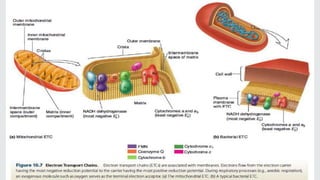
• ROLE OF CYTOCHROMES IN ETC
• EVOLUTION OF CYTOCHROME OXIDASE
WHAT ARE CYTOCHROMES?
• The cytochromes are a family of coloured proteins that
facilitate the movement of electrons in photosynthesis and
anaerobic/aerobic respiration
• Are related by the presence of a bound heme group.
• They are found in all eukaryotes and in most, but not all,
prokaryotes.
BASIC STRUCTURE AND FUNCTION
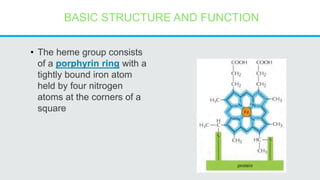
• The heme group consists
of a porphyrin ring with a
tightly bound iron atom
held by four nitrogen
atoms at the corners of a
square
b-type Cytochromes
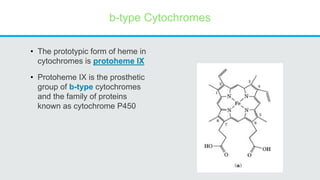
• The prototypic form of heme in
cytochromes is protoheme IX
• Protoheme IX is the prosthetic
group of b-type cytochromes
and the family of proteins
known as cytochrome P450
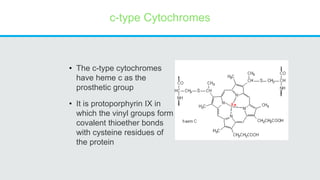
c-type Cytochromes
• The c-type cytochromes
have heme c as the
prosthetic group
• It is protoporphyrin IX in
which the vinyl groups form
covalent thioether bonds
with cysteine residues of
the protein
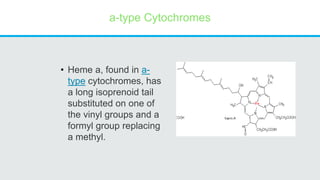
a-type Cytochromes
• Heme a, found in a-
type cytochromes, has
a long isoprenoid tail
substituted on one of
the vinyl groups and a
formyl group replacing
a methyl.
FUNCTION
• They have a wide cellular and biological distribution, functioning as
electron transporters in mitochondria, chloroplasts, endoplasmic
reticulum, as well as in bacterial redox chains.
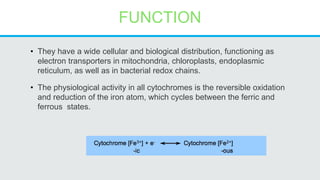
• The physiological activity in all cytochromes is the reversible oxidation
and reduction of the iron atom, which cycles between the ferric and
ferrous states.
DIFFERENT ABSORPTION SPECTRUM
• Mitochondria contain three classes of cytochromes, designated a, b,
and c, which are distinguished by differences in their light-absorption
spectra.
• ~600 nm in type a cytochromes
• ~560 nm in type b cytochromes
• ~550 nm in type c cytochromes
DIFFERENT OXIDATION-REDUCTION
POTENTIALS
• The standard reduction potential of the heme iron atom of a
cytochrome depends on its interaction with protein side
chains and is therefore different for each cytochrome
• The c-type cytochromes have redox potentials ranging from -
400 to +450 mV, although they typically vary between only
+200 and +300 mV in eukaryotic c-type cytochromes.
• The b-type cytochromes have redox potentials that range
from -200 to +150 mV
• The a-type cytochromes have potentials in the +220 to +400
mV range
SOLUBILITY
• The cytochromes of type a and b and some of type c
are integral proteins of the inner mitochondrial
membrane
• The cytochrome c of mitochondria, a soluble protein
that associates through electrostatic interactions with
the outer surface of the inner membrane.
CYTOCHROME COMPLEXES
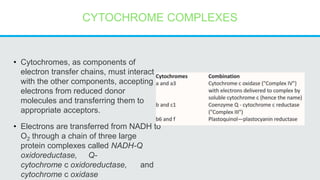
• Cytochromes, as components of
electron transfer chains, must interact
with the other components, accepting
electrons from reduced donor
molecules and transferring them to
appropriate acceptors.
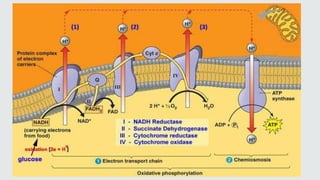
• Electrons are transferred from NADH to
O2 through a chain of three large
protein complexes called NADH-Q
oxidoreductase, Q-
cytochrome c oxidoreductase, and
cytochrome c oxidase
CYTOCHROME bc1 COMPLEX
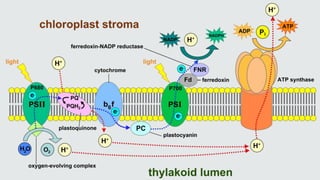
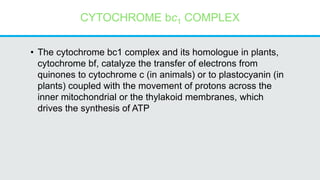
• The cytochrome bc1 complex and its homologue in plants,
cytochrome bf, catalyze the transfer of electrons from
quinones to cytochrome c (in animals) or to plastocyanin (in
plants) coupled with the movement of protons across the
inner mitochondrial or the thylakoid membranes, which
drives the synthesis of ATP
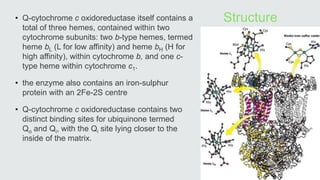
Structure• Q-cytochrome c oxidoreductase itself contains a
total of three hemes, contained within two
cytochrome subunits: two b-type hemes, termed
heme bL (L for low affinity) and heme bH (H for
high affinity), within cytochrome b, and one c-
type heme within cytochrome c1.
• the enzyme also contains an iron-sulphur
protein with an 2Fe-2S centre
• Q-cytochrome c oxidoreductase contains two
distinct binding sites for ubiquinone termed
Qo and Qi, with the Qi site lying closer to the
inside of the matrix.
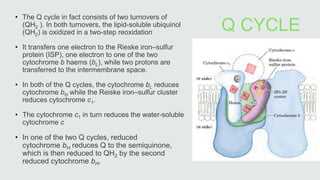
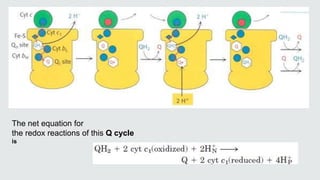
• The Q cycle in fact consists of two turnovers of
(QH2 ). In both turnovers, the lipid-soluble ubiquinol
(QH2) is oxidized in a two-step reoxidation
• It transfers one electron to the Rieske iron–sulfur
protein (ISP), one electron to one of the two
cytochrome b haems (bL), while two protons are
transferred to the intermembrane space.
• In both of the Q cycles, the cytochrome bL reduces
cytochrome bH while the Reiske iron–sulfur cluster
reduces cytochrome c1.
• The cytochrome c1 in turn reduces the water-soluble
cytochrome c
• In one of the two Q cycles, reduced
cytochrome bH reduces Q to the semiquinone,
which is then reduced to QH2 by the second
reduced cytochrome bH.
Q CYCLE
The net equation for
the redox reactions of this Q cycle
is
CYTOCHROME c
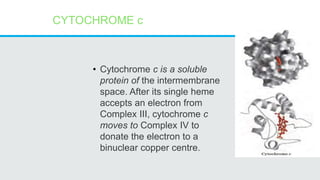
• Cytochrome c is a soluble
protein of the intermembrane
space. After its single heme
accepts an electron from
Complex III, cytochrome c
moves to Complex IV to
donate the electron to a
binuclear copper centre.
CYTOCHROME OXIDASE
• The final stage of the electron-transport chain is the
oxidation of the reduced cytochrome c generated by
Complex III, which is coupled to the reduction of
O2 to two molecules of H2O. This reaction is
catalyzed by cytochrome c oxidase (Complex IV).
STRUCTURE
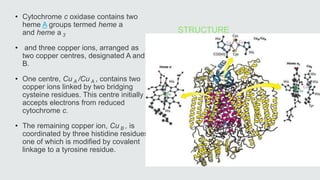
• Cytochrome c oxidase contains two
heme A groups termed heme a
and heme a 3
• and three copper ions, arranged as
two copper centres, designated A and
B.
• One centre, Cu A /Cu A , contains two
copper ions linked by two bridging
cysteine residues. This centre initially
accepts electrons from reduced
cytochrome c.
• The remaining copper ion, Cu B , is
coordinated by three histidine residues,
one of which is modified by covalent
linkage to a tyrosine residue.
Function
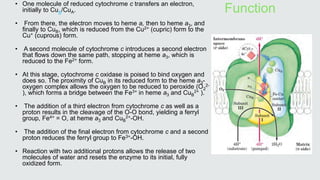
• One molecule of reduced cytochrome c transfers an electron,
initially to CuA/CuA.
• From there, the electron moves to heme a, then to heme a3, and
finally to CuB, which is reduced from the Cu2+ (cupric) form to the
Cu+ (cuprous) form.
• A second molecule of cytochrome c introduces a second electron
that flows down the same path, stopping at heme a3, which is
reduced to the Fe2+ form.
• At this stage, cytochrome c oxidase is poised to bind oxygen and
does so. The proximity of CuB in its reduced form to the heme a3-
oxygen complex allows the oxygen to be reduced to peroxide (O2
2-
), which forms a bridge between the Fe3+ in heme a3 and CuB
2+ ).
• The addition of a third electron from cytochrome c as well as a
proton results in the cleavage of the O-O bond, yielding a ferryl
group, Fe4+ = O, at heme a3 and CuB
2+-OH.
• The addition of the final electron from cytochrome c and a second
proton reduces the ferryl group to Fe3+-OH.
• Reaction with two additional protons allows the release of two
molecules of water and resets the enzyme to its initial, fully
oxidized form.
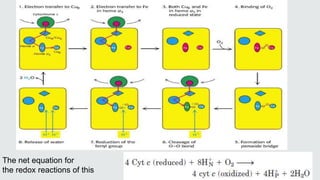
The net equation for
the redox reactions of this
Cytochrome

Cytochrome

  • 1.
    CYTOCHROMES PRESENTED BY :ALIZAY BS MICROBIOLOGY AND MOLECULAR GENETICS-THE WOMEN UNIVERSITY MULTAN
  • 2.
    CONTENTS • WHAT ARECYTOCHROMES? • BASIC STRUCTURE & FUNCTION • TYPES • ROLE OF CYTOCHROMES IN ETC • EVOLUTION OF CYTOCHROME OXIDASE
  • 3.
    WHAT ARE CYTOCHROMES? •The cytochromes are a family of coloured proteins that facilitate the movement of electrons in photosynthesis and anaerobic/aerobic respiration • Are related by the presence of a bound heme group. • They are found in all eukaryotes and in most, but not all, prokaryotes.
  • 4.
    BASIC STRUCTURE ANDFUNCTION • The heme group consists of a porphyrin ring with a tightly bound iron atom held by four nitrogen atoms at the corners of a square
  • 5.
    b-type Cytochromes • Theprototypic form of heme in cytochromes is protoheme IX • Protoheme IX is the prosthetic group of b-type cytochromes and the family of proteins known as cytochrome P450
  • 6.
    c-type Cytochromes • Thec-type cytochromes have heme c as the prosthetic group • It is protoporphyrin IX in which the vinyl groups form covalent thioether bonds with cysteine residues of the protein
  • 7.
    a-type Cytochromes • Hemea, found in a- type cytochromes, has a long isoprenoid tail substituted on one of the vinyl groups and a formyl group replacing a methyl.
  • 8.
    FUNCTION • They havea wide cellular and biological distribution, functioning as electron transporters in mitochondria, chloroplasts, endoplasmic reticulum, as well as in bacterial redox chains. • The physiological activity in all cytochromes is the reversible oxidation and reduction of the iron atom, which cycles between the ferric and ferrous states.
  • 9.
    DIFFERENT ABSORPTION SPECTRUM •Mitochondria contain three classes of cytochromes, designated a, b, and c, which are distinguished by differences in their light-absorption spectra. • ~600 nm in type a cytochromes • ~560 nm in type b cytochromes • ~550 nm in type c cytochromes
  • 10.
    DIFFERENT OXIDATION-REDUCTION POTENTIALS • Thestandard reduction potential of the heme iron atom of a cytochrome depends on its interaction with protein side chains and is therefore different for each cytochrome • The c-type cytochromes have redox potentials ranging from - 400 to +450 mV, although they typically vary between only +200 and +300 mV in eukaryotic c-type cytochromes. • The b-type cytochromes have redox potentials that range from -200 to +150 mV • The a-type cytochromes have potentials in the +220 to +400 mV range
  • 11.
    SOLUBILITY • The cytochromesof type a and b and some of type c are integral proteins of the inner mitochondrial membrane • The cytochrome c of mitochondria, a soluble protein that associates through electrostatic interactions with the outer surface of the inner membrane.
  • 12.
    CYTOCHROME COMPLEXES • Cytochromes,as components of electron transfer chains, must interact with the other components, accepting electrons from reduced donor molecules and transferring them to appropriate acceptors. • Electrons are transferred from NADH to O2 through a chain of three large protein complexes called NADH-Q oxidoreductase, Q- cytochrome c oxidoreductase, and cytochrome c oxidase
  • 16.
    CYTOCHROME bc1 COMPLEX •The cytochrome bc1 complex and its homologue in plants, cytochrome bf, catalyze the transfer of electrons from quinones to cytochrome c (in animals) or to plastocyanin (in plants) coupled with the movement of protons across the inner mitochondrial or the thylakoid membranes, which drives the synthesis of ATP
  • 17.
    Structure• Q-cytochrome coxidoreductase itself contains a total of three hemes, contained within two cytochrome subunits: two b-type hemes, termed heme bL (L for low affinity) and heme bH (H for high affinity), within cytochrome b, and one c- type heme within cytochrome c1. • the enzyme also contains an iron-sulphur protein with an 2Fe-2S centre • Q-cytochrome c oxidoreductase contains two distinct binding sites for ubiquinone termed Qo and Qi, with the Qi site lying closer to the inside of the matrix.
  • 18.
    • The Qcycle in fact consists of two turnovers of (QH2 ). In both turnovers, the lipid-soluble ubiquinol (QH2) is oxidized in a two-step reoxidation • It transfers one electron to the Rieske iron–sulfur protein (ISP), one electron to one of the two cytochrome b haems (bL), while two protons are transferred to the intermembrane space. • In both of the Q cycles, the cytochrome bL reduces cytochrome bH while the Reiske iron–sulfur cluster reduces cytochrome c1. • The cytochrome c1 in turn reduces the water-soluble cytochrome c • In one of the two Q cycles, reduced cytochrome bH reduces Q to the semiquinone, which is then reduced to QH2 by the second reduced cytochrome bH. Q CYCLE
  • 19.
    The net equationfor the redox reactions of this Q cycle is
  • 20.
    CYTOCHROME c • Cytochromec is a soluble protein of the intermembrane space. After its single heme accepts an electron from Complex III, cytochrome c moves to Complex IV to donate the electron to a binuclear copper centre.
  • 21.
    CYTOCHROME OXIDASE • Thefinal stage of the electron-transport chain is the oxidation of the reduced cytochrome c generated by Complex III, which is coupled to the reduction of O2 to two molecules of H2O. This reaction is catalyzed by cytochrome c oxidase (Complex IV).
  • 22.
    STRUCTURE • Cytochrome coxidase contains two heme A groups termed heme a and heme a 3 • and three copper ions, arranged as two copper centres, designated A and B. • One centre, Cu A /Cu A , contains two copper ions linked by two bridging cysteine residues. This centre initially accepts electrons from reduced cytochrome c. • The remaining copper ion, Cu B , is coordinated by three histidine residues, one of which is modified by covalent linkage to a tyrosine residue.
  • 23.
    Function • One moleculeof reduced cytochrome c transfers an electron, initially to CuA/CuA. • From there, the electron moves to heme a, then to heme a3, and finally to CuB, which is reduced from the Cu2+ (cupric) form to the Cu+ (cuprous) form. • A second molecule of cytochrome c introduces a second electron that flows down the same path, stopping at heme a3, which is reduced to the Fe2+ form. • At this stage, cytochrome c oxidase is poised to bind oxygen and does so. The proximity of CuB in its reduced form to the heme a3- oxygen complex allows the oxygen to be reduced to peroxide (O2 2- ), which forms a bridge between the Fe3+ in heme a3 and CuB 2+ ). • The addition of a third electron from cytochrome c as well as a proton results in the cleavage of the O-O bond, yielding a ferryl group, Fe4+ = O, at heme a3 and CuB 2+-OH. • The addition of the final electron from cytochrome c and a second proton reduces the ferryl group to Fe3+-OH. • Reaction with two additional protons allows the release of two molecules of water and resets the enzyme to its initial, fully oxidized form.
  • 24.
    The net equationfor the redox reactions of this

Editor's Notes

  • #6  iron, two vinyl side chains, four methyl groups and two propionic acid side chains on a conjugated tetrapyrole ring
  • #9 The iron in all cytochromes can alternate between an oxidised Fe(III) low-spin state with a single unpaired electron and a formal charge of +1 and a reduced Fe(II) low-spin form with no unpaired electrons and a net charge of zero. Since the iron remains low spin, electron transfer is greatly facilitated.
  • #19 The mechanism for the coupling of electron transfer from Q to cytochrome c to transmembrane proton transport is known as the Q cycle
  • #20 The two electrons of a bound QH2 are transferred, one to cytochrome c and the other to a bound Q to form the semiquinone Q•-. The newly formed Q dissociates and is replaced by a second QH2, which also gives up its electrons, one to a second molecule of cytochrome c and the other to reduce Q•- to QH2. This second electron transfer results in the uptake of two protons from the matrix. Prosthetic groups are shown in their oxidized forms in blue and in their reduced forms in red.
  • #25 The cycle begins with all prosthetic groups in their oxidized forms (shown in blue). Reduced cytochrome c introduces an electron that reduces CuB.  A second reduced cytochrome c then reduces the iron in heme a3. This Fe2+ centre then binds oxygen. Two electrons are transferred to the bound oxygen to form peroxide, which bridges between the iron and CuB. The introduction of an additional electron by a third molecule of reduced cytochrome c cleaves the O-O bond and results in the uptake of a proton from the matrix. The introduction of a final electron and three more protons generates two molecules of H2O, which are released from the enzyme to regenerate the initial state. The four protons found in the water molecules come from the matrix.