Chapter 5 -Cell Respiration and
Metabolism
Metabolism - the sum of all the chemical
reactions that occur in the body. It is
comprised of:
anabolism – synthesis of molecules, requires
input of energy
catabolism – break down of molecules,
releases energy
2.
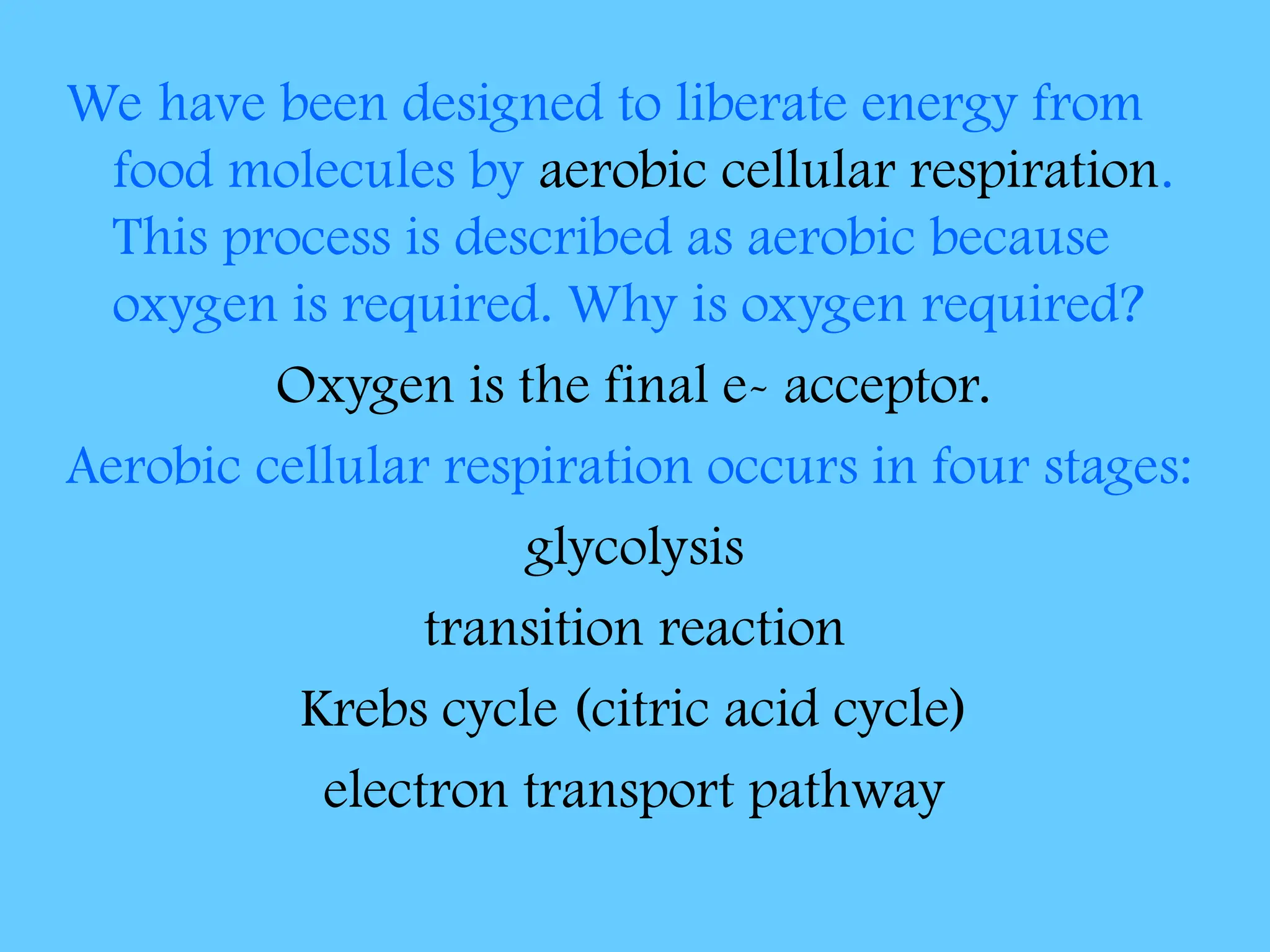
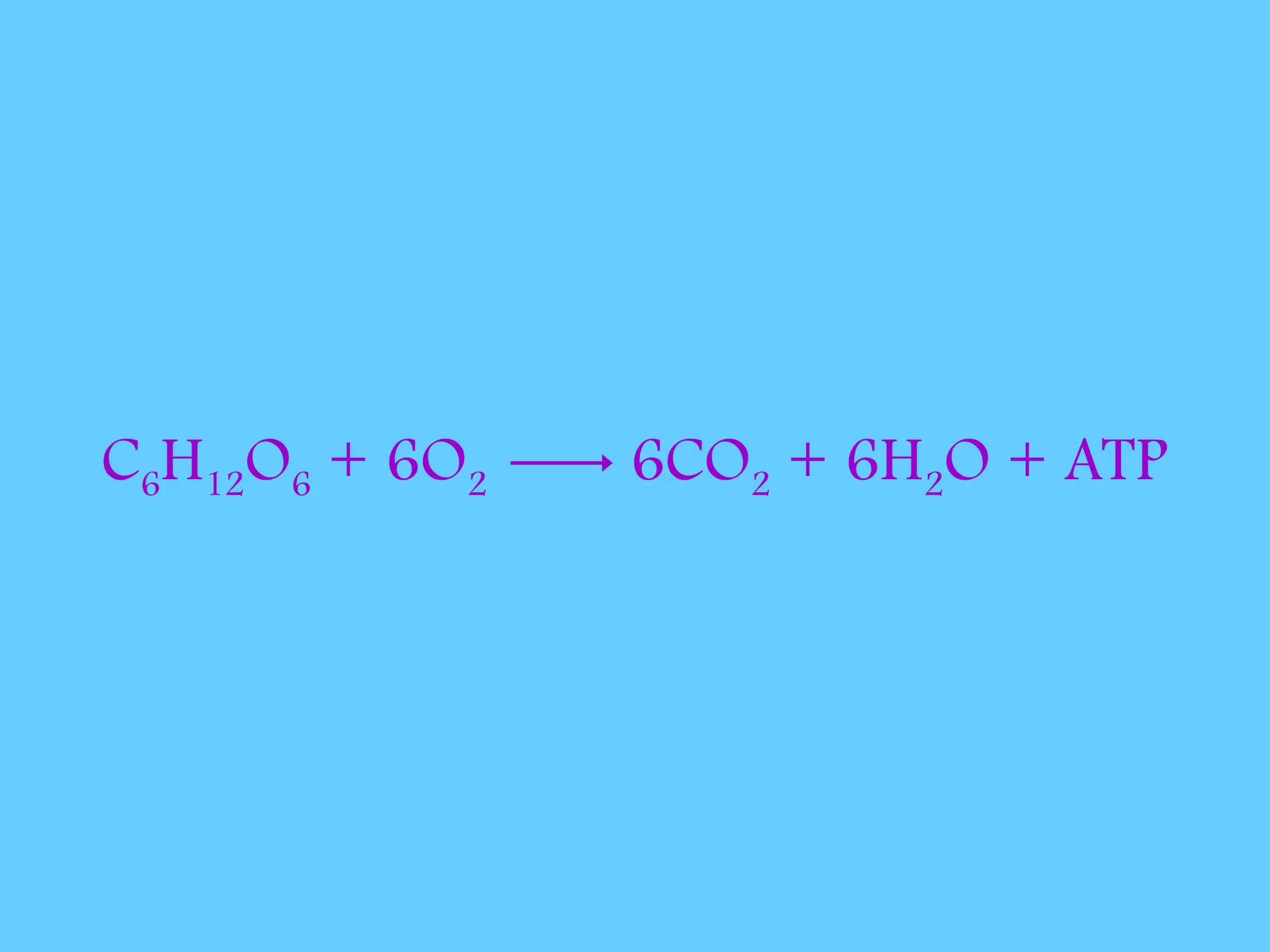
We have beendesigned to liberate energy from
food molecules by aerobic cellular respiration.
This process is described as aerobic because
oxygen is required. Why is oxygen required?
Oxygen is the final e- acceptor.
Aerobic cellular respiration occurs in four stages:
glycolysis
transition reaction
Krebs cycle (citric acid cycle)
electron transport pathway
WARNING: What followsis a
simplified and condensed
version of cellular respiration
and is only appropriate for this
class.
5.
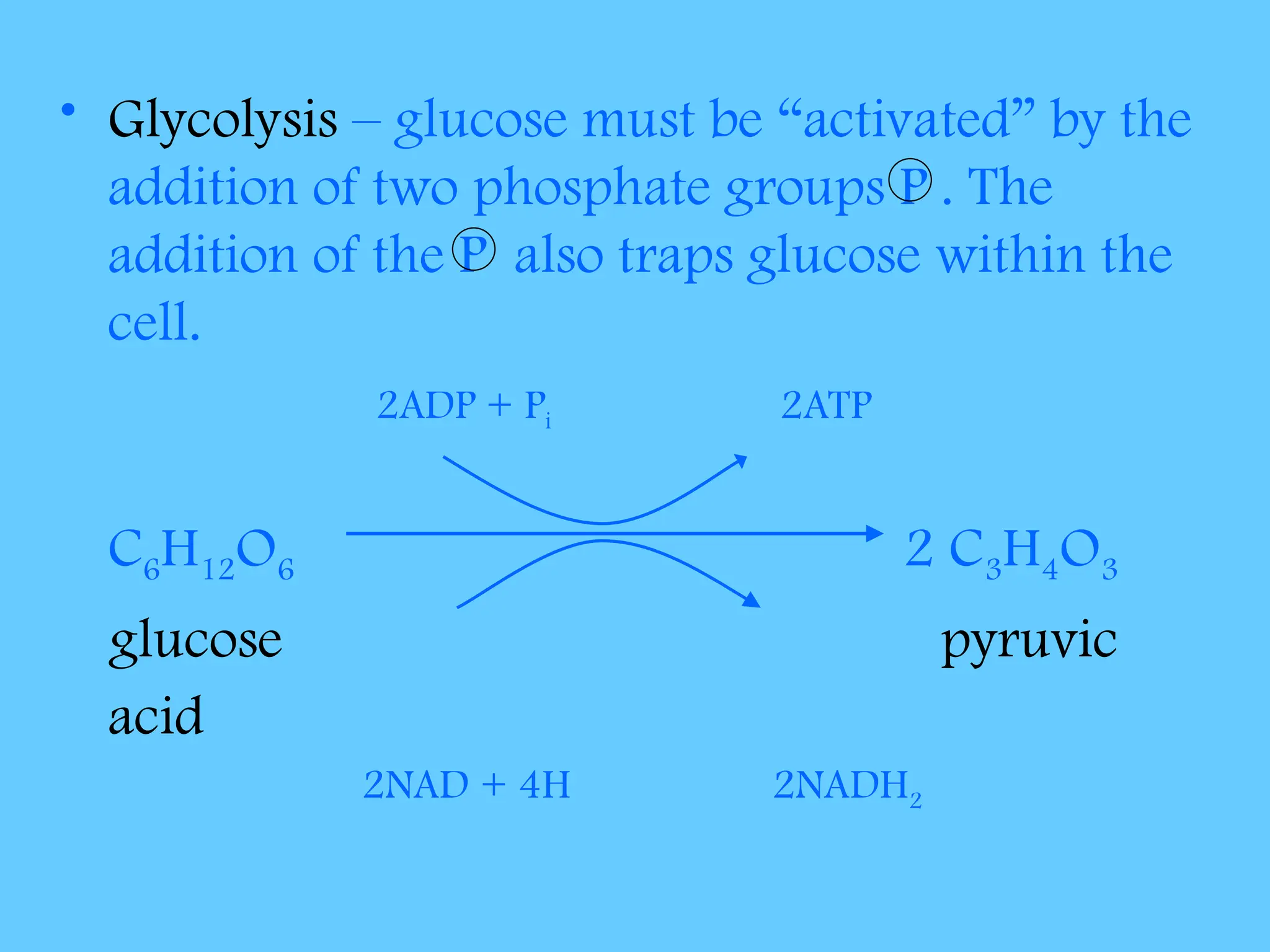
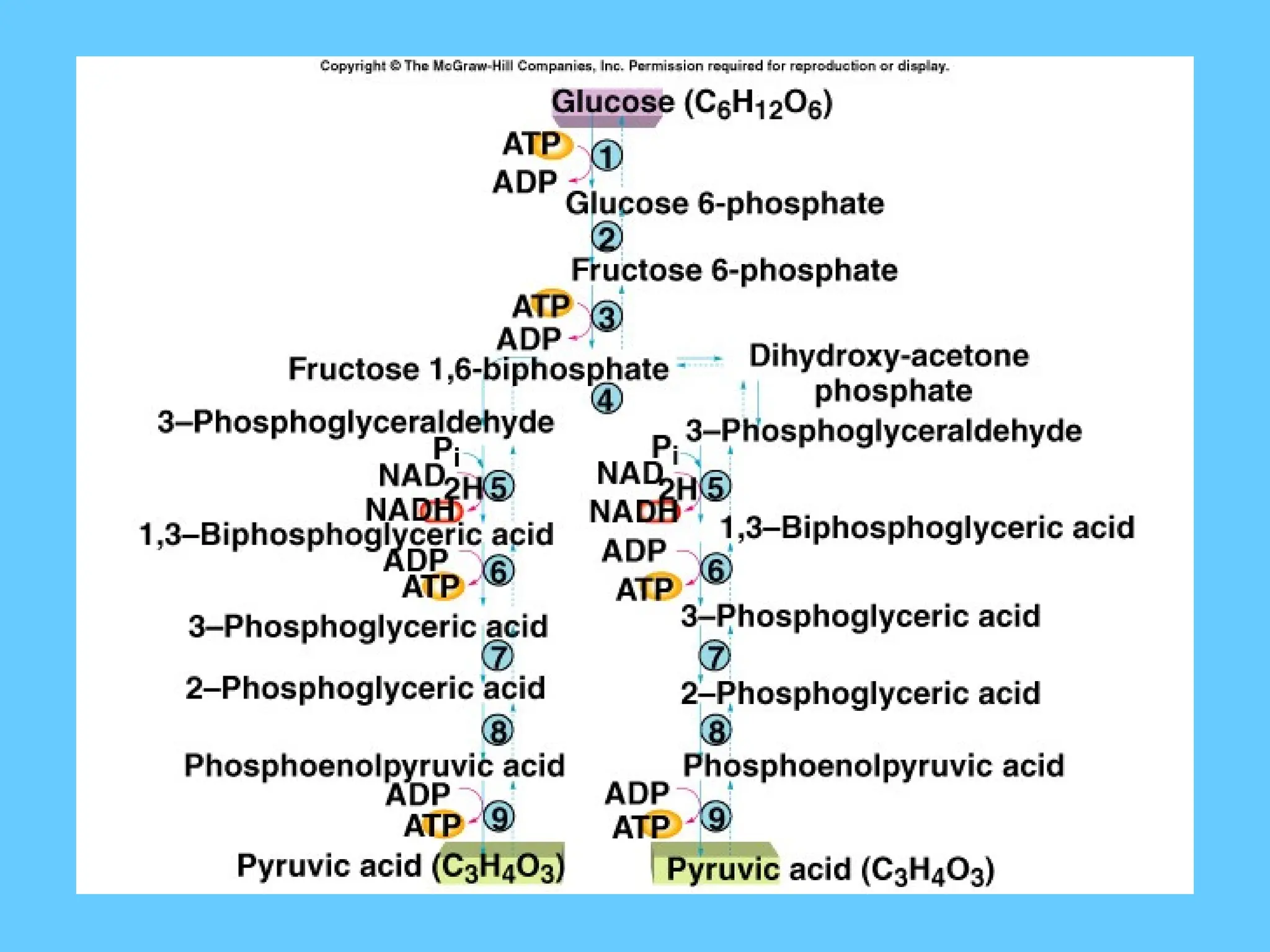
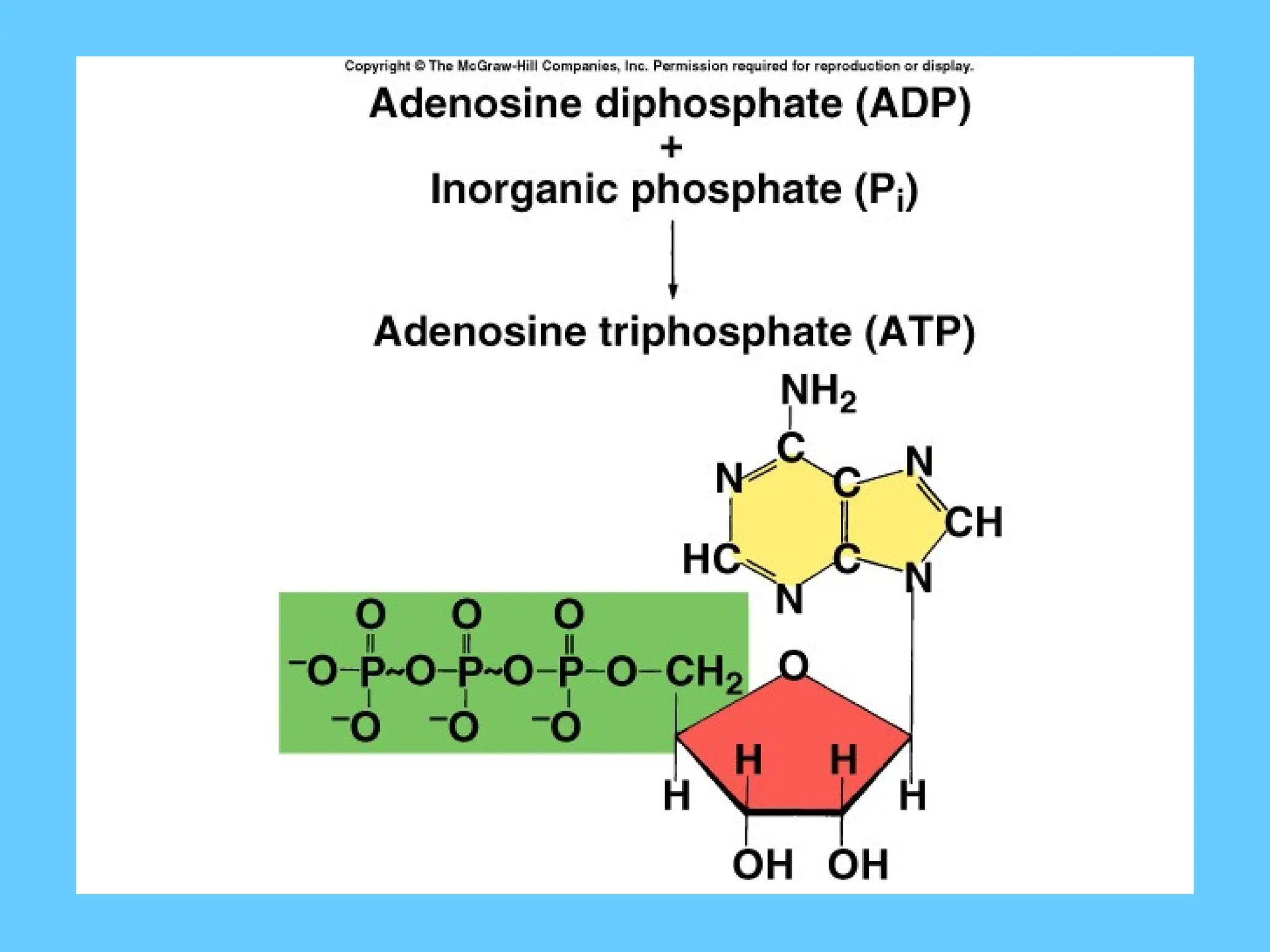
• Glycolysis –glucose must be “activated” by the
addition of two phosphate groups P . The
addition of the P also traps glucose within the
cell.
2ADP + Pi 2ATP
C6H12O6 2 C3H4O3
glucose pyruvic
acid
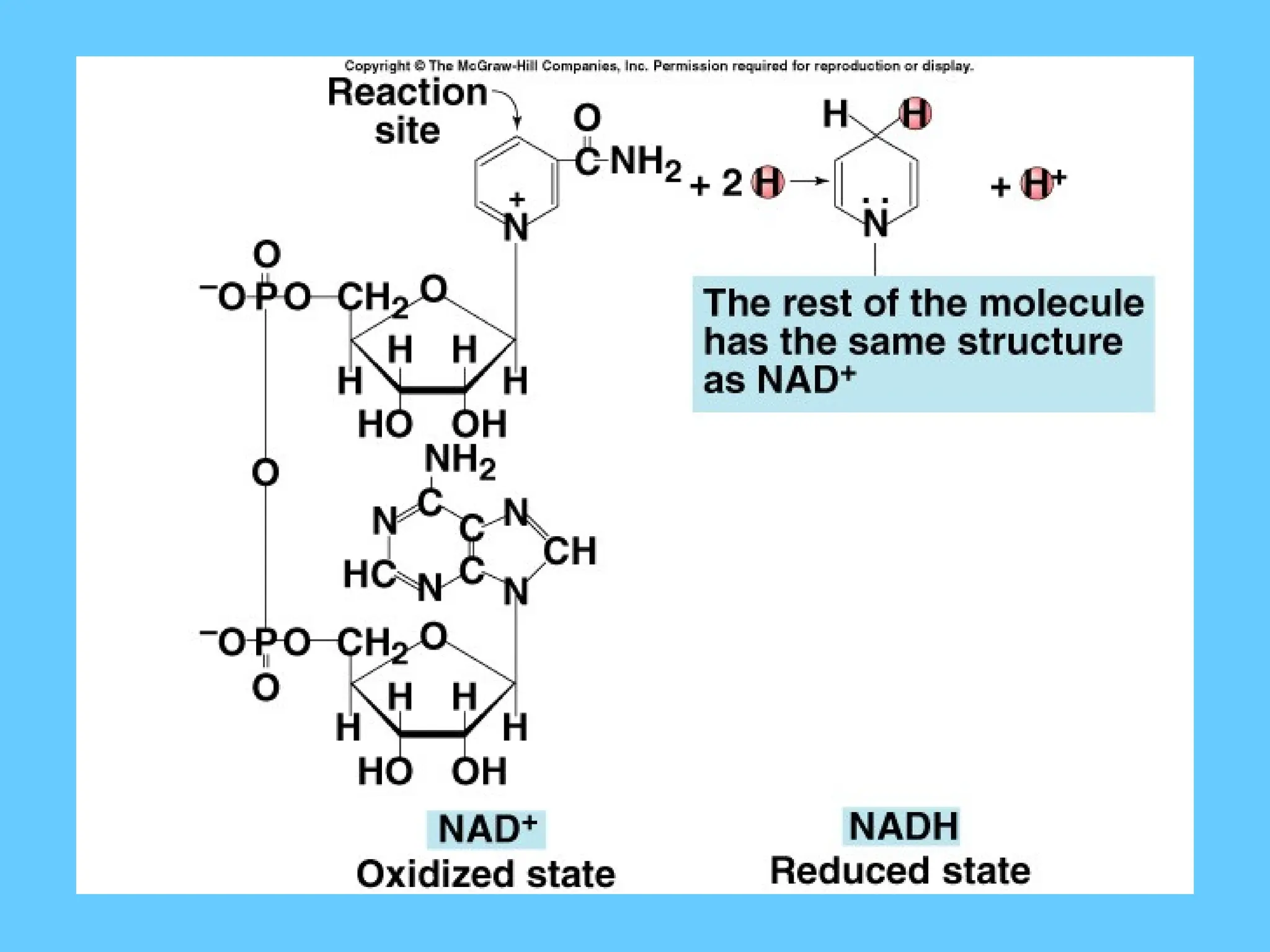
2NAD + 4H 2NADH2
7.
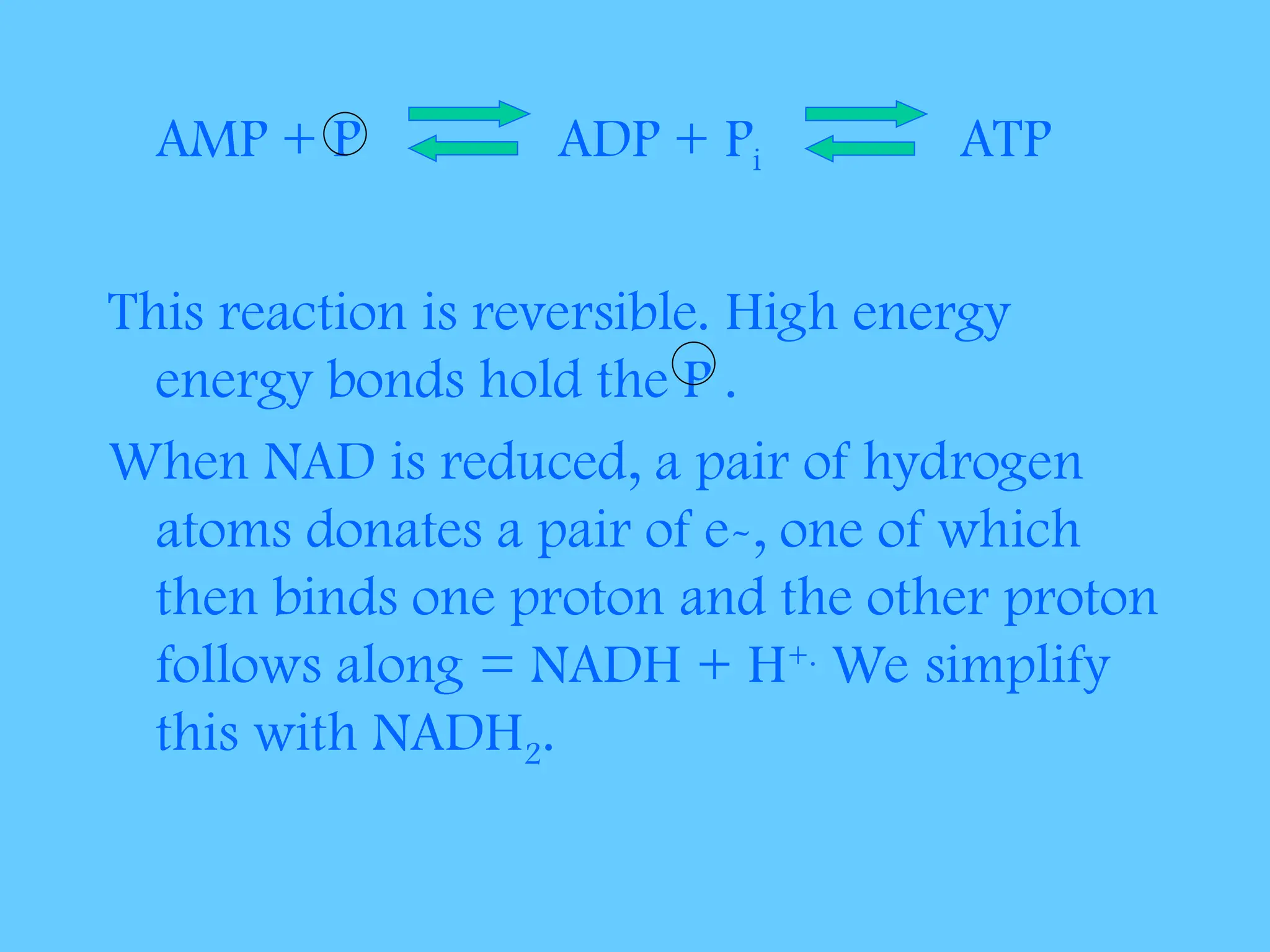
AMP + PADP + Pi ATP
This reaction is reversible. High energy
energy bonds hold the P .
When NAD is reduced, a pair of hydrogen
atoms donates a pair of e-, one of which
then binds one proton and the other proton
follows along = NADH + H+.
We simplify
this with NADH2.
10.
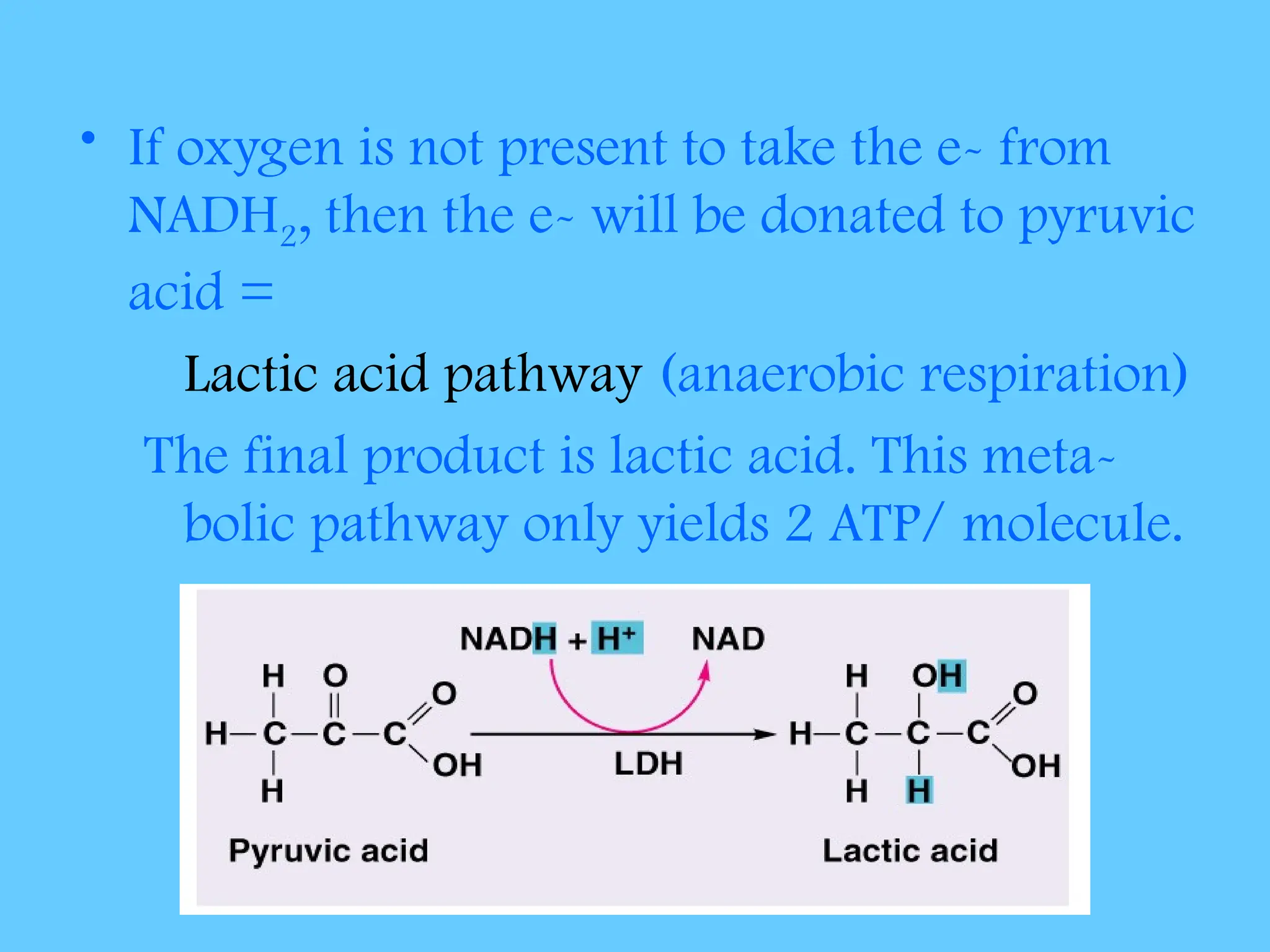
• If oxygenis not present to take the e- from
NADH2, then the e- will be donated to pyruvic
acid =
Lactic acid pathway (anaerobic respiration)
The final product is lactic acid. This meta-
bolic pathway only yields 2 ATP/ molecule.
11.
• Cells cannotstore very much glucose because
the glucose affects the cell’s osmolarity (see
ch. 6). The glucose is converted to glycogen
(or fatty acids) for storage = glycogenesis.
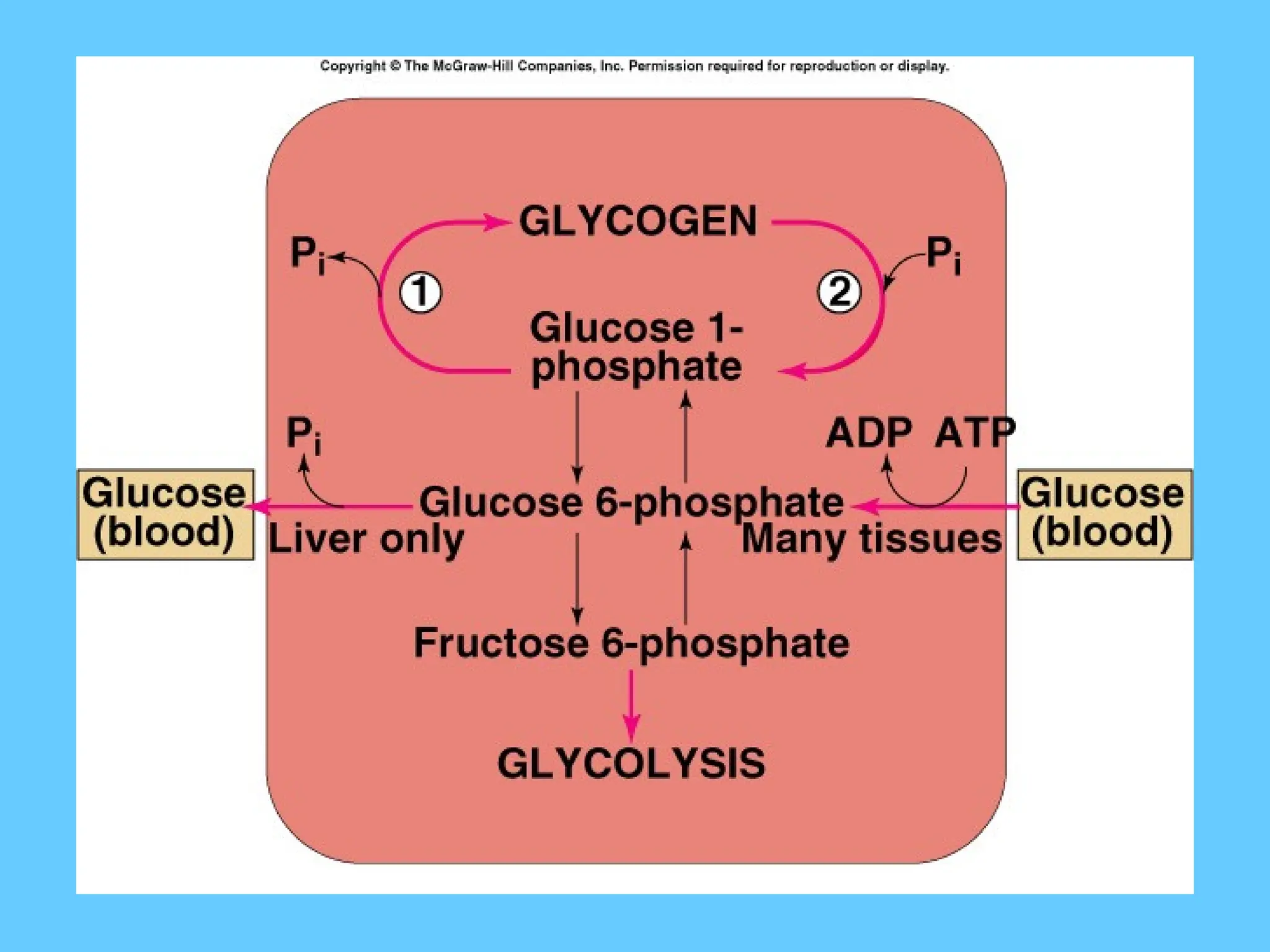
glucose glu–6–P glu– 1—P
glycogen
[glu + glu + glu + glu + … glycogen]
12.
• The storedglycogen can be converted to
glucose for use by the cell or secreted into
the bloodstream (this only in the liver) =
glycogenolysis.
[glycogen glu + glu + glu + glu + …]
glycogen glu–1–P glu– 6—P
liver enzymes
glucose glucose
14.
• Only livercells contain glucose – 6 –
phosphatase, which removes P from glu –
6—P and liberates free glucose. The free
glucose is then transported out of the cell
into the blood stream.
15.
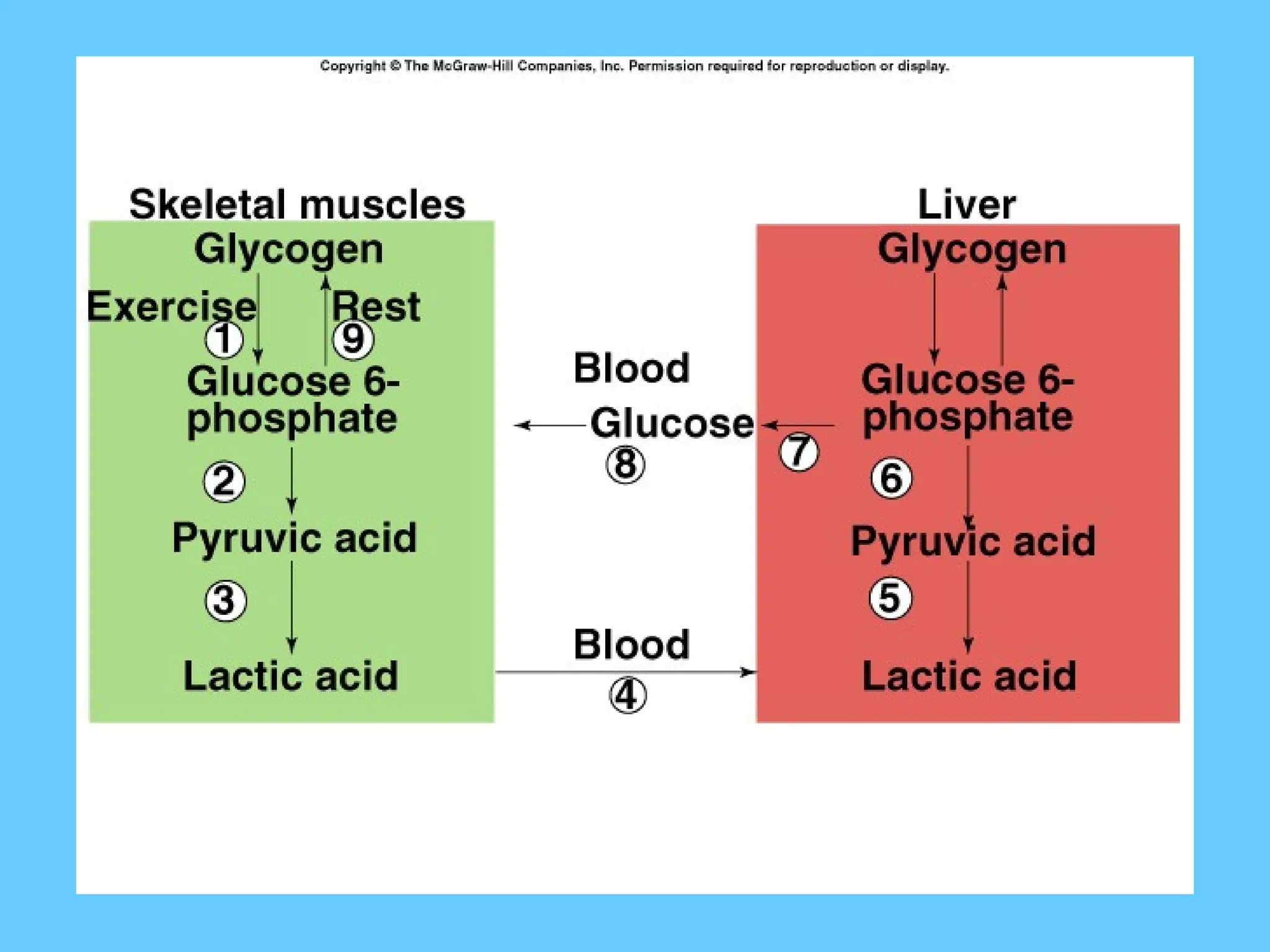
• Gluconeogenesis =liver cells contain another
enzyme, lactic acid dehydrogenase, which
converts lactic acid to pyruvic acid. The
pyruvic acid is then converted to glu – 6—P
(this is the reverse of glycolysis).
• The glu – 6—P can then be used to make
glycogen or released as free glucose.
• The production of glucose from
noncarbohydrate molecules, e.g. lactic acid,
amino acids, fatty acids, is gluconeogenesis.
(The Cori cycle is the production of glu from
lactic acid.)
17.
Continuation of AerobicRespiration
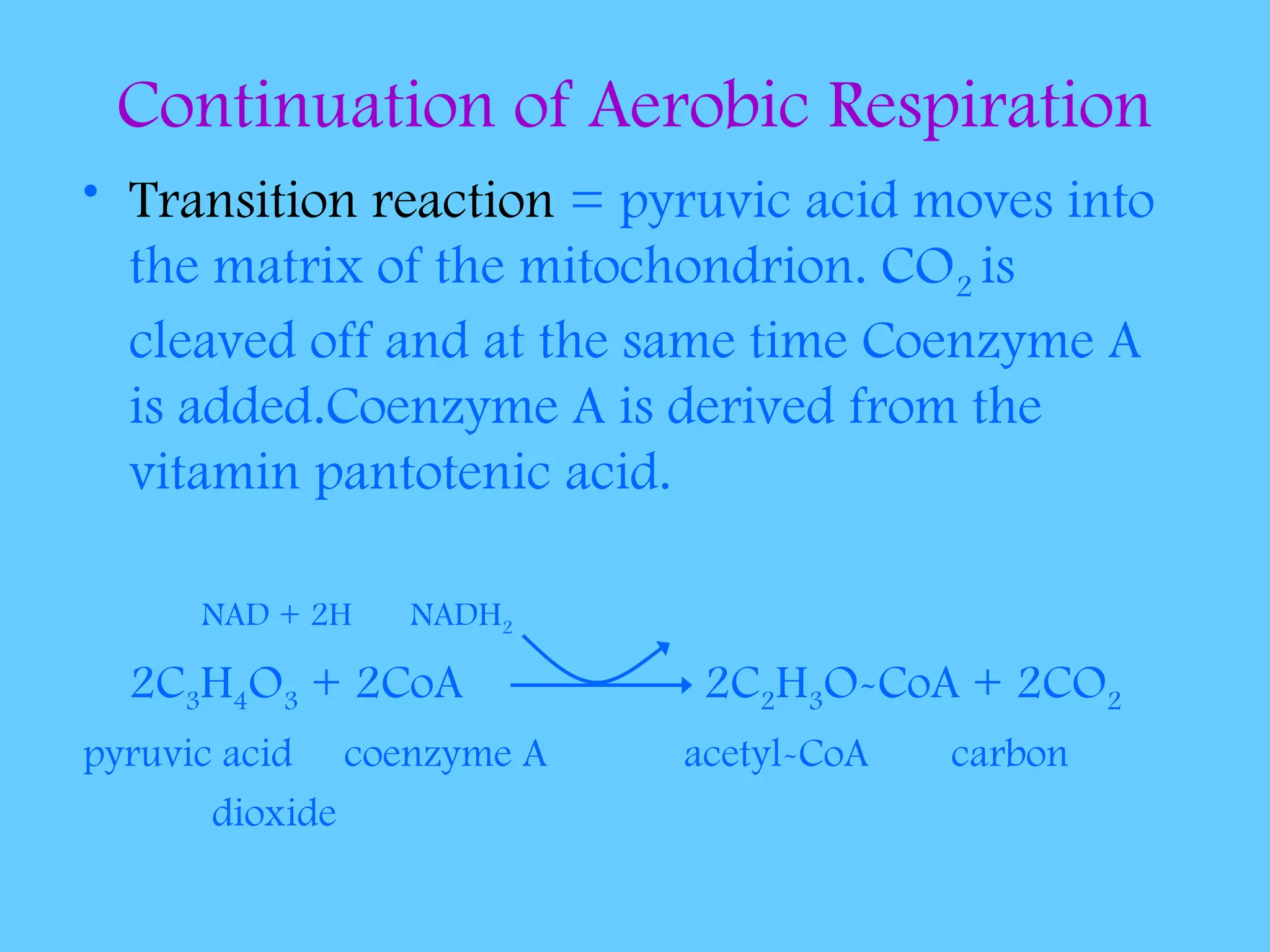
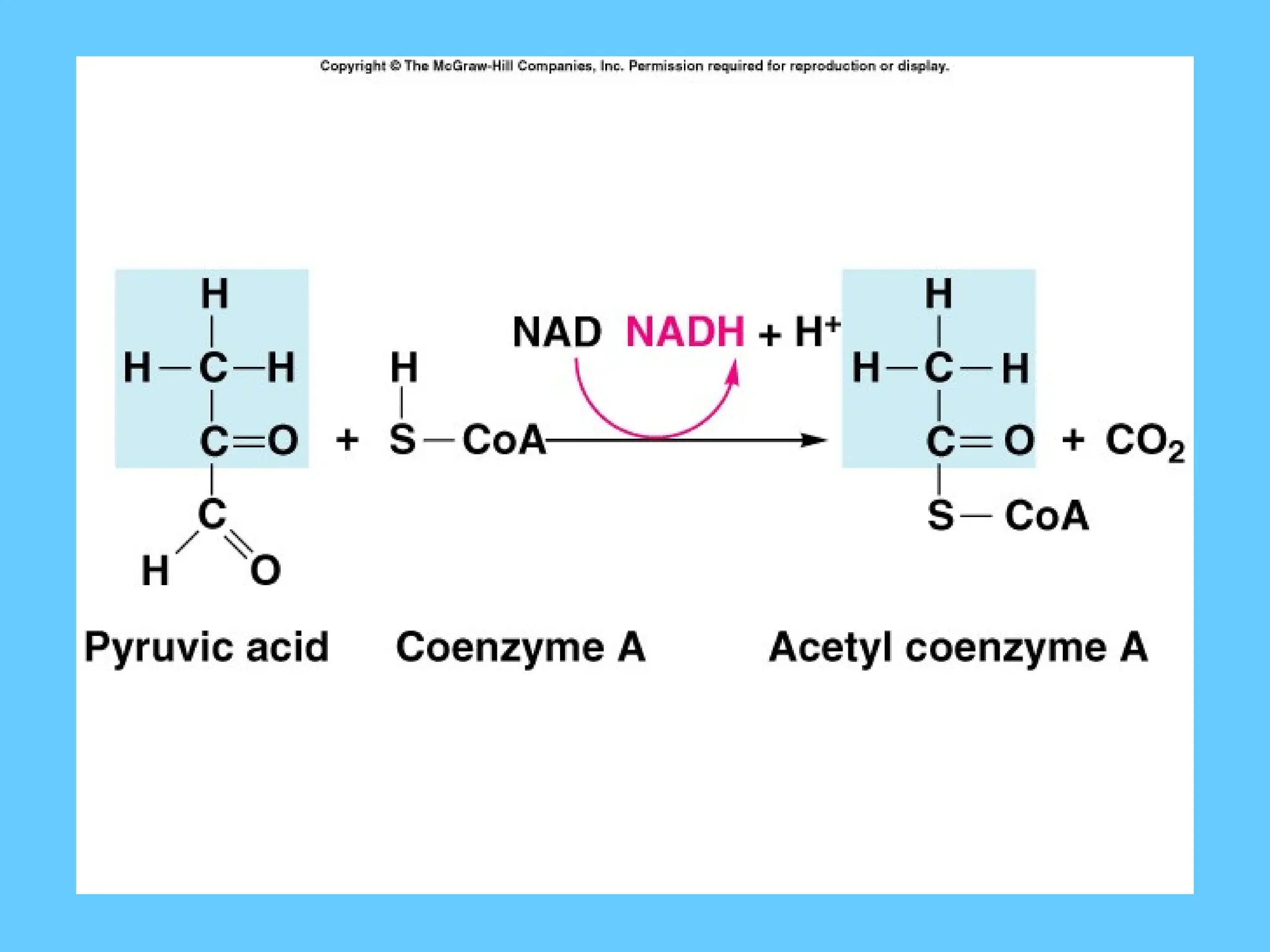
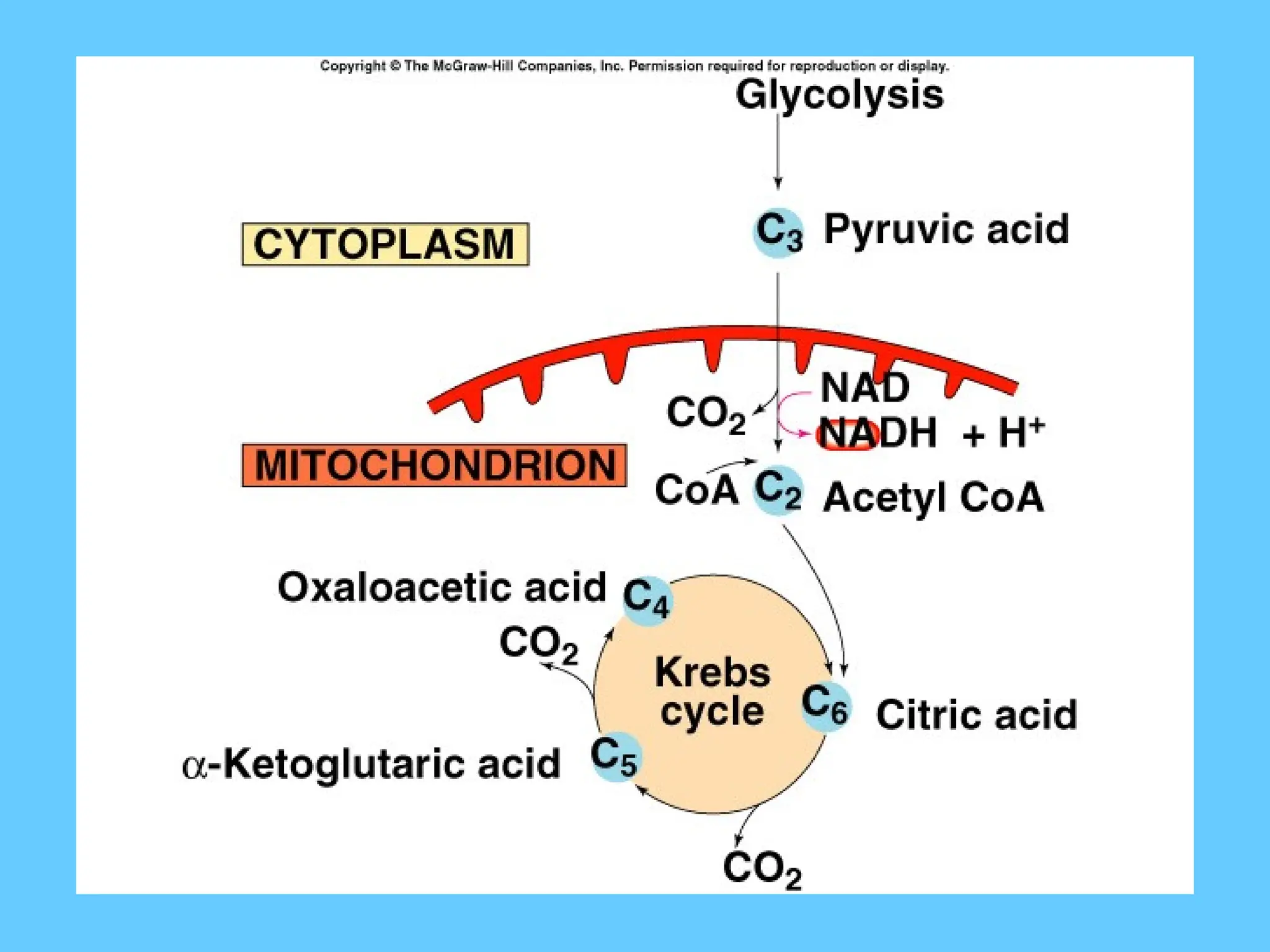
• Transition reaction = pyruvic acid moves into
the matrix of the mitochondrion. CO2 is
cleaved off and at the same time Coenzyme A
is added.Coenzyme A is derived from the
vitamin pantotenic acid.
NAD + 2H NADH2
2C3H4O3 + 2CoA 2C2H3O-CoA + 2CO2
pyruvic acid coenzyme A acetyl-CoA carbon
dioxide
19.
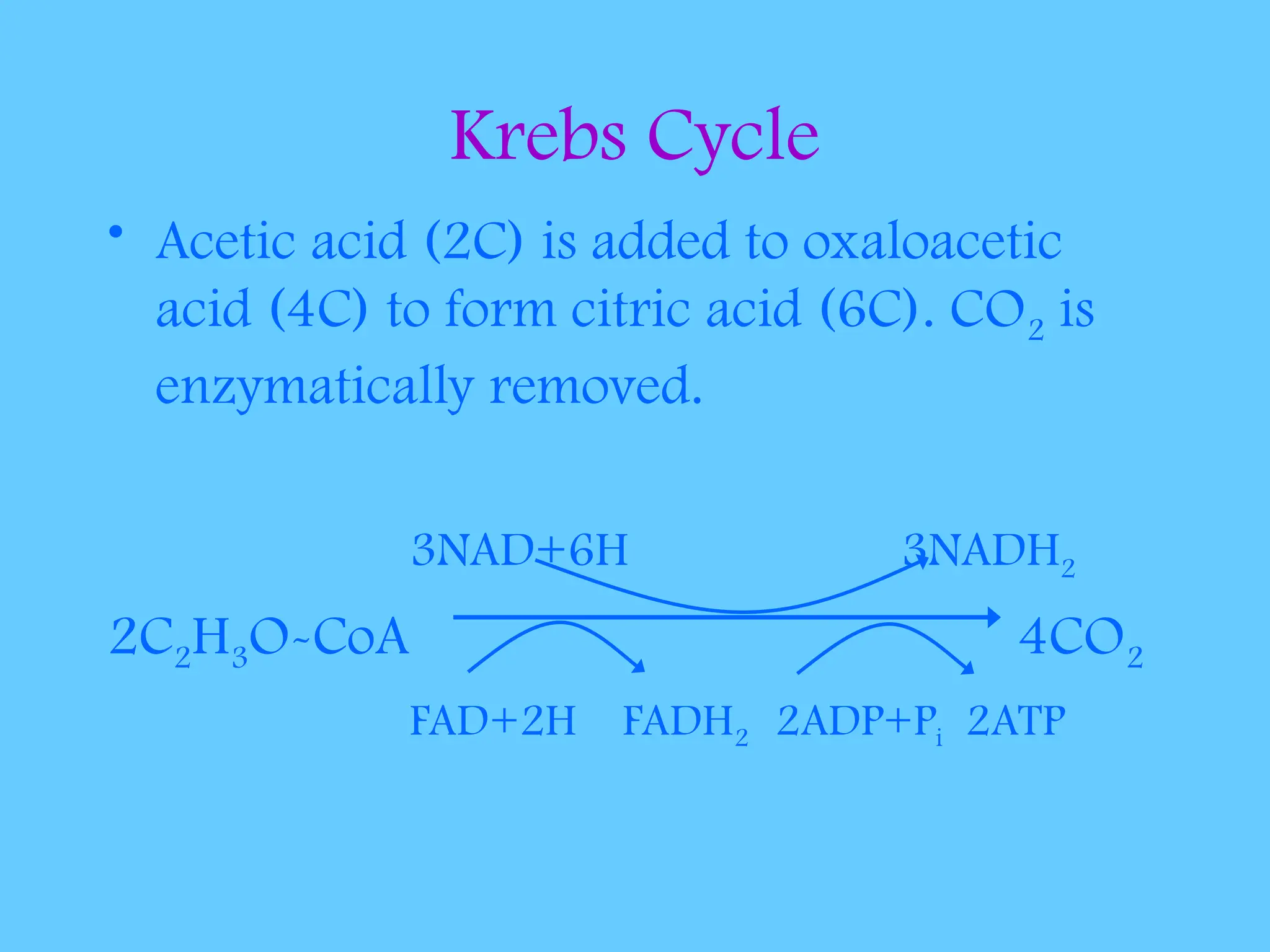
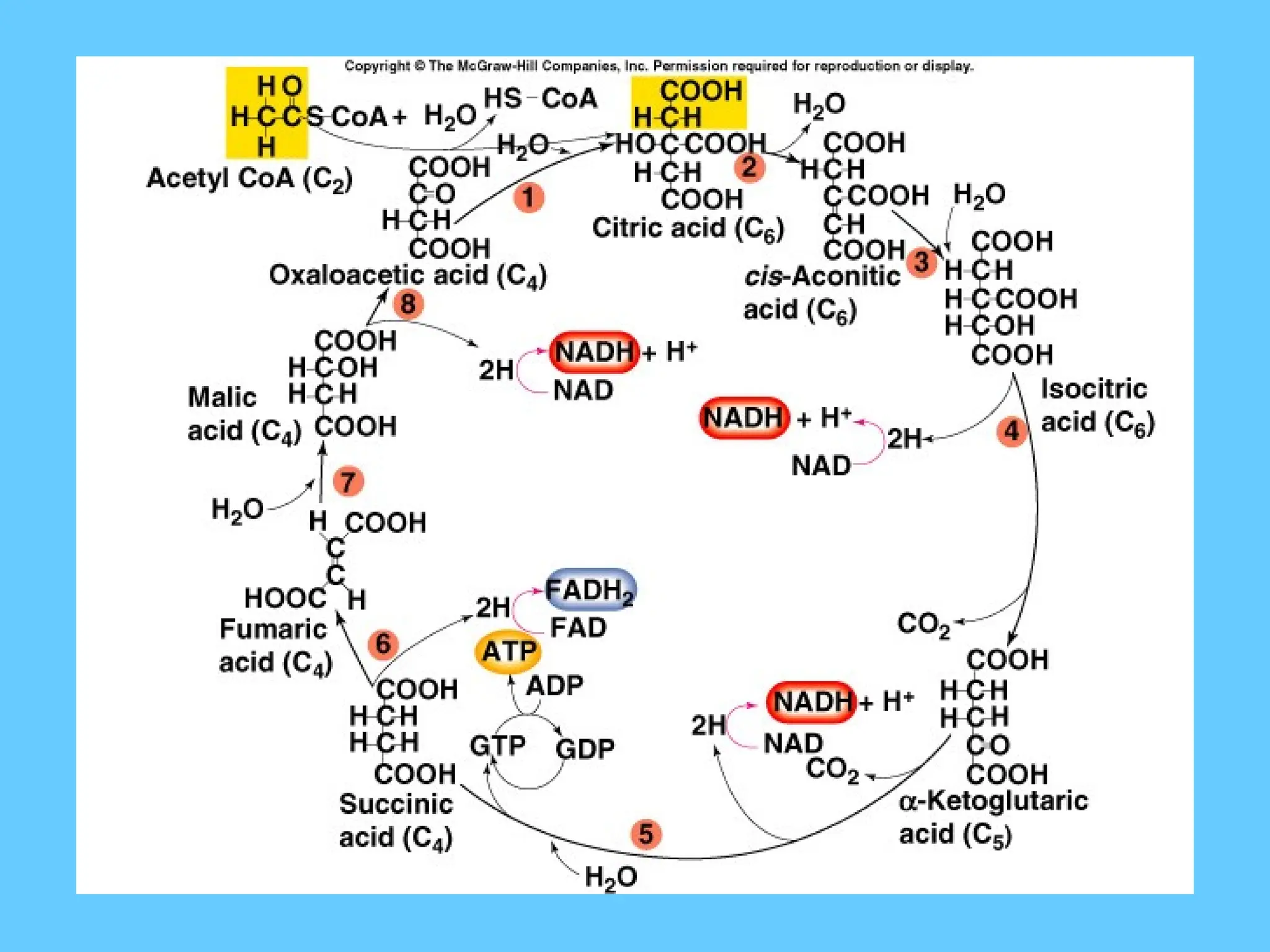
Krebs Cycle
• Aceticacid (2C) is added to oxaloacetic
acid (4C) to form citric acid (6C). CO2 is
enzymatically removed.
3NAD+6H 3NADH2
2C2H3O-CoA 4CO2
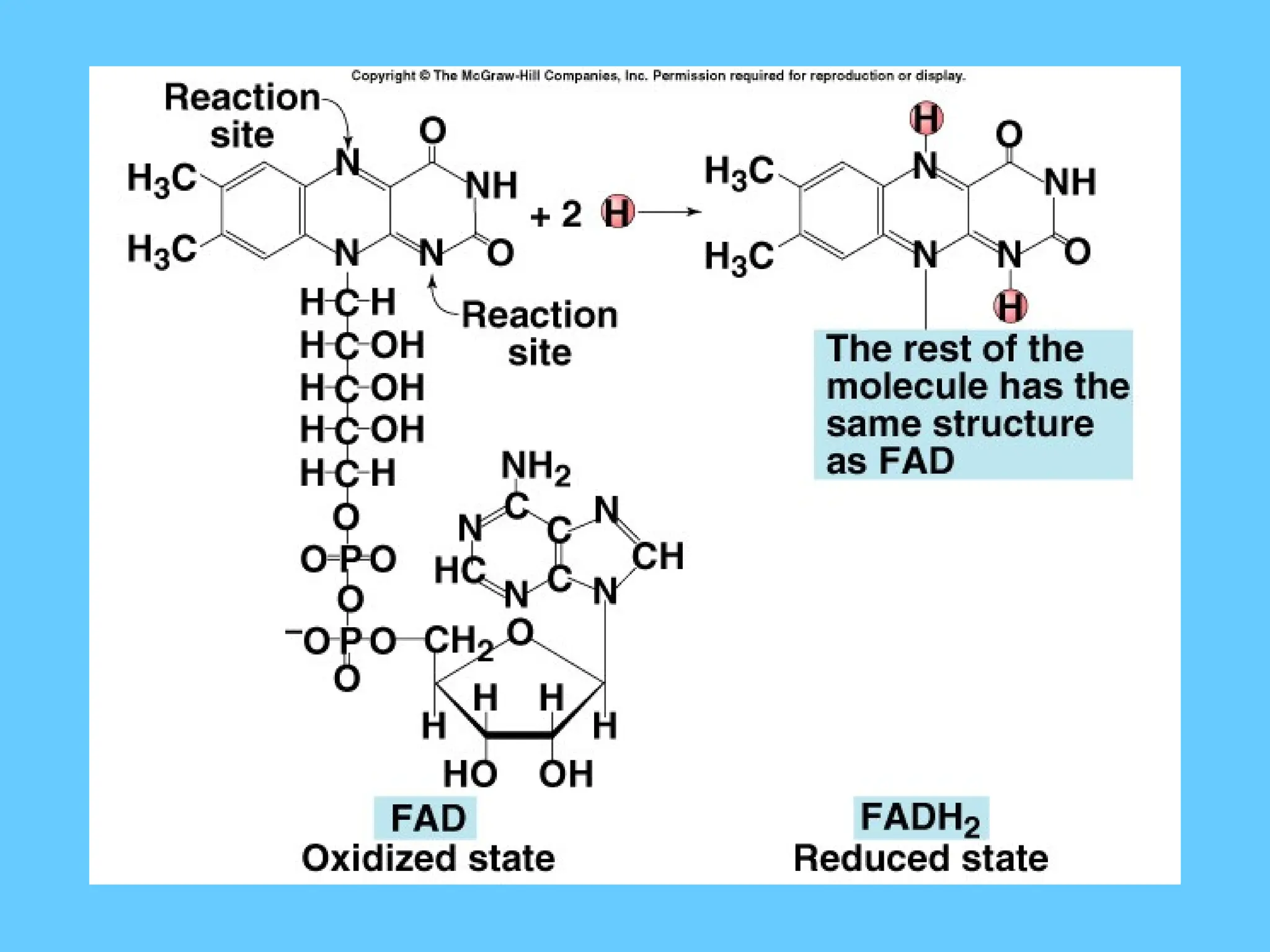
FAD+2H FADH2 2ADP+Pi 2ATP
23.
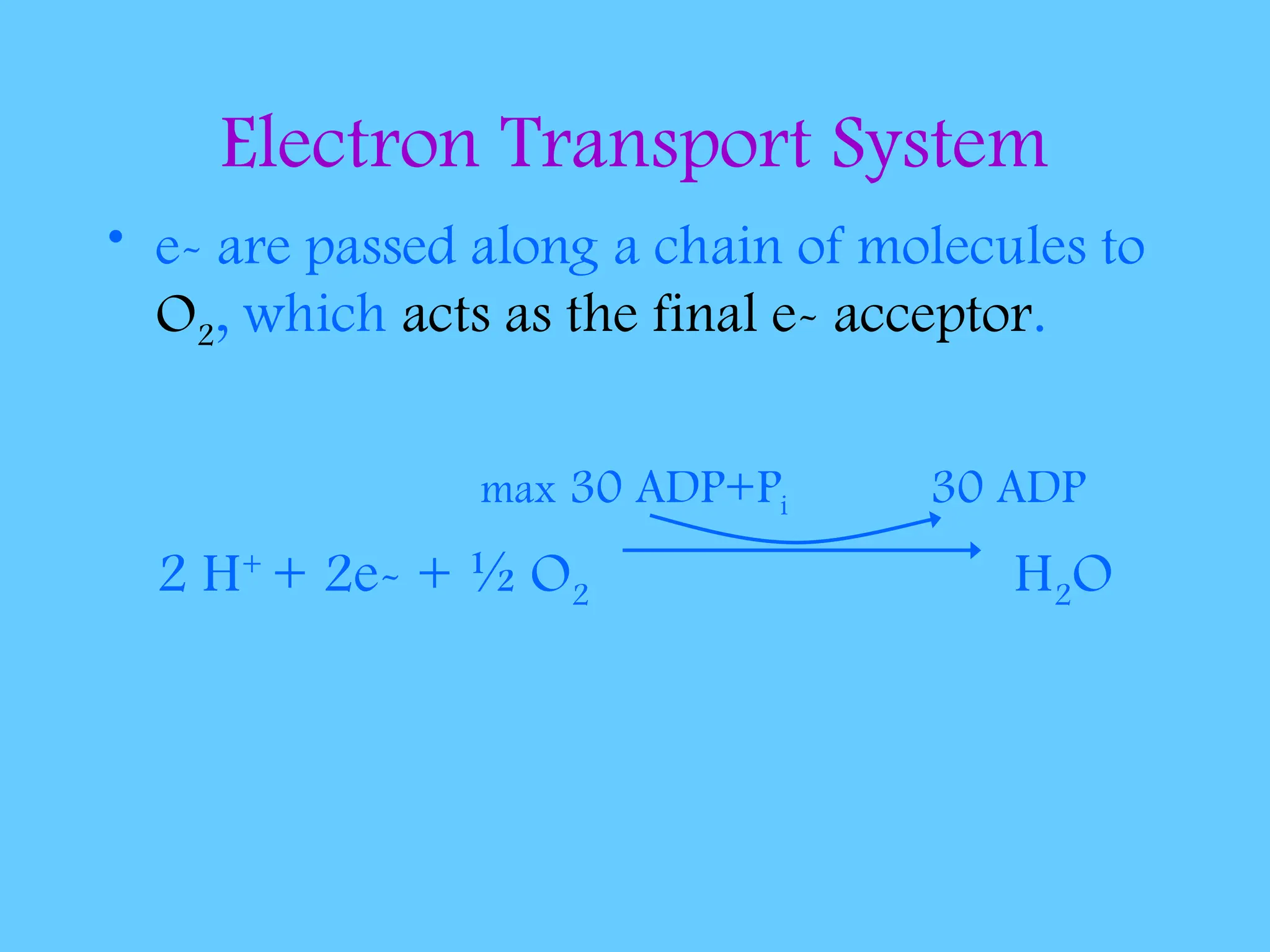
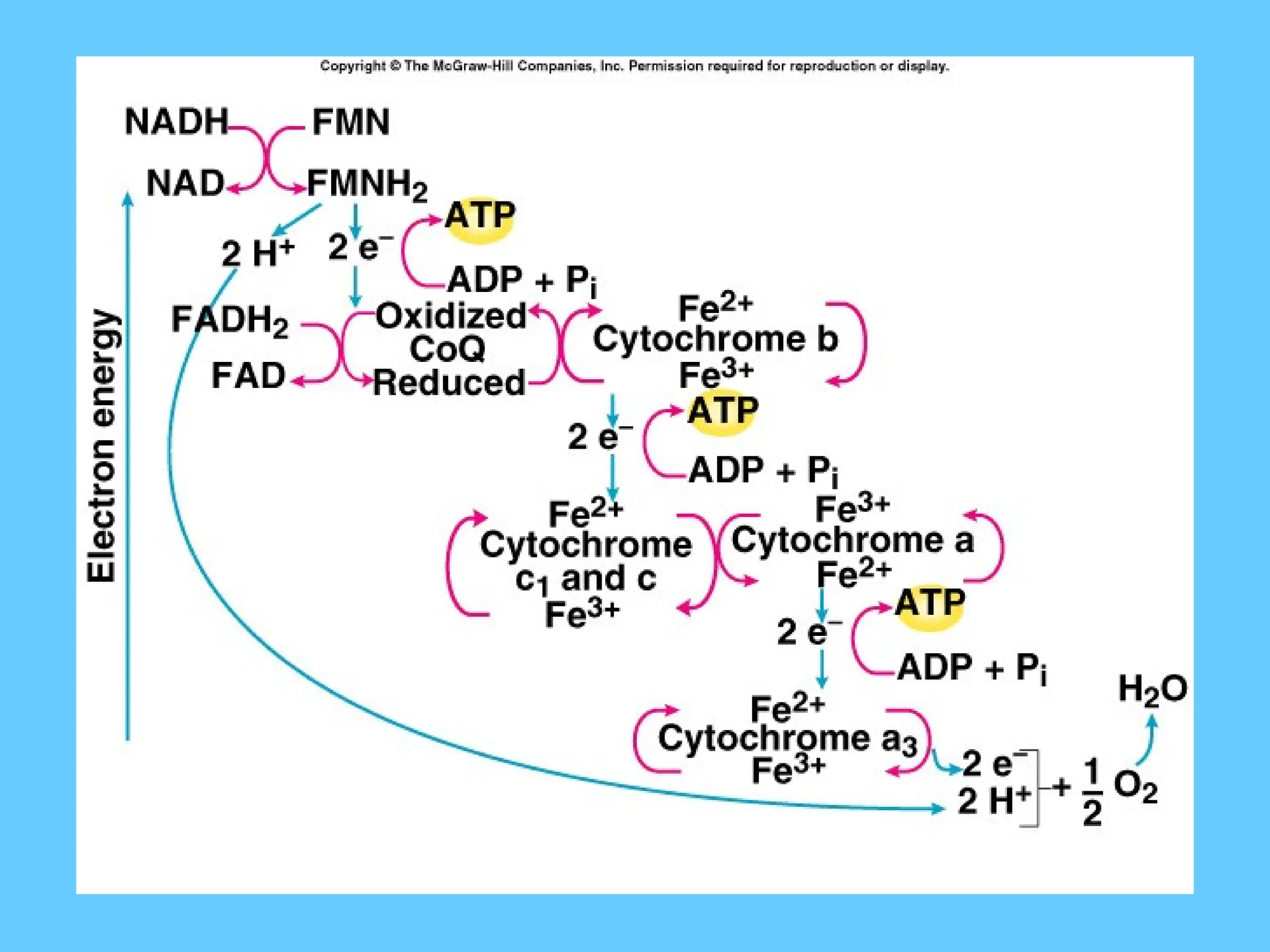
Electron Transport System
•e- are passed along a chain of molecules to
O2, which acts as the final e- acceptor.
max 30 ADP+Pi 30 ADP
2 H+
+ 2e- + ½ O2 H2O
25.
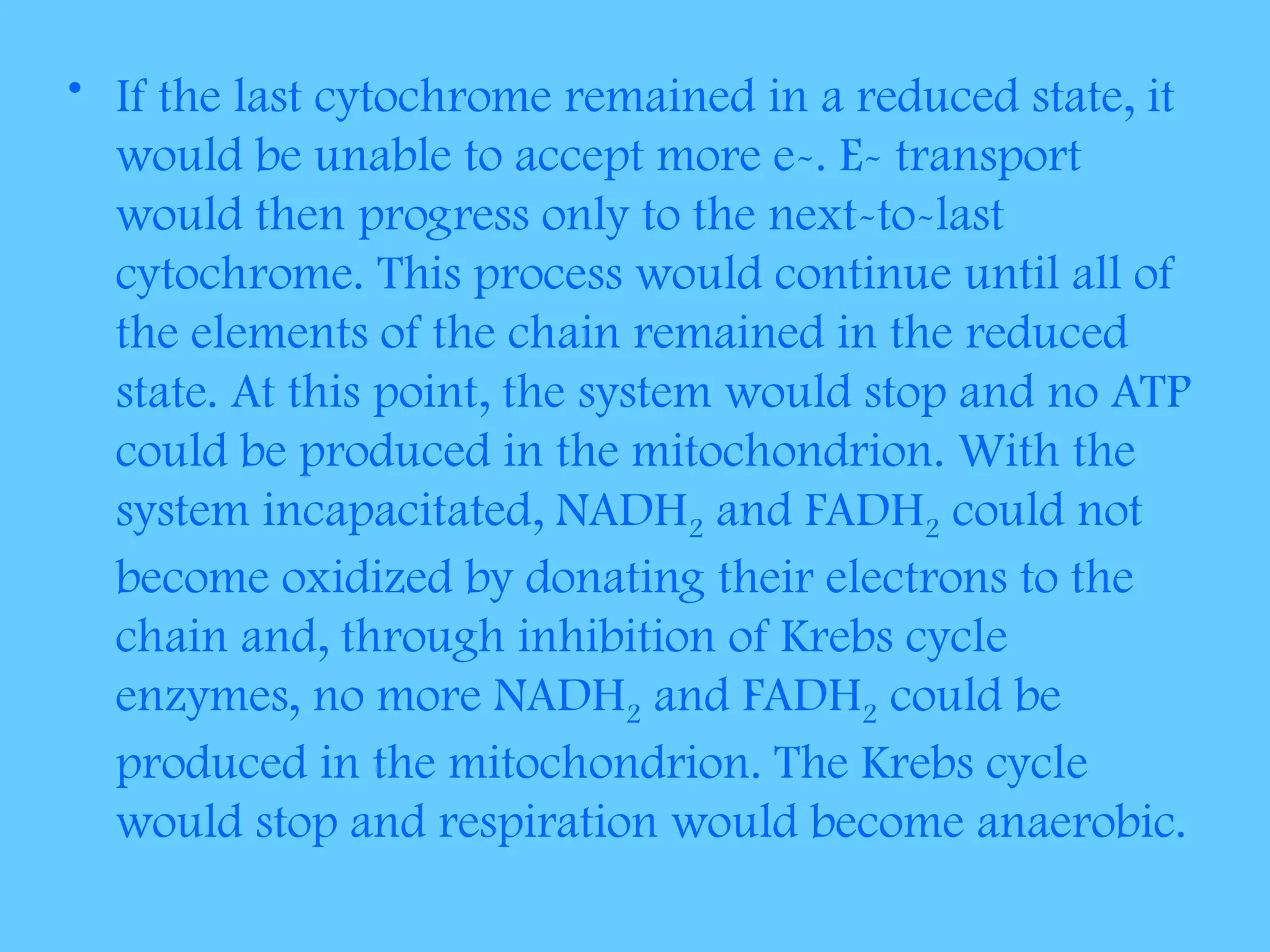
• If thelast cytochrome remained in a reduced state, it
would be unable to accept more e-. E- transport
would then progress only to the next-to-last
cytochrome. This process would continue until all of
the elements of the chain remained in the reduced
state. At this point, the system would stop and no ATP
could be produced in the mitochondrion. With the
system incapacitated, NADH2 and FADH2 could not
become oxidized by donating their electrons to the
chain and, through inhibition of Krebs cycle
enzymes, no more NADH2 and FADH2 could be
produced in the mitochondrion. The Krebs cycle
would stop and respiration would become anaerobic.
26.
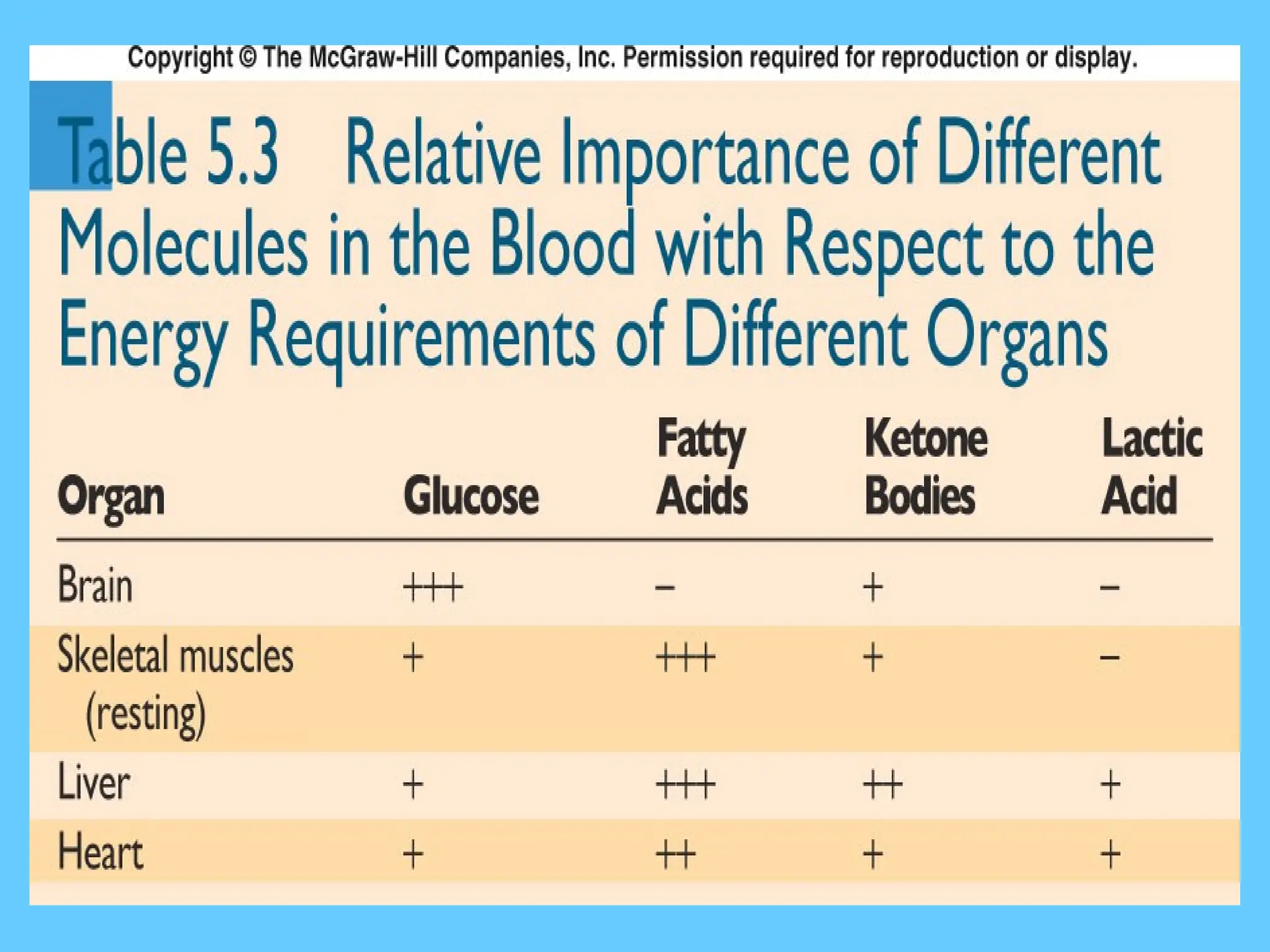
• Lipids andproteins can also be used in
aerobic respiration. Some organs
preferentially use molecules other than
glucose. Why were we designed this way?
To prevent depletion of glucose and conserve
it for the brain.
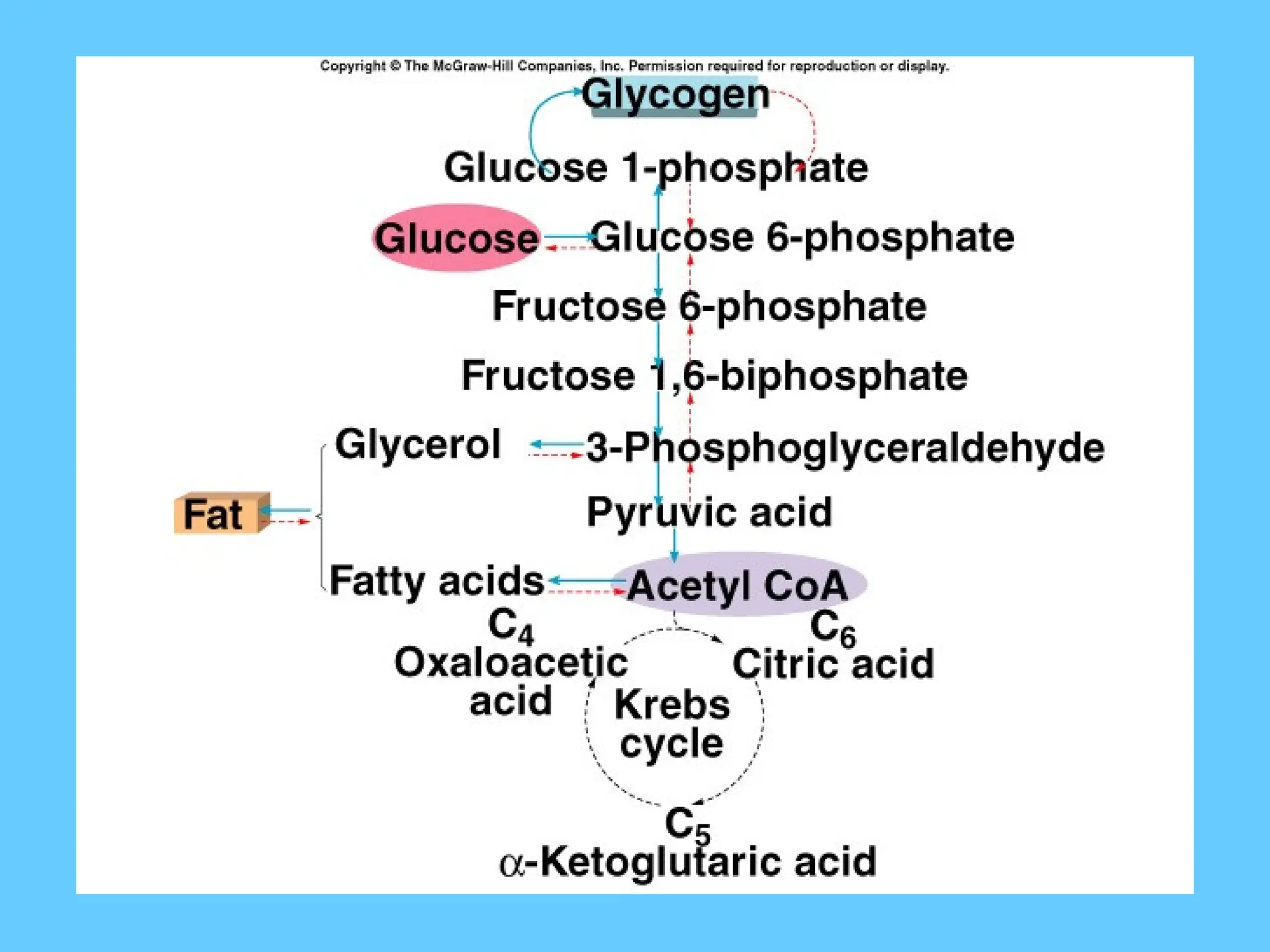
• We can store only small amounts of ATP. If
food molecules are still available and ATP
concentration continues to rise, glycolysis is
inhibited and glucose is converted into
glycogen and fats instead = glycogenesis
and lipogenesis
28.
Lipogenesis
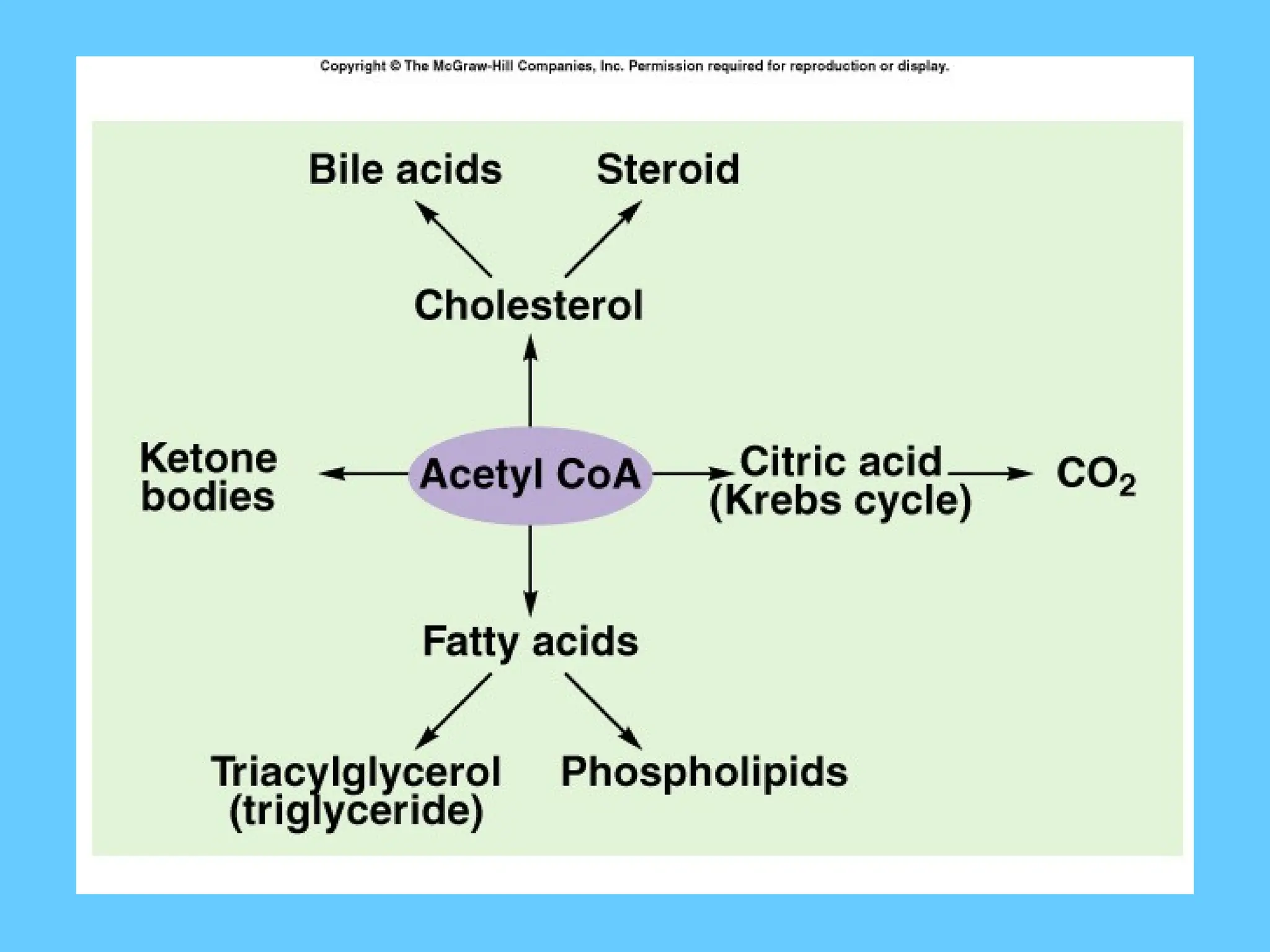
• Excess glucosedoes not complete respiration
but instead is converted into glycerol and
fatty acids. The acetyl-CoA subunits from
the transition reaction are added together to
produce fatty acids. This occurs primarily in
adipose tissue and the liver.
30.
Lipolysis
• Triglycerides arehydrolyzed into glycerol
and free fatty acids (FFA) by lipolysis.
• In some tissues glycerol can be converted
into phosphoglyceraldehyde.
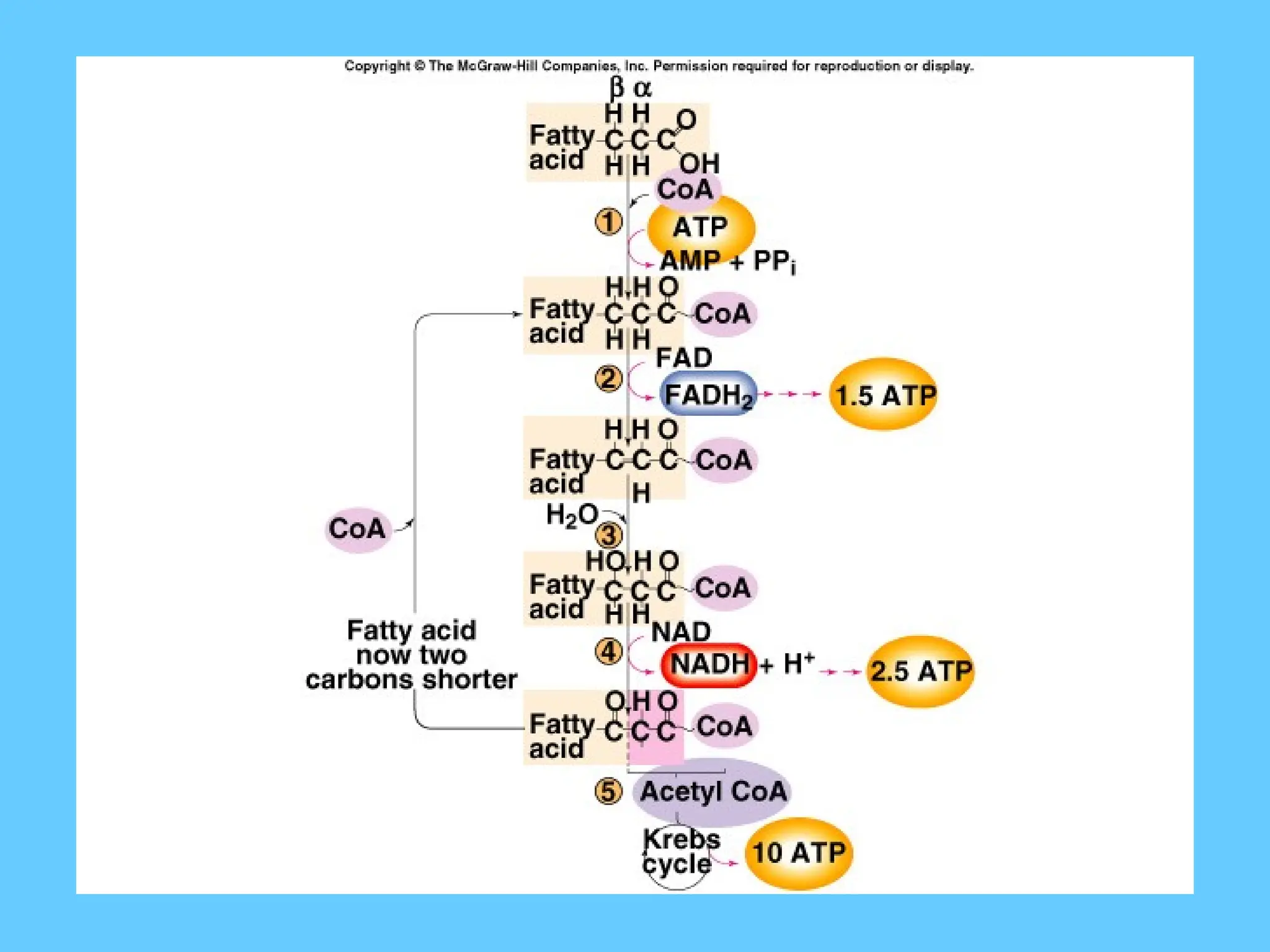
• FFAs are a major energy source and are
metabolized by -oxidation.
32.
Amino Acids
• Excessamino acids (a.a.) in the diet are not simply
stored as additional protein – instead they are
deaminated and the carbon skeleton is either respired
or converted to carbohydrates or fats.
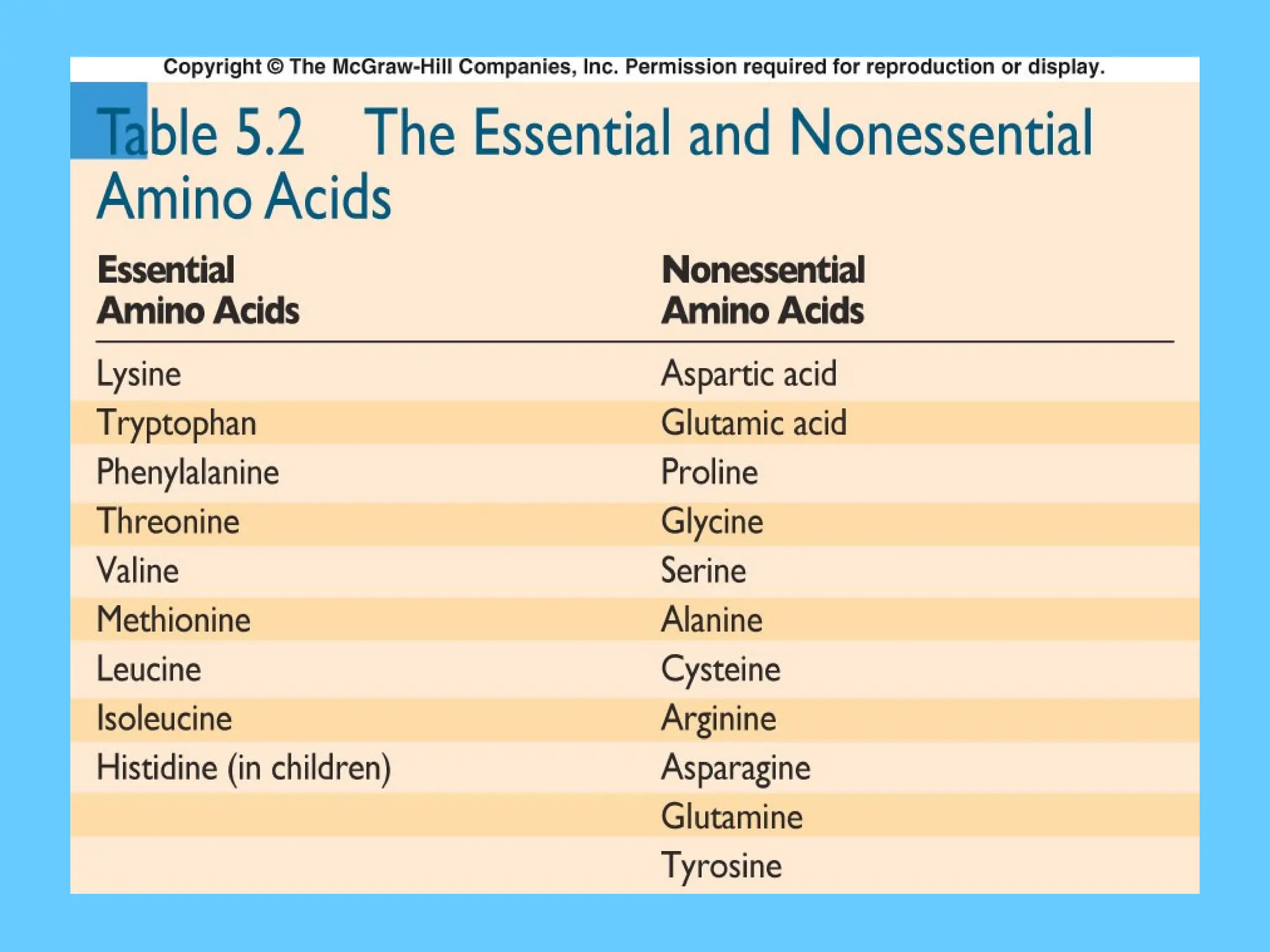
• Adequate amounts of amino acids are required for
growth and repair. Some a.a. can be make by
rearranging parts of carbohydrates and essential a.a.
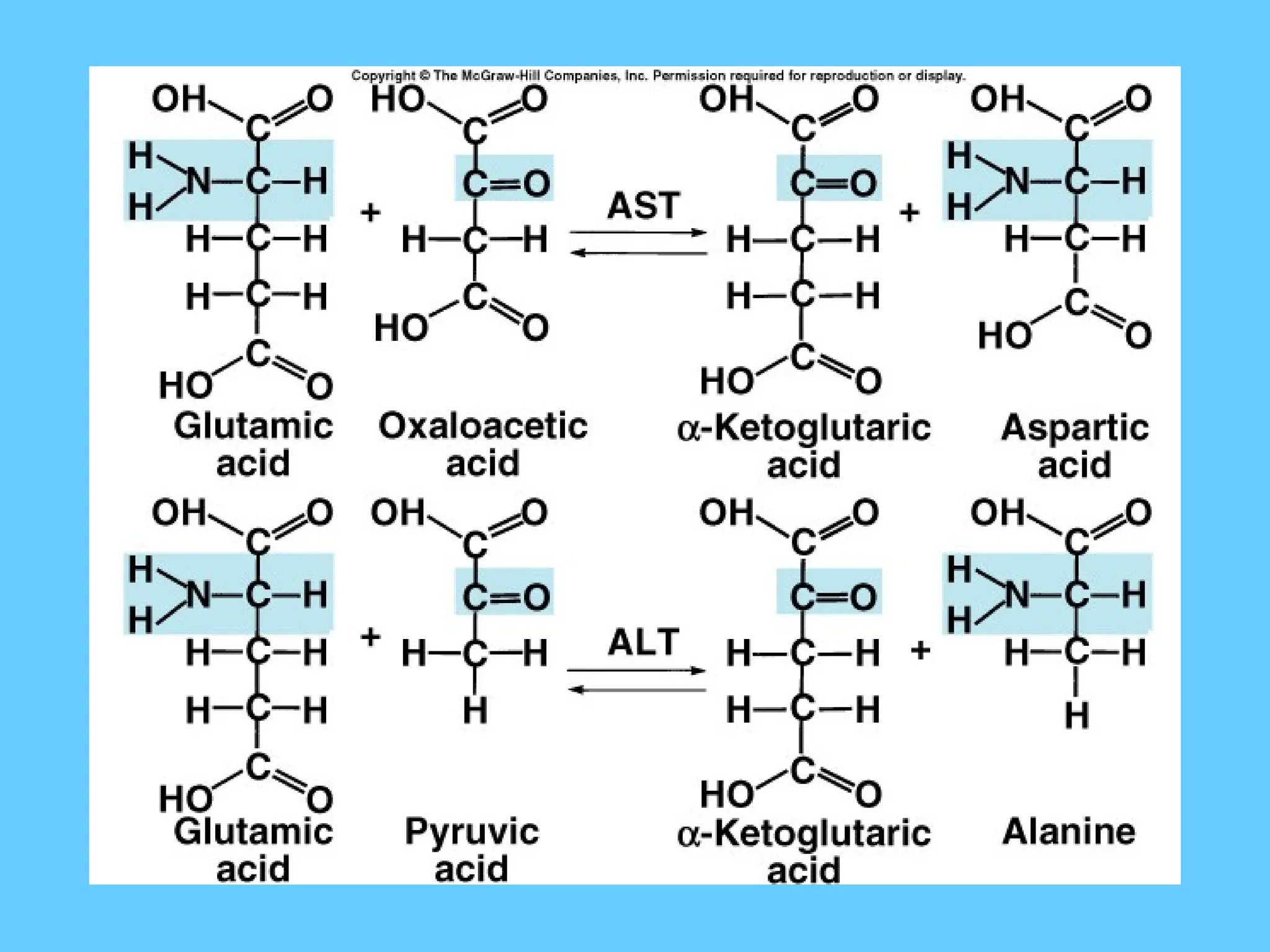
A new amino acid can be obtained by transamination.
– Amine group (NH2) transferred from one amino acid to
form another amino acid and a keto acid.
– Catalyzed by a specific enzyme (transaminase).
35.
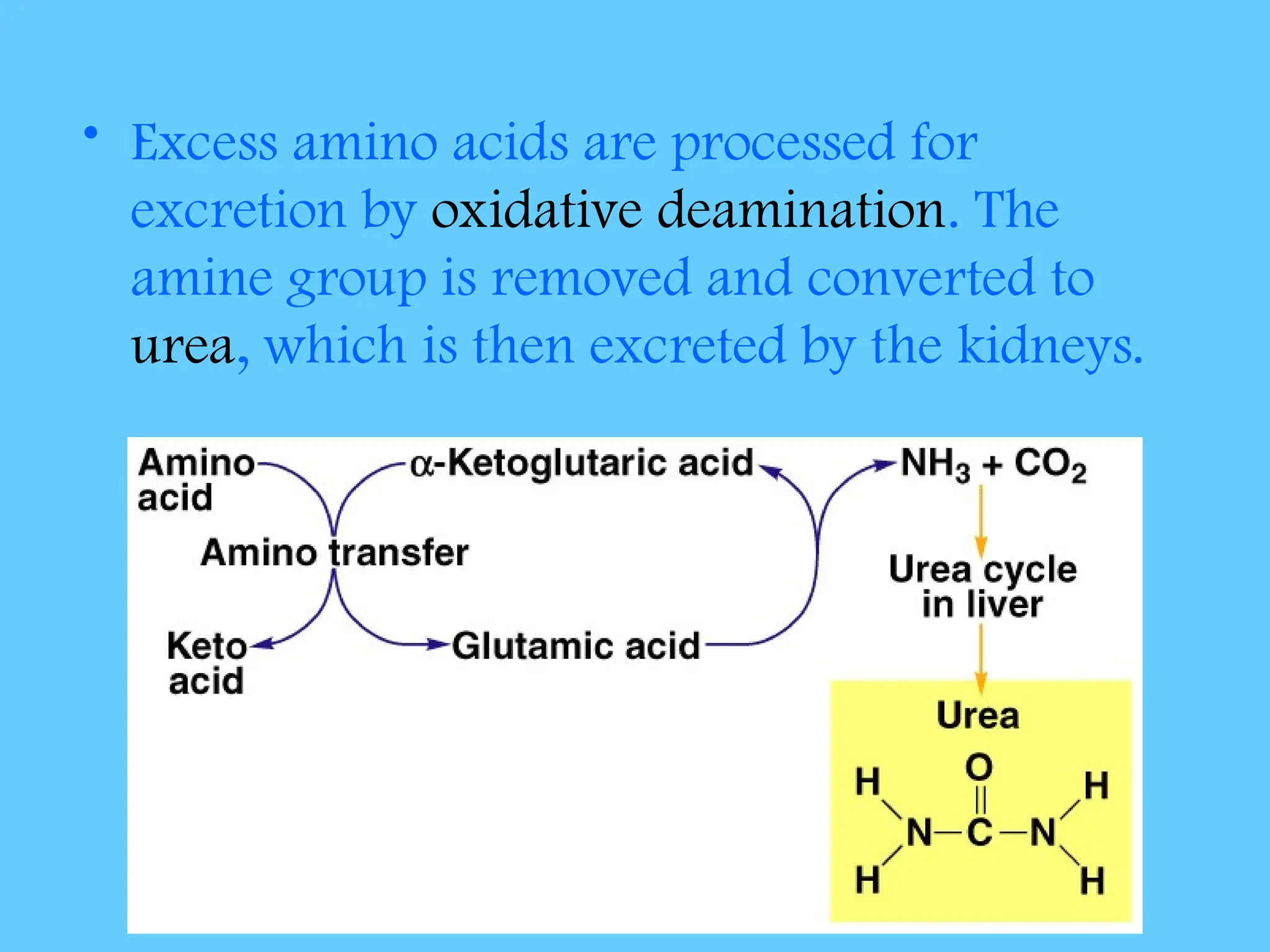
• Excess aminoacids are processed for
excretion by oxidative deamination. The
amine group is removed and converted to
urea, which is then excreted by the kidneys.
36.
• Not allcells can use glucose as the energy
source.
• Blood contains a variety of energy sources:
– Glucose and ketone bodies, fatty acids, lactic
acid, and amino acids.
• Different tissues preferentially use different
energy molecules.
– Blood [glucose] maintained as many organs
spare glucose.
• Why?
![• Cells cannot store very much glucose because
the glucose affects the cell’s osmolarity (see
ch. 6). The glucose is converted to glycogen
(or fatty acids) for storage = glycogenesis.
glucose glu–6–P glu– 1—P
glycogen
[glu + glu + glu + glu + … glycogen]](https://image.slidesharecdn.com/chapter5-cellrespirationandmetabolism-250909140808-30a8d0ad/75/Chapter_5_-_Cell_Respiration_and_Metabolism-ppt-11-2048.jpg)
![• The stored glycogen can be converted to
glucose for use by the cell or secreted into
the bloodstream (this only in the liver) =
glycogenolysis.
[glycogen glu + glu + glu + glu + …]
glycogen glu–1–P glu– 6—P
liver enzymes
glucose glucose](https://image.slidesharecdn.com/chapter5-cellrespirationandmetabolism-250909140808-30a8d0ad/75/Chapter_5_-_Cell_Respiration_and_Metabolism-ppt-12-2048.jpg)
![• Not all cells can use glucose as the energy
source.
• Blood contains a variety of energy sources:
– Glucose and ketone bodies, fatty acids, lactic
acid, and amino acids.
• Different tissues preferentially use different
energy molecules.
– Blood [glucose] maintained as many organs
spare glucose.
• Why?](https://image.slidesharecdn.com/chapter5-cellrespirationandmetabolism-250909140808-30a8d0ad/75/Chapter_5_-_Cell_Respiration_and_Metabolism-ppt-36-2048.jpg)