
Information Literacy Internet Misconceptions Created by: Texas Information Literacy Tutorial Modified by: Victor Castilla
What is Information Literacy Information is available from many sources and in many formats, such as printed text, television, videos, library databases, web sites, and more. To be "information literate" you need to know why, when, and how to use all of these tools and think critically about the information they provide.
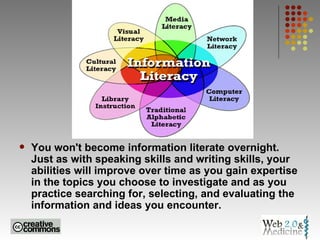
You won't become information literate overnight. Just as with speaking skills and writing skills, your abilities will improve over time as you gain expertise in the topics you choose to investigate and as you practice searching for, selecting, and evaluating the information and ideas you encounter.
Internet Misconceptions The Web is a government conspiracy I want an internet I’m sure one of these 1,256,662 search results is it Everything is on the internet
The Web is a government conspiracy The Internet as we know it today is the product of research begun in the 1950's at the Advanced Research Projects Agency, a department of the US Government. It was pretty visionary back then for the ARPA Director, JCR Licklider, to investigate the uses of technology and computers.
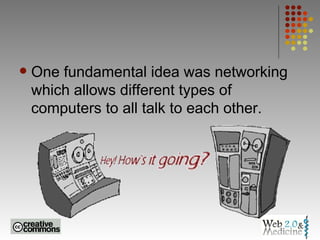
One fundamental idea was networking which allows different types of computers to all talk to each other.
The Internet's original purpose was to help professors and researchers share information regardless of location.  It has since grown to include people, organizations, and companies all over the planet.
In fact, the truth is that no single group is in charge of the Internet.
I want internet The Internet is actually an international network of smaller networks of computers hooked together.  Information travels through fiber optic cables and phone lines from one computer on the Internet to another.
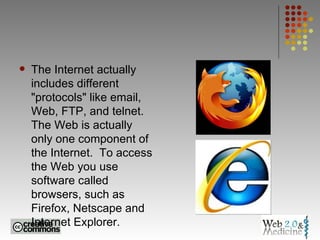
The Internet actually includes different "protocols" like email, Web, FTP, and telnet.  The Web is actually only one component of the Internet.  To access the Web you use software called browsers, such as Firefox, Netscape and Internet Explorer.
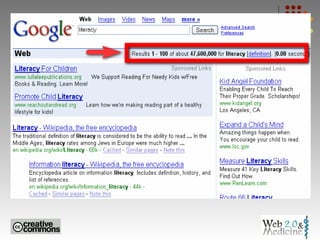
"I'm sure one of these 1,256,662 search results is it."  Searching the Web can be tricky business. Most of the time you will retrieve 1000's of pages, but few will be useful.
 
Why is it so hard to find what you are looking for?  Some people think that if they just know more about computers they'd be more successful when they search. However, you don't have to be a programmer to be a good searcher. Just like you don't have to be a mechanic to drive a car.
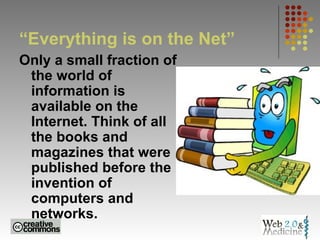
“Everything is on the Net” Only a small fraction of the world of information is available on the Internet. Think of all the books and magazines that were published before the invention of computers and networks.
There's a lot of good information on the Internet. But sometimes it can be hard to find the quality information among all the banner ads, chat rooms and other distractions. Developing skills to evaluate online or print sources will help you become a savvy information consumer.
Conclusions: The Internet is a collaborative information space, not managed by any one group.  The Internet, the Web, and browsers are all different things.  Searching the Internet effectively takes a little know-how.  Lots of useful information isn't (and may never be) in electronic format.
http://web2097.blogspot.com

Digital Literacy: Internet Misconceptions

  • 1.
    Information Literacy InternetMisconceptions Created by: Texas Information Literacy Tutorial Modified by: Victor Castilla
  • 2.
    What is InformationLiteracy Information is available from many sources and in many formats, such as printed text, television, videos, library databases, web sites, and more. To be "information literate" you need to know why, when, and how to use all of these tools and think critically about the information they provide.
  • 3.
    You won't becomeinformation literate overnight. Just as with speaking skills and writing skills, your abilities will improve over time as you gain expertise in the topics you choose to investigate and as you practice searching for, selecting, and evaluating the information and ideas you encounter.
  • 4.
    Internet Misconceptions TheWeb is a government conspiracy I want an internet I’m sure one of these 1,256,662 search results is it Everything is on the internet
  • 5.
    The Web isa government conspiracy The Internet as we know it today is the product of research begun in the 1950's at the Advanced Research Projects Agency, a department of the US Government. It was pretty visionary back then for the ARPA Director, JCR Licklider, to investigate the uses of technology and computers.
  • 6.
    One fundamental ideawas networking which allows different types of computers to all talk to each other.
  • 7.
    The Internet's originalpurpose was to help professors and researchers share information regardless of location.  It has since grown to include people, organizations, and companies all over the planet.
  • 8.
    In fact, thetruth is that no single group is in charge of the Internet.
  • 9.
    I want internetThe Internet is actually an international network of smaller networks of computers hooked together.  Information travels through fiber optic cables and phone lines from one computer on the Internet to another.
  • 10.
    The Internet actuallyincludes different "protocols" like email, Web, FTP, and telnet.  The Web is actually only one component of the Internet.  To access the Web you use software called browsers, such as Firefox, Netscape and Internet Explorer.
  • 11.
    "I'm sure oneof these 1,256,662 search results is it." Searching the Web can be tricky business. Most of the time you will retrieve 1000's of pages, but few will be useful.
  • 12.
  • 13.
    Why is itso hard to find what you are looking for? Some people think that if they just know more about computers they'd be more successful when they search. However, you don't have to be a programmer to be a good searcher. Just like you don't have to be a mechanic to drive a car.
  • 14.
    “Everything is onthe Net” Only a small fraction of the world of information is available on the Internet. Think of all the books and magazines that were published before the invention of computers and networks.
  • 15.
    There's a lotof good information on the Internet. But sometimes it can be hard to find the quality information among all the banner ads, chat rooms and other distractions. Developing skills to evaluate online or print sources will help you become a savvy information consumer.
  • 16.
    Conclusions: The Internetis a collaborative information space, not managed by any one group. The Internet, the Web, and browsers are all different things. Searching the Internet effectively takes a little know-how. Lots of useful information isn't (and may never be) in electronic format.
  • 17.