Immunoglobulins
Antibodies are also called Immunoglobulins
Topics The structure of Immunoglobulins  Classes of Immunoglobulins Biological properties of Immunoglobulins
The Antibodies Antibodies are synthesized by B lymphocytes in 2 forms:  soluble  and  cell bound .  The cell-bound form is the  BCR .  The soluble form is released into the circulation as  antibodies  Each B cell produces Ab of a single specificity and expresses on the cell surface only one BCR specificity  The specificity of the Ab produced by a B cell is the same as of its BCR
The Antibodies Fig 1
Antibodies are also called Immunoglobulins Immunoglobulins (Ig) are divided into 5 classes: IgG IgM IgA IgD IgE Ig are glycoproteins They differ in size, amount of CHO and biologic functions
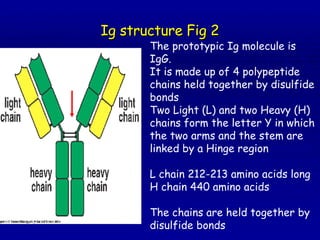
Ig structure Fig 2 The prototypic Ig molecule is IgG. It is made up of 4 polypeptide chains held together by disulfide bonds Two Light (L) and two Heavy (H) chains form the letter Y in which the two arms and the stem are linked by a Hinge region L chain 212-213 amino acids long H chain 440 amino acids The chains are held together by disulfide bonds S-S Hinge
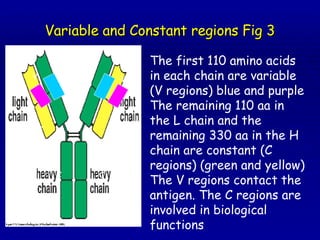
Variable and Constant regions Fig 3 VL CL CH CH The first 110 amino acids in each chain are variable (V regions) blue and purple The remaining 110 aa in the L chain and the remaining 330 aa in the H chain are constant (C regions) (green and yellow) The V regions contact the antigen. The C regions are involved in biological functions V V C C C C
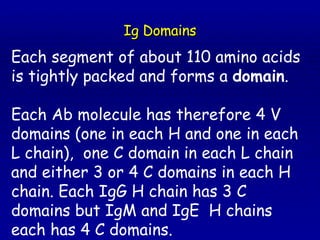
Ig Domains Each segment of about 110 amino acids is tightly packed and forms a  domain .  Each Ab molecule has therefore 4 V domains (one in each H and one in each  L chain),  one C domain in each L chain and either 3 or 4 C domains in each H chain. Each IgG H chain has 3 C domains but IgM and IgE  H chains each has 4 C domains.
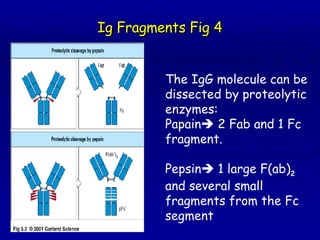
Ig Fragments Fig 4 The IgG molecule can be dissected by proteolytic enzymes: Papain   2 Fab and 1 Fc fragment. Pepsin   1 large F(ab) 2   and several small fragments from the Fc segment
The function of the Ig segments The distinct Ig segments are involved in different functions: The Fab binds Ag The Fc is involved in: Transplacental passage of Ab Enhanced phagocytosis by macrophages and PMN  (opsonization) Activation of Complement: Kills foreign cells, triggers inflammatory reactions. Enhances phagocytosis

Immunoglobulins

  • 1.
  • 2.
    Antibodies are alsocalled Immunoglobulins
  • 3.
    Topics The structureof Immunoglobulins Classes of Immunoglobulins Biological properties of Immunoglobulins
  • 4.
    The Antibodies Antibodiesare synthesized by B lymphocytes in 2 forms: soluble and cell bound . The cell-bound form is the BCR . The soluble form is released into the circulation as antibodies Each B cell produces Ab of a single specificity and expresses on the cell surface only one BCR specificity The specificity of the Ab produced by a B cell is the same as of its BCR
  • 5.
  • 6.
    Antibodies are alsocalled Immunoglobulins Immunoglobulins (Ig) are divided into 5 classes: IgG IgM IgA IgD IgE Ig are glycoproteins They differ in size, amount of CHO and biologic functions
  • 7.
    Ig structure Fig2 The prototypic Ig molecule is IgG. It is made up of 4 polypeptide chains held together by disulfide bonds Two Light (L) and two Heavy (H) chains form the letter Y in which the two arms and the stem are linked by a Hinge region L chain 212-213 amino acids long H chain 440 amino acids The chains are held together by disulfide bonds S-S Hinge
  • 8.
    Variable and Constantregions Fig 3 VL CL CH CH The first 110 amino acids in each chain are variable (V regions) blue and purple The remaining 110 aa in the L chain and the remaining 330 aa in the H chain are constant (C regions) (green and yellow) The V regions contact the antigen. The C regions are involved in biological functions V V C C C C
  • 9.
    Ig Domains Eachsegment of about 110 amino acids is tightly packed and forms a domain . Each Ab molecule has therefore 4 V domains (one in each H and one in each L chain), one C domain in each L chain and either 3 or 4 C domains in each H chain. Each IgG H chain has 3 C domains but IgM and IgE H chains each has 4 C domains.
  • 10.
    Ig Fragments Fig4 The IgG molecule can be dissected by proteolytic enzymes: Papain  2 Fab and 1 Fc fragment. Pepsin  1 large F(ab) 2 and several small fragments from the Fc segment
  • 11.
    The function ofthe Ig segments The distinct Ig segments are involved in different functions: The Fab binds Ag The Fc is involved in: Transplacental passage of Ab Enhanced phagocytosis by macrophages and PMN (opsonization) Activation of Complement: Kills foreign cells, triggers inflammatory reactions. Enhances phagocytosis