Membranes
Stephen Taylor
i-Biology.net

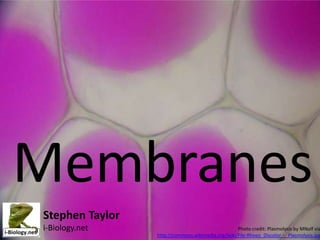
Photo credit: Plasmolysis by MNolf via
http://commons.wikimedia.org/wiki/File:Rhoeo_Discolor_-_Plasmolysis.jpg
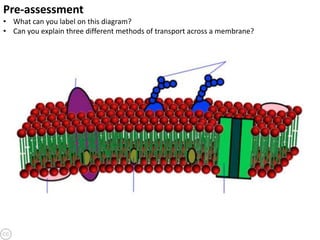
Pre-assessment
• What can you label on this diagram?
• Can you explain three different methods of transport across a membrane?
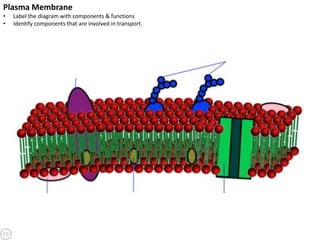
Plasma Membrane
•
•

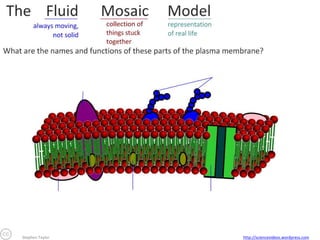
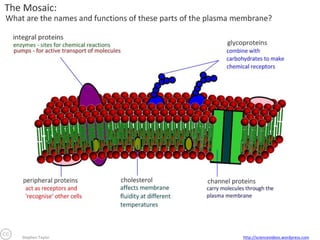
Label the diagram with components & functions
Identify components that are involved in transport.
Stephen Taylor

http://sciencevideos.wordpress.com
Stephen Taylor

http://sciencevideos.wordpress.com
Stephen Taylor

http://sciencevideos.wordpress.com
Stephen Taylor

http://sciencevideos.wordpress.com
Stephen Taylor

http://sciencevideos.wordpress.com
Stephen Taylor

http://sciencevideos.wordpress.com
Stephen Taylor

http://sciencevideos.wordpress.com
Stephen Taylor

http://sciencevideos.wordpress.com
Stephen Taylor

http://sciencevideos.wordpress.com
Stephen Taylor

http://sciencevideos.wordpress.com
Stephen Taylor

http://sciencevideos.wordpress.com
Stephen Taylor

http://sciencevideos.wordpress.com
Stephen Taylor

http://sciencevideos.wordpress.com
Stephen Taylor

http://sciencevideos.wordpress.com
Plasmolysis in Elodea and in onion cells.
1. Set up slides of Elodea cells and onion cells, with tap water medium.
2. Find cells under the microscope. Draw and label what you see.
Include magnification. You might need to try different stains.
3. Draw salt solution through the slides. Observe and draw the effects.
4. Explain the effects of changing the salt concentration on the cells.
Stephen Taylor

http://sciencevideos.wordpress.com
Stephen Taylor

http://sciencevideos.wordpress.com
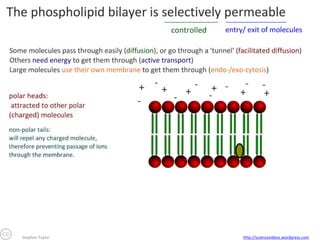
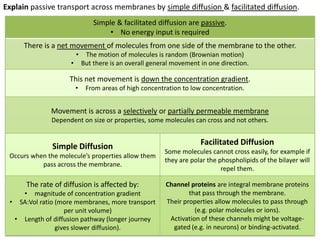
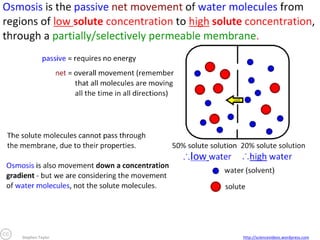
Explain passive transport across membranes by simple diffusion & facilitated diffusion.
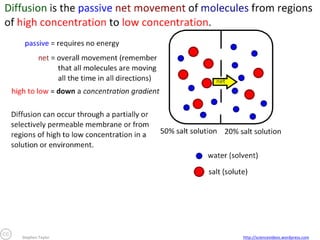
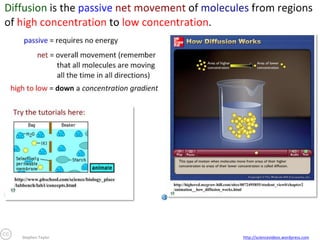
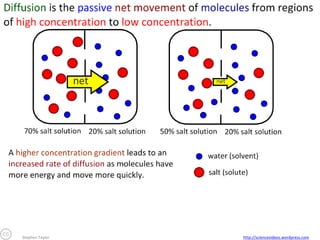
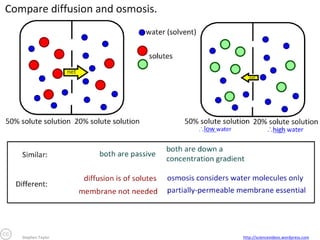
Simple & facilitated diffusion are passive.
• No energy input is required
There is a net movement of molecules from one side of the membrane to the other.
•
•

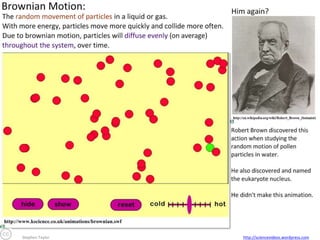
The motion of molecules is random (Brownian motion)
But there is an overall general movement in one direction.

This net movement is down the concentration gradient.
•

From areas of high concentration to low concentration.

Movement is across a selectively or partially permeable membrane
Dependent on size or properties, some molecules can cross and not others.

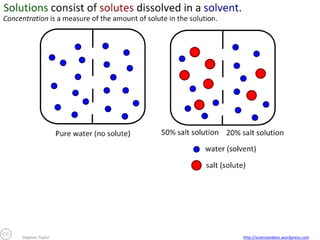
Simple Diffusion
Occurs when the molecule’s properties allow them
pass across the membrane.

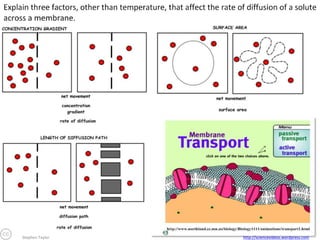
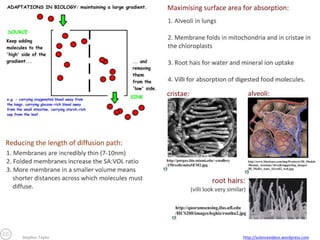
The rate of diffusion is affected by:
• magnitude of concentration gradient
• SA:Vol ratio (more membranes, more transport
per unit volume)
• Length of diffusion pathway (longer journey
gives slower diffusion).

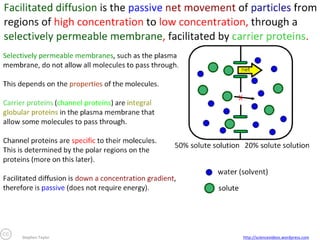
Facilitated Diffusion
Some molecules cannot cross easily, for example if
they are polar the phospholipids of the bilayer will
repel them.
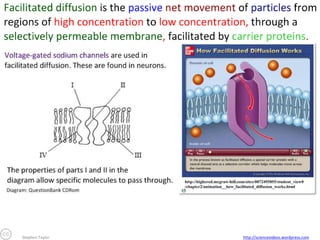
Channel proteins are integral membrane proteins
that pass through the membrane.
Their properties allow molecules to pass through
(e.g. polar molecules or ions).
Activation of these channels might be voltagegated (e.g. in neurons) or binding-activated.
Stephen Taylor

http://sciencevideos.wordpress.com
Stephen Taylor

http://sciencevideos.wordpress.com
Stephen Taylor

http://sciencevideos.wordpress.com
Stephen Taylor

http://sciencevideos.wordpress.com
Stephen Taylor

http://sciencevideos.wordpress.com
Stephen Taylor

http://sciencevideos.wordpress.com
Stephen Taylor

http://sciencevideos.wordpress.com
Stephen Taylor

http://sciencevideos.wordpress.com
Stephen Taylor

http://sciencevideos.wordpress.com
Stephen Taylor

http://sciencevideos.wordpress.com
Stephen Taylor

http://sciencevideos.wordpress.com
Stephen Taylor

http://sciencevideos.wordpress.com
Stephen Taylor

http://sciencevideos.wordpress.com
Stephen Taylor

http://sciencevideos.wordpress.com
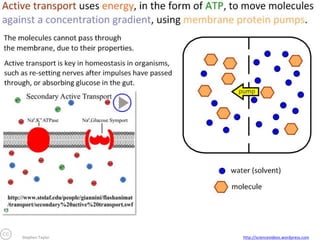
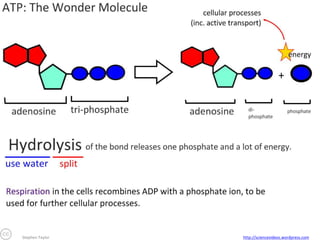
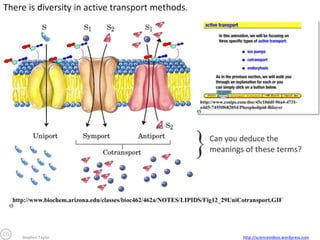
Active transport uses energy, in the form of
ATP, to move molecules across a selectively
permeable membrane against the
concentration gradient, using protein pumps.

Why do this?

To move molecules against the concentration gradient or to create a large
concentration gradient across a membrane.

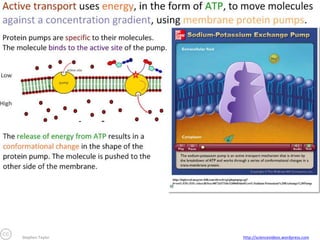
Protein pumps

These are integral, passing through the membrane.
They are specific – only working with the target molecule.

What happens? 1. Target molecules bind to the pump.
2. ATP also binds to the pump. ATP is broken, releasing energy and causing a
conformational (shape) change in the protein pump.
3. This conformational change pushes the molecules across the membrane.
4. The molecule unbinds, and the pump reverts back to the original shape.

Examples

•
•

Sodium-potassium pump is used to re-polarise neurons after an action potential,
ready to fire again.
Proton pumps in mitochondria generate a high concentration gradient of H+ ions,
ready for chemiosmosis through ATP synthase, used for generating ATP.
Active transport uses energy, in the form of
ATP, to move molecules across a selectively
permeable membrane against the
concentration gradient, using protein pumps.

Why do this?

Protein pumps

What happens?

Examples
Stephen Taylor

http://sciencevideos.wordpress.com
Stephen Taylor

http://sciencevideos.wordpress.com
Stephen Taylor

http://sciencevideos.wordpress.com
Stephen Taylor

http://sciencevideos.wordpress.com
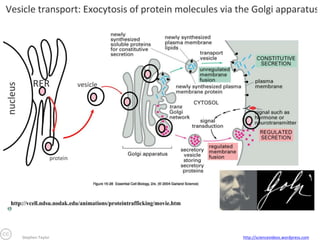
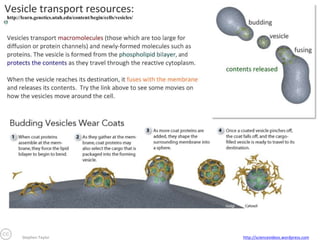
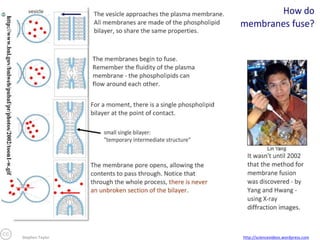
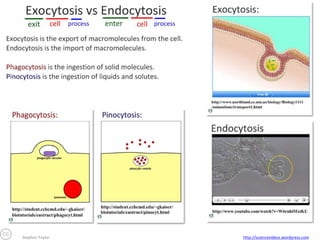
Annotate this diagram to explain vesicle transport & exocytosis.

Animated tutorial: http://bcs.whfreeman.com/thelifewire8e/content/cat_040/0504003.html
Stephen Taylor

http://sciencevideos.wordpress.com
Stephen Taylor

http://sciencevideos.wordpress.com
Stephen Taylor

http://sciencevideos.wordpress.com
Stephen Taylor

http://sciencevideos.wordpress.com
For more resources & links.
Please consider a donation to charity via Biology4Good.
Click here for more information about Biology4Good charity donations.
This is a Creative Commons presentation. It may be linked and embedded but not sold or re-hosted.

Membranes and membrane transport