Cell
Theory
Stephen Taylor
i-Biology.net

Image: Cells by Filter Forge on Flickr http://flic.kr/p/ePXpR5
All living things are made of

C
E
L
L
S

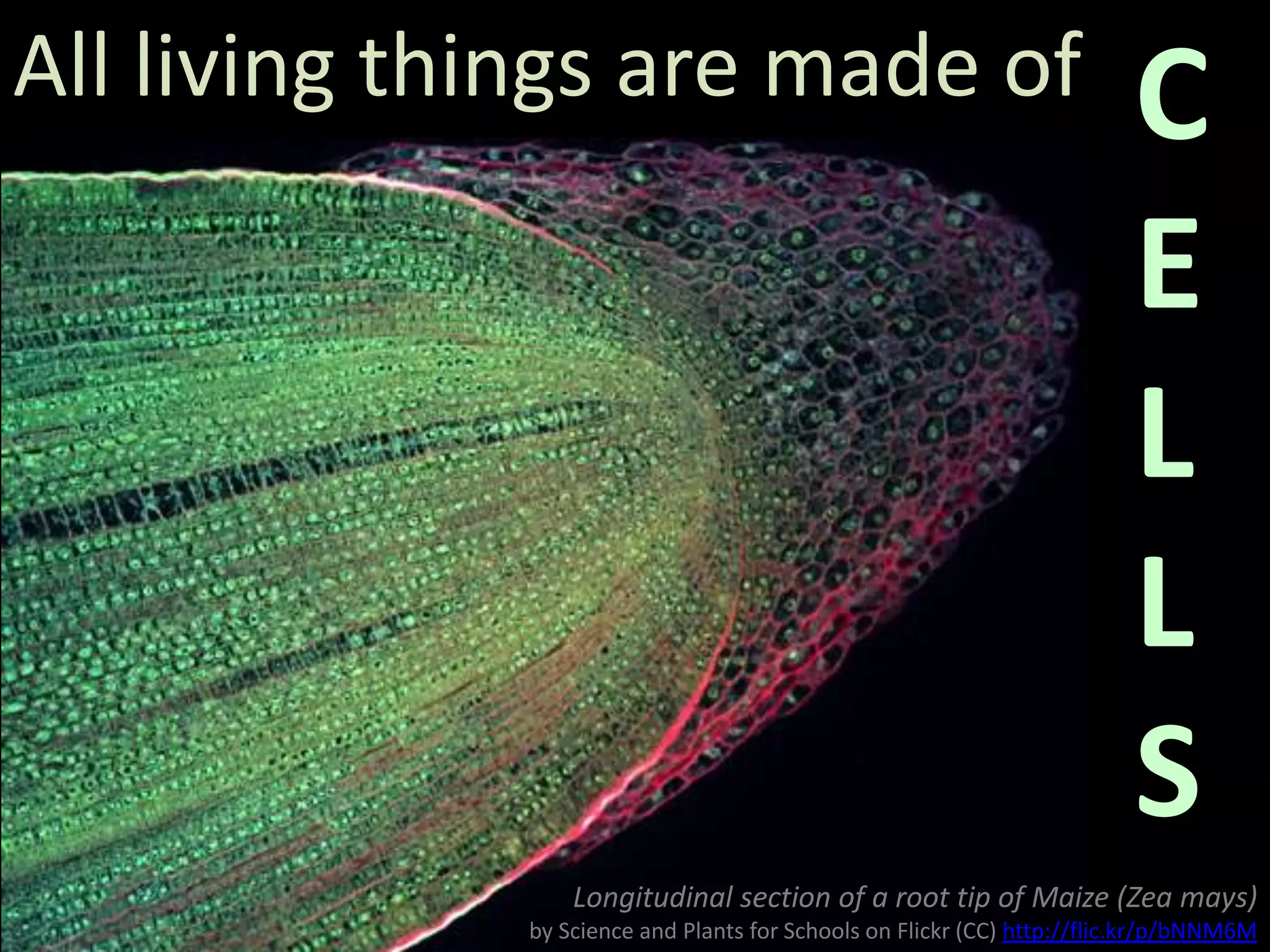
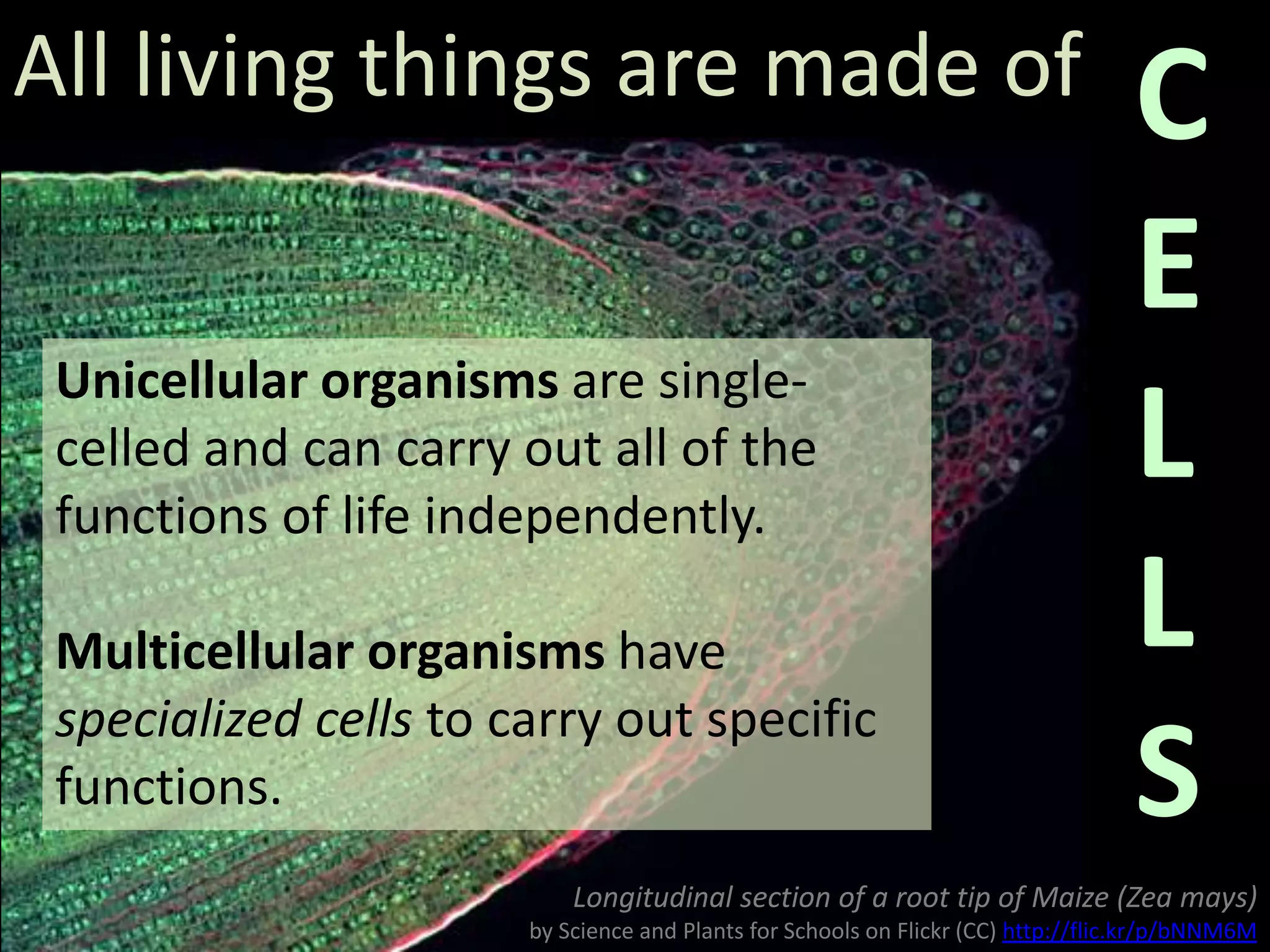
Longitudinal section of a root tip of Maize (Zea mays)
by Science and Plants for Schools on Flickr (CC) http://flic.kr/p/bNNM6M
All living things are made of
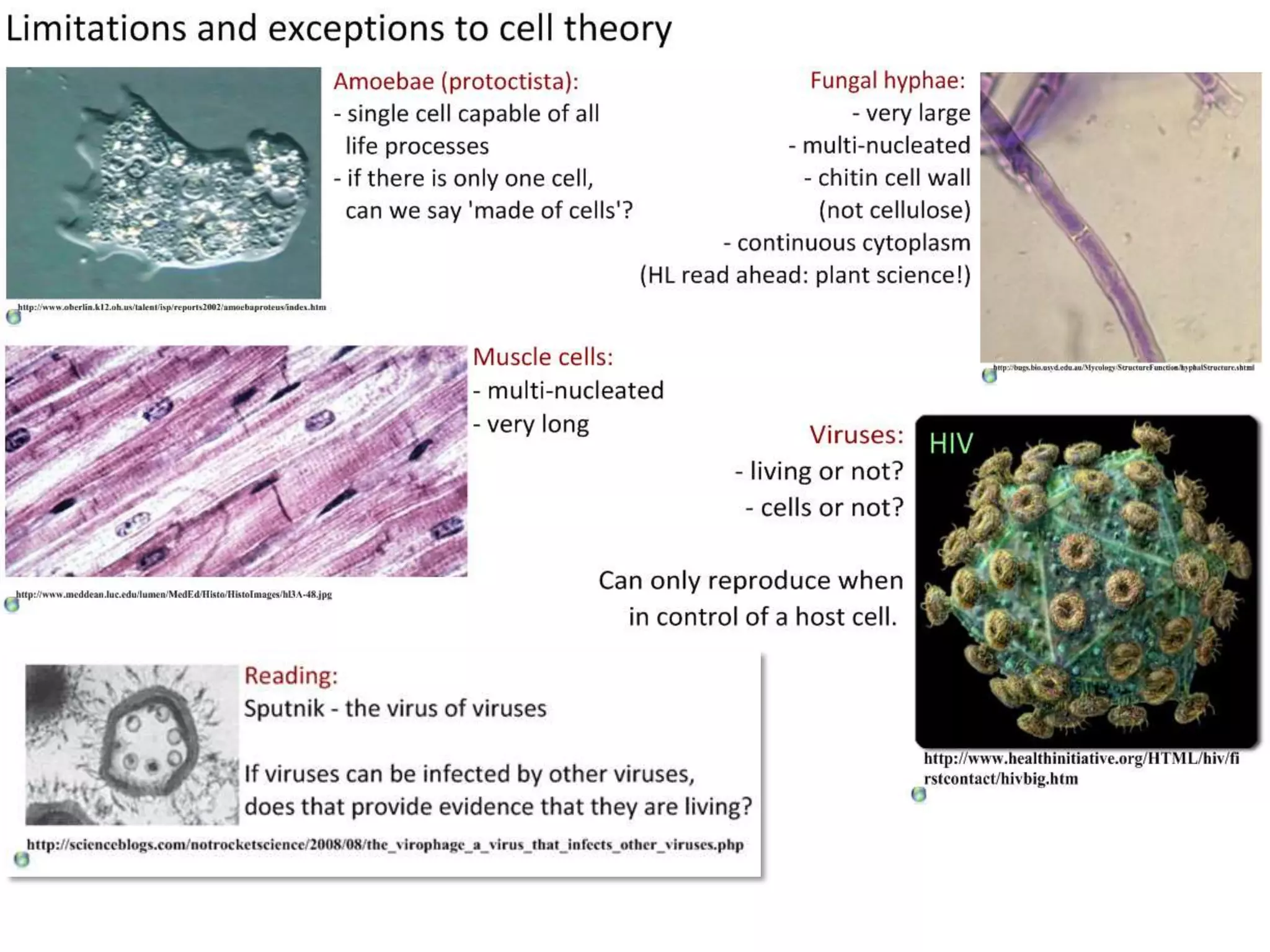
Unicellular organisms are singlecelled and can carry out all of the
functions of life independently.
Multicellular organisms have
specialized cells to carry out specific
functions.

C
E
L
L
S

Longitudinal section of a root tip of Maize (Zea mays)
by Science and Plants for Schools on Flickr (CC) http://flic.kr/p/bNNM6M
C
E
L
L
S

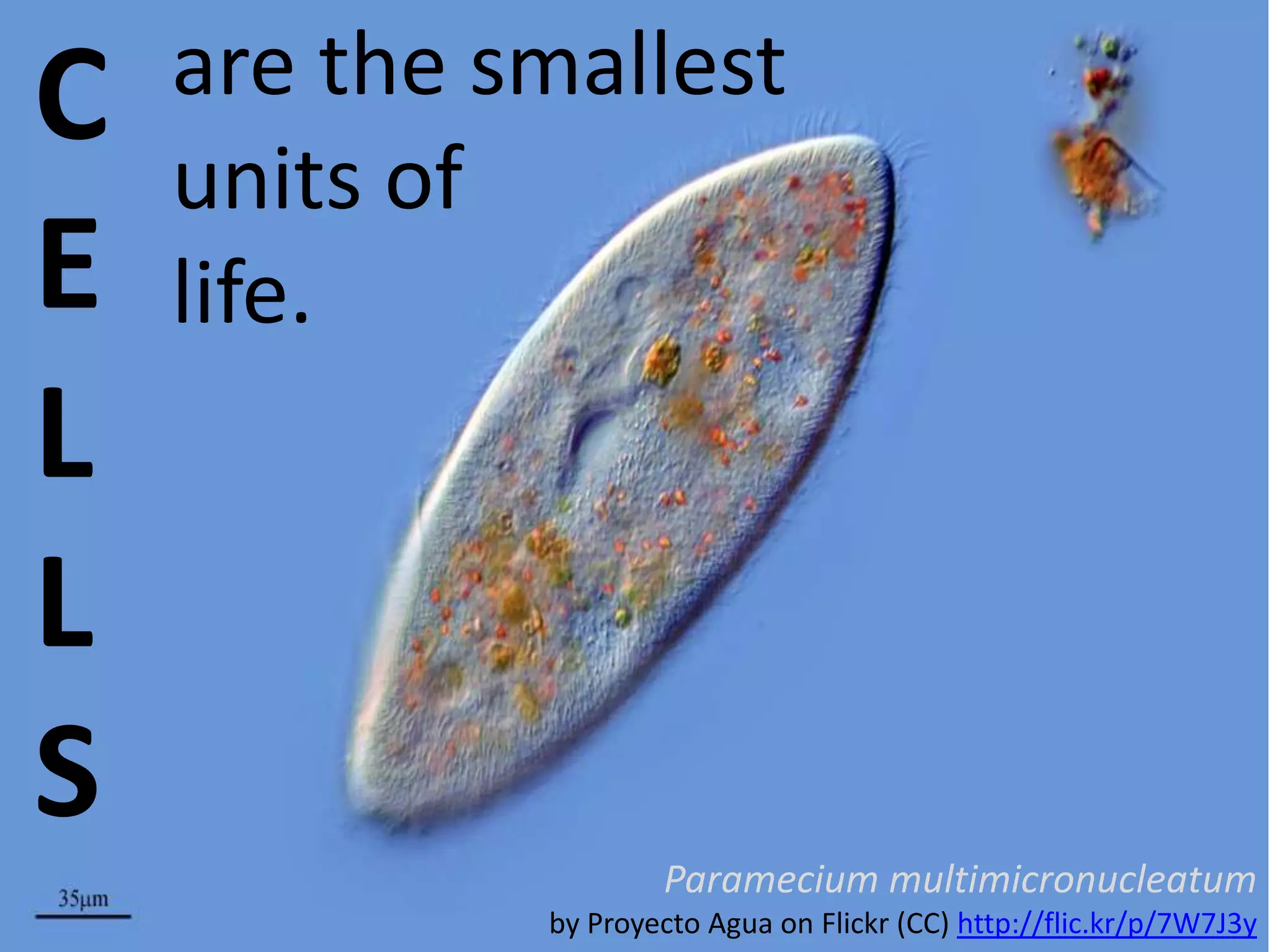
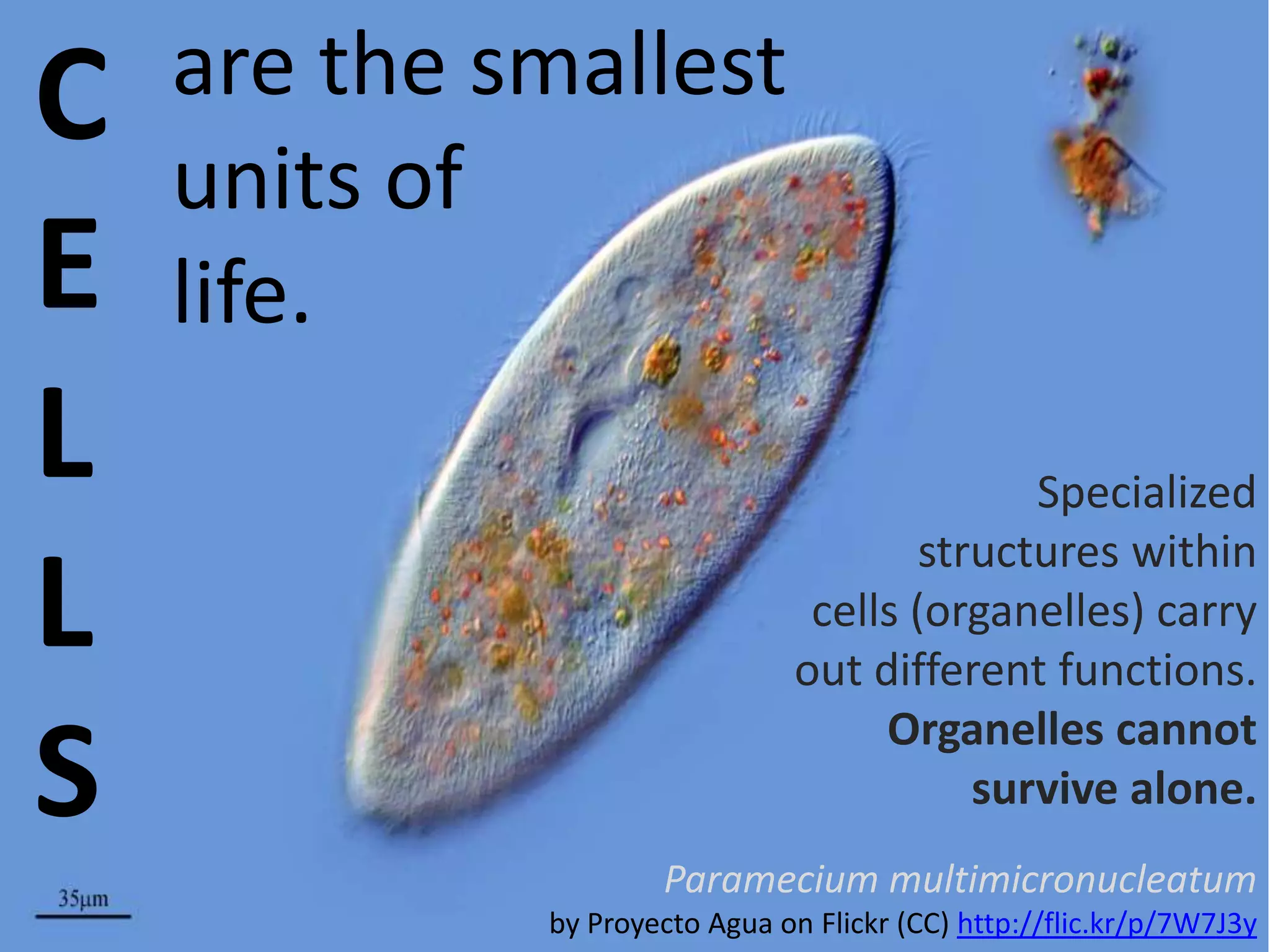
are the smallest
units of
life.

Paramecium multimicronucleatum
by Proyecto Agua on Flickr (CC) http://flic.kr/p/7W7J3y
C
E
L
L
S

are the smallest
units of
life.
Specialized
structures within
cells (organelles) carry
out different functions.
Organelles cannot
survive alone.
Paramecium multimicronucleatum
by Proyecto Agua on Flickr (CC) http://flic.kr/p/7W7J3y
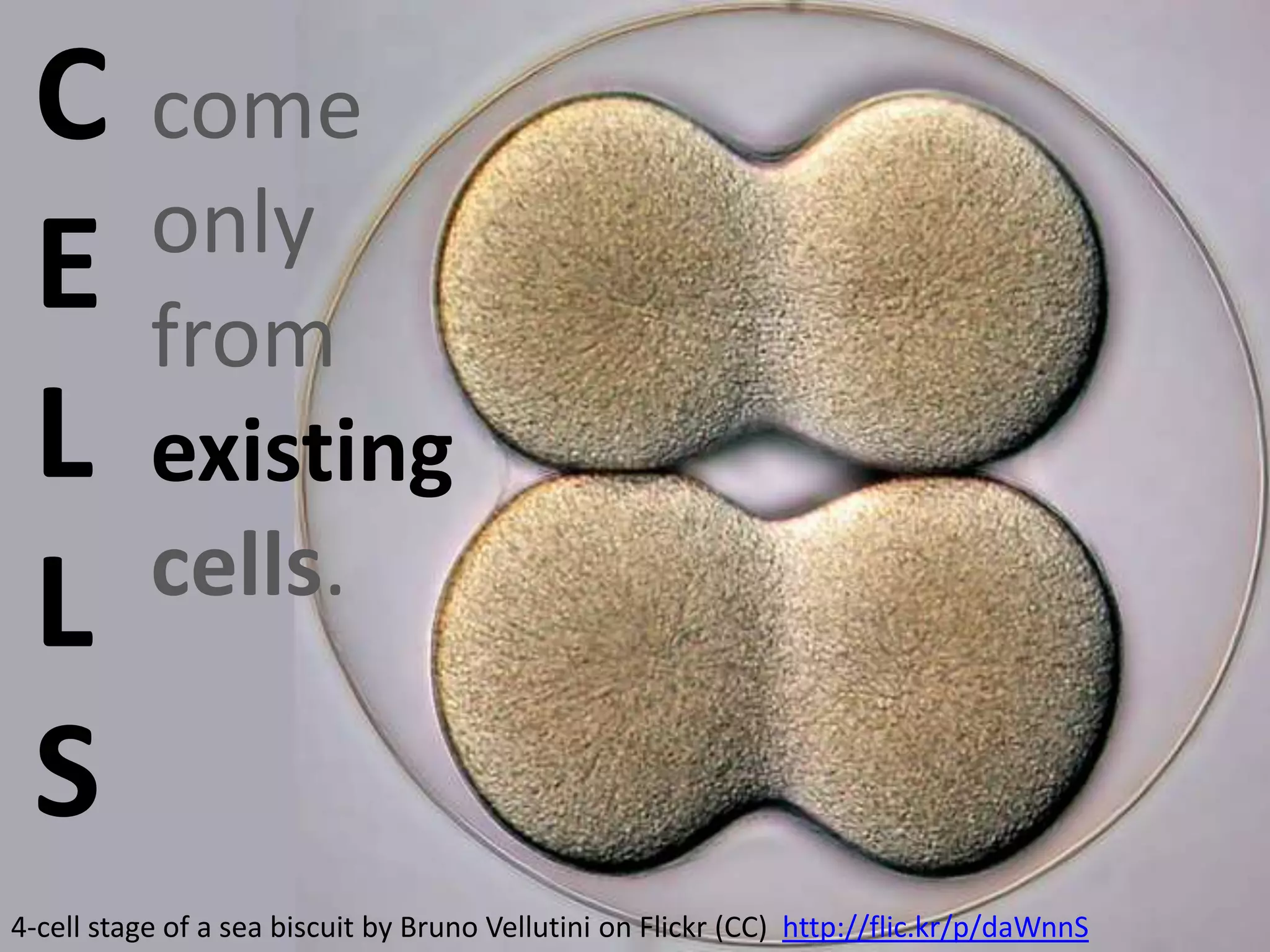
C come
only
E from
L existing
cells.
L
S
4-cell stage of a sea biscuit by Bruno Vellutini on Flickr (CC) http://flic.kr/p/daWnnS
C come
only
E from
L existing
cells.
L
S

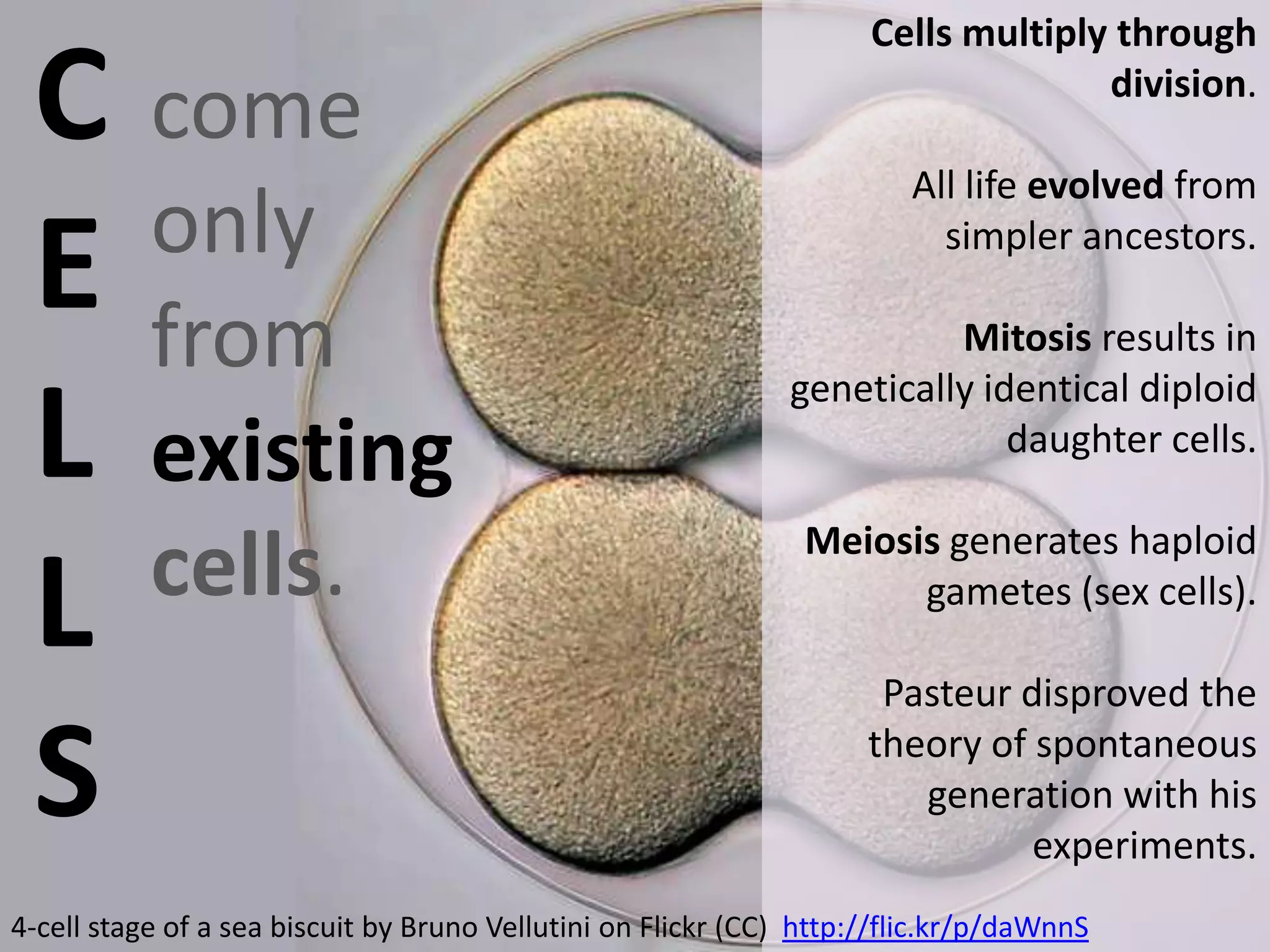
Cells multiply through
division.
All life evolved from
simpler ancestors.

Mitosis results in
genetically identical diploid
daughter cells.
Meiosis generates haploid
gametes (sex cells).
Pasteur disproved the
theory of spontaneous
generation with his
experiments.

4-cell stage of a sea biscuit by Bruno Vellutini on Flickr (CC) http://flic.kr/p/daWnnS
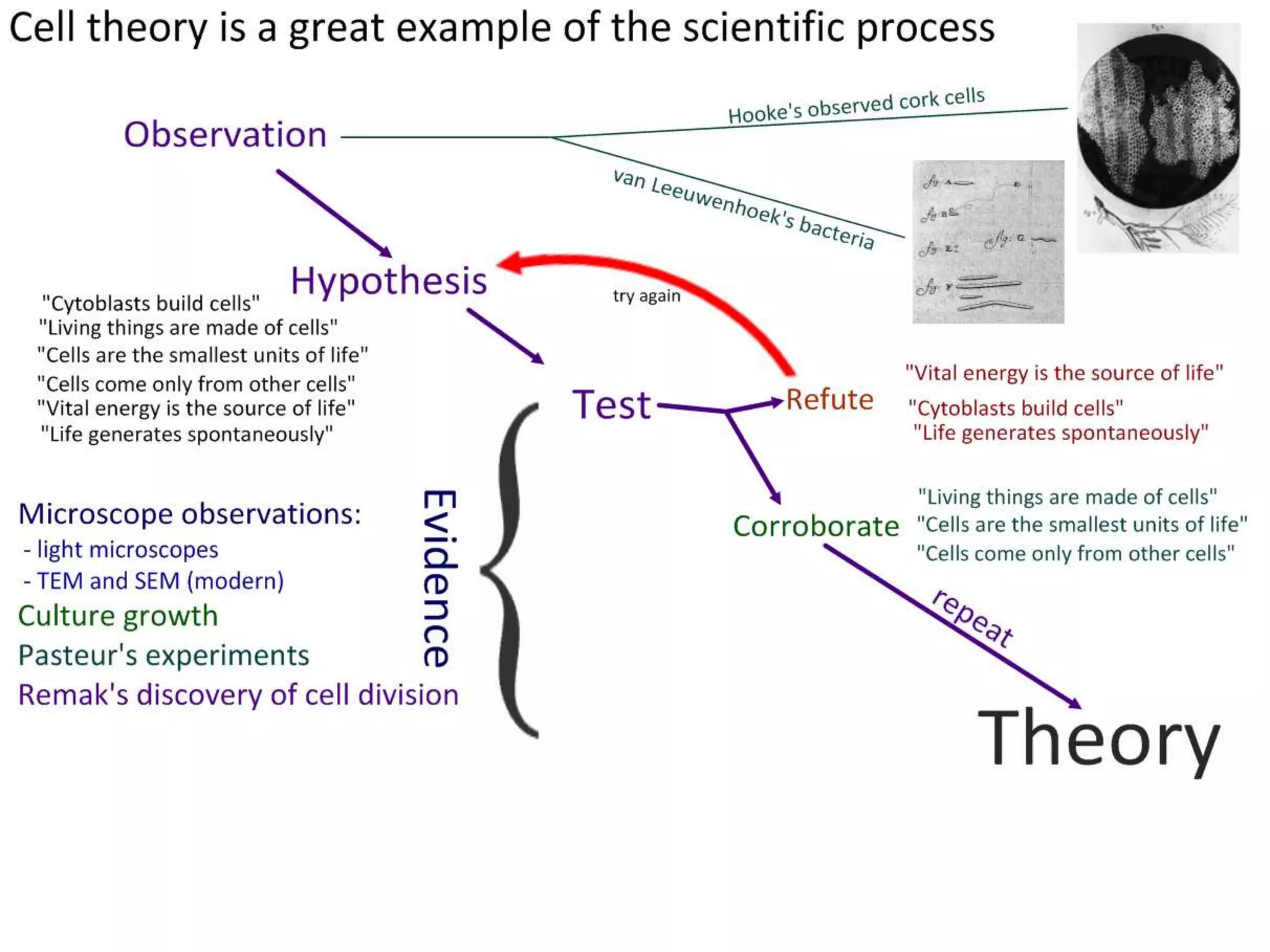
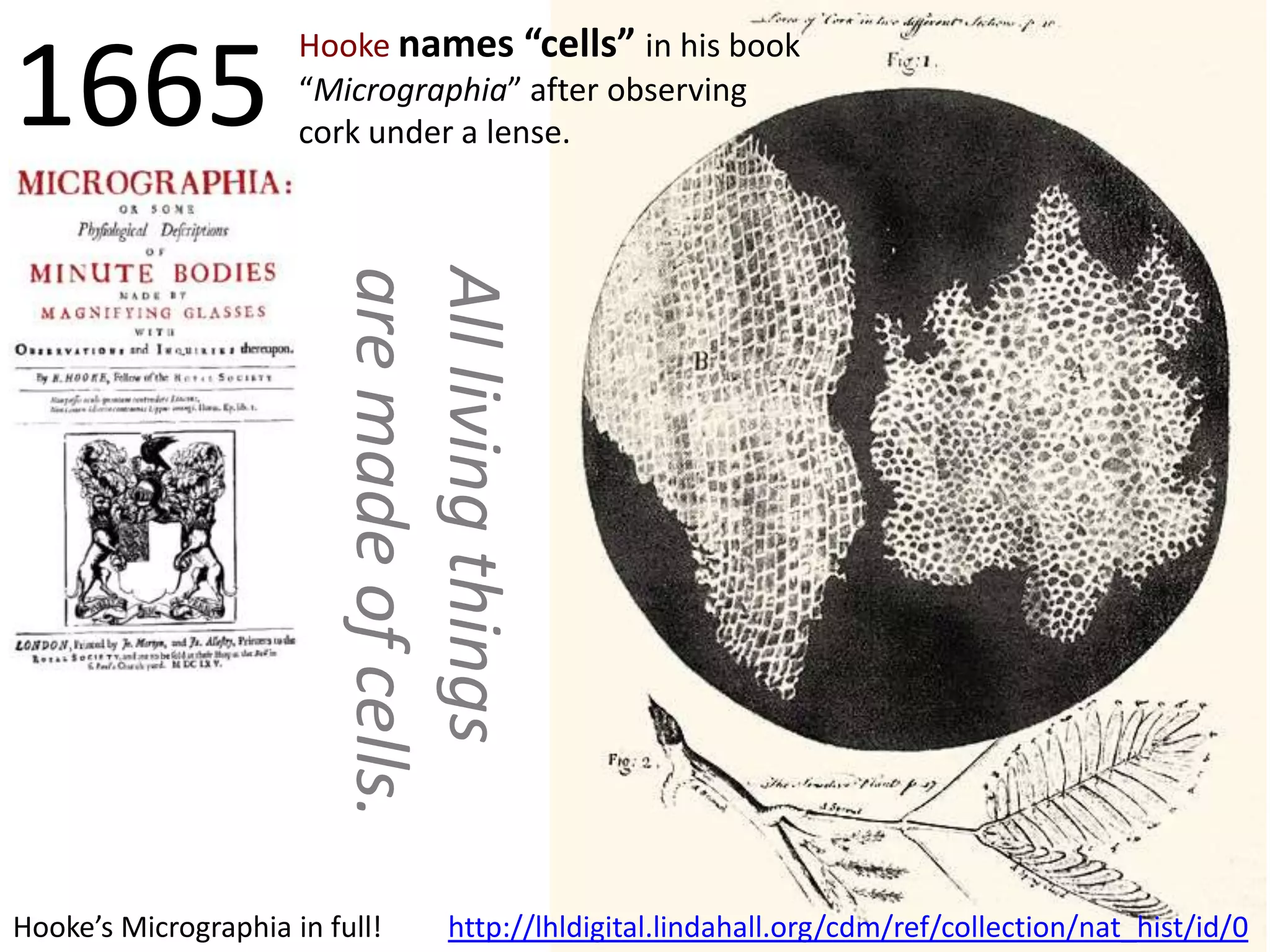
1665

Hooke names “cells” in his book
“Micrographia” after observing
cork under a lense.

All living things
are made of cells.
Hooke’s Micrographia in full!

http://lhldigital.lindahall.org/cdm/ref/collection/nat_hist/id/0
All living things are
made of cells.

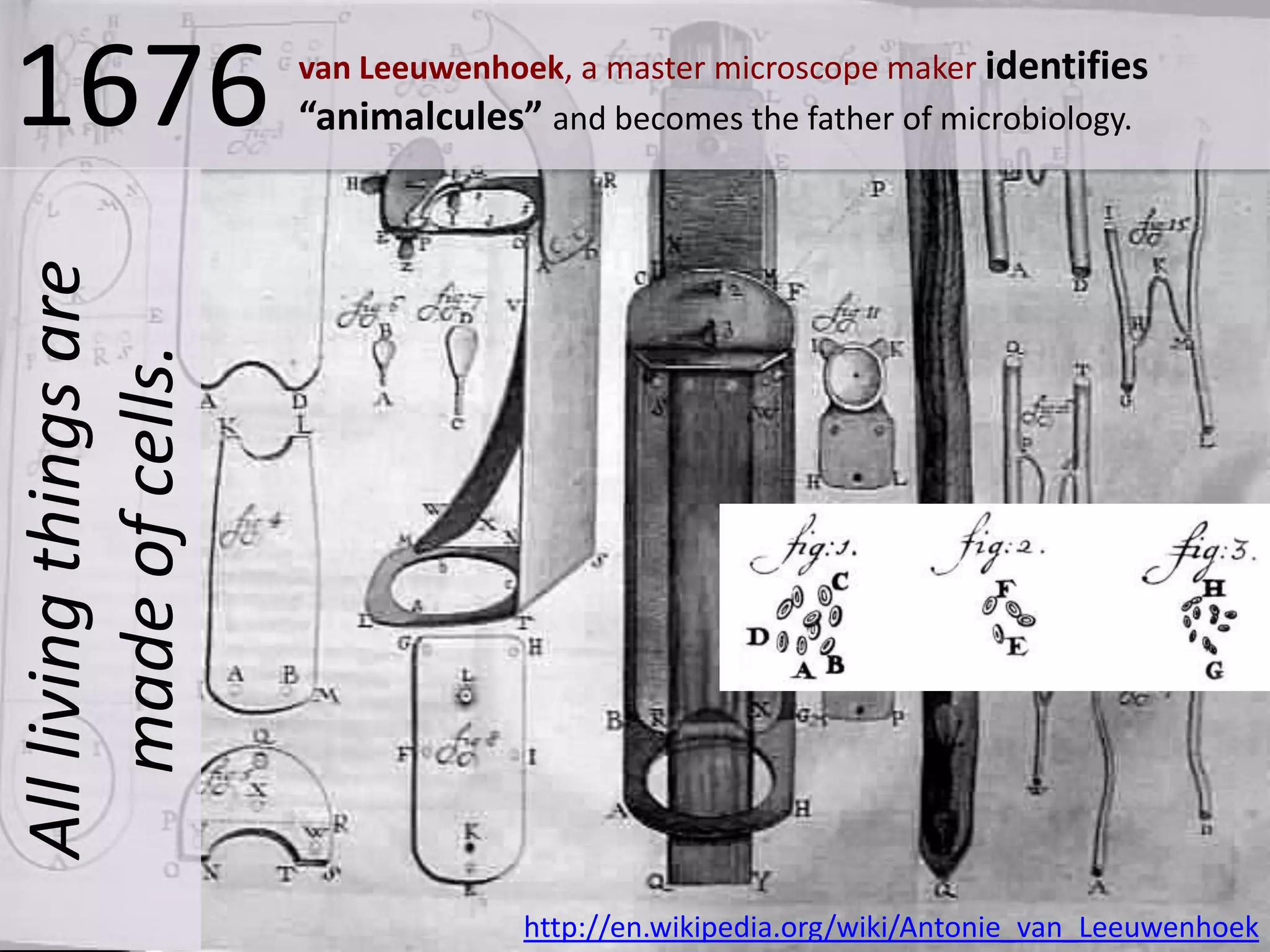
1676

van Leeuwenhoek, a master microscope maker identifies
“animalcules” and becomes the father of microbiology.
http://en.wikipedia.org/wiki/Antonie_van_Leeuwenhoek
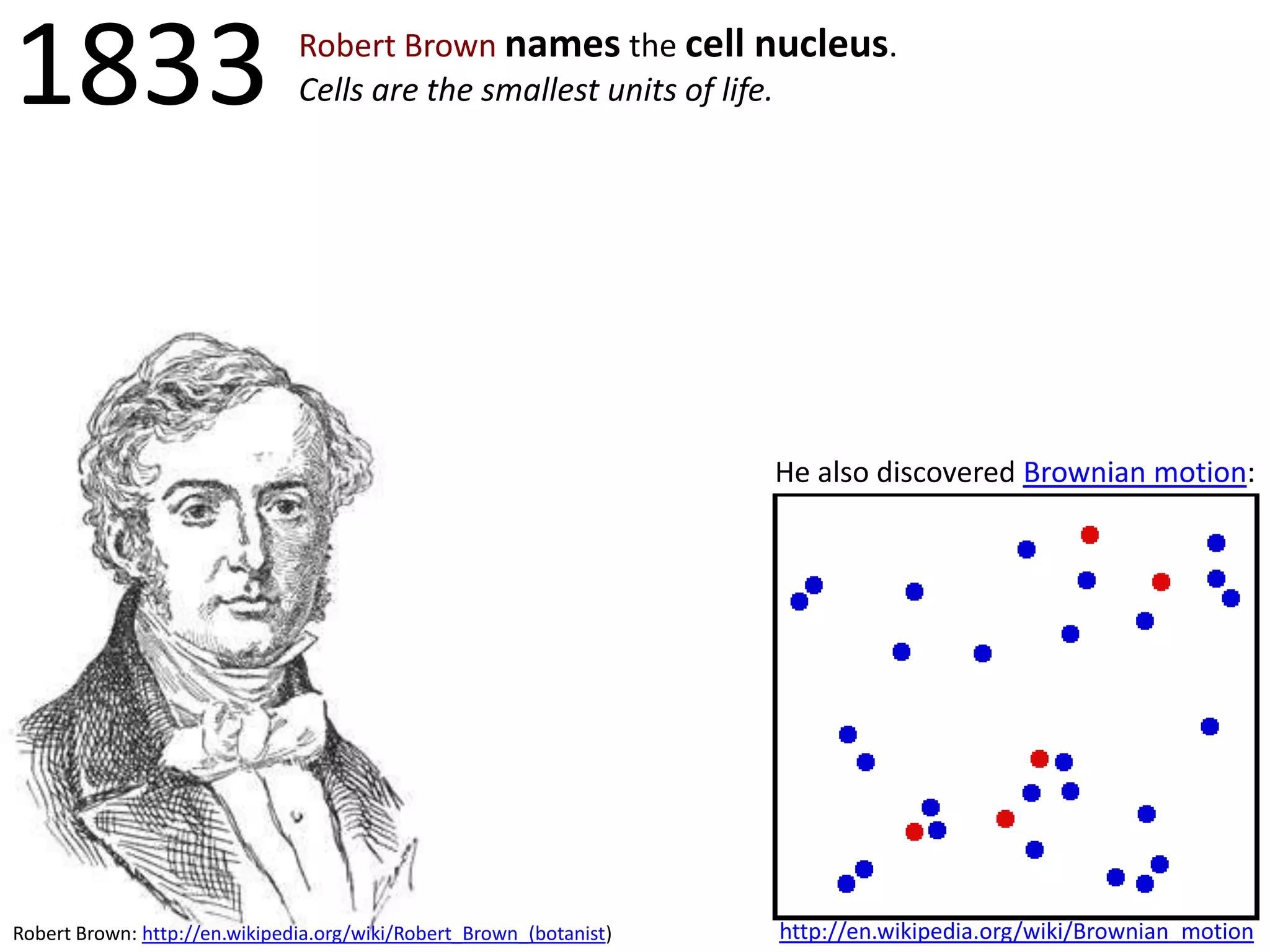
1833

Robert Brown names the cell nucleus.
Cells are the smallest units of life.

He also discovered Brownian motion:

Robert Brown: http://en.wikipedia.org/wiki/Robert_Brown_(botanist)

http://en.wikipedia.org/wiki/Brownian_motion
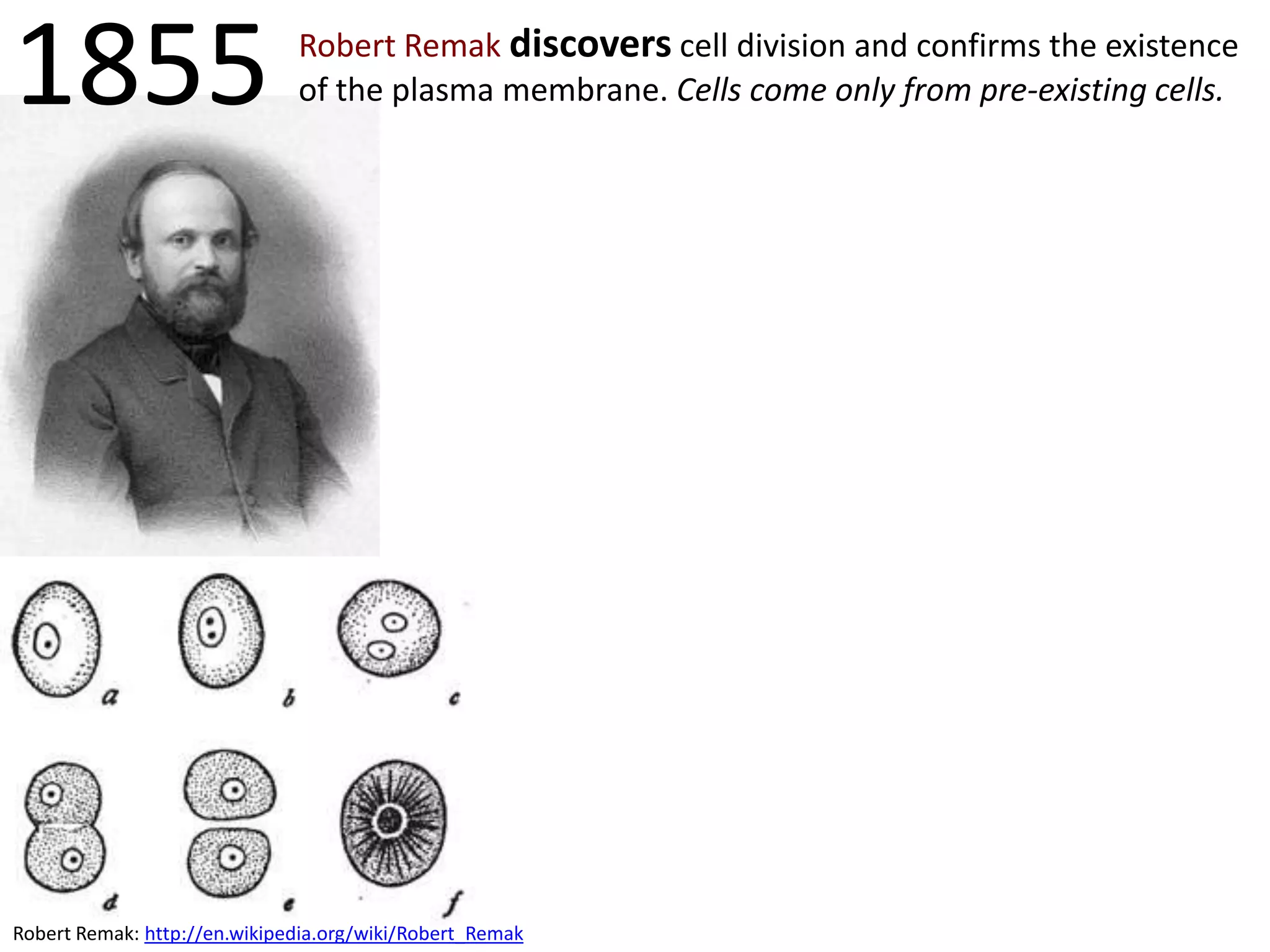
1855

Robert Remak discovers cell division and confirms the existence
of the plasma membrane. Cells come only from pre-existing cells.

Robert Remak: http://en.wikipedia.org/wiki/Robert_Remak
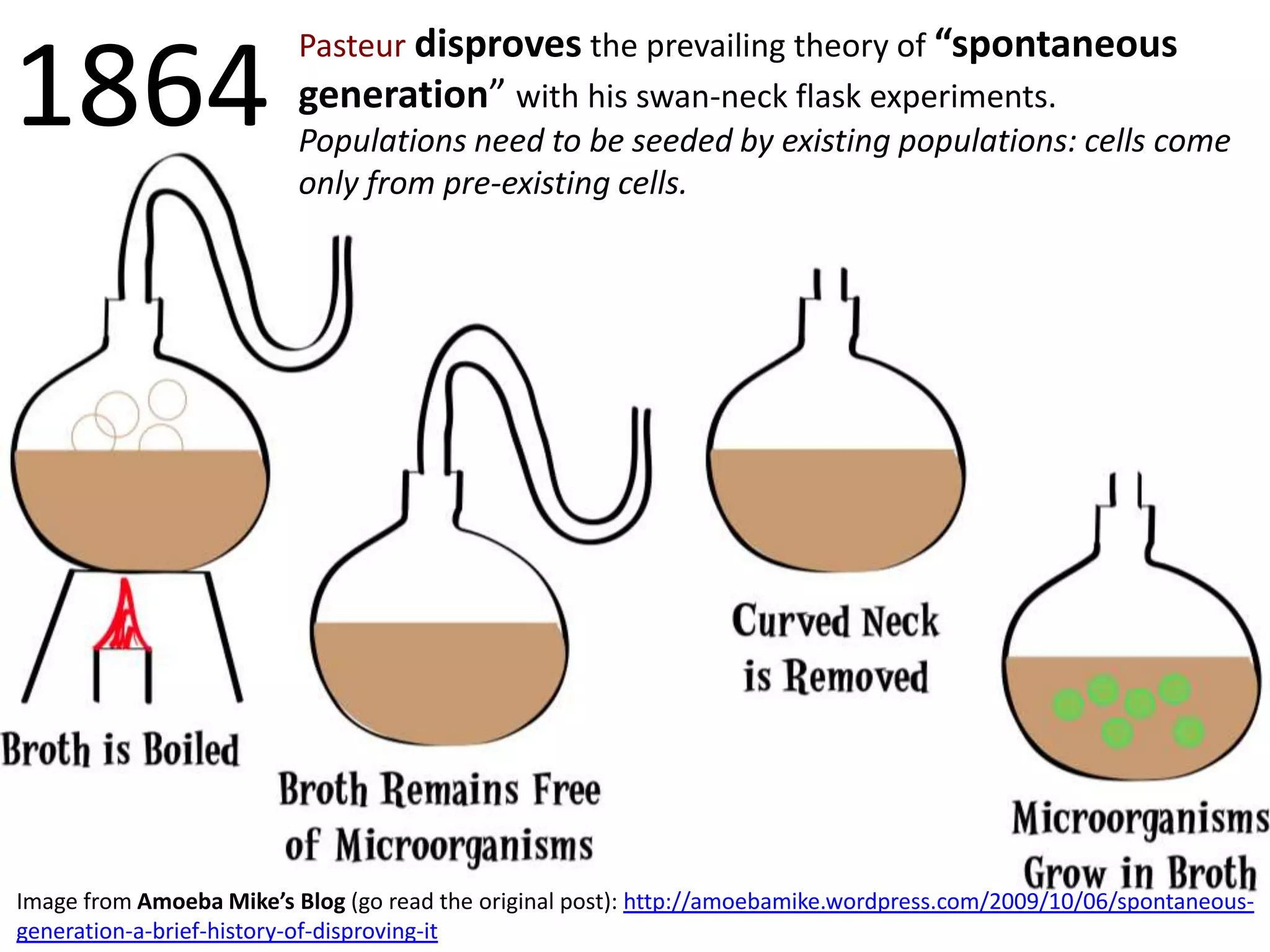
1864

Pasteur disproves the prevailing theory of “spontaneous
generation” with his swan-neck flask experiments.
Populations need to be seeded by existing populations: cells come
only from pre-existing cells.

Image from Amoeba Mike’s Blog (go read the original post): http://amoebamike.wordpress.com/2009/10/06/spontaneousgeneration-a-brief-history-of-disproving-it
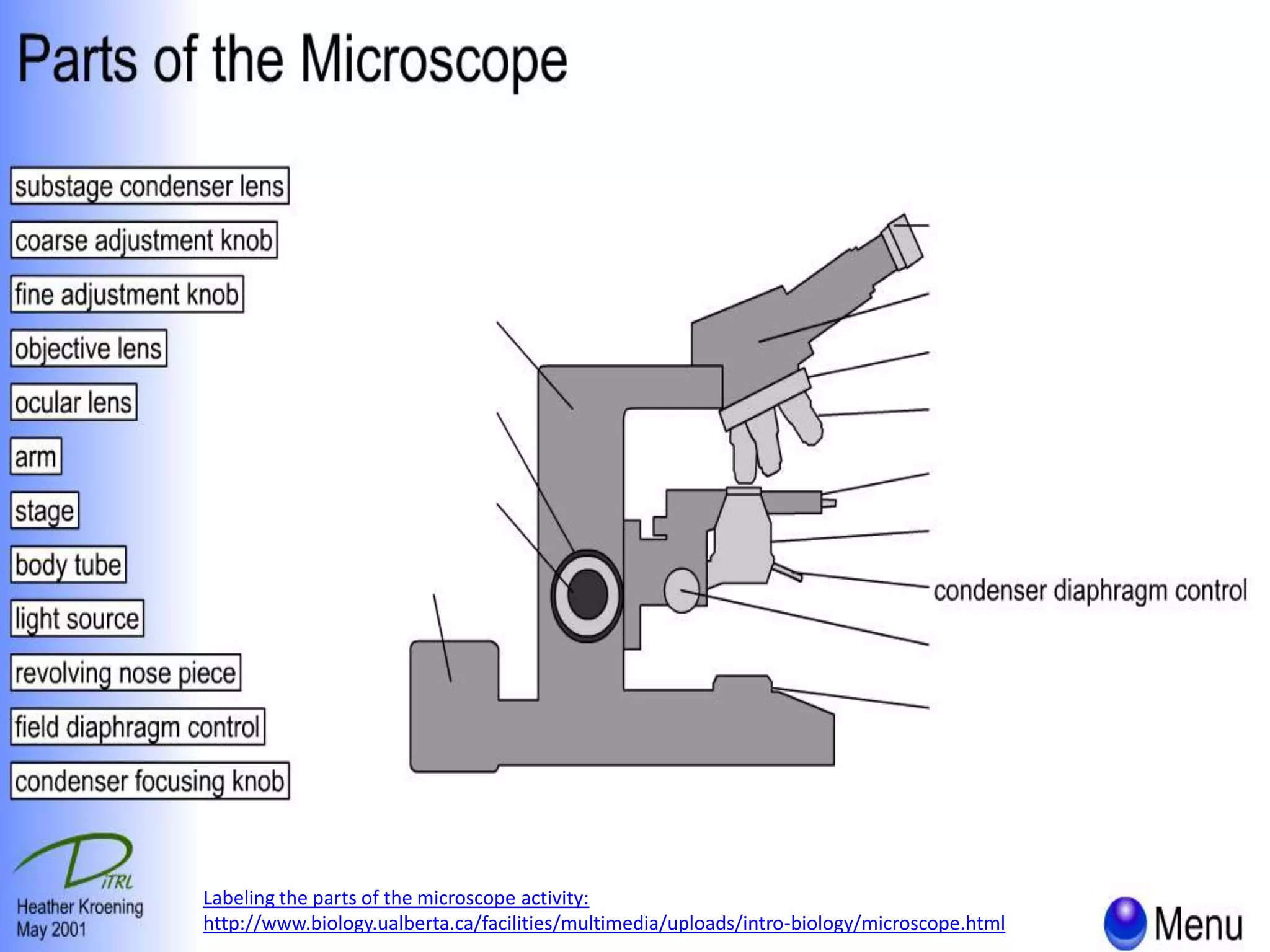
Labeling the parts of the microscope activity:
http://www.biology.ualberta.ca/facilities/multimedia/uploads/intro-biology/microscope.html
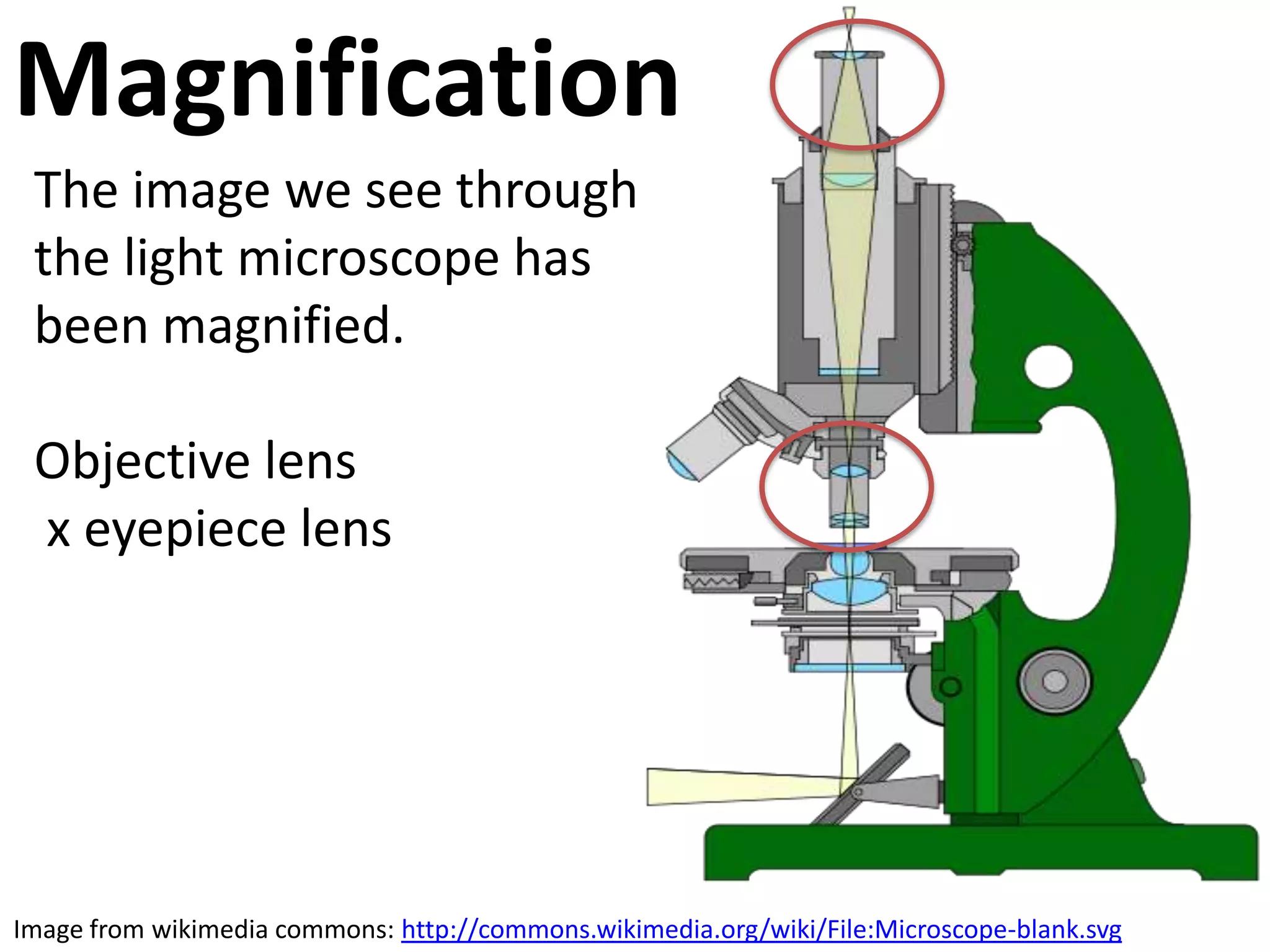
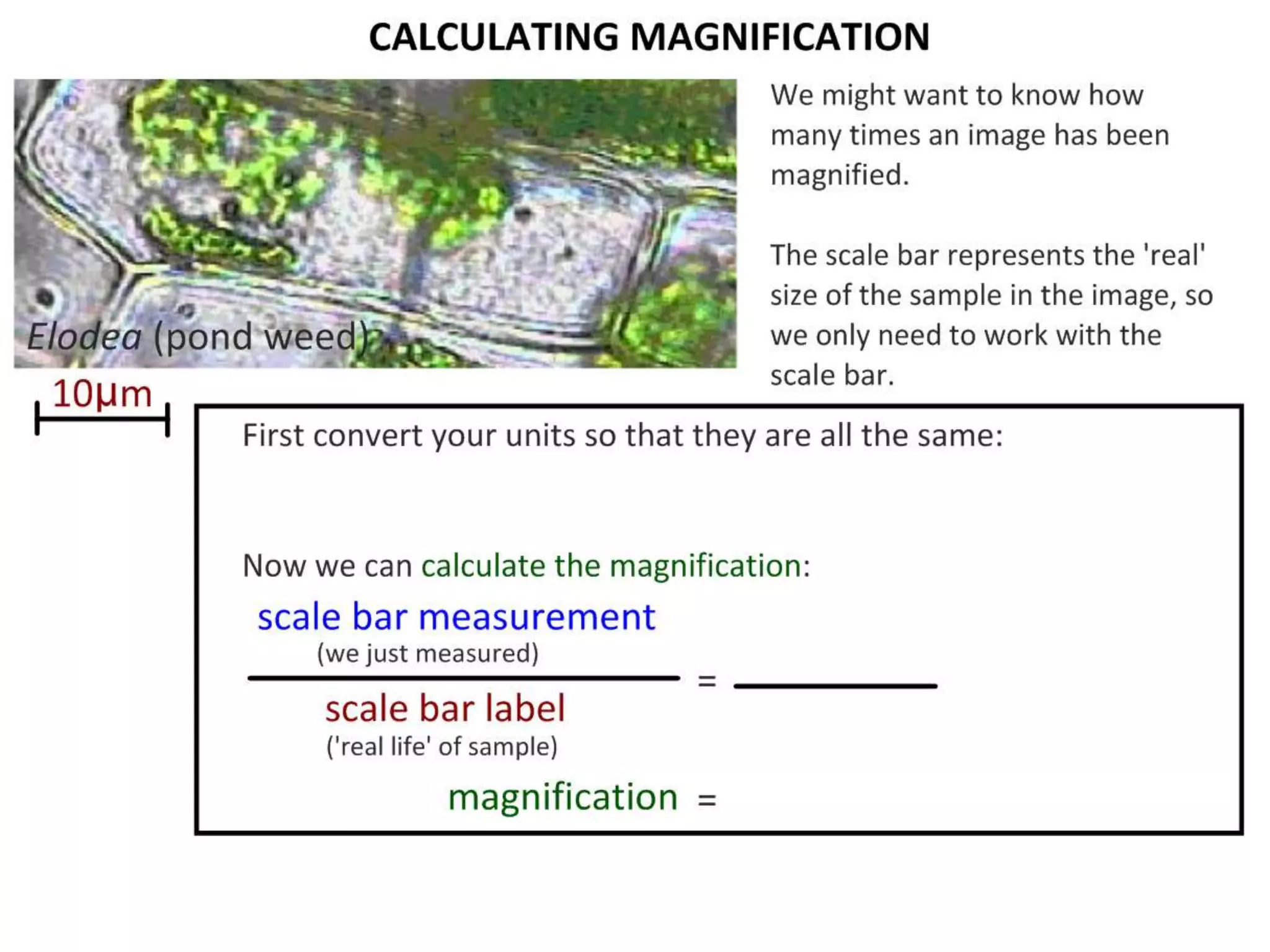
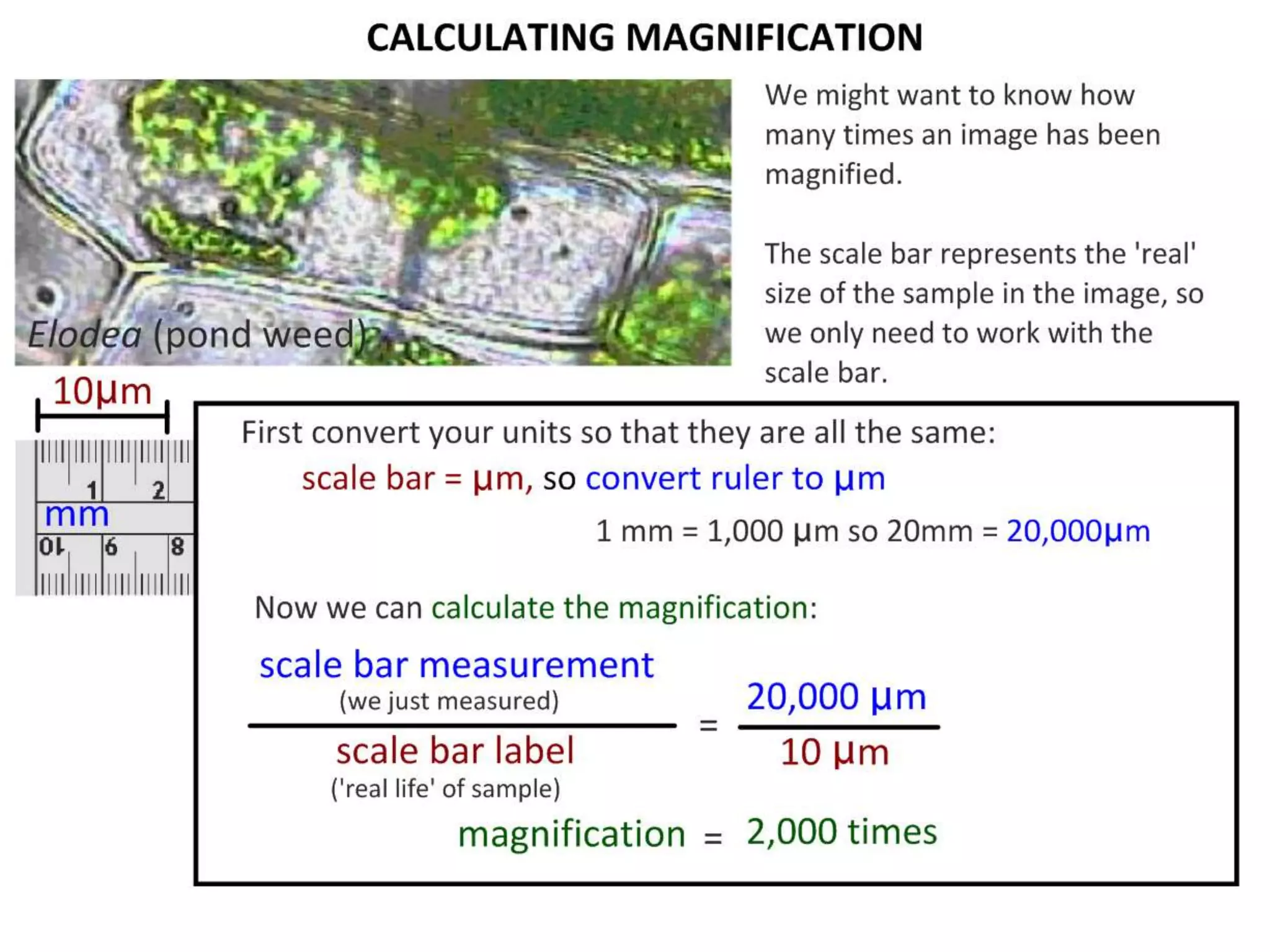
Magnification
The image we see through
the light microscope has
been magnified.
Objective lens
x eyepiece lens

Image from wikimedia commons: http://commons.wikimedia.org/wiki/File:Microscope-blank.svg
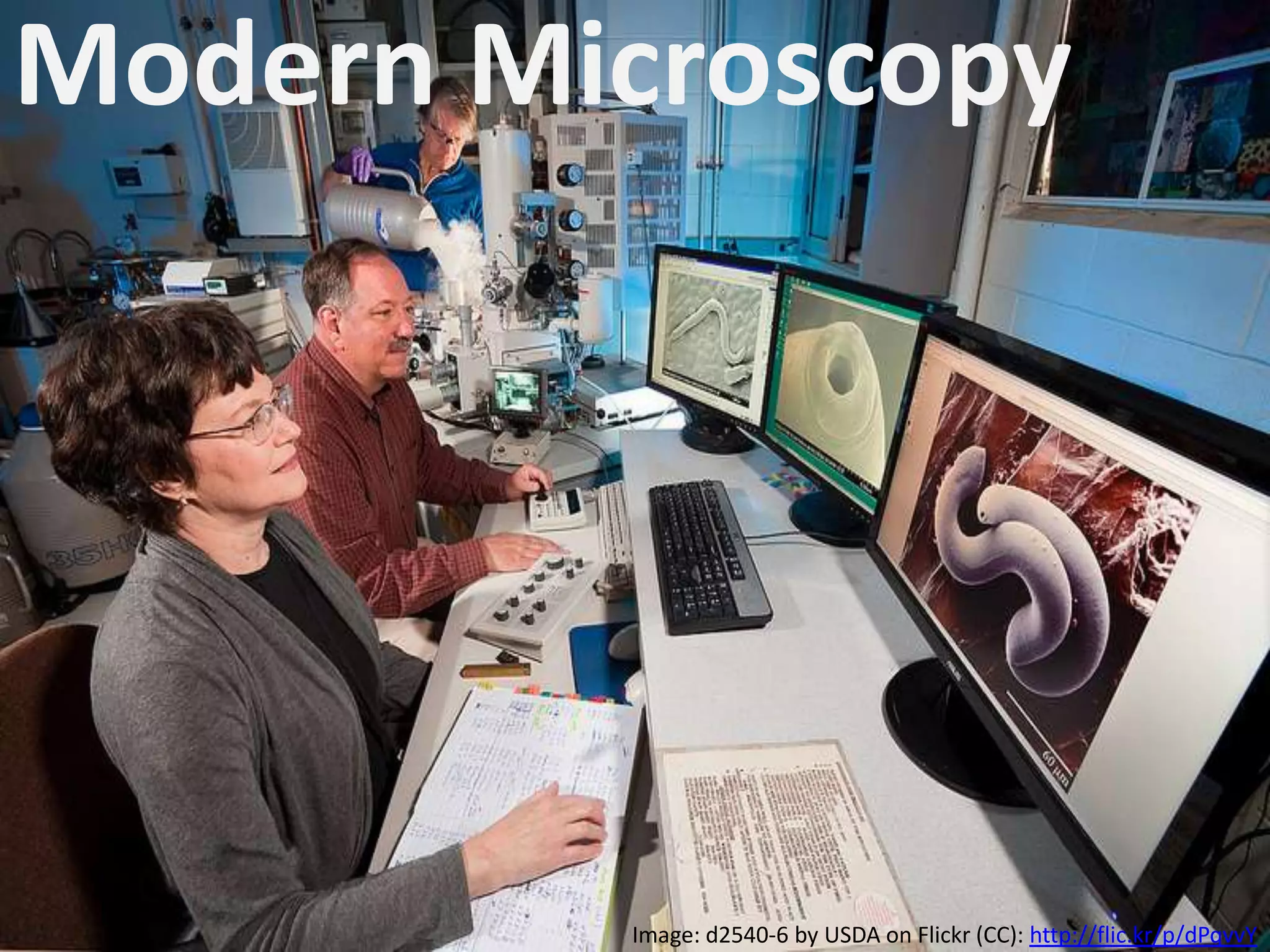
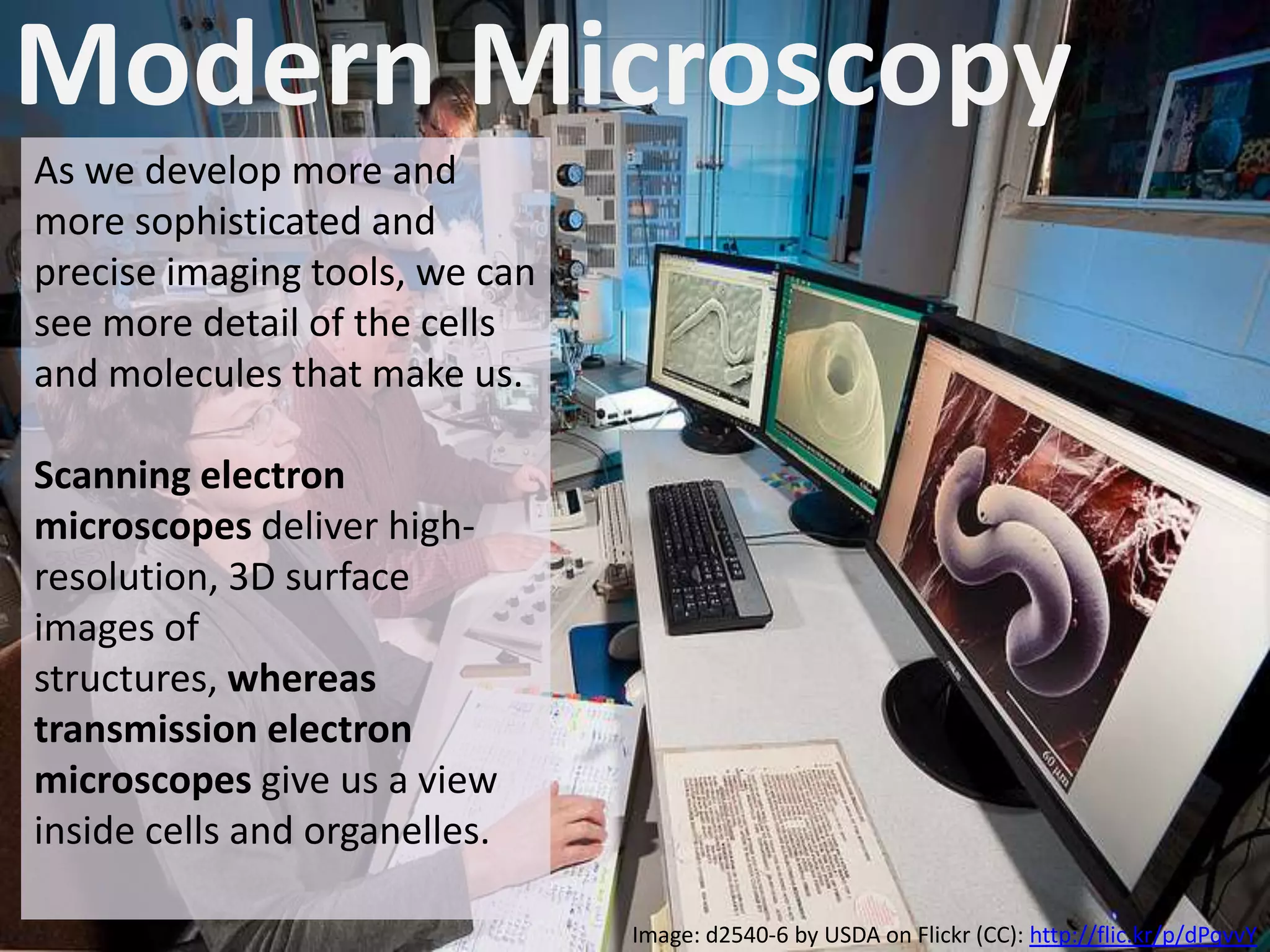
Modern Microscopy

Image: d2540-6 by USDA on Flickr (CC): http://flic.kr/p/dPqvvY
Modern Microscopy
As we develop more and
more sophisticated and
precise imaging tools, we can
see more detail of the cells
and molecules that make us.
Scanning electron
microscopes deliver highresolution, 3D surface
images of structures,
whereas transmission
electron microscopes give us
a view inside cells and
organelles.
Image: d2540-6 by USDA on Flickr (CC): http://flic.kr/p/dPqvvY
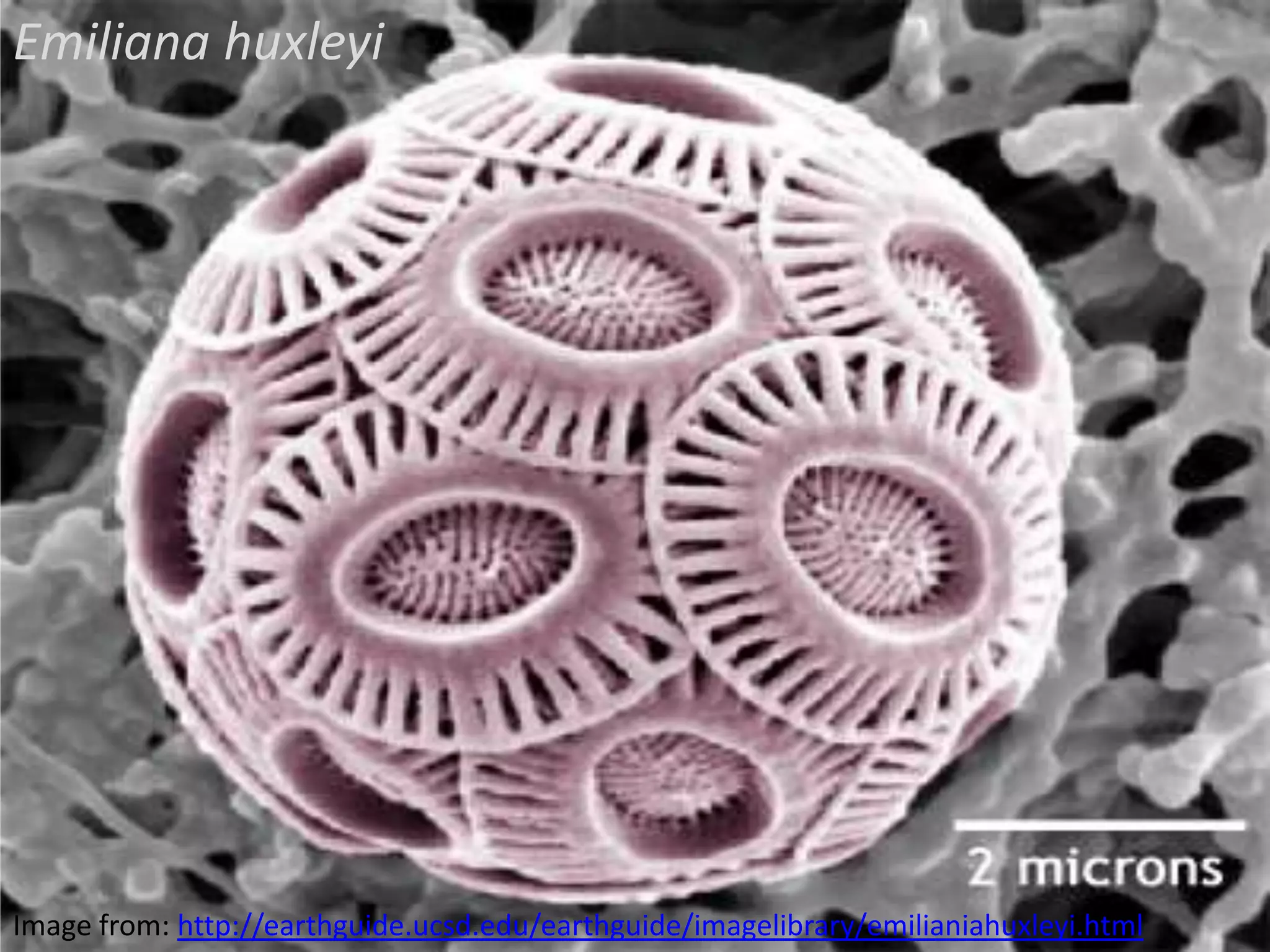
Emiliana huxleyi

Image from: http://earthguide.ucsd.edu/earthguide/imagelibrary/emilianiahuxleyi.html
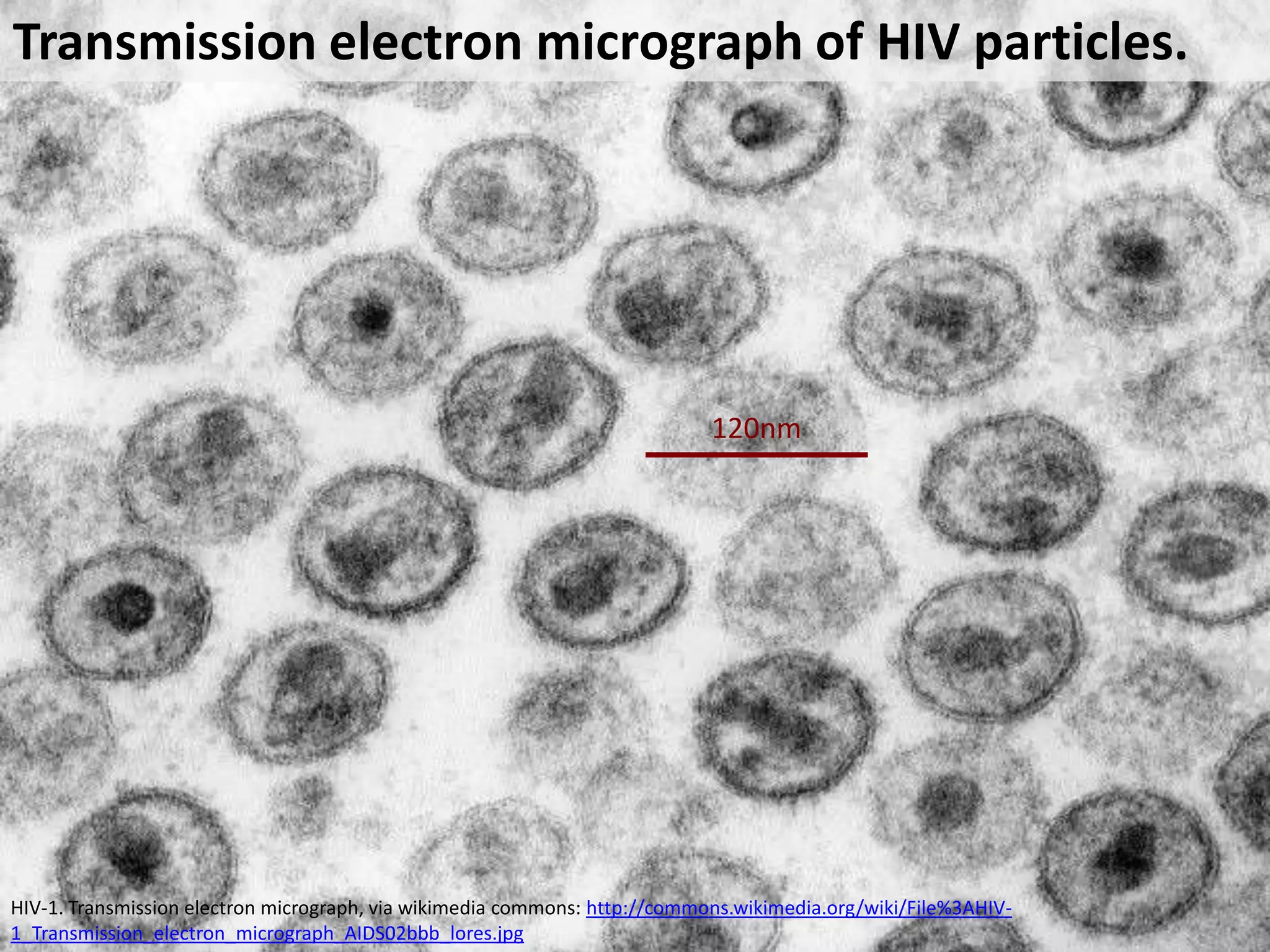
Transmission electron micrograph of HIV particles.

120nm

HIV-1. Transmission electron micrograph, via wikimedia commons: http://commons.wikimedia.org/wiki/File%3AHIV1_Transmission_electron_micrograph_AIDS02bbb_lores.jpg
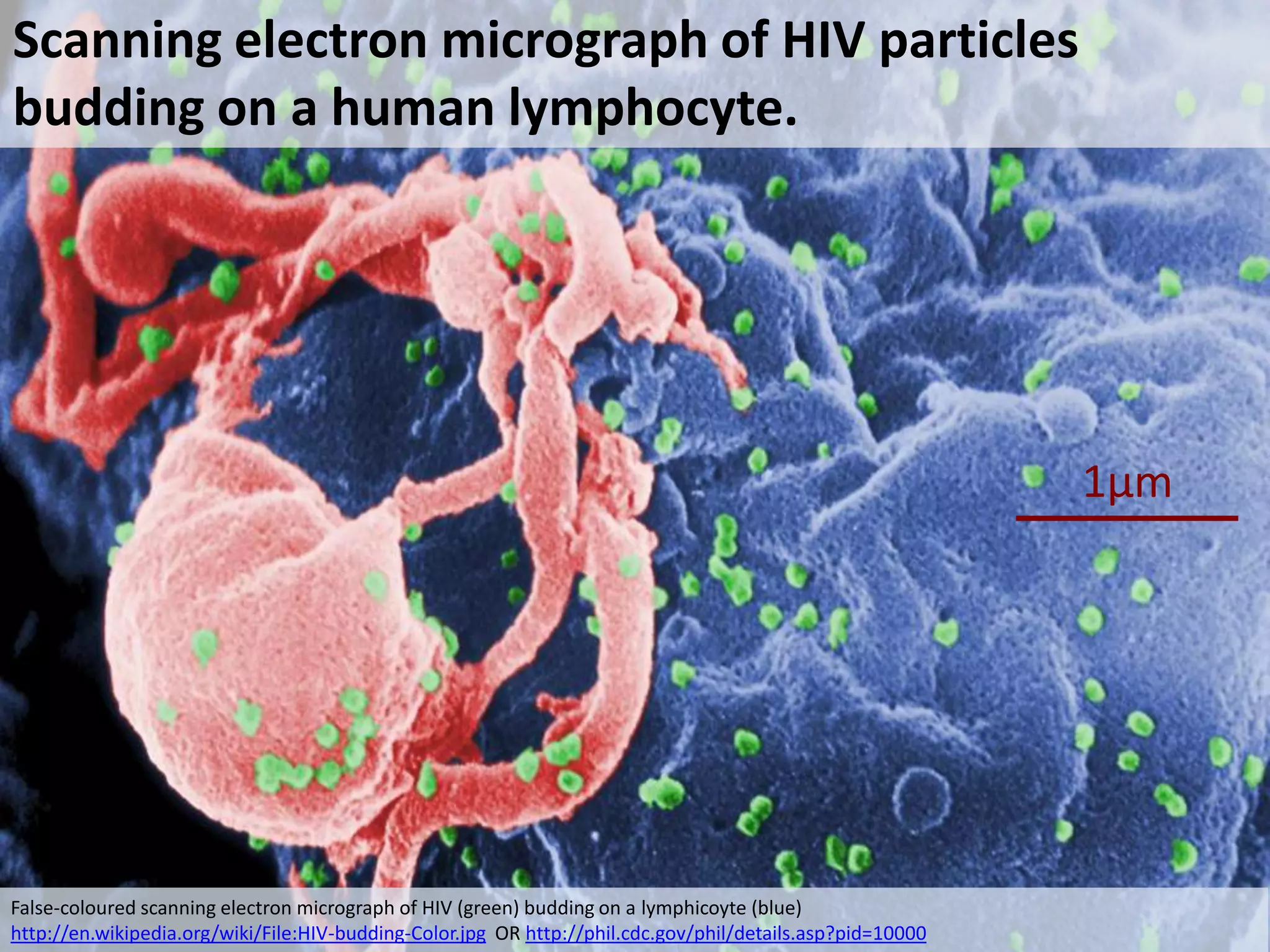
Scanning electron micrograph of HIV particles
budding on a human lymphocyte.

1μm

False-coloured scanning electron micrograph of HIV (green) budding on a lymphicoyte (blue)
http://en.wikipedia.org/wiki/File:HIV-budding-Color.jpg OR http://phil.cdc.gov/phil/details.asp?pid=10000
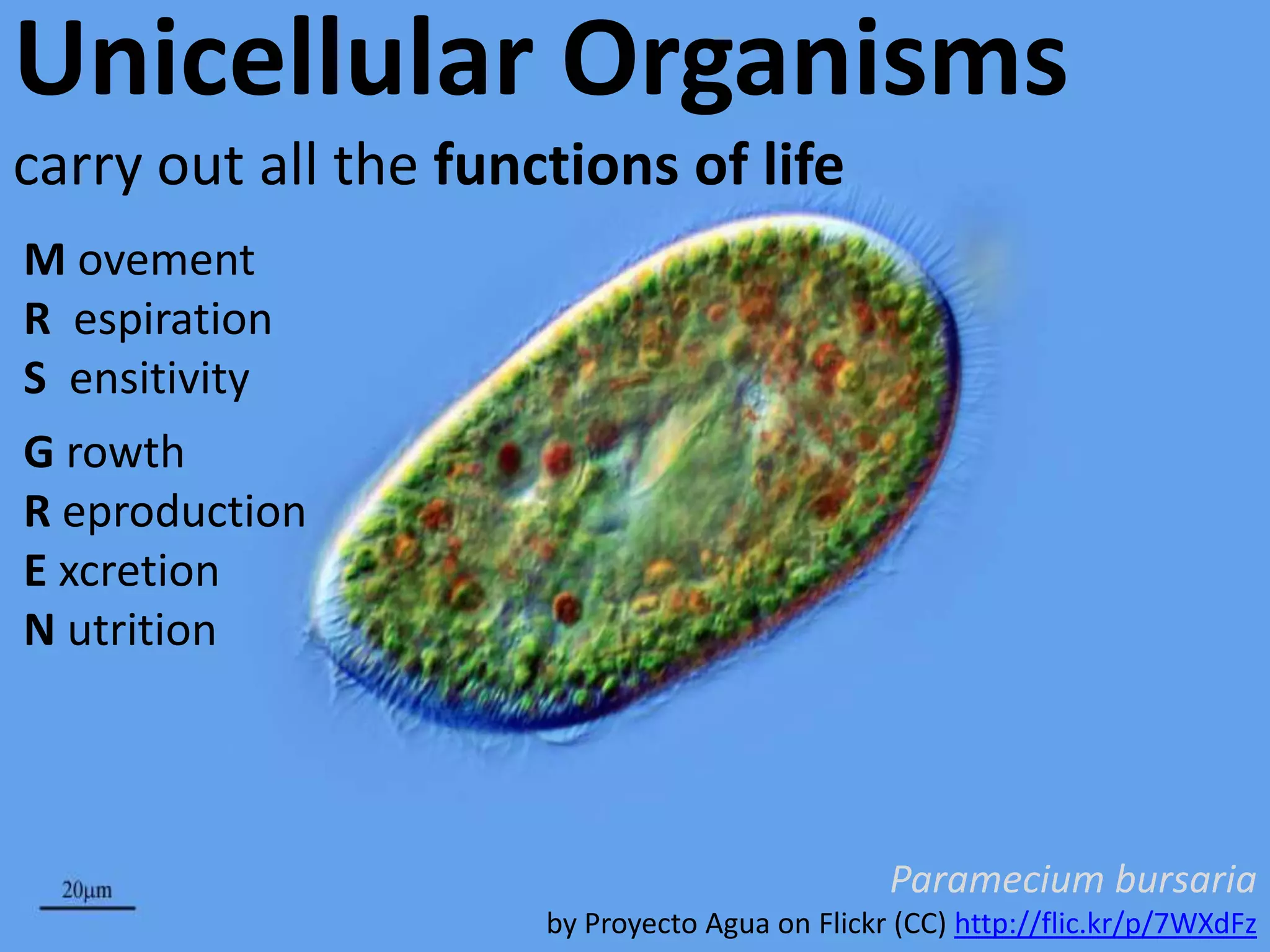
Unicellular Organisms
carry out all the functions of life
M ovement
R espiration
S ensitivity
G rowth
R eproduction
E xcretion
N utrition

Paramecium bursaria
by Proyecto Agua on Flickr (CC) http://flic.kr/p/7WXdFz
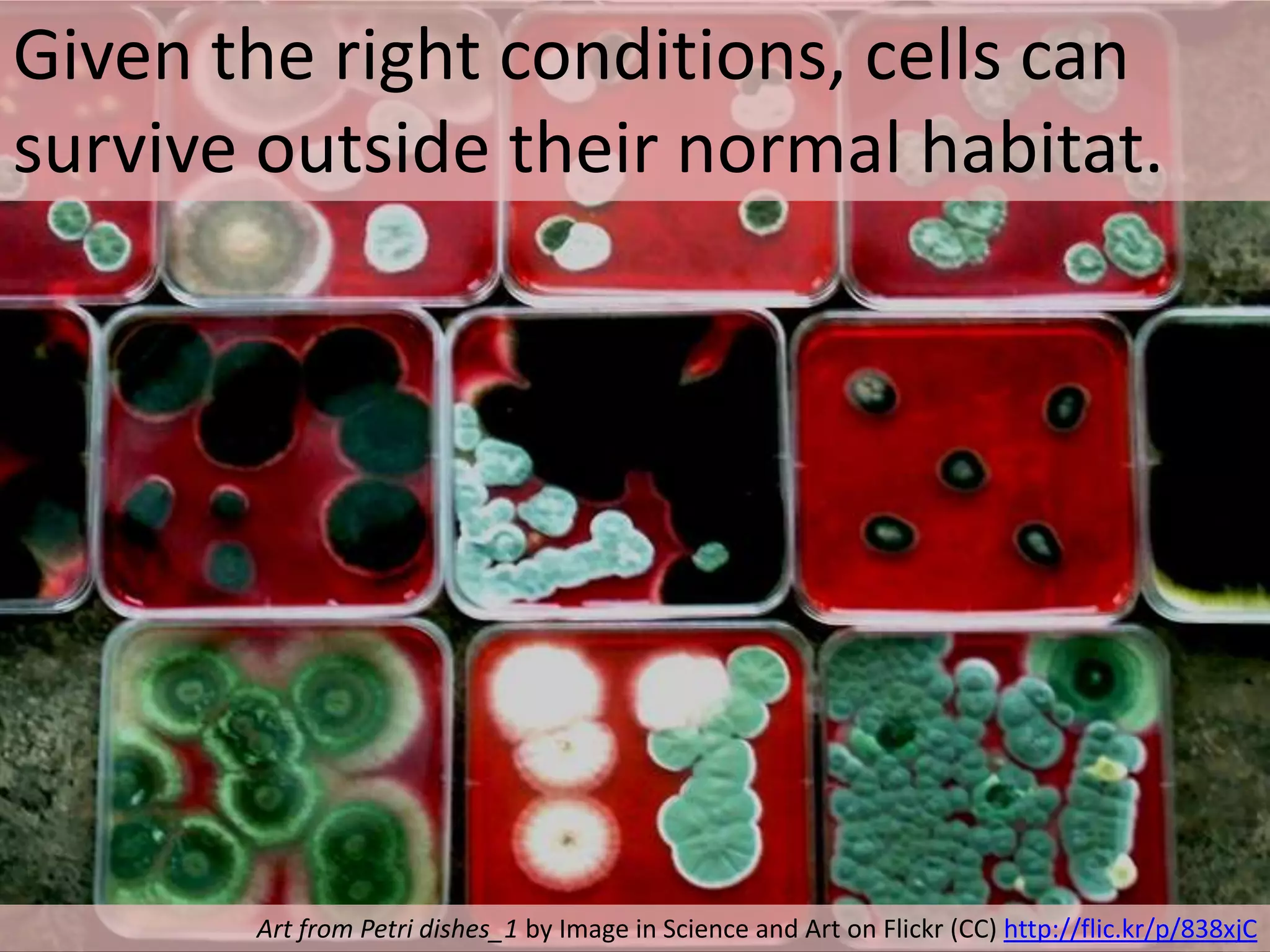
Given the right conditions, cells can
survive outside their normal habitat.

Art from Petri dishes_1 by Image in Science and Art on Flickr (CC) http://flic.kr/p/838xjC
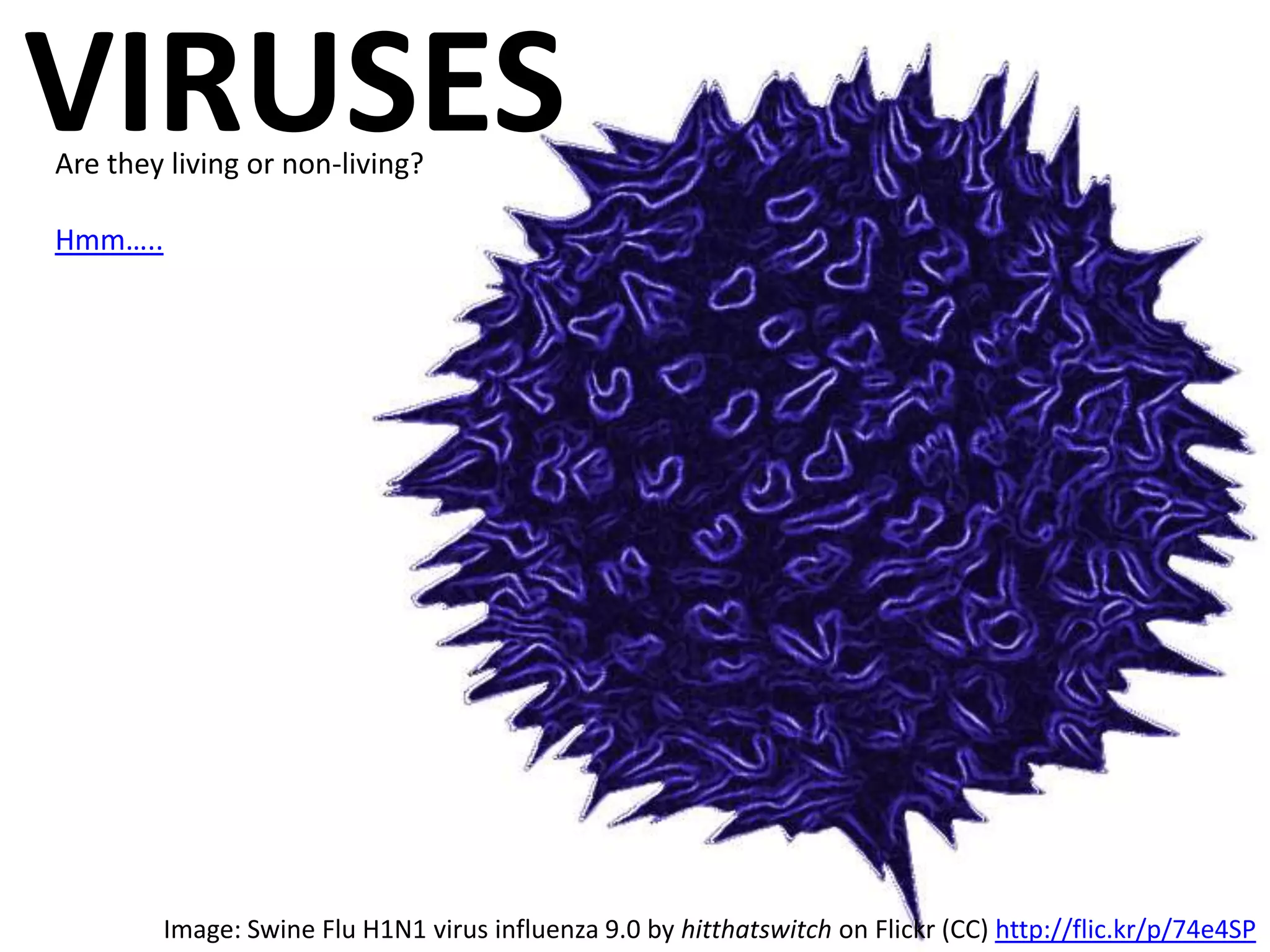
VIRUSES
Are they living or non-living?
Hmm…..

Image: Swine Flu H1N1 virus influenza 9.0 by hitthatswitch on Flickr (CC) http://flic.kr/p/74e4SP
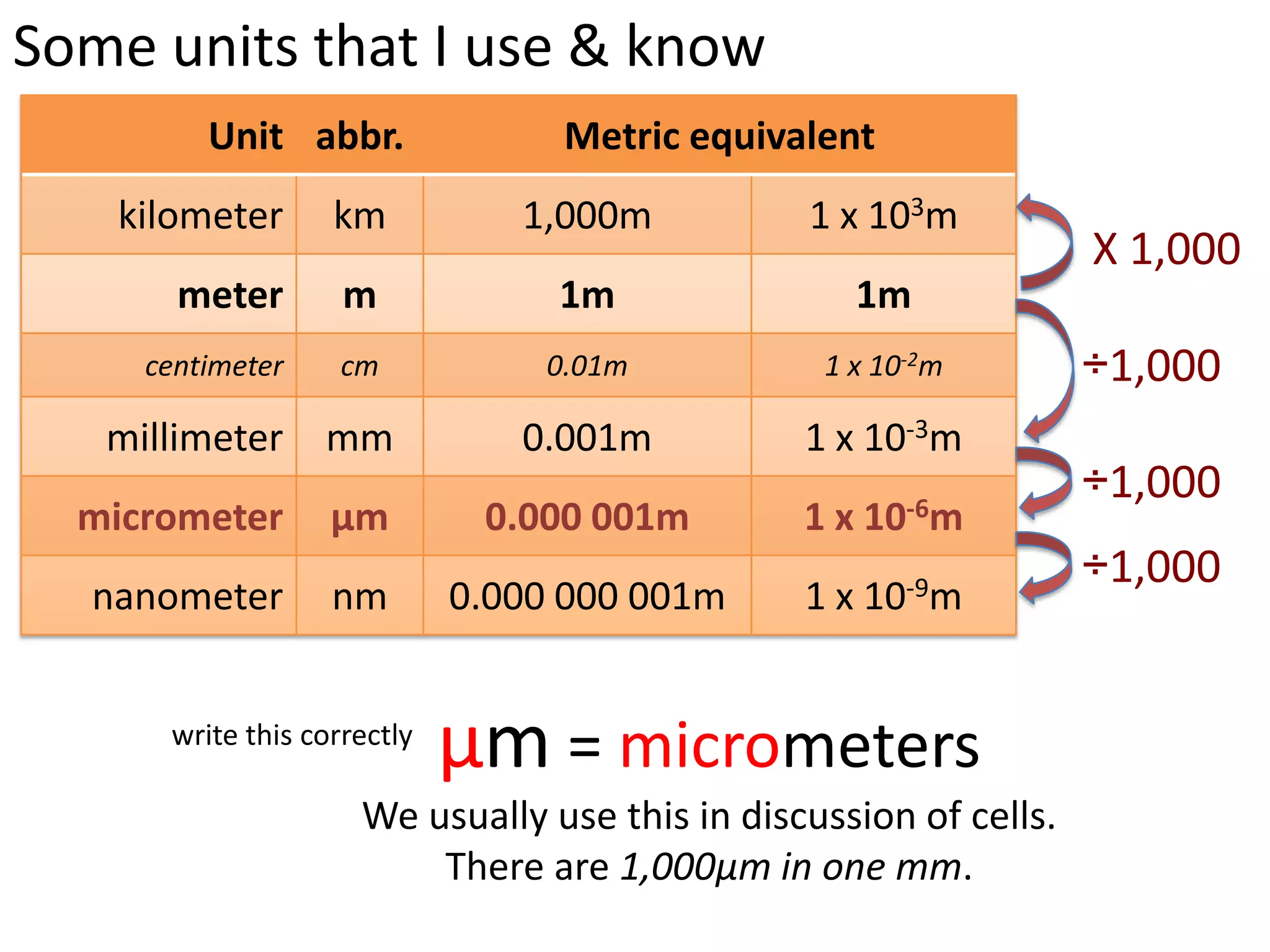
Some units that I use & know
Unit abbr.

Metric equivalent

kilometer

km

1,000m

1 x 10³m

meter

m

1m

1m

centimeter

cm

0.01m

1 x 10⁻²m

mm

0.001m

1 x 10⁻³m

millimeter
micrometer
nanometer

μm
nm

write this correctly

0.000 001m
0.000 000 001m

1x

10-6m

1x

10-9m

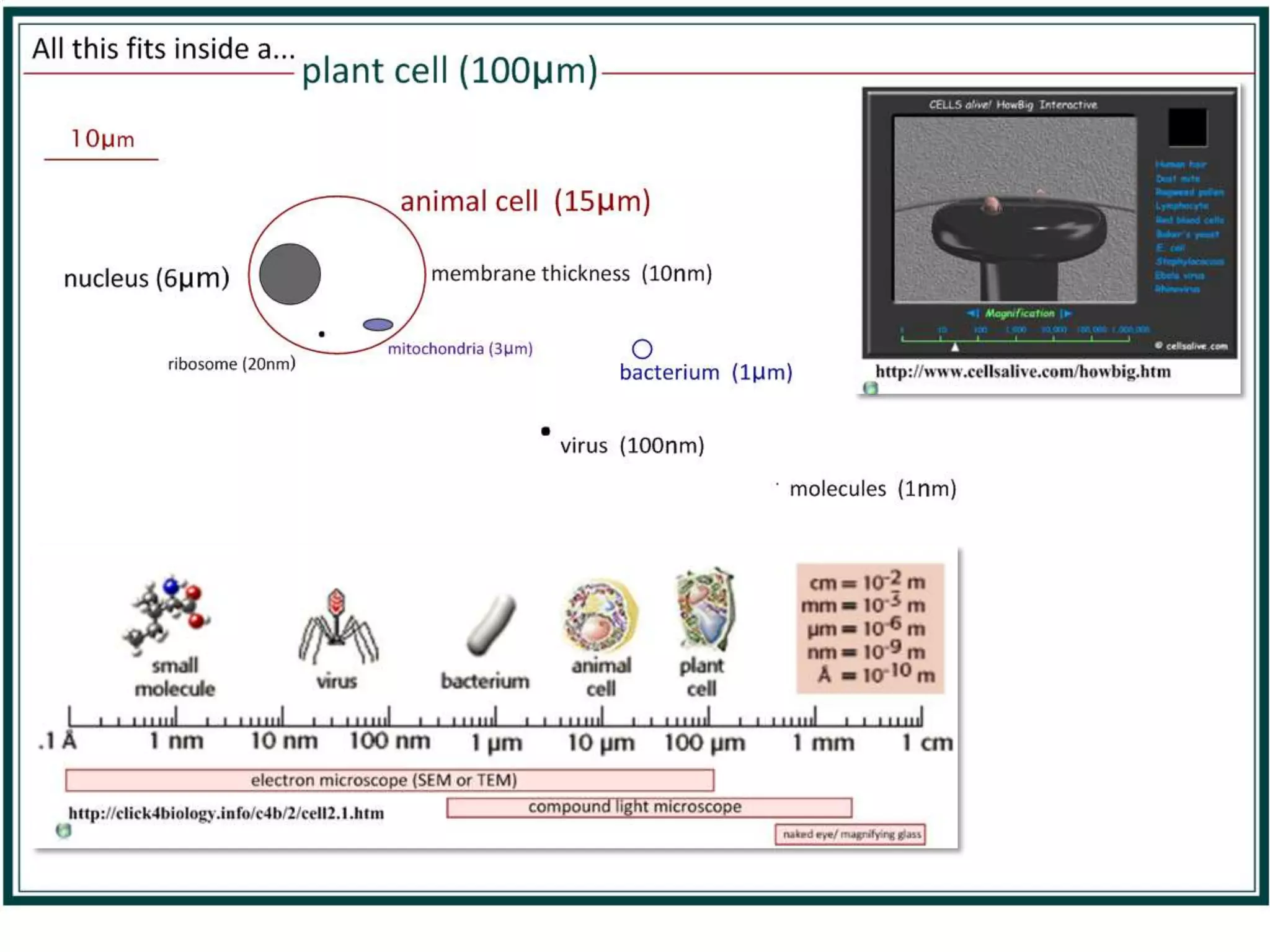
μm = micrometers

We usually use this in discussion of cells.
There are 1,000μm in one mm.

X 1,000
÷1,000
÷1,000
÷1,000
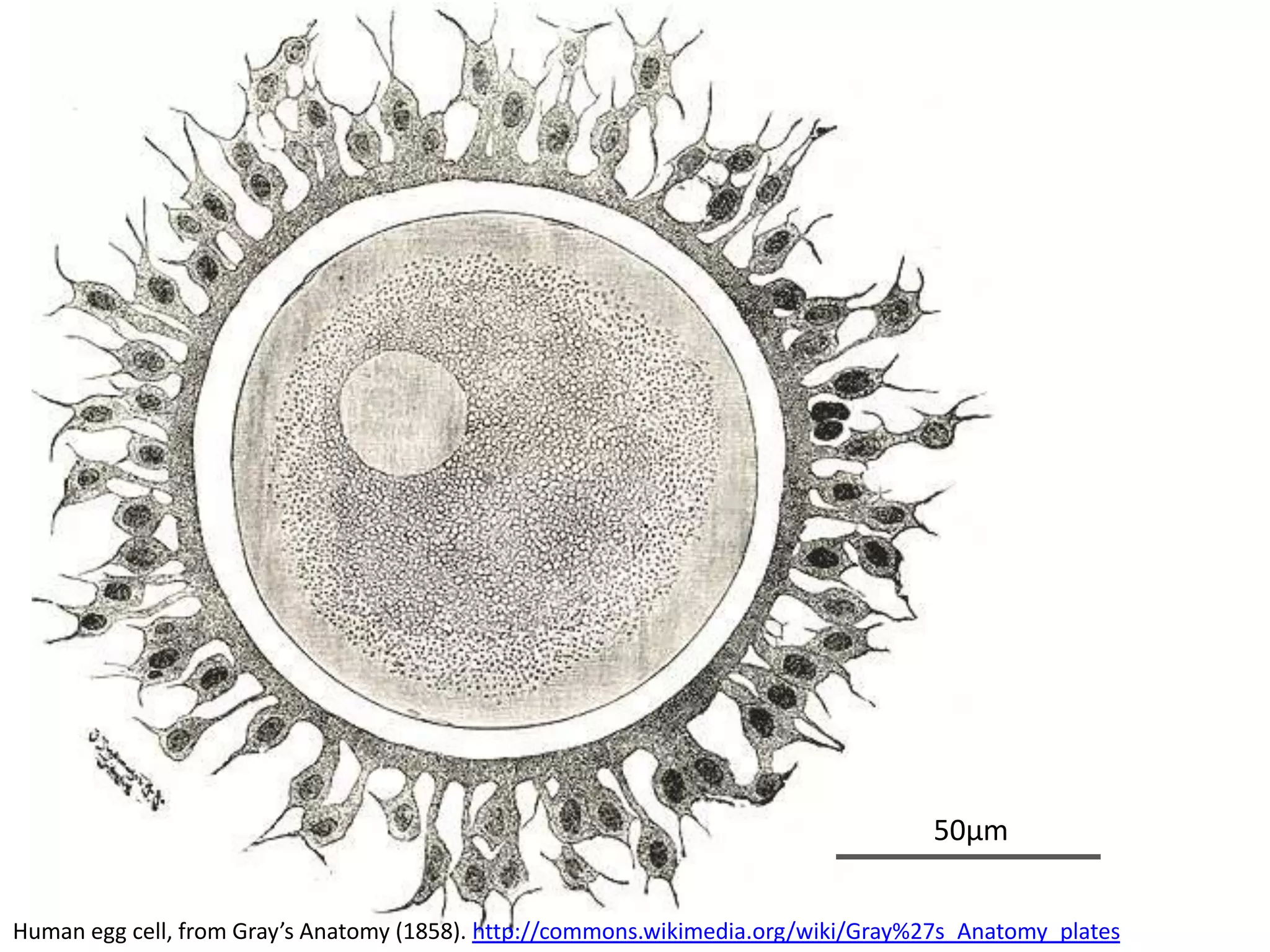
50μm
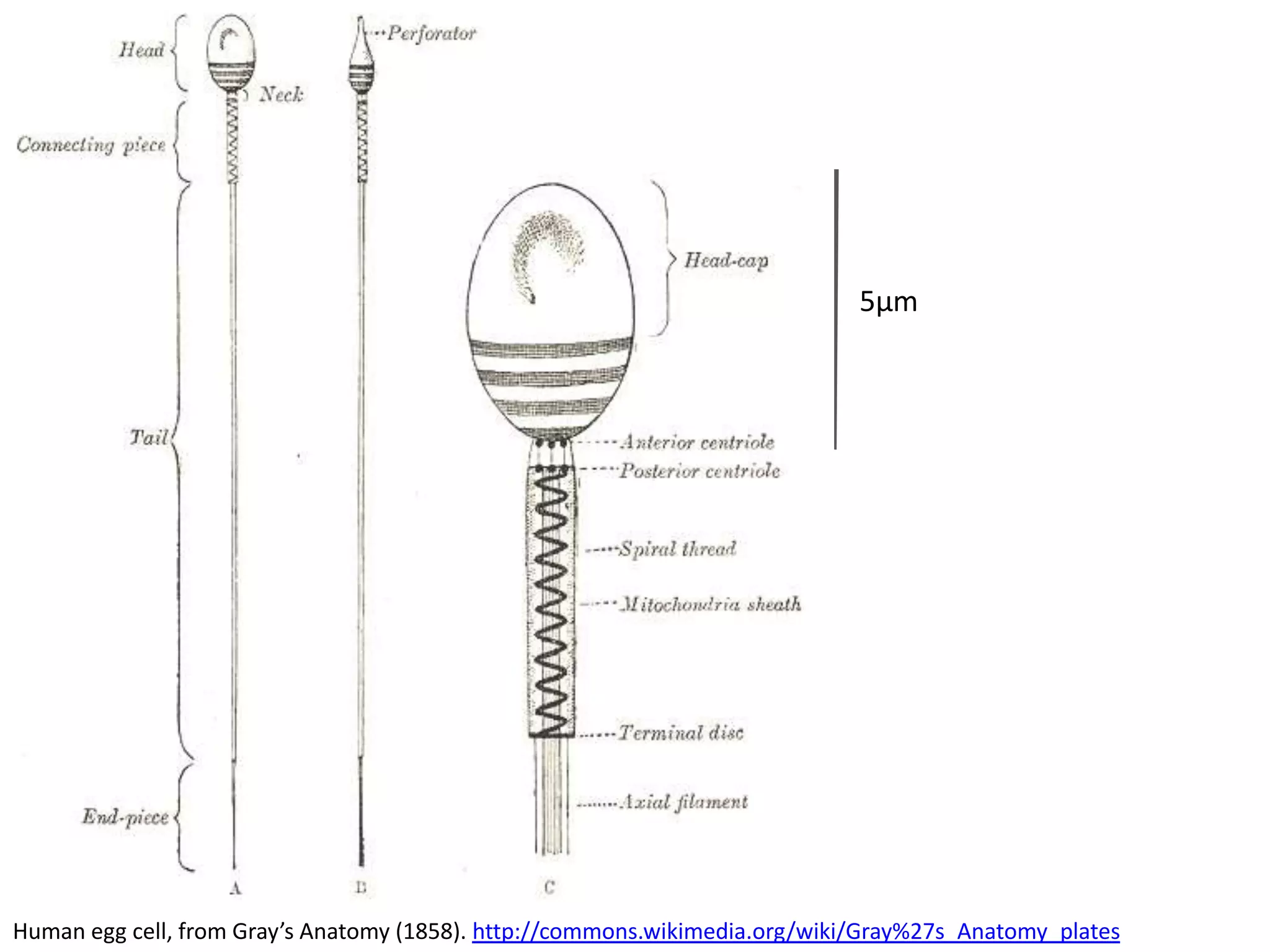
Human egg cell, from Gray’s Anatomy (1858). http://commons.wikimedia.org/wiki/Gray%27s_Anatomy_plates
5μm

Human sperm cell, from Gray’s Anatomy (1858). http://commons.wikimedia.org/wiki/Gray%27s_Anatomy_plates
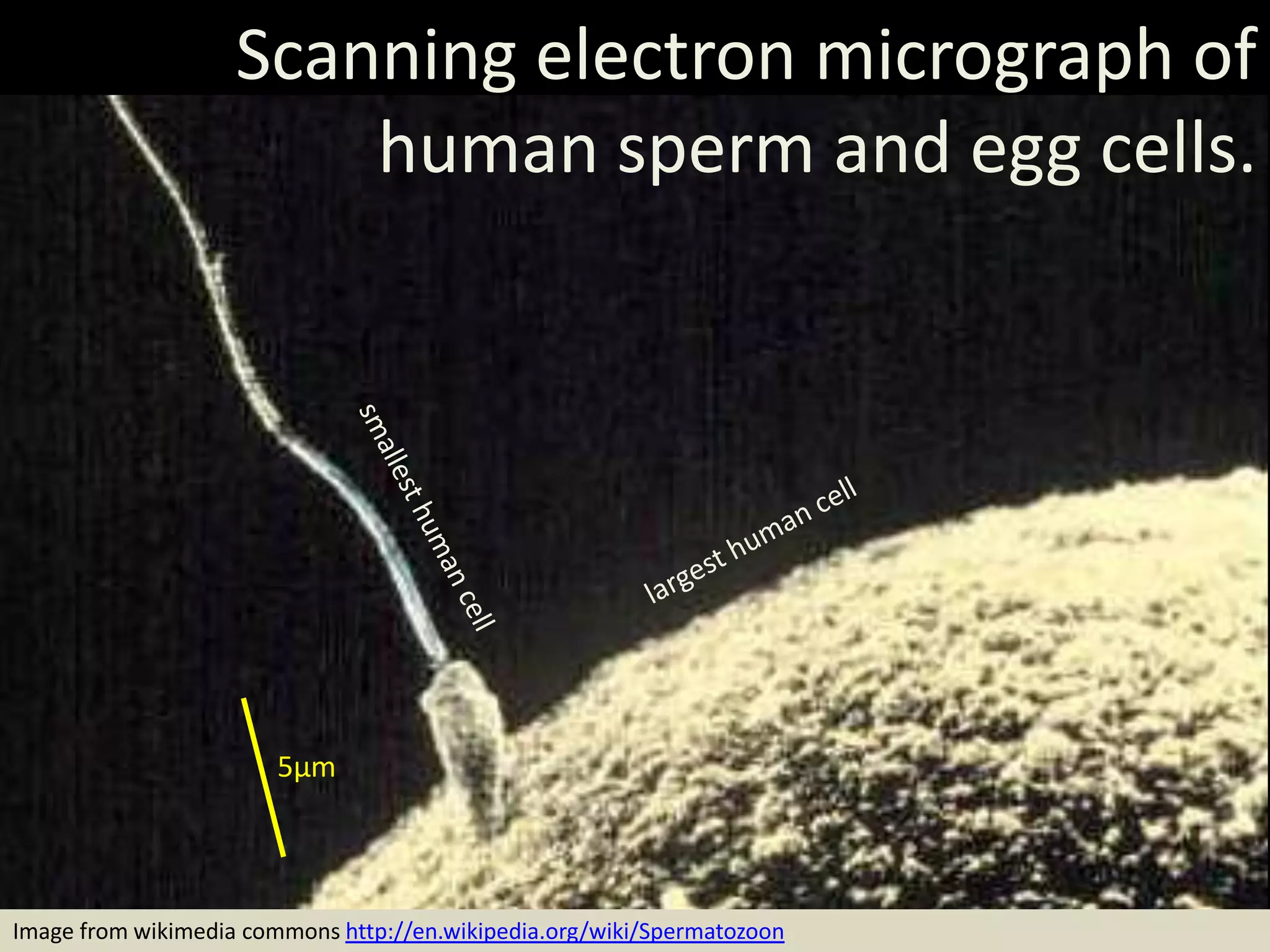
Scanning electron micrograph of
human sperm and egg cells.

5μm

Image from wikimedia commons http://en.wikipedia.org/wiki/Spermatozoon
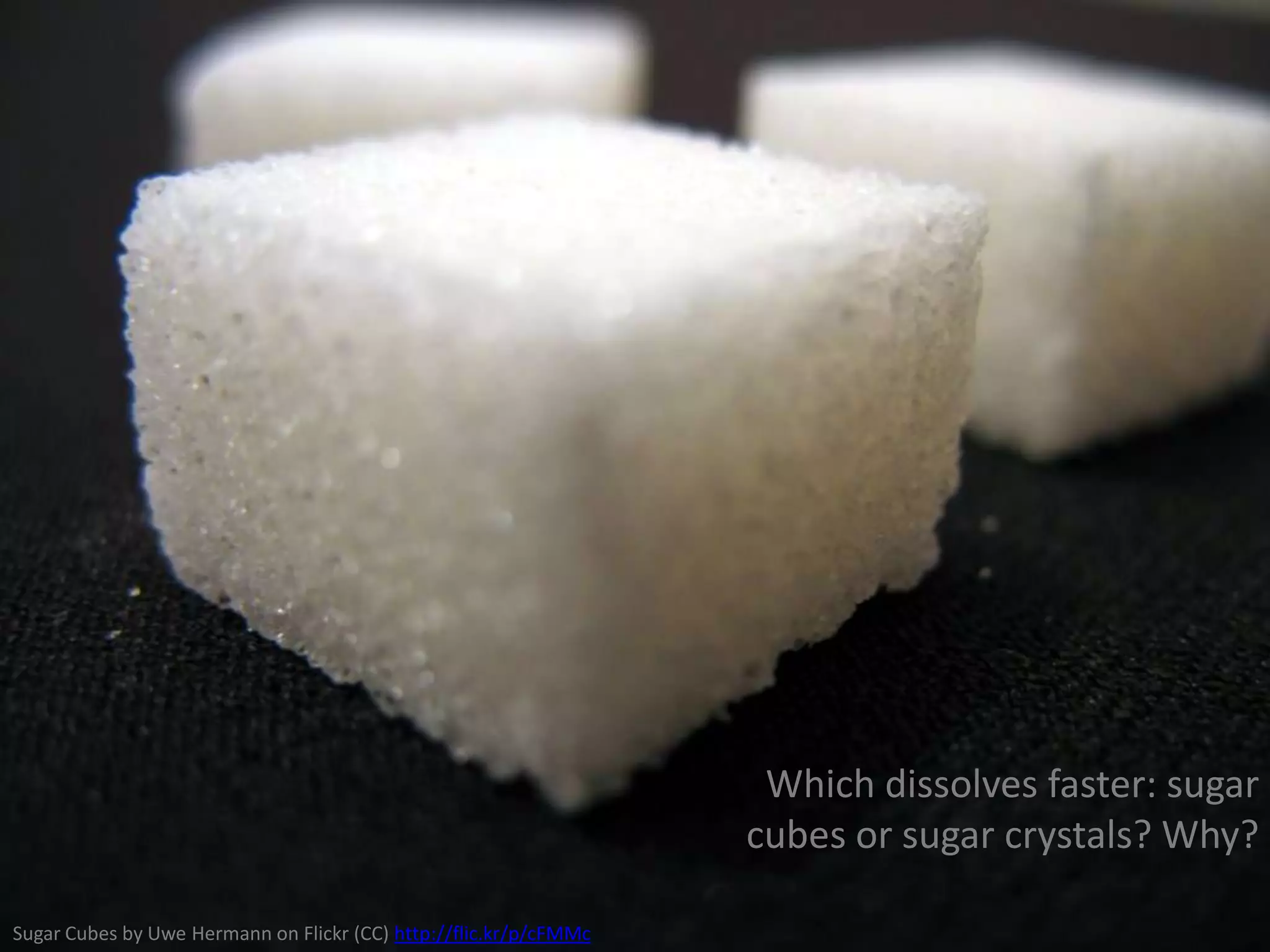
Which dissolves faster: sugar
cubes or sugar crystals? Why?
Sugar Cubes by Uwe Hermann on Flickr (CC) http://flic.kr/p/cFMMc
What will go cold faster: French
fries or a baked potato? Why?

French Fries by Ian Britton on Flickr (CC) http://flic.kr/p/6RLQ8j
Which makes green tea faster: tea leaves or powder?

Matcha Latte by Cupcake Murder Aftermatch on Flickr (CC) http://flic.kr/p/fCkpb5
What type of crisps
delivers more
flavour:
regular-cut
or
crinkle-cut?
Why?
Smiths Plain Chips by Penguin Cakes on Flickr (CC) http://flic.kr/p/5ygb8v
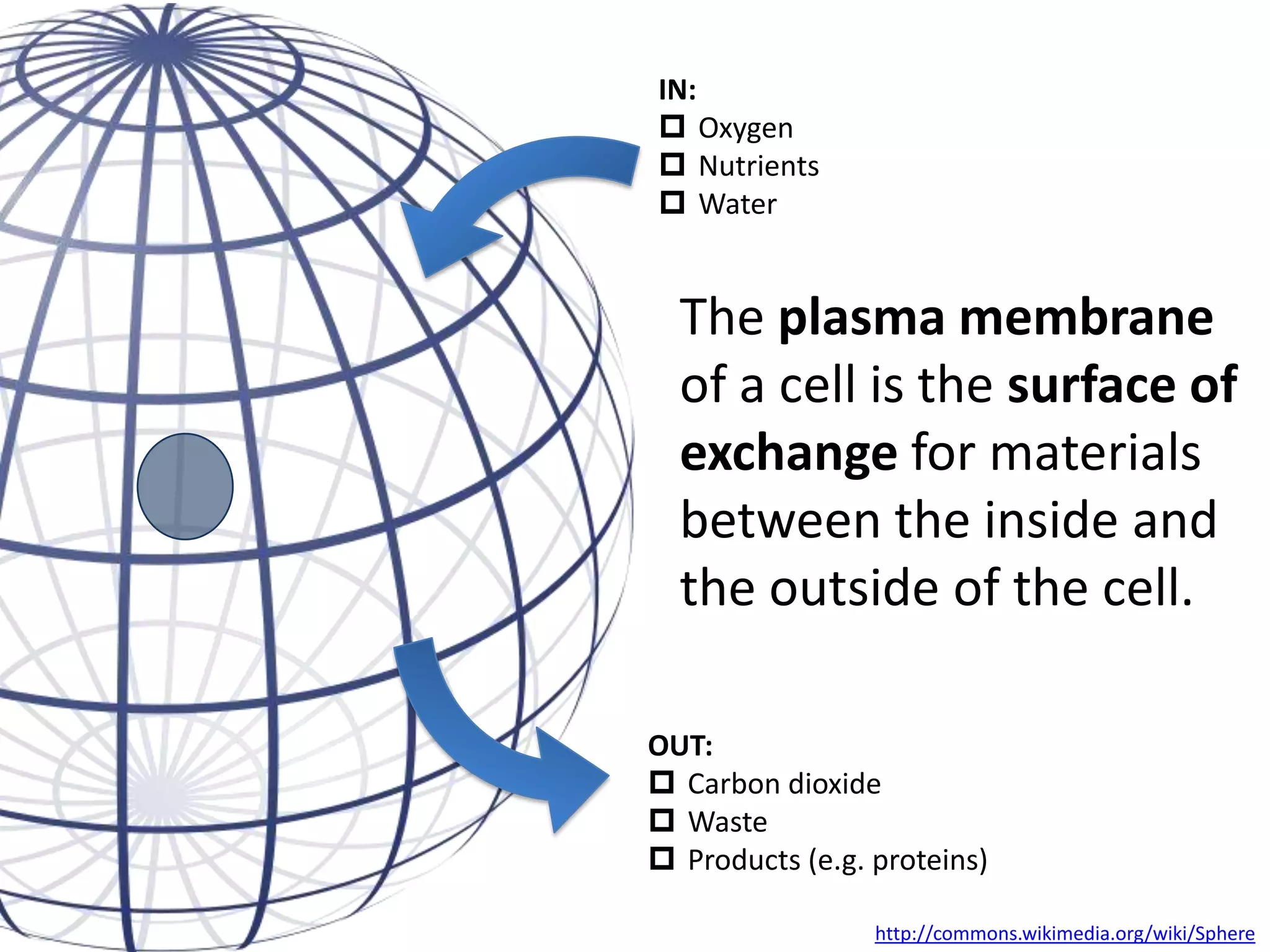
IN:
 Oxygen
 Nutrients
 Water

The plasma membrane
of a cell is the surface of
exchange for materials
between the inside and
the outside of the cell.
OUT:
 Carbon dioxide
 Waste
 Products (e.g. proteins)
http://commons.wikimedia.org/wiki/Sphere
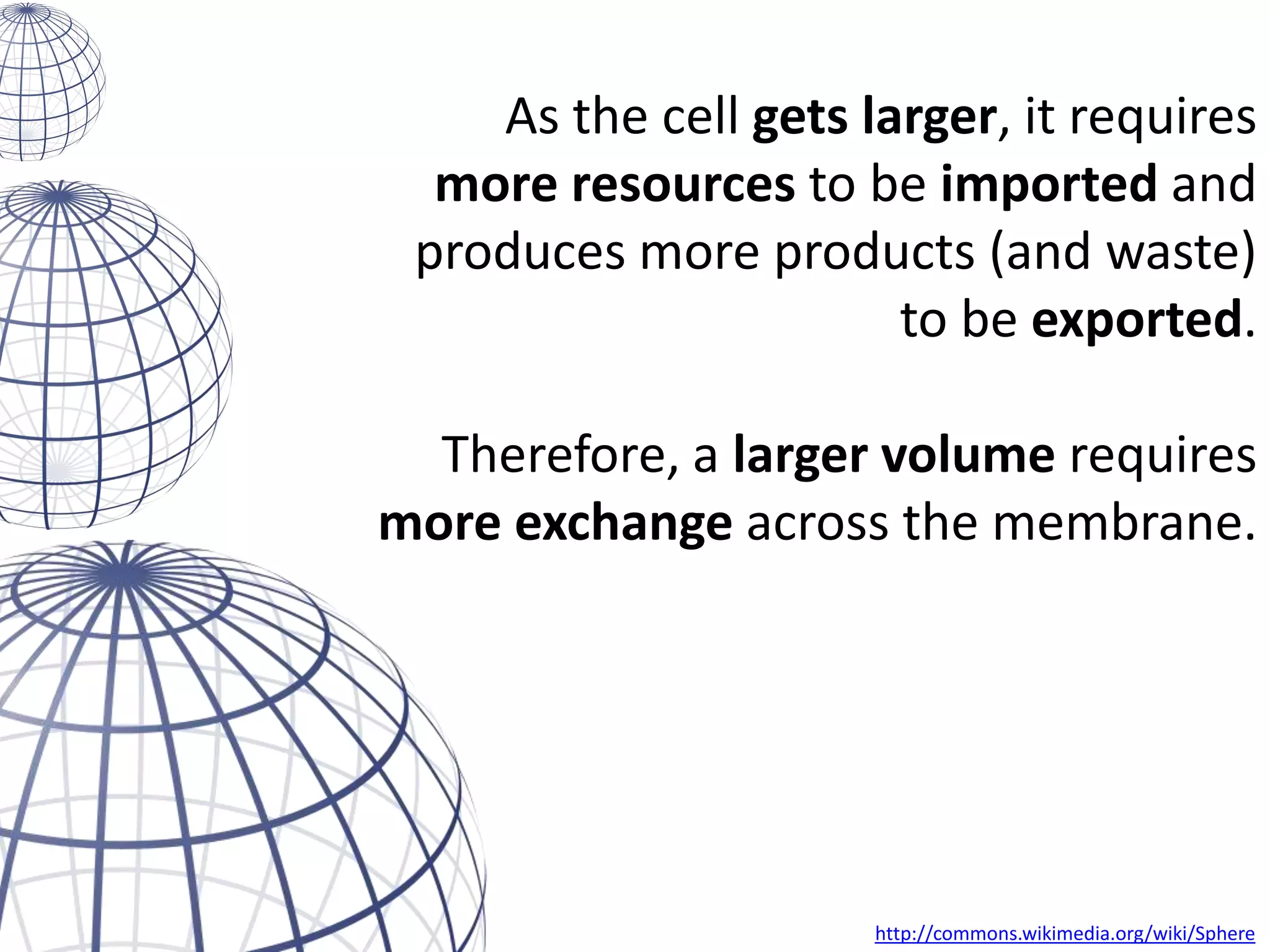
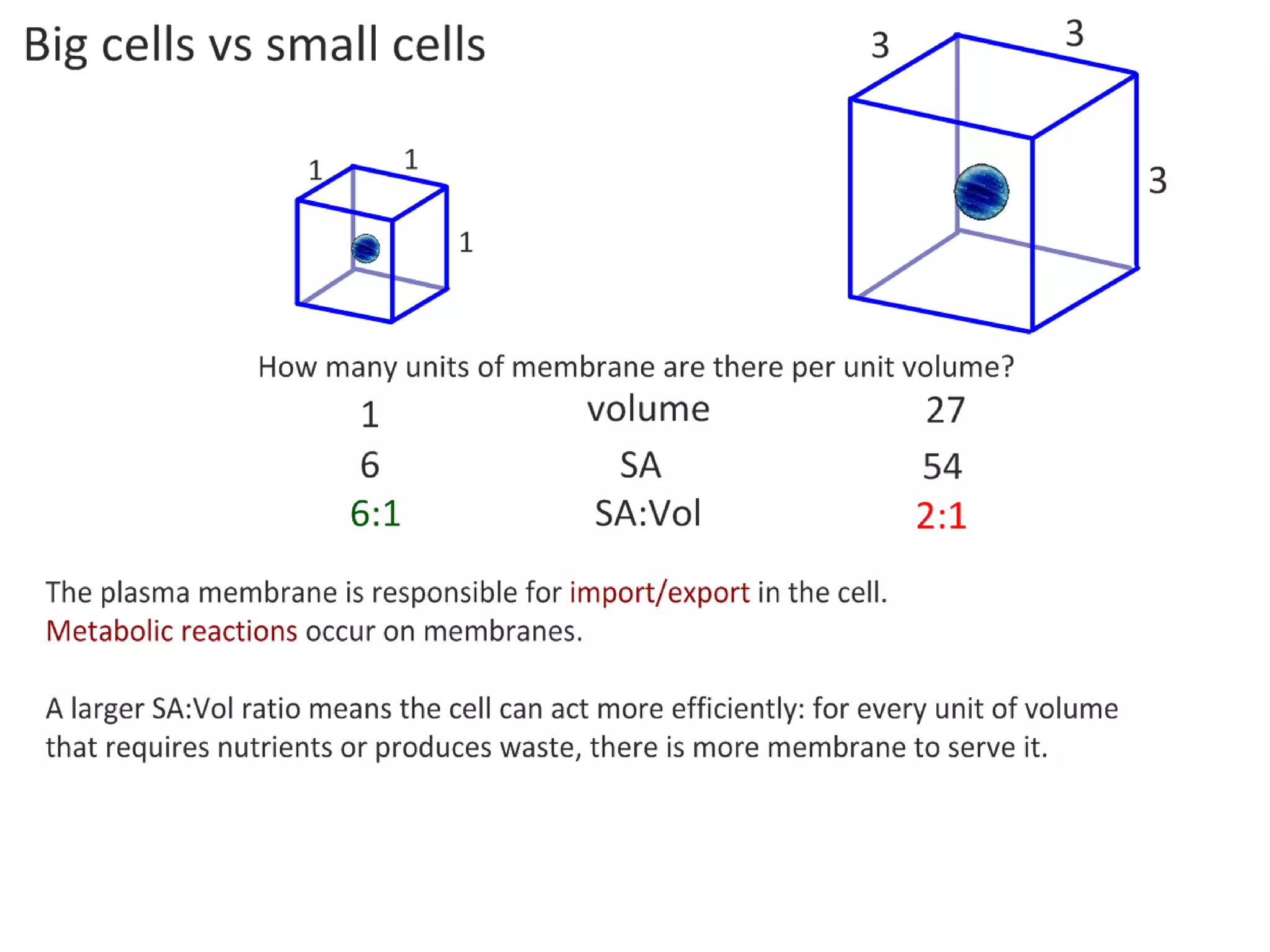
As the cell gets larger, it requires
more resources to be imported and
produces more products (and waste)
to be exported.
Therefore, a larger volume requires
more exchange across the membrane.

http://commons.wikimedia.org/wiki/Sphere
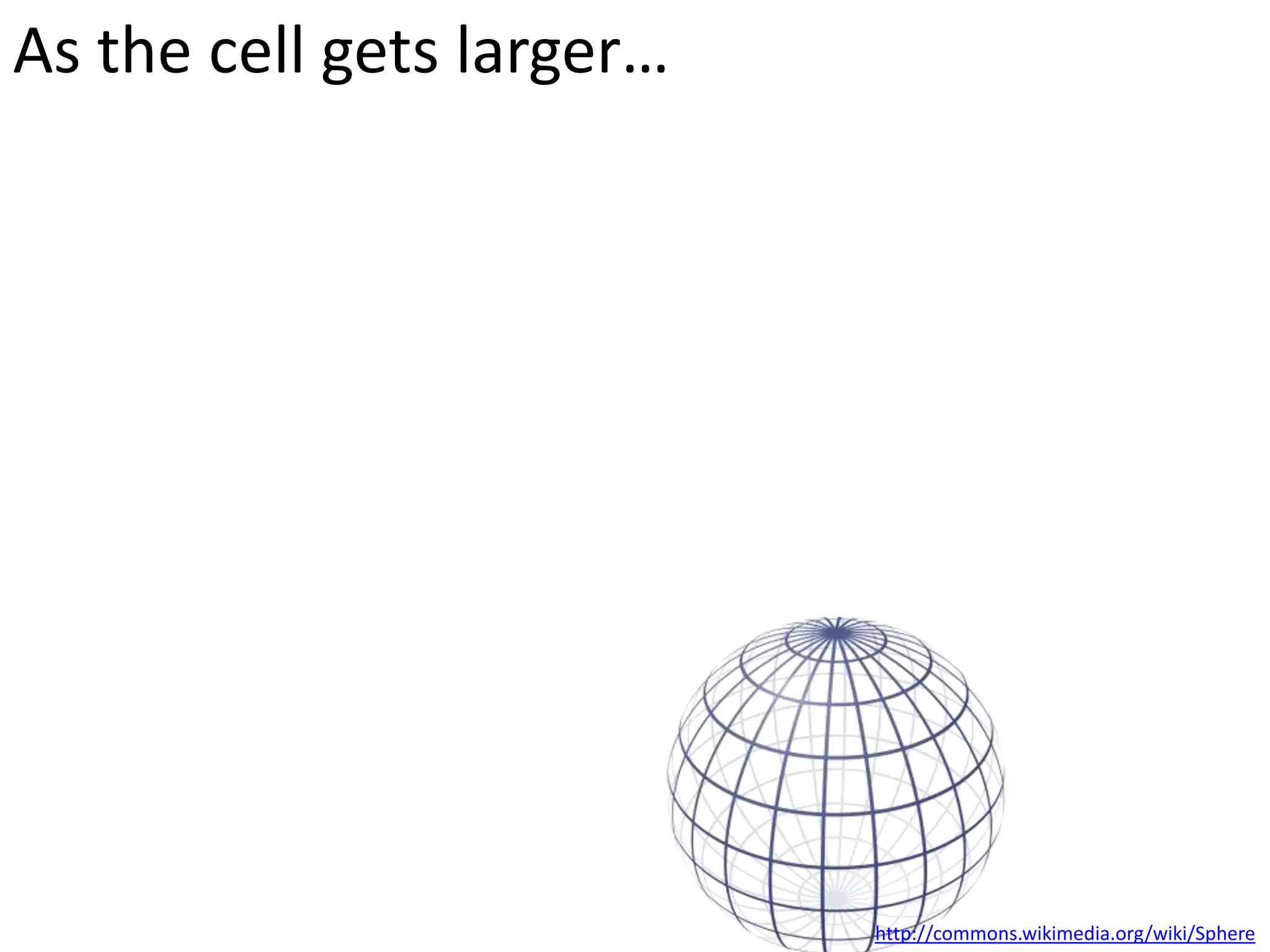
As the cell gets larger…

http://commons.wikimedia.org/wiki/Sphere
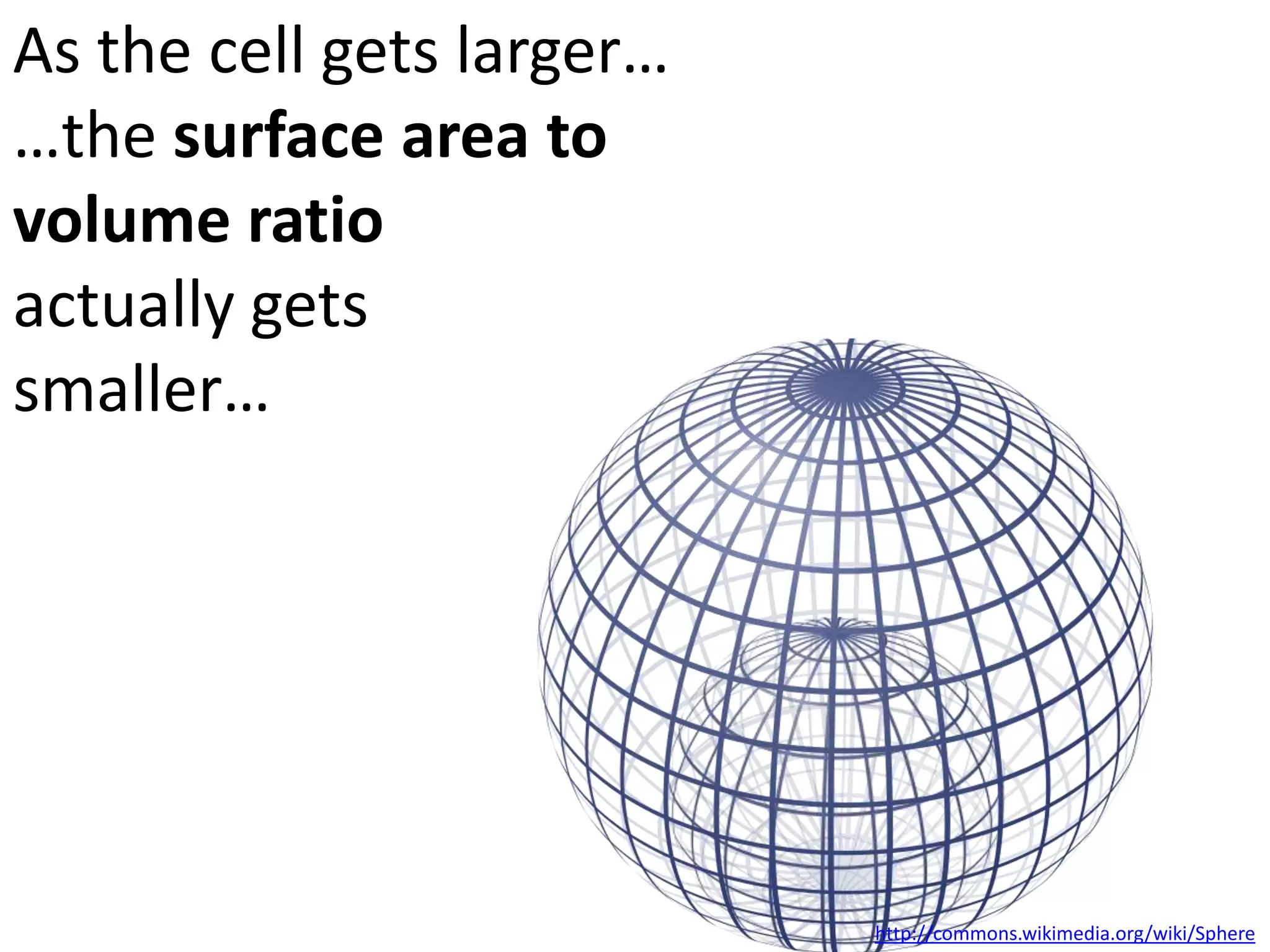
As the cell gets larger…
…the surface area to
volume ratio
actually gets
smaller…

http://commons.wikimedia.org/wiki/Sphere
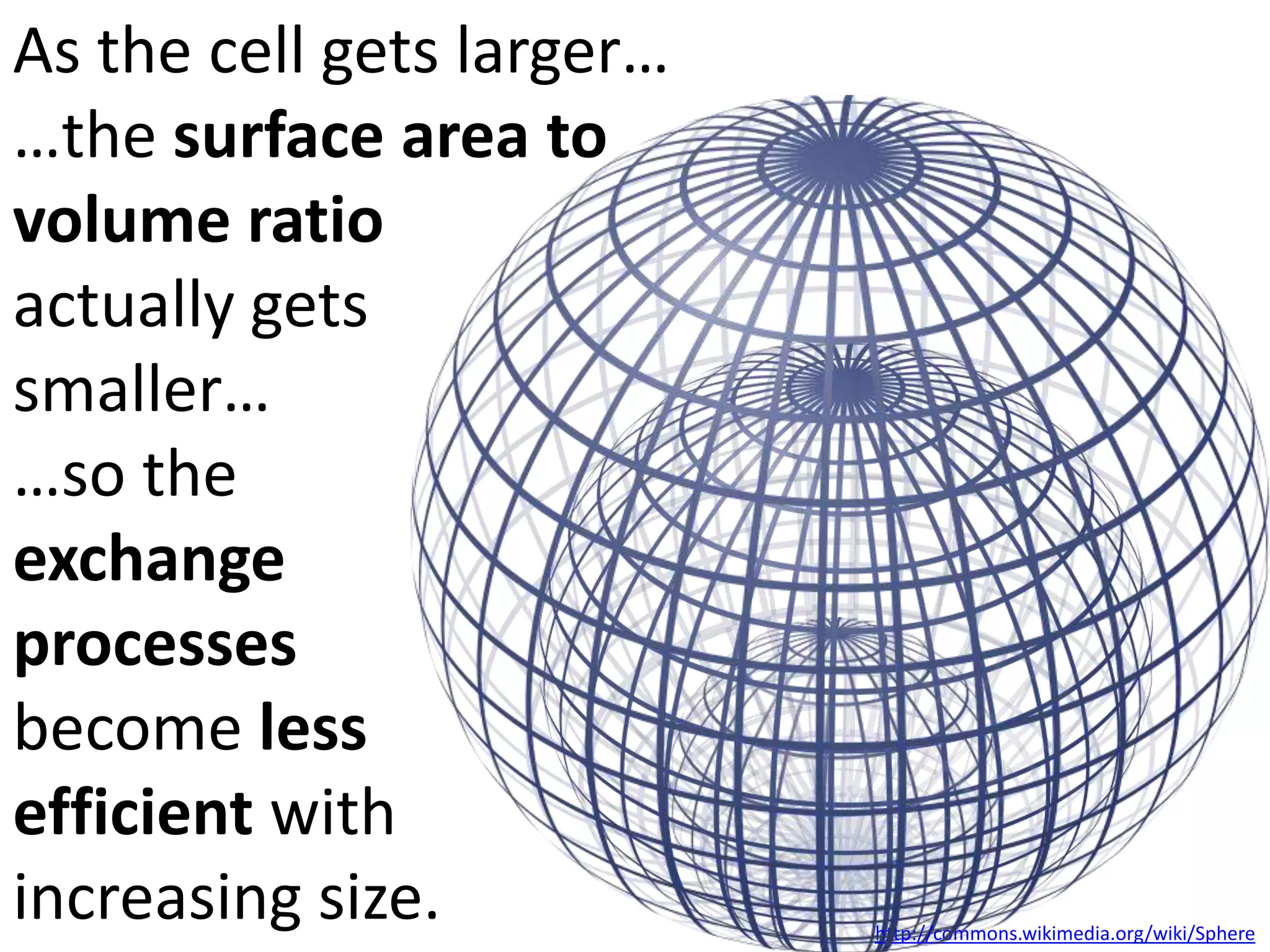
As the cell gets larger…
…the surface area to
volume ratio
actually gets
smaller…
…so the
exchange
processes
become less
efficient with
increasing size.

http://commons.wikimedia.org/wiki/Sphere
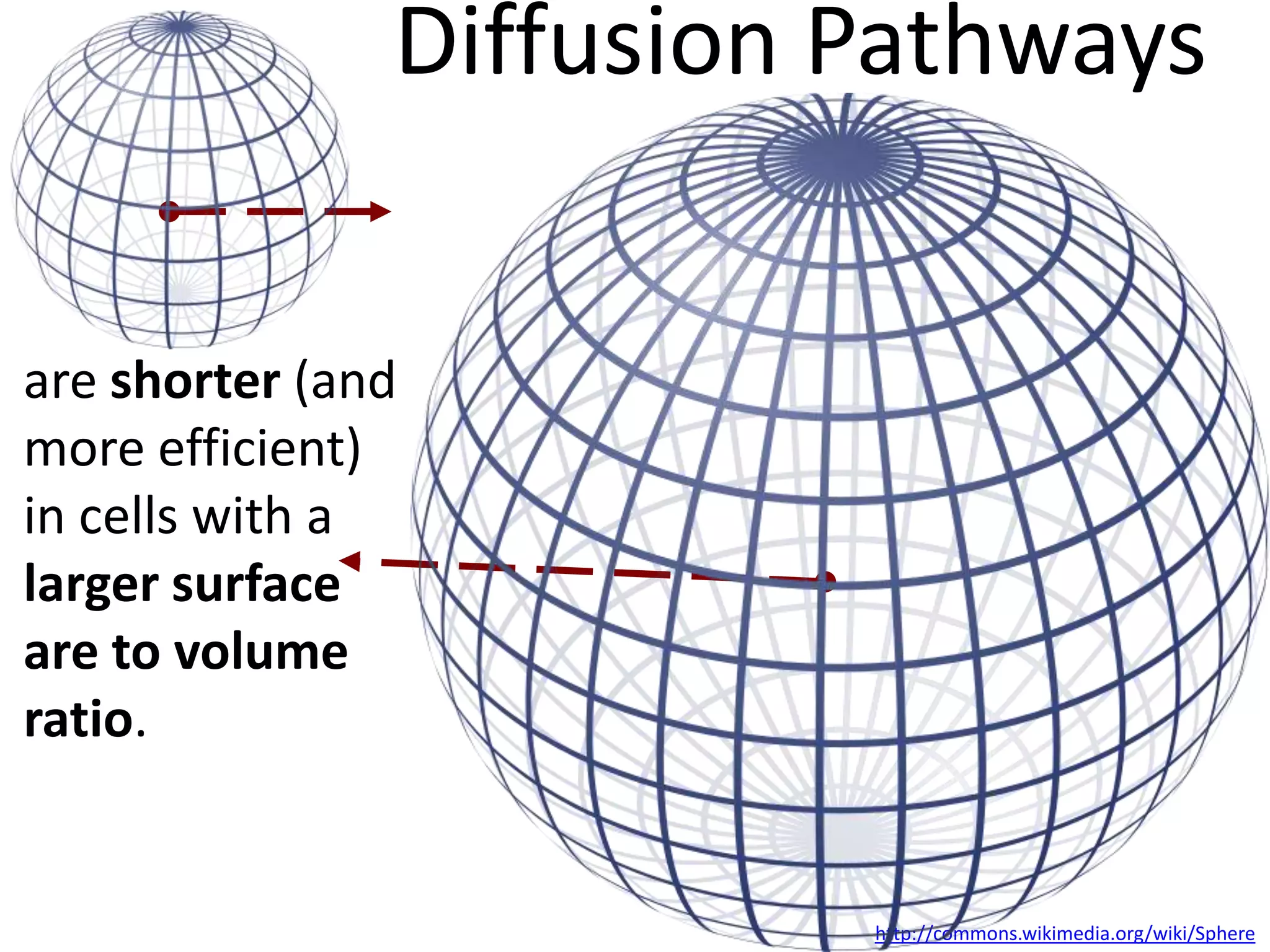
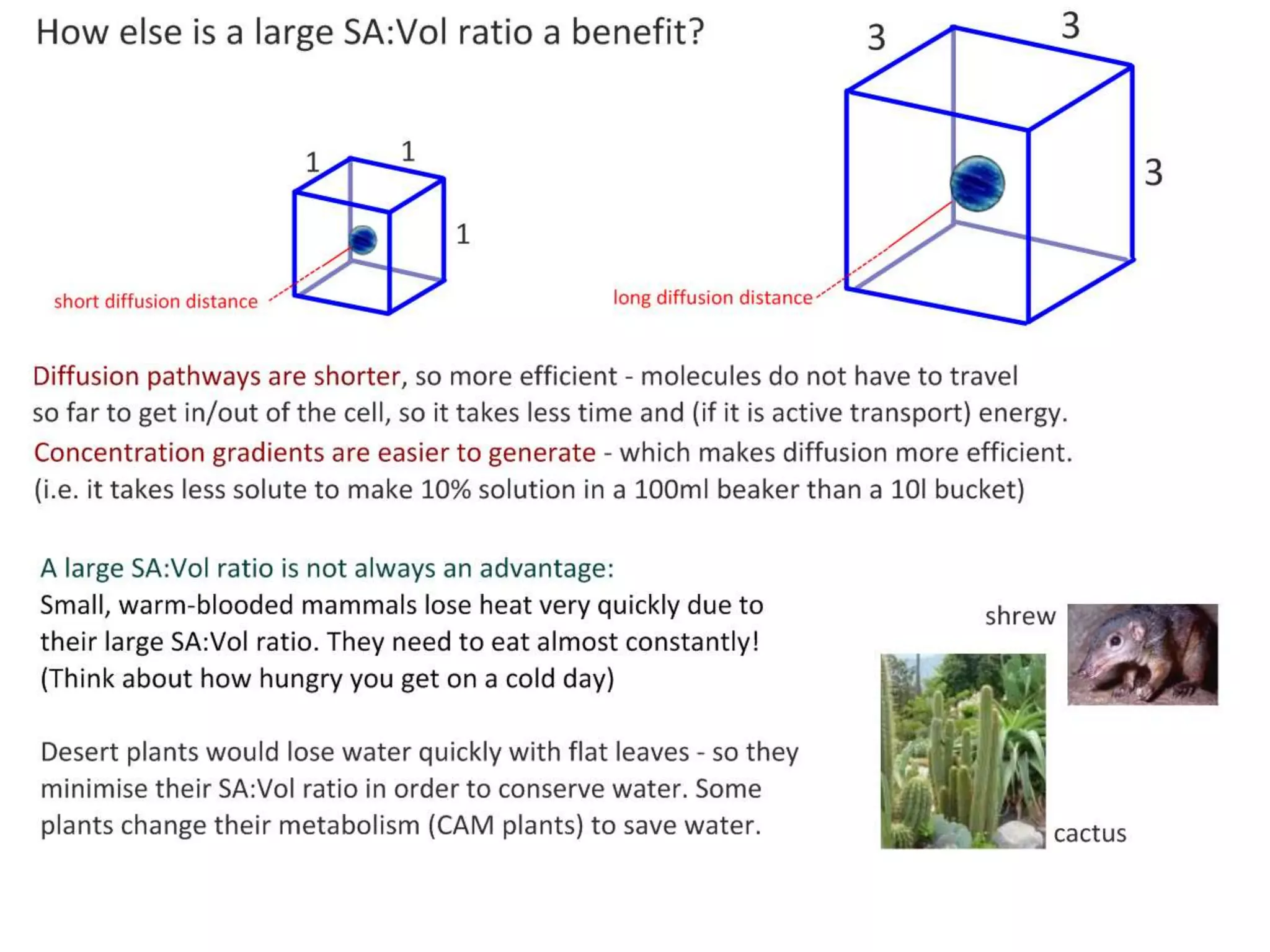
Diffusion Pathways
are shorter (and
more efficient)
in
with a larger
surface are to
volume ratio.

http://commons.wikimedia.org/wiki/Sphere
C
E
L
L
S

D
I
V
I
D
E

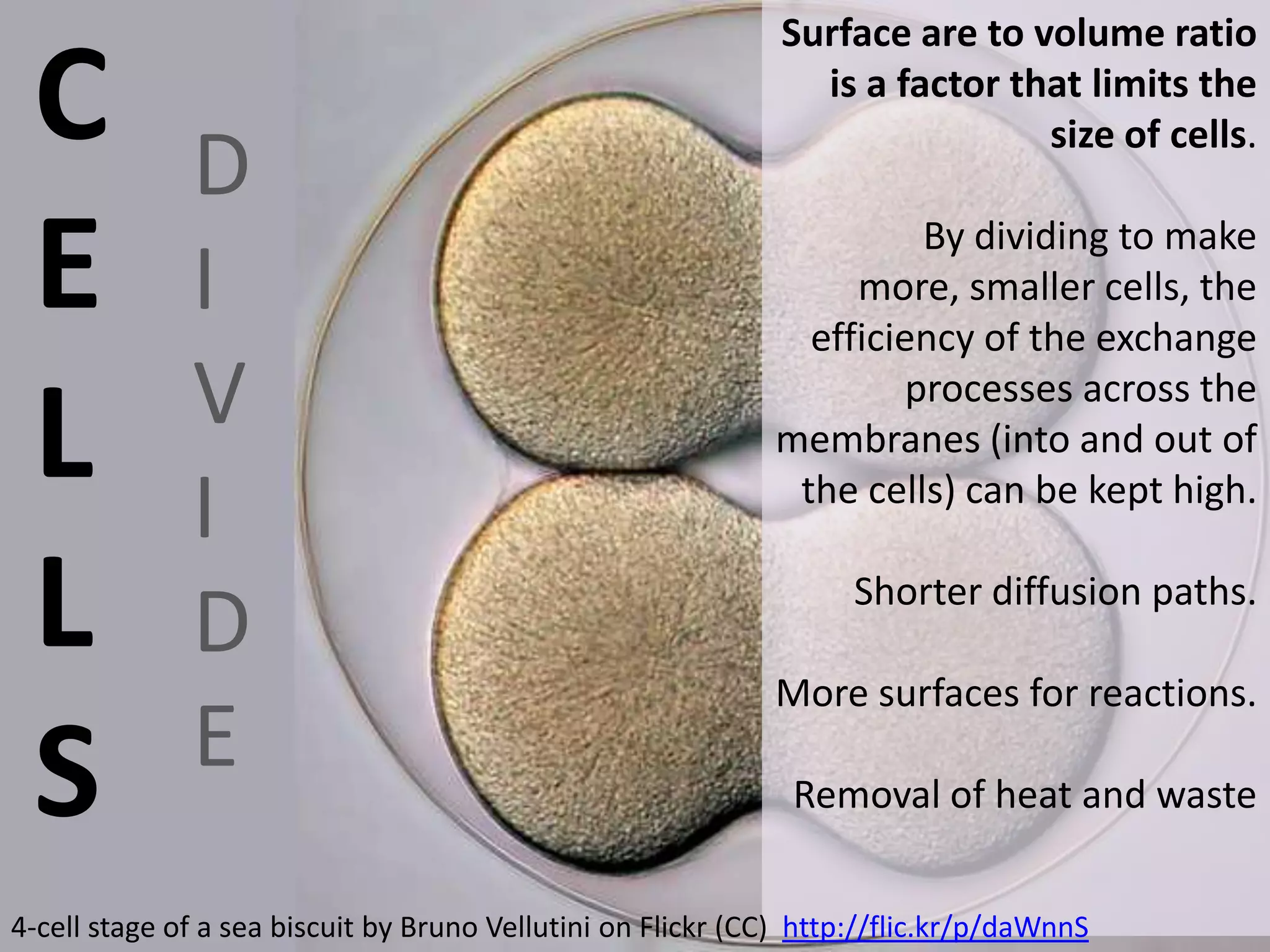
Surface are to volume ratio
is a factor that limits the
size of cells.
By dividing to make more,
smaller cells, the efficiency
of the exchange processes
across the membranes (into
and out of the cells) can be
kept high.
Shorter diffusion paths.
More surfaces for reactions.
Removal of heat and waste

4-cell stage of a sea biscuit by Bruno Vellutini on Flickr (CC) http://flic.kr/p/daWnnS
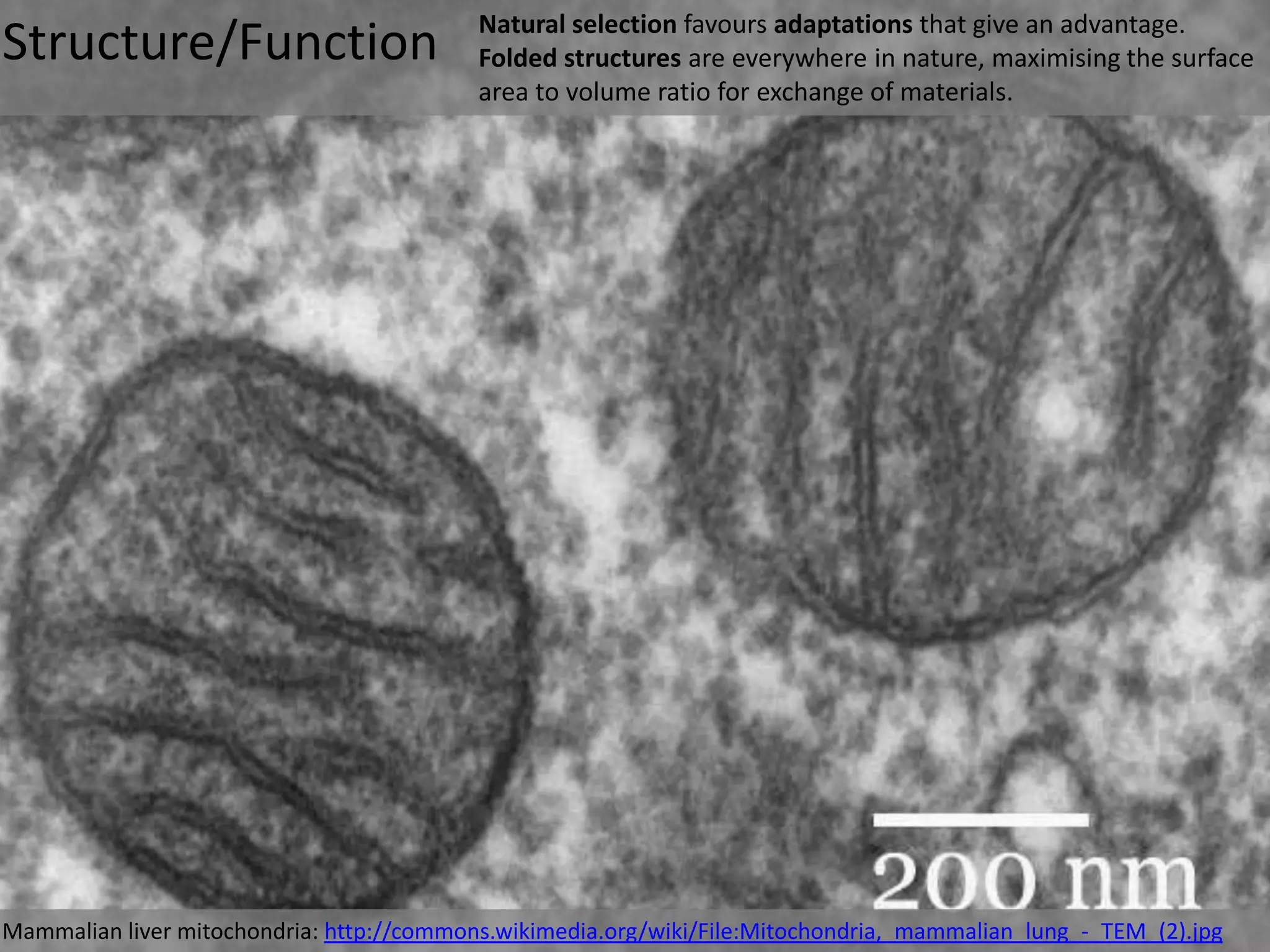
Structure/Function

Natural selection favours adaptations that give an advantage.
Folded structures are everywhere in nature, maximising the surface
area to volume ratio for exchange of materials.

Mammalian liver mitochondria: http://commons.wikimedia.org/wiki/File:Mitochondria,_mammalian_lung_-_TEM_(2).jpg
Big Cell Exceptions
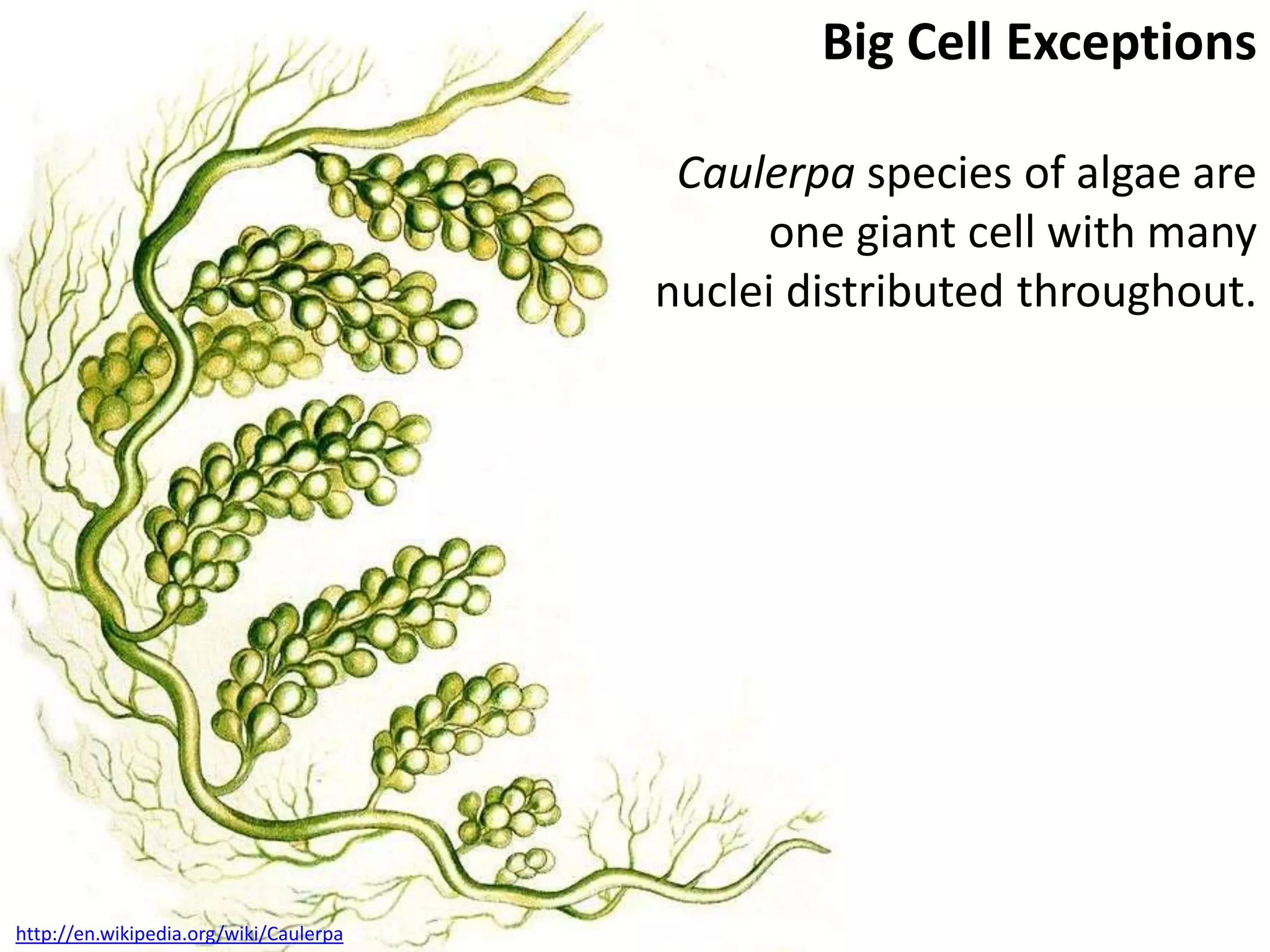
Caulerpa species of algae are
one giant cell with many
nuclei distributed throughout.

http://en.wikipedia.org/wiki/Caulerpa
Big Cell Exceptions
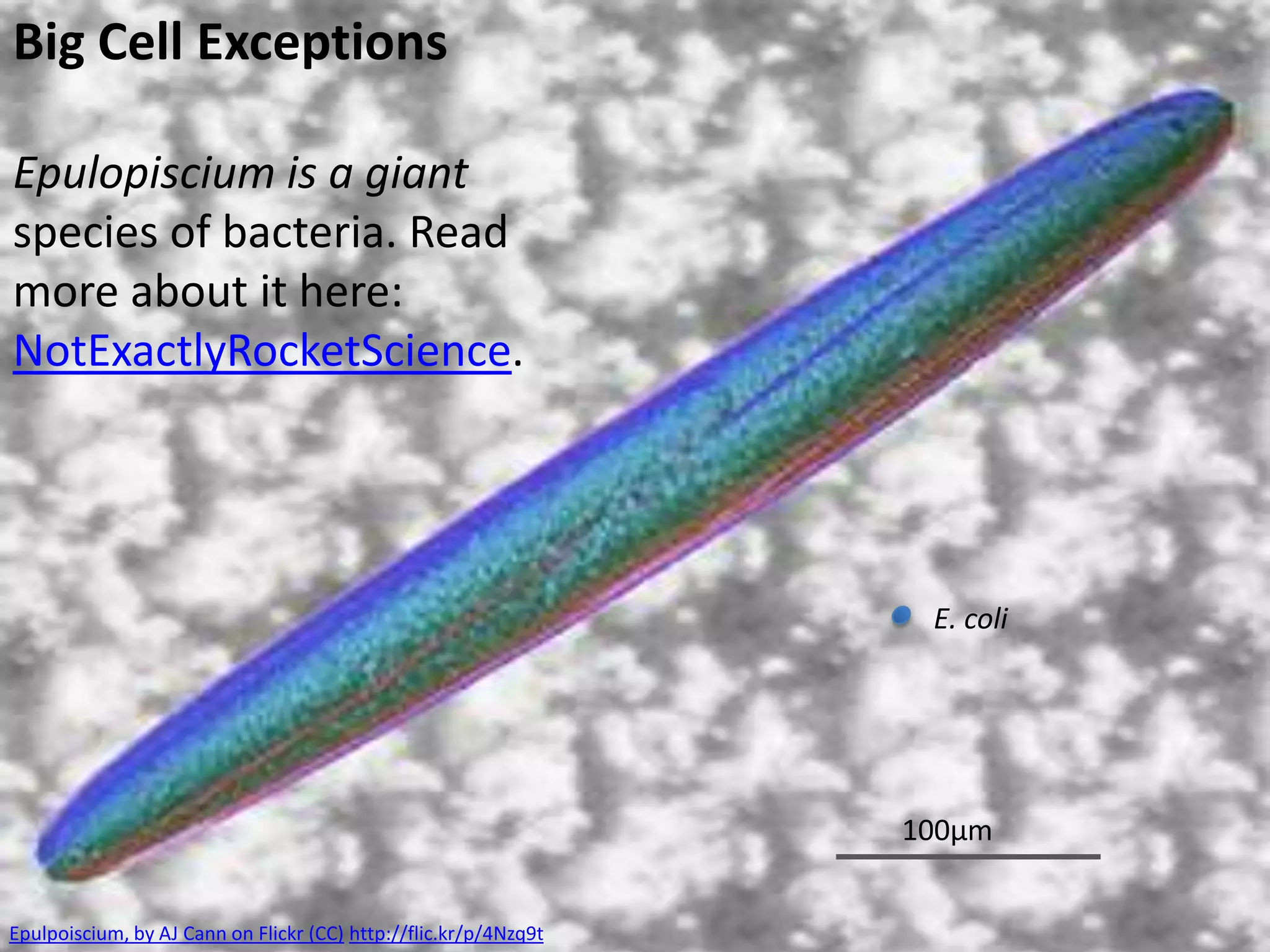
Epulopiscium is a giant
species of bacteria. Read
more about it here:
NotExactlyRocketScience.

E. coli

100μm
Epulpoiscium, by AJ Cann on Flickr (CC) http://flic.kr/p/4Nzq9t
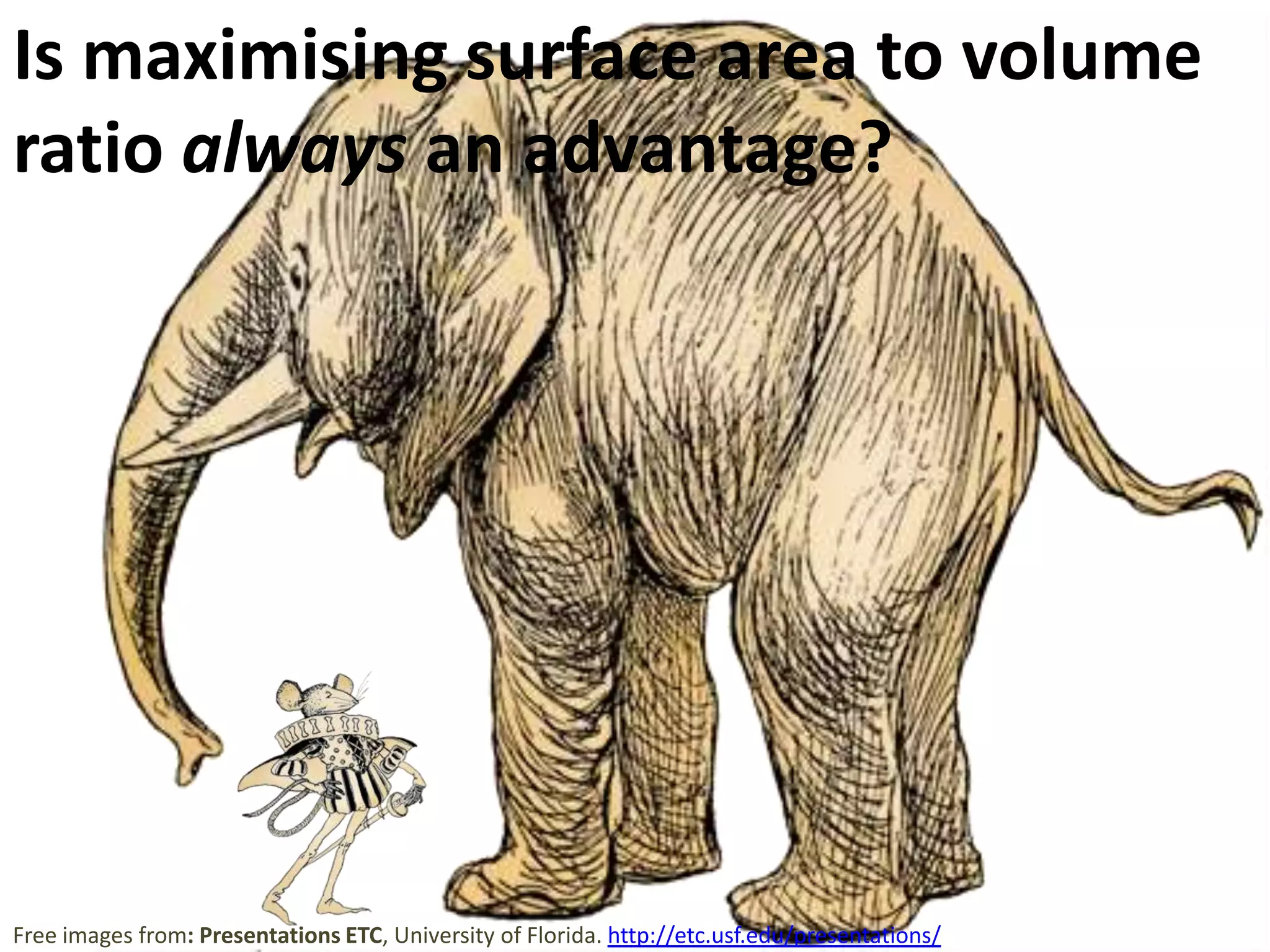
Is maximising surface area to volume
ratio always an advantage?

Free images from: Presentations ETC, University of Florida. http://etc.usf.edu/presentations/
Two Minute Essay
Explain the importance of surface area to
volume ratio as a factor limiting cell size.

Free images from: Presentations ETC, University of Florida. http://etc.usf.edu/presentations/
Exploration: which cools faster?
Add 30ml hot water to a small cup and to a petri dish.
Predict: Will one cool faster? Why?
Record: Take the temperature of each one every minute.
Describe or plot the results.

30ml

30ml
Design an investigation into the effect of SA:Vol ratio on exchange of…
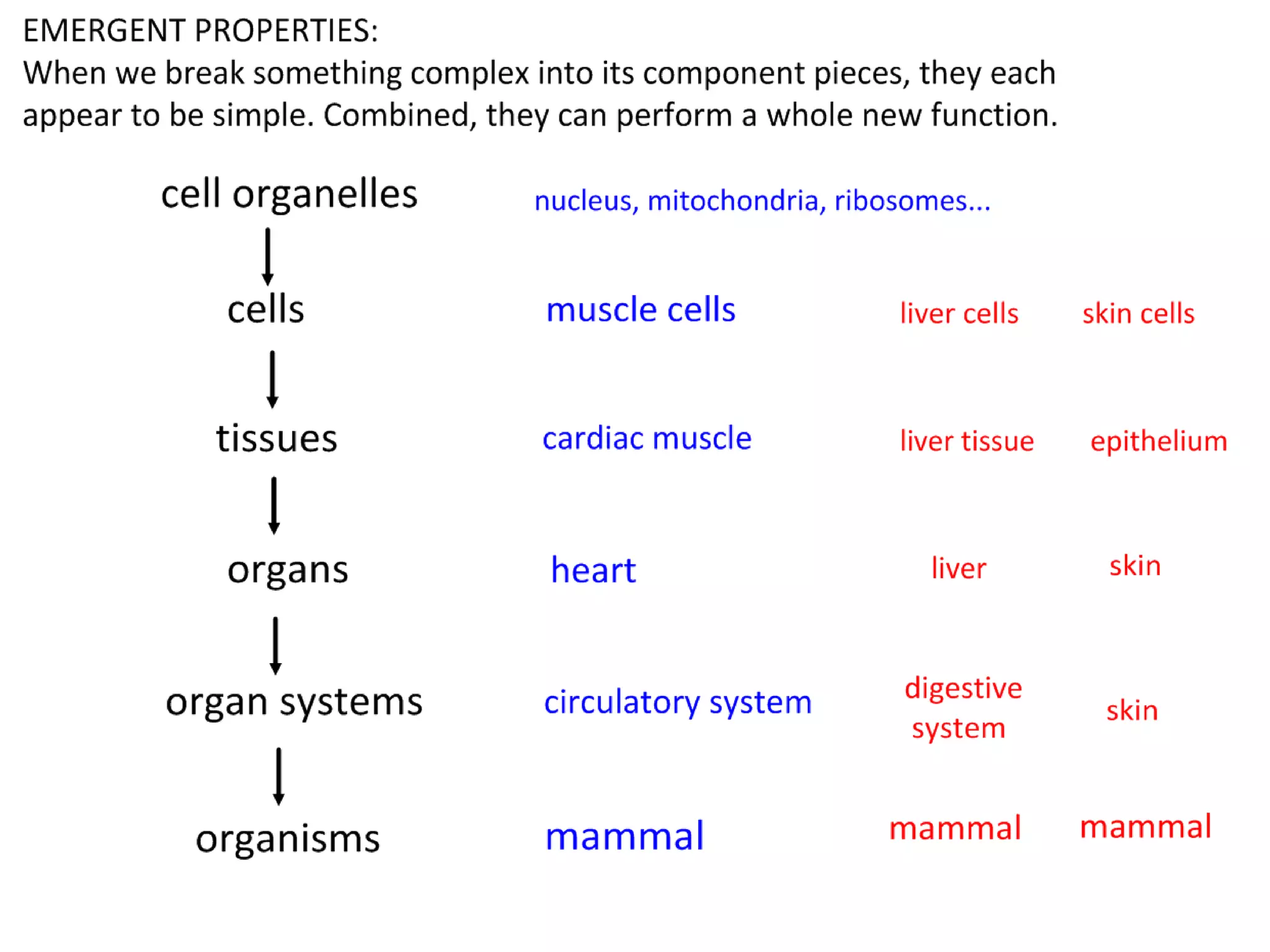
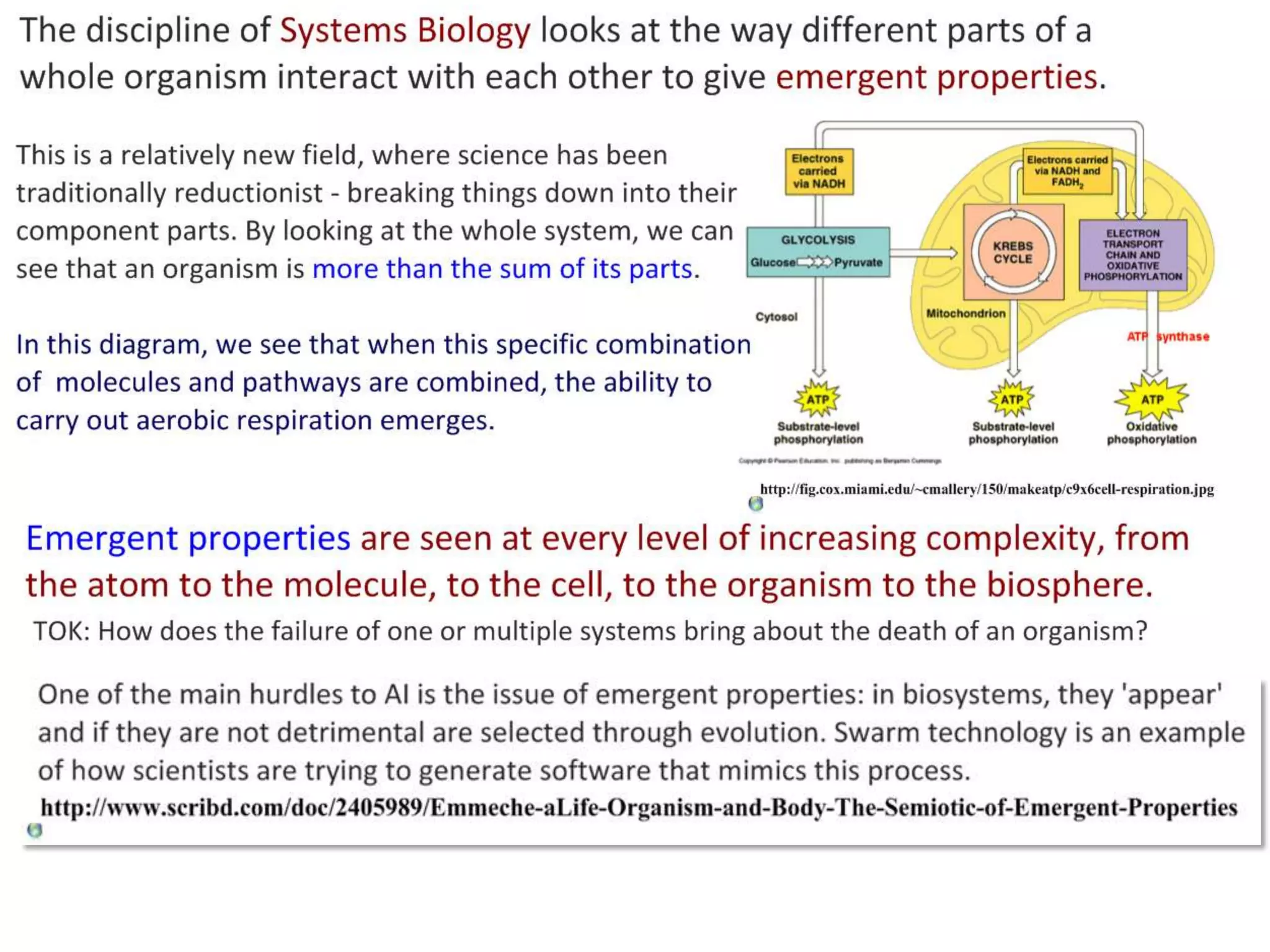
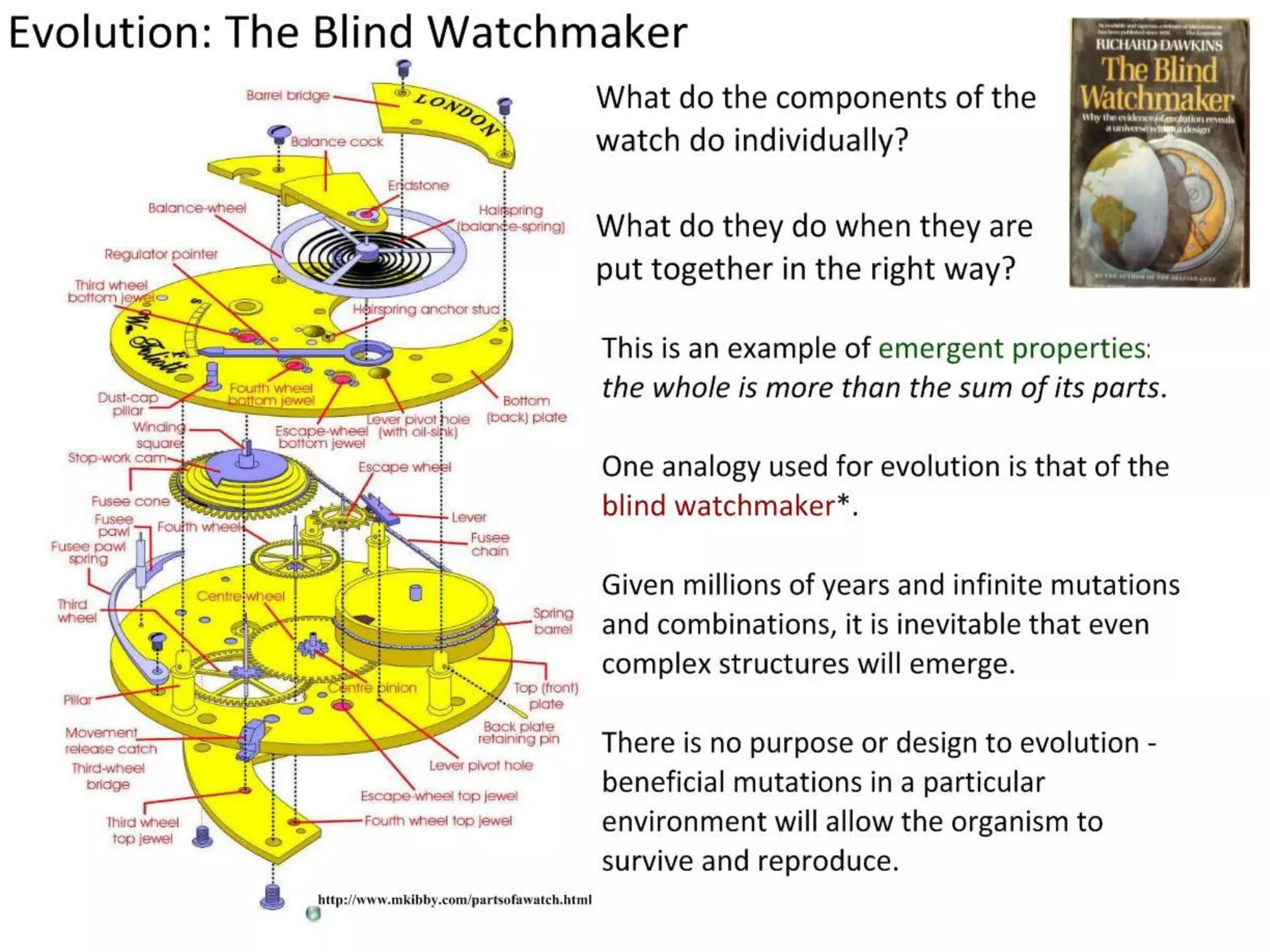
Emergent Properties
the whole is

more than the sum
of its parts

Photo by Stephen Taylor: http://www.flickr.com/photos/gurustip/9668701965/in/photostream
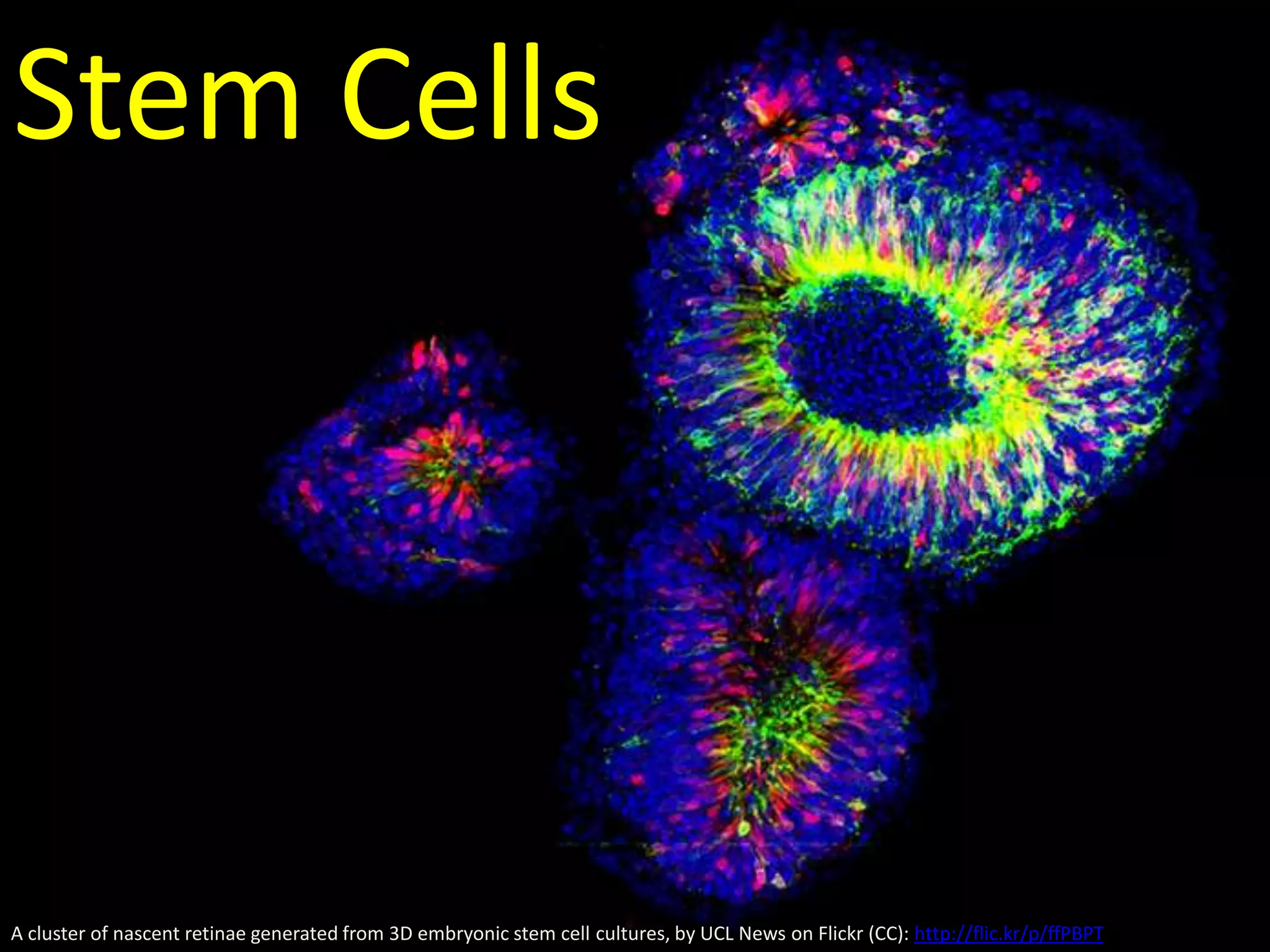
Stem Cells

A cluster of nascent retinae generated from 3D embryonic stem cell cultures, by UCL News on Flickr (CC): http://flic.kr/p/ffPBPT
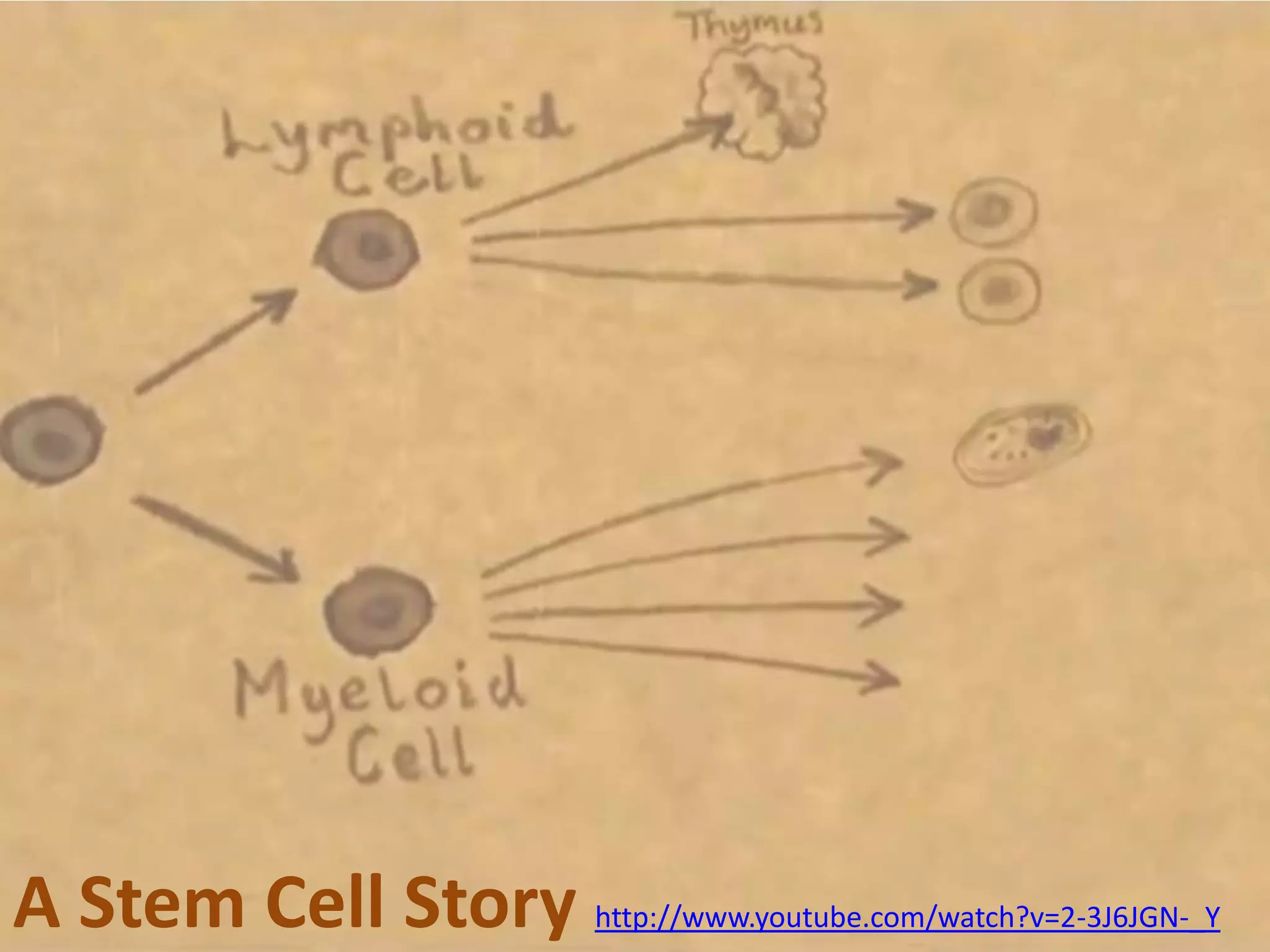
A Stem Cell Story

http://www.youtube.com/watch?v=2-3J6JGN-_Y
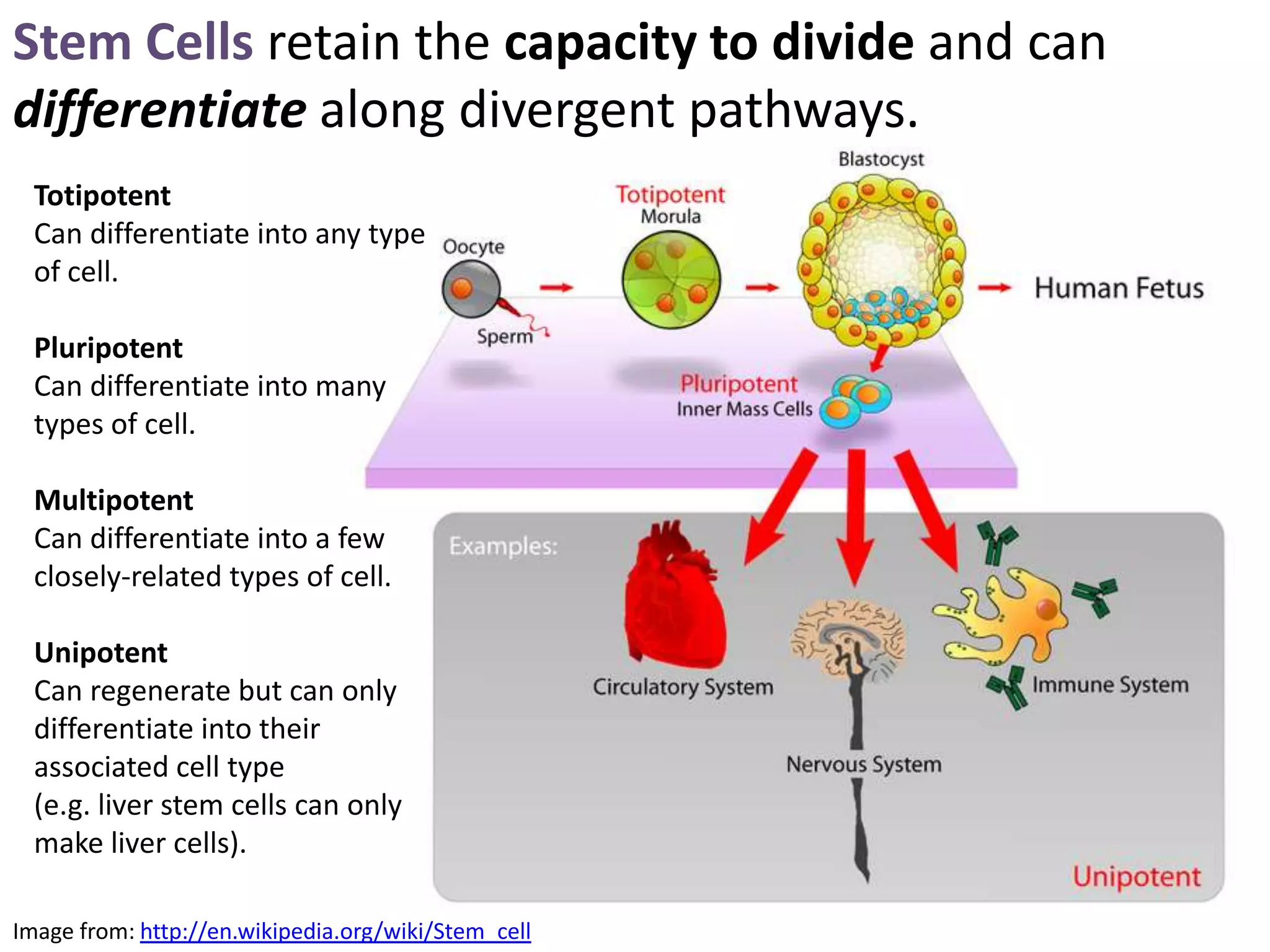
Stem Cells retain the capacity to divide and can
differentiate along divergent pathways.
Totipotent
Can differentiate into any type
of cell.
Pluripotent
Can differentiate into many
types of cell.
Multipotent
Can differentiate into a few
closely-related types of cell.
Unipotent
Can regenerate but can only
differentiate into their
associated cell type
(e.g. liver stem cells can only
make liver cells).
Image from: http://en.wikipedia.org/wiki/Stem_cell
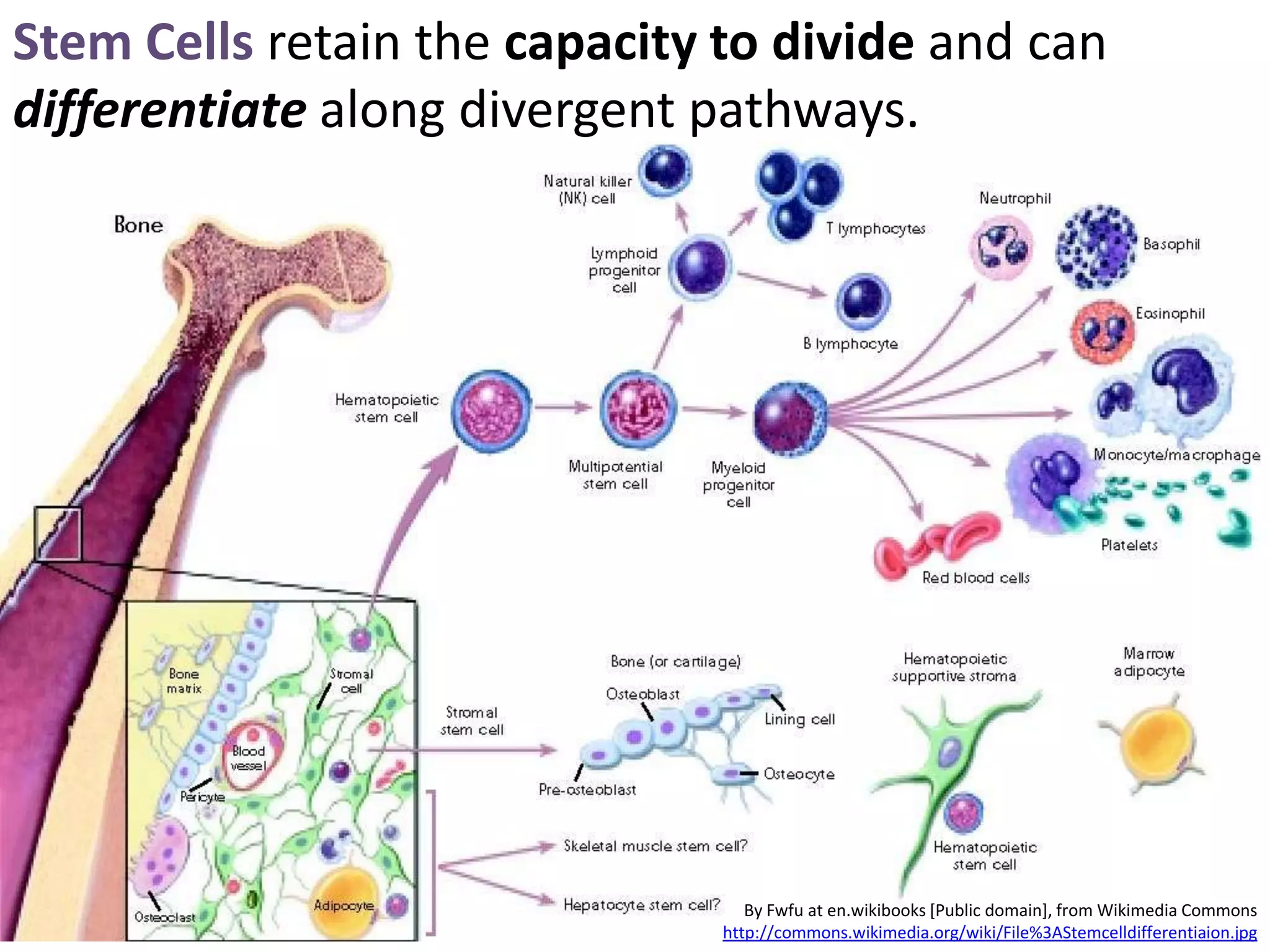
Stem Cells retain the capacity to divide and can
differentiate along divergent pathways.

By Fwfu at en.wikibooks [Public domain], from Wikimedia Commons
http://commons.wikimedia.org/wiki/File%3AStemcelldifferentiaion.jpg
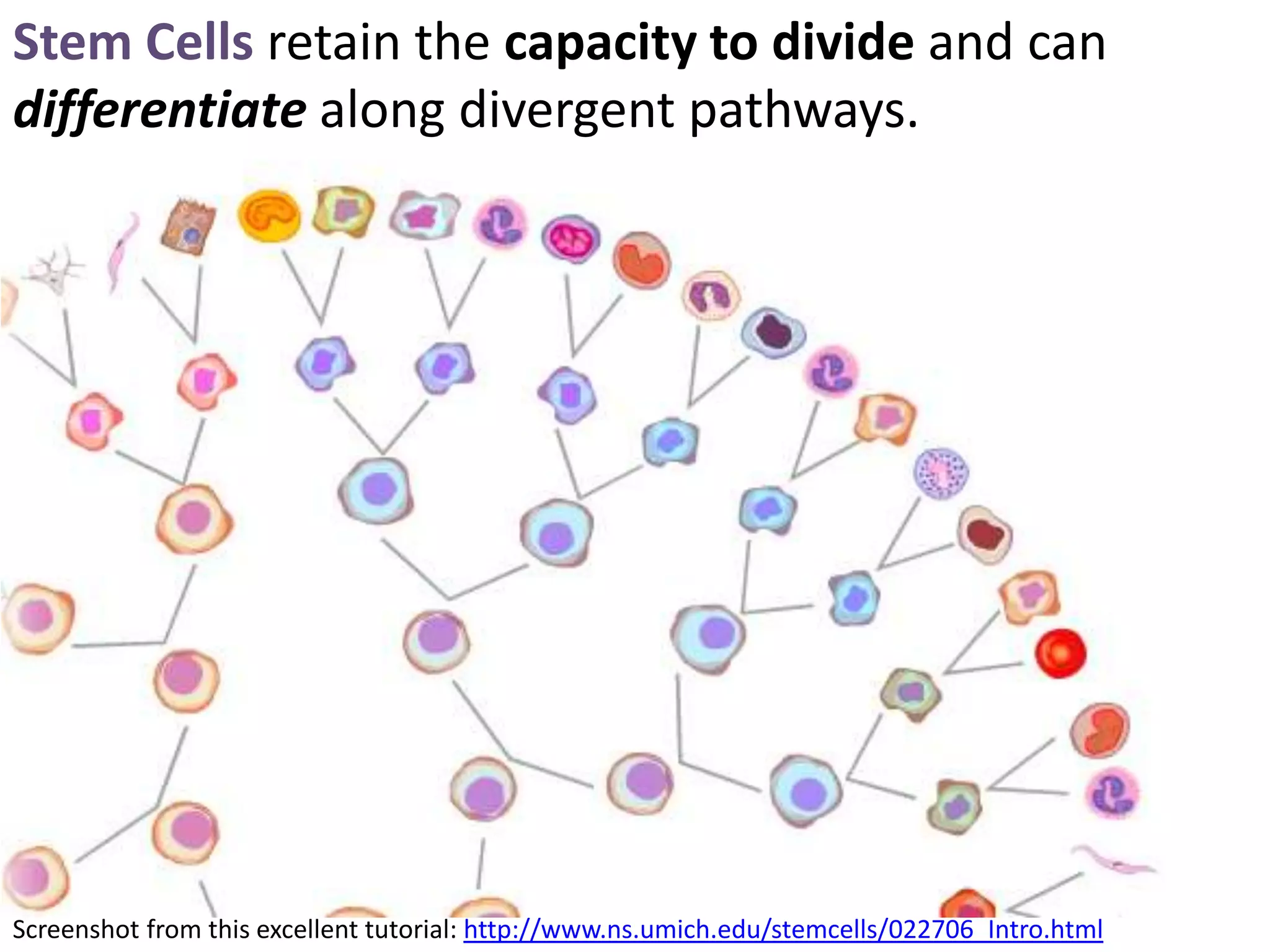
Stem Cells retain the capacity to divide and can
differentiate along divergent pathways.

Screenshot from this excellent tutorial: http://www.ns.umich.edu/stemcells/022706_Intro.html
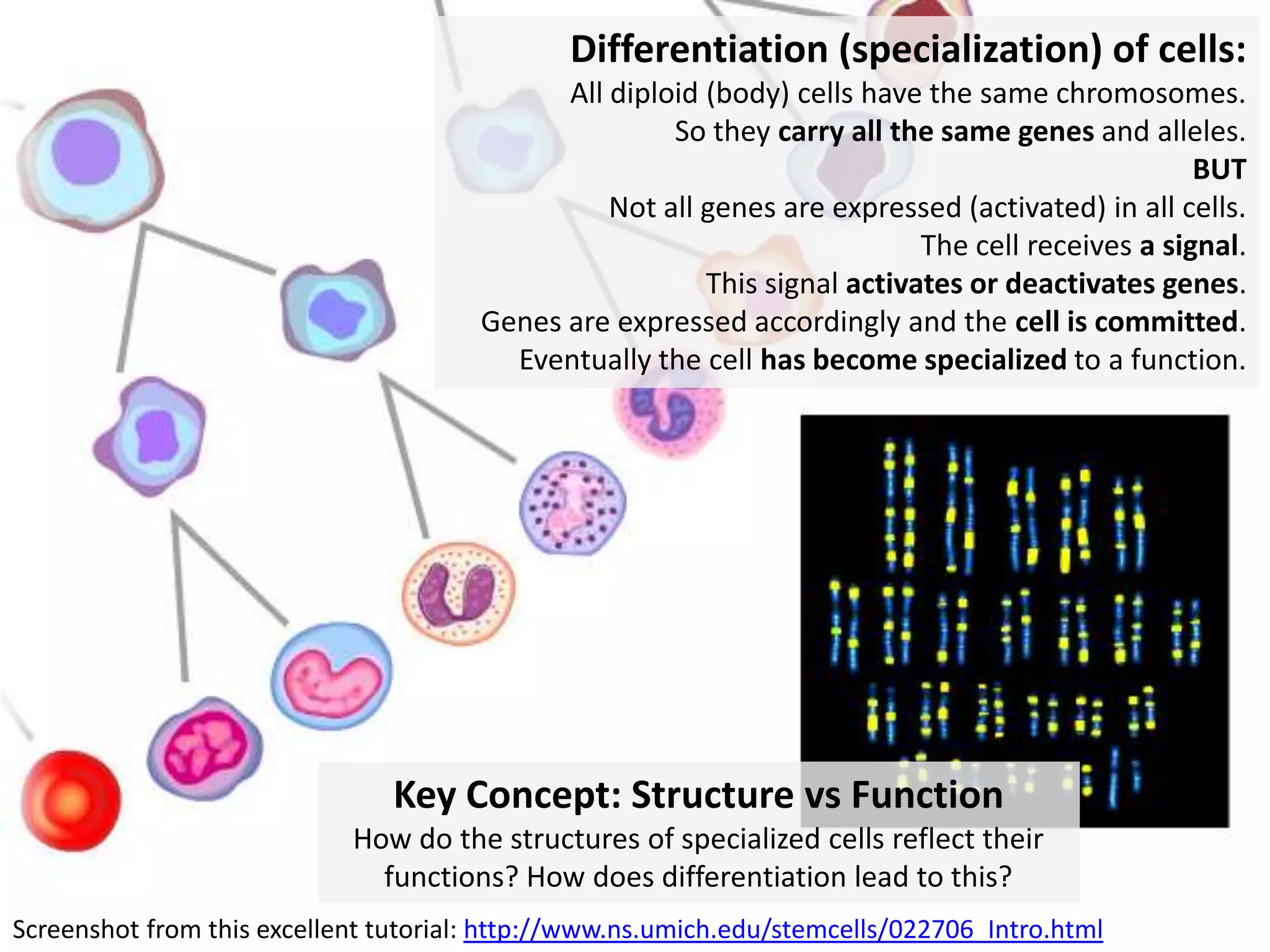
Differentiation (specialization) of cells:
All diploid (body) cells have the same chromosomes.
So they carry all the same genes and alleles.
BUT
Not all genes are expressed (activated) in all cells.
The cell receives a signal.
This signal activates or deactivates genes.
Genes are expressed accordingly and the cell is committed.
Eventually the cell has become specialized to a function.

Key Concept: Structure vs Function
How do the structures of specialized cells reflect their
functions? How does differentiation lead to this?
Screenshot from this excellent tutorial: http://www.ns.umich.edu/stemcells/022706_Intro.html
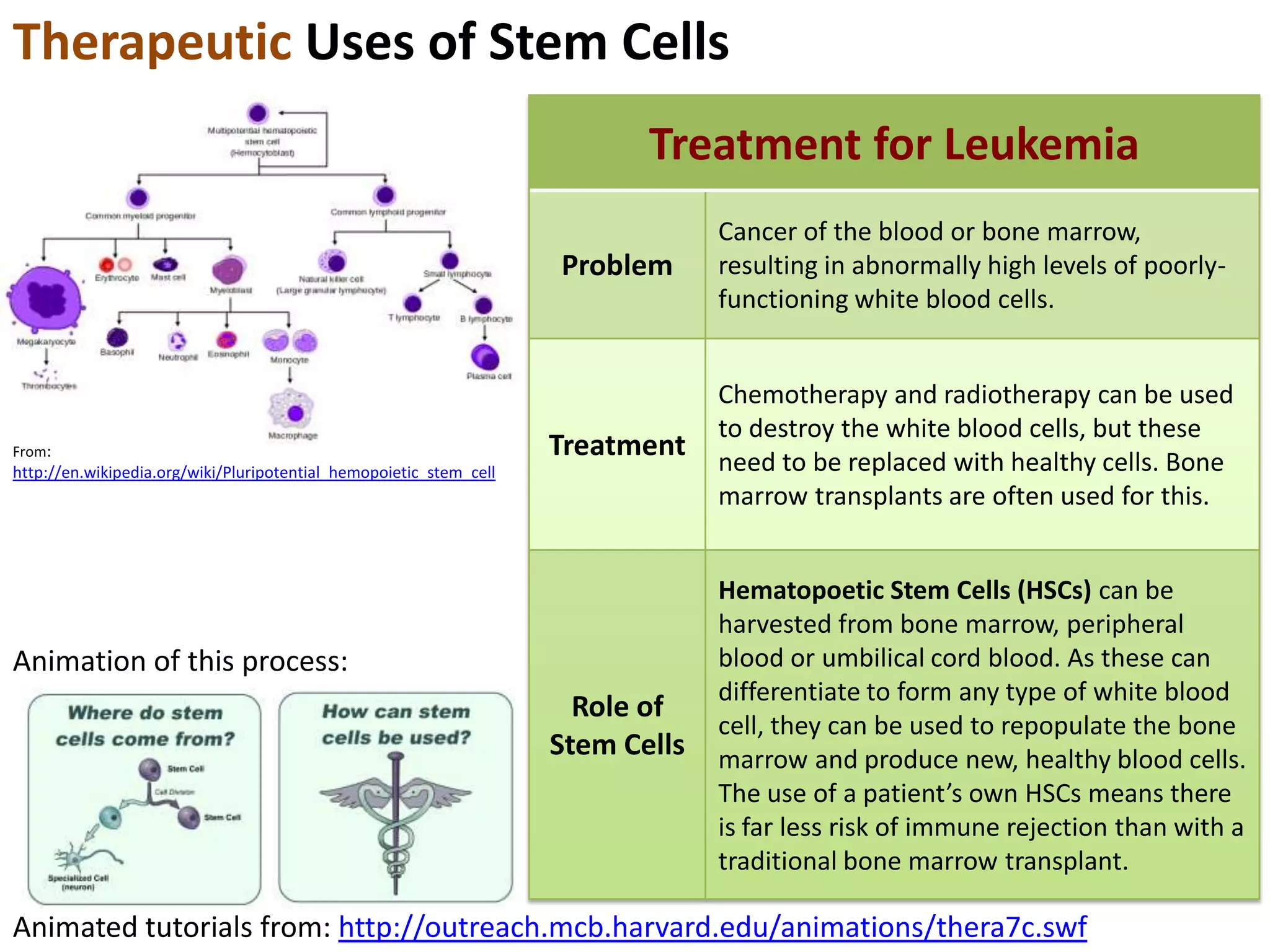
Therapeutic Uses of Stem Cells
Treatment for Leukemia
Problem

Treatment

Chemotherapy and radiotherapy can be used
to destroy the white blood cells, but these
need to be replaced with healthy cells. Bone
marrow transplants are often used for this.

Role of
Stem Cells

From:

Cancer of the blood or bone marrow,
resulting in abnormally high levels of poorlyfunctioning white blood cells.

Hematopoetic Stem Cells (HSCs) can be
harvested from bone marrow, peripheral
blood or umbilical cord blood. As these can
differentiate to form any type of white blood
cell, they can be used to repopulate the bone
marrow and produce new, healthy blood cells.
The use of a patient’s own HSCs means there
is far less risk of immune rejection than with a
traditional bone marrow transplant.

http://en.wikipedia.org/wiki/Pluripotential_hemopoietic_stem_cell

Animation of this process:

Animated tutorials from: http://outreach.mcb.harvard.edu/animations/thera7c.swf
Two Minute Essay
What is a stem cell?
How do stem cells differentiate into specialized cells?
Outline one therapeutic use of stem cells.

Free images from: Presentations ETC, University of Florida. http://etc.usf.edu/presentations/
For more resources & links
including many on Stem Cells.
Please consider a donation to charity via Biology4Good.
Click here for more information about Biology4Good charity donations.
This is a Creative Commons presentation. It may be linked and embedded but not sold or re-hosted.

Cell Theory

  • 1.
    Cell Theory Stephen Taylor i-Biology.net Image: Cellsby Filter Forge on Flickr http://flic.kr/p/ePXpR5
  • 2.
    All living thingsare made of C E L L S Longitudinal section of a root tip of Maize (Zea mays) by Science and Plants for Schools on Flickr (CC) http://flic.kr/p/bNNM6M
  • 3.
    All living thingsare made of Unicellular organisms are singlecelled and can carry out all of the functions of life independently. Multicellular organisms have specialized cells to carry out specific functions. C E L L S Longitudinal section of a root tip of Maize (Zea mays) by Science and Plants for Schools on Flickr (CC) http://flic.kr/p/bNNM6M
  • 4.
    C E L L S are the smallest unitsof life. Paramecium multimicronucleatum by Proyecto Agua on Flickr (CC) http://flic.kr/p/7W7J3y
  • 5.
    C E L L S are the smallest unitsof life. Specialized structures within cells (organelles) carry out different functions. Organelles cannot survive alone. Paramecium multimicronucleatum by Proyecto Agua on Flickr (CC) http://flic.kr/p/7W7J3y
  • 6.
    C come only E from Lexisting cells. L S 4-cell stage of a sea biscuit by Bruno Vellutini on Flickr (CC) http://flic.kr/p/daWnnS
  • 7.
    C come only E from Lexisting cells. L S Cells multiply through division. All life evolved from simpler ancestors. Mitosis results in genetically identical diploid daughter cells. Meiosis generates haploid gametes (sex cells). Pasteur disproved the theory of spontaneous generation with his experiments. 4-cell stage of a sea biscuit by Bruno Vellutini on Flickr (CC) http://flic.kr/p/daWnnS
  • 9.
    1665 Hooke names “cells”in his book “Micrographia” after observing cork under a lense. All living things are made of cells. Hooke’s Micrographia in full! http://lhldigital.lindahall.org/cdm/ref/collection/nat_hist/id/0
  • 10.
    All living thingsare made of cells. 1676 van Leeuwenhoek, a master microscope maker identifies “animalcules” and becomes the father of microbiology. http://en.wikipedia.org/wiki/Antonie_van_Leeuwenhoek
  • 11.
    1833 Robert Brown namesthe cell nucleus. Cells are the smallest units of life. He also discovered Brownian motion: Robert Brown: http://en.wikipedia.org/wiki/Robert_Brown_(botanist) http://en.wikipedia.org/wiki/Brownian_motion
  • 12.
    1855 Robert Remak discoverscell division and confirms the existence of the plasma membrane. Cells come only from pre-existing cells. Robert Remak: http://en.wikipedia.org/wiki/Robert_Remak
  • 13.
    1864 Pasteur disproves theprevailing theory of “spontaneous generation” with his swan-neck flask experiments. Populations need to be seeded by existing populations: cells come only from pre-existing cells. Image from Amoeba Mike’s Blog (go read the original post): http://amoebamike.wordpress.com/2009/10/06/spontaneousgeneration-a-brief-history-of-disproving-it
  • 14.
    Labeling the partsof the microscope activity: http://www.biology.ualberta.ca/facilities/multimedia/uploads/intro-biology/microscope.html
  • 15.
    Magnification The image wesee through the light microscope has been magnified. Objective lens x eyepiece lens Image from wikimedia commons: http://commons.wikimedia.org/wiki/File:Microscope-blank.svg
  • 16.
    Modern Microscopy Image: d2540-6by USDA on Flickr (CC): http://flic.kr/p/dPqvvY
  • 17.
    Modern Microscopy As wedevelop more and more sophisticated and precise imaging tools, we can see more detail of the cells and molecules that make us. Scanning electron microscopes deliver highresolution, 3D surface images of structures, whereas transmission electron microscopes give us a view inside cells and organelles. Image: d2540-6 by USDA on Flickr (CC): http://flic.kr/p/dPqvvY
  • 18.
    Emiliana huxleyi Image from:http://earthguide.ucsd.edu/earthguide/imagelibrary/emilianiahuxleyi.html
  • 19.
    Transmission electron micrographof HIV particles. 120nm HIV-1. Transmission electron micrograph, via wikimedia commons: http://commons.wikimedia.org/wiki/File%3AHIV1_Transmission_electron_micrograph_AIDS02bbb_lores.jpg
  • 20.
    Scanning electron micrographof HIV particles budding on a human lymphocyte. 1μm False-coloured scanning electron micrograph of HIV (green) budding on a lymphicoyte (blue) http://en.wikipedia.org/wiki/File:HIV-budding-Color.jpg OR http://phil.cdc.gov/phil/details.asp?pid=10000
  • 22.
    Unicellular Organisms carry outall the functions of life M ovement R espiration S ensitivity G rowth R eproduction E xcretion N utrition Paramecium bursaria by Proyecto Agua on Flickr (CC) http://flic.kr/p/7WXdFz
  • 23.
    Given the rightconditions, cells can survive outside their normal habitat. Art from Petri dishes_1 by Image in Science and Art on Flickr (CC) http://flic.kr/p/838xjC
  • 24.
    VIRUSES Are they livingor non-living? Hmm….. Image: Swine Flu H1N1 virus influenza 9.0 by hitthatswitch on Flickr (CC) http://flic.kr/p/74e4SP
  • 25.
    Some units thatI use & know Unit abbr. Metric equivalent kilometer km 1,000m 1 x 10³m meter m 1m 1m centimeter cm 0.01m 1 x 10⁻²m mm 0.001m 1 x 10⁻³m millimeter micrometer nanometer μm nm write this correctly 0.000 001m 0.000 000 001m 1x 10⁻⁶m 1x 10⁻⁹m μm = micrometers We usually use this in discussion of cells. There are 1,000μm in one mm. X 1,000 ÷1,000 ÷1,000 ÷1,000
  • 38.
    50μm Human egg cell,from Gray’s Anatomy (1858). http://commons.wikimedia.org/wiki/Gray%27s_Anatomy_plates
  • 39.
    5μm Human sperm cell,from Gray’s Anatomy (1858). http://commons.wikimedia.org/wiki/Gray%27s_Anatomy_plates
  • 40.
    Scanning electron micrographof human sperm and egg cells. 5μm Image from wikimedia commons http://en.wikipedia.org/wiki/Spermatozoon
  • 41.
    Which dissolves faster:sugar cubes or sugar crystals? Why? Sugar Cubes by Uwe Hermann on Flickr (CC) http://flic.kr/p/cFMMc
  • 42.
    What will gocold faster: French fries or a baked potato? Why? French Fries by Ian Britton on Flickr (CC) http://flic.kr/p/6RLQ8j
  • 43.
    Which makes greentea faster: tea leaves or powder? Matcha Latte by Cupcake Murder Aftermatch on Flickr (CC) http://flic.kr/p/fCkpb5
  • 44.
    What type ofcrisps delivers more flavour: regular-cut or crinkle-cut? Why? Smiths Plain Chips by Penguin Cakes on Flickr (CC) http://flic.kr/p/5ygb8v
  • 45.
    IN:  Oxygen  Nutrients Water The plasma membrane of a cell is the surface of exchange for materials between the inside and the outside of the cell. OUT:  Carbon dioxide  Waste  Products (e.g. proteins) http://commons.wikimedia.org/wiki/Sphere
  • 46.
    As the cellgets larger, it requires more resources to be imported and produces more products (and waste) to be exported. Therefore, a larger volume requires more exchange across the membrane. http://commons.wikimedia.org/wiki/Sphere
  • 47.
    As the cellgets larger… http://commons.wikimedia.org/wiki/Sphere
  • 48.
    As the cellgets larger… …the surface area to volume ratio actually gets smaller… http://commons.wikimedia.org/wiki/Sphere
  • 49.
    As the cellgets larger… …the surface area to volume ratio actually gets smaller… …so the exchange processes become less efficient with increasing size. http://commons.wikimedia.org/wiki/Sphere
  • 50.
    Diffusion Pathways are shorter(and more efficient) in with a larger surface are to volume ratio. http://commons.wikimedia.org/wiki/Sphere
  • 53.
    C E L L S D I V I D E Surface are tovolume ratio is a factor that limits the size of cells. By dividing to make more, smaller cells, the efficiency of the exchange processes across the membranes (into and out of the cells) can be kept high. Shorter diffusion paths. More surfaces for reactions. Removal of heat and waste 4-cell stage of a sea biscuit by Bruno Vellutini on Flickr (CC) http://flic.kr/p/daWnnS
  • 54.
    Structure/Function Natural selection favoursadaptations that give an advantage. Folded structures are everywhere in nature, maximising the surface area to volume ratio for exchange of materials. Mammalian liver mitochondria: http://commons.wikimedia.org/wiki/File:Mitochondria,_mammalian_lung_-_TEM_(2).jpg
  • 55.
    Big Cell Exceptions Caulerpaspecies of algae are one giant cell with many nuclei distributed throughout. http://en.wikipedia.org/wiki/Caulerpa
  • 56.
    Big Cell Exceptions Epulopisciumis a giant species of bacteria. Read more about it here: NotExactlyRocketScience. E. coli 100μm Epulpoiscium, by AJ Cann on Flickr (CC) http://flic.kr/p/4Nzq9t
  • 57.
    Is maximising surfacearea to volume ratio always an advantage? Free images from: Presentations ETC, University of Florida. http://etc.usf.edu/presentations/
  • 58.
    Two Minute Essay Explainthe importance of surface area to volume ratio as a factor limiting cell size. Free images from: Presentations ETC, University of Florida. http://etc.usf.edu/presentations/
  • 59.
    Exploration: which coolsfaster? Add 30ml hot water to a small cup and to a petri dish. Predict: Will one cool faster? Why? Record: Take the temperature of each one every minute. Describe or plot the results. 30ml 30ml
  • 60.
    Design an investigationinto the effect of SA:Vol ratio on exchange of…
  • 61.
    Emergent Properties the wholeis more than the sum of its parts Photo by Stephen Taylor: http://www.flickr.com/photos/gurustip/9668701965/in/photostream
  • 65.
    Stem Cells A clusterof nascent retinae generated from 3D embryonic stem cell cultures, by UCL News on Flickr (CC): http://flic.kr/p/ffPBPT
  • 66.
    A Stem CellStory http://www.youtube.com/watch?v=2-3J6JGN-_Y
  • 67.
    Stem Cells retainthe capacity to divide and can differentiate along divergent pathways. Totipotent Can differentiate into any type of cell. Pluripotent Can differentiate into many types of cell. Multipotent Can differentiate into a few closely-related types of cell. Unipotent Can regenerate but can only differentiate into their associated cell type (e.g. liver stem cells can only make liver cells). Image from: http://en.wikipedia.org/wiki/Stem_cell
  • 68.
    Stem Cells retainthe capacity to divide and can differentiate along divergent pathways. By Fwfu at en.wikibooks [Public domain], from Wikimedia Commons http://commons.wikimedia.org/wiki/File%3AStemcelldifferentiaion.jpg
  • 69.
    Stem Cells retainthe capacity to divide and can differentiate along divergent pathways. Screenshot from this excellent tutorial: http://www.ns.umich.edu/stemcells/022706_Intro.html
  • 70.
    Differentiation (specialization) ofcells: All diploid (body) cells have the same chromosomes. So they carry all the same genes and alleles. BUT Not all genes are expressed (activated) in all cells. The cell receives a signal. This signal activates or deactivates genes. Genes are expressed accordingly and the cell is committed. Eventually the cell has become specialized to a function. Key Concept: Structure vs Function How do the structures of specialized cells reflect their functions? How does differentiation lead to this? Screenshot from this excellent tutorial: http://www.ns.umich.edu/stemcells/022706_Intro.html
  • 71.
    Therapeutic Uses ofStem Cells Treatment for Leukemia Problem Treatment Chemotherapy and radiotherapy can be used to destroy the white blood cells, but these need to be replaced with healthy cells. Bone marrow transplants are often used for this. Role of Stem Cells From: Cancer of the blood or bone marrow, resulting in abnormally high levels of poorlyfunctioning white blood cells. Hematopoetic Stem Cells (HSCs) can be harvested from bone marrow, peripheral blood or umbilical cord blood. As these can differentiate to form any type of white blood cell, they can be used to repopulate the bone marrow and produce new, healthy blood cells. The use of a patient’s own HSCs means there is far less risk of immune rejection than with a traditional bone marrow transplant. http://en.wikipedia.org/wiki/Pluripotential_hemopoietic_stem_cell Animation of this process: Animated tutorials from: http://outreach.mcb.harvard.edu/animations/thera7c.swf
  • 72.
    Two Minute Essay Whatis a stem cell? How do stem cells differentiate into specialized cells? Outline one therapeutic use of stem cells. Free images from: Presentations ETC, University of Florida. http://etc.usf.edu/presentations/
  • 75.
    For more resources& links including many on Stem Cells. Please consider a donation to charity via Biology4Good. Click here for more information about Biology4Good charity donations. This is a Creative Commons presentation. It may be linked and embedded but not sold or re-hosted.