OSMOSIS AND
DIFUSSION OF
THE CELL
MEMBRANE
CHARACTERISTIC OF CELL
        MEMBRANE
 Composed   of phospholipid,
 cholesterol, proteins & chains of
 oligosaccharides

 Range     of thickness : 7.5 nm – 10 nm

 Visible   only in the electron microscope
STRUCTURE OF CELL
    MEMBRANE
FUNCTIONS OF CELL MEMBRANE
Selective Permeability
  • Size, charge, chemical properties of
     atoms / molecules determine whether
     the success in getting through the
     membrane

Physical Barrier
  • Separates substances inside and
    outside of the cell
Act As Communicator
  • Communication between cells & its
    environment can occur because it contains
    receptors that recognize & respond to
    molecular signals


Allows Intercellular Connection
   • Establish a flexible boundary, protects
     cellular contents and also supports cell
     structure
Transport Across
                                        The Cell
                                       Membrane


             Passive                   Active Transport         Vesicle Transport
            Transport


 Simple     Facilitated              Primary     Secondary
Diffusion                 Osmosis                            Endocytosis   Exocytosis
             Diffusion
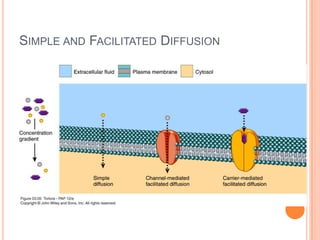
SIMPLE AND FACILITATED DIFFUSION
 Passive transport
 Goes down the concentration gradient

 From high concentration to low concentration of
  solute
 Does not require energy (ATP)
SIMPLE DIFFUSION ACROSS A PLASMA
MEMBRANE
 Movement of small molecule through phospholipid
  bilayer.
 Lipid soluble molecule due to hydrophobic
  characteristic of the bilayer.
FACILITATED DIFFUSION ACROSS A PLASMA
MEMBRANE
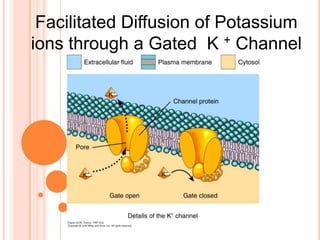
 Diffusion of large molecules
 Requires carrier protein

 Each carrier protein is specific for one molecule

 Example – Potassium diffusion.
Facilitated Diffusion of Potassium
ions through a Gated K + Channel
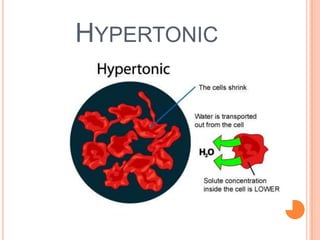
OSMOSIS – HYPOTONIC
HYPERTONIC
ISOTONIC
ACTIVE TRANSPORT
   The movement of substances across the plasma
    membrane against the concentration gradient

   Molecules or ions move from a region of lower
    concentration to higher concentration

   Requires the use of both carrier protein and
    cellular energy to transport molecules

   Carrier protein involved in active transport are
    often called pumps

   The most known pumps is Sodium-Potassium
    pumps
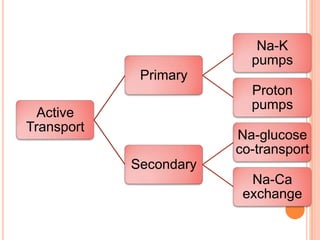
Na-K
                          pumps
             Primary
                          Proton
                          pumps
  Active
Transport
                        Na-glucose
                        co-transport
            Secondary
                          Na-Ca
                         exchange
PRIMARY ACTIVE
       TRANSPORT

 SODIUM-POTASSIUM   PUMP
 PROTON   PUMP
Secondary active transport

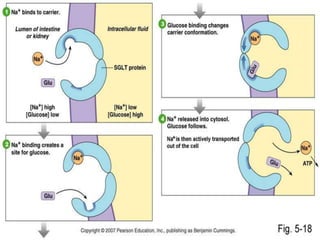
   SODIUM-GLUCOSE CO-
    TRANSPORTER

   SODIUM-CALCIUM EXCHANGER
VESICULAR TRANSPORT
A means for transport of large sized molecules
(e.g. proteins) across cell membrane.
It represents a specialized function of cell
membrane.
Requires energy.
2 types;
ENDOCYTOSIS
Divided into 3 parts:
1.Phagocytosis
-cell eating (uptake of large molecules)

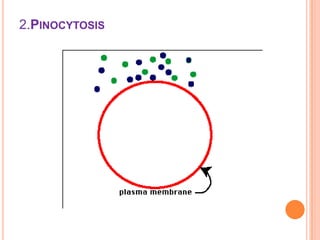
2.Pinocytosis
-cell drinking (uptake of solutes)

3.Receptor-mediated
-cytoplasm membrane folds inwards
and form coated pits.
1.PHAGOCYTOSIS
2.PINOCYTOSIS
3.RECEPTOR-MEDIATED
EXOCYTOSIS
 The excretion of waste material from the cell to its
 outer environment.
 Large waste product which requires the formation of vesicles
Molecules excreted includes:

  Cell Debris
  Waste products
  Membrane
proteins + lipids
which are bound to
become part of the
actual membrane
EXOCYTOSIS
Presentation1 osmosis and diffusion

Presentation1 osmosis and diffusion

  • 1.
  • 2.
    CHARACTERISTIC OF CELL MEMBRANE  Composed of phospholipid, cholesterol, proteins & chains of oligosaccharides  Range of thickness : 7.5 nm – 10 nm  Visible only in the electron microscope
  • 4.
  • 5.
    FUNCTIONS OF CELLMEMBRANE Selective Permeability • Size, charge, chemical properties of atoms / molecules determine whether the success in getting through the membrane Physical Barrier • Separates substances inside and outside of the cell
  • 6.
    Act As Communicator • Communication between cells & its environment can occur because it contains receptors that recognize & respond to molecular signals Allows Intercellular Connection • Establish a flexible boundary, protects cellular contents and also supports cell structure
  • 7.
    Transport Across The Cell Membrane Passive Active Transport Vesicle Transport Transport Simple Facilitated Primary Secondary Diffusion Osmosis Endocytosis Exocytosis Diffusion
  • 8.
  • 9.
     Passive transport Goes down the concentration gradient  From high concentration to low concentration of solute  Does not require energy (ATP)
  • 10.
    SIMPLE DIFFUSION ACROSSA PLASMA MEMBRANE  Movement of small molecule through phospholipid bilayer.  Lipid soluble molecule due to hydrophobic characteristic of the bilayer.
  • 12.
    FACILITATED DIFFUSION ACROSSA PLASMA MEMBRANE  Diffusion of large molecules  Requires carrier protein  Each carrier protein is specific for one molecule  Example – Potassium diffusion.
  • 13.
    Facilitated Diffusion ofPotassium ions through a Gated K + Channel
  • 14.
  • 15.
  • 16.
  • 17.
  • 18.
    The movement of substances across the plasma membrane against the concentration gradient  Molecules or ions move from a region of lower concentration to higher concentration  Requires the use of both carrier protein and cellular energy to transport molecules  Carrier protein involved in active transport are often called pumps  The most known pumps is Sodium-Potassium pumps
  • 19.
    Na-K pumps Primary Proton pumps Active Transport Na-glucose co-transport Secondary Na-Ca exchange
  • 20.
    PRIMARY ACTIVE TRANSPORT  SODIUM-POTASSIUM PUMP  PROTON PUMP
  • 23.
    Secondary active transport  SODIUM-GLUCOSE CO- TRANSPORTER  SODIUM-CALCIUM EXCHANGER
  • 26.
    VESICULAR TRANSPORT A meansfor transport of large sized molecules (e.g. proteins) across cell membrane. It represents a specialized function of cell membrane. Requires energy. 2 types;
  • 27.
    ENDOCYTOSIS Divided into 3parts: 1.Phagocytosis -cell eating (uptake of large molecules) 2.Pinocytosis -cell drinking (uptake of solutes) 3.Receptor-mediated -cytoplasm membrane folds inwards and form coated pits.
  • 28.
  • 29.
  • 30.
  • 31.
    EXOCYTOSIS The excretionof waste material from the cell to its outer environment. Large waste product which requires the formation of vesicles Molecules excreted includes: Cell Debris Waste products Membrane proteins + lipids which are bound to become part of the actual membrane
  • 32.

Editor's Notes

  • #27 Vesicular transporti.e the transport of macromolecules involving vesicles.Most cells use endo and exo to ingest and secrete macromolecules because most of the important subs are large polar molecules and thus arent able to pass through the membrane by the previously discussed methods.
  • #28 Why do cells need endocytosis mechanism? Because most substances are important to them are: polar consist of big moleculesPHAGOCYTOSISThe process by which cells ingest large objects, (such as cells which have undergone apoptosis, bacteria, or viruses). The membrane folds around the object, and the object is sealed off into a large vacuole; known as a phagosome.PINOCYTOSISThis process is concerned with the uptake of solutes and single molecules such as proteins.The membrane folds around the liquid, and the liquid is sealed off into a large vacuole; known as a pinocytic vesicles.RECEPTOR MEDIATED ENDOCYTOSISThe process by which cells internalize molecules (endocytosis) into a cell. by the inward budding of plasma membrane vesicles containing proteins.with receptor sites, specific to the molecules being internalized.The cytoplasm membrane folds inward to form clathrin-coated pits. These inward budding vesicles bud to form cytoplasmic vesicles.
  • #32 In exo the contents of the vesicle are released out of the cell to the extracellular environmentLikewise to endocytosis it requires the formation of vesicles in order to excrete the macromolecules out of the cell.