Molecules and Molecular Structure
Valence Shell Electron Repulsion Theory
(VSEPR)
Sharifah Mona Abdul Aziz Abdullah
Abdul Al-Hafiz Ismail
Centre for Pre-University Studies
Universiti Malaysia Sarawak
This OpenCourseWare@UNIMAS and its related course materials are licensed under
a Creative Commons Attribution-NonCommercial-ShareAlike 4.0 International License.
Introduction
The covalent bonds have directions in space,
which can give rise to different molecular
shapes.
Lewis structure shows the number of bonding
but can not be used to predict the molecular
shape.
VSEPR Theory
VSEPR theory is used to predict the shape for
covalent molecules and polyatomic ions.
The shape of a molecule or ion is governed by
the arrangement of the electron-pairs (bond
and lone pairs) around the central atom.
VSEPR Theory
According to VSEPR theory:
a) The electron-pairs around the central atom will
repel one another.
b) The electron-pairs (bond and lone pairs) arrange
themselves to be as far apart as possible in the
valence shell to minimise the force of repulsion.
VSEPR Theory
The order of repulsion between electron pairs is:
• 2 lone pairs will repel each other the most (leading to a
wider bond angle).
• A lone pair and a bond pair will repel each other less
(smaller bond angle than for 2 lone pairs).
• 2 bond pairs will repel each other much less (smallest
bond angle).
lone pair-lone pair > lone pair-bonding pair > bonding pair-bonding pair
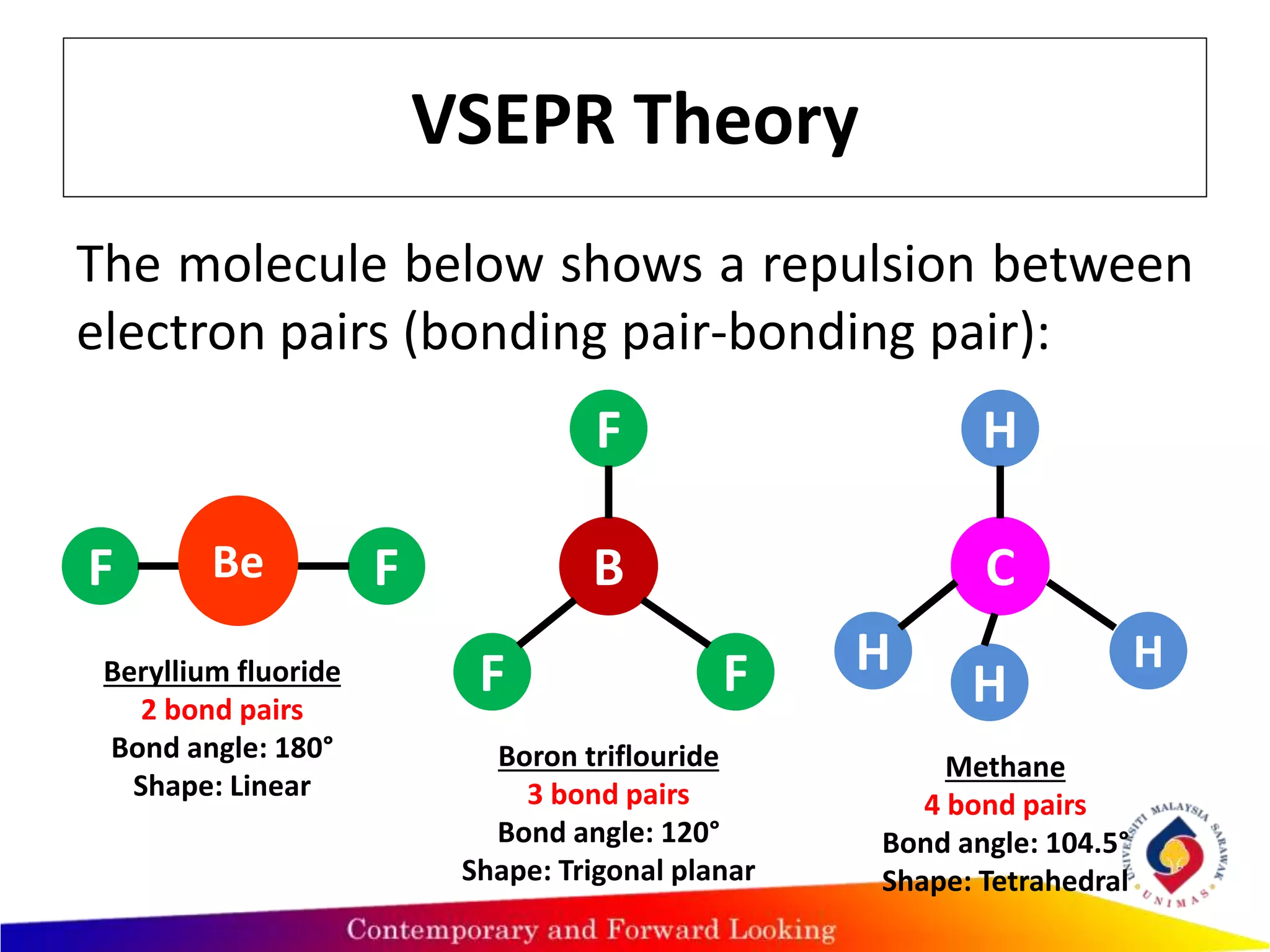
The molecule below shows a repulsion between
electron pairs (bonding pair-bonding pair):
VSEPR Theory
F
F
F
BF F
H
H
H
C
H
Be
Beryllium fluoride
2 bond pairs
Bond angle: 180°
Shape: Linear
Boron triflouride
3 bond pairs
Bond angle: 120°
Shape: Trigonal planar
Methane
4 bond pairs
Bond angle: 104.5°
Shape: Tetrahedral
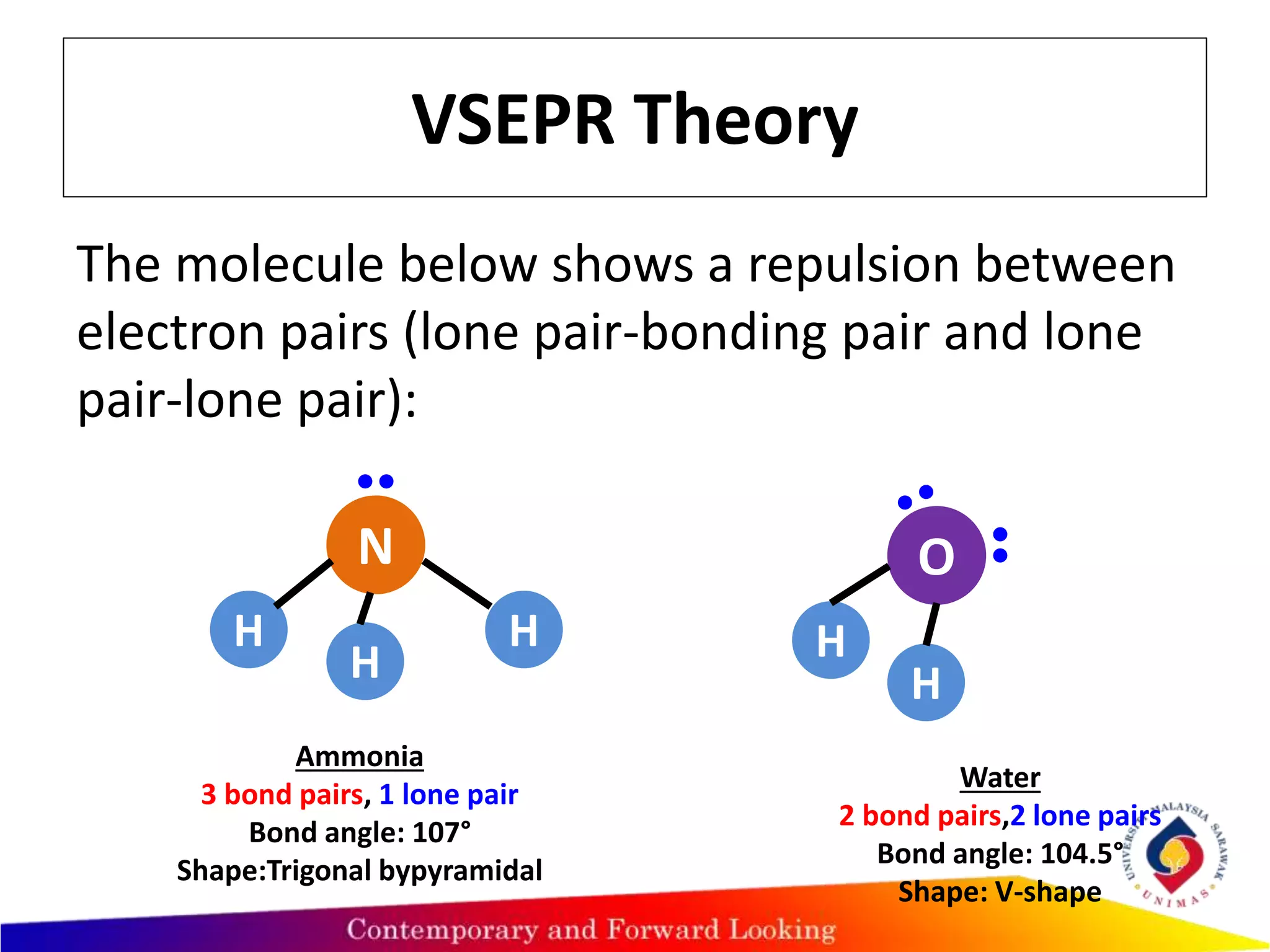
The molecule below shows a repulsion between
electron pairs (lone pair-bonding pair and lone
pair-lone pair):
VSEPR Theory
H H
N
H H
H
O
Ammonia
3 bond pairs, 1 lone pair
Bond angle: 107°
Shape:Trigonal bypyramidal
Water
2 bond pairs,2 lone pairs
Bond angle: 104.5°
Shape: V-shape

Valence Shell Electron Repulsion Theory

  • 1.
    Molecules and MolecularStructure Valence Shell Electron Repulsion Theory (VSEPR) Sharifah Mona Abdul Aziz Abdullah Abdul Al-Hafiz Ismail Centre for Pre-University Studies Universiti Malaysia Sarawak This OpenCourseWare@UNIMAS and its related course materials are licensed under a Creative Commons Attribution-NonCommercial-ShareAlike 4.0 International License.
  • 2.
    Introduction The covalent bondshave directions in space, which can give rise to different molecular shapes. Lewis structure shows the number of bonding but can not be used to predict the molecular shape.
  • 3.
    VSEPR Theory VSEPR theoryis used to predict the shape for covalent molecules and polyatomic ions. The shape of a molecule or ion is governed by the arrangement of the electron-pairs (bond and lone pairs) around the central atom.
  • 4.
    VSEPR Theory According toVSEPR theory: a) The electron-pairs around the central atom will repel one another. b) The electron-pairs (bond and lone pairs) arrange themselves to be as far apart as possible in the valence shell to minimise the force of repulsion.
  • 5.
    VSEPR Theory The orderof repulsion between electron pairs is: • 2 lone pairs will repel each other the most (leading to a wider bond angle). • A lone pair and a bond pair will repel each other less (smaller bond angle than for 2 lone pairs). • 2 bond pairs will repel each other much less (smallest bond angle). lone pair-lone pair > lone pair-bonding pair > bonding pair-bonding pair
  • 6.
    The molecule belowshows a repulsion between electron pairs (bonding pair-bonding pair): VSEPR Theory F F F BF F H H H C H Be Beryllium fluoride 2 bond pairs Bond angle: 180° Shape: Linear Boron triflouride 3 bond pairs Bond angle: 120° Shape: Trigonal planar Methane 4 bond pairs Bond angle: 104.5° Shape: Tetrahedral
  • 7.
    The molecule belowshows a repulsion between electron pairs (lone pair-bonding pair and lone pair-lone pair): VSEPR Theory H H N H H H O Ammonia 3 bond pairs, 1 lone pair Bond angle: 107° Shape:Trigonal bypyramidal Water 2 bond pairs,2 lone pairs Bond angle: 104.5° Shape: V-shape