Grade 9 Introduction to Chemistry                                           Student Name: _________________________
Reactions & Formulas                                                                                        Date: _______

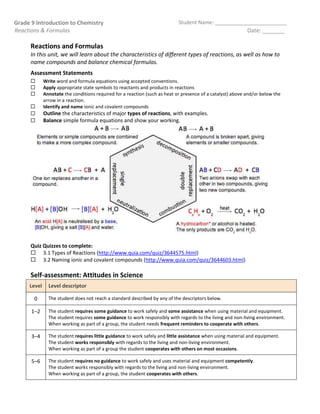
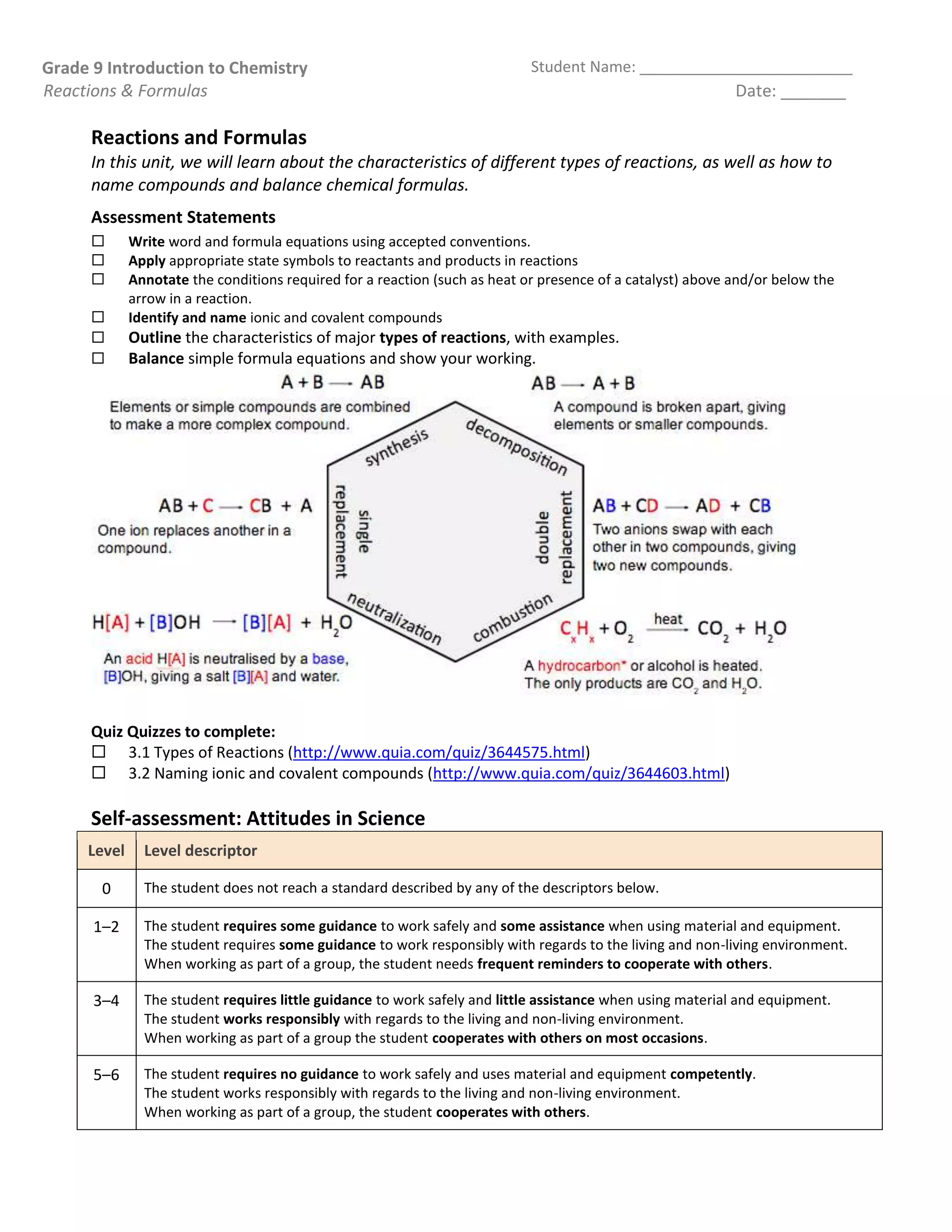
      Reactions and Formulas
      In this unit, we will learn about the characteristics of different types of reactions, as well as how to
      name compounds and balance chemical formulas.
      Assessment Statements
            Write word and formula equations using accepted conventions.
            Apply appropriate state symbols to reactants and products in reactions
            Annotate the conditions required for a reaction (such as heat or presence of a catalyst) above and/or below the
             arrow in a reaction.
            Identify and name ionic and covalent compounds
            Outline the characteristics of major types of reactions, with examples.
            Balance simple formula equations and show your working.


      Quiz Quizzes to complete:
       3.1 Types of Reactions (http://www.quia.com/quiz/3644575.html)
       3.2 Naming ionic and covalent compounds (http://www.quia.com/quiz/3644603.html)

      Self-assessment: Attitudes in Science
     Level     Level descriptor

       0       The student does not reach a standard described by any of the descriptors below.

      1–2      The student requires some guidance to work safely and some assistance when using material and equipment.
               The student requires some guidance to work responsibly with regards to the living and non-living environment.
               When working as part of a group, the student needs frequent reminders to cooperate with others.

      3–4      The student requires little guidance to work safely and little assistance when using material and equipment.
               The student works responsibly with regards to the living and non-living environment.
               When working as part of a group the student cooperates with others on most occasions.

      5–6      The student requires no guidance to work safely and uses material and equipment competently.
               The student works responsibly with regards to the living and non-living environment.
               When working as part of a group, the student cooperates with others.
Grade 9 Introduction to Chemistry                                   Student Name: _________________________
Reactions & Formulas                                                                            Date: _______

      Synthesis Reactions
      In these reactions, one or more reactants are combined to form one product.
      These can be simplified as A + B  AB

      Let’s use the example of magnesium reacting with oxygen
      to learn about how to write equations.

      Ignite a piece of magnesium in the Bunsen roaring flame, using tongs.
      Safety: goggles, tongs. DO NOT LOOK DIRECTLY AT THE REACTION. Follow the demonstration.
                                            This is not burning or combustion.


      State symbols are shown subscripted in brackets next to each element or compound. This is important
      information which tells us about the phase or state of the chemical.
              (s) represents solids. This includes precipitates which form, such as in suspensions.
              (g) represents gases. These could be observed as bubbles or smelled as fumes.
              (l) represents liquids. These are substances in their liquid state – not solutions.
              (aq) represents aqueous solutions. This means a solute dissolved in water.

      Balancing Formula Equations
      Remember the Law of Conservation of Mass? Atoms can neither be created nor destroyed. This means that
      there must be the same number of atoms of each element on the products side as on the reactants side.

      Use the method outlined below and show your working. Adjust the symbol equation above.
      1.   List and count the elements and groups on each side of the reaction. Don’t split polyatomic ionc.
      2.   Identify the compound with the greatest number of atoms.
      3.   Balance the atoms in this compound on both sides of the equation, without changing the compound!
      4.   Balance any groups (such as polyatomic ions).
      5.   Finish up with H and O.

                    Mg        +    O2              ----------->     MgO
                                     Reactants                    Products
                         Mg
                          O
Grade 9 Introduction to Chemistry                                      Student Name: _________________________
Reactions & Formulas                                                                                              Date: _______

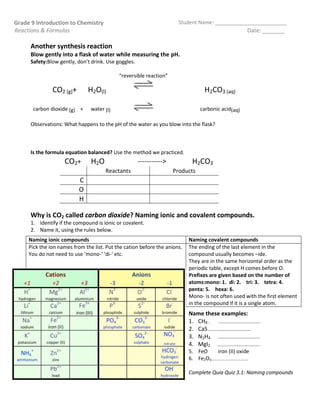
      Another synthesis reaction
      Blow gently into a flask of water while measuring the pH.
      Safety:Blow gently, don’t drink. Use goggles.

                                            “reversible reaction”

               CO2 (g)+       H2O(l)                                                 H2CO3 (aq)

       carbon dioxide (g) +     water (l)                                         carbonic acid(aq)

      Observations: What happens to the pH of the water as you blow into the flask?


      Is the formula equation balanced? Use the method we practiced.
                    CO2+        H2 O                  ----------->           H2CO3
                                       Reactants                     Products
                          C
                          O
                          H

      Why is CO2 called carbon dioxide? Naming ionic and covalent compounds.
      1. Identify if the compound is ionic or covalent.
      2. Name it, using the rules below.
     Naming ionic compounds                                                Naming covalent compounds
     Pick the ion names from the list. Put the cation before the anions.   The ending of the last element in the
     You do not need to use ‘mono-‘ ‘di-‘ etc.                             compound usually becomes –ide.
                                                                           They are in the same horizontal order as the
                                                                           periodic table, except H comes before O.
                                                                           Prefixes are given based on the number of
                                                                           atoms:mono: 1. di: 2. tri: 3. tetra: 4.
                                                                           penta: 5. hexa: 6.
                                                                           Mono- is not often used with the first element
                                                                           in the compound if it is a single atom.
                                                                           Name these examples:
                                                                           1. CH4 - ---------------------------------
                                                                           2. CaS ---------------------------------
                                                                           3. N2H4 ---------------------------------
                                                                           4. MgI2 ---------------------------------
                                                                           5. FeO        iron (II) oxide
                                                                           6. Fe2O3---------------------------------

                                                                           Complete Quia Quiz 3.1: Naming compounds
Grade 9 Introduction to Chemistry                                             Student Name: _________________________
Reactions & Formulas                                                                                  Date: _______

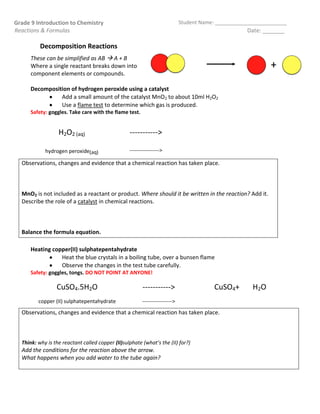
          Decomposition Reactions
      These can be simplified as AB  A + B
      Where a single reactant breaks down into
      component elements or compounds.

      Decomposition of hydrogen peroxide using a catalyst
                Add a small amount of the catalyst MnO2 to about 10ml H2O2
                Use a flame test to determine which gas is produced.
      Safety: goggles. Take care with the flame test.


                  H2O2 (aq)                       ----------->

            hydrogen peroxide(aq)                 ----------------->

  Observations, changes and evidence that a chemical reaction has taken place.


  MnO2 is not included as a reactant or product. Where should it be written in the reaction? Add it.
  Describe the role of a catalyst in chemical reactions.


  Balance the formula equation.

      Heating copper(II) sulphatepentahydrate
                 Heat the blue crystals in a boiling tube, over a bunsen flame
                 Observe the changes in the test tube carefully.
      Safety: goggles, tongs. DO NOT POINT AT ANYONE!

                 CuSO4.5H2O                              ----------->                     CuSO4+        H2O
         copper (II) sulphatepentahydrate                ----------------->
  Observations, changes and evidence that a chemical reaction has taken place.


  Think: why is the reactant called copper (II)sulphate (what’s the (II) for?)
  Add the conditions for the reaction above the arrow.
  What happens when you add water to the tube again?
Grade 9 Introduction to Chemistry                                 Student Name: _________________________
Reactions & Formulas                                                                       Date: _______

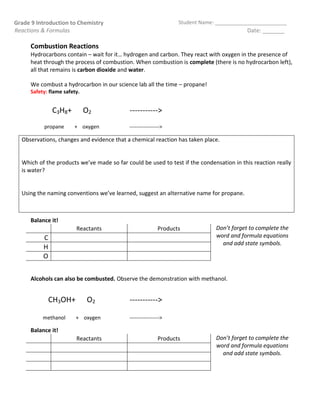
      Combustion Reactions
      Hydrocarbons contain – wait for it… hydrogen and carbon. They react with oxygen in the presence of
      heat through the process of combustion. When combustion is complete (there is no hydrocarbon left),
      all that remains is carbon dioxide and water.

      We combust a hydrocarbon in our science lab all the time – propane!
      Safety: flame safety.


               C3 H 8 +       O2            ----------->
           propane        + oxygen          ----------------->

  Observations, changes and evidence that a chemical reaction has taken place.


  Which of the products we’ve made so far could be used to test if the condensation in this reaction really
  is water?


  Using the naming conventions we’ve learned, suggest an alternative name for propane.


      Balance it!
                          Reactants                        Products            Don’t forget to complete the
           C                                                                   word and formula equations
                                                                                 and add state symbols.
           H
           O


      Alcohols can also be combusted. Observe the demonstration with methanol.


               CH3OH+         O2            ----------->

           methanol       + oxygen          ----------------->

      Balance it!
                          Reactants                        Products            Don’t forget to complete the
                                                                               word and formula equations
                                                                                 and add state symbols.
Grade 9 Introduction to Chemistry                                     Student Name: _________________________
Reactions & Formulas                                                                           Date: _______

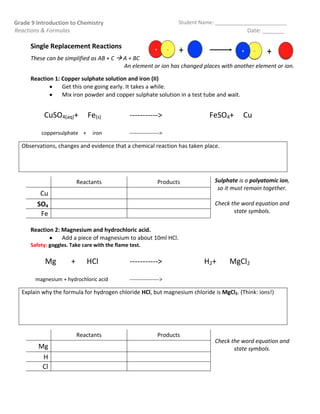
      Single Replacement Reactions
      These can be simplified as AB + C  A + BC
                                          An element or ion has changed places with another element or ion.

      Reaction 1: Copper sulphate solution and iron (II)
                  Get this one going early. It takes a while.
                  Mix iron powder and copper sulphate solution in a test tube and wait.


           CuSO4(aq)+          Fe(s)            ----------->                     FeSO4+       Cu

          coppersulphate +      iron            ----------------->

  Observations, changes and evidence that a chemical reaction has taken place.


                           Reactants                           Products            Sulphate is a polyatomic ion,
                                                                                    so it must remain together.
         Cu
        SO4                                                                        Check the word equation and
         Fe                                                                               state symbols.

      Reaction 2: Magnesium and hydrochloric acid.
                  Add a piece of magnesium to about 10ml HCl.
      Safety: goggles. Take care with the flame test.

            Mg         +      HCl               ----------->                   H2 +     MgCl2

        magnesium + hydrochloric acid           ----------------->

  Explain why the formula for hydrogen chloride HCl, but magnesium chloride is MgCl2. (Think: ions!)


                           Reactants                           Products
                                                                                   Check the word equation and
         Mg                                                                               state symbols.
          H
          Cl
Grade 9 Introduction to Chemistry                                     Student Name: _________________________
Reactions & Formulas                                                                            Date: _______

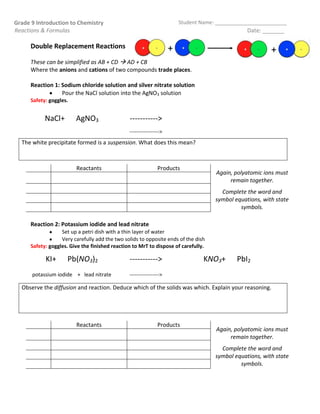
      Double Replacement Reactions

      These can be simplified as AB + CD  AD + CB
      Where the anions and cations of two compounds trade places.

      Reaction 1: Sodium chloride solution and silver nitrate solution
                  Pour the NaCl solution into the AgNO3 solution
      Safety: goggles.


            NaCl+        AgNO3                  ----------->
                                                ----------------->
  The white precipitate formed is a suspension. What does this mean?


                         Reactants                             Products
                                                                                    Again, polyatomic ions must
                                                                                         remain together.
                                                                                      Complete the word and
                                                                                    symbol equations, with state
                                                                                             symbols.

      Reaction 2: Potassium iodide and lead nitrate
                   Set up a petri dish with a thin layer of water
                   Very carefully add the two solids to opposite ends of the dish
      Safety: goggles. Give the finished reaction to MrT to dispose of carefully.

            KI+      Pb(NO3)2                   ----------->                    KNO3+       PbI2
      potassium iodide + lead nitrate           ----------------->

  Observe the diffusion and reaction. Deduce which of the solids was which. Explain your reasoning.


                         Reactants                             Products
                                                                                    Again, polyatomic ions must
                                                                                         remain together.
                                                                                      Complete the word and
                                                                                    symbol equations, with state
                                                                                             symbols.
Grade 9 Introduction to Chemistry                                 Student Name: _________________________
Reactions & Formulas                                                                        Date: _______

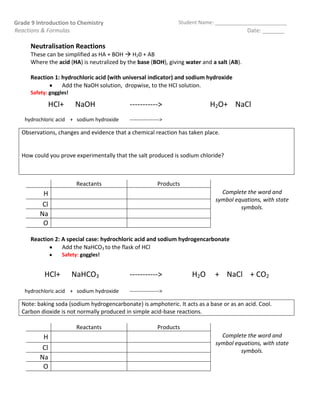
      Neutralisation Reactions
      These can be simplified as HA + BOH  H20 + AB
      Where the acid (HA) is neutralized by the base (BOH), giving water and a salt (AB).

      Reaction 1: hydrochloric acid (with universal indicator) and sodium hydroxide
                  Add the NaOH solution, dropwise, to the HCl solution.
      Safety: goggles!

             HCl+        NaOH               ----------->                     H2O+ NaCl
   hydrochloric acid + sodium hydroxide     ----------------->

  Observations, changes and evidence that a chemical reaction has taken place.


  How could you prove experimentally that the salt produced is sodium chloride?


                          Reactants                        Products
          H                                                                      Complete the word and
                                                                               symbol equations, with state
          Cl                                                                            symbols.
         Na
          O

      Reaction 2: A special case: hydrochloric acid and sodium hydrogencarbonate
                  Add the NaHCO3 to the flask of HCl
                   Safety: goggles!


           HCl+          NaHCO3             ----------->              H2 O     + NaCl + CO2
   hydrochloric acid + sodium hydroxide     ----------------->

  Note: baking soda (sodium hydrogencarbonate) is amphoteric. It acts as a base or as an acid. Cool.
  Carbon dioxide is not normally produced in simple acid-base reactions.

                          Reactants                        Products
          H                                                                      Complete the word and
                                                                               symbol equations, with state
          Cl                                                                            symbols.
         Na
          O
Grade 9 Introduction to Chemistry                               Student Name: _________________________
Reactions & Formulas                                                                    Date: _______

      Identifying and balancing reactions practice
      In each case, identify the type of reaction (circle it) and explain your choice.
      Complete the word and symbol equations. Balance the symbol equation and show your working.

      Reaction 1: Inside our cells!

            C6H12O6+          O2           ----------->                CO2+      H2 O

            glucose     + oxygen           ----------------->

      Type:synthesis decomposition combustion single-replacement double-replacement neutralization
      Reason:


      Balance it:


      Reaction 2: electrolysis of water

                      H2 O                 ----------->                  H2 +    O2

                    water                  ----------------->

      Type:synthesis decomposition combustion single-replacement double-replacement neutralization
      Reason:


      Balance it:


      Reaction 3: making ethane from acetylene

              C2 H2 +        H2            ----------->                     C2 H6

          acetylene     + hydrogen         ----------------->              ethane

      Type:synthesis decomposition combustion single-replacement double-replacement neutralization
      Reason:


      Balance it:
Grade 9 Introduction to Chemistry                                    Student Name: _________________________
Reactions & Formulas                                                                              Date: _______

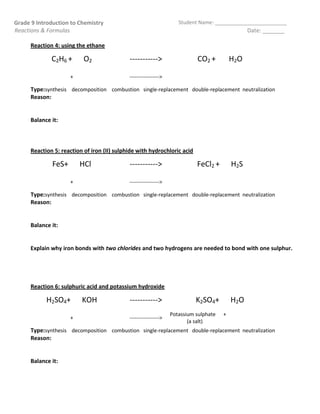
      Reaction 4: using the ethane

              C2 H 6 +     O2                ----------->                   CO2 +          H2 O

                     +                       ----------------->

      Type:synthesis decomposition combustion single-replacement double-replacement neutralization
      Reason:


      Balance it:


      Reaction 5: reaction of iron (II) sulphide with hydrochloric acid

              FeS+       HCl                 ----------->                   FeCl2 +        H2S

                     +                       ----------------->

      Type:synthesis decomposition combustion single-replacement double-replacement neutralization
      Reason:


      Balance it:


      Explain why iron bonds with two chlorides and two hydrogens are needed to bond with one sulphur.


      Reaction 6: sulphuric acid and potassium hydroxide

            H2SO4+        KOH                ----------->                   K2SO4+         H2O
                                                                  Potassium sulphate   +
                     +                       ----------------->
                                                                         (a salt)
      Type:synthesis decomposition combustion single-replacement double-replacement neutralization
      Reason:


      Balance it:
Grade 9 Introduction to Chemistry                                  Student Name: _________________________
Reactions & Formulas                                                                            Date: _______

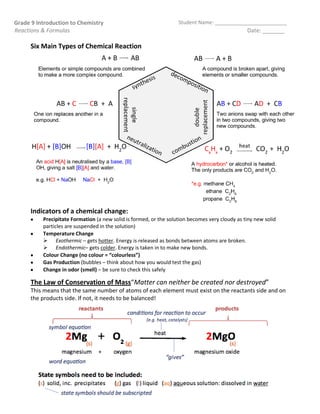
      Six Main Types of Chemical Reaction


      Indicators of a chemical change:
          Precipitate Formation (a new solid is formed, or the solution becomes very cloudy as tiny new solid
          particles are suspended in the solution)
          Temperature Change
           Exothermic – gets hotter. Energy is released as bonds between atoms are broken.
           Endothermic– gets colder. Energy is taken in to make new bonds.
          Colour Change (no colour = “colourless”)
          Gas Production (bubbles – think about how you would test the gas)
          Change in odor (smell) – be sure to check this safely

      The Law of Conservation of Mass“Matter can neither be created nor destroyed”
      This means that the same number of atoms of each element must exist on the reactants side and on
      the products side. If not, it needs to be balanced!

Reactions & Formulas Lab Sequence

  • 1.
    Grade 9 Introductionto Chemistry Student Name: _________________________ Reactions & Formulas Date: _______ Reactions and Formulas In this unit, we will learn about the characteristics of different types of reactions, as well as how to name compounds and balance chemical formulas. Assessment Statements  Write word and formula equations using accepted conventions.  Apply appropriate state symbols to reactants and products in reactions  Annotate the conditions required for a reaction (such as heat or presence of a catalyst) above and/or below the arrow in a reaction.  Identify and name ionic and covalent compounds  Outline the characteristics of major types of reactions, with examples.  Balance simple formula equations and show your working. Quiz Quizzes to complete:  3.1 Types of Reactions (http://www.quia.com/quiz/3644575.html)  3.2 Naming ionic and covalent compounds (http://www.quia.com/quiz/3644603.html) Self-assessment: Attitudes in Science Level Level descriptor 0 The student does not reach a standard described by any of the descriptors below. 1–2 The student requires some guidance to work safely and some assistance when using material and equipment. The student requires some guidance to work responsibly with regards to the living and non-living environment. When working as part of a group, the student needs frequent reminders to cooperate with others. 3–4 The student requires little guidance to work safely and little assistance when using material and equipment. The student works responsibly with regards to the living and non-living environment. When working as part of a group the student cooperates with others on most occasions. 5–6 The student requires no guidance to work safely and uses material and equipment competently. The student works responsibly with regards to the living and non-living environment. When working as part of a group, the student cooperates with others.
  • 2.
    Grade 9 Introductionto Chemistry Student Name: _________________________ Reactions & Formulas Date: _______ Synthesis Reactions In these reactions, one or more reactants are combined to form one product. These can be simplified as A + B  AB Let’s use the example of magnesium reacting with oxygen to learn about how to write equations. Ignite a piece of magnesium in the Bunsen roaring flame, using tongs. Safety: goggles, tongs. DO NOT LOOK DIRECTLY AT THE REACTION. Follow the demonstration. This is not burning or combustion. State symbols are shown subscripted in brackets next to each element or compound. This is important information which tells us about the phase or state of the chemical. (s) represents solids. This includes precipitates which form, such as in suspensions. (g) represents gases. These could be observed as bubbles or smelled as fumes. (l) represents liquids. These are substances in their liquid state – not solutions. (aq) represents aqueous solutions. This means a solute dissolved in water. Balancing Formula Equations Remember the Law of Conservation of Mass? Atoms can neither be created nor destroyed. This means that there must be the same number of atoms of each element on the products side as on the reactants side. Use the method outlined below and show your working. Adjust the symbol equation above. 1. List and count the elements and groups on each side of the reaction. Don’t split polyatomic ionc. 2. Identify the compound with the greatest number of atoms. 3. Balance the atoms in this compound on both sides of the equation, without changing the compound! 4. Balance any groups (such as polyatomic ions). 5. Finish up with H and O. Mg + O2 -----------> MgO Reactants Products Mg O
  • 3.
    Grade 9 Introductionto Chemistry Student Name: _________________________ Reactions & Formulas Date: _______ Another synthesis reaction Blow gently into a flask of water while measuring the pH. Safety:Blow gently, don’t drink. Use goggles. “reversible reaction” CO2 (g)+ H2O(l) H2CO3 (aq) carbon dioxide (g) + water (l) carbonic acid(aq) Observations: What happens to the pH of the water as you blow into the flask? Is the formula equation balanced? Use the method we practiced. CO2+ H2 O -----------> H2CO3 Reactants Products C O H Why is CO2 called carbon dioxide? Naming ionic and covalent compounds. 1. Identify if the compound is ionic or covalent. 2. Name it, using the rules below. Naming ionic compounds Naming covalent compounds Pick the ion names from the list. Put the cation before the anions. The ending of the last element in the You do not need to use ‘mono-‘ ‘di-‘ etc. compound usually becomes –ide. They are in the same horizontal order as the periodic table, except H comes before O. Prefixes are given based on the number of atoms:mono: 1. di: 2. tri: 3. tetra: 4. penta: 5. hexa: 6. Mono- is not often used with the first element in the compound if it is a single atom. Name these examples: 1. CH4 - --------------------------------- 2. CaS --------------------------------- 3. N2H4 --------------------------------- 4. MgI2 --------------------------------- 5. FeO iron (II) oxide 6. Fe2O3--------------------------------- Complete Quia Quiz 3.1: Naming compounds
  • 4.
    Grade 9 Introductionto Chemistry Student Name: _________________________ Reactions & Formulas Date: _______ Decomposition Reactions These can be simplified as AB  A + B Where a single reactant breaks down into component elements or compounds. Decomposition of hydrogen peroxide using a catalyst Add a small amount of the catalyst MnO2 to about 10ml H2O2 Use a flame test to determine which gas is produced. Safety: goggles. Take care with the flame test. H2O2 (aq) -----------> hydrogen peroxide(aq) -----------------> Observations, changes and evidence that a chemical reaction has taken place. MnO2 is not included as a reactant or product. Where should it be written in the reaction? Add it. Describe the role of a catalyst in chemical reactions. Balance the formula equation. Heating copper(II) sulphatepentahydrate Heat the blue crystals in a boiling tube, over a bunsen flame Observe the changes in the test tube carefully. Safety: goggles, tongs. DO NOT POINT AT ANYONE! CuSO4.5H2O -----------> CuSO4+ H2O copper (II) sulphatepentahydrate -----------------> Observations, changes and evidence that a chemical reaction has taken place. Think: why is the reactant called copper (II)sulphate (what’s the (II) for?) Add the conditions for the reaction above the arrow. What happens when you add water to the tube again?
  • 5.
    Grade 9 Introductionto Chemistry Student Name: _________________________ Reactions & Formulas Date: _______ Combustion Reactions Hydrocarbons contain – wait for it… hydrogen and carbon. They react with oxygen in the presence of heat through the process of combustion. When combustion is complete (there is no hydrocarbon left), all that remains is carbon dioxide and water. We combust a hydrocarbon in our science lab all the time – propane! Safety: flame safety. C3 H 8 + O2 -----------> propane + oxygen -----------------> Observations, changes and evidence that a chemical reaction has taken place. Which of the products we’ve made so far could be used to test if the condensation in this reaction really is water? Using the naming conventions we’ve learned, suggest an alternative name for propane. Balance it! Reactants Products Don’t forget to complete the C word and formula equations and add state symbols. H O Alcohols can also be combusted. Observe the demonstration with methanol. CH3OH+ O2 -----------> methanol + oxygen -----------------> Balance it! Reactants Products Don’t forget to complete the word and formula equations and add state symbols.
  • 6.
    Grade 9 Introductionto Chemistry Student Name: _________________________ Reactions & Formulas Date: _______ Single Replacement Reactions These can be simplified as AB + C  A + BC An element or ion has changed places with another element or ion. Reaction 1: Copper sulphate solution and iron (II) Get this one going early. It takes a while. Mix iron powder and copper sulphate solution in a test tube and wait. CuSO4(aq)+ Fe(s) -----------> FeSO4+ Cu coppersulphate + iron -----------------> Observations, changes and evidence that a chemical reaction has taken place. Reactants Products Sulphate is a polyatomic ion, so it must remain together. Cu SO4 Check the word equation and Fe state symbols. Reaction 2: Magnesium and hydrochloric acid. Add a piece of magnesium to about 10ml HCl. Safety: goggles. Take care with the flame test. Mg + HCl -----------> H2 + MgCl2 magnesium + hydrochloric acid -----------------> Explain why the formula for hydrogen chloride HCl, but magnesium chloride is MgCl2. (Think: ions!) Reactants Products Check the word equation and Mg state symbols. H Cl
  • 7.
    Grade 9 Introductionto Chemistry Student Name: _________________________ Reactions & Formulas Date: _______ Double Replacement Reactions These can be simplified as AB + CD  AD + CB Where the anions and cations of two compounds trade places. Reaction 1: Sodium chloride solution and silver nitrate solution Pour the NaCl solution into the AgNO3 solution Safety: goggles. NaCl+ AgNO3 -----------> -----------------> The white precipitate formed is a suspension. What does this mean? Reactants Products Again, polyatomic ions must remain together. Complete the word and symbol equations, with state symbols. Reaction 2: Potassium iodide and lead nitrate Set up a petri dish with a thin layer of water Very carefully add the two solids to opposite ends of the dish Safety: goggles. Give the finished reaction to MrT to dispose of carefully. KI+ Pb(NO3)2 -----------> KNO3+ PbI2 potassium iodide + lead nitrate -----------------> Observe the diffusion and reaction. Deduce which of the solids was which. Explain your reasoning. Reactants Products Again, polyatomic ions must remain together. Complete the word and symbol equations, with state symbols.
  • 8.
    Grade 9 Introductionto Chemistry Student Name: _________________________ Reactions & Formulas Date: _______ Neutralisation Reactions These can be simplified as HA + BOH  H20 + AB Where the acid (HA) is neutralized by the base (BOH), giving water and a salt (AB). Reaction 1: hydrochloric acid (with universal indicator) and sodium hydroxide Add the NaOH solution, dropwise, to the HCl solution. Safety: goggles! HCl+ NaOH -----------> H2O+ NaCl hydrochloric acid + sodium hydroxide -----------------> Observations, changes and evidence that a chemical reaction has taken place. How could you prove experimentally that the salt produced is sodium chloride? Reactants Products H Complete the word and symbol equations, with state Cl symbols. Na O Reaction 2: A special case: hydrochloric acid and sodium hydrogencarbonate Add the NaHCO3 to the flask of HCl Safety: goggles! HCl+ NaHCO3 -----------> H2 O + NaCl + CO2 hydrochloric acid + sodium hydroxide -----------------> Note: baking soda (sodium hydrogencarbonate) is amphoteric. It acts as a base or as an acid. Cool. Carbon dioxide is not normally produced in simple acid-base reactions. Reactants Products H Complete the word and symbol equations, with state Cl symbols. Na O
  • 9.
    Grade 9 Introductionto Chemistry Student Name: _________________________ Reactions & Formulas Date: _______ Identifying and balancing reactions practice In each case, identify the type of reaction (circle it) and explain your choice. Complete the word and symbol equations. Balance the symbol equation and show your working. Reaction 1: Inside our cells! C6H12O6+ O2 -----------> CO2+ H2 O glucose + oxygen -----------------> Type:synthesis decomposition combustion single-replacement double-replacement neutralization Reason: Balance it: Reaction 2: electrolysis of water H2 O -----------> H2 + O2 water -----------------> Type:synthesis decomposition combustion single-replacement double-replacement neutralization Reason: Balance it: Reaction 3: making ethane from acetylene C2 H2 + H2 -----------> C2 H6 acetylene + hydrogen -----------------> ethane Type:synthesis decomposition combustion single-replacement double-replacement neutralization Reason: Balance it:
  • 10.
    Grade 9 Introductionto Chemistry Student Name: _________________________ Reactions & Formulas Date: _______ Reaction 4: using the ethane C2 H 6 + O2 -----------> CO2 + H2 O + -----------------> Type:synthesis decomposition combustion single-replacement double-replacement neutralization Reason: Balance it: Reaction 5: reaction of iron (II) sulphide with hydrochloric acid FeS+ HCl -----------> FeCl2 + H2S + -----------------> Type:synthesis decomposition combustion single-replacement double-replacement neutralization Reason: Balance it: Explain why iron bonds with two chlorides and two hydrogens are needed to bond with one sulphur. Reaction 6: sulphuric acid and potassium hydroxide H2SO4+ KOH -----------> K2SO4+ H2O Potassium sulphate + + -----------------> (a salt) Type:synthesis decomposition combustion single-replacement double-replacement neutralization Reason: Balance it:
  • 11.
    Grade 9 Introductionto Chemistry Student Name: _________________________ Reactions & Formulas Date: _______ Six Main Types of Chemical Reaction Indicators of a chemical change: Precipitate Formation (a new solid is formed, or the solution becomes very cloudy as tiny new solid particles are suspended in the solution) Temperature Change  Exothermic – gets hotter. Energy is released as bonds between atoms are broken.  Endothermic– gets colder. Energy is taken in to make new bonds. Colour Change (no colour = “colourless”) Gas Production (bubbles – think about how you would test the gas) Change in odor (smell) – be sure to check this safely The Law of Conservation of Mass“Matter can neither be created nor destroyed” This means that the same number of atoms of each element must exist on the reactants side and on the products side. If not, it needs to be balanced!