Periodic Table
s- p-d- f- Blocks
The Periodic Law
• The statement that there is a periodic
repetition of chemical and physical properties
of the elements when they are arranged by
increasing atomic number is called the
PERIODIC LAW.
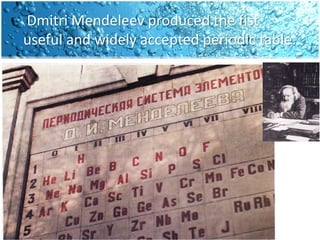
Dmitri Mendeleev produced the fist
useful and widely accepted periodic table.
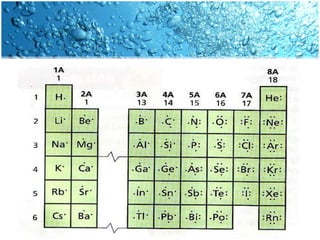
• Electron configuration determines
the chemical properties of an
element.
• However, the process of writing out
the electron configuration using the
Aufbau principle can be tedious.
Fortunately, by noting an atom’s
position on the periodic table, you
can determine its electron
configuration and its number of
valence electrons.
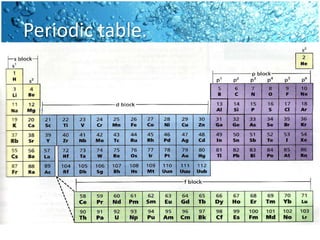
Periodic table.
• The reason behind the table’s odd
shape, becomes clear if it is divided
into sections, or blocks, representing
the atom’s energy sublevel being
filled with valence electrons.
The s-, p-, d- and f-
Block of Elements
s-block elements
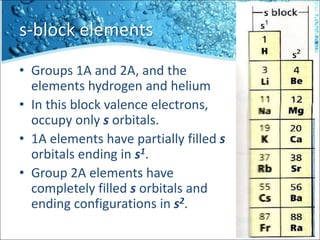
• Groups 1A and 2A, and the
elements hydrogen and helium
• In this block valence electrons,
occupy only s orbitals.
• 1A elements have partially filled s
orbitals ending in s1.
• Group 2A elements have
completely filled s orbitals and
ending configurations in s2.
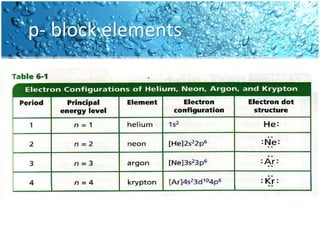
p- block elements
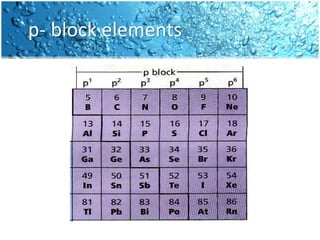
• Comprised of groups 3A through 8A contains
elements with filled or partially filled p
orbitals.
• The p block spans six groups (the three p
orbitals can hold two electons each).
• Together, the s- and the p- blocks comprise
the representative, or group A, elements.
p- block elements
p- block elements
• The group 8A, or noble gas, elements are
unique members of the p-block because of
their incredible stability.
• Noble gas atoms are so stable that they
undergo virtually no chemical reactions.
• The reason for their stability lies in their
electron configuration: Both s and p orbitals
are completely filled.
p- block elements
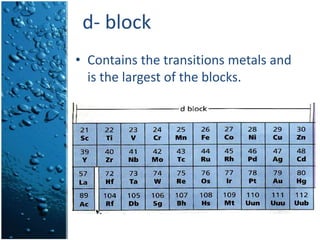
• Contains the transitions metals and
is the largest of the blocks.
d- block
• Although there are number of
exceptions, d- block elements are
characterized by a filled outermost s
orbital of energy level n, and a filled
or partially filled d orbital of energy
level n-1.
d- block
• For example:
• scandium (Sc) [Ar]4s23d1
• titanium (Ti) [Ar]4s23d2
• The five d- orbitals can hold a total of
ten electrons; thus the d- block
spans ten groups.
d- block
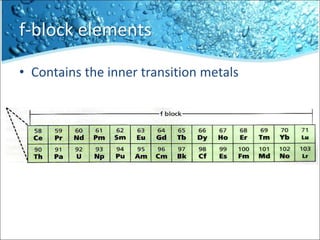
f-block elements
• Contains the inner transition metals
f-block elements
• f- block elements are characterized by a filled,
or partially filled outermost s orbitals, and
partially filled 4f or 5f orbitals.
• The electrons of the f sublevel do not fill their
orbitals in a predictable manner.

Spdf blocks 1

  • 1.
  • 2.
    The Periodic Law •The statement that there is a periodic repetition of chemical and physical properties of the elements when they are arranged by increasing atomic number is called the PERIODIC LAW.
  • 3.
    Dmitri Mendeleev producedthe fist useful and widely accepted periodic table.
  • 4.
    • Electron configurationdetermines the chemical properties of an element. • However, the process of writing out the electron configuration using the Aufbau principle can be tedious. Fortunately, by noting an atom’s position on the periodic table, you can determine its electron configuration and its number of valence electrons.
  • 6.
  • 7.
    • The reasonbehind the table’s odd shape, becomes clear if it is divided into sections, or blocks, representing the atom’s energy sublevel being filled with valence electrons. The s-, p-, d- and f- Block of Elements
  • 8.
    s-block elements • Groups1A and 2A, and the elements hydrogen and helium • In this block valence electrons, occupy only s orbitals. • 1A elements have partially filled s orbitals ending in s1. • Group 2A elements have completely filled s orbitals and ending configurations in s2.
  • 9.
    p- block elements •Comprised of groups 3A through 8A contains elements with filled or partially filled p orbitals. • The p block spans six groups (the three p orbitals can hold two electons each). • Together, the s- and the p- blocks comprise the representative, or group A, elements.
  • 10.
  • 11.
    p- block elements •The group 8A, or noble gas, elements are unique members of the p-block because of their incredible stability. • Noble gas atoms are so stable that they undergo virtually no chemical reactions. • The reason for their stability lies in their electron configuration: Both s and p orbitals are completely filled.
  • 12.
  • 13.
    • Contains thetransitions metals and is the largest of the blocks. d- block
  • 14.
    • Although thereare number of exceptions, d- block elements are characterized by a filled outermost s orbital of energy level n, and a filled or partially filled d orbital of energy level n-1. d- block
  • 15.
    • For example: •scandium (Sc) [Ar]4s23d1 • titanium (Ti) [Ar]4s23d2 • The five d- orbitals can hold a total of ten electrons; thus the d- block spans ten groups. d- block
  • 16.
    f-block elements • Containsthe inner transition metals
  • 17.
    f-block elements • f-block elements are characterized by a filled, or partially filled outermost s orbitals, and partially filled 4f or 5f orbitals. • The electrons of the f sublevel do not fill their orbitals in a predictable manner.