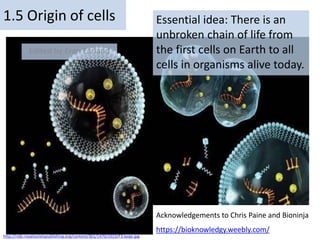
1.5 Origin of cells Essential idea: There is an
unbroken chain of life from
the first cells on Earth to all
cells in organisms alive today.
http://rstb.royalsocietypublishing.org/content/361/1470/1023/F3.large.jpg
Acknowledgements to Chris Paine and Bioninja
https://bioknowledgy.weebly.com/
Edited by Eran Earland
Understandings, Applications and Skills
Statement Guidance
1.5.U1 Cells can only be formed by division of pre-existing
cells.
Students should be aware that the 64 codons
in the genetic code have the same meanings
in nearly all organisms, but that there are
some minor variations that are likely to have
accrued since the common origin of life on
Earth.
1.5.U2 The first cells must have arisen from non-living
material.
1.5.U3 The origin of eukaryotic cells can be explained by
the endosymbiotic theory.
Evidence for the endosymbiotic theory is
expected. The origin of eukaryote cilia and
flagella does not need to be included.
1.5.A1 Evidence from Pasteur’s experiments that
spontaneous generation of cells and organisms
does not now occur on Earth.
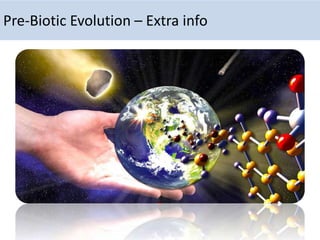
Pre-Biotic Evolution – Extra info
• The initial formation of primitive living structures (protocells) is
thought to require a specific supporting chemical environment
• Early Earth had a chemically-reducing atmosphere, which when
exposed to energy in various forms (heat, electrical discharge, etc.)
produced a variety of simple organic compounds (monomers)
• These compounds accumulated in a molecular ‘soup’, allowing for
the formation of more complex compounds (polymers)
Pre-Biotic Evolution – Extra info
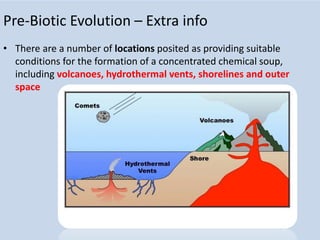
• There are a number of locations posited as providing suitable
conditions for the formation of a concentrated chemical soup,
including volcanoes, hydrothermal vents, shorelines and outer
space
Pre-Biotic Evolution – Extra info
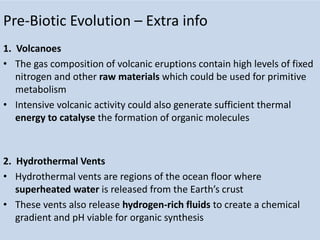
1. Volcanoes
• The gas composition of volcanic eruptions contain high levels of fixed
nitrogen and other raw materials which could be used for primitive
metabolism
• Intensive volcanic activity could also generate sufficient thermal
energy to catalyse the formation of organic molecules
2. Hydrothermal Vents
• Hydrothermal vents are regions of the ocean floor where
superheated water is released from the Earth’s crust
• These vents also release hydrogen-rich fluids to create a chemical
gradient and pH viable for organic synthesis
Pre-Biotic Evolution – Extra info
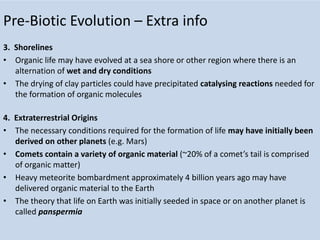
3. Shorelines
• Organic life may have evolved at a sea shore or other region where there is an
alternation of wet and dry conditions
• The drying of clay particles could have precipitated catalysing reactions needed for
the formation of organic molecules
4. Extraterrestrial Origins
• The necessary conditions required for the formation of life may have initially been
derived on other planets (e.g. Mars)
• Comets contain a variety of organic material (~20% of a comet’s tail is comprised
of organic matter)
• Heavy meteorite bombardment approximately 4 billion years ago may have
delivered organic material to the Earth
• The theory that life on Earth was initially seeded in space or on another planet is
called panspermia
Pre-Biotic Evolution – Extra info
RNA Pre-Biotic Evolution
• The RNA world hypothesis proposes that a world filled with RNA-
based life predates current DNA-based lifeforms
• RNA has two key qualities that would have allowed it to function in
this manner:
RNA can self-replicate
• RNA is able to store information in a sequence composed of four
recurring nucleotides (similar to DNA)
• Short sequences of RNA are able to be accurately duplicated to
form identical RNA molecules
RNA can act as a catalyst
• Modern cells use RNA catalysts (called ribozymes) to remove
introns from mRNA and help synthesise new RNA molecules
• In ribosomes, rRNA functions as the catalytic component and plays
a pivotal role in peptide bond formation
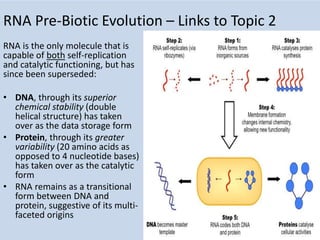
RNA Pre-Biotic Evolution – Links to Topic 2
RNA is the only molecule that is
capable of both self-replication
and catalytic functioning, but has
since been superseded:
• DNA, through its superior
chemical stability (double
helical structure) has taken
over as the data storage form
• Protein, through its greater
variability (20 amino acids as
opposed to 4 nucleotide bases)
has taken over as the catalytic
form
• RNA remains as a transitional
form between DNA and
protein, suggestive of its multi-
faceted origins
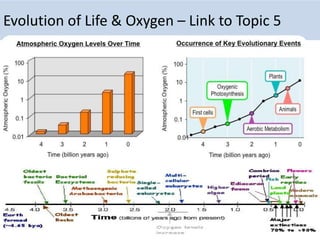
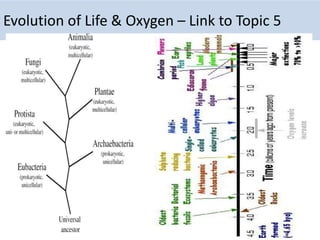
Evolution of Life & Oxygen – Link to Topic 5
Primordial Earth had a reducing atmosphere that contained very
low levels of oxygen gas
• After about ~2 billion years of prokaryotic life, a form of
chlorophyll evolved in prokaryotes (forming cyanobacteria)
• This allowed for the process of photosynthesis to occur, creating
oxygen gas as a by-product via the photolysis of water
The increase in oxygen in the atmosphere was coupled to a number
of significant effects:
• There was a breakdown of chemicals in the atmosphere and
oceans to produce oxidized compounds (e.g. CO2)
• There was an evolution of organisms capable of breaking down
oxygen-rich oxidizing agents (e.g. aerobes)
• The subsequent formation of an ozone layer restricted UV
radiation to allow for the proliferation of a wider range of life
forms
Evolution of Life & Oxygen – Link to Topic 5
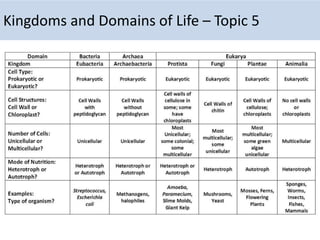
Kingdoms and Domains of Life – Topic 5
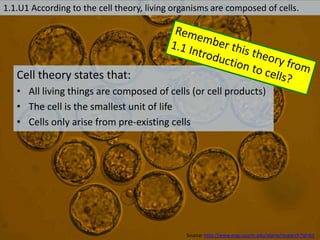
1.1.U1 According to the cell theory, living organisms are composed of cells.
Cell theory states that:
• All living things are composed of cells (or cell products)
• The cell is the smallest unit of life
• Cells only arise from pre-existing cells
Source: http://www.engr.uconn.edu/alarm/research?id=63
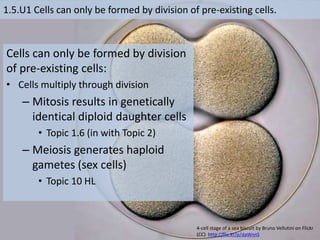
1.5.U1 Cells can only be formed by division of pre-existing cells.
Cells can only be formed by division
of pre-existing cells:
• Cells multiply through division
– Mitosis results in genetically
identical diploid daughter cells
• Topic 1.6 (in with Topic 2)
– Meiosis generates haploid
gametes (sex cells)
• Topic 10 HL
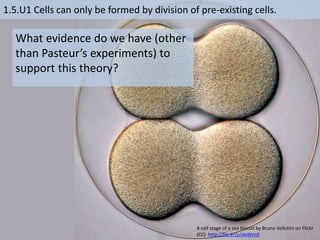
4-cell stage of a sea biscuit by Bruno Vellutini on Flickr
(CC) http://flic.kr/p/daWnnS
1.5.U1 Cells can only be formed by division of pre-existing cells.
What evidence do we have (other
than Pasteur’s experiments) to
support this theory?
4-cell stage of a sea biscuit by Bruno Vellutini on Flickr
(CC) http://flic.kr/p/daWnnS
1.5.U1 Cells can only be formed by division of pre-existing cells.
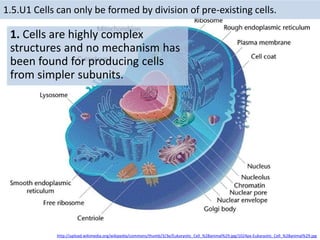
1. Cells are highly complex
structures and no mechanism has
been found for producing cells
from simpler subunits.
http://upload.wikimedia.org/wikipedia/commons/thumb/3/3e/Eukaryotic_Cell_%28animal%29.jpg/1024px-Eukaryotic_Cell_%28animal%29.jpg
1.5.U1 Cells can only be formed by division of pre-existing cells.
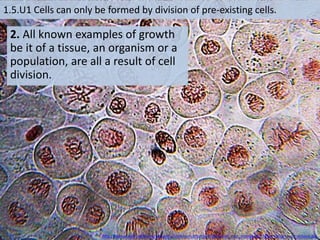
2. All known examples of growth
be it of a tissue, an organism or a
population, are all a result of cell
division.
http://upload.wikimedia.org/wikipedia/commons/thumb/d/d3/Onion_root_mitosis.jpg/749px-Onion_root_mitosis.jpg
1.5.U1 Cells can only be formed by division of pre-existing cells.
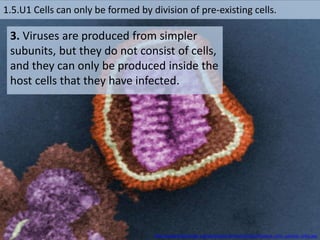
3. Viruses are produced from simpler
subunits, but they do not consist of cells,
and they can only be produced inside the
host cells that they have infected.
http://upload.wikimedia.org/wikipedia/commons/3/3a/Influenza_virus_particle_color.jpg
1.5.U1 Cells can only be formed by division of pre-existing cells.
4. Genetic code is universal each
of the 64 codons (a codon is a
combination of 3 DNA bases)
produces the same amino acid in
translation, regardless of the
organism [2.7.A2]*.
* There are some minor variations that are likely to have accrued since the common origin of
life on Earth, but these are rare and most of the genetic code is universal most of the time.
The logical deduction is that all
cells have arisen as the result of
cell division from a single
common ancestor.
http://www.slideshare.net/gurustip/protein-synthesis-35-transcription-translation-sl
If we accept that there were times in the history of the Earth when cells did not exist then
it is an obvious point that ‘The first cells must have arisen from non-living material’. The
only other possible explanation is that life, in the form of cells, was transported here from
elsewhere in the universe. As illustrated above, it is extremely difficult (and given our level
of technology currently impossible), to generate cells from anything but other cells. So
how did the first cells arise?
http://exploringorigins.org/resources.html
1.5.U2 The first cells must have arisen from non-living material.
Some of the key problems are:
1. Non-living synthesis of simple organic
molecules, e.g. sugars and amino acids
2. Assembly of these organic molecules into
polymers
3. Formation of polymers that can self-
replicate (enabling inheritance)
4. Formation of membranes to package the
organic molecules
http://exploringorigins.org/resources.html
1.5.U2 The first cells must have arisen from non-living material.
The theory that living cells arose from non-living matter is
known as abiogenesis
This process is theorized to have occurred over four key stages:
• There was non-living synthesis of simple organic
molecules (from primordial inorganic molecules)
• These simple organic molecules became assembled into more
complex polymers
• Certain polymers formed the capacity to self-
replicate (enabling inheritance)
• These molecules became packaged into membranes with an
internal chemistry different from their surroundings
(protobionts)
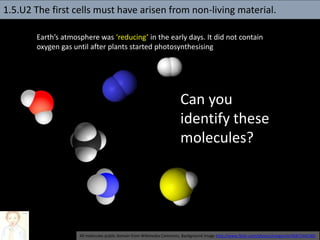
Earth’s atmosphere was ‘reducing’ in the early days. It did not contain
oxygen gas until after plants started photosynthesising
All molecules public domain from Wikimedia Commons, Background image http://www.flickr.com/photos/lrargerich/4587244190/
Can you
identify these
molecules?
1.5.U2 The first cells must have arisen from non-living material.
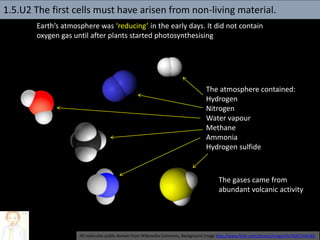
Earth’s atmosphere was ‘reducing’ in the early days. It did not contain
oxygen gas until after plants started photosynthesising
The atmosphere contained:
Hydrogen
Nitrogen
Water vapour
Methane
Ammonia
Hydrogen sulfide
All molecules public domain from Wikimedia Commons, Background image http://www.flickr.com/photos/lrargerich/4587244190/
The gases came from
abundant volcanic activity
1.5.U2 The first cells must have arisen from non-living material.
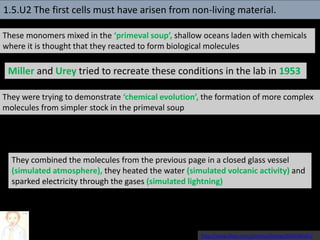
These monomers mixed in the ‘primeval soup’, shallow oceans laden with chemicals
where it is thought that they reacted to form biological molecules
Miller and Urey tried to recreate these conditions in the lab in 1953
They were trying to demonstrate ‘chemical evolution’, the formation of more complex
molecules from simpler stock in the primeval soup
They combined the molecules from the previous page in a closed glass vessel
(simulated atmosphere), they heated the water (simulated volcanic activity) and
sparked electricity through the gases (simulated lightning)
http://www.flickr.com/photos/afeman/663646181/
1.5.U2 The first cells must have arisen from non-living material.
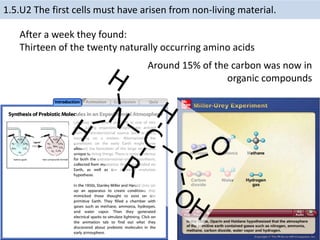
After a week they found:
Thirteen of the twenty naturally occurring amino acids
Around 15% of the carbon was now in
organic compounds
1.5.U2 The first cells must have arisen from non-living material.
Carny http://upload.wikimedia.org/wikipedia/commons/5/59/MUexperiment.png
1.5.U2 The first cells must have arisen from non-living material.
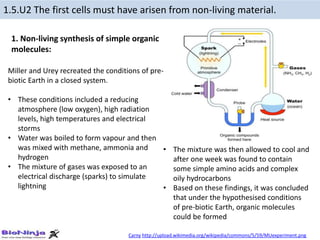
Miller and Urey recreated the conditions of pre-
biotic Earth in a closed system.
• These conditions included a reducing
atmosphere (low oxygen), high radiation
levels, high temperatures and electrical
storms
• Water was boiled to form vapour and then
was mixed with methane, ammonia and
hydrogen
• The mixture of gases was exposed to an
electrical discharge (sparks) to simulate
lightning
• The mixture was then allowed to cool and
after one week was found to contain
some simple amino acids and complex
oily hydrocarbons
• Based on these findings, it was concluded
that under the hypothesised conditions
of pre-biotic Earth, organic molecules
could be formed
1. Non-living synthesis of simple organic
molecules:
1.5.U2 The first cells must have arisen from non-living material.
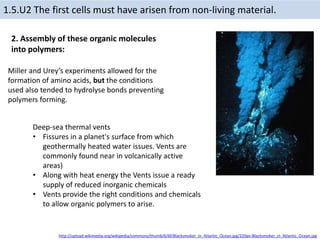
Miller and Urey’s experiments allowed for the
formation of amino acids, but the conditions
used also tended to hydrolyse bonds preventing
polymers forming.
Deep-sea thermal vents
• Fissures in a planet's surface from which
geothermally heated water issues. Vents are
commonly found near in volcanically active
areas)
• Along with heat energy the Vents issue a ready
supply of reduced inorganic chemicals
• Vents provide the right conditions and chemicals
to allow organic polymers to arise.
2. Assembly of these organic molecules
into polymers:
http://upload.wikimedia.org/wikipedia/commons/thumb/6/6f/Blacksmoker_in_Atlantic_Ocean.jpg/220px-Blacksmoker_in_Atlantic_Ocean.jpg
1.5.U2 The first cells must have arisen from non-living material.
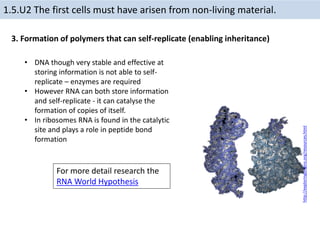
• DNA though very stable and effective at
storing information is not able to self-
replicate – enzymes are required
• However RNA can both store information
and self-replicate - it can catalyse the
formation of copies of itself.
• In ribosomes RNA is found in the catalytic
site and plays a role in peptide bond
formation
For more detail research the
RNA World Hypothesis
3. Formation of polymers that can self-replicate (enabling inheritance)
http://exploringorigins.org/resources.html
1.5.U2 The first cells must have arisen from non-living material.
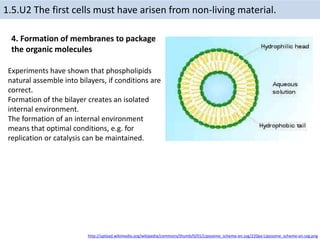
Experiments have shown that phospholipids
natural assemble into bilayers, if conditions are
correct.
Formation of the bilayer creates an isolated
internal environment.
The formation of an internal environment
means that optimal conditions, e.g. for
replication or catalysis can be maintained.
4. Formation of membranes to package
the organic molecules
http://upload.wikimedia.org/wikipedia/commons/thumb/0/01/Liposome_scheme-en.svg/220px-Liposome_scheme-en.svg.png
http://youtu.be/q71DWYJD-dI
1.5.U3 The origin of eukaryotic cells can be explained by the
endosymbiotic theory.
Use the video and/or the tutorial to
understand how this occurred.
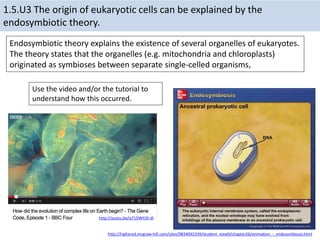
Endosymbiotic theory explains the existence of several organelles of eukaryotes.
The theory states that the organelles (e.g. mitochondria and chloroplasts)
originated as symbioses between separate single-celled organisms,
http://highered.mcgraw-hill.com/sites/9834092339/student_view0/chapter26/animation_-_endosymbiosis.html
1.5.U3 The origin of eukaryotic cells can be explained by the
endosymbiotic theory.
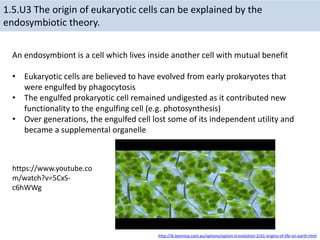
An endosymbiont is a cell which lives inside another cell with mutual benefit
• Eukaryotic cells are believed to have evolved from early prokaryotes that
were engulfed by phagocytosis
• The engulfed prokaryotic cell remained undigested as it contributed new
functionality to the engulfing cell (e.g. photosynthesis)
• Over generations, the engulfed cell lost some of its independent utility and
became a supplemental organelle
http://ib.bioninja.com.au/options/option-d-evolution-2/d1-origins-of-life-on-earth.html
https://www.youtube.co
m/watch?v=5CxS-
c6hWWg
1.5.U3 The origin of eukaryotic cells can be explained by the
endosymbiotic theory.
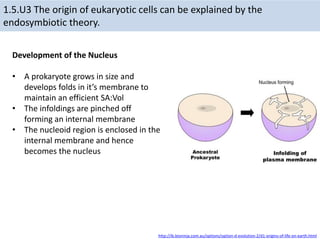
Development of the Nucleus
• A prokaryote grows in size and
develops folds in it’s membrane to
maintain an efficient SA:Vol
• The infoldings are pinched off
forming an internal membrane
• The nucleoid region is enclosed in the
internal membrane and hence
becomes the nucleus
http://ib.bioninja.com.au/options/option-d-evolution-2/d1-origins-of-life-on-earth.html
1.5.U3 The origin of eukaryotic cells can be
explained by the endosymbiotic theory.
http://ib.bioninja.com.au/options/option-d-evolution-2/d1-origins-of-life-on-earth.html
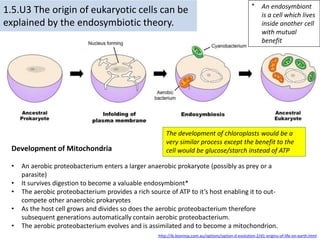
* An endosymbiont
is a cell which lives
inside another cell
with mutual
benefit
Development of Mitochondria
• An aerobic proteobacterium enters a larger anaerobic prokaryote (possibly as prey or a
parasite)
• It survives digestion to become a valuable endosymbiont*
• The aerobic proteobacterium provides a rich source of ATP to it’s host enabling it to out-
compete other anaerobic prokaryotes
• As the host cell grows and divides so does the aerobic proteobacterium therefore
subsequent generations automatically contain aerobic proteobacterium.
• The aerobic proteobacterium evolves and is assimilated and to become a mitochondrion.
The development of chloroplasts would be a
very similar process except the benefit to the
cell would be glucose/starch instead of ATP
1.5.U3 The origin of eukaryotic cells can be explained
by the endosymbiotic theory.
Evidence for Endosymbiosis
Mitochondria and chloroplasts are both organelles suggested to have
arisen via endosymbiosis
Evidence that supports the extracellular origins of these organelles
can be seen by looking at certain key features:
Membranes (double membrane bound)
Antibiotics (susceptibility)
Division (mode of replication)
DNA (presence and structural composition)
Ribosomes (size)
Mnmemonic: MAD DR (mad doctor)
1.5.U3 The origin of eukaryotic cells can be explained
by the endosymbiotic theory.
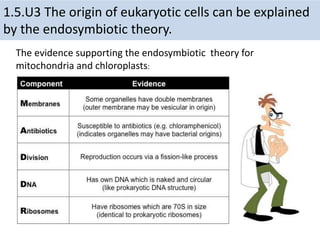
The evidence supporting the endosymbiotic theory for
mitochondria and chloroplasts:
1.5.U3 The origin of eukaryotic cells can be explained by the
endosymbiotic theory.
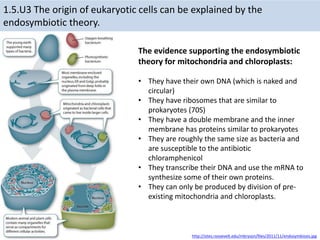
The evidence supporting the endosymbiotic
theory for mitochondria and chloroplasts:
• They have their own DNA (which is naked and
circular)
• They have ribosomes that are similar to
prokaryotes (70S)
• They have a double membrane and the inner
membrane has proteins similar to prokaryotes
• They are roughly the same size as bacteria and
are susceptible to the antibiotic
chloramphenicol
• They transcribe their DNA and use the mRNA to
synthesize some of their own proteins.
• They can only be produced by division of pre-
existing mitochondria and chloroplasts.
http://sites.roosevelt.edu/mbryson/files/2011/11/endosymbiosis.jpg
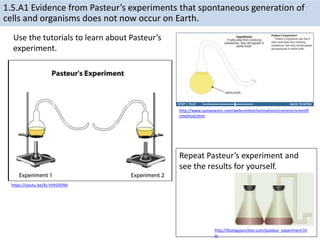
Use the tutorials to learn about Pasteur’s
experiment.
1.5.A1 Evidence from Pasteur’s experiments that spontaneous generation of
cells and organisms does not now occur on Earth.
https://youtu.be/Xc-hHhDID9A
Repeat Pasteur’s experiment and
see the results for yourself.
http://biologyjunction.com/pasteur_experiment.ht
m
http://www.sumanasinc.com/webcontent/animations/content/scientifi
cmethod.html
1.5.A1 Evidence from Pasteur’s experiments that spontaneous generation of
cells and organisms does not now occur on Earth.
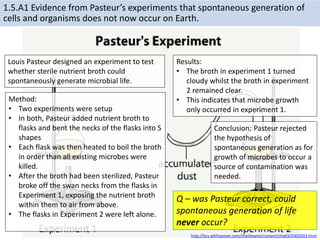
Method:
• Two experiments were setup
• In both, Pasteur added nutrient broth to
flasks and bent the necks of the flasks into S
shapes
• Each flask was then heated to boil the broth
in order than all existing microbes were
killed.
• After the broth had been sterilized, Pasteur
broke off the swan necks from the flasks in
Experiment 1, exposing the nutrient broth
within them to air from above.
• The flasks in Experiment 2 were left alone.
http://bcs.whfreeman.com/thelifewire/content/chp03/0302003.html
Results:
• The broth in experiment 1 turned
cloudy whilst the broth in experiment
2 remained clear.
• This indicates that microbe growth
only occurred in experiment 1.
Conclusion: Pasteur rejected
the hypothesis of
spontaneous generation as for
growth of microbes to occur a
source of contamination was
needed.
Louis Pasteur designed an experiment to test
whether sterile nutrient broth could
spontaneously generate microbial life.
Q – was Pasteur correct, could
spontaneous generation of life
never occur?
Bibliography / Acknowledgments
Jason de Nys

IB Topic 1.5 Cell Origins

  • 1.
    1.5 Origin ofcells Essential idea: There is an unbroken chain of life from the first cells on Earth to all cells in organisms alive today. http://rstb.royalsocietypublishing.org/content/361/1470/1023/F3.large.jpg Acknowledgements to Chris Paine and Bioninja https://bioknowledgy.weebly.com/ Edited by Eran Earland
  • 2.
    Understandings, Applications andSkills Statement Guidance 1.5.U1 Cells can only be formed by division of pre-existing cells. Students should be aware that the 64 codons in the genetic code have the same meanings in nearly all organisms, but that there are some minor variations that are likely to have accrued since the common origin of life on Earth. 1.5.U2 The first cells must have arisen from non-living material. 1.5.U3 The origin of eukaryotic cells can be explained by the endosymbiotic theory. Evidence for the endosymbiotic theory is expected. The origin of eukaryote cilia and flagella does not need to be included. 1.5.A1 Evidence from Pasteur’s experiments that spontaneous generation of cells and organisms does not now occur on Earth.
  • 3.
  • 4.
    Pre-Biotic Evolution –Extra info • The initial formation of primitive living structures (protocells) is thought to require a specific supporting chemical environment • Early Earth had a chemically-reducing atmosphere, which when exposed to energy in various forms (heat, electrical discharge, etc.) produced a variety of simple organic compounds (monomers) • These compounds accumulated in a molecular ‘soup’, allowing for the formation of more complex compounds (polymers)
  • 5.
    Pre-Biotic Evolution –Extra info • There are a number of locations posited as providing suitable conditions for the formation of a concentrated chemical soup, including volcanoes, hydrothermal vents, shorelines and outer space
  • 6.
    Pre-Biotic Evolution –Extra info 1. Volcanoes • The gas composition of volcanic eruptions contain high levels of fixed nitrogen and other raw materials which could be used for primitive metabolism • Intensive volcanic activity could also generate sufficient thermal energy to catalyse the formation of organic molecules 2. Hydrothermal Vents • Hydrothermal vents are regions of the ocean floor where superheated water is released from the Earth’s crust • These vents also release hydrogen-rich fluids to create a chemical gradient and pH viable for organic synthesis
  • 7.
    Pre-Biotic Evolution –Extra info 3. Shorelines • Organic life may have evolved at a sea shore or other region where there is an alternation of wet and dry conditions • The drying of clay particles could have precipitated catalysing reactions needed for the formation of organic molecules 4. Extraterrestrial Origins • The necessary conditions required for the formation of life may have initially been derived on other planets (e.g. Mars) • Comets contain a variety of organic material (~20% of a comet’s tail is comprised of organic matter) • Heavy meteorite bombardment approximately 4 billion years ago may have delivered organic material to the Earth • The theory that life on Earth was initially seeded in space or on another planet is called panspermia
  • 8.
  • 9.
    RNA Pre-Biotic Evolution •The RNA world hypothesis proposes that a world filled with RNA- based life predates current DNA-based lifeforms • RNA has two key qualities that would have allowed it to function in this manner: RNA can self-replicate • RNA is able to store information in a sequence composed of four recurring nucleotides (similar to DNA) • Short sequences of RNA are able to be accurately duplicated to form identical RNA molecules RNA can act as a catalyst • Modern cells use RNA catalysts (called ribozymes) to remove introns from mRNA and help synthesise new RNA molecules • In ribosomes, rRNA functions as the catalytic component and plays a pivotal role in peptide bond formation
  • 10.
    RNA Pre-Biotic Evolution– Links to Topic 2 RNA is the only molecule that is capable of both self-replication and catalytic functioning, but has since been superseded: • DNA, through its superior chemical stability (double helical structure) has taken over as the data storage form • Protein, through its greater variability (20 amino acids as opposed to 4 nucleotide bases) has taken over as the catalytic form • RNA remains as a transitional form between DNA and protein, suggestive of its multi- faceted origins
  • 11.
    Evolution of Life& Oxygen – Link to Topic 5 Primordial Earth had a reducing atmosphere that contained very low levels of oxygen gas • After about ~2 billion years of prokaryotic life, a form of chlorophyll evolved in prokaryotes (forming cyanobacteria) • This allowed for the process of photosynthesis to occur, creating oxygen gas as a by-product via the photolysis of water The increase in oxygen in the atmosphere was coupled to a number of significant effects: • There was a breakdown of chemicals in the atmosphere and oceans to produce oxidized compounds (e.g. CO2) • There was an evolution of organisms capable of breaking down oxygen-rich oxidizing agents (e.g. aerobes) • The subsequent formation of an ozone layer restricted UV radiation to allow for the proliferation of a wider range of life forms
  • 12.
    Evolution of Life& Oxygen – Link to Topic 5
  • 13.
    Evolution of Life& Oxygen – Link to Topic 5
  • 14.
    Kingdoms and Domainsof Life – Topic 5
  • 15.
    1.1.U1 According tothe cell theory, living organisms are composed of cells. Cell theory states that: • All living things are composed of cells (or cell products) • The cell is the smallest unit of life • Cells only arise from pre-existing cells Source: http://www.engr.uconn.edu/alarm/research?id=63
  • 16.
    1.5.U1 Cells canonly be formed by division of pre-existing cells. Cells can only be formed by division of pre-existing cells: • Cells multiply through division – Mitosis results in genetically identical diploid daughter cells • Topic 1.6 (in with Topic 2) – Meiosis generates haploid gametes (sex cells) • Topic 10 HL 4-cell stage of a sea biscuit by Bruno Vellutini on Flickr (CC) http://flic.kr/p/daWnnS
  • 17.
    1.5.U1 Cells canonly be formed by division of pre-existing cells. What evidence do we have (other than Pasteur’s experiments) to support this theory? 4-cell stage of a sea biscuit by Bruno Vellutini on Flickr (CC) http://flic.kr/p/daWnnS
  • 18.
    1.5.U1 Cells canonly be formed by division of pre-existing cells. 1. Cells are highly complex structures and no mechanism has been found for producing cells from simpler subunits. http://upload.wikimedia.org/wikipedia/commons/thumb/3/3e/Eukaryotic_Cell_%28animal%29.jpg/1024px-Eukaryotic_Cell_%28animal%29.jpg
  • 19.
    1.5.U1 Cells canonly be formed by division of pre-existing cells. 2. All known examples of growth be it of a tissue, an organism or a population, are all a result of cell division. http://upload.wikimedia.org/wikipedia/commons/thumb/d/d3/Onion_root_mitosis.jpg/749px-Onion_root_mitosis.jpg
  • 20.
    1.5.U1 Cells canonly be formed by division of pre-existing cells. 3. Viruses are produced from simpler subunits, but they do not consist of cells, and they can only be produced inside the host cells that they have infected. http://upload.wikimedia.org/wikipedia/commons/3/3a/Influenza_virus_particle_color.jpg
  • 21.
    1.5.U1 Cells canonly be formed by division of pre-existing cells. 4. Genetic code is universal each of the 64 codons (a codon is a combination of 3 DNA bases) produces the same amino acid in translation, regardless of the organism [2.7.A2]*. * There are some minor variations that are likely to have accrued since the common origin of life on Earth, but these are rare and most of the genetic code is universal most of the time. The logical deduction is that all cells have arisen as the result of cell division from a single common ancestor. http://www.slideshare.net/gurustip/protein-synthesis-35-transcription-translation-sl
  • 22.
    If we acceptthat there were times in the history of the Earth when cells did not exist then it is an obvious point that ‘The first cells must have arisen from non-living material’. The only other possible explanation is that life, in the form of cells, was transported here from elsewhere in the universe. As illustrated above, it is extremely difficult (and given our level of technology currently impossible), to generate cells from anything but other cells. So how did the first cells arise? http://exploringorigins.org/resources.html 1.5.U2 The first cells must have arisen from non-living material. Some of the key problems are: 1. Non-living synthesis of simple organic molecules, e.g. sugars and amino acids 2. Assembly of these organic molecules into polymers 3. Formation of polymers that can self- replicate (enabling inheritance) 4. Formation of membranes to package the organic molecules
  • 23.
    http://exploringorigins.org/resources.html 1.5.U2 The firstcells must have arisen from non-living material. The theory that living cells arose from non-living matter is known as abiogenesis This process is theorized to have occurred over four key stages: • There was non-living synthesis of simple organic molecules (from primordial inorganic molecules) • These simple organic molecules became assembled into more complex polymers • Certain polymers formed the capacity to self- replicate (enabling inheritance) • These molecules became packaged into membranes with an internal chemistry different from their surroundings (protobionts)
  • 24.
    Earth’s atmosphere was‘reducing’ in the early days. It did not contain oxygen gas until after plants started photosynthesising All molecules public domain from Wikimedia Commons, Background image http://www.flickr.com/photos/lrargerich/4587244190/ Can you identify these molecules? 1.5.U2 The first cells must have arisen from non-living material.
  • 25.
    Earth’s atmosphere was‘reducing’ in the early days. It did not contain oxygen gas until after plants started photosynthesising The atmosphere contained: Hydrogen Nitrogen Water vapour Methane Ammonia Hydrogen sulfide All molecules public domain from Wikimedia Commons, Background image http://www.flickr.com/photos/lrargerich/4587244190/ The gases came from abundant volcanic activity 1.5.U2 The first cells must have arisen from non-living material.
  • 26.
    These monomers mixedin the ‘primeval soup’, shallow oceans laden with chemicals where it is thought that they reacted to form biological molecules Miller and Urey tried to recreate these conditions in the lab in 1953 They were trying to demonstrate ‘chemical evolution’, the formation of more complex molecules from simpler stock in the primeval soup They combined the molecules from the previous page in a closed glass vessel (simulated atmosphere), they heated the water (simulated volcanic activity) and sparked electricity through the gases (simulated lightning) http://www.flickr.com/photos/afeman/663646181/ 1.5.U2 The first cells must have arisen from non-living material.
  • 27.
    After a weekthey found: Thirteen of the twenty naturally occurring amino acids Around 15% of the carbon was now in organic compounds 1.5.U2 The first cells must have arisen from non-living material.
  • 28.
    Carny http://upload.wikimedia.org/wikipedia/commons/5/59/MUexperiment.png 1.5.U2 Thefirst cells must have arisen from non-living material. Miller and Urey recreated the conditions of pre- biotic Earth in a closed system. • These conditions included a reducing atmosphere (low oxygen), high radiation levels, high temperatures and electrical storms • Water was boiled to form vapour and then was mixed with methane, ammonia and hydrogen • The mixture of gases was exposed to an electrical discharge (sparks) to simulate lightning • The mixture was then allowed to cool and after one week was found to contain some simple amino acids and complex oily hydrocarbons • Based on these findings, it was concluded that under the hypothesised conditions of pre-biotic Earth, organic molecules could be formed 1. Non-living synthesis of simple organic molecules:
  • 29.
    1.5.U2 The firstcells must have arisen from non-living material. Miller and Urey’s experiments allowed for the formation of amino acids, but the conditions used also tended to hydrolyse bonds preventing polymers forming. Deep-sea thermal vents • Fissures in a planet's surface from which geothermally heated water issues. Vents are commonly found near in volcanically active areas) • Along with heat energy the Vents issue a ready supply of reduced inorganic chemicals • Vents provide the right conditions and chemicals to allow organic polymers to arise. 2. Assembly of these organic molecules into polymers: http://upload.wikimedia.org/wikipedia/commons/thumb/6/6f/Blacksmoker_in_Atlantic_Ocean.jpg/220px-Blacksmoker_in_Atlantic_Ocean.jpg
  • 30.
    1.5.U2 The firstcells must have arisen from non-living material. • DNA though very stable and effective at storing information is not able to self- replicate – enzymes are required • However RNA can both store information and self-replicate - it can catalyse the formation of copies of itself. • In ribosomes RNA is found in the catalytic site and plays a role in peptide bond formation For more detail research the RNA World Hypothesis 3. Formation of polymers that can self-replicate (enabling inheritance) http://exploringorigins.org/resources.html
  • 31.
    1.5.U2 The firstcells must have arisen from non-living material. Experiments have shown that phospholipids natural assemble into bilayers, if conditions are correct. Formation of the bilayer creates an isolated internal environment. The formation of an internal environment means that optimal conditions, e.g. for replication or catalysis can be maintained. 4. Formation of membranes to package the organic molecules http://upload.wikimedia.org/wikipedia/commons/thumb/0/01/Liposome_scheme-en.svg/220px-Liposome_scheme-en.svg.png
  • 32.
    http://youtu.be/q71DWYJD-dI 1.5.U3 The originof eukaryotic cells can be explained by the endosymbiotic theory. Use the video and/or the tutorial to understand how this occurred. Endosymbiotic theory explains the existence of several organelles of eukaryotes. The theory states that the organelles (e.g. mitochondria and chloroplasts) originated as symbioses between separate single-celled organisms, http://highered.mcgraw-hill.com/sites/9834092339/student_view0/chapter26/animation_-_endosymbiosis.html
  • 33.
    1.5.U3 The originof eukaryotic cells can be explained by the endosymbiotic theory. An endosymbiont is a cell which lives inside another cell with mutual benefit • Eukaryotic cells are believed to have evolved from early prokaryotes that were engulfed by phagocytosis • The engulfed prokaryotic cell remained undigested as it contributed new functionality to the engulfing cell (e.g. photosynthesis) • Over generations, the engulfed cell lost some of its independent utility and became a supplemental organelle http://ib.bioninja.com.au/options/option-d-evolution-2/d1-origins-of-life-on-earth.html https://www.youtube.co m/watch?v=5CxS- c6hWWg
  • 34.
    1.5.U3 The originof eukaryotic cells can be explained by the endosymbiotic theory. Development of the Nucleus • A prokaryote grows in size and develops folds in it’s membrane to maintain an efficient SA:Vol • The infoldings are pinched off forming an internal membrane • The nucleoid region is enclosed in the internal membrane and hence becomes the nucleus http://ib.bioninja.com.au/options/option-d-evolution-2/d1-origins-of-life-on-earth.html
  • 35.
    1.5.U3 The originof eukaryotic cells can be explained by the endosymbiotic theory. http://ib.bioninja.com.au/options/option-d-evolution-2/d1-origins-of-life-on-earth.html * An endosymbiont is a cell which lives inside another cell with mutual benefit Development of Mitochondria • An aerobic proteobacterium enters a larger anaerobic prokaryote (possibly as prey or a parasite) • It survives digestion to become a valuable endosymbiont* • The aerobic proteobacterium provides a rich source of ATP to it’s host enabling it to out- compete other anaerobic prokaryotes • As the host cell grows and divides so does the aerobic proteobacterium therefore subsequent generations automatically contain aerobic proteobacterium. • The aerobic proteobacterium evolves and is assimilated and to become a mitochondrion. The development of chloroplasts would be a very similar process except the benefit to the cell would be glucose/starch instead of ATP
  • 36.
    1.5.U3 The originof eukaryotic cells can be explained by the endosymbiotic theory. Evidence for Endosymbiosis Mitochondria and chloroplasts are both organelles suggested to have arisen via endosymbiosis Evidence that supports the extracellular origins of these organelles can be seen by looking at certain key features: Membranes (double membrane bound) Antibiotics (susceptibility) Division (mode of replication) DNA (presence and structural composition) Ribosomes (size) Mnmemonic: MAD DR (mad doctor)
  • 37.
    1.5.U3 The originof eukaryotic cells can be explained by the endosymbiotic theory. The evidence supporting the endosymbiotic theory for mitochondria and chloroplasts:
  • 38.
    1.5.U3 The originof eukaryotic cells can be explained by the endosymbiotic theory. The evidence supporting the endosymbiotic theory for mitochondria and chloroplasts: • They have their own DNA (which is naked and circular) • They have ribosomes that are similar to prokaryotes (70S) • They have a double membrane and the inner membrane has proteins similar to prokaryotes • They are roughly the same size as bacteria and are susceptible to the antibiotic chloramphenicol • They transcribe their DNA and use the mRNA to synthesize some of their own proteins. • They can only be produced by division of pre- existing mitochondria and chloroplasts. http://sites.roosevelt.edu/mbryson/files/2011/11/endosymbiosis.jpg
  • 39.
    Use the tutorialsto learn about Pasteur’s experiment. 1.5.A1 Evidence from Pasteur’s experiments that spontaneous generation of cells and organisms does not now occur on Earth. https://youtu.be/Xc-hHhDID9A Repeat Pasteur’s experiment and see the results for yourself. http://biologyjunction.com/pasteur_experiment.ht m http://www.sumanasinc.com/webcontent/animations/content/scientifi cmethod.html
  • 40.
    1.5.A1 Evidence fromPasteur’s experiments that spontaneous generation of cells and organisms does not now occur on Earth. Method: • Two experiments were setup • In both, Pasteur added nutrient broth to flasks and bent the necks of the flasks into S shapes • Each flask was then heated to boil the broth in order than all existing microbes were killed. • After the broth had been sterilized, Pasteur broke off the swan necks from the flasks in Experiment 1, exposing the nutrient broth within them to air from above. • The flasks in Experiment 2 were left alone. http://bcs.whfreeman.com/thelifewire/content/chp03/0302003.html Results: • The broth in experiment 1 turned cloudy whilst the broth in experiment 2 remained clear. • This indicates that microbe growth only occurred in experiment 1. Conclusion: Pasteur rejected the hypothesis of spontaneous generation as for growth of microbes to occur a source of contamination was needed. Louis Pasteur designed an experiment to test whether sterile nutrient broth could spontaneously generate microbial life. Q – was Pasteur correct, could spontaneous generation of life never occur?
  • 41.