Intro Physics                                                                               Name: _____________

Criterion C: Knowledge and Understanding                                (Formative)                   Introduction to Forces
Questions on this task fit the descriptors below.

 Level Descriptors
   0   The student does not reach a standard described by any of the descriptors below.
         The student recalls some scientific ideas, concepts and/or processes.
 1-2     The student applies scientific understanding to solve simple problems.
         The student describes scientific ideas, concepts and/or processes.

 3-4     The student applies scientific understanding to solve complex problems in familiar situations.
         The student analyses scientific information by identifying parts, relationships or causes.
         The student uses scientific ideas, concepts and/or processes correctly to construct scientific explanations.
         The student applies scientific understanding to solve complex problems including those in unfamiliar situations.
 5-6
         The student analyses and evaluates scientific       information   and makes      judgments     supported   by   scientific
         understanding.


1. State the names of three at-a-distance forces and three contact forces.
                                                                                                                           (L1-2)
 At-a-distance                                                      Contact


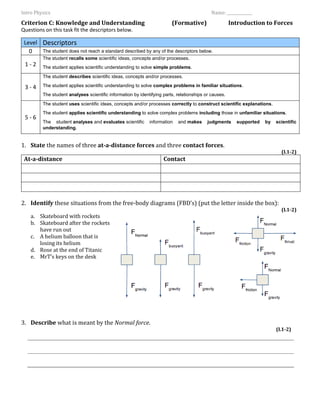
2. Identify these situations from the free-body diagrams (FBD’s) (put the letter inside the box):
                                                                                                                           (L1-2)
    a. Skateboard with rockets
    b. Skateboard after the rockets
       have run out
    c. A helium balloon that is
       losing its helium
    d. Rose at the end of Titanic
    e. MrT’s keys on the desk


3. Describe what is meant by the Normal force.
                                                                                                                         (L1-2)
Intro Physics                                                               Name: _____________

4. Describe what happens when there is an unbalancednet force acting on an object.
                                                                                                       (L3-4)


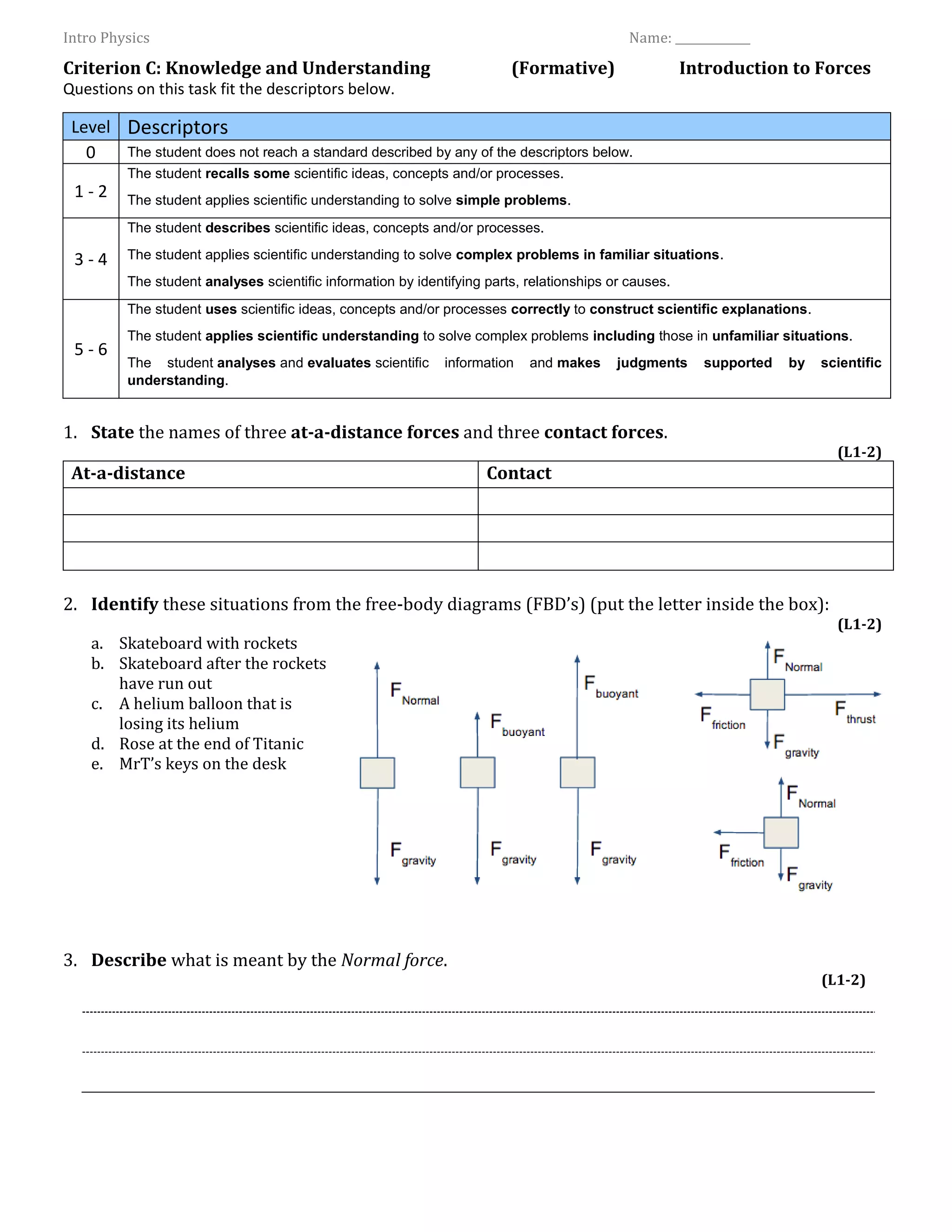
Felix took a balloon a long way up into the sky, jumped out, fell for a bit in freefall, lost control a while,
recovered, went faster than the speed of sound and then deployed his parachute to land safely.
           Some quick stats:
                Jump height: 39,045m
                Max speed: 1,342.8 km/h
                Total freefall time: 260s
                Freefall time to max speed: 40s(Time to Speed of Sound: 34s)
                Total jump time 9min 9s
                Felix’s mass with all the gear: 118kg
Sources: http://www.redbullstratos.com/blog/post/33739561019

5. Mass is a measure of the quantity of matter in an object (kg). Weight is a measure
   of the force of that object being pulled to Earth. On Earth, objects have a weight of
   10N per kg. Determine Felix’s weight with all the gear.
                                                                                      (L1-2)
                                                                    ___________ N

6. Calculate Felix’s average downward velocity in m/s over the whole jump.
                                                                                                         (L3-4)


7. Calculate the average accelerationfrom standing on the platform to maximum speed (m/s/s):
                                                                                                         (L3-4)


8. Suggest reasons why Felix’s average acceleration was slightly less than 9.8m/s/s.
                                                                                                       (L3-4)
Intro Physics                                                                       Name: _____________

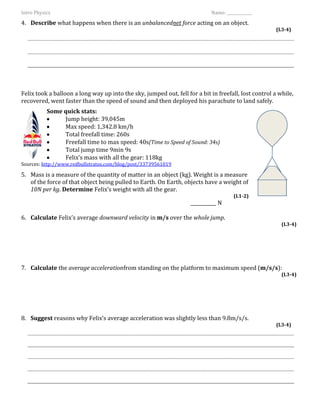
9. Drawand labelfree body diagrams (FBD’s) for these situations.
Note: Air resistance is a function of velocity – so the faster an object moves, the greater the air resistance it
generates. A small, fast object can generate as much air resistance as a large, slow parachute.
This animation might help: http://www.mrwaynesclass.com/teacher/projectile/terminal/home.html
And this: http://www.physicsclassroom.com/mmedia/newtlaws/sd.cfm                             (L3-4)
    a.   The capsule on the ascent.
    b.   Felix before stepping off the platform
    c.   Felix as he accelerates in freefall                                      Notes:
    d.   Felix at terminal velocity in freefall                                       Gravity is constant
    e.   Felix and his parachute just after the parachute is opened                   FBDs are vector diagrams
    f.   Felix and the parachute at the new, slower, terminal velocity


10. Two of the FBD’s above should look exactly the same. Identify them and explain your choice.
                                                                                                                    (L5-6)
Intro Physics                                                               Name: _____________

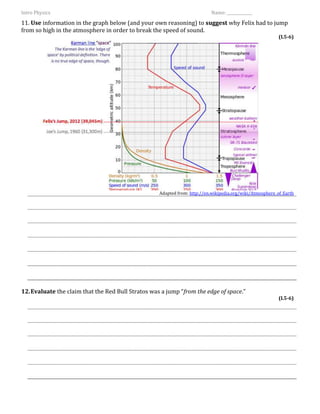
11. Use information in the graph below (and your own reasoning) to suggest why Felix had to jump
from so high in the atmosphere in order to break the speed of sound.
                                                                                                           (L5-6)


                                                    Adapted from: http://en.wikipedia.org/wiki/Atmosphere_of_Earth


12. Evaluate the claim that the Red Bull Stratos was a jump “from the edge of space.”
                                                                                                           (L5-6)

Red Bull Stratos: Freefall Physics

  • 1.
    Intro Physics Name: _____________ Criterion C: Knowledge and Understanding (Formative) Introduction to Forces Questions on this task fit the descriptors below. Level Descriptors 0 The student does not reach a standard described by any of the descriptors below. The student recalls some scientific ideas, concepts and/or processes. 1-2 The student applies scientific understanding to solve simple problems. The student describes scientific ideas, concepts and/or processes. 3-4 The student applies scientific understanding to solve complex problems in familiar situations. The student analyses scientific information by identifying parts, relationships or causes. The student uses scientific ideas, concepts and/or processes correctly to construct scientific explanations. The student applies scientific understanding to solve complex problems including those in unfamiliar situations. 5-6 The student analyses and evaluates scientific information and makes judgments supported by scientific understanding. 1. State the names of three at-a-distance forces and three contact forces. (L1-2) At-a-distance Contact 2. Identify these situations from the free-body diagrams (FBD’s) (put the letter inside the box): (L1-2) a. Skateboard with rockets b. Skateboard after the rockets have run out c. A helium balloon that is losing its helium d. Rose at the end of Titanic e. MrT’s keys on the desk 3. Describe what is meant by the Normal force. (L1-2)
  • 2.
    Intro Physics Name: _____________ 4. Describe what happens when there is an unbalancednet force acting on an object. (L3-4) Felix took a balloon a long way up into the sky, jumped out, fell for a bit in freefall, lost control a while, recovered, went faster than the speed of sound and then deployed his parachute to land safely. Some quick stats: Jump height: 39,045m Max speed: 1,342.8 km/h Total freefall time: 260s Freefall time to max speed: 40s(Time to Speed of Sound: 34s) Total jump time 9min 9s Felix’s mass with all the gear: 118kg Sources: http://www.redbullstratos.com/blog/post/33739561019 5. Mass is a measure of the quantity of matter in an object (kg). Weight is a measure of the force of that object being pulled to Earth. On Earth, objects have a weight of 10N per kg. Determine Felix’s weight with all the gear. (L1-2) ___________ N 6. Calculate Felix’s average downward velocity in m/s over the whole jump. (L3-4) 7. Calculate the average accelerationfrom standing on the platform to maximum speed (m/s/s): (L3-4) 8. Suggest reasons why Felix’s average acceleration was slightly less than 9.8m/s/s. (L3-4)
  • 3.
    Intro Physics Name: _____________ 9. Drawand labelfree body diagrams (FBD’s) for these situations. Note: Air resistance is a function of velocity – so the faster an object moves, the greater the air resistance it generates. A small, fast object can generate as much air resistance as a large, slow parachute. This animation might help: http://www.mrwaynesclass.com/teacher/projectile/terminal/home.html And this: http://www.physicsclassroom.com/mmedia/newtlaws/sd.cfm (L3-4) a. The capsule on the ascent. b. Felix before stepping off the platform c. Felix as he accelerates in freefall Notes: d. Felix at terminal velocity in freefall Gravity is constant e. Felix and his parachute just after the parachute is opened FBDs are vector diagrams f. Felix and the parachute at the new, slower, terminal velocity 10. Two of the FBD’s above should look exactly the same. Identify them and explain your choice. (L5-6)
  • 4.
    Intro Physics Name: _____________ 11. Use information in the graph below (and your own reasoning) to suggest why Felix had to jump from so high in the atmosphere in order to break the speed of sound. (L5-6) Adapted from: http://en.wikipedia.org/wiki/Atmosphere_of_Earth 12. Evaluate the claim that the Red Bull Stratos was a jump “from the edge of space.” (L5-6)