By Chris Paine
https://bioknowledgy.weebly.com/
1.4 Membrane transport
Essential idea: Membranes control the composition
of cells by active and passive transport.
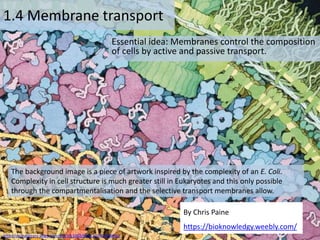
The background image is a piece of artwork inspired by the complexity of an E. Coli.
Complexity in cell structure is much greater still in Eukaryotes and this only possible
through the compartmentalisation and the selective transport membranes allow.
By Chris Paine
https://bioknowledgy.weebly.com/
http://onlinelibrary.wiley.com/doi/10.1002/bmb.20345/full#fig2
Understandings, Applications and Skills
Statement Guidance
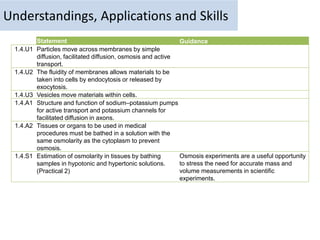
1.4.U1 Particles move across membranes by simple
diffusion, facilitated diffusion, osmosis and active
transport.
1.4.U2 The fluidity of membranes allows materials to be
taken into cells by endocytosis or released by
exocytosis.
1.4.U3 Vesicles move materials within cells.
1.4.A1 Structure and function of sodium–potassium pumps
for active transport and potassium channels for
facilitated diffusion in axons.
1.4.A2 Tissues or organs to be used in medical
procedures must be bathed in a solution with the
same osmolarity as the cytoplasm to prevent
osmosis.
1.4.S1 Estimation of osmolarity in tissues by bathing
samples in hypotonic and hypertonic solutions.
(Practical 2)
Osmosis experiments are a useful opportunity
to stress the need for accurate mass and
volume measurements in scientific
experiments.
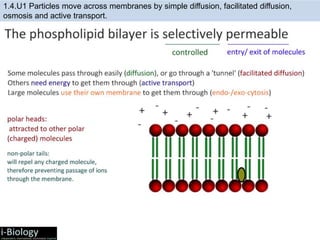
1.4.U1 Particles move across membranes by simple diffusion, facilitated diffusion,
osmosis and active transport.
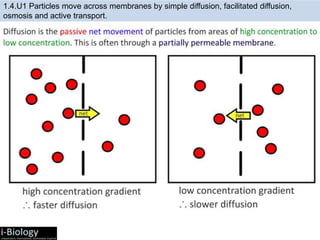
1.4.U1 Particles move across membranes by simple diffusion, facilitated diffusion,
osmosis and active transport.
http://highered.mheducation.com/sites/0072495855/student_view0/chapter2/anima
tion__how_diffusion_works.html
http://www.phschool.com/science/biology_place/labb
ench/lab1/concepts.html
1.4.U1 Particles move across membranes by simple diffusion, facilitated diffusion,
osmosis and active transport.
1.4.U1 Particles move across membranes by simple diffusion, facilitated diffusion,
osmosis and active transport.
1.4.U1 Particles move across membranes by simple diffusion, facilitated diffusion,
osmosis and active transport.
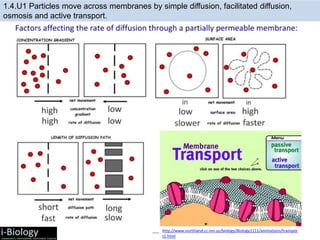
http://www.northland.cc.mn.us/biology/Biology1111/animations/transpor
t1.html
1.4.U1 Particles move across membranes by simple diffusion, facilitated diffusion,
osmosis and active transport.
What is
osmosis?
http://www.flickr.com/photos/luchilu/399970490/
1.4.U1 Particles move across membranes by simple diffusion, facilitated diffusion,
osmosis and active transport.
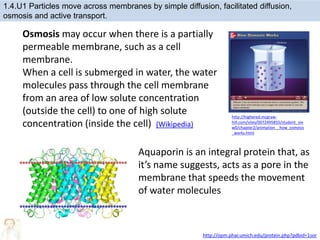
Osmosis may occur when there is a partially
permeable membrane, such as a cell
membrane.
When a cell is submerged in water, the water
molecules pass through the cell membrane
from an area of low solute concentration
(outside the cell) to one of high solute
concentration (inside the cell) (Wikipedia)
Aquaporin is an integral protein that, as
it’s name suggests, acts as a pore in the
membrane that speeds the movement
of water molecules
http://opm.phar.umich.edu/protein.php?pdbid=1sor
1.4.U1 Particles move across membranes by simple diffusion, facilitated diffusion,
osmosis and active transport.
http://highered.mcgraw-
hill.com/sites/0072495855/student_vie
w0/chapter2/animation__how_osmosis
_works.html
http://commons.wikimedia.org/wiki/File:Osmotic_pressure_on_blood_cells_diagram.svg
http://commons.wikimedia.org/wiki/File:Turgor_pressure_on_plant_cells_diagram.svg
The
importance
of osmotic
control
1.4.A2 Tissues or organs to be used in medical procedures must be bathed in a solution
with the same osmolarity as the cytoplasm to prevent osmosis.
http://highered.mcgraw-
hill.com/sites/0072495855/student_vie
w0/chapter2/animation__how_osmosis
_works.html
The importance of osmotic control
preventing damage to cells and tissues
1.4.A2 Tissues or organs to be used in medical procedures must be bathed in a solution
with the same osmolarity as the cytoplasm to prevent osmosis.
Common medical procedures in
which an isotonic saline
solution is useful:
• fluids introduction to a
patient’s blood system via an
intravenous drip, e.g for
rehydration
• used to rinse wounds, skin
abrasions etc.
• keep areas of damaged skin
moist before applying skin
grafts
• eye drops/wash
• frozen and used pack donor
organs for transportation
http://www.defenseimagery.mil/imageRetrieve.action?guid=8c9d5fade029a4f5a68fe667d1ae802ba9f30dd5&t=2
Simple
Diffusion
http://commons.wikimedia.org/wiki/File:Scheme_simple_diffusion_in_cell_membrane-en.svg
1.4.U1 Particles move across membranes by simple diffusion, facilitated diffusion,
osmosis and active transport.
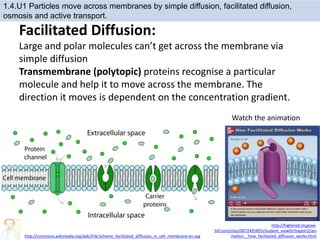
http://commons.wikimedia.org/wiki/File:Scheme_facilitated_diffusion_in_cell_membrane-en.svg
Facilitated Diffusion:
Large and polar molecules can’t get across the membrane via
simple diffusion
Transmembrane (polytopic) proteins recognise a particular
molecule and help it to move across the membrane. The
direction it moves is dependent on the concentration gradient.
Watch the animation
1.4.U1 Particles move across membranes by simple diffusion, facilitated diffusion,
osmosis and active transport.
http://highered.mcgraw-
hill.com/sites/0072495855/student_view0/chapter2/ani
mation__how_facilitated_diffusion_works.html
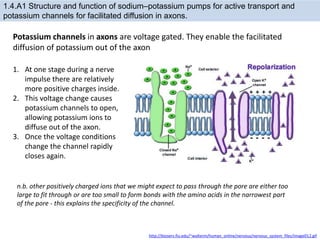
1.4.A1 Structure and function of sodium–potassium pumps for active transport and
potassium channels for facilitated diffusion in axons.
http://bioserv.fiu.edu/~walterm/human_online/nervous/nervous_system_files/image012.gif
1. At one stage during a nerve
impulse there are relatively
more positive charges inside.
2. This voltage change causes
potassium channels to open,
allowing potassium ions to
diffuse out of the axon.
3. Once the voltage conditions
change the channel rapidly
closes again.
Potassium channels in axons are voltage gated. They enable the facilitated
diffusion of potassium out of the axon
n.b. other positively charged ions that we might expect to pass through the pore are either too
large to fit through or are too small to form bonds with the amino acids in the narrowest part
of the pore - this explains the specificity of the channel.
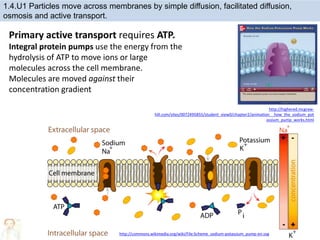
Primary active transport requires ATP.
Integral protein pumps use the energy from the
hydrolysis of ATP to move ions or large
molecules across the cell membrane.
Molecules are moved against their
concentration gradient
http://commons.wikimedia.org/wiki/File:Scheme_sodium-potassium_pump-en.svg
1.4.U1 Particles move across membranes by simple diffusion, facilitated diffusion,
osmosis and active transport.
http://highered.mcgraw-
hill.com/sites/0072495855/student_view0/chapter2/animation__how_the_sodium_pot
assium_pump_works.html
1.4.U1 Particles move across membranes by simple diffusion, facilitated diffusion,
osmosis and active transport.
1.4.U1 Particles move across membranes by simple diffusion, facilitated diffusion,
osmosis and active transport.
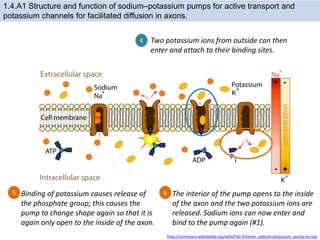
1.4.A1 Structure and function of sodium–potassium pumps for active transport and
potassium channels for facilitated diffusion in axons.
http://commons.wikimedia.org/wiki/File:Scheme_sodium-potassium_pump-en.svg
The sodium–potassium pump follows a repeating cycle of steps that result in
three sodium ions being pumped out of the axon (of neurons) and two
potassium ions being pumped in. Each time the pump goes round this cycle it
uses one ATP. The cycle consists of these steps:
The interior of the pump is open to the inside of
the axon; three sodium ions enter the pump
and attach to their binding sites.
1
1.4.A1 Structure and function of sodium–potassium pumps for active transport and
potassium channels for facilitated diffusion in axons.
http://commons.wikimedia.org/wiki/File:Scheme_sodium-potassium_pump-en.svg
The interior of the pump opens to the outside
of the axon and the three sodium ions are
released.
2 ATP transfers a phosphate group from itself to
the pump; this causes the pump to change
shape and the interior is then closed.
3
1.4.A1 Structure and function of sodium–potassium pumps for active transport and
potassium channels for facilitated diffusion in axons.
http://commons.wikimedia.org/wiki/File:Scheme_sodium-potassium_pump-en.svg
Two potassium ions from outside can then
enter and attach to their binding sites.
5 Binding of potassium causes release of
the phosphate group; this causes the
pump to change shape again so that it is
again only open to the inside of the axon.
4
The interior of the pump opens to the inside
of the axon and the two potassium ions are
released. Sodium ions can now enter and
bind to the pump again (#1).
6
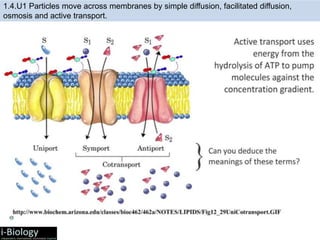
http://commons.wikimedia.org/wiki/File:Scheme_secundary_active_transport-en.svg
In secondary active transport, the required energy is
derived from energy stored in the form of concentration
differences in a second solute.
1.4.U1 Particles move across membranes by simple diffusion, facilitated diffusion,
osmosis and active transport.
Typically, the
concentration
gradient of the
second solute was
created by primary
active transport,
and the diffusion of
the second solute
across the
membrane drives
secondary active
transport.
1.4.U1 Particles move across membranes by simple diffusion, facilitated diffusion,
osmosis and active transport.
http://bcs.whfreeman.com/thelifewire/content/chp05/0502002.html
Vesicles are small spheroidal
packages that bud off of the
RER and the Golgi apparatus
They carry proteins produced
by ribosomes on the RER to
the Golgi apparatus, where
they are prepared for export
from the cell via another
vesicle
http://www.sumanasinc.com/webcontent/animations
/content/vesiclebudding.html
1.4.U3 Vesicles move materials within cells.
Use the animated tutorial to
learn more about the formation
and use of vesicles in cells
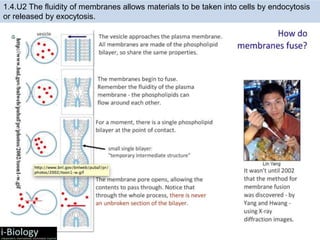
Endocytosis: The taking in
of external substances by an
inward pouching of the
plasma membrane, forming
a vesicle
Exocytosis: The release of
substances from a cell
(secretion) when a vesicle
joins with the cell plasma
membrane.
Diagrams on following slides
http://highered.mcgraw-hill.com/olc/dl/120068/bio02.swf
1.4.U2 The fluidity of membranes allows materials to be taken into cells by endocytosis
or released by exocytosis.
http://commons.wikimedia.org/wiki/File:Exocytosis_types.svg
Regulated
secretion is in
response to a
trigger e.g. the
release of
neurotransmitters
Constitutive
secretion
occurs
continuously in
cells,
depending on
their function
1.4.U2 The fluidity of membranes allows materials to be taken into cells by endocytosis
or released by exocytosis.
http://commons.wikimedia.org/wiki/File:Endocytosis_types.svg
“Cell eating” “Cell drinking”
1.4.U2 The fluidity of membranes allows materials to be taken into cells by endocytosis
or released by exocytosis.
1.4.U2 The fluidity of membranes allows materials to be taken into cells by endocytosis
or released by exocytosis.
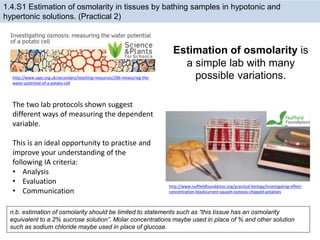
1.4.S1 Estimation of osmolarity in tissues by bathing samples in hypotonic and
hypertonic solutions. (Practical 2)
http://www.saps.org.uk/secondary/teaching-resources/286-measuring-the-
water-potential-of-a-potato-cell
http://www.nuffieldfoundation.org/practical-biology/investigating-effect-
concentration-blackcurrant-squash-osmosis-chipped-potatoes
The two lab protocols shown suggest
different ways of measuring the dependent
variable.
This is an ideal opportunity to practise and
improve your understanding of the
following IA criteria:
• Analysis
• Evaluation
• Communication
n.b. estimation of osmolarity should be limited to statements such as “this tissue has an osmolarity
equivalent to a 2% sucrose solution”. Molar concentrations maybe used in place of % and other solution
such as sodium chloride maybe used in place of glucose.
Estimation of osmolarity is
a simple lab with many
possible variations.
Bibliography / Acknowledgments
Jason de Nys

membrane transport ppt.pptx

  • 1.
    By Chris Paine https://bioknowledgy.weebly.com/ 1.4Membrane transport Essential idea: Membranes control the composition of cells by active and passive transport. The background image is a piece of artwork inspired by the complexity of an E. Coli. Complexity in cell structure is much greater still in Eukaryotes and this only possible through the compartmentalisation and the selective transport membranes allow. By Chris Paine https://bioknowledgy.weebly.com/ http://onlinelibrary.wiley.com/doi/10.1002/bmb.20345/full#fig2
  • 2.
    Understandings, Applications andSkills Statement Guidance 1.4.U1 Particles move across membranes by simple diffusion, facilitated diffusion, osmosis and active transport. 1.4.U2 The fluidity of membranes allows materials to be taken into cells by endocytosis or released by exocytosis. 1.4.U3 Vesicles move materials within cells. 1.4.A1 Structure and function of sodium–potassium pumps for active transport and potassium channels for facilitated diffusion in axons. 1.4.A2 Tissues or organs to be used in medical procedures must be bathed in a solution with the same osmolarity as the cytoplasm to prevent osmosis. 1.4.S1 Estimation of osmolarity in tissues by bathing samples in hypotonic and hypertonic solutions. (Practical 2) Osmosis experiments are a useful opportunity to stress the need for accurate mass and volume measurements in scientific experiments.
  • 3.
    1.4.U1 Particles moveacross membranes by simple diffusion, facilitated diffusion, osmosis and active transport.
  • 4.
    1.4.U1 Particles moveacross membranes by simple diffusion, facilitated diffusion, osmosis and active transport. http://highered.mheducation.com/sites/0072495855/student_view0/chapter2/anima tion__how_diffusion_works.html http://www.phschool.com/science/biology_place/labb ench/lab1/concepts.html
  • 5.
    1.4.U1 Particles moveacross membranes by simple diffusion, facilitated diffusion, osmosis and active transport.
  • 6.
    1.4.U1 Particles moveacross membranes by simple diffusion, facilitated diffusion, osmosis and active transport.
  • 7.
    1.4.U1 Particles moveacross membranes by simple diffusion, facilitated diffusion, osmosis and active transport. http://www.northland.cc.mn.us/biology/Biology1111/animations/transpor t1.html
  • 8.
    1.4.U1 Particles moveacross membranes by simple diffusion, facilitated diffusion, osmosis and active transport.
  • 9.
    What is osmosis? http://www.flickr.com/photos/luchilu/399970490/ 1.4.U1 Particlesmove across membranes by simple diffusion, facilitated diffusion, osmosis and active transport.
  • 10.
    Osmosis may occurwhen there is a partially permeable membrane, such as a cell membrane. When a cell is submerged in water, the water molecules pass through the cell membrane from an area of low solute concentration (outside the cell) to one of high solute concentration (inside the cell) (Wikipedia) Aquaporin is an integral protein that, as it’s name suggests, acts as a pore in the membrane that speeds the movement of water molecules http://opm.phar.umich.edu/protein.php?pdbid=1sor 1.4.U1 Particles move across membranes by simple diffusion, facilitated diffusion, osmosis and active transport. http://highered.mcgraw- hill.com/sites/0072495855/student_vie w0/chapter2/animation__how_osmosis _works.html
  • 11.
    http://commons.wikimedia.org/wiki/File:Osmotic_pressure_on_blood_cells_diagram.svg http://commons.wikimedia.org/wiki/File:Turgor_pressure_on_plant_cells_diagram.svg The importance of osmotic control 1.4.A2 Tissuesor organs to be used in medical procedures must be bathed in a solution with the same osmolarity as the cytoplasm to prevent osmosis. http://highered.mcgraw- hill.com/sites/0072495855/student_vie w0/chapter2/animation__how_osmosis _works.html
  • 12.
    The importance ofosmotic control preventing damage to cells and tissues 1.4.A2 Tissues or organs to be used in medical procedures must be bathed in a solution with the same osmolarity as the cytoplasm to prevent osmosis. Common medical procedures in which an isotonic saline solution is useful: • fluids introduction to a patient’s blood system via an intravenous drip, e.g for rehydration • used to rinse wounds, skin abrasions etc. • keep areas of damaged skin moist before applying skin grafts • eye drops/wash • frozen and used pack donor organs for transportation http://www.defenseimagery.mil/imageRetrieve.action?guid=8c9d5fade029a4f5a68fe667d1ae802ba9f30dd5&t=2
  • 13.
    Simple Diffusion http://commons.wikimedia.org/wiki/File:Scheme_simple_diffusion_in_cell_membrane-en.svg 1.4.U1 Particles moveacross membranes by simple diffusion, facilitated diffusion, osmosis and active transport.
  • 14.
    http://commons.wikimedia.org/wiki/File:Scheme_facilitated_diffusion_in_cell_membrane-en.svg Facilitated Diffusion: Large andpolar molecules can’t get across the membrane via simple diffusion Transmembrane (polytopic) proteins recognise a particular molecule and help it to move across the membrane. The direction it moves is dependent on the concentration gradient. Watch the animation 1.4.U1 Particles move across membranes by simple diffusion, facilitated diffusion, osmosis and active transport. http://highered.mcgraw- hill.com/sites/0072495855/student_view0/chapter2/ani mation__how_facilitated_diffusion_works.html
  • 15.
    1.4.A1 Structure andfunction of sodium–potassium pumps for active transport and potassium channels for facilitated diffusion in axons. http://bioserv.fiu.edu/~walterm/human_online/nervous/nervous_system_files/image012.gif 1. At one stage during a nerve impulse there are relatively more positive charges inside. 2. This voltage change causes potassium channels to open, allowing potassium ions to diffuse out of the axon. 3. Once the voltage conditions change the channel rapidly closes again. Potassium channels in axons are voltage gated. They enable the facilitated diffusion of potassium out of the axon n.b. other positively charged ions that we might expect to pass through the pore are either too large to fit through or are too small to form bonds with the amino acids in the narrowest part of the pore - this explains the specificity of the channel.
  • 16.
    Primary active transportrequires ATP. Integral protein pumps use the energy from the hydrolysis of ATP to move ions or large molecules across the cell membrane. Molecules are moved against their concentration gradient http://commons.wikimedia.org/wiki/File:Scheme_sodium-potassium_pump-en.svg 1.4.U1 Particles move across membranes by simple diffusion, facilitated diffusion, osmosis and active transport. http://highered.mcgraw- hill.com/sites/0072495855/student_view0/chapter2/animation__how_the_sodium_pot assium_pump_works.html
  • 17.
    1.4.U1 Particles moveacross membranes by simple diffusion, facilitated diffusion, osmosis and active transport.
  • 18.
    1.4.U1 Particles moveacross membranes by simple diffusion, facilitated diffusion, osmosis and active transport.
  • 19.
    1.4.A1 Structure andfunction of sodium–potassium pumps for active transport and potassium channels for facilitated diffusion in axons. http://commons.wikimedia.org/wiki/File:Scheme_sodium-potassium_pump-en.svg The sodium–potassium pump follows a repeating cycle of steps that result in three sodium ions being pumped out of the axon (of neurons) and two potassium ions being pumped in. Each time the pump goes round this cycle it uses one ATP. The cycle consists of these steps: The interior of the pump is open to the inside of the axon; three sodium ions enter the pump and attach to their binding sites. 1
  • 20.
    1.4.A1 Structure andfunction of sodium–potassium pumps for active transport and potassium channels for facilitated diffusion in axons. http://commons.wikimedia.org/wiki/File:Scheme_sodium-potassium_pump-en.svg The interior of the pump opens to the outside of the axon and the three sodium ions are released. 2 ATP transfers a phosphate group from itself to the pump; this causes the pump to change shape and the interior is then closed. 3
  • 21.
    1.4.A1 Structure andfunction of sodium–potassium pumps for active transport and potassium channels for facilitated diffusion in axons. http://commons.wikimedia.org/wiki/File:Scheme_sodium-potassium_pump-en.svg Two potassium ions from outside can then enter and attach to their binding sites. 5 Binding of potassium causes release of the phosphate group; this causes the pump to change shape again so that it is again only open to the inside of the axon. 4 The interior of the pump opens to the inside of the axon and the two potassium ions are released. Sodium ions can now enter and bind to the pump again (#1). 6
  • 22.
    http://commons.wikimedia.org/wiki/File:Scheme_secundary_active_transport-en.svg In secondary activetransport, the required energy is derived from energy stored in the form of concentration differences in a second solute. 1.4.U1 Particles move across membranes by simple diffusion, facilitated diffusion, osmosis and active transport.
  • 23.
    Typically, the concentration gradient ofthe second solute was created by primary active transport, and the diffusion of the second solute across the membrane drives secondary active transport. 1.4.U1 Particles move across membranes by simple diffusion, facilitated diffusion, osmosis and active transport. http://bcs.whfreeman.com/thelifewire/content/chp05/0502002.html
  • 24.
    Vesicles are smallspheroidal packages that bud off of the RER and the Golgi apparatus They carry proteins produced by ribosomes on the RER to the Golgi apparatus, where they are prepared for export from the cell via another vesicle http://www.sumanasinc.com/webcontent/animations /content/vesiclebudding.html 1.4.U3 Vesicles move materials within cells. Use the animated tutorial to learn more about the formation and use of vesicles in cells
  • 25.
    Endocytosis: The takingin of external substances by an inward pouching of the plasma membrane, forming a vesicle Exocytosis: The release of substances from a cell (secretion) when a vesicle joins with the cell plasma membrane. Diagrams on following slides http://highered.mcgraw-hill.com/olc/dl/120068/bio02.swf 1.4.U2 The fluidity of membranes allows materials to be taken into cells by endocytosis or released by exocytosis.
  • 26.
    http://commons.wikimedia.org/wiki/File:Exocytosis_types.svg Regulated secretion is in responseto a trigger e.g. the release of neurotransmitters Constitutive secretion occurs continuously in cells, depending on their function 1.4.U2 The fluidity of membranes allows materials to be taken into cells by endocytosis or released by exocytosis.
  • 27.
    http://commons.wikimedia.org/wiki/File:Endocytosis_types.svg “Cell eating” “Celldrinking” 1.4.U2 The fluidity of membranes allows materials to be taken into cells by endocytosis or released by exocytosis.
  • 28.
    1.4.U2 The fluidityof membranes allows materials to be taken into cells by endocytosis or released by exocytosis.
  • 29.
    1.4.S1 Estimation ofosmolarity in tissues by bathing samples in hypotonic and hypertonic solutions. (Practical 2) http://www.saps.org.uk/secondary/teaching-resources/286-measuring-the- water-potential-of-a-potato-cell http://www.nuffieldfoundation.org/practical-biology/investigating-effect- concentration-blackcurrant-squash-osmosis-chipped-potatoes The two lab protocols shown suggest different ways of measuring the dependent variable. This is an ideal opportunity to practise and improve your understanding of the following IA criteria: • Analysis • Evaluation • Communication n.b. estimation of osmolarity should be limited to statements such as “this tissue has an osmolarity equivalent to a 2% sucrose solution”. Molar concentrations maybe used in place of % and other solution such as sodium chloride maybe used in place of glucose. Estimation of osmolarity is a simple lab with many possible variations.
  • 30.