By Chris Paine
https://bioknowledgy.weebly.com/
1.4 Membrane transport – Part 2
Essential idea: Membranes control the composition
of cells by active and passive transport.
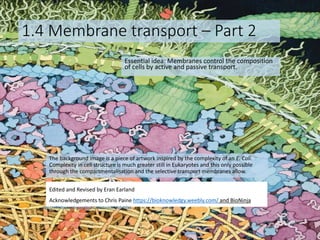
The background image is a piece of artwork inspired by the complexity of an E. Coli.
Complexity in cell structure is much greater still in Eukaryotes and this only possible
through the compartmentalisation and the selective transport membranes allow.
Edited and Revised by Eran Earland
Acknowledgements to Chris Paine https://bioknowledgy.weebly.com/ and BioNinja
http://onlinelibrary.wiley.com/doi/10.1002/bmb.20345/full#fig2
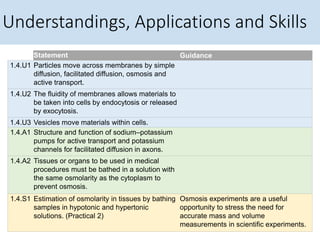
Understandings, Applications and Skills
Statement Guidance
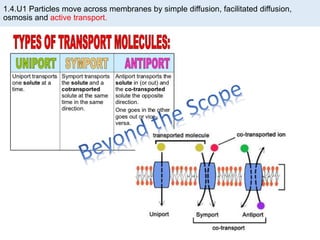
1.4.U1 Particles move across membranes by simple
diffusion, facilitated diffusion, osmosis and
active transport.
1.4.U2 The fluidity of membranes allows materials to
be taken into cells by endocytosis or released
by exocytosis.
1.4.U3 Vesicles move materials within cells.
1.4.A1 Structure and function of sodium–potassium
pumps for active transport and potassium
channels for facilitated diffusion in axons.
1.4.A2 Tissues or organs to be used in medical
procedures must be bathed in a solution with
the same osmolarity as the cytoplasm to
prevent osmosis.
1.4.S1 Estimation of osmolarity in tissues by bathing
samples in hypotonic and hypertonic
solutions. (Practical 2)
Osmosis experiments are a useful
opportunity to stress the need for
accurate mass and volume
measurements in scientific experiments.
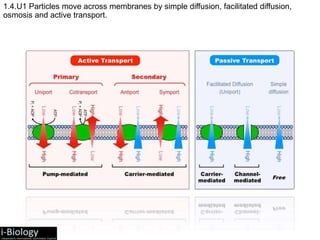
1.4.U1 Particles move across membranes by simple diffusion, facilitated diffusion,
osmosis and active transport.
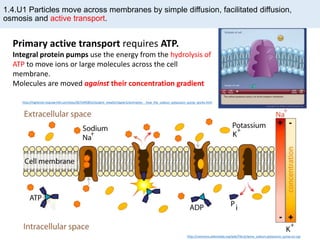
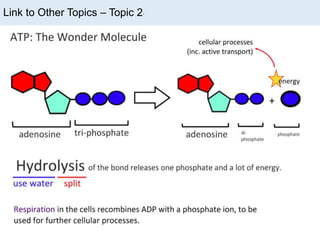
Primary active transport requires ATP.
Integral protein pumps use the energy from the hydrolysis of
ATP to move ions or large molecules across the cell
membrane.
Molecules are moved against their concentration gradient
http://commons.wikimedia.org/wiki/File:Scheme_sodium-potassium_pump-en.svg
1.4.U1 Particles move across membranes by simple diffusion, facilitated diffusion,
osmosis and active transport.
http://highered.mcgraw-hill.com/sites/0072495855/student_view0/chapter2/animation__how_the_sodium_potassium_pump_works.html
Link to Other Topics – Topic 2.
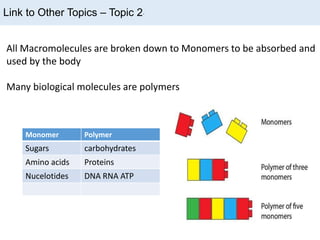
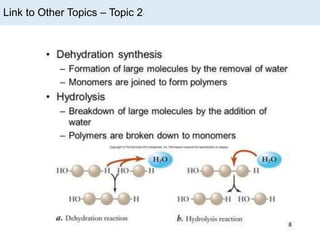
All Macromolecules are broken down to Monomers to be absorbed and
used by the body
Many biological molecules are polymers
Monomer Polymer
Sugars carbohydrates
Amino acids Proteins
Nucelotides DNA RNA ATP
Link to Other Topics – Topic 2.
1.4.U1 Particles move across membranes by simple diffusion, facilitated diffusion,
osmosis and active transport.
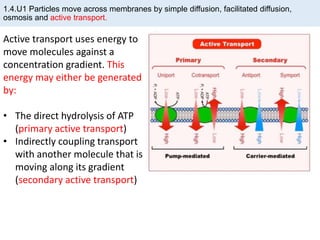
Active transport uses energy to
move molecules against a
concentration gradient. This
energy may either be generated
by:
• The direct hydrolysis of ATP
(primary active transport)
• Indirectly coupling transport
with another molecule that is
moving along its gradient
(secondary active transport)
1.4.U1 Particles move across membranes by simple diffusion, facilitated diffusion,
osmosis and active transport.
1.4.A1 Structure and function of sodium–potassium pumps for active transport and
potassium channels for facilitated diffusion in axons.
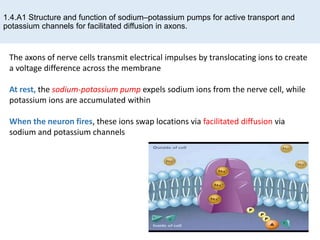
The axons of nerve cells transmit electrical impulses by translocating ions to create
a voltage difference across the membrane
At rest, the sodium-potassium pump expels sodium ions from the nerve cell, while
potassium ions are accumulated within
When the neuron fires, these ions swap locations via facilitated diffusion via
sodium and potassium channels
1.4.A1 Structure and function of sodium–potassium pumps for active transport and
potassium channels for facilitated diffusion in axons.
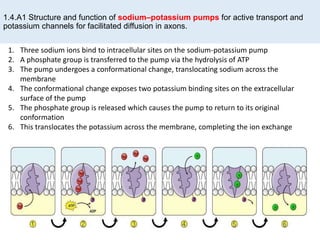
1. Three sodium ions bind to intracellular sites on the sodium-potassium pump
2. A phosphate group is transferred to the pump via the hydrolysis of ATP
3. The pump undergoes a conformational change, translocating sodium across the
membrane
4. The conformational change exposes two potassium binding sites on the extracellular
surface of the pump
5. The phosphate group is released which causes the pump to return to its original
conformation
6. This translocates the potassium across the membrane, completing the ion exchange
1.4.A1 Structure and function of sodium–potassium pumps for active transport and
potassium channels for facilitated diffusion in axons.
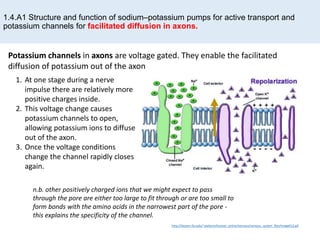
http://bioserv.fiu.edu/~walterm/human_online/nervous/nervous_system_files/image012.gif
1. At one stage during a nerve
impulse there are relatively more
positive charges inside.
2. This voltage change causes
potassium channels to open,
allowing potassium ions to diffuse
out of the axon.
3. Once the voltage conditions
change the channel rapidly closes
again.
Potassium channels in axons are voltage gated. They enable the facilitated
diffusion of potassium out of the axon
n.b. other positively charged ions that we might expect to pass
through the pore are either too large to fit through or are too small to
form bonds with the amino acids in the narrowest part of the pore -
this explains the specificity of the channel.
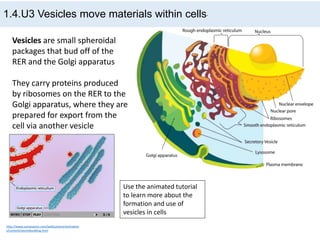
Vesicles are small spheroidal
packages that bud off of the
RER and the Golgi apparatus
They carry proteins produced
by ribosomes on the RER to the
Golgi apparatus, where they are
prepared for export from the
cell via another vesicle
http://www.sumanasinc.com/webcontent/animation
s/content/vesiclebudding.html
1.4.U3 Vesicles move materials within cells.
Use the animated tutorial
to learn more about the
formation and use of
vesicles in cells
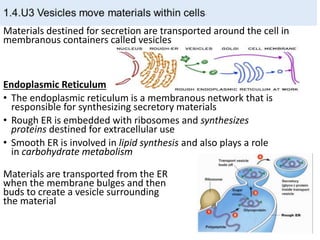
Materials destined for secretion are transported around the cell in
membranous containers called vesicles
Endoplasmic Reticulum
• The endoplasmic reticulum is a membranous network that is
responsible for synthesizing secretory materials
• Rough ER is embedded with ribosomes and synthesizes
proteins destined for extracellular use
• Smooth ER is involved in lipid synthesis and also plays a role
in carbohydrate metabolism
Materials are transported from the ER
when the membrane bulges and then
buds to create a vesicle surrounding
the material
Golgi Apparatus
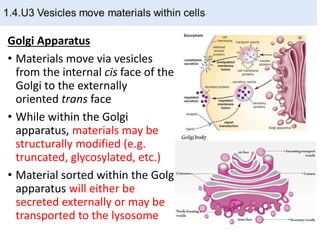
• Materials move via vesicles
from the internal cis face of the
Golgi to the externally
oriented trans face
• While within the Golgi
apparatus, materials may be
structurally modified (e.g.
truncated, glycosylated, etc.)
• Material sorted within the Golgi
apparatus will either be
secreted externally or may be
transported to the lysosome
Plasma Membrane
• Vesicles containing materials destined for extracellular use will
be transported to the plasma membrane
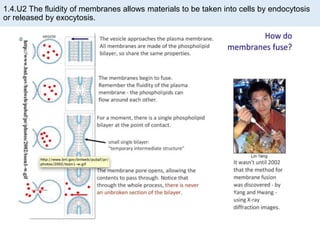
• The vesicle will fuse with the cell membrane and its materials
will be expelled into the extracellular fluid
Materials sorted by the Golgi apparatus may be either:
• Released immediately into the extracellular fluid (constitutive
secretion)
• Stored within an intracellular vesicle for a delayed release in
response to a cellular signal (regulatory secretion)
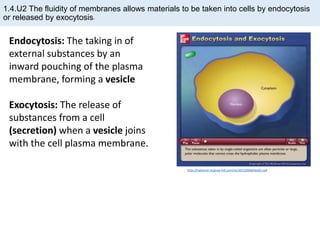
Endocytosis: The taking in of
external substances by an
inward pouching of the plasma
membrane, forming a vesicle
Exocytosis: The release of
substances from a cell
(secretion) when a vesicle joins
with the cell plasma membrane.
http://highered.mcgraw-hill.com/olc/dl/120068/bio02.swf
1.4.U2 The fluidity of membranes allows materials to be taken into cells by endocytosis
or released by exocytosis.
1.4.U2 The fluidity of membranes allows materials to be taken into cells by endocytosis
or released by exocytosis.
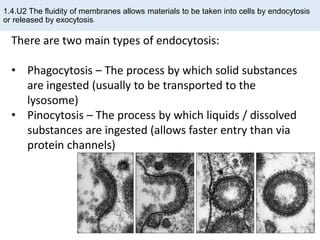
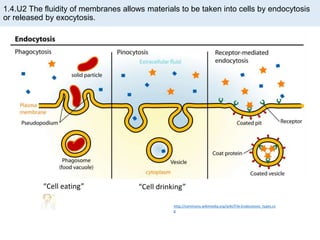
There are two main types of endocytosis:
• Phagocytosis – The process by which solid substances
are ingested (usually to be transported to the
lysosome)
• Pinocytosis – The process by which liquids / dissolved
substances are ingested (allows faster entry than via
protein channels)
http://commons.wikimedia.org/wiki/File:Endocytosis_types.sv
g
“Cell eating” “Cell drinking”
1.4.U2 The fluidity of membranes allows materials to be taken into cells by endocytosis
or released by exocytosis.
1.4.U2 The fluidity of membranes allows materials to be taken into cells by endocytosis
or released by exocytosis.
Bibliography /
Acknowledgments
Jason de Nys

1.4 Part 3 - Active Cell Transport

  • 1.
    By Chris Paine https://bioknowledgy.weebly.com/ 1.4Membrane transport – Part 2 Essential idea: Membranes control the composition of cells by active and passive transport. The background image is a piece of artwork inspired by the complexity of an E. Coli. Complexity in cell structure is much greater still in Eukaryotes and this only possible through the compartmentalisation and the selective transport membranes allow. Edited and Revised by Eran Earland Acknowledgements to Chris Paine https://bioknowledgy.weebly.com/ and BioNinja http://onlinelibrary.wiley.com/doi/10.1002/bmb.20345/full#fig2
  • 2.
    Understandings, Applications andSkills Statement Guidance 1.4.U1 Particles move across membranes by simple diffusion, facilitated diffusion, osmosis and active transport. 1.4.U2 The fluidity of membranes allows materials to be taken into cells by endocytosis or released by exocytosis. 1.4.U3 Vesicles move materials within cells. 1.4.A1 Structure and function of sodium–potassium pumps for active transport and potassium channels for facilitated diffusion in axons. 1.4.A2 Tissues or organs to be used in medical procedures must be bathed in a solution with the same osmolarity as the cytoplasm to prevent osmosis. 1.4.S1 Estimation of osmolarity in tissues by bathing samples in hypotonic and hypertonic solutions. (Practical 2) Osmosis experiments are a useful opportunity to stress the need for accurate mass and volume measurements in scientific experiments.
  • 3.
    1.4.U1 Particles moveacross membranes by simple diffusion, facilitated diffusion, osmosis and active transport.
  • 4.
    Primary active transportrequires ATP. Integral protein pumps use the energy from the hydrolysis of ATP to move ions or large molecules across the cell membrane. Molecules are moved against their concentration gradient http://commons.wikimedia.org/wiki/File:Scheme_sodium-potassium_pump-en.svg 1.4.U1 Particles move across membranes by simple diffusion, facilitated diffusion, osmosis and active transport. http://highered.mcgraw-hill.com/sites/0072495855/student_view0/chapter2/animation__how_the_sodium_potassium_pump_works.html
  • 5.
    Link to OtherTopics – Topic 2. All Macromolecules are broken down to Monomers to be absorbed and used by the body Many biological molecules are polymers Monomer Polymer Sugars carbohydrates Amino acids Proteins Nucelotides DNA RNA ATP
  • 6.
    Link to OtherTopics – Topic 2.
  • 7.
    Link to OtherTopics – Topic 2.
  • 8.
    1.4.U1 Particles moveacross membranes by simple diffusion, facilitated diffusion, osmosis and active transport. Active transport uses energy to move molecules against a concentration gradient. This energy may either be generated by: • The direct hydrolysis of ATP (primary active transport) • Indirectly coupling transport with another molecule that is moving along its gradient (secondary active transport)
  • 9.
    1.4.U1 Particles moveacross membranes by simple diffusion, facilitated diffusion, osmosis and active transport.
  • 10.
    1.4.A1 Structure andfunction of sodium–potassium pumps for active transport and potassium channels for facilitated diffusion in axons. The axons of nerve cells transmit electrical impulses by translocating ions to create a voltage difference across the membrane At rest, the sodium-potassium pump expels sodium ions from the nerve cell, while potassium ions are accumulated within When the neuron fires, these ions swap locations via facilitated diffusion via sodium and potassium channels
  • 11.
    1.4.A1 Structure andfunction of sodium–potassium pumps for active transport and potassium channels for facilitated diffusion in axons. 1. Three sodium ions bind to intracellular sites on the sodium-potassium pump 2. A phosphate group is transferred to the pump via the hydrolysis of ATP 3. The pump undergoes a conformational change, translocating sodium across the membrane 4. The conformational change exposes two potassium binding sites on the extracellular surface of the pump 5. The phosphate group is released which causes the pump to return to its original conformation 6. This translocates the potassium across the membrane, completing the ion exchange
  • 12.
    1.4.A1 Structure andfunction of sodium–potassium pumps for active transport and potassium channels for facilitated diffusion in axons. http://bioserv.fiu.edu/~walterm/human_online/nervous/nervous_system_files/image012.gif 1. At one stage during a nerve impulse there are relatively more positive charges inside. 2. This voltage change causes potassium channels to open, allowing potassium ions to diffuse out of the axon. 3. Once the voltage conditions change the channel rapidly closes again. Potassium channels in axons are voltage gated. They enable the facilitated diffusion of potassium out of the axon n.b. other positively charged ions that we might expect to pass through the pore are either too large to fit through or are too small to form bonds with the amino acids in the narrowest part of the pore - this explains the specificity of the channel.
  • 13.
    Vesicles are smallspheroidal packages that bud off of the RER and the Golgi apparatus They carry proteins produced by ribosomes on the RER to the Golgi apparatus, where they are prepared for export from the cell via another vesicle http://www.sumanasinc.com/webcontent/animation s/content/vesiclebudding.html 1.4.U3 Vesicles move materials within cells. Use the animated tutorial to learn more about the formation and use of vesicles in cells
  • 14.
    Materials destined forsecretion are transported around the cell in membranous containers called vesicles Endoplasmic Reticulum • The endoplasmic reticulum is a membranous network that is responsible for synthesizing secretory materials • Rough ER is embedded with ribosomes and synthesizes proteins destined for extracellular use • Smooth ER is involved in lipid synthesis and also plays a role in carbohydrate metabolism Materials are transported from the ER when the membrane bulges and then buds to create a vesicle surrounding the material
  • 15.
    Golgi Apparatus • Materialsmove via vesicles from the internal cis face of the Golgi to the externally oriented trans face • While within the Golgi apparatus, materials may be structurally modified (e.g. truncated, glycosylated, etc.) • Material sorted within the Golgi apparatus will either be secreted externally or may be transported to the lysosome
  • 16.
    Plasma Membrane • Vesiclescontaining materials destined for extracellular use will be transported to the plasma membrane • The vesicle will fuse with the cell membrane and its materials will be expelled into the extracellular fluid Materials sorted by the Golgi apparatus may be either: • Released immediately into the extracellular fluid (constitutive secretion) • Stored within an intracellular vesicle for a delayed release in response to a cellular signal (regulatory secretion)
  • 17.
    Endocytosis: The takingin of external substances by an inward pouching of the plasma membrane, forming a vesicle Exocytosis: The release of substances from a cell (secretion) when a vesicle joins with the cell plasma membrane. http://highered.mcgraw-hill.com/olc/dl/120068/bio02.swf 1.4.U2 The fluidity of membranes allows materials to be taken into cells by endocytosis or released by exocytosis.
  • 18.
    1.4.U2 The fluidityof membranes allows materials to be taken into cells by endocytosis or released by exocytosis. There are two main types of endocytosis: • Phagocytosis – The process by which solid substances are ingested (usually to be transported to the lysosome) • Pinocytosis – The process by which liquids / dissolved substances are ingested (allows faster entry than via protein channels)
  • 19.
    http://commons.wikimedia.org/wiki/File:Endocytosis_types.sv g “Cell eating” “Celldrinking” 1.4.U2 The fluidity of membranes allows materials to be taken into cells by endocytosis or released by exocytosis.
  • 20.
    1.4.U2 The fluidityof membranes allows materials to be taken into cells by endocytosis or released by exocytosis.
  • 21.