Human Anatomy & Physiology-1
Transport process across the cell membrane
Presented by: Lovekesh Singh
Assistant Professor
ISF College of Pharmacy
Contents
 Introduction
 Passive transport and its different types
 Active transport and its different types
 References
 Questions
Introduction
• Transport of materials across the plasma membrane is
essential to the life of a cell. Certain substances must
move into the cell to support metabolic reactions.
• Other substances that have been produced by the cell for
export or as cellular waste products must move out of the
cell.
• Substances generally move across cellular membranes via
transport processes that can be classified into two types
depending on whether they require cellular energy.
 Passive Transport
 Active Transport
A. Passive Transport
• Passive transport is a movement of ions and other atomic or
molecular substances across cell membrane without need of
energy input.
• The substance moves down its concentration or electrical gradient
to cross the membrane using only its own kinetic energy (energy
of motion).
• The rate of passive transport depends on the permeability of the
cell membrane, which, in turn, depends on the organization and
characteristics of the membrane lipids and proteins.
• The three main kinds of passive transport are
1. simple diffusion 3. osmosis
2. facilitated diffusion
1. Simple Diffusion
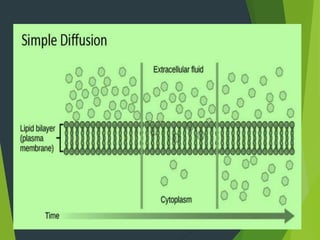
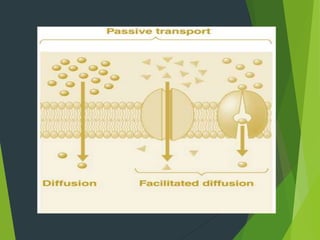
 Simple diffusion is a passive process in which substances move
freely through the lipid bilayer of the plasma membranes of cells
without the help of membrane transport proteins.
 Nonpolar, hydrophobic molecules move across the lipid bilayer.
 Such molecules include oxygen, carbon dioxide, and nitrogen gases,
fatty acids, steroids, and fat-soluble vitamins (A, D, E, and K).
 Small, uncharged polar molecules such as water, urea, and alcohols
also pass through the lipid bilayer by simple diffusion.
 Simple diffusion through the lipid bilayer is important in the
movement of oxygen and carbon dioxide between blood and body
cells, and between blood and air within the lungs during breathing.
2. Facilitated Diffusion
• Solutes that are too polar or highly charged to move
through the lipid bilayer by simple diffusion can cross
the plasma membrane by a passive process called
facilitated diffusion.
• Facilitated diffusion also called carrier-mediated
osmosis.
• Facilitated diffusion is further of two types-
a) Channel mediated Facilitated diffusion
b) Carrier mediated Facilitated diffusion
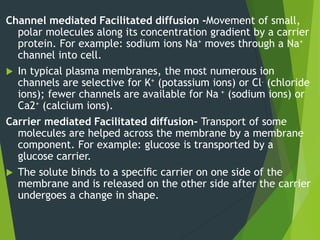
Channel mediated Facilitated diffusion -Movement of small,
polar molecules along its concentration gradient by a carrier
protein. For example: sodium ions Na+ moves through a Na+
channel into cell.
 In typical plasma membranes, the most numerous ion
channels are selective for K+ (potassium ions) or Cl- (chloride
ions); fewer channels are available for Na + (sodium ions) or
Ca2+ (calcium ions).
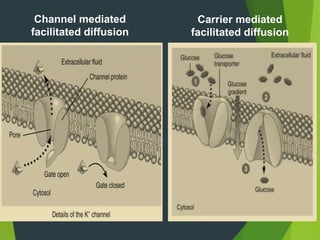
Carrier mediated Facilitated diffusion- Transport of some
molecules are helped across the membrane by a membrane
component. For example: glucose is transported by a
glucose carrier.
 The solute binds to a specific carrier on one side of the
membrane and is released on the other side after the carrier
undergoes a change in shape.
Channel mediated
facilitated diffusion
Carrier mediated
facilitated diffusion
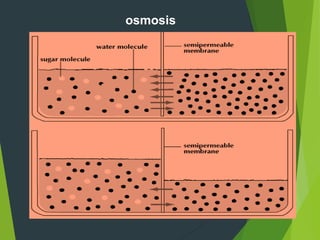
3. Osmosis
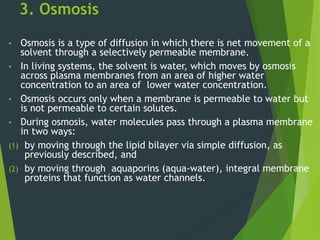
• Osmosis is a type of diffusion in which there is net movement of a
solvent through a selectively permeable membrane.
• In living systems, the solvent is water, which moves by osmosis
across plasma membranes from an area of higher water
concentration to an area of lower water concentration.
• Osmosis occurs only when a membrane is permeable to water but
is not permeable to certain solutes.
• During osmosis, water molecules pass through a plasma membrane
in two ways:
(1) by moving through the lipid bilayer via simple diffusion, as
previously described, and
(2) by moving through aquaporins (aqua-water), integral membrane
proteins that function as water channels.
osmosis
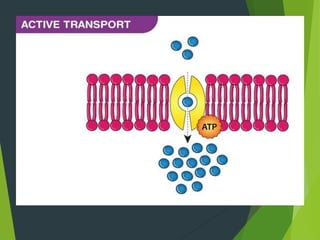
B. Active Transport
• Active transport is the movement of molecules across a cell
membrane from a region of lower concentration to a region of
higher concentration—against the concentration gradient.
• Active transport mechanisms require the use of the cell’s energy,
usually in the form of adenosine triphosphate (ATP) to move
molecules against a gradient.
• The uptake of glucose in the intestine of the human body and also
the uptake of minerals or ions into the root hair cells of the
plants are some of the examples of active transport.
There are two types of active transport-
1. Primary active transport
2. Secondary active transport
1. Primary Active Transport
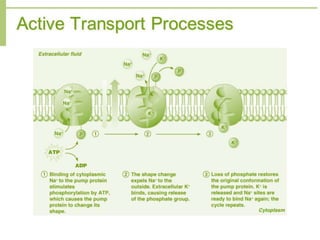
 In this process of transportation, the energy is utilized from
breakdown of ATP that changes the shape of a carrier protein,
which “pumps” molecules across a plasma membrane against its
concentration gradient.
 Basically, the primary active transport uses external chemical
energy such as the ATP.
 All the groups of ATP powered pumps contain one or more binding
sites for the ATP molecules, which are present on the cytosolic
face of the membrane.
 Sodium-potassium pump, the most important pump in the animal
cell is considered as an example of primary active transport. In
this process of transportation, the sodium ions are moved to the
outside of the cell and potassium ions are moved to the inside of
the cell.
2. Secondary Active Transport
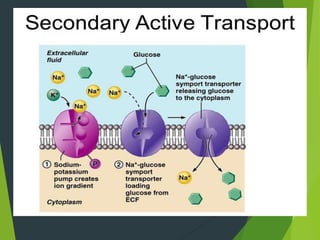
 Secondary active transport is a kind of active transport that
uses electrochemical energy.
 It takes place across a biological membrane where a
transporter protein couples the movement of an
electrochemical ion (typically Na+ or H+) down its
electrochemical gradient to the upward movement of
another molecule or an ion against a concentration or
electrochemical gradient.
 In humans, sodium (Na+) is a commonly co transported ion
across the plasma membrane, whose electrochemical
gradient is then used to power the active transport of a
second ion or molecule against its gradient.
References
 Essentials of Medical Physiology by K. Sembulingam and P.
Sembulingam. Jaypee
Brothers Medical Publishers, New Delhi.
 Anatomy and Physiology in Health and Illness by Kathleen J.W.
Wilson, Churchill, Livingstone, New York.
 Physiological basis of Medical Practice-Best and Tailor. Williams and
Wilkins Co, Riverview, MI USA.
 Text book of Medical Physiology- Arthur C, Guyton and John.E. Hall.
Miamisburg, OH, U.S.A.
 Principles of Anatomy and Physiology by Tortora Grabowski.
Palmetto, GA, U.S.A.
 Human Physiology (vol 1 and 2) by Dr. C.C. Chatterrje, Academic
Publishers Kolkata.
Questions
 Differentiate between channel mediated and carrier
mediated facilitated diffusion.
 What is simple diffusion? Give example.
 Define active transport and also explain its types.
 Differentiate between primary active transport and
secondary active transport.
THANKS

Transport across the plasma membrane.ppt

  • 1.
    Human Anatomy &Physiology-1 Transport process across the cell membrane Presented by: Lovekesh Singh Assistant Professor ISF College of Pharmacy
  • 2.
    Contents  Introduction  Passivetransport and its different types  Active transport and its different types  References  Questions
  • 3.
    Introduction • Transport ofmaterials across the plasma membrane is essential to the life of a cell. Certain substances must move into the cell to support metabolic reactions. • Other substances that have been produced by the cell for export or as cellular waste products must move out of the cell. • Substances generally move across cellular membranes via transport processes that can be classified into two types depending on whether they require cellular energy.  Passive Transport  Active Transport
  • 4.
    A. Passive Transport •Passive transport is a movement of ions and other atomic or molecular substances across cell membrane without need of energy input. • The substance moves down its concentration or electrical gradient to cross the membrane using only its own kinetic energy (energy of motion). • The rate of passive transport depends on the permeability of the cell membrane, which, in turn, depends on the organization and characteristics of the membrane lipids and proteins. • The three main kinds of passive transport are 1. simple diffusion 3. osmosis 2. facilitated diffusion
  • 5.
    1. Simple Diffusion Simple diffusion is a passive process in which substances move freely through the lipid bilayer of the plasma membranes of cells without the help of membrane transport proteins.  Nonpolar, hydrophobic molecules move across the lipid bilayer.  Such molecules include oxygen, carbon dioxide, and nitrogen gases, fatty acids, steroids, and fat-soluble vitamins (A, D, E, and K).  Small, uncharged polar molecules such as water, urea, and alcohols also pass through the lipid bilayer by simple diffusion.  Simple diffusion through the lipid bilayer is important in the movement of oxygen and carbon dioxide between blood and body cells, and between blood and air within the lungs during breathing.
  • 7.
    2. Facilitated Diffusion •Solutes that are too polar or highly charged to move through the lipid bilayer by simple diffusion can cross the plasma membrane by a passive process called facilitated diffusion. • Facilitated diffusion also called carrier-mediated osmosis. • Facilitated diffusion is further of two types- a) Channel mediated Facilitated diffusion b) Carrier mediated Facilitated diffusion
  • 8.
    Channel mediated Facilitateddiffusion -Movement of small, polar molecules along its concentration gradient by a carrier protein. For example: sodium ions Na+ moves through a Na+ channel into cell.  In typical plasma membranes, the most numerous ion channels are selective for K+ (potassium ions) or Cl- (chloride ions); fewer channels are available for Na + (sodium ions) or Ca2+ (calcium ions). Carrier mediated Facilitated diffusion- Transport of some molecules are helped across the membrane by a membrane component. For example: glucose is transported by a glucose carrier.  The solute binds to a specific carrier on one side of the membrane and is released on the other side after the carrier undergoes a change in shape.
  • 9.
    Channel mediated facilitated diffusion Carriermediated facilitated diffusion
  • 11.
    3. Osmosis • Osmosisis a type of diffusion in which there is net movement of a solvent through a selectively permeable membrane. • In living systems, the solvent is water, which moves by osmosis across plasma membranes from an area of higher water concentration to an area of lower water concentration. • Osmosis occurs only when a membrane is permeable to water but is not permeable to certain solutes. • During osmosis, water molecules pass through a plasma membrane in two ways: (1) by moving through the lipid bilayer via simple diffusion, as previously described, and (2) by moving through aquaporins (aqua-water), integral membrane proteins that function as water channels.
  • 12.
  • 13.
    B. Active Transport •Active transport is the movement of molecules across a cell membrane from a region of lower concentration to a region of higher concentration—against the concentration gradient. • Active transport mechanisms require the use of the cell’s energy, usually in the form of adenosine triphosphate (ATP) to move molecules against a gradient. • The uptake of glucose in the intestine of the human body and also the uptake of minerals or ions into the root hair cells of the plants are some of the examples of active transport. There are two types of active transport- 1. Primary active transport 2. Secondary active transport
  • 15.
    1. Primary ActiveTransport  In this process of transportation, the energy is utilized from breakdown of ATP that changes the shape of a carrier protein, which “pumps” molecules across a plasma membrane against its concentration gradient.  Basically, the primary active transport uses external chemical energy such as the ATP.  All the groups of ATP powered pumps contain one or more binding sites for the ATP molecules, which are present on the cytosolic face of the membrane.  Sodium-potassium pump, the most important pump in the animal cell is considered as an example of primary active transport. In this process of transportation, the sodium ions are moved to the outside of the cell and potassium ions are moved to the inside of the cell.
  • 17.
    2. Secondary ActiveTransport  Secondary active transport is a kind of active transport that uses electrochemical energy.  It takes place across a biological membrane where a transporter protein couples the movement of an electrochemical ion (typically Na+ or H+) down its electrochemical gradient to the upward movement of another molecule or an ion against a concentration or electrochemical gradient.  In humans, sodium (Na+) is a commonly co transported ion across the plasma membrane, whose electrochemical gradient is then used to power the active transport of a second ion or molecule against its gradient.
  • 19.
    References  Essentials ofMedical Physiology by K. Sembulingam and P. Sembulingam. Jaypee Brothers Medical Publishers, New Delhi.  Anatomy and Physiology in Health and Illness by Kathleen J.W. Wilson, Churchill, Livingstone, New York.  Physiological basis of Medical Practice-Best and Tailor. Williams and Wilkins Co, Riverview, MI USA.  Text book of Medical Physiology- Arthur C, Guyton and John.E. Hall. Miamisburg, OH, U.S.A.  Principles of Anatomy and Physiology by Tortora Grabowski. Palmetto, GA, U.S.A.  Human Physiology (vol 1 and 2) by Dr. C.C. Chatterrje, Academic Publishers Kolkata.
  • 20.
    Questions  Differentiate betweenchannel mediated and carrier mediated facilitated diffusion.  What is simple diffusion? Give example.  Define active transport and also explain its types.  Differentiate between primary active transport and secondary active transport.
  • 21.