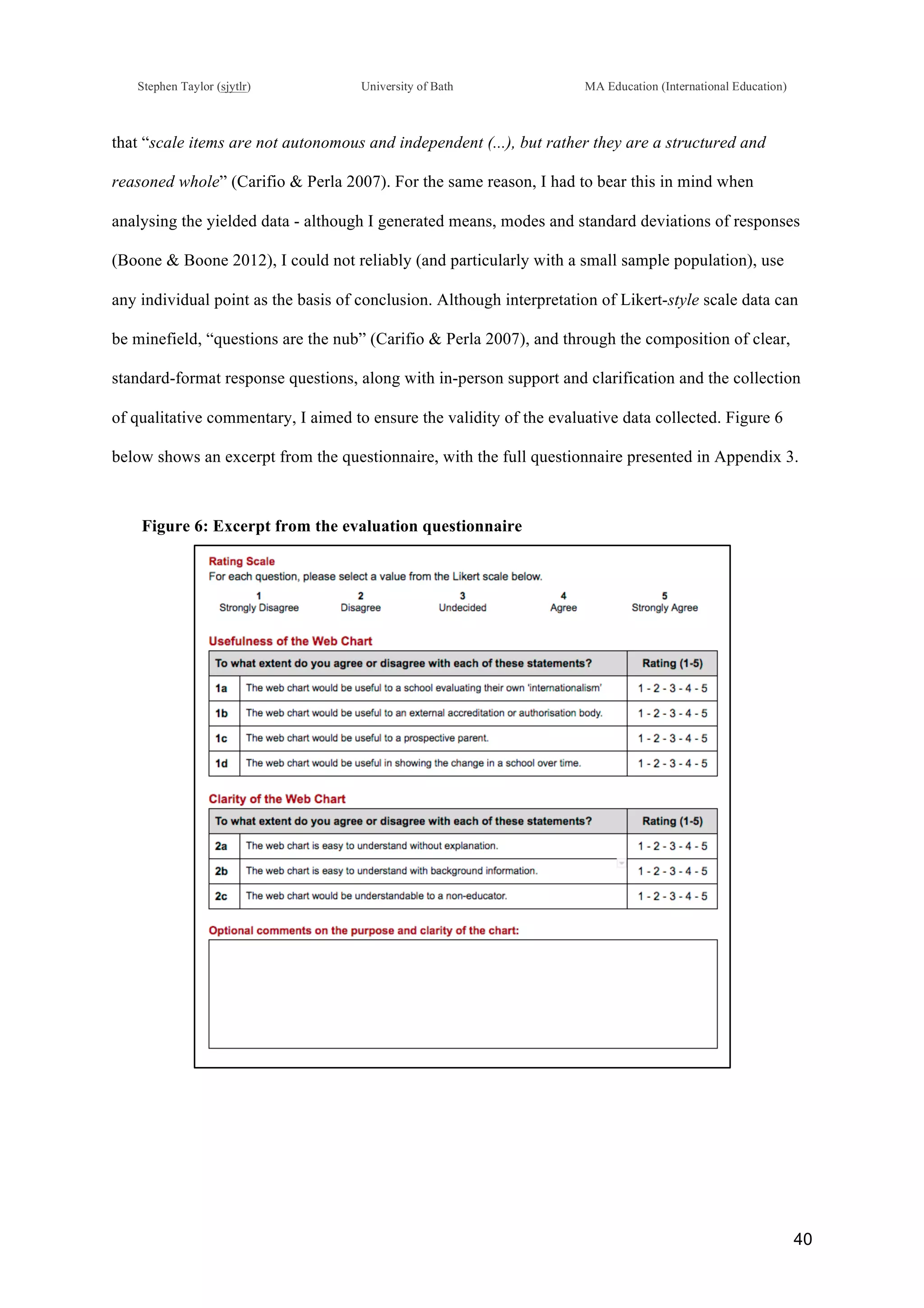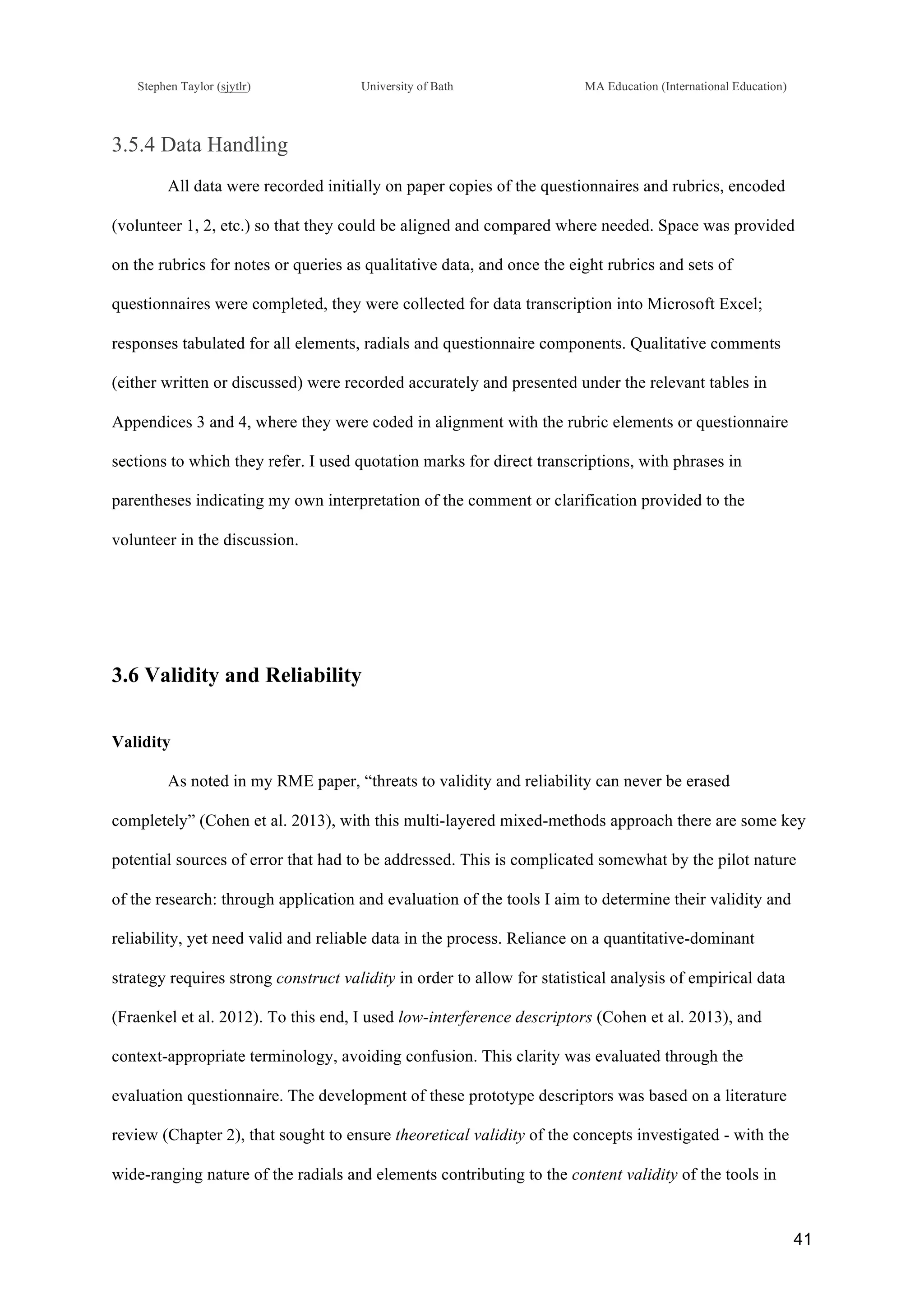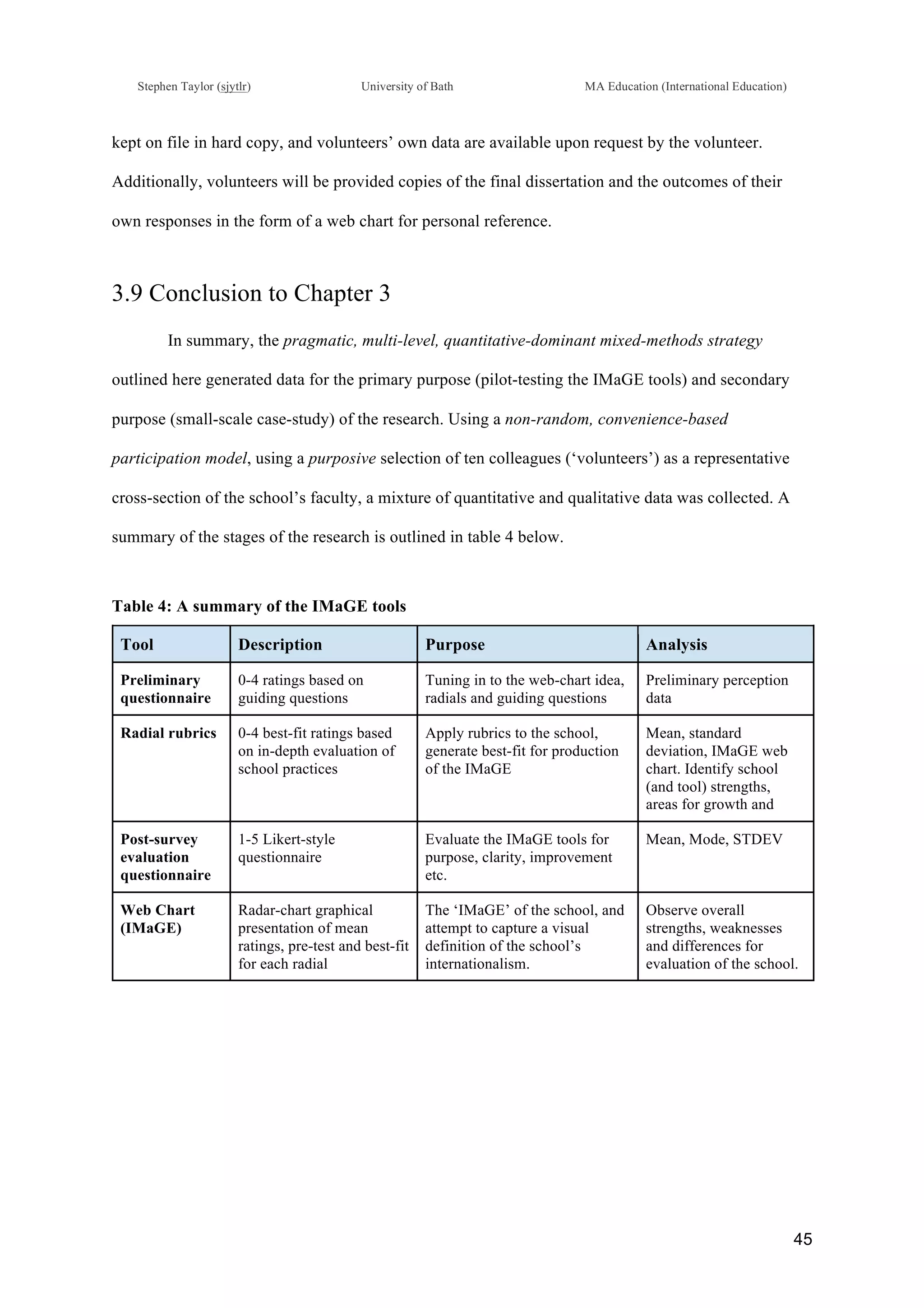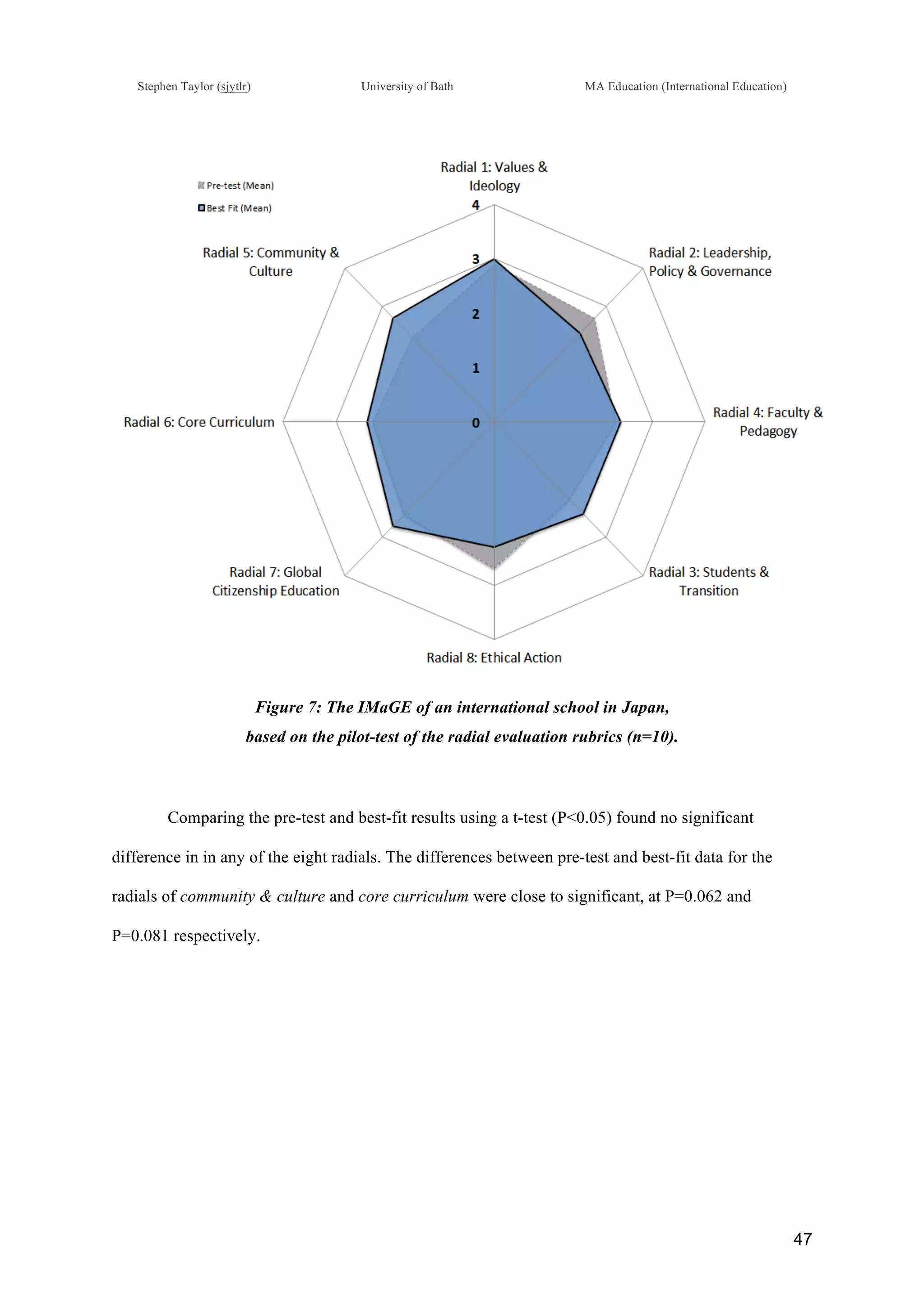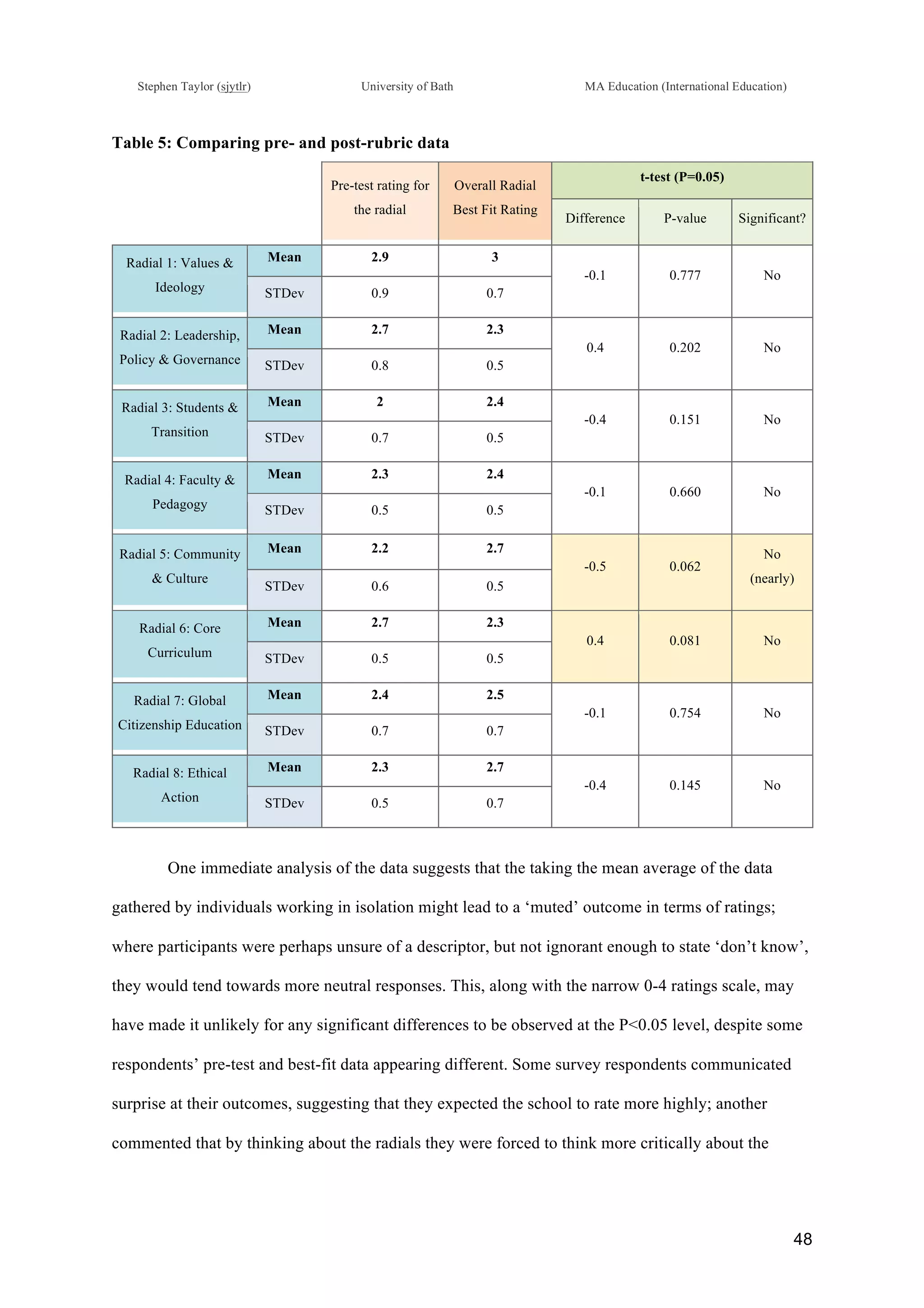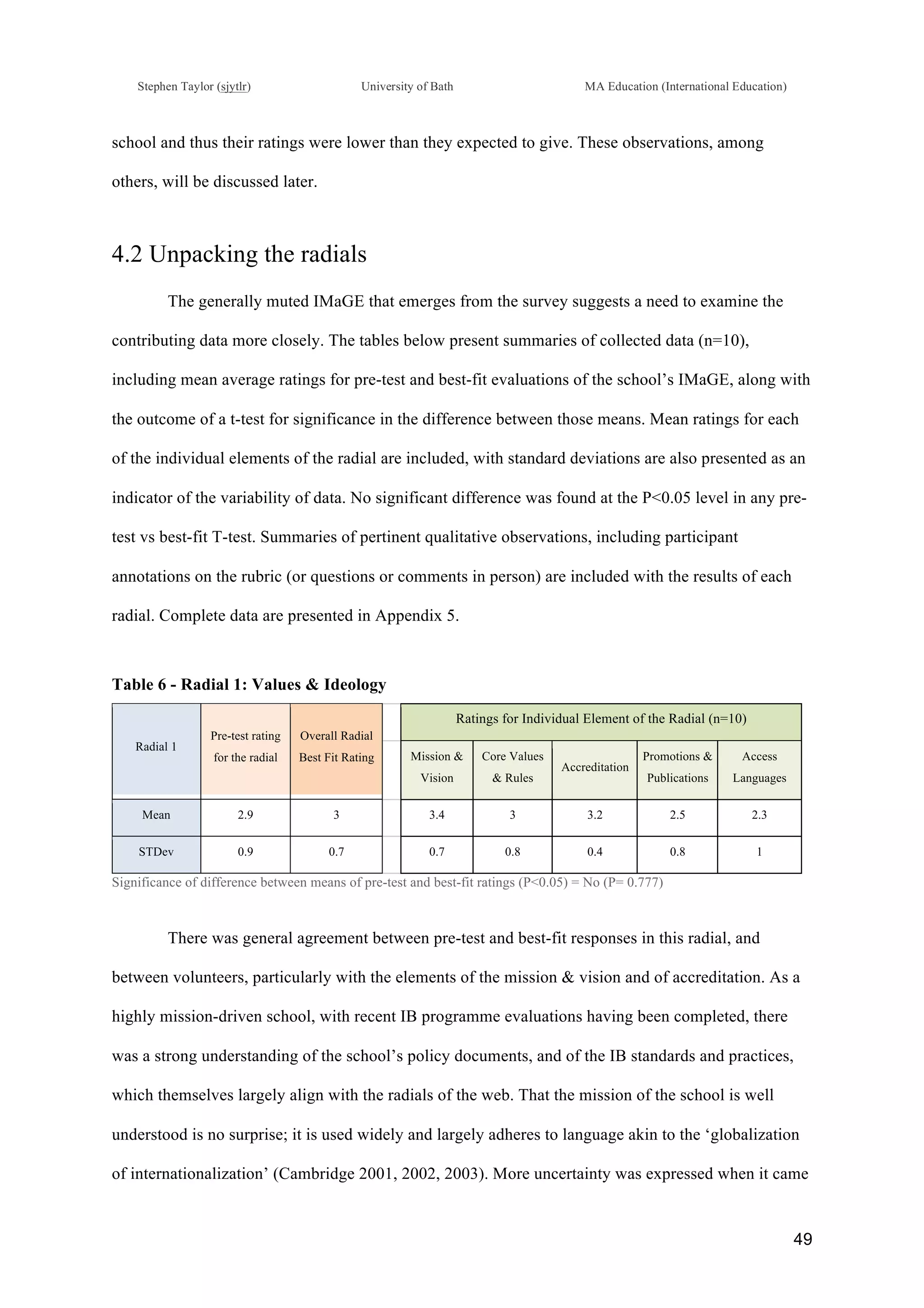
Stephen Taylor (sjtylr) University of Bath MA Education (International Education)
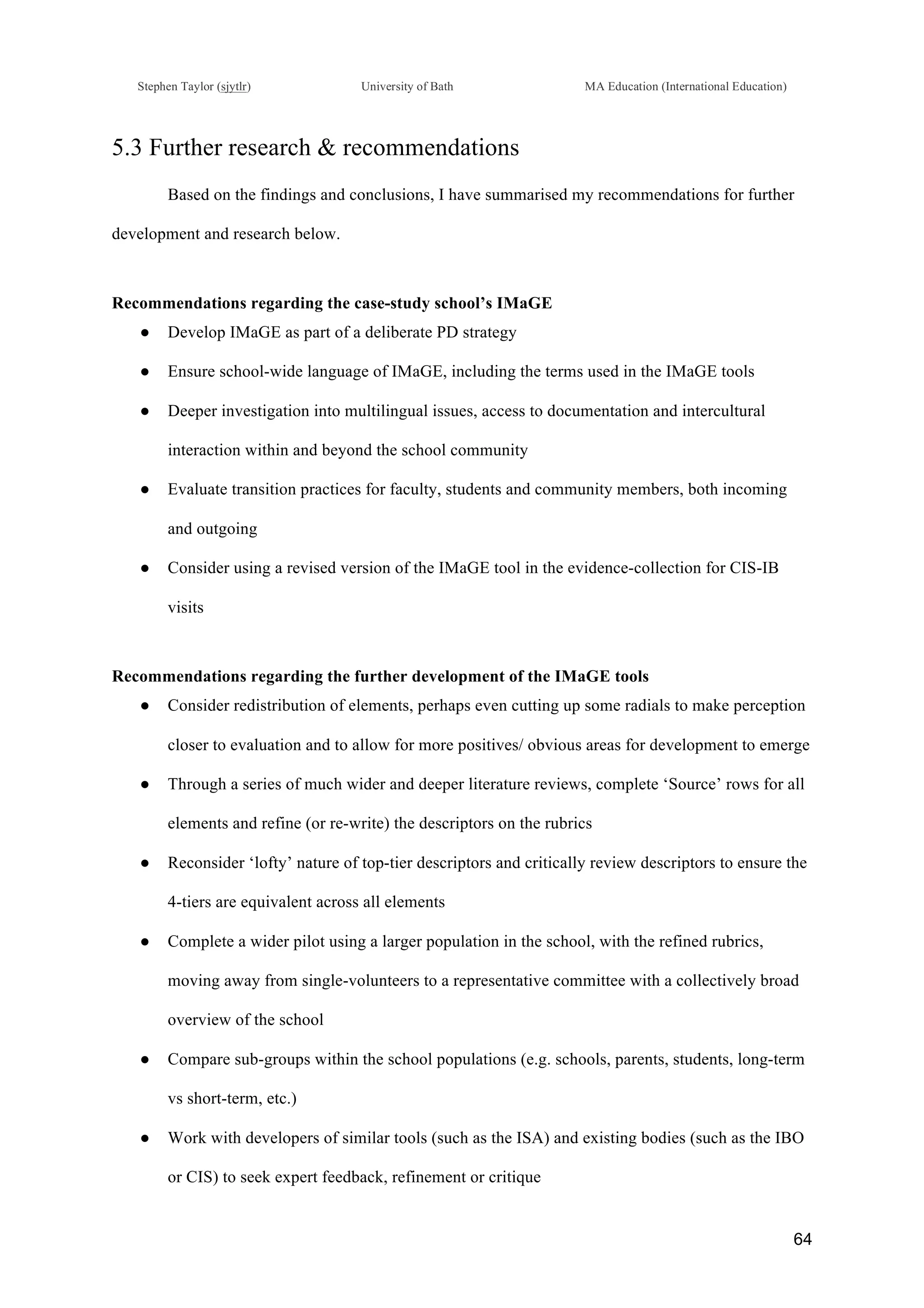
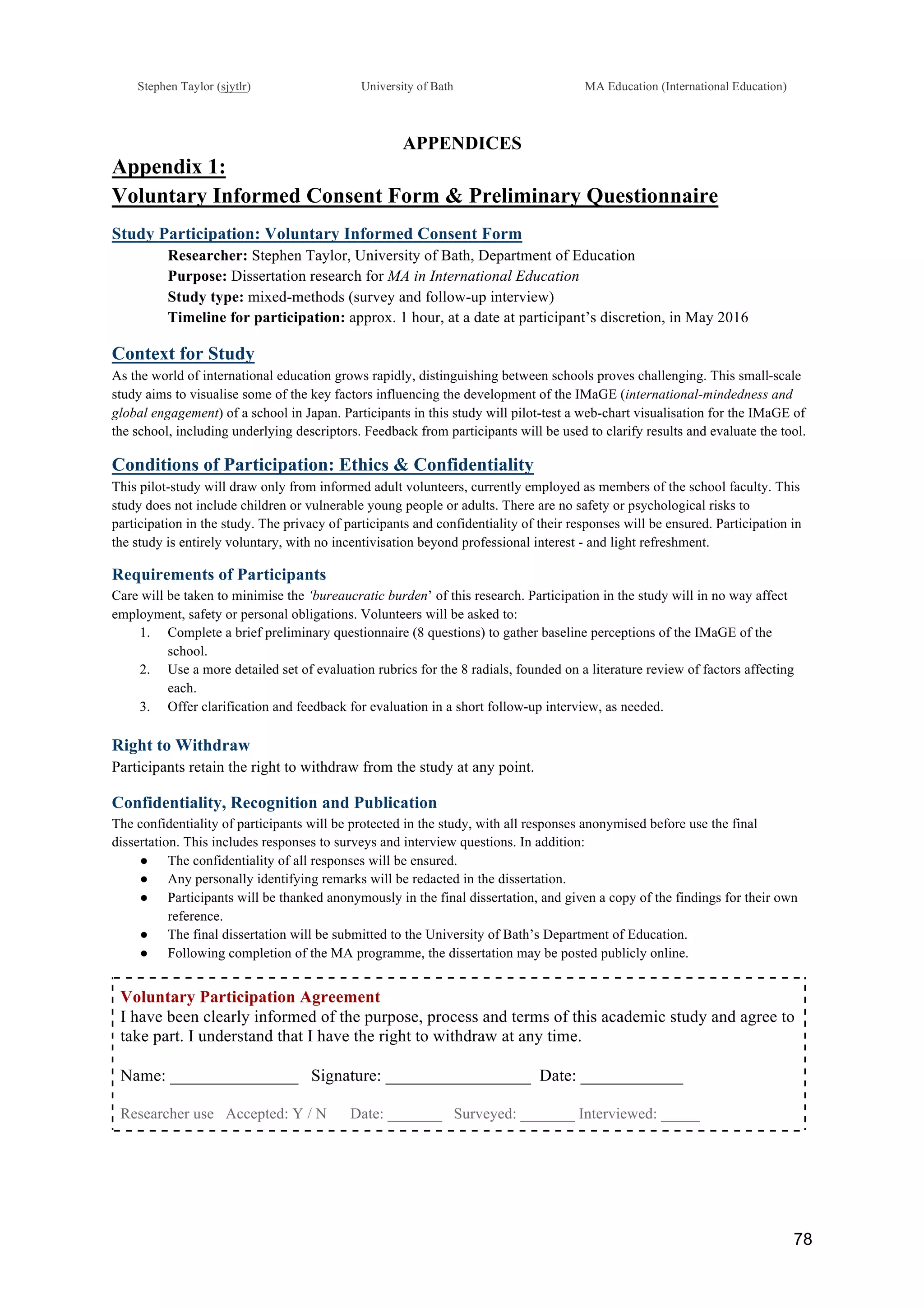
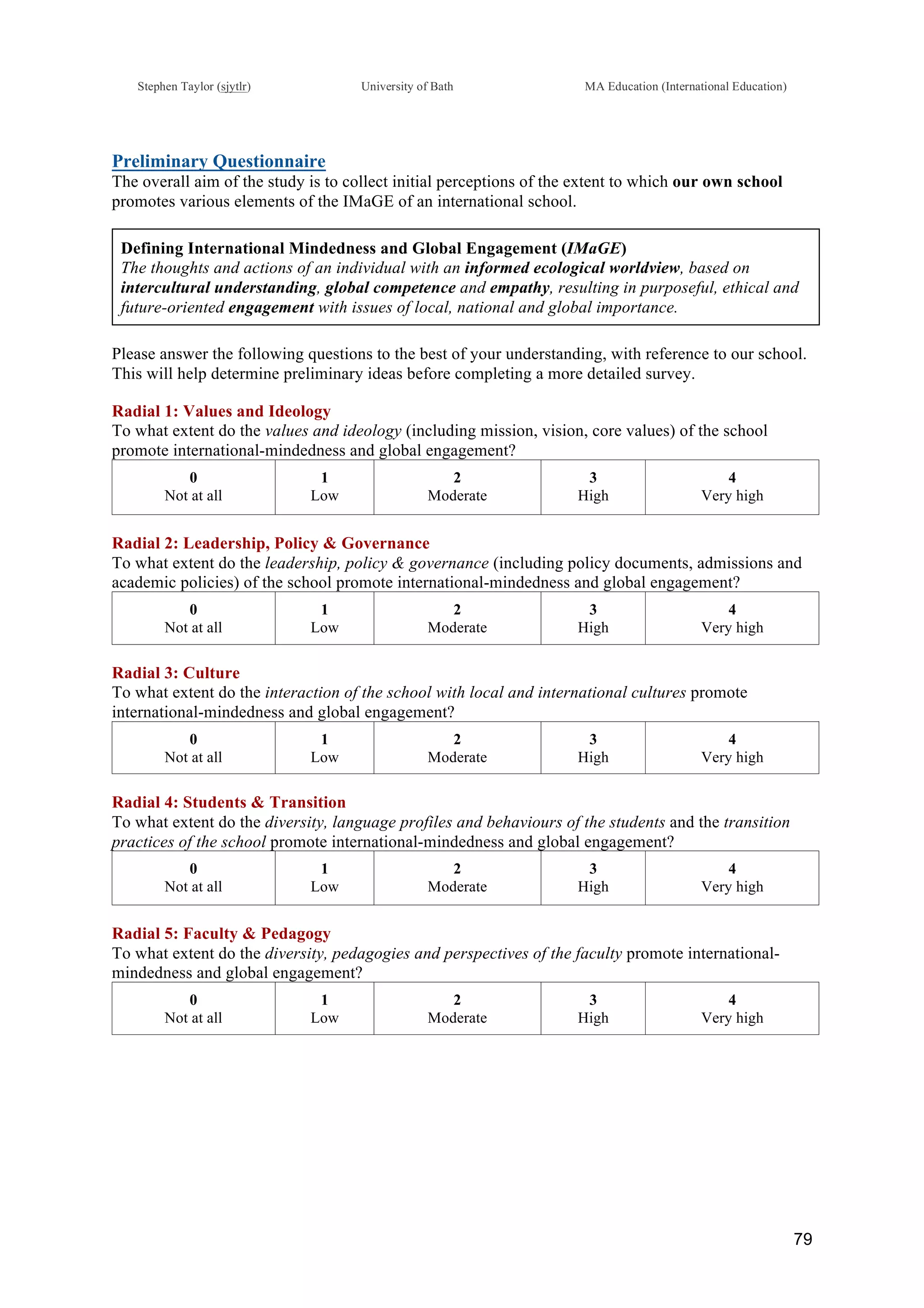
!
1!
!
UNIVERSITY OF BATH
DEPARTMENT OF EDUCATION
HOW INTERNATIONAL IS OUR SCHOOL?
A pilot-test of a visualization and set of evaluation rubrics for factors affecting
the promotion of international-mindedness and global engagement (IMaGE) of
a school.
by
STEPHEN JAMES TAYLOR
July 12 2016
Dissertation for the award of MA Education (International Education).
Word Count: 16,302
This dissertation has been edited lightly to activate hyperlinks in the references, and to remove the
university submission coversheet. This paper is hosted on my personal professional blog at:
https://ibiologystephen.wordpress.com/2017/01/15/how-international-is-our-school-ma-dissertation
Contact: Stephen@i-biology.net or on Twitter: @sjtylr
!
Stephen Taylor (sjytlr) University of Bath MA Education (International Education)
!
!
2!
Abstract
Developing ideas proposed in the Education in an International Context (EIC) paper in 2012,
and adapting a research design from my Research Methods in Education (RME) paper in 2015, I
sought to create, pilot-test and evaluate a set of tools that would allow a school to reliably evaluate
and compare the various characteristics of its organization and practices that promote international
mindedness and global engagement (IMaGE).
A literature review was used to create a working definition of IMaGE, and a set of eight
descriptive rubrics for the various characteristics (radials) and their contributing elements, were
generated. Based on a 0-4 scale of degrees of quality, the rubrics were used in a small-scale cases-
study of my own international school in Japan as a pilot test. Using faculty volunteers (n=10), with
the outcomes generating a ‘web chart’ graphical representation of the IMaGE, some preliminary
conclusions about the IMaGE of the school were drawn, along with evaluation of the IMaGE tools
themselves. The outcomes for the school were positive, though muted, with methodological
limitations restricting the reliability of any conclusion regarding the state of the IMaGE of our school.
Results suggested a need for more targeted professional development and consistent use of language
regarding IMaGE across the school. Although evaluation of the web chart for its intended purpose
was encouraging, implications for the further development of the IMaGE tools include a need for
further testing with larger sample sizes, a change in approach to a committee-based self-study model
and significant further development (and possible redistribution) of the radials and contributing
elements. There was significant concern about the tools’ usefulness with parent or non-educator
audiences.
Through future development of the IMaGE tools, there may potential application in
collaboration with other evaluative protocols or professional development. As this naturally leads
towards more focused description and standardization, I have become conflicted about the IMaGE
tool’s potential role in homogenizing international education, and would like to carefully reconsider
its purpose before developing it further.
!
Stephen Taylor (sjytlr) University of Bath MA Education (International Education)
!
!
3!
Acknowledgements
A huge thank-you to Prof. Mary Hayden for her ongoing support and guidance through this
project and through the MA programme at the University of Bath. Thanks also to Dr. John Lowe and
Prof. Jeff Thompson for their enthusiasm at the inception of the idea in the EIC unit in the summer of
2012, and to Dr. Kyoko Murakami for her guidance in the RME unit in 2015. Thank-you also to Luiz
Zorzo of the International Schools’ Association for providing me with the most recent ISA self-study
tool for reference and to my school – in particular my ten willing volunteers – for providing the
inspiration and context for the study.
Most importantly of all, thank-you to my family, for the hugs, patience, space, time, food and
love throughout this MA programme.
Author Declaration
1.! The author, Stephen Taylor, has not been registered for any other academic award during the
period of registration for this study.
2.! The material included in this dissertation has not been submitted wholly or in part for any
other academic award.
3.! The programme of advanced study of which this dissertation is part (MA International
Education) has included completion of the following units:
a.! Assessment
b.! Curriculum Studies
c.! Understanding Learners and Learning
d.! Education in an International Context
e.! Research Methods in Education
4.! Where my material has been previously submitted as part of an assignment within any of
these units, it has been clearly identified.
Stephen Taylor
July 12 2016
!
Stephen Taylor (sjytlr) University of Bath MA Education (International Education)
!
!
4!
Contents
Chapter 1: Introduction
1.1.! Context 6
1.2.! Rationale for the Research 8
1.3.! Overview of the Research 10
1.3.1.! Research Questions 11
1.3.2.! Overview of Chapters 11
Chapter 2: Literature Review
2.1!Defining International-Mindedness and Global Engagement (IMaGE) 12
2.2!Measuring International-Mindedness and Global Engagement (IMaGE) 17
2.3!Evolving the web-chart 21
2.4!Influences on the IMaGE of a school: radials and elements 24
Chapter 3: Research Design
3.1!Timeline 30
3.2!Research Strategy 30
3.3!Research Design 32
3.4!Participants (Research Volunteers) 33
3.5!Methods and Procedures of Data Collection 35
3.6!Validity & Reliability 41
3.7!Methods of Data Analysis 43
3.8!Ethical Issues 44
3.9!Conclusions 45
!
Stephen Taylor (sjytlr) University of Bath MA Education (International Education)
!
!
5!
Chapter 4: Data & Analysis
4.1!The IMaGE our international school 46
4.2!Analysis of findings: unpacking the radials 49
4.3!Analysis of findings: evaluating the web-chart 55
Chapter 5: Conclusions of the Pilot Study
5.1!Limitations of the research design 59
5.2!Discussion of findings 60
5.2.1! Implications for our international school 60
5.2.2! Implications for the IMaGE project as a tool 62
5.3!Recommendations & Further Research 64
5.4!Final Conclusions & Reflections 65
References 67
Appendices
Appendix 1: Ethics & voluntary informed consent form 78
Appendix 2: Prototype evaluation rubrics for the eight radials of the web 79
Appendix 3: Survey evaluation and feedback questionnaire 89
Appendix 4: Volunteer rubric responses (raw and processed data) 93
Appendix 5: Volunteer survey evaluation responses (raw and processed data) 96
!
Stephen Taylor (sjytlr) University of Bath MA Education (International Education)
!
!
6!
Chapter 1: Introduction
1.1 Context
“Is every school an international school?”
That is a question I set out to explore through my Education in in an International Context
(EIC) unit for the University of Bath, resulting in the inception of a web-chart of the dimensions of a
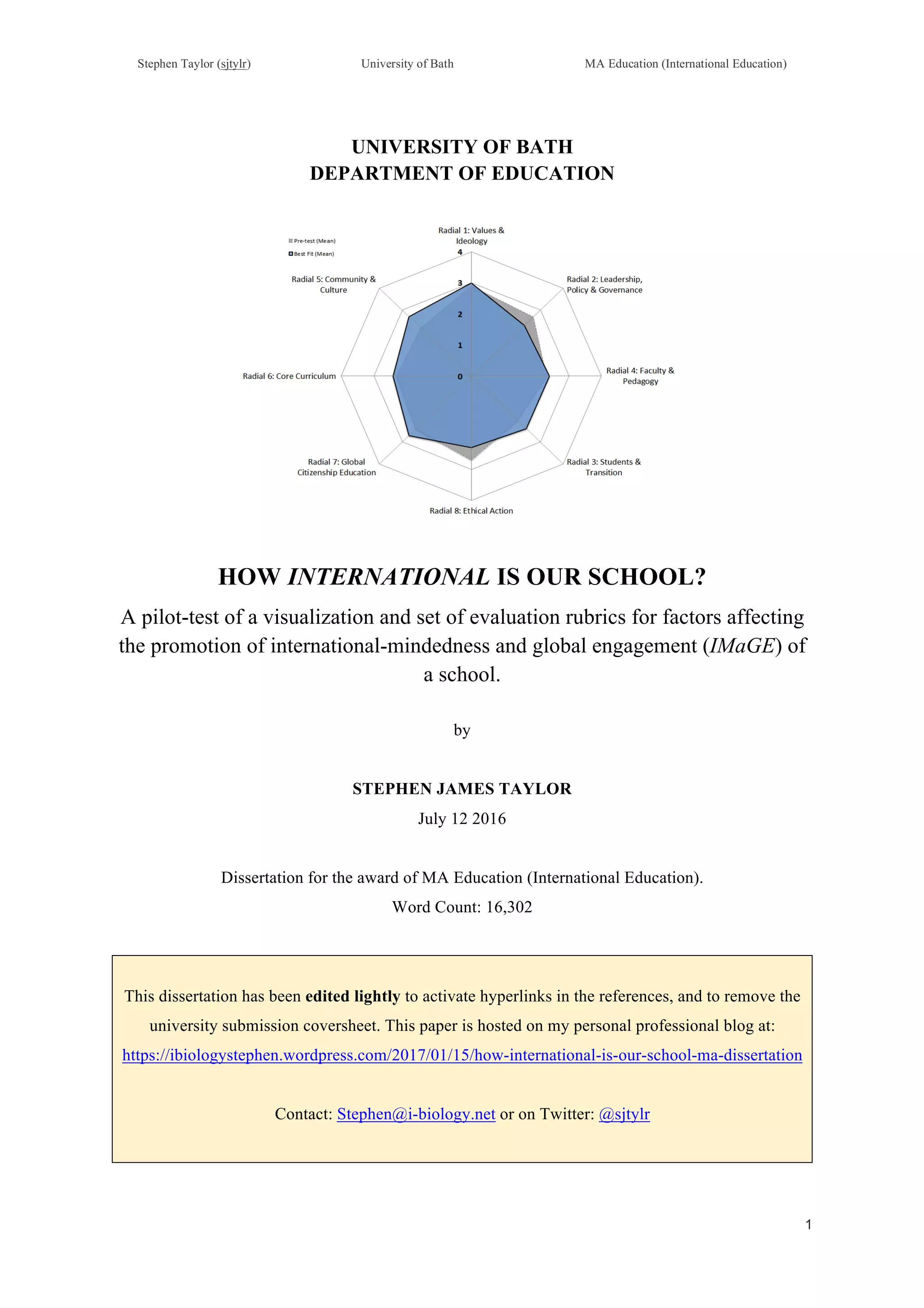
school that promote international mindedness (IM) and global engagement (GE), or “IMaGE” (Taylor
2013). The idea behind the web chart was to create a ‘visual definition’ of the international dimension
of schools, a tool with which a school might be able to self-assess and present their relative qualities
in terms of the promotion of IMaGE. Where the shape of a spider’s web is the ‘fingerprint’ of its
species (Zschokke & Vollrath 1995), the shape of a school’s IMaGE web-chart is unique; its
international dimension strengthened by connections and tensions between its radials (Taylor 2013).
I chose the acronym IMaGE in a deliberate attempt to communicate a collection of ideas in
one simple term. First, it serves as a ‘catch-all’ term for defining the essence of international
education, including the individual and school-wide states of mind of international mindedness and
the observable actions of global engagement. Secondly, through the development and application of a
series of rubrics, I propose a that the various components of schooling that contribute to the
development of IMaGE can be measured, and thus represented graphically in a form that clearly
presents the levels of quality of a school that might be used in place of lengthy descriptions or
definitions that might not be accessible to all stakeholders. I use the phrase ‘the IMaGE of a school’
as shorthand for ‘a visual definition of the degree of quality of eight contributing factors (radials) in
the development and promotion of international mindedness and global engagement of its learners, as
determined through the application of eight descriptive rubrics’, with IMaGE itself defined as “the
thoughts and actions of an individual with an informed ecological worldview, based on intercultural
understanding, global competence and empathy, resulting in purposeful, ethical and future-oriented
engagement with issues of local, national and global importance,” a definition which will be justified
!
Stephen Taylor (sjytlr) University of Bath MA Education (International Education)
!
!
7!
in Chapter 1.1. The ‘IMaGE tool’ referred to throughout the paper encompasses the eight rubrics and
the resultant web-chart, clarified below.
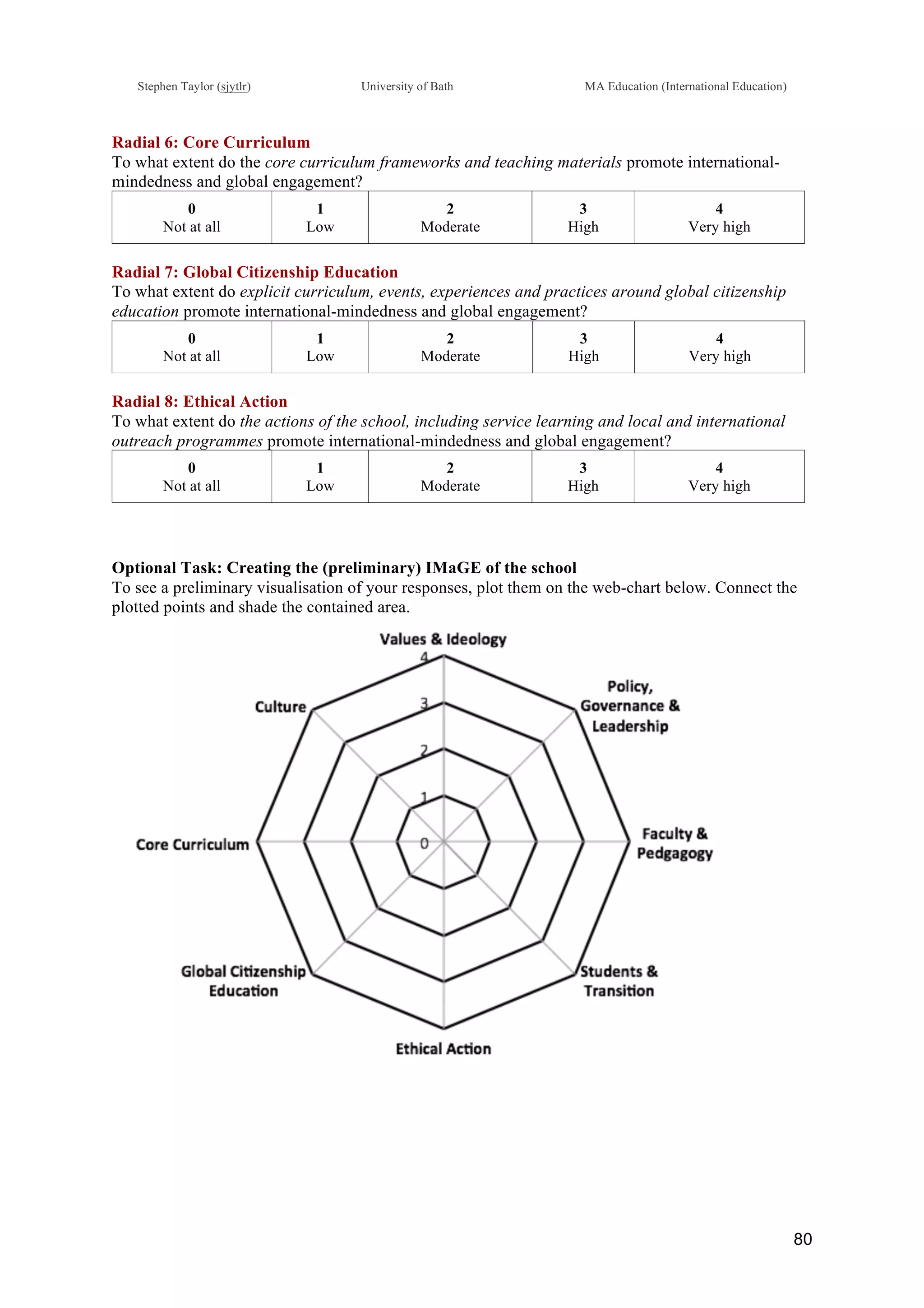
Also known as a radar chart (Tague 2005, in Taylor 2015) the web-chart is a graphic
representation that communicates multiple degrees of quality of contributing factors in a concentric
shape, with the outer levels representing a higher degree of quality (Fig. 1). As noted in my EIC
paper, the degree of quality reflects the extent to which a school evidences that characteristic or trait
(after Nikel & Lowe, 2010), and must not be confused with a judgement of the relative standard of
‘goodness’ of the school (a school can be educationally strong without being ‘international’). As in
Hill’s 2006 model of cultural interaction, a higher rating for the degree of quality of a radial gives a
greater shaded area on the web, moving out from the centre (see Fig. 1). Through overlapping of and
interaction between the elements for the radials, Furthermore, the ‘fabric’ of education is reflected, or
“stretched or maintained in tension” (Nikel & Lowe 2010).
Important definitions to consider in reading this study relate to construction of the web-chart
and the research design. In keeping with the web analogy, the eight contributing factors to the chart
are known as radials (Zschokke & Vollrath 1995; Taylor 2013). Participants in the pilot-test are
known as volunteers. In the initial stage of the pilot-test, volunteers gave a quick pre-test assessment
of their perceived degree of quality of each of the eight radials, to be used later in evaluating the tools.
Between five and seven elements were identified through the literature review as contributing to each
of the radials; each of the elements has been assigned descriptors on a scale of 0 (‘not at all’) to 4
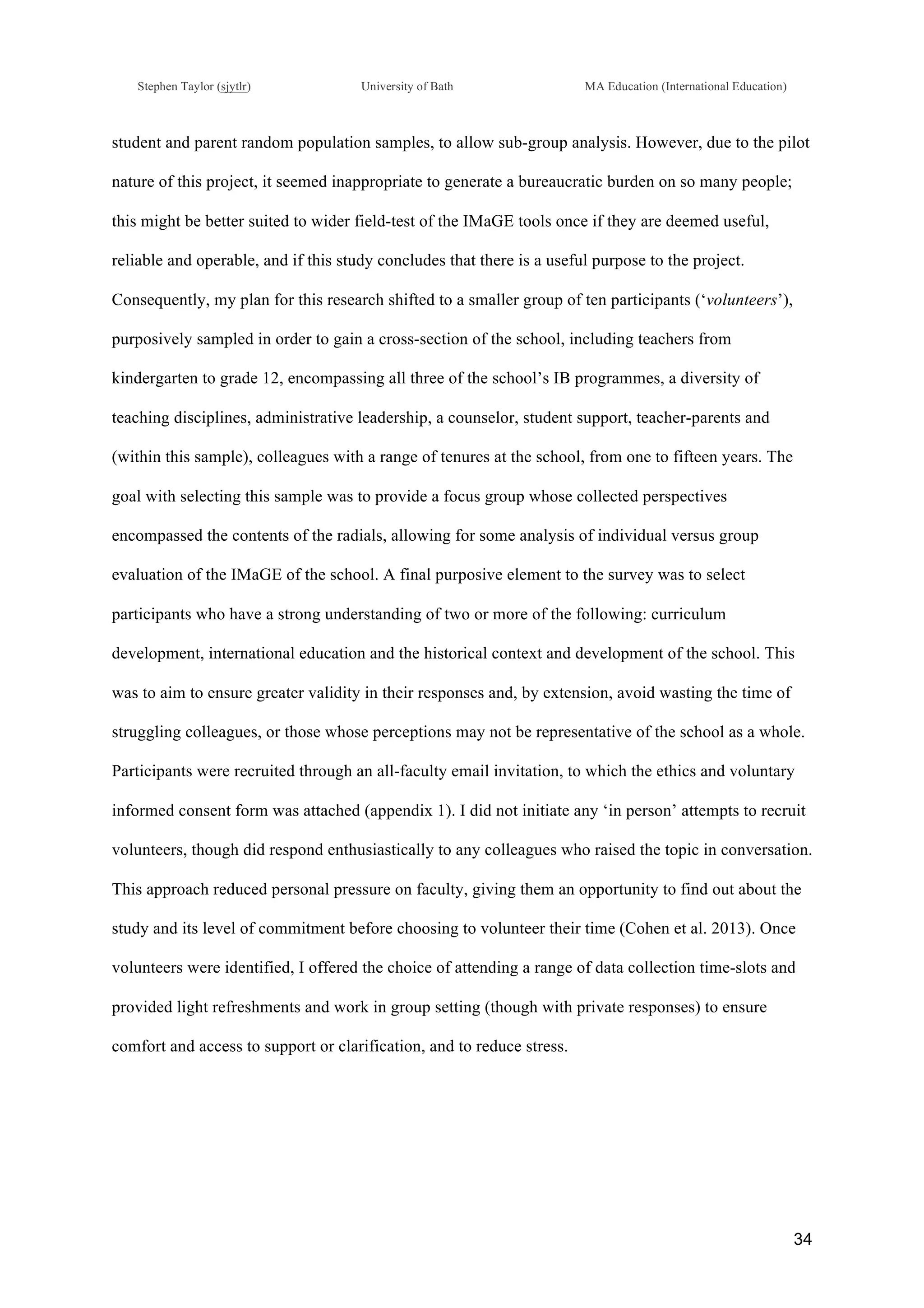
(‘very high’) (or ‘I don’t know’) in an evaluation rubric for each radial. After volunteers assigned a
degree of quality for each element in a radial, they gave an overall best-fit rating for the radial, which
was recorded in the sample population data and used to create the IMaGE of the school.
!
Stephen Taylor (sjytlr) University of Bath MA Education (International Education)
!
!
8!
Figure 1. Summarizing the IMaGE tools: the web-chart and supporting terminology
1.2 Rationale for Research
I wrote in my EIC paper that as we see the rapid growth of international education (Hill 2015;
Hayden 2011), and are better equipped to study and evaluate the qualities that make an education
international (Cambridge 2003; Cambridge & Carthew 2007; Cambridge & Thompson 2001; Hill
2000; Lowe 1998), so we also see challenges of identifying and describing types of schools in a more
crowded marketplace (Haywood 2007; Yamato 2003). Consequently, “teachers and global
!
Stephen Taylor (sjytlr) University of Bath MA Education (International Education)
!
!
9!
educationalists are currently drowning in a sea of seemingly similar terms” (Marshall 2007). There is
great variability between schools offering apparently similar experiences (Haywood 2007; Hayden
2011; Yamato 2003), and schools can become accredited, authorized or evaluated by a range of
agencies (Fertig 2007, 2015; Murphy 2012).
With clear descriptors for comparative purposes (Taylor 2013), any school might apply the
IMaGE tools, and each school would show a different pattern of degrees of quality: for example, a
multicultural international school, a local school offering an ‘internationalised’ curriculum, an
‘overseas school’ of one nation or a national school with a high immigrant population would each
have a unique IMaGE. In other words, “an international school may offer an education that makes no
claims to be international, while an international education may be experienced by a student that has
attended a school that has not identified itself as international” (Hayden & Thompson 1995),
Necessarily limited to the international dimensions of a school, the tool seeks only to
visualize the degrees of quality (characteristics) of the various radials (factors) that contribute to the
school’s IMaGE; quality here being used in a descriptive yet non-judgemental sense (Nikel & Lowe
2010), rather than Alderman and Brown’s (2005) “public and independent affirmation” as part of a
high-stakes external audit. Where it is possible that adherence to too restrictive a set of standards
might lead to isomorphism (schools becoming similar through competition), it is not a normative scale
in which some schools are ‘better than’ others (Shields 2015), but which illustrates a school’s unique
IMaGE in relation to others. I proposed that potential uses for the tools might include tracking a
school’s development of IMaGE over time, as a component of self-study for external bodies, as a
comparative tool for schools in a similar area or simply as an internal audit for a school exploring
issues of international education (Taylor 2013); “a culturally unbiased instrument or process for
measuring IM is [also] needed in the field.” (Duckworth, Levy & Levy 2005).
Since completing the EIC paper in 2012, I have come across further sources and
developments that have helped mature the web-chart visualization, including the updated and
comprehensive SAGE Handbook of Research in International Education (Hayden, Levy & Thompson
2015), Miri Yemini’s 2012 explorations of internationalization assessment in schools, Singh & Qi’s
!
Stephen Taylor (sjytlr) University of Bath MA Education (International Education)
!
!
10!
(2013) thorough, IB-funded research into 21st Century international-mindedness and Gerhad Muller’s
2012 EdD thesis on factors affecting IM in schools. Furthermore, my role as an IB Middle Years
Programme (MYP) Coordinator, whole-school Director of Learning and school visitor and consultant
for the IB Asia Pacific region, I am intimate with the IB standards and practices (IBO 2014, currently
under review), as well as the Council of International Schools’ (CIS 2016) standards for accreditation.
These outcomes, however, may not be understandable by all stakeholders; from personal experience,
it has been necessary to add extra visualisation and explanation to the outcomes of my own school’s,
programme evaluation report in order to make sense for parents and avoid ‘focusing on the negatives’.
I will refer to all of these sources, among others, in my literature review of the topic in Chapter 2.
In conclusion, my goal for this project was to use the literature review to develop a prototype
set of rubrics for the IMaGE of a school, pilot-testing them for validity, reliability and operability. I
developed a small-scale case-study of my own school, using my findings to make recommendations
for my school and for the evaluation of the IMaGE tools.
1.3 Overview of the Research
Through this research, I aimed to develop the IMaGE tools and apply them in a pilot test,
using my own school as a small-scale case-study to generate feedback on reliability, validity and
operability, modified from my RME paper (Taylor 2015). In doing, so, I interrogated the literature on
the factors that affect the IMaGE of a school, making adjustments to the model where necessary and
using critical analysis to develop an underlying set of prototype rubrics for the evaluation of each
radial. I then conducted a pilot-test using a group of ten faculty volunteers to evaluate our context and
analyse the data, producing a web chart for our international school in Japan.
Using a quantitative (survey-based) then qualitative (commentary) mixed-methods approach,
the case-study generated sample web-charts for the IMaGE of the school, a PreK-12 international day
and boarding school of 600 students of around 35 nationalities in Kobe, Japan. It was hoped that this
case-study might help lay some foundations for the school’s further IMaGE development and
evidence collection in time for a synchronised CIS and IB evaluation visit in 2019.
!
Stephen Taylor (sjytlr) University of Bath MA Education (International Education)
!
!
11!
1.3.1 Research Questions
In summary, this study investigates the following primary research question:
•! To what extent does the web-chart and its supporting rubrics generate a useful, reliable and
operable tool for self-evaluation and visualization of the IMaGE of a school?
A sub-question, regarding the outcome of the pilot-test as a limited case-study of our context is:
•! What preliminary conclusions can we draw regarding the IMaGE of our school, from this
pilot-test?
1.3.1 Overview of Upcoming Chapters
Through the literature review in chapter 2, I put the research in a wider context of
international school evaluation, justifying the choice of the web radials and the design of the rubric. I
critically evaluate key literature on factors affecting the IMaGE of a school, resulting in the
production of a working prototype set of evaluation rubrics (presented in full in Appendix 2). The
research design and tools are clarified in Chapter 3, including choices of survey instruments,
justification for choices of methodology and statistical tests. In Chapter 4, I process, present and
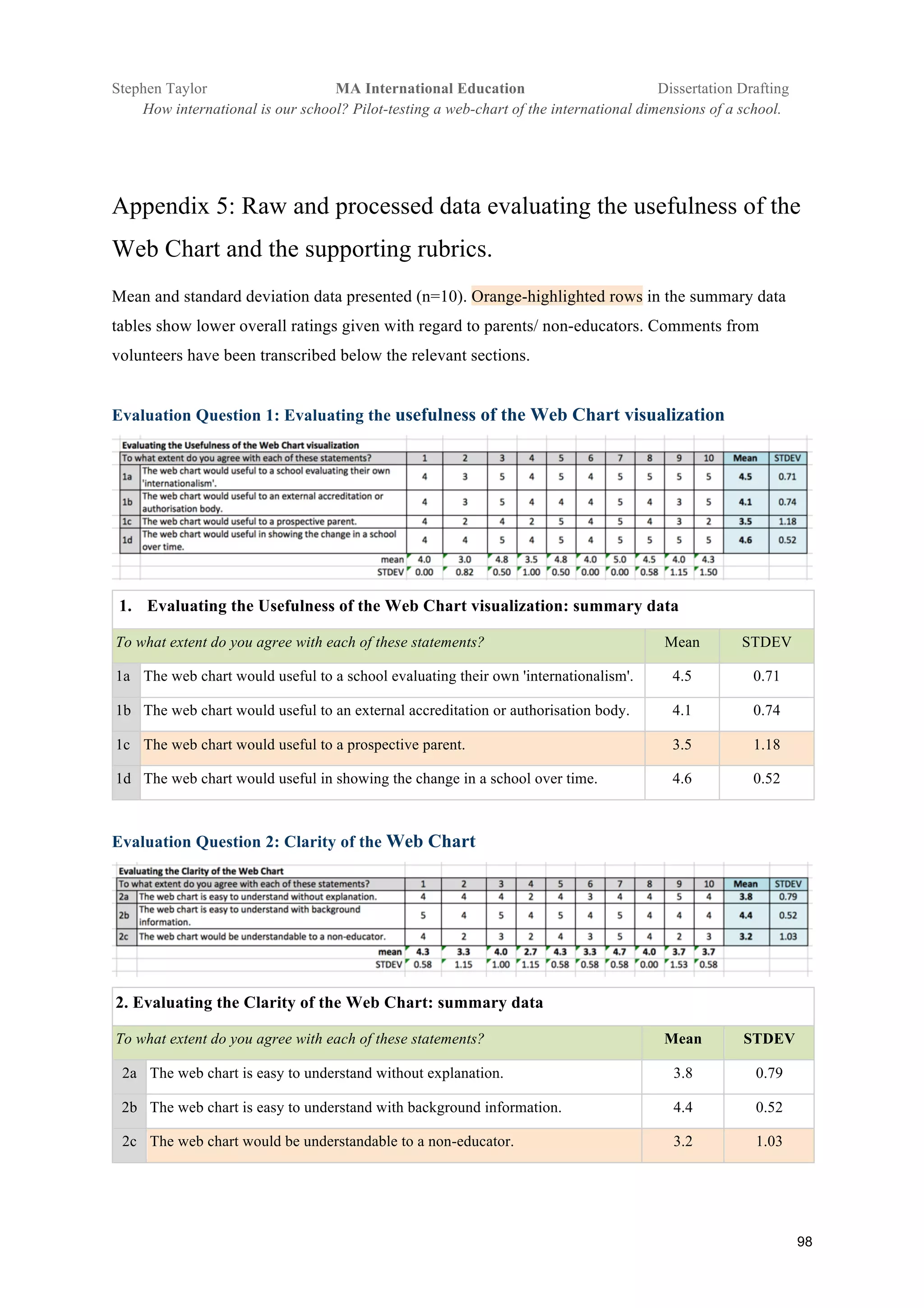
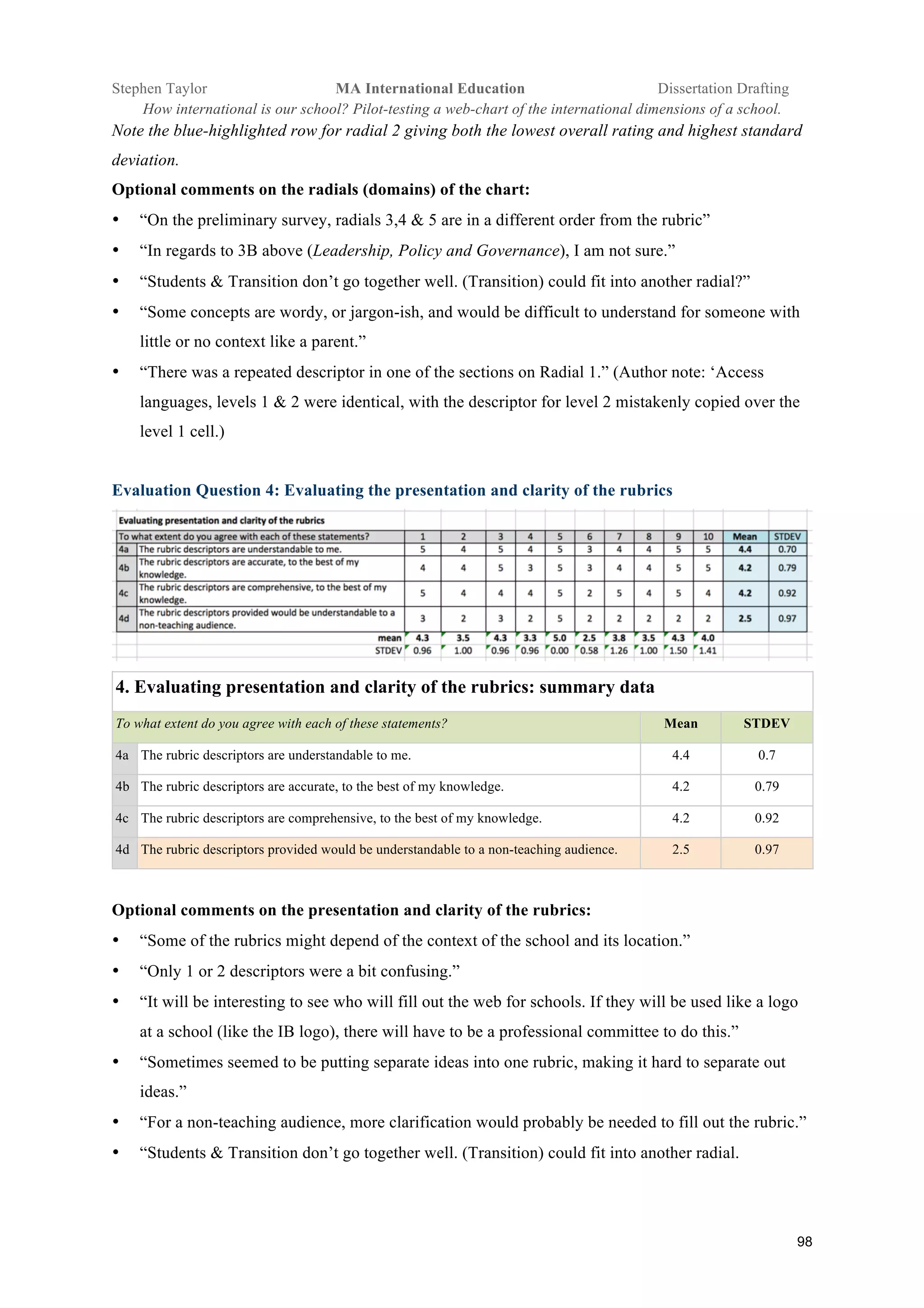
analyse the collected data, giving comparisons of pre-test and best-fit population mean data for the
eight radials and generating a preliminary web-chart “IMaGE for our international school”, supported
by tables for individual radial elements, as well as analysis participant feedback data on the design of
the tool. This data analysis informs the conclusions of Chapter 5, leading to a critique of the research
design, overall outcomes and implications of the study, and closing recommendations for further
research.
!
Stephen Taylor (sjytlr) University of Bath MA Education (International Education)
!
!
12!
Chapter 2: Literature Review
With such a rapidly-developing field of research, this could be a constantly fluid project,
adapting and evolving as the landscape of international education shifts. In this chapter, I review
literature on definitions of IMaGE, contemporary attempts and protocols used to measure or evaluate
IMaGE and key literature regarding factors that influence the development of IMaGE in a school. The
combined findings of the literature review will form the basis for the development of the prototype
IMaGE rubrics (Appendix 2).
2.1 Defining International Mindedness & Global Engagement
Although the International Schools Association’s (ISA 2011) self-study guide for
internationalism in education “offers no preconceived definitions or interpretation of internationalism
or international-mindedness”, instead opting to allow the school to “speak to and for itself”, Swain
(2007, in Singh & Qi 2013) argues that “defining and applying international-mindedness [...] might
be used as a basis for formal learning”. In my experience it is helpful to provide a common definition
for IMaGE that can be used by all stakeholders; given the potential future application for comparison
between schools (or within a changing school over time), it may be necessary to have a stable
reference for interpretation of the rubrics and questionnaires. In my EIC and RME assignments, I
stated that
“a school that promotes a high degree of IMaGE in its students demonstrates a commitment
to international understanding and education for a sustainable future. Through its
curriculum, faculty and learning opportunities it provides opportunities for its students to
appreciate and engage with a wide range of perspectives, cultures and values. Its learners
demonstrate compassion for others through their thoughts and actions, and are engaged in
meaningful service and action with the wider world.” (Taylor 2013, 2015).
!
Stephen Taylor (sjytlr) University of Bath MA Education (International Education)
!
!
13!
Though it captures some sense of internationalism in education, it is over-long, poorly-
understood and so necessary to generate a more contemporary and concise definition for use in the
tools that incorporates and reflects 21st century thinking and actions. To achieve this, I needed to
unpack the separate terms of international mindedness (referring mostly to thoughts and dispositions)
and global engagement (actions). Terms emphasised in bold in the coming paragraphs connect to the
working definition of IMaGE presented at the end of this section.
Where Haywood (2015, p79) asserts that that international education is a term that “may
simply be too vague to be useful”, and Marshall (2015, p38) prefers the term global education, Hill
(2013) advocates for education for international-mindedness. This focus, Haywood notes, “shifts the
focus of attention towards the outcomes of education rather than on the process itself”, giving an
observable set out outcomes that may be measured or evaluated and that “begs for definition in terms
of specific criteria.” (Haywood 2007). Using the term international-mindedness recognizes the
decades of work that have been done in the field by the IBO (Hill, 2015), with their Learner Profile
giving an example of some observable outcomes of education (Haywood 2007), creating individuals
“who recognize their common humanity and shared guardianship of the planet, help to create a better
and more peaceful world.” (IBO 2009).
As we dig deeper into research on international education, the term international-mindedness
(IM) is commonly used, with Haywood (2015) noting that “there seems to be a prevailing perception
that ‘we know what we mean, even if the definition is still under construction’”. Under construction it
may be, yet there have been many attempts, with overlapping ideas and phrases. In 1991, Hett
described internationally-minded individuals as those “possess an ecological world view, believe in
the unity of humankind and the interdependence of humanity, support universal human rights, have
loyalties that exist beyond borders and are futurists”, and in 1993 described global-mindedness as “a
worldview in which one sees oneself as connected to the world community and feels a sense of
responsibility for its members and reflects this commitment through demonstrated attitudes, beliefs,
and behaviors” (Hett, 1993, p.143). Hett’s five dimensions of global-mindedness (responsibility,
!
Stephen Taylor (sjytlr) University of Bath MA Education (International Education)
!
!
14!
cultural pluralism, efficacy, global centrism, and interconnectedness), were informative in developing
the radials and elements of the web chart.
The IBO stress that learners need to understand “their place in their local community as well
as in an increasingly interdependent, globalized world” in a process that “starts with self-awareness
and encompasses the individual and the local/national and cultural setting of the school as well as
exploring the wider environment.” (IBO 2009), and defining an internationally-minded individual as
one who “values the world as the broadest context for learning, develops conceptual understanding
across a range of subjects and offers opportunities to inquire, act and reflect” (IBO 2012a). Common
elements of IM definitions are found in much work, including a sense of ‘self’ and orientation in the
world, inter-connectedness, intercultural understanding and responsibility for the future and others
(Muller 2012; Skelton 2007; Skelton 2013; Hersey 2012; Duckworth, Levy & Levy 2005).
Building on the mindset of IM, and the sense of responsibility and action that comes through
some of the definitions so far, is global engagement (GE), defined by the IBO as a “commitment to
address humanity’s greatest challenges in the classroom and beyond, [...] developing opportunities to
engage with a wide range of locally, nationally and globally significant issues and ideas” (IBO
2012b). Engagement should be interpreted as the actions of an internationally-minded individual, and
may give more of the ‘observable outcomes’ of education for IM mentioned by Haywood (2015, p80).
A distinction should be made here between global engagement and global citizenship; terms that
sound similar but are again a source of potential confusion (Marshall 2007). Global citizenship should
be interpreted as the means through which a globally engaged individual takes action, “understood as
a multidimensional construct that hinges on the interrelated dimensions of social responsibility, global
competence, and global civic engagement” (Fig. 2, Morais & Ogden 2011). Global citizenship,
therefore, reflects a set of skills and a fluid body of knowledge that could be built into a school’s
curriculum (OXFAM 2016), a complex set of practices that has been included as its own radial in the
web chart. Global competence bears highlighting in the final definition, making clear that to be
successfully globally engaged, one must be armed with an appropriate set of skills and informed
global knowledge (Morais & Ogden 2011).
!
Stephen Taylor (sjytlr) University of Bath MA Education (International Education)
!
!
15!
Figure 2: Morais & Ogden’s (2011) Global Citizenship Model
Interestingly former Director General of the IBO, George Walker, described international-
mindedness as a ‘20th century’ notion of ‘otherness’ or of events occurring in ‘distant, exotic’ places;
he preferred global-mindedness, with its suggestion of inter-connectedness, and with four components
that reflect “21st Century realities[...]: emotional intelligence, communication, (inter)cultural
understanding and collaboration” (Hill, 2000 & Walker, 2004 in Hersey 2012). Although this may
be in keeping (perhaps unintentionally) with language around the globalization of international
education (Cambridge 2002; Bates 2010; Bunnell 2008), I elected to use the compound term
international-mindedness and global engagement (IMaGE). Other than the obvious neatness of the
acronym and its suggestion of visualisation, its components can be easily recognized and interpreted,
even if the reader is not familiar with the literature.
Recognizing that technology and accessible international travel have removed many barriers
to global communication, learning and action (Hill, 2000 & Walker, 2004 in (Hersey 2012), studies of
IMaGE education offer new insights. We can see the shift from ‘international understanding’ as a
construct of ‘us vs. them’, to more inclusive international-mindedness as an inter-personal (or
!
Stephen Taylor (sjytlr) University of Bath MA Education (International Education)
!
!
16!
ecological, interconnected) state, which itself can branch of into related fields of cosmopolitanism,
cultural intelligence and studies of common humanity (Singh & Qi 2013). Singh and Qi offer the
following five ‘concepts of 21st century international-mindedness’, (summarized in parentheses by
me), which are informative in part for defining IMaGE for this study, but more usefully for informing
the construction of the rubrics:
1.! Planetary intellectual conversation (Transnational sharing, knowledge, development
and discovery, including collaboration across disciplines and borders, perhaps
facilitated by technology)
2.! Pedagogies of intellectual equality (between students from all nationalities, including
practices such as differentiation, language support)
3.! Planetary education (a ‘we-humans’ (Bilewicz & Bilewicz 2012)) approach to global
education, important in curriculum development and pedagogy)
4.! Post-monolingual language learning (moving beyond a second language into
multilingual education, with some focus on cross-language transfer)
5.! Bringing forward non-Western knowledge (students learning from and with each
other, across languages and with a ‘planetary’ curriculum)
This more modern framework serves to emphasise idealistic ‘common humanity’ values of
empathy-focused internationalism in education, bringing them to the fore, yet providing clarity on
their pragmatic implications (after Cambridge & Thompson 2004). As it moves the definition of
international education from a cosmopolitan (or overseas schools) notion of learning new languages in
new places with new people, to something more holistic and shared (“planetary”,“transnational”), it
also incorporates more modern educational ideas on intellectual equality, conceptual language
learning and the global engagement through the use of technology. Having said this, Singh & Qi’s
five concepts represent a lot of new – potentially confusing or threatening – vocabulary that might
stand in the way of understanding of the users of the IMaGE tools. Consequently, though the rubrics
include elements related to these concepts, the language used in my definitions of IMaGE is more
recognizable.
!
Stephen Taylor (sjytlr) University of Bath MA Education (International Education)
!
!
17!
Although it is impossible to capture decades of research in IMaGE education in a short
definition my working definition of 21st Century IMaGE for use in the prototype tools is below, and
is included on all survey tools for reference during the study:
The thoughts and actions of an individual with an informed ecological worldview, based on
intercultural understanding, global competence and empathy, resulting in purposeful, ethical
and future-oriented engagement with issues of local, national and global importance.
2.2 Measuring international-mindedness in schools
As long as we have been trying to define international-mindedness, we have been trying to
measure it (Cambridge & Carthew 2015; Yemini 2012), yet as Yemini (2012) notes “although schools
around the world invest increasing resources and attention to encouraging the development of an
international mindset in students, almost no specific measures are currently available to assess the
outcomes of these efforts”. With a diversity of purposes and methods, from the individual-focused
measurement of perception and attitudes (Hett 1991; Hayden, Rancic & Thompson 2000; Yemini
2012; Singh & Qi 2013), to qualitative formative school-level self-studies (ISA 2011; Muller 2012),
through to more high-stakes external evaluation (Fertig 2015; CIS 2016a; IBO 2014), the application
of assessment of international-mindedness tends not to be in the comparative sense. Although
multiple international (or global) mindedness scales exist (Singh & Qi 2013), these tend to focus on
individual perceptions rather than the organizational actions that lead to those perceptions; for my
purpose they are more useful in the development of the element descriptors than in the overarching
model. For example, Hett’s Global-Mindedness Scale or Morais & Ogden’s 2011 Global Citizenship
Scale might provide useful indicators for elements within the Students & Transition and Faculty &
Pedagogy radials. For the remainder of this section, I will focus on measures of a school’s IMaGE (or
internationalization) as a whole.
!
Stephen Taylor (sjytlr) University of Bath MA Education (International Education)
!
!
18!
Common to measures of internationalization in education tend be the following classifications
or standards (Beerkens et al. 2010, in Yemini 2012):
1.! “the purpose of the assessment (self-evaluation, classification or rating);
2.! the type of indicators to be measured (qualitative or quantitative);
3.! the dimensions to be measured (including institutional commitment and curriculum,
among others);
4.! the structure to be used (survey, independent expert observations or internal data
collection); and
5.! the method of indicator validation (comparisons over time or of different
institutions).” (Beerkens et. al 2010)
Regarding classifications 1 and 5, One of the potential applications of the IMaGE tools is to
provide a reliable, comparative tools for visualizing a school’s evaluation of its IMaGE, either within
the school over time or between schools (Taylor 2013, 2015). Through this study, I aim to develop my
IMaGE tools to be complementary to key existing resources, so that users might apply them in their
own context without an additional burden. Through the development of the evaluation rubrics, I aim
for a mixture of quantitative and qualitative data (classification 2), collected across eight broad radials
(dimensions) of internationalization of the school (classification 3). The structure of my study is based
on self-study (classification 4), which allows schools to “speak for themselves”, identifying their own
areas of strength and development (MacBeath 2005). This lower-anxiety model of evaluation (as
opposed to a purely external ‘inspection’), involves more stakeholders in the school, generating buy-
in into the outcomes (MacBeath 2005), and which may then be verified by external agencies such as
the CIS or the IB. Along with their wider participation, they have a wide general audience, from
school governance, leadership and faculty to students and (prospective) parents; one might find the
outcomes of an evaluation on the school’s website or promotional materials, and there is an
expectation that the results are shared with the community (CIS 2016a; IBO 2014).
Clear, standards-based tools are a commonality in self-study of internationalization (Yemini
2012), though by the descriptive nature of a school’s IMaGE qualities these may tend towards
!
Stephen Taylor (sjytlr) University of Bath MA Education (International Education)
!
!
19!
qualitative data collection (Yemini 2012). Beyond simple diversity statistics much quantitative data
collected by the school reflect other ‘qualities’ (such as exam results, funding) that are not considered
in this IMaGE study, the rubrics being an attempt to quantify the qualitative. Three commonly-used
measures for international schools are the CIS’s (2016a) Criteria for the Evaluation & International
Accreditation of Schools, the IBO’s (2014) Programme Standards and Practices and the International
Schools Association’s (ISA 2011) Self-Study Guide for Internationalism in Education. Comparison of
these measures informs the development of my own IMaGE tools.
The ISA’s self-study tool, though lowest-stakes, offers the greatest flexibility of the three
tools, declining to offer a definition of international and focusing on an iterative process of reflection.
As a school defines, investigates and reflects on their own definition of international in education,
they explore four self-study areas of the school: school values; curriculum and teaching practices;
school communities and school management. The self-study guide breaks these areas down into sub-
areas, offering guiding questions for investigation and suggestions for evidence – though deliberately
shies away from statements of standards or quality. This approach might promote the greater diversity
across international schools of the three tools, though is limited in that it does not offer an externally-
validated accreditation. Furthermore, its openness to interpretation might be limited by the experience
(or expertise) of the participants (Cambridge 2015), and would require strong guidance or institutional
memory to maintain a sense of ‘standard’ over time as faculty changes. However, it offers an inviting
approach and a with its guiding questions and suggestions is a strong resource for use in evaluation.
Accreditation or authorization by recognized bodies, dependent on clear standards or
descriptors, may increase a school’s hold in an increasingly crowded market (Fertig 2007, Cambridge
2002, Hayden 2011; Murphy 2012), yet the application of global standards may lead to schools that
more homogeneous and less diverse (Fertig 2007). This poses an interesting problem for my study –
though the aim is to develop reliable IMaGE tools, it is not to homogenise schools. Both the IB and
CIS tools offer external accreditation and evaluation following a process of self-study, and now the
organisations are working together to align visits in schools (CIS 2016a, IBO 2016), where the
authorization of the IB programmes can be seen as a subset of the wider school accreditation of the
!
Stephen Taylor (sjytlr) University of Bath MA Education (International Education)
!
!
20!
CIS. In both cases, the self-study requires a steering committee and diverse stakeholder
representation, a process of evidence collection and presentation and the formation on an action plan
for improvement. Where the CIS protocols encompass all aspects of the school across 9 domains
(including physical and safety), with internationalism woven in through some standards of some
domains, the IB’s protocols zoom in on philosophy, organization and curriculum (including teaching)
practices, with frequent reference to international-mindedness and the learner profile. In both cases,
there are standards that must be met prior to authorisation, with others allowed to be in progress. The
overlap between the protocols, along with the potential to align visits, opens an opportunity for
application of the IMaGE tools in a useful sense.
Both organizations have a four-tier evaluation system, with the CIS protocols defined as (with
increasing quality) ‘membership, preparatory, team visit and future aspiration’ stages. The IB’s
protocol requires schools to develop their own descriptors for the four levels, though where a school
rates themselves as a ‘1 (low)’ or a ‘4 (very high)’ they must be prepared to provide evidence (IBO
2014). A school working with both agencies might naturally align their descriptors, though this
ambiguity again limits the potential for comparative or longitudinal studies, and is why I propose the
use of a set of defined rubrics with descriptors that connect the agencies. To meet this end, the rubrics
have four bands for ‘degree of quality’, plus ‘zero’ and ‘I don’t know’ bands, and their construction
will be explained in chapter 3.5.1.
!
Stephen Taylor (sjytlr) University of Bath MA Education (International Education)
!
!
21!
2.3 Evolving the web-chart
Since 2012, some development has taken place in
the selection and description of the elements of the rubrics
and the structure of the web chart. Initial anecdotal
response to the web chart was positive, as an easily-
interpreted, multi-faceted graphic (Tague 2005). The
concentric design, with outward progression representing
an increasing quality echoes Hill’s (2006) cultural model of
interaction, as well as the Global Competence Aptitude
ModelTM
(Hunter, Singh & Habick, n.d., Fig 3), where the
inner (green) circles represent internal readiness, the blue
represent external readiness and which itself provides a
useful toolkit for development of skills and attributes in the
Global Citizenship Education radial.
Figure 3: Global Competence Aptitude ModelTM
,
from http://www.globallycompetent.com/model
In keeping with Nikel and Lowe’s (2010) model of the fabric of quality in education, I have
maintained the positioning of the radials to try to communicate the tensions between radials – some
have overlapping or complementary elements. For example, intercultural relationships are seen as
important in the Students & Transition, Faculty & Pedagogy and Community & Culture radials.
Building on the assertion that “a contextually relevant balance [...] does not imply equalization”
(Nikel & Lowe 2010), I have attempted to maintain balance through the distribution of ideas in the
radials and underlying elements. The Values & Ideology radial, with a high degree of commonality
across other measures of internationalism (IB 2014; CIS 2016; ISA 2011), has five contributing
elements, giving each a relatively high weighting in the development of the school’s IMaGE.
Contrastingly, in the Students & Transition radial, with seven elements and more varied approaches to
their teaching and measurement, each element therefore contributes slightly less to the overall IMaGE
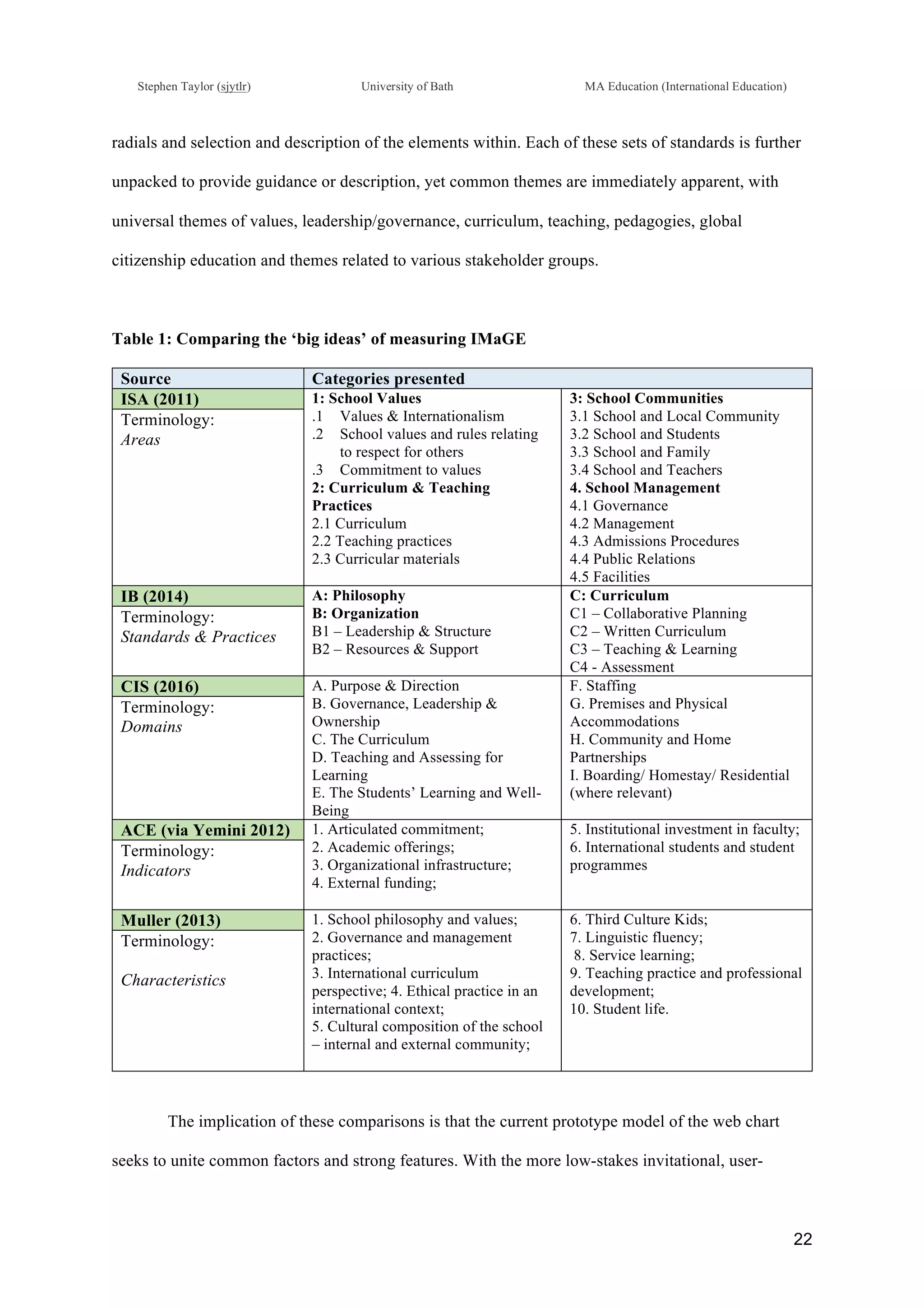
of the school. Table 1 below presents a comparison of the ‘big ideas’ of the foundational resources I
have used, in an attempt to identify common themes and categories to inform the adjustment of the
!
Stephen Taylor (sjytlr) University of Bath MA Education (International Education)
!
!
22!
radials and selection and description of the elements within. Each of these sets of standards is further
unpacked to provide guidance or description, yet common themes are immediately apparent, with
universal themes of values, leadership/governance, curriculum, teaching, pedagogies, global
citizenship education and themes related to various stakeholder groups.
Table 1: Comparing the ‘big ideas’ of measuring IMaGE
Source Categories presented
ISA (2011) 1: School Values
.1! Values & Internationalism
.2! School values and rules relating
to respect for others
.3! Commitment to values
2: Curriculum & Teaching
Practices
2.1 Curriculum
2.2 Teaching practices
2.3 Curricular materials
3: School Communities
3.1 School and Local Community
3.2 School and Students
3.3 School and Family
3.4 School and Teachers
4. School Management
4.1 Governance
4.2 Management
4.3 Admissions Procedures
4.4 Public Relations
4.5 Facilities
Terminology:
Areas
IB (2014) A: Philosophy
B: Organization
B1 – Leadership & Structure
B2 – Resources & Support
C: Curriculum
C1 – Collaborative Planning
C2 – Written Curriculum
C3 – Teaching & Learning
C4 - Assessment
Terminology:
Standards & Practices
CIS (2016) A. Purpose & Direction
B. Governance, Leadership &
Ownership
C. The Curriculum
D. Teaching and Assessing for
Learning
E. The Students’ Learning and Well-
Being
F. Staffing
G. Premises and Physical
Accommodations
H. Community and Home
Partnerships
I. Boarding/ Homestay/ Residential
(where relevant)
Terminology:
Domains
ACE (via Yemini 2012) 1. Articulated commitment;
2. Academic offerings;
3. Organizational infrastructure;
4. External funding;
5. Institutional investment in faculty;
6. International students and student
programmes
Terminology:
Indicators
Muller (2013) 1. School philosophy and values;
2. Governance and management
practices;
3. International curriculum
perspective; 4. Ethical practice in an
international context;
5. Cultural composition of the school
– internal and external community;
6. Third Culture Kids;
7. Linguistic fluency;
8. Service learning;
9. Teaching practice and professional
development;
10. Student life.
Terminology:
Characteristics
The implication of these comparisons is that the current prototype model of the web chart
seeks to unite common factors and strong features. With the more low-stakes invitational, user-
!
Stephen Taylor (sjytlr) University of Bath MA Education (International Education)
!
!
23!
friendly and open-ended ISA tools providing inspiration for the radials and many elements, the IB and
CIS tools give structure and accountability, as well as supporting resources and definitions.
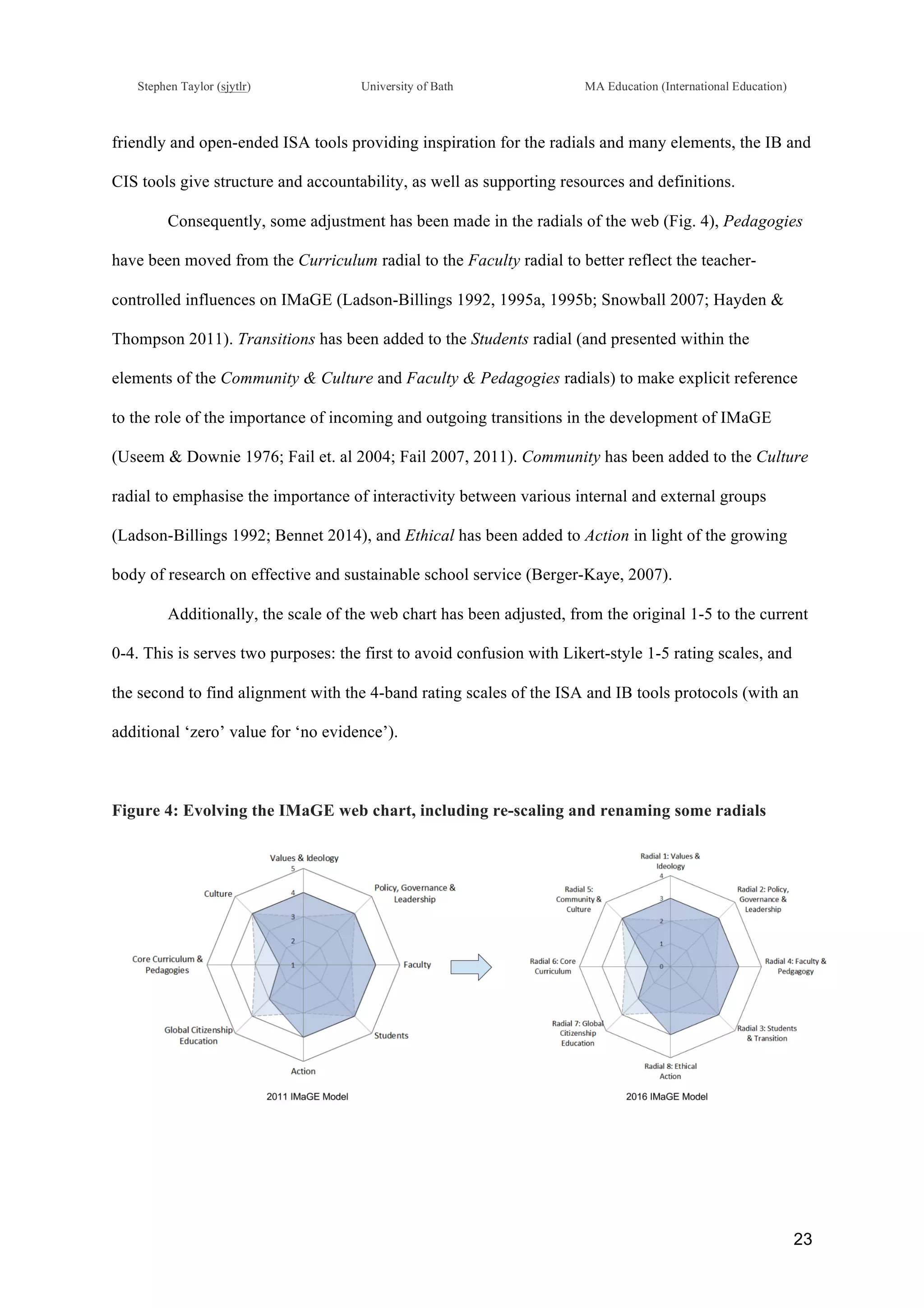
Consequently, some adjustment has been made in the radials of the web (Fig. 4), Pedagogies
have been moved from the Curriculum radial to the Faculty radial to better reflect the teacher-
controlled influences on IMaGE (Ladson-Billings 1992, 1995a, 1995b; Snowball 2007; Hayden &
Thompson 2011). Transitions has been added to the Students radial (and presented within the
elements of the Community & Culture and Faculty & Pedagogies radials) to make explicit reference
to the role of the importance of incoming and outgoing transitions in the development of IMaGE
(Useem & Downie 1976; Fail et. al 2004; Fail 2007, 2011). Community has been added to the Culture
radial to emphasise the importance of interactivity between various internal and external groups
(Ladson-Billings 1992; Bennet 2014), and Ethical has been added to Action in light of the growing
body of research on effective and sustainable school service (Berger-Kaye, 2007).
Additionally, the scale of the web chart has been adjusted, from the original 1-5 to the current
0-4. This is serves two purposes: the first to avoid confusion with Likert-style 1-5 rating scales, and
the second to find alignment with the 4-band rating scales of the ISA and IB tools protocols (with an
additional ‘zero’ value for ‘no evidence’).
Figure 4: Evolving the IMaGE web chart, including re-scaling and renaming some radials
!
Stephen Taylor (sjytlr) University of Bath MA Education (International Education)
!
!
24!
These adjustment, in alignment with Singh & Qi’s (2013) five concepts of 21st
century
international-mindedness, will be used to populate and describe the elements of the radials for the
IMaGE tool evaluation rubrics, and these will be discussed in the next section.
2.4 Influences on IMaGE: Web-chart radials and elements
Although the main focus of this paper is to pilot-test the prototype IMaGE tools (web chart
and rubrics), it is necessary to justify some of the choices made in the selection of radial elements and
their descriptors, with the complete list of elements presented in table 2. Some key sources used in the
development of the elements descriptors are presented under a few element columns of the prototype
rubrics in Appendix 2, as an example of how the completed rubrics might present their pedigree. The
standards outlined in the tools compared above offer much of the structure of the IMaGE tools, yet
there has been significant supplementation from literature sources. Although it is not possible in the
scope of this assignment to justify the choices of all four degrees of quality of all 49 identified
elements, I will justify some important or counter-intuitive choices and concepts that cross radials,
adding to the “tension in the fabric of quality” (Nikel & Lowe 2010).
Structures from the ISA, CIS and IB are common in their description of elements of mission
and core values, for example. Where Sylvester (1998) noted that “the greatest challenge […] facing
multilateral international schools is one of worldview”, we have since seen the development – almost
homogenization (Fertig 2007) – of international school missions. In keeping with Cambridge (2003)
and Muller (2013), who discuss the internationalist and globalist missions of schools and the role of
internationalization language in the foundational documents of schools, the ‘Mission & Vision’ and
Core Values & Rules’ elements are identified. Internationalization is most likely a deliberate choice
(Cambridge 2002), with adoption of international standards balancing the idealistic internationalist
worldview mission of the school with the pragmatic realities of school business (Cambridge &
Thompson 2014); the adoption of international programmes not only providing market legitimacy and
brand recognition for the school (Murphy 2012), but also affording tools, resources and definitions for
their development in line with values and ideology.
!
Stephen Taylor (sjytlr) University of Bath MA Education (International Education)
!
!
25!
Multilingualism sits alongside intercultural understanding and global engagement in the IB’s
conceptual framework for international-mindedness (IB 2013), yet its realisation reaches beyond the
simple acquisition of a second (or third) language (Nieto 2009; Singh & Qi 2013). Multilinguals
“experience the world differently […] because culturally important concepts and ways of thinking
[…] are embedded in language” (Duckworth, Levy & Levy 2005). Singh & Qi (2013) assert that an
effectively multilingual learner can make connections between languages, using them as a
“multimodal communication for international understanding”, leading to their classification of the
school’s contribution as post-monolingual language learning. Multilingualism, therefore influences
multiple radials and is clearly a shared responsibility of an international school, contributing to the
elements of ‘Promotions & Publications’ and ‘Access Languages’ the Values & Ideology radial,
‘Multilingual Support’ in Faculty & Pedagogy radial, ‘Curriculum Offerings’, ‘Multilingualism in the
Curriculum’ and ‘Communicating the Curriculum’ in the Core Curriculum radial and ‘Intercultural
Engagement’ in the Ethical Action radial.
Another wide-reaching concept is the perception of internationalism by groups and
individuals, including ‘Leadership Communication’ and ‘Recruitment’ in the Leadership, Policy and
Governance radial, ‘Students & Internationalism’ in the Students & Transition radial, ‘Faculty &
Internationalism’ and ‘Professional Development’ in the Faculty & Pedagogy radial, ‘Community,
Culture & Events’ in the Community & Culture radial, ‘Curriculum Frameworks’ and ‘Curriculum
Content and Materials’ in the Core Curriculum radial, and ‘Values Education’ in the Global
Citizenship Education radial. Where many attempts at measuring perceptions of IM have been made,
the development of true IM as an extension of self may be riddled with challenges (Skelton 2015),
perhaps harder still to accurately measure the impacts of the school on the student’s IMaGE (after
Hayden, Rancic & Thompson 2000). However, tools such as the Global Mindedness Scale, the Global
Citizenship Scale or the Global Competence Model might be put to use to measure perspectives of
students, teachers (including applicants), leadership and governance, as well as to inform strategic and
instructional planning.
!
Stephen Taylor (sjytlr) University of Bath MA Education (International Education)
!
!
26!
Experience of transitions in culture, language and values that can be in turns enriching and
culture-shocking (Useem & Downie 1976; Zilber 2009). As Morales (2015) notes, “the programs
implemented, or lack thereof, are imperative to the successful transition of TCKs into their new,
diverse, multicultural environment,”. This can be expanded to the community beyond the students,
with the induction of new faculty crucial to development of their own international-mindedness as
well as providing the ‘safe’ conditions for them to influence the IMaGE of their students (Fail 2011;
Hersey 2012). Consequently, issues of incoming and outgoing transition are included in the ‘Support
of Faculty’ in the Leadership, Policy & Governance radial, ‘Orientation & Integration’ and Outgoing
Transition’ in the Students and Transition radial, ‘Professional Development’ in the Faculty and
Pedagogy radial, and ‘Community Transition & Support’ in the Community & Culture radial.
With transition comes change in interaction, another wide-reaching concept in the radials.
Intercultural interactions shape relationships and the success of the organization (Hofstede 1986,
1994), yet understanding of intercultural communications may not come naturally (McCaig 1994) and
might need to be explicitly taught or expected (Heyward 2000; Hayden 2015; Snowball 2015),
leading the individuals and organization from monocultural and multicultural communication through
the cross-cultural and intercultural to the transcultural (Van Hook 2005, 2011). A similar, more
practical hierarchy is presented in Milton’s (2014) Developmental Model of Intercultural Sensitivity
(DMIS), which I have used in descriptors relating to interactions. With ethno-centric interactions (the
experience of one's own culture as "central to reality,"”) at lower degree of quality and ethno-relativist
(“the experience of one's own and other cultures as "relative to context"”) at the higher, I am curious
to see how this terminology is interpreted by the survey volunteers. With intercultural understanding
and communication a central part of intercultural competence (Morais & Ogden 2011), effective
interaction across cultures reaches many radials: ‘Leadership Communication’ and Recruitment’ in
the Leadership, Policy & Governance radial, ‘Intercultural Relationships’ in the Students &
Transition and Faculty & Pedagogy radials, ‘Local Community’ and ‘International Community’ in the
Community & Culture radial, ‘Intercultural Relationships’ in the Global Citizenship Education radial
and ‘Intercultural Engagement’ in the Ethical Action radial.
!
Stephen Taylor (sjytlr) University of Bath MA Education (International Education)
!
!
27!
Where intercultural education requires a change in pedagogy (Ladson-Billings 1992, 1995a,
1995b; Duckworth, Levy & Levy 2005), recruitment and ongoing professional development of
teachers requires significant attention (Cambridge 2002; Hayden 2015). With the growth of similarly-
missioned schools, we see increasing competition for internationalized teachers, leading perhaps to a
“war for talent” (Lauder 2007) and a “segmented labour market” in which “disproportionately large”
sections of faculty come from ‘trusted’ nationalities (Canterford 2003). The implications for the
IMaGE the school may lead towards further homogenization (Fertig 2007), and so there is a need for
purposeful, effective professional development (Hayden 2015), framed on pedagogies of “intellectual
equality” (Singh & Qi 2013). Useful here is Snowball’s model of professional development (2015),
with seven key domains reflected throughout the elements of the Faculty & Pedagogy radial and
iterated through many of the remaining radials.
1! “International Education in Context
2! Teaching in Multilingual Classrooms
3! Multiculturalism
4! Student characteristics and learning
5! Transition
6! Internationalising curricula
7! The reflective international teacher” (Snowball 2015)
As we see from Snowball’s domains, the teacher plays an important role in internationalising
the curriculum (Wylie 2008; Cambridge 2011), with an internationalized curriculum becoming truly
planetary (Singh & Qi 2013), based on diverse curricular materials and resources, open to
multilingual access and making use of educational technologies to learn across boundaries and
borders (Singh & Qi 2013, Lindsay & Davis 2012).
Although the Core Curriculum radial includes elements that seek to internationalize learning,
the purpose of the radial is to emphasises the ‘nuts and bolts’ of a recognizable, standardized
education - the product of which might be measured in traditional means such as exams or standards-
!
Stephen Taylor (sjytlr) University of Bath MA Education (International Education)
!
!
28!
based assessment. Global Citizenship Education, though interacting with the Core Curriculum, has
been given its own radial, bringing together some of the ideas discussed above (intercultural
interaction, values education, educational technology), as well as making explicit the CIS’s standards
of ethics, diversity, global issues, communication, service and leadership (CIS 2016) and the practices
of global competence and global engagement outlined in OXFAM’s guides (2016).
The concepts of the first seven radials lead towards the outcomes of Ethical Action, in the
final radial. Combining elements of programmes, intercultural engagement and ethics with elements
of Student Agency, Sustainability and Efficacy, derived from the works of Berger-Kaye (2004, 2007,
2009), the descriptors offer a set of objectives (Woolf 2005, in Muller 2012) that contribute to the
development of “global competence, cross-cultural communication, enhancing mutual understanding,
personal growth etc.” (Muller 2012). These elements also connect to the IB’s Middle Years
Programme Service Learning Outcomes, themselves heavily guided by Berger-Kaye’s work (IBO
2013), and in which Service is defined as a subset of Action.
In conclusion, although the IMaGE tools are in a prototype form and subject to critique and
evaluation, I have sought to connect diverse concepts in international education and metrics of
internationalization. Though each radial may in itself feed a dissertation, these prototype elements
(shown below in table 2) and descriptors (presented in full in Appendix 2), offer a starting point for
the IMaGE of our international school.
!
Stephen Taylor (sjytlr) University of Bath MA Education (International Education)
!
!
29!
Table 2: Identifying the Radials and Elements of the IMaGE Web Chart
Radial 1: Values & Ideology Radial 2 Leadership, Policy & Governance
●! Mission & Vision
●! Core Values & Rules
●! Accreditation
●! Promotions & Publications
●! Access Languages
●! Board representation
●! Board policies
●! Leadership diversity
●! Leadership communication
●! School policies
●! Recruitment
●! Support of Faculty
Radial 3: Students & Transition Radial 4: Faculty & Pedagogy
●! Student Diversity
●! Students & Internationalism
●! Intercultural Relationships
●! Admissions & Promotions
●! Orientation & Integration
●! Outgoing transition
●! Faculty Diversity
●! Faculty & Internationalism
●! Intercultural Relationships
●! PD
●! Faculty & Curriculum
●! Pedagogies
●! Multilingual Support
Radial 5: Community & Culture Radial 6: Core Curriculum
●! Local Community
●! Host Culture Influence
●! International Community
●! Participation in Global Community
●! Community Transition Support
●! Community, Culture & Events
●! Curriculum Frameworks
●! Curriculum Content & Materials
●! Curriculum Offerings
●! Multilingualism in the Curriculum
●! Communicating the Curriculum
●! Educational Technologies
Radial 7: Global Citizenship Education Radial 8: Ethical Action
●! Values Education
●! Thinking & Learning Skills
●! Global Engagement
●! Global Centrism
●! Intercultural Relationships
●! Educational Technology
●! School Programmes
●! Student Agency
●! Sustainability
●! Intercultural Engagement
●! Ethics
●! Efficacy
!
Stephen Taylor (sjytlr) University of Bath MA Education (International Education)
!
!
30!
Chapter 3: Research Design
3.1 Timeline
This research began in 2012, with my EIC assignment and a basic outline for the research
plan was developed in 2015 through the RME unit. However, the bulk of the research, including the
literature review, survey design, web-chart development, rubric creation (and pre-pilot), testing and
evaluation was carried out between October 2015 and June 2016, with the literature review building
on the EIC and RME work over the winter and spring. Pilot-testing of the web and rubrics took place
across two weeks in May 2016, giving sufficient time to process the data and seek feedback from
volunteers before the end of the academic year in June, and thus the loss of access to volunteers.
3.2 Research Strategy
As noted in my RME work (Taylor 2015), this pilot test, based on the collection of empirical
data, leans towards a positivist perspective on educational research (Cohen et al. 2013, p7), though the
application of what might be considered an inherently subjectivist set of value descriptors in the
rubrics generates an ontological problem: how can I generate valid and reliable empirical,
comparative data founded on a basis of participant perceptions? My proposed strategy, developed
further through this research, takes a pragmatic, multi-level, quantitative-dominant mixed-methods
approach (Johnson et al. 2007), that will allow me to recognize “four dimensions” of the study:
“research question (what?), purpose (why), process (how?) and potential (scope of results)”
(McLafferty & Onwuegbuzie 2006) in (Johnson et al. 2007).
I identify the strategy as quantitative-dominant as the greater weight is placed on the
empirical data generated by the study, with the target outcome, a web-chart of our school, itself the
product of statistical processing. Qualitative methods add value and insight to the results yielded for
the generation of the IMaGE, and for the evaluation of the rubrics used. The multilevel identification
signifies the integrated yet varied use of data types at various stages of the study (Cohen et al. 2013),
with qualitative descriptions informing the generation of quantitative rubrics, quantitative data
!
Stephen Taylor (sjytlr) University of Bath MA Education (International Education)
!
!
31!
emerging from the application of the rubrics and evaluation questionnaires and a return to qualitative
data (written and oral) in clarifying and expanding on volunteer responses.
This pragmatic, “methodologically pluralist approach to research” (Cohen et al. 2013) allows
for flexibility and a ‘practice-driven’ investigation; the naturally social, inter-disciplinary field of
education lending itself to ‘communities of practice’ in research (Denscombe 2008). Furthermore,
according to Johnson et al (2007), “the mixed methods research paradigm offers an important
approach for generating important research questions and providing warranted answers to those
questions”; a sentiment of particular importance in this study that seeks to pilot-test prototype
evaluation rubrics, a process which may in itself lead to unpredicted results or the generation of new
research questions.
Pragmatic mixed-methods allows triangulation of findings between the qualitative and
quantitative and a methodological triangulation (Cohen et al. 2013) between the results yielded in this
study between the application of the tool and its evaluation; an attempt to increase reliability and “a
powerful way of demonstrating concurrent validity” (Campbell & Fiske 1959 in Cohen et al. 2013).
As a result, the quantitative and qualitative components of a study become “mutually illuminating”
(Bryman 2007), in Cohen, 2013, p24).
As a scientist and science teacher, I am comfortable with the use of statistical analysis and
comparison, and will tend towards graphical and numeric presentations of data, whilst considering
issues of validity and reliability and recognising the importance of qualitative observations in
interpreting empirical outcomes. In my role as Director of Learning for the school, I am the
professional learning leader, seeking to support the development of ‘communities of practice’ as
described by Denscombe (2008); through choosing a mixed-methods strategy for a project that
generates a whole-school case-study, I hope to be able to demonstrate an example (albeit elementary)
of a “mutual collaboration linked to a key research problem” (Denscombe 2008). Finally, as noted in
my RME paper, as this pilot study seeks to test and evaluate a tool of my own creation: I am highly
aware of the potential for personal bias to slip into its evaluation (Denscombe 2014), though
!
Stephen Taylor (sjytlr) University of Bath MA Education (International Education)
!
!
32!
recognize that even with triangulation through mixed-methods data collection, I might not be
successful in removing all bias (Fielding et al. 1986, in Cohen et al. 2013).
3.3 Research Design
The pragmatic, multi-level, quantitative-dominant mixed-methods strategy justified above has
two main purposes and four components. The primary purpose, a pilot-test of the IMaGE tools, is
supported by the secondary purpose, a small-scale case-study of our school. The components of the
research include the design of the rubrics and survey tools, initial engagement with volunteers through
a preliminary ‘pre-test’ survey, a small-scale case-study of the IMaGE of our school based on the
application of the prototype rubrics, and finally a follow-up evaluation of the web-chart and rubrics
using a questionnaire and open-ended responses. The literature review, in Chapter 2, was used to
refine the model of the web-chart and select the eight radials, identify their contributing elements and
then to generate 0-4 scale descriptors for the degree of quality potentially observable by stakeholders.
Due to the limitations of scale of a dissertation, the broad scope of the web idea and the prototype
nature of the aim of the study, this was an early attempt to align qualitative indicators of the IMaGE
of a school with an empirical quantitative assessment method. In this section, I’ll justify the pilot and
case-study design of the research, before expanding the design of individuals tools and procedures in
section 3.5.
Piloting is a crucial element of the development of survey tools in educational research, and
the primary purpose of this study; the outcomes of this pilot should help evaluate “the reliability,
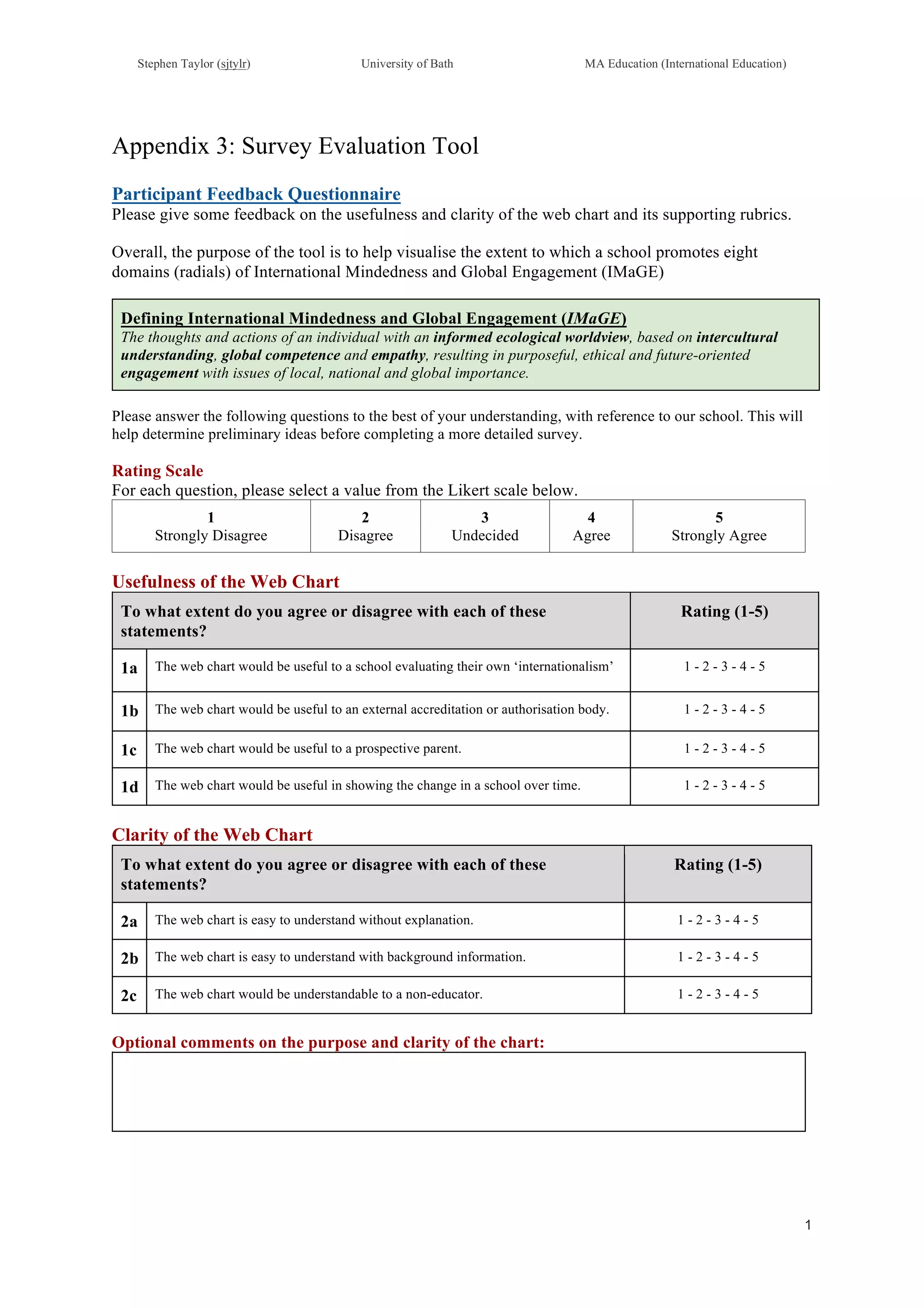
validity and practicability” of the IMaGE tools (Cohen et al. 2013). To this end, the feedback
questionnaire has been designed to collect targeted feedback on the following factors identified by
Cohen et. al. (2013, p402):
●! Clarity, construction and layout
●! Feedback on: validity, operability, clarity, readability for the target audience(s), layout,
numbering, formatting
!
Stephen Taylor (sjytlr) University of Bath MA Education (International Education)
!
!
33!
●! Identify omissions and redundancies
●! Identify items that are too easy/difficult or too nuanced
●! Identify commonly misunderstood or problematic items
●! Evaluate time requirements (reasonable burden)
●! Identify how motivating/non-motivating the tool might be for various audiences
Consequently, the small-scale case-study provides a part of the overall pilot-test of the IMaGE tools,
where the outcomes of the pilot will inform the further evaluation and development of the survey
(Cohen et al. 2013).
Defined by boundaries of time (2016, between accreditation visits), location (Japan) and
institution (a three-programme IB World school in Japan), this case-study forms part of a “step to
action” for future development (Cohen et al. 2013). This embedded, single-case design (Yin 2009)
contributes to the wider pilot-test of the IMaGE tools, but the small-scale nature and sample size of
the pilot limits the generalizability of the outcomes (Cohen et al. 2013). Though I intend to strengthen
its construct validity through the pilot process, its ecological validity may be limited to providing
clues for further investigation within our context (Cohen et al. 2013); the school is acting more as a
“real-life context” (Yin 2009) for the pilot, rather than the pilot giving rise to a comprehensive,
empirical view of the school. As volunteers participate in the case-study, they provide valuable
ongoing feedback for the pilot of the tool: they will “describe, illustrate and enlighten” its
development (Yin 2009 in Cohen et al. 2013).
3.4 Participants (Research Volunteers)
As outlined in my RME paper, I will use a non-random, convenience-based participation
model, using a purposive selection of colleagues (Cohen et al. 2013). Where I had originally planned a
sample of secondary teaching colleagues to evaluate the school’s IMaGE, satisfying a 95%
confidence level with a 5% confidence limit, this would have required a sample size of 40/45
colleagues (calculated with www.surveysystem.com, (Cohen et al. 2013). I had also considered
!
Stephen Taylor (sjytlr) University of Bath MA Education (International Education)
!
!
34!
student and parent random population samples, to allow sub-group analysis. However, due to the pilot
nature of this project, it seemed inappropriate to generate a bureaucratic burden on so many people;
this might be better suited to wider field-test of the IMaGE tools once if they are deemed useful,
reliable and operable, and if this study concludes that there is a useful purpose to the project.
Consequently, my plan for this research shifted to a smaller group of ten participants (‘volunteers’),
purposively sampled in order to gain a cross-section of the school, including teachers from
kindergarten to grade 12, encompassing all three of the school’s IB programmes, a diversity of
teaching disciplines, administrative leadership, a counselor, student support, teacher-parents and
(within this sample), colleagues with a range of tenures at the school, from one to fifteen years. The
goal with selecting this sample was to provide a focus group whose collected perspectives
encompassed the contents of the radials, allowing for some analysis of individual versus group
evaluation of the IMaGE of the school. A final purposive element to the survey was to select
participants who have a strong understanding of two or more of the following: curriculum
development, international education and the historical context and development of the school. This
was to aim to ensure greater validity in their responses and, by extension, avoid wasting the time of
struggling colleagues, or those whose perceptions may not be representative of the school as a whole.
Participants were recruited through an all-faculty email invitation, to which the ethics and voluntary
informed consent form was attached (appendix 1). I did not initiate any ‘in person’ attempts to recruit
volunteers, though did respond enthusiastically to any colleagues who raised the topic in conversation.
This approach reduced personal pressure on faculty, giving them an opportunity to find out about the
study and its level of commitment before choosing to volunteer their time (Cohen et al. 2013). Once
volunteers were identified, I offered the choice of attending a range of data collection time-slots and
provided light refreshments and work in group setting (though with private responses) to ensure
comfort and access to support or clarification, and to reduce stress.
!
Stephen Taylor (sjytlr) University of Bath MA Education (International Education)
!
!
35!
3.5 Methods and Procedures of Data Collection
In a departure from the planned internet-based survey of my RME paper (Taylor 2015), I
conducted this survey using personal paper-based questionnaires, rubrics and discussions; online
surveys more at risk to drop-outs (Denscombe 2009, in Cohen et. al., 2013, p261). Having already
selected the ten volunteers, avoiding ‘unit non-response’ and ‘item non-response’ issues (Durrant
2009), using supervision instead of Durrant’s suggested imputation (inappropriate due to small sample
size). Through in-person support in a focus-group setting, I sought to avoid the following contributors
to non-completion (or rush-responses)(Cohen et al. 2013):
●! Answer refusal due to misunderstanding, typological errors, confusion or other
survey-generated problems
●! Item non-response due to missed instructions, pages or mis-read items
●! Time pressure of competing demands for respondent time
●! False responses due to ignorance or misunderstanding of the topic
The survey consisted of three components: a preliminary pre-test questionnaire, the
comprehensive prototype rubrics of the IMaGE radials and a follow-up evaluative questionnaire. I
will outline these below, beginning with the rubrics, as they are the foundation for the pre-test
questionnaire, and the basis for evaluation in the pilot. These three tools have the following in
common, in order to ensure a high completion rate and to reduce distractors (Cohen et al. 2013):
●! Making the surveys easy to read and complete (as far as possible)
●! Making instructions very clear (in written and oral form)
●! Giving advanced notice and protected time for the survey
●! Cutting the survey to include only essential questions and sections
●! A simple linear structure that uses recognizable survey formats
●! Limiting the number of open-ended responses and placing them at the end of survey
sections
!
Stephen Taylor (sjytlr) University of Bath MA Education (International Education)
!
!
36!
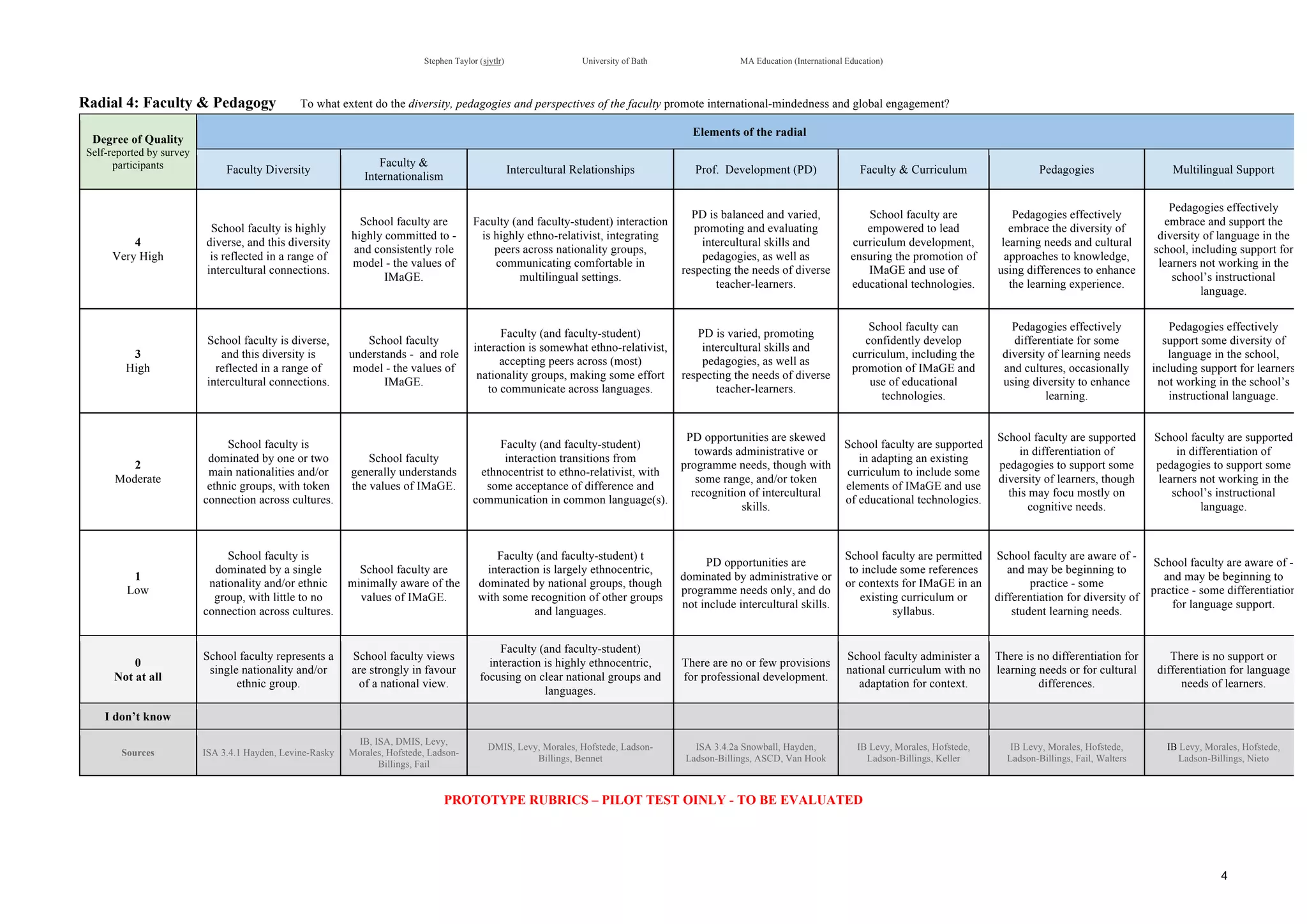
3.5.1 Rubric Design
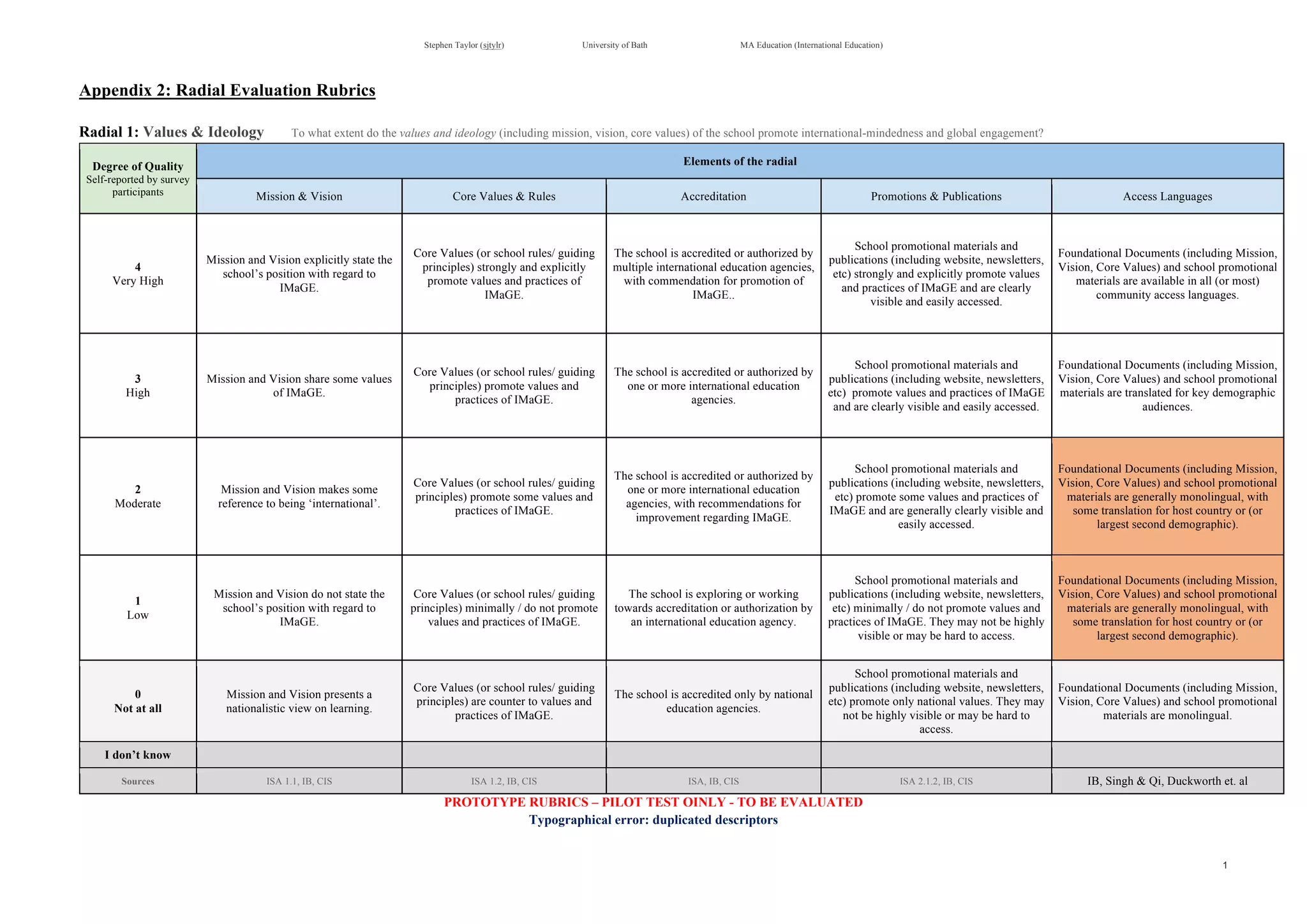
The use of a rubric allows for higher operability and accessibility to multiple stakeholders
than surface-level rating scales, and carefully-designed rubrics may increase validity and reliability
(Jonsson & Svingby 2007). Rubrics allow for clear identification of levels of mastery (Allen &
Tanner 2006), or in the case of this study, degrees of quality. They can be broken down into clearly-
defined subsections (such as a subject standards or skills, or in this case the elements of each radial),
and their application can provide reliable, growth-focused evaluation that is accessible to diverse
users (Jonsson & Svingby 2007).
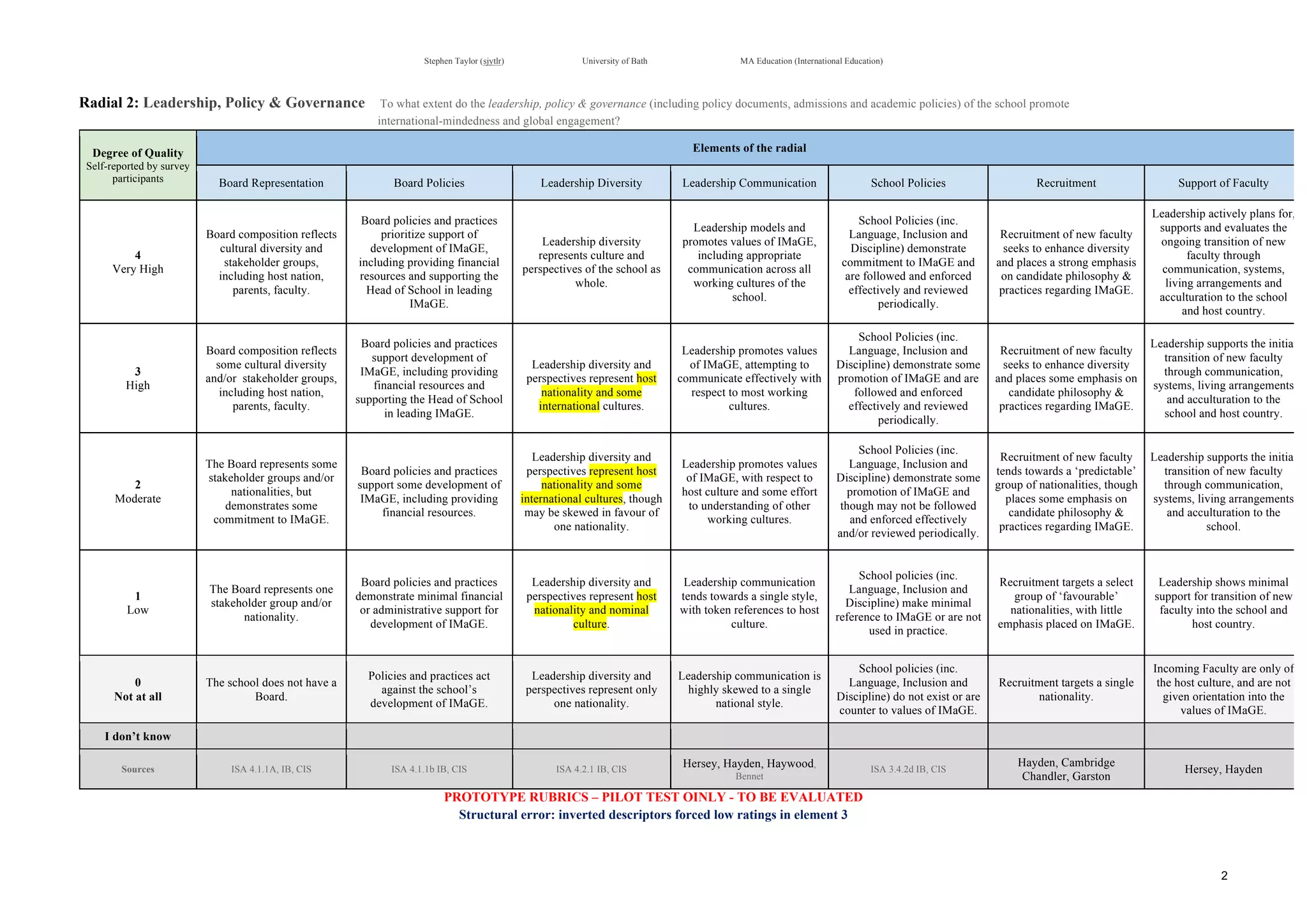
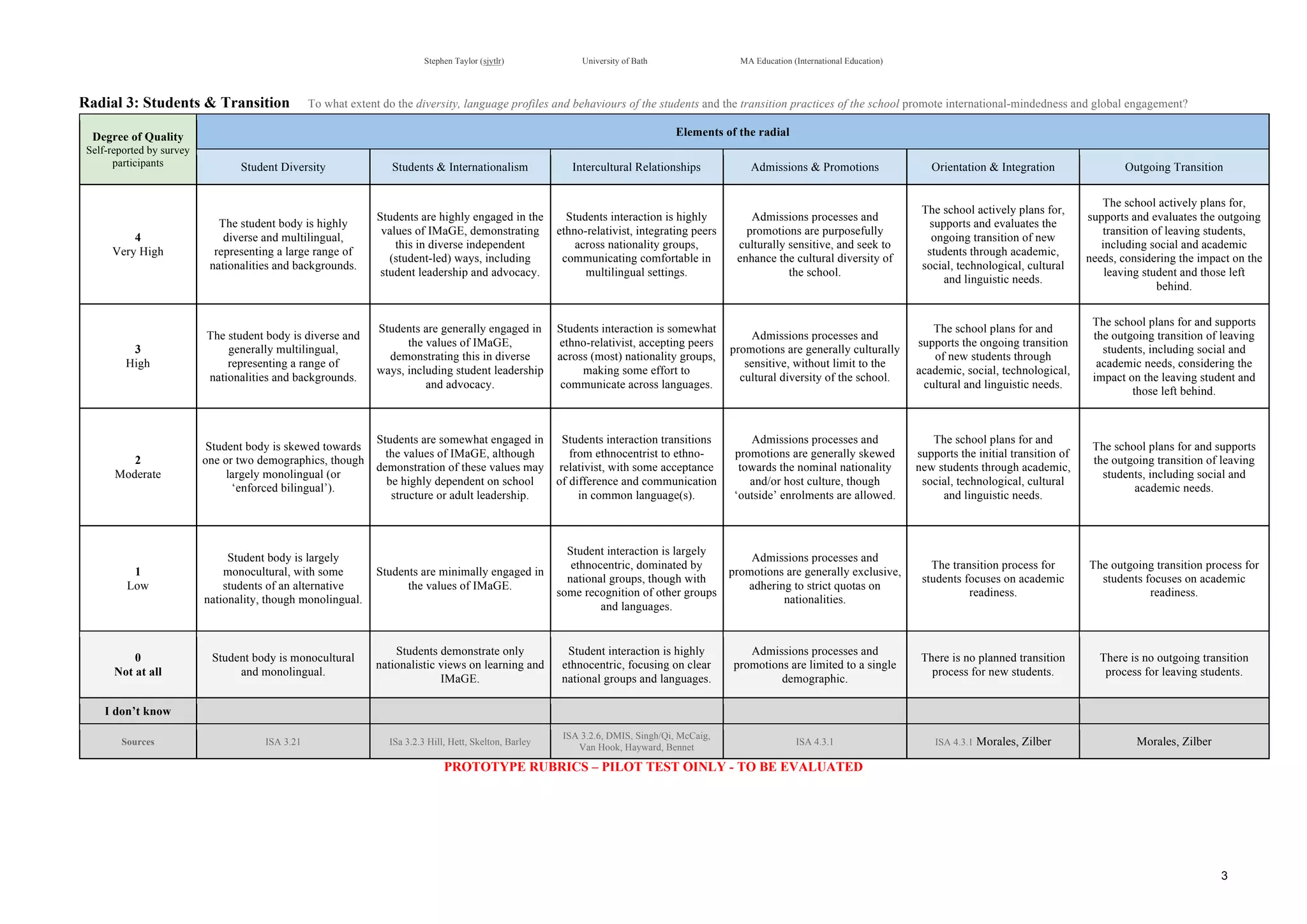
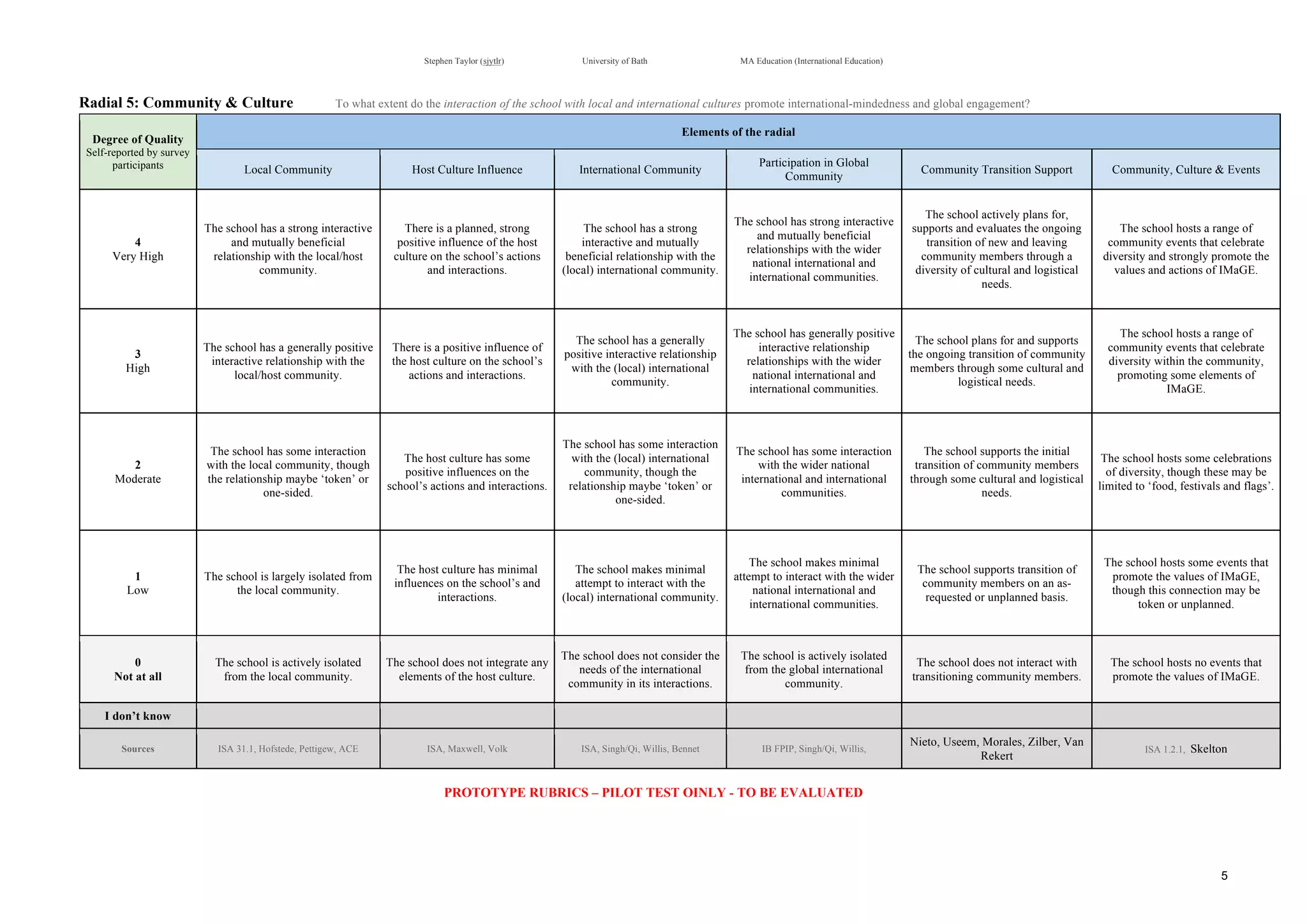
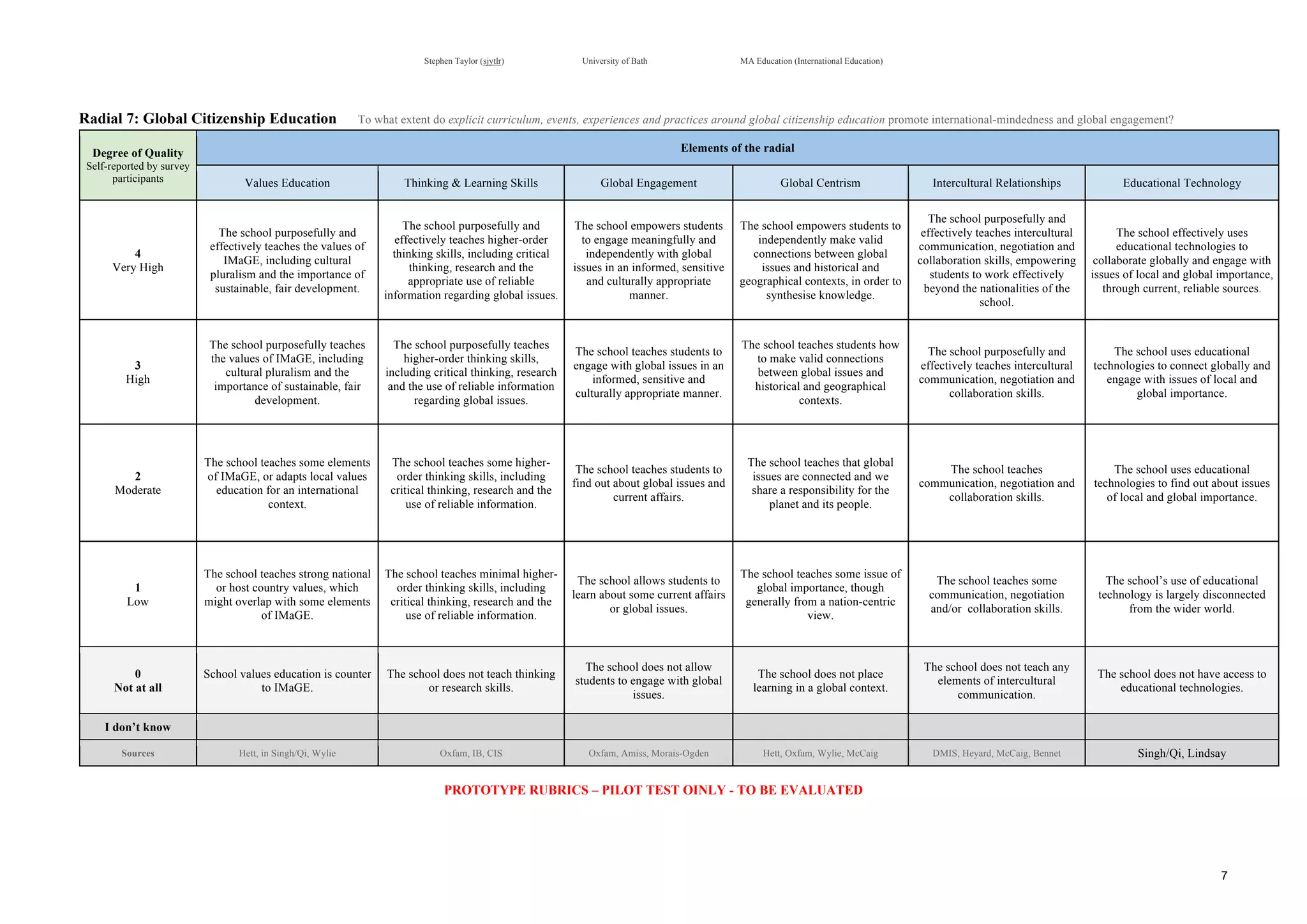
Figure 5: Example prototype rubric for a single radial of the web chart. Full rubrics are
included in Appendix 2.
Whereas in the RME paper I proposed a 1-5 model for the rubric, here I used a 0-4 scale.
Where 1-5 might suggest some degree of active quality at all levels, the 0-4 scale includes ‘not at all
or no evidence’ plus four levels of quality. This fits into a general 4-level rubric model, and
descriptors are written to ensure a clear distinction between levels, which can be supported by
evidence (Allen & Tanner 2006; Jonsson & Svingby 2007). In addition to the four bands representing
!
Stephen Taylor (sjytlr) University of Bath MA Education (International Education)
!
!
37!
four increasing degrees of active quality plus a ‘zero’ band, I included an ‘I don’t know’ band; the
important distinction being that ‘zero’ denotes a known lack of quality, whereas ‘I don’t know’
identifies a lack of knowledge on the part of the volunteer. The meanings of the bands of the rubrics
are summarized in table 3 below, and these generic definitions were used as a reference for writing
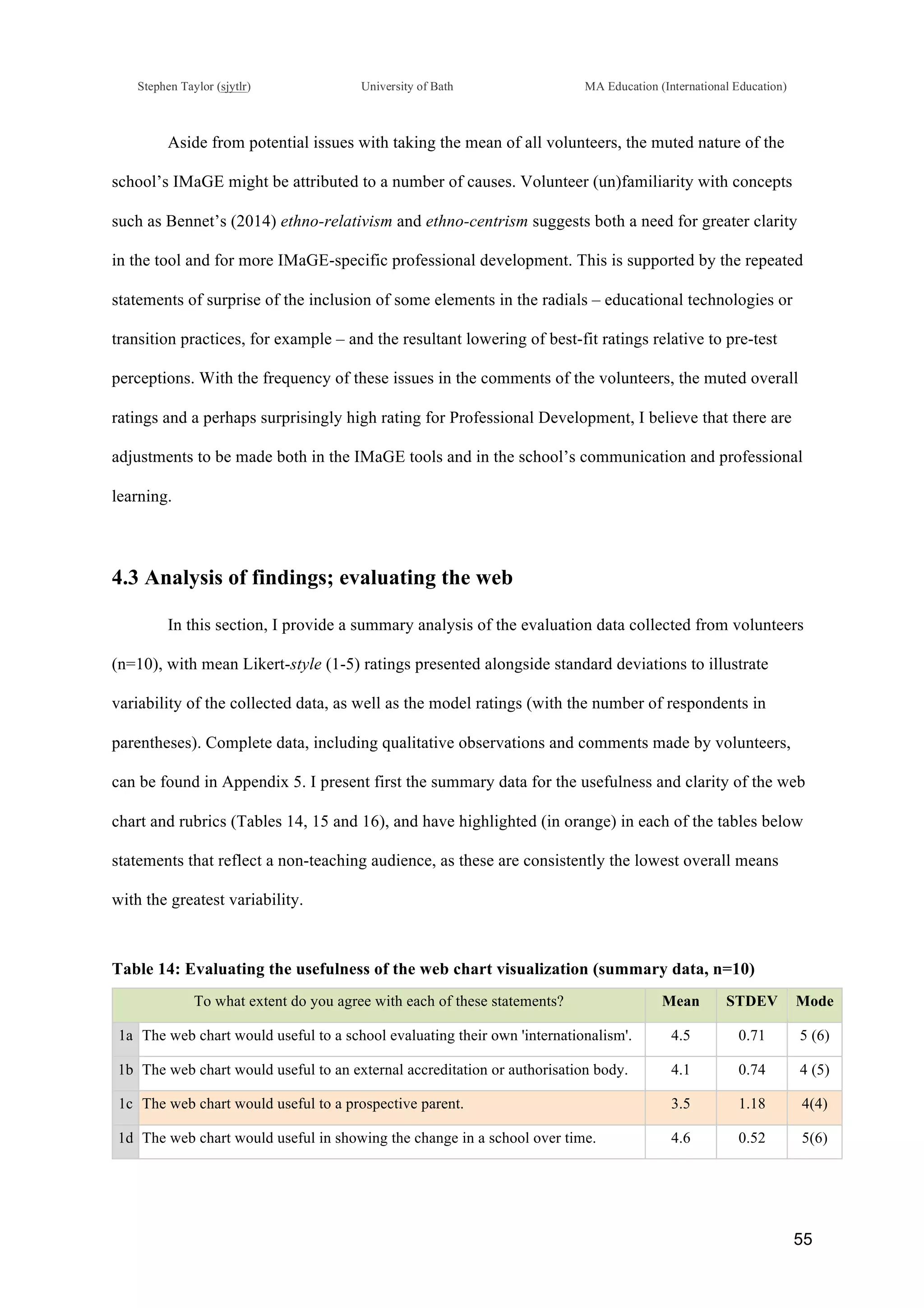
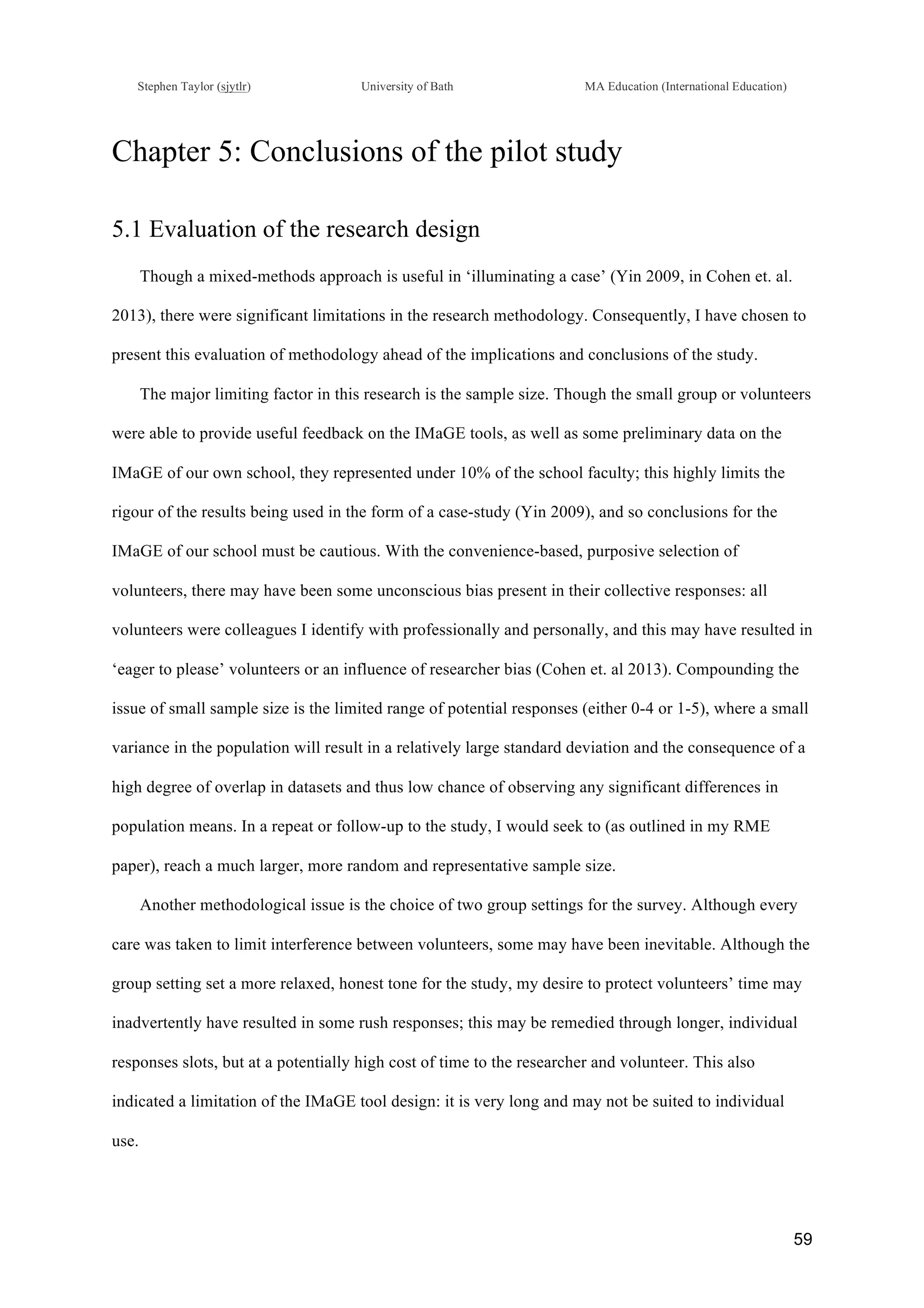
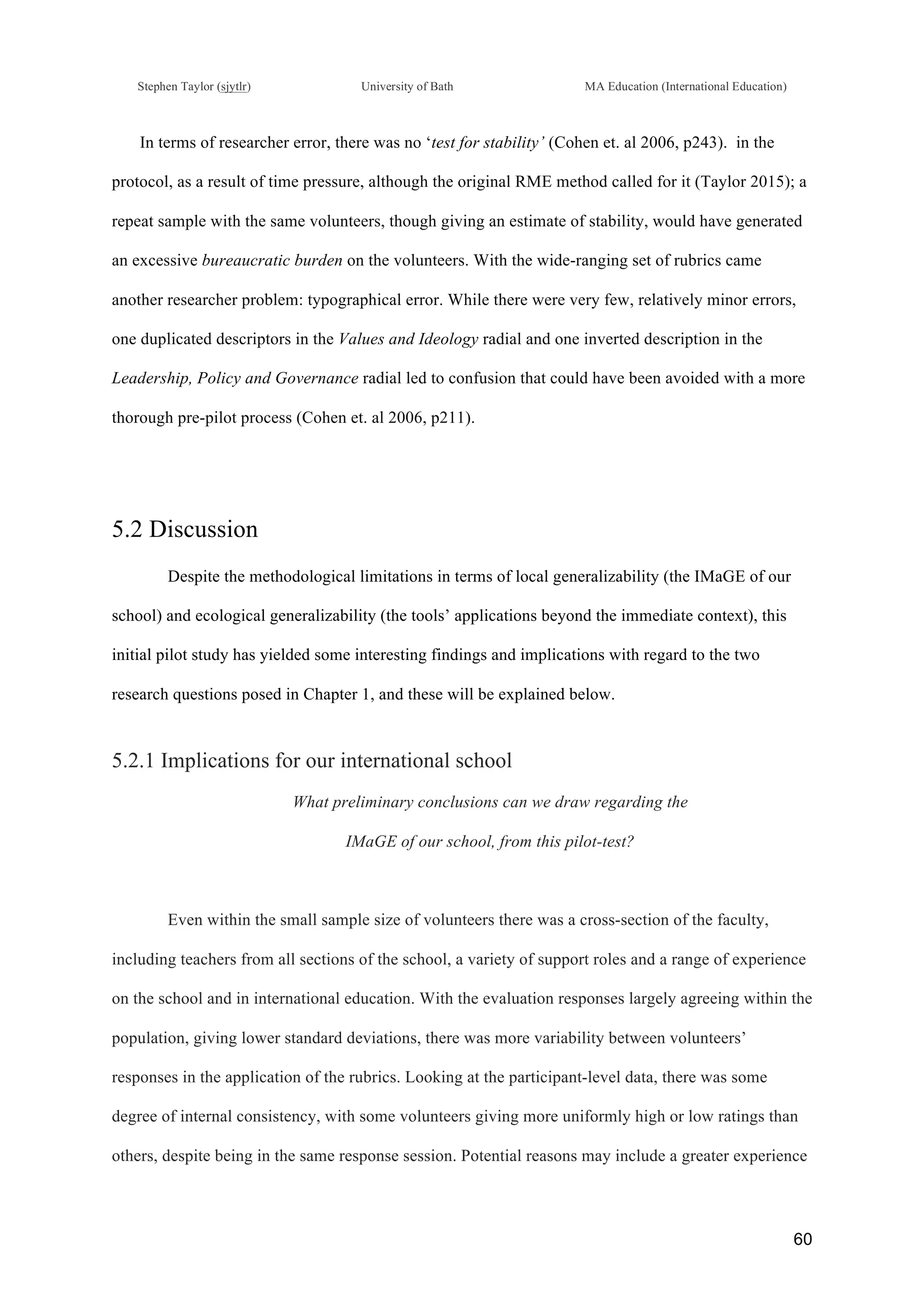
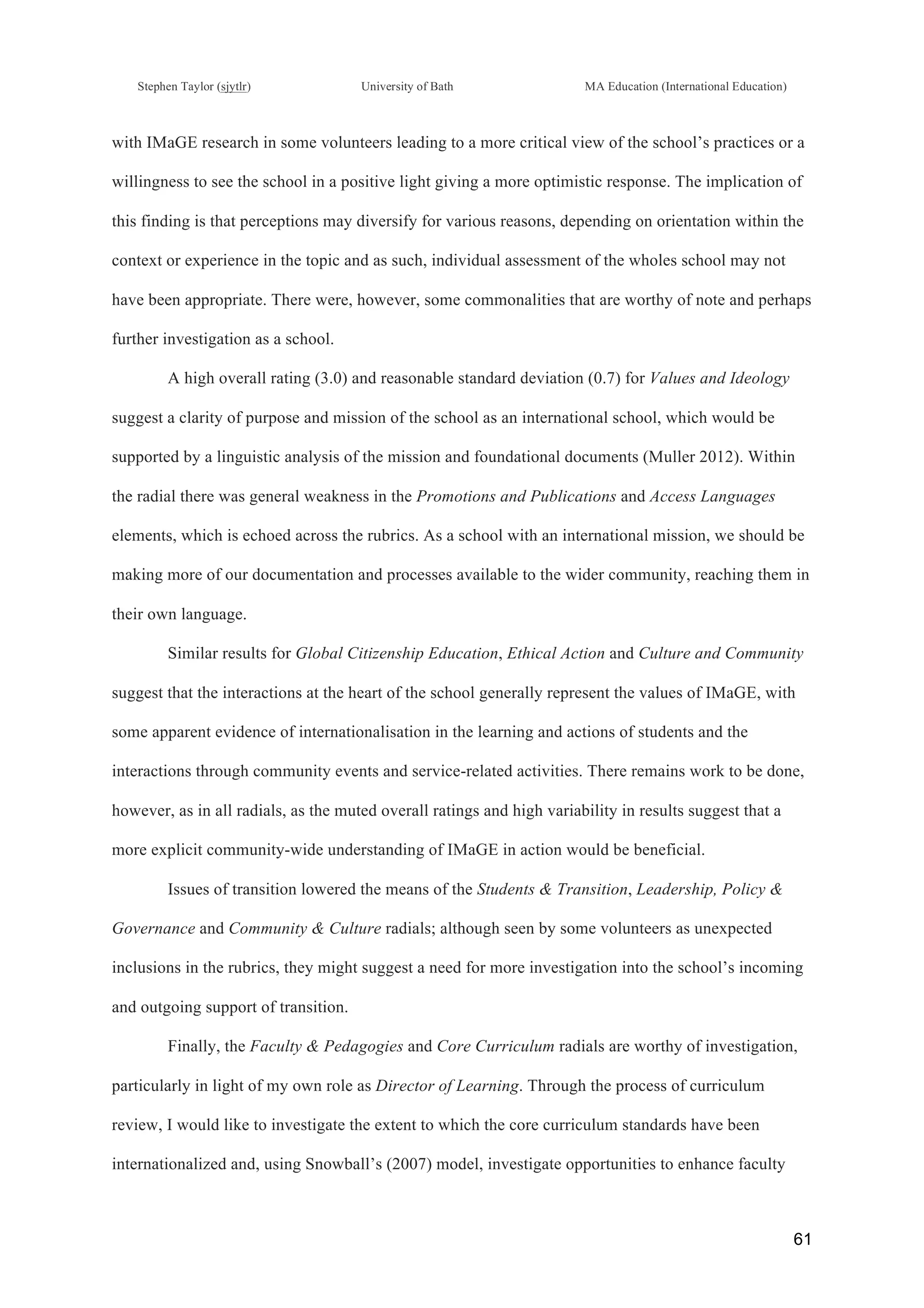
the descriptors for each of the elements.
Table 3: General descriptors for ‘degrees of quality’ on the radial evaluation rubrics
Degree of quality General descriptor
4 / Very high
Aligning with ‘exceeds expectations’ or a very high standard of implementation as
might be expected by a high-performing international school with an exemplary
IMaGE programme.
3 / High
Aligning with ‘meets expectations’ or a high standard of implementation as might be
expected by a well-performing international school.
2 / Moderate
Aligning with ‘approaches expectations’ or a moderate standard of implementation of
IMaGE practices.
1 / Low
Aligning with ‘does not meet expectations’ or a low (or tokenistic) implementation of
IMaGE practices.
0 / No evidence The school cannot provide evidence for this element.
‘I don’t know’ The respondent does not know of the school’s degree of implementation.
After identifying the degree of quality of each element in the radial rubric, volunteers applied
a ‘best-fit’ rating for the radial as a whole, making a balanced, holistic judgement for the radial, where
the relative weights of each elements may or may not be seen as equal. It also allowed for ‘I don’t
know’ ratings to be discounted from the overall rating for the radial; a lack of knowledge of one
element will not affect the degree of quality of others. This is preferable to an averaging that assumes
equal weighting, and results in an integer rating on the individual level. It also allows for data to be
collected at the individual and population level, and for data to be compared at the radial and
elementary levels. Figure 6 demonstrates two examples of the best-fit rating in application.
!
Stephen Taylor (sjytlr) University of Bath MA Education (International Education)
!
!
38!
Figure 6: Example applications of the best-fit approach to the rubrics
Elements of the radial (Respondent 1) Elements of the radial (Respondent 2)
Rating A B C D A B C D E
4 X
3 X X X X
2 X X
1
0 X
IDK X
Notes
Best fit: 3
Note the lack of knowledge of element C
does not affect overall rating.
Best fit: 2
The ‘0’ rating here is based on the respondent’s knowledge of
the school’s (lack of) quality in this element, and so swings the
overall radial rating between 3 and 2.
In terms of operability of this method, as teachers in an IB World School, the volunteers are
accustomed to using a four-band evaluation rubric, the foundation of much assessment in the
standards-based middle-years and diploma programmes. Furthermore, our teacher evaluation model
uses a four-band rubric, whereas completion of the IB self-study process requires the development
and application of four levels of implementation of the standards and practices, with the highest rating
requiring ‘extraordinary evidence’ (IB cite). This may, in turn, feed into school self-study efforts for
accreditation without duplicating effort.
3.5.2 Preliminary Questionnaires
The purpose of the preliminary questionnaire was twofold: to help ‘tune in’ the volunteers to
thinking about the school’s IMaGE and to provide a baseline assessment of volunteer perceptions of
the school’s IMaGE. I was interested here in the relationship between volunteers’ preconceptions of
the IMaGE versus their responses when applying the rubrics. In keeping with the principles outlined
above in (Cohen et al. 2013), this initial questionnaire aims to be brief, clear and easily operable.
Volunteers complete this after the project is explained to them and they have read and completed the
ethics and voluntary consent form. The purpose of the study was restated at the top of the linear
survey, along with the working definition of IMaGE for easy reference. Each radial was clearly
!
Stephen Taylor (sjytlr) University of Bath MA Education (International Education)
!
!
39!
identified and a ‘to what extent…?” question posed, against which the volunteer makes a 0-4 scale
judgement based on their perception of the school. The 0-4 scale descriptors match those in the
rubrics. Figure 5 shows the introductory excerpt from the questionnaire, with the full tool presented in
Appendix 1. The preliminary questionnaire concluded with the option for the volunteer of plotting
their own web-chart based on their responses, with the intention of further familiarizing the volunteer
with the web-chart model. Upon completion, the responses were collected and tabulated, and the
rubrics given to the volunteer.
Figure 5: excerpt from the preliminary questionnaire.
3.5.3 Evaluation Questionnaires
This final questionnaire was used to capture evaluative data on the web-chart (including its
usefulness and clarity), the content of the radials and the clarity and usefulness of the rubrics. For this
purpose, the rating tool switched into a 1-5 Likert-style response format, founded on agree/disagree
statements with an assumed interval scale (Carifio & Perla 2007), combining descriptors with
numerical values to suggest equality of intervals, and position the strongest-positive response to the
‘natural’ ‘5’ rating (Cohen et al. 2013). This signalled a shift in purposes to the respondent, using a
commonplace format that is recognizable to questionnaire-users (Boone & Boone 2012). The
questionnaire kept to a simple, linear format, avoiding distracting early open-ended responses (Cohen
et al. 2013), though I provide opportunities for qualitative justification after each section, recognizing
!
Stephen Taylor (sjytlr) University of Bath MA Education (International Education)
!
!
40!
that “scale items are not autonomous and independent (...), but rather they are a structured and
reasoned whole” (Carifio & Perla 2007). For the same reason, I had to bear this in mind when
analysing the yielded data - although I generated means, modes and standard deviations of responses
(Boone & Boone 2012), I could not reliably (and particularly with a small sample population), use
any individual point as the basis of conclusion. Although interpretation of Likert-style scale data can
be minefield, “questions are the nub” (Carifio & Perla 2007), and through the composition of clear,
standard-format response questions, along with in-person support and clarification and the collection
of qualitative commentary, I aimed to ensure the validity of the evaluative data collected. Figure 6
below shows an excerpt from the questionnaire, with the full questionnaire presented in Appendix 3.
Figure 6: Excerpt from the evaluation questionnaire
!
Stephen Taylor (sjytlr) University of Bath MA Education (International Education)
!
!
41!
3.5.4 Data Handling
All data were recorded initially on paper copies of the questionnaires and rubrics, encoded
(volunteer 1, 2, etc.) so that they could be aligned and compared where needed. Space was provided
on the rubrics for notes or queries as qualitative data, and once the eight rubrics and sets of
questionnaires were completed, they were collected for data transcription into Microsoft Excel;
responses tabulated for all elements, radials and questionnaire components. Qualitative comments
(either written or discussed) were recorded accurately and presented under the relevant tables in
Appendices 3 and 4, where they were coded in alignment with the rubric elements or questionnaire
sections to which they refer. I used quotation marks for direct transcriptions, with phrases in
parentheses indicating my own interpretation of the comment or clarification provided to the
volunteer in the discussion.
3.6 Validity and Reliability
Validity
As noted in my RME paper, “threats to validity and reliability can never be erased
completely” (Cohen et al. 2013), with this multi-layered mixed-methods approach there are some key
potential sources of error that had to be addressed. This is complicated somewhat by the pilot nature
of the research: through application and evaluation of the tools I aim to determine their validity and
reliability, yet need valid and reliable data in the process. Reliance on a quantitative-dominant
strategy requires strong construct validity in order to allow for statistical analysis of empirical data
(Fraenkel et al. 2012). To this end, I used low-interference descriptors (Cohen et al. 2013), and
context-appropriate terminology, avoiding confusion. This clarity was evaluated through the
evaluation questionnaire. The development of these prototype descriptors was based on a literature
review (Chapter 2), that sought to ensure theoretical validity of the concepts investigated - with the
wide-ranging nature of the radials and elements contributing to the content validity of the tools in
!
Stephen Taylor (sjytlr) University of Bath MA Education (International Education)
!
!
42!
reference to IMaGE (Cohen et al. 2013). Triangulation of the pre-test, best-fit and evaluative data
aimed for internal validity to increase reliability of any conclusions made (Cohen et al. 2013). The
limits of external validity in this study are bound by the extent to which the volunteers’ collected
responses truly capture the IMaGE of the school, and as a pilot-test I expect this to be somewhat
narrow (Cohen et al. 2013). Similarly, although this project might ultimately describe characteristics
of all international school, the ecological validity of the results was limited to our own school context
(Cohen et al. 2013).
Reliability
The mixed-methods nature of the research required multiple safeguards for reliability (Taylor
2015). To ensure the stability of quantitative data I used an appropriate sample size (n=10), and
application of a two-tailed, paired T-test to compare population means, along with standard deviation
deviations of all questionnaire and rubric items and the identification of modal responses in the
evaluation questionnaire. Although the sample size of ten participants was smaller than the planned 40
of the original, internet-based survey method, I adjusted for this with a focused protocol, careful
volunteer selection and measures to reduce non-response (or false response). Comparison of the pre-
test and best-fit data provide some test of reliability as equivalence, and the significance of differences
between these means may indicate areas for analysis and evaluation (Cohen et al. 2013). With a 0-4
scale for the pre-test questionnaire and 1-5 scale for the evaluation questionnaire, I will identify
standard deviations of 0.8 or greater as ‘large’ (where n=10), and investigate accordingly.
In viewing reliability in these qualitative data through the lenses of credibility, confirmability,
applicability and transferability (Cohen et al. 2013), I narrowed the scope of qualitative data
collection from the proposal in my RME assignment from an interview with structured and open-
ended questions following an online survey (Taylor 2015), to shorter guided-response comment boxes
on the evaluative questionnaire. With in-person support and the option to annotate the rubrics and
seek clarification on any elements of the survey, this avoided problems of item non-response (Cohen
et al. 2013). Finally, triangulation remained the foundation of reliability and validity in this survey,
!
Stephen Taylor (sjytlr) University of Bath MA Education (International Education)
!
!
43!
with personal access to volunteers, focused questionnaires and rubrics and clear prompts for
qualitative responses working together to ensure clarity of understanding of yielded data (Cohen et al.
2013).
3.7 Methods of Data Analysis
All raw and processed data are presented in Appendix 3. Using Excel formulas, the following
transformations and analyses were completed.
Mean average values (n=10) for all rating-based questions, pre-test and best-fit data, to show
the central tendency of the data, for comparison, using the formulas “=AVERAGE”. Each mean is
accompanied by the standards deviation (normal distribution), to indicate the variability (spread) of
the data, using the formula “=STDEV”. With a sample size of 10 volunteers and a scales of 0-4 or 1-
5, I set a standard deviation of 0.8 or greater as being ‘high’, and worthy of further investigation,
though the purpose of standard deviation is also comparative and allows one to observe the relative
spread of data between population means (Cohen et. al. 2007, p514). Additionally, in the evaluative
questionnaire the modes were identified, to avoid issues of the standard deviation being influences by
outliers “exerting a disproportional effect” on the mean and standard deviation (Cohen et al. 2013,
p514).
Pre-test and best-fit rating data for each of the radials were compared at the 95% confidence
level through a two-tailed, type II (normal distribution) T-test using the formula, “=TTEST”, selecting
raw data and P-value of 0.05, with any T-value below this critical value determined as rejecting the
null hypothesis (no significant difference) and thus concluding a significant difference between means
(Cohen et al. 2013, p515-517). Although the small sample size and relatively-limited range of
potential responses (with large potential overlap) inhibit the potential for discovery of significant
differences, this gave some indicator for evaluation of radials of concern in the pilot test.
Population means for pre-test and best-fit data were used to generate the IMaGE of the
school, using the Excel ‘radar chart’ graphical presentation. For clarity of comparison, pre-test data
were presented in a lighter, dotted-line and the best-fit (more reliable) outcomes overlaid with a solid
!
Stephen Taylor (sjytlr) University of Bath MA Education (International Education)
!
!
44!
line and darker shading. A setting of 25% transparency allows for the two sets of data to be seen
clearly simultaneously (Tague 2005).
3.8 Ethical Issues
Care was taken to adhere to guidelines provided by the British Educational Research
Association (BERA 2011), with approval given on the Bath MA Education departmental ethics form
before survey participants were sought. Explicit reference to BERA guidelines was made on the study
participation: voluntary informed consent form (Appendix 1), explained in-person to the study
participants before proceeding with data collection.
Volunteers were active participants (BERA 2011), with the voluntary informed consent form,
“call for volunteers’ email and introductory session all explicitly clarifying the process and necessity
of their participation and audience of reporting of the pilot study (BERA 2011). As the pilot study was
conducted in an international school in Japan, care was taken to ensure that communication was
inclusive, culturally sensitive and undertaken with consent of the Head of School, whilst remaining
within guidelines for British educational research ((BERA 2011). Volunteers were informed of their
right to withdraw ((BERA 2011). Only voluntary adults were used in the pilot study, ensuring that no
“children, vulnerable young people vulnerable adults” ((BERA 2011) could be affected by
participation. No significant incentives were offered to participants, other than light refreshment for
the duration of their survey session ((BERA 2011).
The privacy and confidentiality of respondents and their data was treated seriously ((BERA
2011). In order to protect respondents’ time, reduce “bureaucratic burden” and facilitate support and
feedback in using the pilot materials, survey responses were collected in two group sessions, though
the privacy of individuals’ responses was protected. Individual responses were anonymised in data
processing to ensure that responses provided by participants could not be traced back to individuals
through data presentation or statements made in this report. The confidentiality of respondents’ data
was protected with regard to reporting outcomes to school leadership and other stakeholders in this
pilot study, to ensure no potential personal or professional risk to volunteers. Respondent data was
!
Stephen Taylor (sjytlr) University of Bath MA Education (International Education)
!
!
45!
kept on file in hard copy, and volunteers’ own data are available upon request by the volunteer.
Additionally, volunteers will be provided copies of the final dissertation and the outcomes of their
own responses in the form of a web chart for personal reference.
3.9 Conclusion to Chapter 3
In summary, the pragmatic, multi-level, quantitative-dominant mixed-methods strategy
outlined here generated data for the primary purpose (pilot-testing the IMaGE tools) and secondary
purpose (small-scale case-study) of the research. Using a non-random, convenience-based
participation model, using a purposive selection of ten colleagues (‘volunteers’) as a representative
cross-section of the school’s faculty, a mixture of quantitative and qualitative data was collected. A
summary of the stages of the research is outlined in table 4 below.
Table 4: A summary of the IMaGE tools
Tool Description Purpose Analysis
Preliminary
questionnaire
0-4 ratings based on
guiding questions
Tuning in to the web-chart idea,
radials and guiding questions
Preliminary perception
data
Radial rubrics 0-4 best-fit ratings based
on in-depth evaluation of
school practices
Apply rubrics to the school,
generate best-fit for production
of the IMaGE
Mean, standard
deviation, IMaGE web
chart. Identify school
(and tool) strengths,
areas for growth and
Post-survey
evaluation
questionnaire
1-5 Likert-style
questionnaire
Evaluate the IMaGE tools for
purpose, clarity, improvement
etc.
Mean, Mode, STDEV
Web Chart
(IMaGE)
Radar-chart graphical
presentation of mean
ratings, pre-test and best-fit
for each radial
The ‘IMaGE’ of the school, and
attempt to capture a visual
definition of the school’s
internationalism.
Observe overall
strengths, weaknesses
and differences for
evaluation of the school.
!
Stephen Taylor (sjytlr) University of Bath MA Education (International Education)
!
!
46!
Chapter 4: Data & Analysis
This chapter presents summaries of collected data and analyse the findings of the pilot study,
beginning with the web-chart of IMaGE generated by the responses from the ten volunteers. I then
unpack the survey results by radial, highlighting areas of interest and including important qualitative
observations. Analysis of findings are communicated in chapter 5.3. Chapter 5.4 summarises data
regarding the evaluation of the web chart and evaluation rubrics. Broader implications of the study,
evaluation of research design and suggestions for future research will be communicated in chapter 6.
Complete data tables are presented in Appendix 5.
4.1 The IMaGE of our international school
Figure 7 shows the results of the pilot study (n=10). The underlying grey-shaded polygon
shows the initial survey results, generated before respondents had engaged with the rubrics.
Superimposed on top of this, in blue, are the results generated after applying the evaluative descriptors
to each of the elements of each radial, after which the respondent then selected a ‘best fit’ integer
value for the radial. Both the pre-test and best-fit values used to create this web-chart (IMaGE) were
generated using mean averages of the ten responses. Initial observation of the chart suggests general
agreement between the pre-test and best-fit data, with the school being perceived as demonstrating an
overall moderate-high degree of quality in terms of promoting IMaGE.
!
!
Stephen Taylor (sjytlr) University of Bath MA Education (International Education)
!
!
47!
Figure 7: The IMaGE of an international school in Japan,
based on the pilot-test of the radial evaluation rubrics (n=10).
Comparing the pre-test and best-fit results using a t-test (P<0.05) found no significant
difference in in any of the eight radials. The differences between pre-test and best-fit data for the
radials of community & culture and core curriculum were close to significant, at P=0.062 and
P=0.081 respectively.
!
Stephen Taylor (sjytlr) University of Bath MA Education (International Education)
!
!
48!
Table 5: Comparing pre- and post-rubric data
Pre-test rating for
the radial
Overall Radial
Best Fit Rating
t-test (P=0.05)
Difference P-value Significant?
Radial 1: Values &
Ideology
Mean 2.9 3
-0.1 0.777 No
STDev 0.9 0.7
Radial 2: Leadership,
Policy & Governance
Mean 2.7 2.3
0.4 0.202 No
STDev 0.8 0.5
Radial 3: Students &
Transition
Mean 2 2.4
-0.4 0.151 No
STDev 0.7 0.5
Radial 4: Faculty &
Pedagogy
Mean 2.3 2.4
-0.1 0.660 No
STDev 0.5 0.5
Radial 5: Community
& Culture
Mean 2.2 2.7
-0.5 0.062
No
(nearly)
STDev 0.6 0.5
Radial 6: Core
Curriculum
Mean 2.7 2.3
0.4 0.081 No
STDev 0.5 0.5
Radial 7: Global
Citizenship Education
Mean 2.4 2.5
-0.1 0.754 No
STDev 0.7 0.7
Radial 8: Ethical
Action
Mean 2.3 2.7
-0.4 0.145 No
STDev 0.5 0.7
One immediate analysis of the data suggests that the taking the mean average of the data
gathered by individuals working in isolation might lead to a ‘muted’ outcome in terms of ratings;
where participants were perhaps unsure of a descriptor, but not ignorant enough to state ‘don’t know’,
they would tend towards more neutral responses. This, along with the narrow 0-4 ratings scale, may
have made it unlikely for any significant differences to be observed at the P<0.05 level, despite some
respondents’ pre-test and best-fit data appearing different. Some survey respondents communicated
surprise at their outcomes, suggesting that they expected the school to rate more highly; another
commented that by thinking about the radials they were forced to think more critically about the
!
Stephen Taylor (sjytlr) University of Bath MA Education (International Education)
!
!
49!
school and thus their ratings were lower than they expected to give. These observations, among
others, will be discussed later.
4.2 Unpacking the radials
The generally muted IMaGE that emerges from the survey suggests a need to examine the
contributing data more closely. The tables below present summaries of collected data (n=10),
including mean average ratings for pre-test and best-fit evaluations of the school’s IMaGE, along with
the outcome of a t-test for significance in the difference between those means. Mean ratings for each
of the individual elements of the radial are included, with standard deviations are also presented as an
indicator of the variability of data. No significant difference was found at the P<0.05 level in any pre-
test vs best-fit T-test. Summaries of pertinent qualitative observations, including participant
annotations on the rubric (or questions or comments in person) are included with the results of each
radial. Complete data are presented in Appendix 5.
Table 6 - Radial 1: Values & Ideology
Radial 1
Pre-test rating
for the radial
Overall Radial
Best Fit Rating
Ratings for Individual Element of the Radial (n=10)
Mission &
Vision
Core Values
& Rules
Accreditation
Promotions &
Publications
Access
Languages
Mean 2.9 3 3.4 3 3.2 2.5 2.3
STDev 0.9 0.7 0.7 0.8 0.4 0.8 1
Significance of difference between means of pre-test and best-fit ratings (P<0.05) = No (P= 0.777)
There was general agreement between pre-test and best-fit responses in this radial, and
between volunteers, particularly with the elements of the mission & vision and of accreditation. As a
highly mission-driven school, with recent IB programme evaluations having been completed, there
was a strong understanding of the school’s policy documents, and of the IB standards and practices,
which themselves largely align with the radials of the web. That the mission of the school is well
understood is no surprise; it is used widely and largely adheres to language akin to the ‘globalization
of internationalization’ (Cambridge 2001, 2002, 2003). More uncertainty was expressed when it came
!
Stephen Taylor (sjytlr) University of Bath MA Education (International Education)
!
!
50!
to the elements of promotions and publications and of access languages, where some respondents
were unsure of how the school was reaching stakeholders whose first language was not English or
Japanese. One volunteer expressed surprise at the inclusion of these two elements, stating that they
had expected to rate the school more highly overall in this radial.
Table 7 - Radial 2: Leadership, Policy & Governance
Radial 2
Pre-test
rating for
the radial
Overall
Radial
Best Fit
Rating
Ratings for Individual Element of the Radial (n=10)
Board
Representation
Board
Policies
Leadership
Diversity
Leadership
Communication
School
Policies
Recruitment
Support
of Faculty
Mean 2.7 2.3 2.8 2.2 2 1.8 1.9 2.6 2.4
STDev 0.8 0.5 0.9 1 1.2 1.1 0.7 0.9 0.7
Significance of difference between means of pre-test and best-fit ratings (P<0.05) = No (P= 0.202)
This radial proved to be the most challenging for volunteers to complete, with a total of nine
‘I don’t know’ responses in place of ratings for the elements and relatively high standard deviations in
the elements. As a school with a stable, supportive, though largely hidden board, the board policies
element precipitated four ‘I don’t know’ responses, with recruitment and board representation giving
two each, and one for leadership diversity. Many respondents found the wording of the leadership
diversity radial problematic, with the statement that ‘leadership diversity and perspectives represent
host nationality and some international cultures’ forcing them to apply lower ratings than they
thought the school deserved; although school leadership represents six nationalities with experience of
over ten countries, the lack of a Japanese leadership team member was taken as a literal block to
giving a higher rating. Furthermore, as generally well established faculty members, volunteers did not
know the extent to which recruitment ‘placed a strong emphasis on candidate philosophy and
practices regarding IMaGE’. The implications of these issues are potentially binary: either we need to
ensure greater transparency and explicit communication of these issues in our leadership and/or we
should ensure the self-study is completed by appropriate stakeholders for each domain, rather than
having all respondents cover all radials.
!
Stephen Taylor (sjytlr) University of Bath MA Education (International Education)
!
!
51!
Table 8 - Radial 3: Students & Transition
Radial 3
Pre-test
rating for
the radial
Overall
Radial Best
Fit Rating
Ratings for Individual Element of the Radial (n=10)
Student
Diversity
Students &
Inter-
nationalism
Intercultural
Relationships
Admissions
&
Promotions
Orientation &
Integration
Outgoing
Transition
Mean 2 2.4 2.7 2.2 2.7 3.1 2.3 2.1
STDev 0.7 0.5 0.7 0.6 0.5 0.8 1.1 1.1
Significance of difference between means of pre-test and best-fit ratings (P<0.05) = No (P= 0.151)
Some volunteers felt the inclusion of some elements was unexpected. Where volunteers
understood and expected the elements of student diversity, students & internationalism and
intercultural relationships, they were mixed on their awareness of admissions & promotions
practices, and divided on their opinions related to orientation, integration and transition. One
volunteer commented after using the rubric that “I see now that it is not enough to have kids from
different places”. The results of the pre-test for this radial make me question the methodology of the
pre-test somewhat, with one volunteer commenting that they would have rated the pre-test value
higher had it not had the guiding question ‘to what extent do the diversity, language profiles and
behaviours of the students and the transition practices of the school promote international-
mindedness and global engagement?’ A comment from another volunteer stated that the use of the
terms ethnocentrism and ethnorelativism (Bennet 2014) in the descriptors for the intercultural
relationships element was confusing, and suggested either clarifying them further or replacing them
with simpler terms.
Table 9 - Radial 4: Faculty & Pedagogy
Radial 4
Pre-test
rating for
the radial
Overall
Radial
Best Fit
Rating
Ratings for Individual Element of the Radial (n=10)
Faculty
Diversity
Faculty &
Inter-
nationalism
Intercultural
Relationships
Professional
Development
Faculty &
Curriculum
Pedagogies
Multilingual
Support
Mean 2.3 2.4 2.5 2.4 2.7 2.5 2.6 2.2 2.1
STDev 0.5 0.5 0.7 0.5 1.2 1 0.5 0.4 0.7
Significance of difference between means of pre-test and best-fit ratings (P<0.05) = No (P= 0.660)
!
Stephen Taylor (sjytlr) University of Bath MA Education (International Education)
!
!
52!
This radial seemed clear to volunteers, though again some expressed surprise at the many
elements that were included as contributors to faculty IMaGE. Standard deviations of responses in the
elements were generally low, suggesting an understanding of the descriptors and some clarity of
perception of our school in relation them. The highest variability came through the intercultural
relationships element, again with the comment that the terminology of the descriptors was confusing.
Volunteer responses on faculty pedagogies and multilingual support as contributions to the IMaGE of
the school were uniformly moderate, with the suggestion made that these are issues that more teachers
should be introduced to and offered professional development in. With issues regarding the
understanding and application foo IMaGE terminology starting to emerge, I am surprised that the
Professional Development radial did not rate lower; the descriptors for this may need to be revised in
future versions of the tool.
Table 10 - Radial 5: Culture
Radial 5
Pre-test
rating for
the radial
Overall
Radial Best
Fit Rating
Ratings for Individual Element of the Radial (n=10)
Local
Community
Host Culture
Influence
International
Community
Participation
in Global
Community
Community
Transition &
Support
Community,
Culture &
Events
Mean 2.2 2.7 2.5 2.6 2.8 2.7 2 2.4
STDev 0.6 0.5 0.5 0.5 1.1 0.7 1.1 0.7
Significance of difference between means of pre-test and best-fit ratings (P<0.05) = No (P= 0.062)
Elements of this radial were rated consistently in the moderate-high range, with some high
variability in responses. Volunteers noted that in this case - contrary to others such as students &
transition - the application of the descriptors helped illuminate some of the practices that the school
was implementing that contribute positively to IMaGE. The notable exception here is in community
transition & support, with an overall low rating (2) and high standard deviation, accompanied by
some queries to the school’s role in supporting the transition of community members beyond the
school’s own students and faculty. A criticism voiced through this radial was that the inclusion of this
radial (as described in the rubric) could bring the overall rating for school down, where it is assumed
!
Stephen Taylor (sjytlr) University of Bath MA Education (International Education)
!
!
53!
that many school might not be pro-active in this regard. This perception might be valid, or it might
suggest a misunderstanding of the term ‘quality’ as used in this context; either way, it is worthy of
further investigation.
Table 11 - Radial 6: Core Curriculum
Radial 6
Pre-test
rating for
the radial
Overall
Radial Best
Fit Rating
Ratings for Individual Element of the Radial (n=10)
Curriculum
Frameworks
Curriculum
Content &
Materials
Curriculum
Offerings
Multilingualis
m in the
Curriculum
Communicating
the Curriculum
Educational
Technologies
Mean 2.7 2.3 3.3 2.6 2.4 2 2.3 2.7
STDev 0.5 0.5 0.7 0.7 0.7 0.5 0.5 0.8
Significance of difference between means of pre-test and best-fit ratings (P<0.05) = No (P= 0.081)
As an IB World School with a generally robust curriculum, some volunteers voiced surprise
at the difference between their pre-test and best-fit ratings for this radial, with no overall significant
difference but some shift downwards after applying the rubrics. In a similar sense as the students and
transition radial, ratings for the ‘obvious’ elements of curriculum frameworks, content and materials
were in the moderate-high range, where ratings for curriculum offerings, multilingualism and
communicating the curriculum were low-moderate. Some participants were surprised at the inclusion
of educational technologies in this radial, though the overall rating was moderate.
Table 12 - Radial 7: Global Citizenship Education
Radial 7
Pre-test
rating for the
radial
Overall
Radial Best
Fit Rating
Ratings for Individual Element of the Radial (n=10)
Values
Education
Thinking &
Learning
Skills
Global
Engagement
Global
Centrism
Intercultural
Relationships
Educational
Technology
Mean 2.4 2.5 2.1 3.1 2.5 2.5 2.4 2.6
STDev 0.7 0.7 0.7 0.7 0.5 0.7 0.5 0.7
Significance of difference between means of pre-test and best-fit ratings (P<0.05) = No (P= 0.754)
Responses to this radial showed a high level of overlap between pre-test and best-fit ratings,
and a generally low degree of variability in responses, suggesting that volunteers could understand the
!
Stephen Taylor (sjytlr) University of Bath MA Education (International Education)
!
!
54!
elements of the radial and were able to evaluate the school with some reliability. Responses were in
the moderate-high range, with thinking and learning skills receiving an overall higher rating than
other radials. This is unsurprising - as an IB Word School we have a strong emphasis on teaching
these skills through the MYP & Diploma Programme’s (DP) approaches to learning and Primary
Years Programme (PYP) transdisciplinary skills. Again there was some uncertainty around
terminology in the global centrism element, though this was clarified upon explanation of the
descriptors.
Table 13 - Radial 8: Ethical Action
Radial 8
Pre-test
rating for the
radial
Overall
Radial Best
Fit Rating
Ratings for Individual Element of the Radial (n=10)
School
Programme
Student
Agency
Sustainability
Intercultural
Engagement
Ethics Efficacy
Mean 2.3 2.7 2.9 2.6 2.6 2.2 2.7 2.7
STDev 0.5 0.7 0.7 0.8 0.5 0.6 1.1 0.9
Significance of difference between means of pre-test and best-fit ratings (P<0.05) = No (P= 0.145)
There was an upward shift in ratings after application of the rubrics. Similar to the culture
radial, some volunteers felt that the included elements and their descriptors helped show the school’s
actions (perhaps otherwise hidden) in a more explicit light. One respondent felt that the elements were
skewed in favour of service over other forms of intercultural action, such as local and international
athletics and the arts. Another expressed concern that they felt that the school was doing more than
this set of descriptors gave ‘credit’ for; that the top-level descriptors were perhaps too stringent. This
is an interesting observation, and raises the question of whether the rubric was indeed to stringent, or
whether another perception issue was at large. For example, a confirmation bias in favour of the
school might lead one to want to see the school in a more positively altruistic light. Alternatively, a
limited experience of either the ethical action radial or of the kinds of actions other international
schools are engaging in might limit the perspective of the volunteer with regard to our own school’s
actions.
!
Stephen Taylor (sjytlr) University of Bath MA Education (International Education)
!
!
55!
Aside from potential issues with taking the mean of all volunteers, the muted nature of the
school’s IMaGE might be attributed to a number of causes. Volunteer (un)familiarity with concepts
such as Bennet’s (2014) ethno-relativism and ethno-centrism suggests both a need for greater clarity
in the tool and for more IMaGE-specific professional development. This is supported by the repeated
statements of surprise of the inclusion of some elements in the radials – educational technologies or
transition practices, for example – and the resultant lowering of best-fit ratings relative to pre-test
perceptions. With the frequency of these issues in the comments of the volunteers, the muted overall
ratings and a perhaps surprisingly high rating for Professional Development, I believe that there are
adjustments to be made both in the IMaGE tools and in the school’s communication and professional
learning.
4.3 Analysis of findings; evaluating the web
In this section, I provide a summary analysis of the evaluation data collected from volunteers
(n=10), with mean Likert-style (1-5) ratings presented alongside standard deviations to illustrate
variability of the collected data, as well as the model ratings (with the number of respondents in
parentheses). Complete data, including qualitative observations and comments made by volunteers,
can be found in Appendix 5. I present first the summary data for the usefulness and clarity of the web
chart and rubrics (Tables 14, 15 and 16), and have highlighted (in orange) in each of the tables below
statements that reflect a non-teaching audience, as these are consistently the lowest overall means
with the greatest variability.
Table 14: Evaluating the usefulness of the web chart visualization (summary data, n=10)
To what extent do you agree with each of these statements? Mean STDEV Mode
1a The web chart would useful to a school evaluating their own 'internationalism'. 4.5 0.71 5 (6)
1b The web chart would useful to an external accreditation or authorisation body. 4.1 0.74 4 (5)
1c The web chart would useful to a prospective parent. 3.5 1.18 4(4)
1d The web chart would useful in showing the change in a school over time. 4.6 0.52 5(6)
!
Stephen Taylor (sjytlr) University of Bath MA Education (International Education)
!
!
56!
Table 15: Evaluating the clarity of the web chart visualization (summary data, n=10)
To what extent do you agree with each of these statements? Mean STDEV Mode
2a The web chart is easy to understand without explanation. 3.8 0.79 4(7)
2b The web chart is easy to understand with background information. 4.4 0.52 4(6)
2c The web chart would be understandable to a non-educator. 3.2 1.03 2,3,4 (3 each)
Table 16: Evaluating the presentation and clarity of the rubrics (summary data, n=10)
To what extent do you agree with each of these statements? Mean STDEV Mode
4a The rubric descriptors are understandable to me. 4.4 0.7 5 (5)
4b The rubric descriptors are accurate, to the best of my knowledge. 4.2 0.79 4, 5 (4)
4c The rubric descriptors are comprehensive, to the best of my knowledge. 4.2 0.92 4 (5)
4d The rubric descriptors provided would be understandable to a non-teaching audience. 2.5 0.97 •! (7)
With high mean and consistent modal ratings for the ‘teacher-facing’ questions, accompanied
by low variability, there was general consensus from the volunteers that the IMaGE tools were useful
and clear, giving a positive response in terms of the operability and validity of the tools, with
generally positive comments regarding the web as a visualization, though one volunteer suggested a
bar chart might be clearer for the viewer, and another requested a more colourful presentation to
differentiate between pre-test and best-fit data. Volunteers could see a potential value in the IMaGE
tools for use by the school as a whole, or with a wider organization, with one commenting that the
web chart might be used “like a logo/mark next to a school […] on a website or brochure,” with
another observing that is a “strong visual when matched with the rubric to describe the fine points/
concepts.”
Comments were more cautious when it came to the rubrics the process, however. Where one
volunteer commented that “I have never seen any rubric for internationalism, so it’s about time that
the public is exposed to this kind of rubric,” a recurring theme was of some confusion in the wording
(or formatting errors), and a more significant concern about who would complete the rubrics if they
were to be used for comparative purposes. Furthermore, two volunteers expressed concern about the
inclusion of seemingly unrelated elements being included in some radials (for example transition or
!
Stephen Taylor (sjytlr) University of Bath MA Education (International Education)
!
!
57!
educational technologies); this, along with observations of the muted overall responses generated in
the school’s IMaGE has implications for the development of the tools.
Finally, in this section, we can see much lower responses in terms of the suitability for a non-
teaching audience, with the lowest mean and highest variability in each of the questions pertaining to
the use of the tools by parents or non-educators. Although one volunteer noted that this would be
“useful for parents who are looking for an “excellent” international school,” the more common
feeling was that it would need significant improvement or explanation to be truly useful to a non-
educator or parent, and this also has implications for the future of the tool.
Table 17 presents summary data of ratings for individual rubrics, in terms of their content and
comprehensiveness, most commonly ‘agree’ (4) or ‘strongly agree’ (5), and generally low standard
deviations (under 0.8). Although the ratings are generally high and volunteers were positive in their
participation, there are some concerns regarding the completion of the process that echo the comments
above. Where participants found the use of the rubrics natural, they queried some of the descriptors
and the inclusion of some elements. Most problematic of the radials, with a meaning-changing
typographic error in the Leadership Diversity descriptors and a high number of ‘I don’t know’
responses’, was the Leadership, Policy and Governance radial, giving both the lowest mean rating
(4.2) and highest standard deviation (0.8). The implications of this will be outlined in Chapter 5.
!
Stephen Taylor (sjytlr) University of Bath MA Education (International Education)
!
!
58!
Table 17: Evaluating the content and comprehensiveness of descriptors for the elements of each
radial (summary data, n=10)
To what extent do you think that each of the radials and their elements clearly present the factors affecting the
development of the IMaGE of a school? (n=10). Modes: n=x represents number of volunteers giving that rating.
3a Radial 1: Values & Ideology
Mean 4.6 Mode
5 (n=6)
STDev 0.5
3b
Radial 2: Leadership, Policy & Governance
Note: lowest mean, highest standard deviation
Mean 4.2 Mode
4, 5 (n=4)
STDev 0.8
3c Radial 3: Students & Transition
Mean 4.3 Mode
4 (n=5)
STDev 0.7
3d Radial 4: Faculty & Pedagogy
Mean 4.6 Mode
5 (n=6)
STDev 0.5
3e Radial 5: Community & Culture
Mean 4.5
Mode
4,5, (n=5)
STDev 0.5
3f Radial 6: Core Curriculum
Mean 4.6 Mode
5 (n=6)
STDev 0.5
3g Radial 7: Global Citizenship Education
Mean 4.5
Mode
5 (n=6)
STDev 0.7
3g Radial 6: Core Curriculum
Mean 4.4
Mode
5 (n=5)STDev 0.7
!
Stephen Taylor (sjytlr) University of Bath MA Education (International Education)
!
!
59!
Chapter 5: Conclusions of the pilot study
5.1 Evaluation of the research design
Though a mixed-methods approach is useful in ‘illuminating a case’ (Yin 2009, in Cohen et. al.
2013), there were significant limitations in the research methodology. Consequently, I have chosen to
present this evaluation of methodology ahead of the implications and conclusions of the study.
The major limiting factor in this research is the sample size. Though the small group or volunteers
were able to provide useful feedback on the IMaGE tools, as well as some preliminary data on the
IMaGE of our own school, they represented under 10% of the school faculty; this highly limits the
rigour of the results being used in the form of a case-study (Yin 2009), and so conclusions for the
IMaGE of our school must be cautious. With the convenience-based, purposive selection of
volunteers, there may have been some unconscious bias present in their collective responses: all
volunteers were colleagues I identify with professionally and personally, and this may have resulted in
‘eager to please’ volunteers or an influence of researcher bias (Cohen et. al 2013). Compounding the
issue of small sample size is the limited range of potential responses (either 0-4 or 1-5), where a small
variance in the population will result in a relatively large standard deviation and the consequence of a
high degree of overlap in datasets and thus low chance of observing any significant differences in
population means. In a repeat or follow-up to the study, I would seek to (as outlined in my RME
paper), reach a much larger, more random and representative sample size.
Another methodological issue is the choice of two group settings for the survey. Although every
care was taken to limit interference between volunteers, some may have been inevitable. Although the
group setting set a more relaxed, honest tone for the study, my desire to protect volunteers’ time may
inadvertently have resulted in some rush responses; this may be remedied through longer, individual
responses slots, but at a potentially high cost of time to the researcher and volunteer. This also
indicated a limitation of the IMaGE tool design: it is very long and may not be suited to individual
use.
!
Stephen Taylor (sjytlr) University of Bath MA Education (International Education)
!
!
60!
In terms of researcher error, there was no ‘test for stability’ (Cohen et. al 2006, p243). in the
protocol, as a result of time pressure, although the original RME method called for it (Taylor 2015); a
repeat sample with the same volunteers, though giving an estimate of stability, would have generated
an excessive bureaucratic burden on the volunteers. With the wide-ranging set of rubrics came
another researcher problem: typographical error. While there were very few, relatively minor errors,
one duplicated descriptors in the Values and Ideology radial and one inverted description in the
Leadership, Policy and Governance radial led to confusion that could have been avoided with a more
thorough pre-pilot process (Cohen et. al 2006, p211).
5.2 Discussion
Despite the methodological limitations in terms of local generalizability (the IMaGE of our
school) and ecological generalizability (the tools’ applications beyond the immediate context), this
initial pilot study has yielded some interesting findings and implications with regard to the two
research questions posed in Chapter 1, and these will be explained below.
5.2.1 Implications for our international school
What preliminary conclusions can we draw regarding the
IMaGE of our school, from this pilot-test?
Even within the small sample size of volunteers there was a cross-section of the faculty,
including teachers from all sections of the school, a variety of support roles and a range of experience
on the school and in international education. With the evaluation responses largely agreeing within the
population, giving lower standard deviations, there was more variability between volunteers’
responses in the application of the rubrics. Looking at the participant-level data, there was some
degree of internal consistency, with some volunteers giving more uniformly high or low ratings than
others, despite being in the same response session. Potential reasons may include a greater experience
!
Stephen Taylor (sjytlr) University of Bath MA Education (International Education)
!
!
61!
with IMaGE research in some volunteers leading to a more critical view of the school’s practices or a
willingness to see the school in a positive light giving a more optimistic response. The implication of
this finding is that perceptions may diversify for various reasons, depending on orientation within the
context or experience in the topic and as such, individual assessment of the wholes school may not
have been appropriate. There were, however, some commonalities that are worthy of note and perhaps
further investigation as a school.
A high overall rating (3.0) and reasonable standard deviation (0.7) for Values and Ideology
suggest a clarity of purpose and mission of the school as an international school, which would be
supported by a linguistic analysis of the mission and foundational documents (Muller 2012). Within
the radial there was general weakness in the Promotions and Publications and Access Languages
elements, which is echoed across the rubrics. As a school with an international mission, we should be
making more of our documentation and processes available to the wider community, reaching them in
their own language.
Similar results for Global Citizenship Education, Ethical Action and Culture and Community
suggest that the interactions at the heart of the school generally represent the values of IMaGE, with
some apparent evidence of internationalisation in the learning and actions of students and the
interactions through community events and service-related activities. There remains work to be done,
however, as in all radials, as the muted overall ratings and high variability in results suggest that a
more explicit community-wide understanding of IMaGE in action would be beneficial.
Issues of transition lowered the means of the Students & Transition, Leadership, Policy &
Governance and Community & Culture radials; although seen by some volunteers as unexpected
inclusions in the rubrics, they might suggest a need for more investigation into the school’s incoming
and outgoing support of transition.
Finally, the Faculty & Pedagogies and Core Curriculum radials are worthy of investigation,
particularly in light of my own role as Director of Learning. Through the process of curriculum
review, I would like to investigate the extent to which the core curriculum standards have been
internationalized and, using Snowball’s (2007) model, investigate opportunities to enhance faculty
!
Stephen Taylor (sjytlr) University of Bath MA Education (International Education)
!
!
62!
professional learning on IMaGE issues, aiming towards a more widespread understanding of the
terminology, pedagogies and intercultural interactions that characterise a highly-internationalised
school.
5.2.2 Implications for the IMaGE tools
To what extent does the web-chart and its supporting rubrics generate a useful, reliable
and operable tool for self-evaluation and visualization of the IMaGE of a school?
Though the case-study may be limited in its usefulness for the school, I am a little more
confident in the outcomes of the pilot study, where evaluative responses tended towards higher ratings
and lower variability. However, the limitations mentioned in section 5.1 still apply, and the
conclusion remain cautious.
In terms of usefulness of the IMaGE tools, I was encouraged by the volunteer responses, with
the implications for their future development suggesting that it is worthy of pursuing further, though
with significant improvements. The uniformly-muted results, although signifying methodological
issue explained above, suggest a need for a change in the approach to the self-study: an average of
individual responses does not necessarily represent the consensus of the community. Similarly,
applying the rubrics in a single session may limit the thoughtfulness and depth of analysis that is
needed to give valid and reliable results. The implication of this is that I would change the protocol to
one of a representative committee applying the rubrics in a genuine process of self-study, akin to an
accreditation process (CIS 2016a; IB 2014) or in alignment with the ISA’s (2011) suggestions.
Another implication of the muted responses, in combination with respondent feedback, is that
the distribution of the elements of the radials needs to be carefully reconsidered; in particular, those
elements (such as transitions) that may be unfamiliar to respondents. It is not clear if the confusion
these elements caused was purely due to their presence, or if the time-pressure played a role; it may be
that they were accurately-placed and the protracted self-study suggested above would nullify this
!
Stephen Taylor (sjytlr) University of Bath MA Education (International Education)
!
!
63!
issue. While evaluating the distribution of the elements, I would dig much deeper into the literature
and comparative sources, to ensure appropriate rigour and accuracy of the descriptors.
Although the faculty-based volunteer group gave generally favourable ratings for usefulness
and clarity of the IMaGE tools, there was as consistent view that their operability might be limited
with a non-teaching audience, which needs to be investigated further. Even more critically in terms of
operability, the individual results produced by volunteers suggest that the tools might not be useful in
the hands of an individual, except for one with an intimate understanding of all elements of the
school. This is Again, including parents in the process of a longer self-study may serve to promote the
concepts of IMaGE and make the tool useful to a more diverse audience. A challenge here will be in
finding the balance between user-friendly language in the tools and authenticity of purpose. Another
concern is in the nature of quality: to what extent does the community need to be inducted into the
intended application of the tool as a non-threatening self-study tool and not a determination of how
‘good/bad’ the school is overall.
In my RME paper, I proposed that the IMaGE tools be developed as an online survey with
questionnaires, rubrics and live results (Taylor 2015). Where this might be a future outcome of the
project, there is significant investigation and improvement to be done with the tools before this would
be useful in a wider ecological context. Furthermore, with the wide-reaching scope of the tool in the
school, it might be necessary to provide professional development for an individual or team to
interpret the tools and lead the process of self-study and evidence collection in order to generate a
more valid and reliable IMaGE of the school being studied.
In summary, although the feedback was generally supportive and positive in terms of the
usefulness of the tool, a critical analysis suggests a strong need for more in-depth development and
improvement before being applied in any wider context.
!
Stephen Taylor (sjytlr) University of Bath MA Education (International Education)
!
!
64!
5.3 Further research & recommendations
Based on the findings and conclusions, I have summarised my recommendations for further
development and research below.
Recommendations regarding the case-study school’s IMaGE
●! Develop IMaGE as part of a deliberate PD strategy
●! Ensure school-wide language of IMaGE, including the terms used in the IMaGE tools
●! Deeper investigation into multilingual issues, access to documentation and intercultural
interaction within and beyond the school community
●! Evaluate transition practices for faculty, students and community members, both incoming
and outgoing
●! Consider using a revised version of the IMaGE tool in the evidence-collection for CIS-IB
visits
Recommendations regarding the further development of the IMaGE tools
●! Consider redistribution of elements, perhaps even cutting up some radials to make perception
closer to evaluation and to allow for more positives/ obvious areas for development to emerge
●! Through a series of much wider and deeper literature reviews, complete ‘Source’ rows for all
elements and refine (or re-write) the descriptors on the rubrics
●! Reconsider ‘lofty’ nature of top-tier descriptors and critically review descriptors to ensure the
4-tiers are equivalent across all elements
●! Complete a wider pilot using a larger population in the school, with the refined rubrics,
moving away from single-volunteers to a representative committee with a collectively broad
overview of the school
●! Compare sub-groups within the school populations (e.g. schools, parents, students, long-term
vs short-term, etc.)
●! Work with developers of similar tools (such as the ISA) and existing bodies (such as the IBO
or CIS) to seek expert feedback, refinement or critique
!
Stephen Taylor (sjytlr) University of Bath MA Education (International Education)
!
!
65!
5.4 Final Conclusions & Reflections
Through this research I have learned that although there is a broadening body of research on
the factors influencing the IMaGE of a school and multiple measures of internationalism are in place
or under development, I have not yet come across a tool that can reliably compare schools over time
or across contexts. Through the inception of my IMaGE tools: a web-chart visualization and
supporting prototype rubrics, I have attempted to unite complementary resources for evaluation and
promotion of internationalism in schools. Where the application of the mixed-methods approach
served to illuminate some issues of the school’s IMaGE and the prototype tools, the limitations to the
rubrics and protocol used prohibit the statement of definitive conclusions. To draw reliable
conclusions on the application of the tools and the IMaGE of our school will require larger sample
sizes and perhaps a shift from individual responses to balanced, representative committees. By
extension, this might improve the current limitations to local generalizability as a result of the
research methodology and give clues to wider extension or ecological generalizability. Additionally, a
more stable and globally understandable tool would allow for more applications within the school,
such as longitudinal study, parent education or professional development planning. Once these issues
are resolved, along with the significant work needed on the IMaGE tools as outlined in the
recommendations above, there may be potential for use of the tools in conjunction with other
measures or process, applied, for example to the self-study processes of CIS or IB evaluation. The
outcomes of my research have left me conflicted, however: where I sought to contribute to a
perceived need in the field, I am instead concerned that further standardization of evaluation of the
international dimension of schools might promote yet more homogenization (Fertig 2007, 2015) or
isomorphism (Shields 2015) of international education.
As a personal reflection, I have learned a lot about processes and challenges of educational
research through this study, enjoying in particular the literature reviews and creation of the IMaGE
rubrics. Through the distance learning model, as a busy school leader and parent and with a pretty
mobile lifestyle I have developed some strategies for time management and research-on-the-go,
including using new online research tools with access to the University library. If I were to repeat the
!
Stephen Taylor (sjytlr) University of Bath MA Education (International Education)
!
!
66!
study, I’d aim for a larger sample group, working as a committee, and would ensure a more rigorous
pre-pilot of the tools. This exploration into the IMaGE of my school (and schools I general) has armed
me with new resources and perspectives, useful to my roles in the school and beyond, and I look
forward to following-up on Singh & Qi’s (2013) five concepts for 21st
century international-
mindedness in my own professional role.
!
Stephen Taylor (sjytlr) University of Bath MA Education (International Education)
!
!
67!
References
Alderman, G. & Brown, R., 2005. Can Quality Assurance Survive the Market? Accreditation and
Audit at the Crossroads. Higher Education Quarterly, 59(4), pp.313–328. Available at:
http://dx.doi.org/10.1111/j.1468-2273.2005.00300.x. [Accessed 6 July 2016]
Allen, D. & Tanner, K., 2006. Rubrics: tools for making learning goals and evaluation criteria explicit
for both teachers and learners. CBE life sciences education, 5(3), pp.197–203.
Bates, R., 2010. Schooling Internationally: Globalisation, Internationalisation and the Future for
International Schools. London: Routledge.
Beerkens, E. et al., 2010. Indicator projects on internationalisation: Approaches, methods and
findings [online]. A report in the context of the European project ‘Indicators for Mapping and
Profiling Internationalization’ (IMPI). European Commission. Available at: !
http://cdigital.uv.mx/handle/123456789/31235. [Accessed July 5, 2016].
Bennet, M.J., 2014. Intercultural Development Research Institute - DMIS. The Developmental Model
of Intercultural Sensitivity. Available at: http://idrinstitute.org/page.asp?menu1=15[Accessed
July 8, 2016].
BERA, 2011. Ethical Guidelines for Educational Resarch, [online]. British Educational Research
Association. Available at: https://www.bera.ac.uk/researchers-resources/publications/ethical-
guidelines-for-educational-research-2011. [Accessed Jan 22, 2016].
Berger-Kaye, C., 2004. The complete guide to service learning: Proven, practical ways to engage
students in civic responsibility, academic curriculum, & social action, Golden Valley,
Minnesota, USA: Free Spirit Publishing. Available at:
https://books.google.com/books?hl=en&lr=&id=6eiL_zTB-
AYC&oi=fnd&pg=PP1&dq=berger-
kaye&ots=YHash1A3LZ&sig=pirXjfP7vk6k4wa7swRdfWz8Hnc. [Accessed May 15, 2016].
!
Stephen Taylor (sjytlr) University of Bath MA Education (International Education)
!
!
68!
Berger-Kaye, C., 2007. Bring Learning to Life: What Is Service-Learning? A Guide for Parents.
USA: National Service-Learning Clearinghouse. Available at: http://www.servicelearning.org
[Accessed May 15, 2016].
Berger-Kaye, C, 2009. Service-Learning: The Time Is Now. Middle Ground, 13(2), p.10.
Available at: http://search.proquest.com/openview/33fdde8e88ccdb7205ad4089871a52eb/1?pq-
origsite=gscholar&cbl=27602. [Accessed May 15, 2016].
Bilewicz, M. & Bilewicz, A., 2012. Who defines humanity? Psychological and cultural obstacles to
omniculturalism. Culture & Psychology, 18(3), pp.331–344.
Boone, H.N. & Boone, D.A., 2012. Analyzing likert data. Journal of extension, 50(2), pp.1–5.
Bryman, A., 2007. Barriers to Integrating Quantitative and Qualitative Research. Journal of mixed
methods research, 1(1), pp.8–22.
Bunnell, T., 2008. International education and the “second phase”: a framework for conceptualizing
its nature and for the future assessment of its effectiveness. Compare: A Journal of Comparative
and International Education, 38(4), pp.415–426.
Cambridge, J., 2002. Global Product Branding and International Education. Journal of Research in
International Education, 1(2), pp.227–243.
Cambridge, J., 2003. Identifying the Globalist and Internationalist Missions of International Schools.
International Schools Journal, 22(2), pp.54–58.
Cambridge, J. & Carthew, C., 2015. Schools Self-Evaluating Their International Values: A Case
Study. In Hayden, M., Levy, J. & Thompson, J. (6th
Edition, online). The SAGE Handbook of
Research in International Education. pp. 283-288. London, UK: SAGE Publications Ltd.
Accessed from: https://www-dawsonera-com.ezproxy1.bath.ac.uk/readonline/9780857023742/
[Accessed 6 July 2016]
!
Stephen Taylor (sjytlr) University of Bath MA Education (International Education)
!
!
69!
Cambridge, J. & Thompson, J., 2001. Internationalism, international-mindedness, multiculturalism
and globalisation as concepts in defining international schools. Unpublished paper. Available
online at: http://staff.bath.ac.uk/edsjcc/intmindedness.html(accessed 22 September 2003).
Cambridge, J. & Thompson, J., 2004. Internationalism and globalization as contexts for international
education. Compare: A Journal of Comparative and International Education, 34(2), pp.161–175.
Campbell, D.T. & Fiske, D.W., 1959. Convergent and discriminant validation by the multitrait-
multimethod matrix. Psychological bulletin, 56(2), pp.81–105.
Carifio, J. & Perla, R.J., 2007. Ten common misunderstandings, misconceptions, persistent myths and
urban legends about Likert scales and Likert response formats and their antidotes. Journal of
Social Sciences, 3(3), pp.106–116.
Cohen, L., Manion, L. Morrison, K. 2007., Research Methods in Education. 6th
Edition
[online]. London, UK: Routledge. Available from: http://www.myilibrary.com?ID=85853
[Accessed 10 July 2016].
Cohen, L., Manion, L. & Morrison, K., 2013. Research Methods in Education, 7th
Edition. London,
UK: Routledge.
Council of International Schools (CIS), 2016a. CIS International Accreditation Protocols 2016.
Available at: http://www.cois.org/page.cfm?p=2444[Accessed July 7, 2016].
Council of International Schools (CIS), 2016b. Global Citizenship. Council of International Schools
(CIS). Available at: http://www.cois.org/page.cfm?p=1801 [Accessed May 4, 2016].
Denscombe, M., 2008. Communities of practice a research paradigm for the mixed methods approach.
Journal of mixed methods research, 2(3), pp.270–283.
Denscombe, M., 2014. The Good Research Guide: For Small-scale Social Research Projects,
London, UK: McGraw-Hill Education.
!
Stephen Taylor (sjytlr) University of Bath MA Education (International Education)
!
!
70!
Duckworth, R.L., Levy, L.W. & Levy, J., 2005. Present and future teachers of the world’s children
How internationally-minded are they? Journal of Research in International Education, 4(3),
pp.279–311.
Durrant, G.B., 2009. Imputation methods for handling item!nonresponse in practice: methodological
issues and recent debates. International journal of social research methodology, 12(4), pp.293–
304.
Fail, H., 2007. The potential of the past in practice: Life histories of former international school
students. In Hayden, M., Levy, J. & Thompson, J. (6th Edition, online). The SAGE Handbook of
Research in International Education. pp. 103-112. London, UK: SAGE Publications Ltd.
Accessed from: https://www-dawsonera.com.ezproxy1.bath.ac.uk/readonline/9780857023742/
[Accessed 6 July 2016]
Fail, H., Thompson, J. & Walker, G., 2004. Belonging, identity and Third Culture Kids Life histories
of former international school students. Journal of Research in International Education, 3(3),
pp.319–338. Available at: http://jri.sagepub.com/content/3/3/319.short.
Fertig, M., 2007. International school accreditation: Between a rock and a hard place? Journal of
Research in International Education, 6(3), pp.333–348.
Fertig, M., 2015. Quality Assurance in National and International Schools: Accreditation,
Authorization and Inspection. In Hayden, M., Levy, J. & Thompson, J. (7th
Edition). The SAGE
Handbook of Research in International Education. pp. 447-457.
Fielding, N.G.F., Fielding, J.L.N.G. & Fielding, J.L., 1986. Linking data,
Fraenkel, J., Hyun, H. & Wallen, N., 2012. How to Design and Evaluate Research in Education 8th
ed., McGraw-Hill Education.
Hayden, M. & Thompson, J., 1995. International Schools and International Education: a relationship
reviewed. Oxford Review of Education, 21(3), pp.327–345.
!
Stephen Taylor (sjytlr) University of Bath MA Education (International Education)
!
!
71!
Hayden, M.C., Rancic, B.A. & Thompson, J.J., 2000. Being International: Student and teacher
perceptions from international schools. Oxford Review of Education, 26(1), pp.107–123.
Available at: http://dx.doi.org/10.1080/030549800103890.
Hayden, M., Levy, J. & Thompson, J. (Eds), 2007. The SAGE Handbook of Research in International
Education. (6th Edition, online). London, UK: SAGE Publications Ltd. Accessed from:
https://www-dawsonera-com.ezproxy1.bath.ac.uk/readonline/9780857023742/ [Accessed 6 July
2016]
Hayden, M., 2011. Transnational spaces of education: the growth of the international school sector.
Globalisation, Societies and Education, 9(2), pp.211–224.
Hayden, M., Mary, H. & Thompson, J., 2013. International Schools and International Education:
Improving Teaching, Management and Quality, Taylor & Francis. Available at:
https://books.google.co.jp/books?id=v8MYnV4GEbsC.
Hayden, M., Levy, J. & Thompson, J. (Eds), 2015. The SAGE Handbook of Research in International
Education. (7th Edition). London, UK: SAGE Publications Ltd.
Haywood, T., 2007. A simple typology of international-mindedness and its implications for education.
In Hayden, M., Levy, J. & Thompson, J. (6th Edition, online). The SAGE Handbook of Research
in International Education. pp. 79-89. London, UK: SAGE Publications Ltd. Accessed from:
https://www-dawsonera-com.ezproxy1.bath.ac.uk/readonline/9780857023742/ [Accessed 6 July
2016]
Hersey, M., 2012. The development of global-mindedness: School leadership perspectives. Florida
Atlantic University Boca Raton, FL. Available at:
http://fau.digital.flvc.org/islandora/object/fau%3A3862/datastream/OBJ/download/development_
of_global-mindedness.pdf.
Hett, E.J., 1991. The development of an instrument to measure global-mindedness, San Diego, USA:
University of San Diego Press.
!
Stephen Taylor (sjytlr) University of Bath MA Education (International Education)
!
!
72!
Hill, I., 2000. Internationally-minded schools. The International Schools Journal, 20(1), p.24.
Hill, I., 2006. Student types, school types and their combined influence on the development of
intercultural understanding. Journal of Research in International Education, 5(1), pp.5–33.
Hill, I., 2015. The history and development of international-mindedness. In Hayden, M., Levy, J. &
Thompson, J. (7th Edition, online). The SAGE Handbook of Research in International
Education. pp. 20-34. London, UK: SAGE Publications Ltd. Accessed from:
https://goo.gl/UWTyld [Accessed 6 July 2016]
Hill, I., 2013. International-mindedness: Ian Hill explores the emergence of the term “internationally
minded.” International School Magazine, 15(2), pp.13–14.
Hunter, C., Singh, P. & Habick, T., Global Competence Aptitude Assessment® - Global Competence
ModelTM
. Global Competence Aptitude Assessment. Available at:
http://www.globallycompetent.com/model/[Accessed July 8, 2016].
International Baccalaureate Organization (IBO), 2009. The Diploma Programme: A basis for
practice, International Baccalaureate Organization.
International Baccalaureate Organization (IBO), 2012a. What is international mindedness? [Online].
IB Answers. Available at: https://ibanswers.ibo.org/app/answers/detail/a_id/3341/~/what-is-
international-mindedness%3F [Accessed May 1, 2016].
International Baccalaureate Organization (IBO), 2012b. What is global engagement? [Online]. IB
Answers. Available from: https://ibanswers.ibo.org/app/answers/detail/a_id/3338/related/1/
session/L2F2LzEvdGltZS8xNDYyMDgzOTU3L3NpZC9VUW51eW5QbQ== [Accessed May
1, 2016].
International Baccalaureate Organization (IBO), 2013. What is an IB Education? [Online]. Available
from: http://www.ibo.org/globalassets/digital-tookit/brochures/what-is-an-ib-education-en.pdf
[Accessed May 1, 2016].
!
Stephen Taylor (sjytlr) University of Bath MA Education (International Education)
!
!
73!
International Baccalaureate Organization (IBO), 2014. Programme Standards and Practices [Online].
Available from: http://www.ibo.org/globalassets/publications/become-an-ib-school/programme-
standards-and-practices-en.pdf [Accessed May 1, 2016].
International Baccalaureate Organization (IBO), 2016. Postcards to the Director General [Online].
The IB Community Blog. Available from: http://blogs.ibo.org/blog/2016/03/16/postcards-to-the-
director-general/ [Accessed July 7, 2016].
International Schools Association (ISA), 2011. Internationalism in Schools - a Self-Study Guide,
[Online] Available at: http://isaschools.org/portfolio-view/internationalism-in-schools-a-self-
study-guide/.
Johnson, R.B., Onwuegbuzie, A.J. & Turner, L.A., 2007. Toward a Definition of Mixed Methods
Research. Journal of mixed methods research, 1(2), pp.112–133.
Jonsson, A. & Svingby, G., 2007. The use of scoring rubrics: Reliability, validity and educational
consequences. Educational Research Review, 2(2), pp.130–144.
Ladson-Billings, G., 1992. Culturally relevant teaching: The key to making multicultural education
work. Research and multicultural education: From the margins to the mainstream, pp.106–
121. Available at: https://books.google.co.uk/books?hl=en&lr=&id=N4KOAgAAQBAJ
&oi=fnd&pg=PA102&dq=ladson+billings+education&ots=suIp_jsbi&sig=SUDdB_6_3hlP5u
t4a9PlubLJsE8.
Ladson!Billings, G., 1995a. But that’s just good teaching! The case for culturally relevant pedagogy.
Theory into practice, 34(3), pp.159–165. Available at:
http://dx.doi.org/10.1080/00405849509543675.
Ladson-Billings, G., 1995b. Multicultural Teacher Education: Research, Practice, and Policy.
Available at: http://eric.ed.gov/?id=ED382738 [Accessed May 1, 2016].
!
Stephen Taylor (sjytlr) University of Bath MA Education (International Education)
!
!
74!
Lauder, H., 2007. International schools, education and globalization: towards a research agenda. In
Hayden, M., Levy, J. & Thompson, J. (6th Edition, online). The SAGE Handbook of Research in
International Education. pp. 441-449. London, UK: SAGE Publications Ltd. Accessed from:
https://www-dawsonera-com.ezproxy1.bath.ac.uk/readonline/9780857023742/ [Accessed 6 July
2016]
Lowe, J., 1998. International and comparative education. The International Schools Journal, 17(2),
p.18.
Lindsay, J. & Davis, V., 2012. Flattening classrooms, engaging minds: Move to global collaboration
one step at a time. Columbus, Ohio, USA: Pearson Higher Ed.
MacBeath, J., 2005. Schools Must Speak for Themselves: The Case for School Self-Evaluation,
London, UK: Routledge.
Marshall, H., 2007. The Global Education Terminology Debate: Exploring Some of the Issues. In
Hayden, M., Levy, J. & Thompson, J. (6th
Edition, online). The SAGE Handbook of Research in
International Education. pp. 108–121. United Kingdom: Routledge. Accessed from:
https://www-dawsonera-com.ezproxy1.bath.ac.uk/readonline/9780857023742/ [Accessed 6 July
2016]
McLafferty, C. & Onwuegbuzie, A.J., 2006. A dimensional resolution of the qualitative-quantitative
dichotomy: Implications for theory, praxis, and national research policy. In annual meeting of the
Mid-South Educational Research Association, Birmingham, AL.
McCaig, N.M., 1994. Growing up with a world view: Nomad children develop multicultural skills.
Foreign Service Journal, 9, pp.32–39.
Morais, D.B. & Ogden, A.C., 2011. Initial Development and Validation of the Global Citizenship
Scale. Journal of Studies in International Education, 15(5), pp.445–466.
!
Stephen Taylor (sjytlr) University of Bath MA Education (International Education)
!
!
75!
Morales, A., 2015. Factors Affecting Third Culture Kids (TCKs) Transition. Journal of International
Education Research (JIER), 11(1), pp.51–56. Available at:
http://cluteinstitute.com/ojs/index.php/JIER/article/view/9098[Accessed May 1, 2016].
Muller, G.C., 2012. Exploring characteristics of international schools that promote international-
mindedness. Teachers College, Columbia University. Available at:
http://gradworks.umi.com/34/94/3494836.html. [Accessed 6 July 2016]
Murphy, E., 2012. International School Accreditation: Who Needs It? In Hayden, M. & Thompson, J.
International Education, Principles and Practice [Online]. p.212-223. London: Kogan Page.
Available from https://goo.gl/e3SrPs. [Accessed 10 July 2016]
Nieto, S., 2009. Language, Culture, and Teaching: Critical Perspectives, Routledge.
Available at: https://books.google.co.uk/books?id=AdyNAgAAQBAJ.
Nikel, J. & Lowe, J., 2010. Talking of fabric: a multi!dimensional model of quality in education.
Compare: A Journal of Comparative and International Education, 40(5), pp.589–605.
OXFAM. 2016. Global Citizenship Guides [Online]. United Kingdom: Oxfam Education GB.
Available at: http://www.oxfam.org.uk/education/global-citizenship/global-citizenship-guides
[Accessed February 14, 2016a].
Ritzer, G., 1983. The “McDonaldization” of Society. Journal of American culture, 6(1), pp.100–107.
Singh, M. & Qi, J., 2013. 21st century international mindedness: An exploratory study of its
conceptualisation and assessment, University of Western Sydney.
Shields, R., 2015. Measurement and Isomorphism in International Education. In Hayden, M., Levy, J.
& Thompson, J., 2015. The SAGE Handbook of Research in International Education. (7th
Edition). London, UK: SAGE Publications Ltd. pp.477-487.
!
Stephen Taylor (sjytlr) University of Bath MA Education (International Education)
!
!
76!
Skelton, M., 2007. International mindedness and the Brain: The Difficulties of" Becoming. The SAGE
handbook of research in international education, pp.379–389.
Skelton, M., 2013. International-mindedness: Martin Skelton examines definitions and issues.
International School Magazine, 15(2), pp.13–14.
Snowball, L., 2007. Becoming more internationally-minded: International teacher certification and
professional development. In Hayden, M., Levy, J. & Thompson, J. (6th Edition, online). The
SAGE Handbook of Research in International Education. London, UK: SAGE Publications Ltd.
Accessed from: https://www-dawsonera.com.ezproxy1.bath.ac.uk/readonline/ 9780857023742/
[Accessed 6 July 2016] pp.247–255.
Swain, G., 2007. Is a global mindset in your DNA? Thunderbird Magazine, 60, pp.24–30.
Sylvester, B., 1998. Through the lens of diversity: inclusive and encapsulated school missions.
International education: Principles and practice, pp.184–196.
Taylor, S., 2013. A Web Chart of the International Dimension of a School [MA Assignment]. i-
Biology | Reflections. Available at: https://ibiologystephen.wordpress.com/2013/10/03/a-web-
chart-of-the-international-dimension-of-a-school-ma-assignment/ [Accessed February 14, 2016].
Taylor, S., 2015. The IMaGE of an international school. Plan of a small-scale case study to pilot-test a
web chart of the international dimension of a school. [Unpublished MA assignment]
Useem, R.H. & Downie, R.D., 1976. Third-Culture Kids [Online]. Today’s Education. Available at:
http://eric.ed.gov/?id=EJ157665 [Accessed May 1, 2016].
Van Hook, S.R., 2005. Themes and Images That Transcend Cultural Differences in International
Classrooms. Online Submission. Available at: http://eric.ed.gov/?id=ED490740. [Accessed 6
July 2016]
!
Stephen Taylor (sjytlr) University of Bath MA Education (International Education)
!
!
77!
Van Hook, S.R., 2011. Modes and models for transcending cultural differences in international
classrooms. Journal of Research in International Education, 10(1), pp.5–27. Available at:
http://jri.sagepub.com/content/10/1/5.abstract. [Accessed 6 July 2016]
Woolf, M., 2005. Avoiding the missionary tendency. International Educator, 14(2), p.27. Available
at: http://search.proquest.com/openview/6a1560b2b205b9d28b515297300f329f/1?pq-
origsite=gscholar. [Accessed 8 May 2016]
Wylie, M., 2008. Internationalizing curriculum: Framing theory and practice in international schools.
Journal of Research in International Education, 7(1), pp.5–19. Available at:
http://jri.sagepub.com/content/7/1/5.abstract.
Yamato, Y., 2003. Education in the market place: Hong Kong’s international schools and their
modes of operation, Comparative Education Research Centre, University of Hong Kong.
Yemini, M., 2012. Internationalization assessment in schools: Theoretical contributions and practical
implications. Journal of Research in International Education, 11(2), pp.152–164.
Yin, R.K., 2009. Case study research: Design and methods 4th ed. In United States: Library of
Congress Cataloguing-in-Publication Data.
Zilber, E., 2009. Third Culture Kids - The Children of Educators in International Schools [Online],
John Catt Educational Ltd. Available from: http://books.google.co.jp/books/about/
Third_Culture_Kids_The_Children_of_Educa.html? hl=&id=SOjzeqaFEA0C. [Accessed 6 July
2016]
Zschokke, S. & Vollrath, F., 1995. Web construction patterns in a range of orb-weaving spiders
(Araneae). European journal of entomology, 92(3), pp.523–541.
!
Stephen Taylor (sjytlr) University of Bath MA Education (International Education)
!
!
78!
APPENDICES
Appendix 1:
Voluntary Informed Consent Form & Preliminary Questionnaire
Study Participation: Voluntary Informed Consent Form
Researcher: Stephen Taylor, University of Bath, Department of Education
Purpose: Dissertation research for MA in International Education
Study type: mixed-methods (survey and follow-up interview)
Timeline for participation: approx. 1 hour, at a date at participant’s discretion, in May 2016
Context for Study
As the world of international education grows rapidly, distinguishing between schools proves challenging. This small-scale
study aims to visualise some of the key factors influencing the development of the IMaGE (international-mindedness and
global engagement) of a school in Japan. Participants in this study will pilot-test a web-chart visualisation for the IMaGE of
the school, including underlying descriptors. Feedback from participants will be used to clarify results and evaluate the tool.
Conditions of Participation: Ethics & Confidentiality
This pilot-study will draw only from informed adult volunteers, currently employed as members of the school faculty. This
study does not include children or vulnerable young people or adults. There are no safety or psychological risks to
participation in the study. The privacy of participants and confidentiality of their responses will be ensured. Participation in
the study is entirely voluntary, with no incentivisation beyond professional interest - and light refreshment.
Requirements of Participants
Care will be taken to minimise the ‘bureaucratic burden’ of this research. Participation in the study will in no way affect
employment, safety or personal obligations. Volunteers will be asked to:
1.! Complete a brief preliminary questionnaire (8 questions) to gather baseline perceptions of the IMaGE of the
school.
2.! Use a more detailed set of evaluation rubrics for the 8 radials, founded on a literature review of factors affecting
each.
3.! Offer clarification and feedback for evaluation in a short follow-up interview, as needed.
Right to Withdraw
Participants retain the right to withdraw from the study at any point.
Confidentiality, Recognition and Publication
The confidentiality of participants will be protected in the study, with all responses anonymised before use the final
dissertation. This includes responses to surveys and interview questions. In addition:
●! The confidentiality of all responses will be ensured.
●! Any personally identifying remarks will be redacted in the dissertation.
●! Participants will be thanked anonymously in the final dissertation, and given a copy of the findings for their own
reference.
●! The final dissertation will be submitted to the University of Bath’s Department of Education.
●! Following completion of the MA programme, the dissertation may be posted publicly online.
Voluntary Participation Agreement
I have been clearly informed of the purpose, process and terms of this academic study and agree to
take part. I understand that I have the right to withdraw at any time.
Name: _______________ Signature: _________________ Date: ____________
Researcher use Accepted: Y / N Date: _______ Surveyed: _______ Interviewed: _____
!
Stephen Taylor (sjytlr) University of Bath MA Education (International Education)
!
!
79!
Preliminary Questionnaire
The overall aim of the study is to collect initial perceptions of the extent to which our own school
promotes various elements of the IMaGE of an international school.
Defining International Mindedness and Global Engagement (IMaGE)
The thoughts and actions of an individual with an informed ecological worldview, based on
intercultural understanding, global competence and empathy, resulting in purposeful, ethical and
future-oriented engagement with issues of local, national and global importance.
Please answer the following questions to the best of your understanding, with reference to our school.
This will help determine preliminary ideas before completing a more detailed survey.
Radial 1: Values and Ideology
To what extent do the values and ideology (including mission, vision, core values) of the school
promote international-mindedness and global engagement?
0
Not at all
1
Low
2
Moderate
3
High
4
Very high
Radial 2: Leadership, Policy & Governance
To what extent do the leadership, policy & governance (including policy documents, admissions and
academic policies) of the school promote international-mindedness and global engagement?
0
Not at all
1
Low
2
Moderate
3
High
4
Very high
Radial 3: Culture
To what extent do the interaction of the school with local and international cultures promote
international-mindedness and global engagement?
0
Not at all
1
Low
2
Moderate
3
High
4
Very high
Radial 4: Students & Transition
To what extent do the diversity, language profiles and behaviours of the students and the transition
practices of the school promote international-mindedness and global engagement?
0
Not at all
1
Low
2
Moderate
3
High
4
Very high
Radial 5: Faculty & Pedagogy
To what extent do the diversity, pedagogies and perspectives of the faculty promote international-
mindedness and global engagement?
0
Not at all
1
Low
2
Moderate
3
High
4
Very high
!
Stephen Taylor (sjytlr) University of Bath MA Education (International Education)
!
!
80!
Radial 6: Core Curriculum
To what extent do the core curriculum frameworks and teaching materials promote international-
mindedness and global engagement?
0
Not at all
1
Low
2
Moderate
3
High
4
Very high
Radial 7: Global Citizenship Education
To what extent do explicit curriculum, events, experiences and practices around global citizenship
education promote international-mindedness and global engagement?
0
Not at all
1
Low
2
Moderate
3
High
4
Very high
Radial 8: Ethical Action
To what extent do the actions of the school, including service learning and local and international
outreach programmes promote international-mindedness and global engagement?
0
Not at all
1
Low
2
Moderate
3
High
4
Very high
Optional Task: Creating the (preliminary) IMaGE of the school
To see a preliminary visualisation of your responses, plot them on the web-chart below. Connect the
plotted points and shade the contained area.
Stephen Taylor (sjtylr) University of Bath MA Education (International Education)
!
1!
!
Appendix 2: Radial Evaluation Rubrics
Radial 1: Values & Ideology To what extent do the values and ideology (including mission, vision, core values) of the school promote international-mindedness and global engagement?
Degree of Quality
Self-reported by survey
participants
Elements of the radial
Mission & Vision Core Values & Rules Accreditation Promotions & Publications Access Languages
4
Very High
Mission and Vision explicitly state the
school’s position with regard to
IMaGE.
Core Values (or school rules/ guiding
principles) strongly and explicitly
promote values and practices of
IMaGE.
The school is accredited or authorized by
multiple international education agencies,
with commendation for promotion of
IMaGE..
School promotional materials and
publications (including website, newsletters,
etc) strongly and explicitly promote values
and practices of IMaGE and are clearly
visible and easily accessed.
Foundational Documents (including Mission,
Vision, Core Values) and school promotional
materials are available in all (or most)
community access languages.
3
High
Mission and Vision share some values
of IMaGE.
Core Values (or school rules/ guiding
principles) promote values and
practices of IMaGE.
The school is accredited or authorized by
one or more international education
agencies.
School promotional materials and
publications (including website, newsletters,
etc) promote values and practices of IMaGE
and are clearly visible and easily accessed.
Foundational Documents (including Mission,
Vision, Core Values) and school promotional
materials are translated for key demographic
audiences.
2
Moderate
Mission and Vision makes some
reference to being ‘international’.
Core Values (or school rules/ guiding
principles) promote some values and
practices of IMaGE.
The school is accredited or authorized by
one or more international education
agencies, with recommendations for
improvement regarding IMaGE.
School promotional materials and
publications (including website, newsletters,
etc) promote some values and practices of
IMaGE and are generally clearly visible and
easily accessed.
Foundational Documents (including Mission,
Vision, Core Values) and school promotional
materials are generally monolingual, with
some translation for host country or (or
largest second demographic).
1
Low
Mission and Vision do not state the
school’s position with regard to
IMaGE.
Core Values (or school rules/ guiding
principles) minimally / do not promote
values and practices of IMaGE.
The school is exploring or working
towards accreditation or authorization by
an international education agency.
School promotional materials and
publications (including website, newsletters,
etc) minimally / do not promote values and
practices of IMaGE. They may not be highly
visible or may be hard to access.
Foundational Documents (including Mission,
Vision, Core Values) and school promotional
materials are generally monolingual, with
some translation for host country or (or
largest second demographic).
0
Not at all
Mission and Vision presents a
nationalistic view on learning.
Core Values (or school rules/ guiding
principles) are counter to values and
practices of IMaGE.
The school is accredited only by national
education agencies.
School promotional materials and
publications (including website, newsletters,
etc) promote only national values. They may
not be highly visible or may be hard to
access.
Foundational Documents (including Mission,
Vision, Core Values) and school promotional
materials are monolingual.
I don’t know
Sources ISA 1.1, IB, CIS ISA 1.2, IB, CIS ISA, IB, CIS ISA 2.1.2, IB, CIS IB, Singh & Qi, Duckworth et. al
PROTOTYPE RUBRICS – PILOT TEST OINLY - TO BE EVALUATED
Typographical error: duplicated descriptors
!
Stephen Taylor (sjytlr) University of Bath MA Education (International Education)
!
!
2!
Radial 2: Leadership, Policy & Governance To what extent do the leadership, policy & governance (including policy documents, admissions and academic policies) of the school promote
international-mindedness and global engagement?
Degree of Quality
Self-reported by survey
participants
Elements of the radial
Board Representation Board Policies Leadership Diversity Leadership Communication School Policies Recruitment Support of Faculty
4
Very High
Board composition reflects
cultural diversity and
stakeholder groups,
including host nation,
parents, faculty.
Board policies and practices
prioritize support of
development of IMaGE,
including providing financial
resources and supporting the
Head of School in leading
IMaGE.
Leadership diversity
represents culture and
perspectives of the school as
whole.
Leadership models and
promotes values of IMaGE,
including appropriate
communication across all
working cultures of the
school.
School Policies (inc.
Language, Inclusion and
Discipline) demonstrate
commitment to IMaGE and
are followed and enforced
effectively and reviewed
periodically.
Recruitment of new faculty
seeks to enhance diversity
and places a strong emphasis
on candidate philosophy &
practices regarding IMaGE.
Leadership actively plans for,
supports and evaluates the
ongoing transition of new
faculty through
communication, systems,
living arrangements and
acculturation to the school
and host country.
3
High
Board composition reflects
some cultural diversity
and/or stakeholder groups,
including host nation,
parents, faculty.
Board policies and practices
support development of
IMaGE, including providing
financial resources and
supporting the Head of School
in leading IMaGE.
Leadership diversity and
perspectives represent host
nationality and some
international cultures.
Leadership promotes values
of IMaGE, attempting to
communicate effectively with
respect to most working
cultures.
School Policies (inc.
Language, Inclusion and
Discipline) demonstrate some
promotion of IMaGE and are
followed and enforced
effectively and reviewed
periodically.
Recruitment of new faculty
seeks to enhance diversity
and places some emphasis on
candidate philosophy &
practices regarding IMaGE.
Leadership supports the initial
transition of new faculty
through communication,
systems, living arrangements
and acculturation to the
school and host country.
2
Moderate
The Board represents some
stakeholder groups and/or
nationalities, but
demonstrates some
commitment to IMaGE.
Board policies and practices
support some development of
IMaGE, including providing
financial resources.
Leadership diversity and
perspectives represent host
nationality and some
international cultures, though
may be skewed in favour of
one nationality.
Leadership promotes values
of IMaGE, with respect to
host culture and some effort
to understanding of other
working cultures.
School Policies (inc.
Language, Inclusion and
Discipline) demonstrate some
promotion of IMaGE and
though may not be followed
and enforced effectively
and/or reviewed periodically.
Recruitment of new faculty
tends towards a ‘predictable’
group of nationalities, though
places some emphasis on
candidate philosophy &
practices regarding IMaGE.
Leadership supports the initial
transition of new faculty
through communication,
systems, living arrangements
and acculturation to the
school.
1
Low
The Board represents one
stakeholder group and/or
nationality.
Board policies and practices
demonstrate minimal financial
or administrative support for
development of IMaGE.
Leadership diversity and
perspectives represent host
nationality and nominal
culture.
Leadership communication
tends towards a single style,
with token references to host
culture.
School policies (inc.
Language, Inclusion and
Discipline) make minimal
reference to IMaGE or are not
used in practice.
Recruitment targets a select
group of ‘favourable’
nationalities, with little
emphasis placed on IMaGE.
Leadership shows minimal
support for transition of new
faculty into the school and
host country.
0
Not at all
The school does not have a
Board.
Policies and practices act
against the school’s
development of IMaGE.
Leadership diversity and
perspectives represent only
one nationality.
Leadership communication is
highly skewed to a single
national style.
School policies (inc.
Language, Inclusion and
Discipline) do not exist or are
counter to values of IMaGE.
Recruitment targets a single
nationality.
Incoming Faculty are only of
the host culture, and are not
given orientation into the
values of IMaGE.
I don’t know
Sources ISA 4.1.1A, IB, CIS ISA 4.1.1b IB, CIS ISA 4.2.1 IB, CIS
Hersey, Hayden, Haywood,
Bennet
ISA 3.4.2d IB, CIS
Hayden, Cambridge
Chandler, Garston
Hersey, Hayden
PROTOTYPE RUBRICS – PILOT TEST OINLY - TO BE EVALUATED
Structural error: inverted descriptors forced low ratings in element 3
!
Stephen Taylor (sjytlr) University of Bath MA Education (International Education)
!
!
3!
Radial 3: Students & Transition To what extent do the diversity, language profiles and behaviours of the students and the transition practices of the school promote international-mindedness and global engagement?
Degree of Quality
Self-reported by survey
participants
Elements of the radial
Student Diversity Students & Internationalism Intercultural Relationships Admissions & Promotions Orientation & Integration Outgoing Transition
4
Very High
The student body is highly
diverse and multilingual,
representing a large range of
nationalities and backgrounds.
Students are highly engaged in the
values of IMaGE, demonstrating
this in diverse independent
(student-led) ways, including
student leadership and advocacy.
Students interaction is highly
ethno-relativist, integrating peers
across nationality groups,
communicating comfortable in
multilingual settings.
Admissions processes and
promotions are purposefully
culturally sensitive, and seek to
enhance the cultural diversity of
the school.
The school actively plans for,
supports and evaluates the
ongoing transition of new
students through academic,
social, technological, cultural
and linguistic needs.
The school actively plans for,
supports and evaluates the outgoing
transition of leaving students,
including social and academic
needs, considering the impact on the
leaving student and those left
behind.
3
High
The student body is diverse and
generally multilingual,
representing a range of
nationalities and backgrounds.
Students are generally engaged in
the values of IMaGE,
demonstrating this in diverse
ways, including student leadership
and advocacy.
Students interaction is somewhat
ethno-relativist, accepting peers
across (most) nationality groups,
making some effort to
communicate across languages.
Admissions processes and
promotions are generally culturally
sensitive, without limit to the
cultural diversity of the school.
The school plans for and
supports the ongoing transition
of new students through
academic, social, technological,
cultural and linguistic needs.
The school plans for and supports
the outgoing transition of leaving
students, including social and
academic needs, considering the
impact on the leaving student and
those left behind.
2
Moderate
Student body is skewed towards
one or two demographics, though
largely monolingual (or
‘enforced bilingual’).
Students are somewhat engaged in
the values of IMaGE, although
demonstration of these values may
be highly dependent on school
structure or adult leadership.
Students interaction transitions
from ethnocentrist to ethno-
relativist, with some acceptance
of difference and communication
in common language(s).
Admissions processes and
promotions are generally skewed
towards the nominal nationality
and/or host culture, though
‘outside’ enrolments are allowed.
The school plans for and
supports the initial transition of
new students through academic,
social, technological, cultural
and linguistic needs.
The school plans for and supports
the outgoing transition of leaving
students, including social and
academic needs.
1
Low
Student body is largely
monocultural, with some
students of an alternative
nationality, though monolingual.
Students are minimally engaged in
the values of IMaGE.
Student interaction is largely
ethnocentric, dominated by
national groups, though with
some recognition of other groups
and languages.
Admissions processes and
promotions are generally exclusive,
adhering to strict quotas on
nationalities.
The transition process for
students focuses on academic
readiness.
The outgoing transition process for
students focuses on academic
readiness.
0
Not at all
Student body is monocultural
and monolingual.
Students demonstrate only
nationalistic views on learning and
IMaGE.
Student interaction is highly
ethnocentric, focusing on clear
national groups and languages.
Admissions processes and
promotions are limited to a single
demographic.
There is no planned transition
process for new students.
There is no outgoing transition
process for leaving students.
I don’t know
Sources ISA 3.21 ISa 3.2.3 Hill, Hett, Skelton, Barley
ISA 3.2.6, DMIS, Singh/Qi, McCaig,
Van Hook, Hayward, Bennet
ISA 4.3.1 ISA 4.3.1 Morales, Zilber Morales, Zilber
PROTOTYPE RUBRICS – PILOT TEST OINLY - TO BE EVALUATED
!
Stephen Taylor (sjytlr) University of Bath MA Education (International Education)
!
!
4!
Radial 4: Faculty & Pedagogy To what extent do the diversity, pedagogies and perspectives of the faculty promote international-mindedness and global engagement?
Degree of Quality
Self-reported by survey
participants
Elements of the radial
Faculty Diversity
Faculty &
Internationalism
Intercultural Relationships Prof. Development (PD) Faculty & Curriculum Pedagogies Multilingual Support
4
Very High
School faculty is highly
diverse, and this diversity
is reflected in a range of
intercultural connections.
School faculty are
highly committed to -
and consistently role
model - the values of
IMaGE.
Faculty (and faculty-student) interaction
is highly ethno-relativist, integrating
peers across nationality groups,
communicating comfortable in
multilingual settings.
PD is balanced and varied,
promoting and evaluating
intercultural skills and
pedagogies, as well as
respecting the needs of diverse
teacher-learners.
School faculty are
empowered to lead
curriculum development,
ensuring the promotion of
IMaGE and use of
educational technologies.
Pedagogies effectively
embrace the diversity of
learning needs and cultural
approaches to knowledge,
using differences to enhance
the learning experience.
Pedagogies effectively
embrace and support the
diversity of language in the
school, including support for
learners not working in the
school’s instructional
language.
3
High
School faculty is diverse,
and this diversity is
reflected in a range of
intercultural connections.
School faculty
understands - and role
model - the values of
IMaGE.
Faculty (and faculty-student)
interaction is somewhat ethno-relativist,
accepting peers across (most)
nationality groups, making some effort
to communicate across languages.
PD is varied, promoting
intercultural skills and
pedagogies, as well as
respecting the needs of diverse
teacher-learners.
School faculty can
confidently develop
curriculum, including the
promotion of IMaGE and
use of educational
technologies.
Pedagogies effectively
differentiate for some
diversity of learning needs
and cultures, occasionally
using diversity to enhance
learning.
Pedagogies effectively
support some diversity of
language in the school,
including support for learners
not working in the school’s
instructional language.
2
Moderate
School faculty is
dominated by one or two
main nationalities and/or
ethnic groups, with token
connection across cultures.
School faculty
generally understands
the values of IMaGE.
Faculty (and faculty-student)
interaction transitions from
ethnocentrist to ethno-relativist, with
some acceptance of difference and
communication in common language(s).
PD opportunities are skewed
towards administrative or
programme needs, though with
some range, and/or token
recognition of intercultural
skills.
School faculty are supported
in adapting an existing
curriculum to include some
elements of IMaGE and use
of educational technologies.
School faculty are supported
in differentiation of
pedagogies to support some
diversity of learners, though
this may focu mostly on
cognitive needs.
School faculty are supported
in differentiation of
pedagogies to support some
learners not working in the
school’s instructional
language.
1
Low
School faculty is
dominated by a single
nationality and/or ethnic
group, with little to no
connection across cultures.
School faculty are
minimally aware of the
values of IMaGE.
Faculty (and faculty-student) t
interaction is largely ethnocentric,
dominated by national groups, though
with some recognition of other groups
and languages.
PD opportunities are
dominated by administrative or
programme needs only, and do
not include intercultural skills.
School faculty are permitted
to include some references
or contexts for IMaGE in an
existing curriculum or
syllabus.
School faculty are aware of -
and may be beginning to
practice - some
differentiation for diversity of
student learning needs.
School faculty are aware of -
and may be beginning to
practice - some differentiation
for language support.
0
Not at all
School faculty represents a
single nationality and/or
ethnic group.
School faculty views
are strongly in favour
of a national view.
Faculty (and faculty-student)
interaction is highly ethnocentric,
focusing on clear national groups and
languages.
There are no or few provisions
for professional development.
School faculty administer a
national curriculum with no
adaptation for context.
There is no differentiation for
learning needs or for cultural
differences.
There is no support or
differentiation for language
needs of learners.
I don’t know
Sources ISA 3.4.1 Hayden, Levine-Rasky
IB, ISA, DMIS, Levy,
Morales, Hofstede, Ladson-
Billings, Fail
DMIS, Levy, Morales, Hofstede, Ladson-
Billings, Bennet
ISA 3.4.2a Snowball, Hayden,
Ladson-Billings, ASCD, Van Hook
IB Levy, Morales, Hofstede,
Ladson-Billings, Keller
IB Levy, Morales, Hofstede,
Ladson-Billings, Fail, Walters
IB Levy, Morales, Hofstede,
Ladson-Billings, Nieto
PROTOTYPE RUBRICS – PILOT TEST OINLY - TO BE EVALUATED
!
Stephen Taylor (sjytlr) University of Bath MA Education (International Education)
!
!
5!
Radial 5: Community & Culture To what extent do the interaction of the school with local and international cultures promote international-mindedness and global engagement?
Degree of Quality
Self-reported by survey
participants
Elements of the radial
Local Community Host Culture Influence International Community
Participation in Global
Community
Community Transition Support Community, Culture & Events
4
Very High
The school has a strong interactive
and mutually beneficial
relationship with the local/host
community.
There is a planned, strong
positive influence of the host
culture on the school’s actions
and interactions.
The school has a strong
interactive and mutually
beneficial relationship with the
(local) international community.
The school has strong interactive
and mutually beneficial
relationships with the wider
national international and
international communities.
The school actively plans for,
supports and evaluates the ongoing
transition of new and leaving
community members through a
diversity of cultural and logistical
needs.
The school hosts a range of
community events that celebrate
diversity and strongly promote the
values and actions of IMaGE.
3
High
The school has a generally positive
interactive relationship with the
local/host community.
There is a positive influence of
the host culture on the school’s
actions and interactions.
The school has a generally
positive interactive relationship
with the (local) international
community.
The school has generally positive
interactive relationship
relationships with the wider
national international and
international communities.
The school plans for and supports
the ongoing transition of community
members through some cultural and
logistical needs.
The school hosts a range of
community events that celebrate
diversity within the community,
promoting some elements of
IMaGE.
2
Moderate
The school has some interaction
with the local community, though
the relationship maybe ‘token’ or
one-sided.
The host culture has some
positive influences on the
school’s actions and interactions.
The school has some interaction
with the (local) international
community, though the
relationship maybe ‘token’ or
one-sided.
The school has some interaction
with the wider national
international and international
communities.
The school supports the initial
transition of community members
through some cultural and logistical
needs.
The school hosts some celebrations
of diversity, though these may be
limited to ‘food, festivals and flags’.
1
Low
The school is largely isolated from
the local community.
The host culture has minimal
influences on the school’s and
interactions.
The school makes minimal
attempt to interact with the
(local) international community.
The school makes minimal
attempt to interact with the wider
national international and
international communities.
The school supports transition of
community members on an as-
requested or unplanned basis.
The school hosts some events that
promote the values of IMaGE,
though this connection may be
token or unplanned.
0
Not at all
The school is actively isolated
from the local community.
The school does not integrate any
elements of the host culture.
The school does not consider the
needs of the international
community in its interactions.
The school is actively isolated
from the global international
community.
The school does not interact with
transitioning community members.
The school hosts no events that
promote the values of IMaGE.
I don’t know
Sources ISA 31.1, Hofstede, Pettigew, ACE ISA, Maxwell, Volk ISA, Singh/Qi, Willis, Bennet IB FPIP, Singh/Qi, Willis,
Nieto, Useem, Morales, Zilber, Van
Rekert
ISA 1.2.1, Skelton
PROTOTYPE RUBRICS – PILOT TEST OINLY - TO BE EVALUATED
!
Stephen Taylor (sjytlr) University of Bath MA Education (International Education)
!
!
6!
Radial 6: Core Curriculum To what extent do the core curriculum frameworks and teaching materials promote international-mindedness and global engagement?
Degree of Quality
Self-reported by survey
participants
Elements of the radial
Curriculum Frameworks Curriculum Content & Materials Curriculum Offerings
Multilingualism in the
Curriculum
Communicating the Curriculum Educational Technologies
4
Very High
The school curriculum is based on
a strong implementation of
frameworks recognized for
promoting the values of IMaGE.
Course knowledge and skills and
curriculum resources are drawn
from diverse, relevant and highly
internationalised sources and
regularly reviewed for quality
regarding IMaGE.
The school offers a wide range
of curriculum options that reflect
the diverse academic and
cultural needs of the community.
The school offers a wide range of
language options that reflect the
diverse needs of the community.
Support for multilingualism is
explicit in all areas of the
curriculum.
The school clearly and
effectively communicates the
curriculum, including principles
and pedagogies, to all members
of the community in their access
languages.
The school makes effective use of
educational technologies to enhance the
curriculum for the international setting,
transcending the requirements of the
core curriculum.
3
High
The school curriculum is based on
frameworks recognized for
promoting the values of IMaGE or
is a significantly internationalized
local model.
Course knowledge and skills and
curriculum resources are drawn
from diverse internationalised
sources and occasionally
reviewed for quality regarding
IMaGE.
The school offers a range of
curriculum options that partly
reflect the diverse academic and
cultural needs of the community.
The school offers a range of
language options that reflect some
needs of the community. Support
for multilingualism is visible in
many areas of the curriculum.
The school communicates the
curriculum, including principles
and pedagogies, to all members
of the community in some access
languages.
The school makes effective use of
educational technologies to enhance the
curriculum for the international setting.
2
Moderate
The curriculum is based on a
national framework, with some
adaptation for the local or
international context.
Course knowledge and skills and
curriculum resources are adapted
from some internationalised
sources.
The school offers some
curriculum options that partly
reflect the academic needs of the
community.
The school offers a restricted
range of language options.
Support for multilingualism is
visible in few areas of the
curriculum.
The school curriculum is largely
shared in the school’s working
language, with some support for
host country langauges.
The school makes some use of
educational technologies to enhance the
curriculum for the international setting.
1
Low
The curriculum is based on a
national framework, with minimal
adaptation for the local or
international context.
Content and resources are tied to
the national context, with
minimal adaptation for the local
or international context.
The school offers minimal
choice in courses and/or levels
offered.
The school offers a restricted
range of language options.
The school shares some
curriculum documentation in a
single working language, but
does not support the community
in understanding.
The school’s use of educational
technology is largely limited to meeting
national curriculum needs.
0
Not at all
The school adopts a strictly
national curriculum structure.
Content and resources are tied to
the national context.
All students follow the same
course option.
All students learn the same
language(s).
The school does not
communicate its curriculum.
The school does not have access to
educational technologies.
I don’t know
Sources Marsh, Apply, Kelly, Singh/Qi Singh/Qi, Wylie, Cambridge Singh/Qi, Singh/Qi, Singh/Qi, Singh/Qi, Lindsay
PROTOTYPE RUBRICS – PILOT TEST OINLY - TO BE EVALUATED
!
Stephen Taylor (sjytlr) University of Bath MA Education (International Education)
!
!
7!
Radial 7: Global Citizenship Education To what extent do explicit curriculum, events, experiences and practices around global citizenship education promote international-mindedness and global engagement?
Degree of Quality
Self-reported by survey
participants
Elements of the radial
Values Education Thinking & Learning Skills Global Engagement Global Centrism Intercultural Relationships Educational Technology
4
Very High
The school purposefully and
effectively teaches the values of
IMaGE, including cultural
pluralism and the importance of
sustainable, fair development.
The school purposefully and
effectively teaches higher-order
thinking skills, including critical
thinking, research and the
appropriate use of reliable
information regarding global issues.
The school empowers students
to engage meaningfully and
independently with global
issues in an informed, sensitive
and culturally appropriate
manner.
The school empowers students to
independently make valid
connections between global
issues and historical and
geographical contexts, in order to
synthesise knowledge.
The school purposefully and
effectively teaches intercultural
communication, negotiation and
collaboration skills, empowering
students to work effectively
beyond the nationalities of the
school.
The school effectively uses
educational technologies to
collaborate globally and engage with
issues of local and global importance,
through current, reliable sources.
3
High
The school purposefully teaches
the values of IMaGE, including
cultural pluralism and the
importance of sustainable, fair
development.
The school purposefully teaches
higher-order thinking skills,
including critical thinking, research
and the use of reliable information
regarding global issues.
The school teaches students to
engage with global issues in an
informed, sensitive and
culturally appropriate manner.
The school teaches students how
to make valid connections
between global issues and
historical and geographical
contexts.
The school purposefully and
effectively teaches intercultural
communication, negotiation and
collaboration skills.
The school uses educational
technologies to connect globally and
engage with issues of local and
global importance.
2
Moderate
The school teaches some elements
of IMaGE, or adapts local values
education for an international
context.
The school teaches some higher-
order thinking skills, including
critical thinking, research and the
use of reliable information.
The school teaches students to
find out about global issues and
current affairs.
The school teaches that global
issues are connected and we
share a responsibility for the
planet and its people.
The school teaches
communication, negotiation and
collaboration skills.
The school uses educational
technologies to find out about issues
of local and global importance.
1
Low
The school teaches strong national
or host country values, which
might overlap with some elements
of IMaGE.
The school teaches minimal higher-
order thinking skills, including
critical thinking, research and the
use of reliable information.
The school allows students to
learn about some current affairs
or global issues.
The school teaches some issue of
global importance, though
generally from a nation-centric
view.
The school teaches some
communication, negotiation
and/or collaboration skills.
The school’s use of educational
technology is largely disconnected
from the wider world.
0
Not at all
School values education is counter
to IMaGE.
The school does not teach thinking
or research skills.
The school does not allow
students to engage with global
issues.
The school does not place
learning in a global context.
The school does not teach any
elements of intercultural
communication.
The school does not have access to
educational technologies.
I don’t know
Sources Hett, in Singh/Qi, Wylie Oxfam, IB, CIS Oxfam, Amiss, Morais-Ogden Hett, Oxfam, Wylie, McCaig DMIS, Heyard, McCaig, Bennet Singh/Qi, Lindsay
PROTOTYPE RUBRICS – PILOT TEST OINLY - TO BE EVALUATED
!
Stephen Taylor (sjytlr) University of Bath MA Education (International Education)
!
!
8!
Radial 8: Ethical Action To what extent do the actions of the school, including service learning and local and international outreach programmes promote international-mindedness and global engagement?
Degree of Quality
Self-reported by survey
participants
Elements of the radial
School Programmes Student Agency Sustainability Intercultural Engagement Ethics Efficacy
4
Very High
School action or service
programmes demonstrate a wide,
stable range of effective, globally-
informed, locally-rooted projects
and initiatives.
The school places high value on
authentic, effective, age-
appropriate student leadership
and agency in the development
and implementation of action.
The school empowers students to
ensure that all action is
sustainable and mutually
beneficial, ensuring ongoing
positive impacts.
Through meaningful engagement
in action, students develop
enhanced intercultural awareness
and effective skills in
communication between
languages.
The school empowers students to
plan, enact and reflect upon the
ethical implications of their
actions, ensuring mutually
beneficial outcomes based on
authentic need.
The school empowers students to
plan, enact and evaluate the
effectiveness of their action,
ensuring highly mutually
beneficial outcomes.
3
High
School action or service
programmes demonstrate a range
of generally effective, globally-
informed, locally-rooted projects
and initiatives.
The school promotes age-
appropriate student leadership
and agency in the development
and implementation of action.
The school ensures that most or
all action is sustainable and
mutually beneficial, ensuring
ongoing positive impacts.
Through engagement in action,
students develop enhanced
intercultural awareness and some
skills in communication between
languages.
The school ensures that ethical
implications of action, have been
considered resulting in generally
mutually beneficial outcomes.
The school ensures that actions are
as effective as possible in terms of
meeting a genuine need.
2
Moderate
School action or service
programmes are are sufficient to
meet the requirements of an
international organization.
Students are generally keen
participants and occasional
leaders in action.
The programme includes some
school-directed projects that
ensure sustainability or
longevity.
Through engagement in action,
students learn about the
importance of intercultural
understanding and
communication.
The school teaches students to
consider the implications of their
actions.
The school teaches students to
consider the effectiveness of their
actions in meeting their intended
goal.
1
Low
School action or service
programmes are largely driven by
requirements of a national system.
Students participate in action to
meet minimum quantitative
requirements only.
The school does not ensure the
sustainability of action; most are
‘one-off’ events.
Through engagement in action,
students learn about different
cultures.
Student participation in action
includes superficial consideration
of ‘helping others’, based on a
perceived need.
Student evaluation of action
includes superficial consideration
of ‘helping others’, based on a
perceived need.
0
Not at all
Students do not participate in
action or service.
Students do not participate in
action or service.
Students do not participate in
action or service.
Students do not participate in
action or service.
Students do not participate in
action or service.
Students do not participate in
action or service.
I don’t know
Sources Berger-Kaye, IB, Berger-Kaye, IB, Berger-Kaye, IB, Berger-Kaye, IB, Bennet Berger-Kaye, IB, Hett in Singh/Qi
PROTOTYPE RUBRICS – PILOT TEST OINLY - TO BE EVALUATED
Stephen Taylor (sjtylr) University of Bath MA Education (International Education)
!
1!
!
Appendix 3: Survey Evaluation Tool
Participant Feedback Questionnaire
Please give some feedback on the usefulness and clarity of the web chart and its supporting rubrics.
Overall, the purpose of the tool is to help visualise the extent to which a school promotes eight
domains (radials) of International Mindedness and Global Engagement (IMaGE)
Defining International Mindedness and Global Engagement (IMaGE)
The thoughts and actions of an individual with an informed ecological worldview, based on intercultural
understanding, global competence and empathy, resulting in purposeful, ethical and future-oriented
engagement with issues of local, national and global importance.
Please answer the following questions to the best of your understanding, with reference to our school. This will
help determine preliminary ideas before completing a more detailed survey.
Rating Scale
For each question, please select a value from the Likert scale below.
1
Strongly Disagree
2
Disagree
3
Undecided
4
Agree
5
Strongly Agree
Usefulness of the Web Chart
To what extent do you agree or disagree with each of these
statements?
Rating (1-5)
1a The web chart would be useful to a school evaluating their own ‘internationalism’ 1 - 2 - 3 - 4 - 5
1b The web chart would be useful to an external accreditation or authorisation body. 1 - 2 - 3 - 4 - 5
1c The web chart would be useful to a prospective parent. 1 - 2 - 3 - 4 - 5
1d The web chart would be useful in showing the change in a school over time. 1 - 2 - 3 - 4 - 5
Clarity of the Web Chart
To what extent do you agree or disagree with each of these
statements?
Rating (1-5)
2a The web chart is easy to understand without explanation. 1 - 2 - 3 - 4 - 5
2b The web chart is easy to understand with background information. 1 - 2 - 3 - 4 - 5
2c The web chart would be understandable to a non-educator. 1 - 2 - 3 - 4 - 5
Optional comments on the purpose and clarity of the chart:
!
Stephen Taylor (sjytlr) University of Bath MA Education (International Education)
!
!
2!
Radials (domains) of the Web Chart
To what extent do you think that each of the radials and their elements clearly present
the factors affecting the development of the IMaGE of a school?
Rating (1-5)
3a Radial 1: Values & Ideology 1 - 2 - 3 - 4 - 5
3b Radial 2: Leadership, Policy & Governance 1 - 2 - 3 - 4 - 5
3c Radial 3: Students & Transition 1 - 2 - 3 - 4 - 5
3d Radial 4: Faculty & Pedagogy 1 - 2 - 3 - 4 - 5
3e Radial 5: Community & Culture 1 - 2 - 3 - 4 - 5
3f Radial 6: Core Curriculum 1 - 2 - 3 - 4 - 5
3g Radial 7: Global Citizenship Education 1 - 2 - 3 - 4 - 5
3h Radial 8: Ethical Action 1 - 2 - 3 - 4 - 5
Optional comments on the radials (domains) of the chart:
Presentation and clarity of the Rubrics
To what extent do you agree or disagree with each of these statements? Rating (1-5)
4a The rubric descriptors are understandable to me 1 - 2 - 3 - 4 - 5
4b The rubric descriptors are accurate, to the best of my knowledge 1 - 2 - 3 - 4 - 5
4c The rubric descriptors are comprehensive, to the best of my knowledge 1 - 2 - 3 - 4 - 5
4c The rubric descriptors provided would be understandable to a non-teaching
audience
1 - 2 - 3 - 4 - 5
Optional comments on the presentation and clarity of the chart:
May the researcher contact you for follow-up questions about your responses? Yes / No
!
93!
Appendix 4: Participant Rubric Responses (Raw Data)
The following tables present the raw collected data for the surveys, including pre-test ratings, ratings
for individual elements of each radial, overall ‘best-fit’ratings for each radial and a feedback rating on
the clarity of the radial’s descriptors. Also included: mean and standard deviation data for each rating,
based on (n=10), along with t-test significance date (P=0.05) for comparison between pre-test and
best-fit radials for each radial. Finally, notes and observations obtained through the survey feedback
questionnaire and follow-up discussions have been transcribed under the appropriate sections.
Radial 1: Values & Ideology (n=10)
Volunteer comments:
●! “[Mission & Vision, Core Values & Rules] But not clear whether the mission and core values
are being followed.”
●! “[Access languages] The ‘Low’ (1) descriptor is mistakenly a repeat of the ‘Moderate’ (2)
descriptor”
●! “[Access languages] Two of the descriptors are the same.” (clarified in conversation - level 1
was an error.”
!
Stephen Taylor MA International Education Dissertation Drafting!
How international is our school? Pilot-testing a web-chart of the international dimensions of a school. !
98!
Radial 2: leadership, Policy & Governance (n=10)
Note the high number of ‘I don’t know’ responses for this radial.
Volunteer comments:
●! “[Recruitment] [Responded ‘I don’t know’] Believe that admin looks for ‘best fit’ for the job
regardless of nationality.
●! “[Leadership diversity] “host nationality and nominal culture” should be reversed.
Radial 3: Students & Transition (n=10)
Volunteer comments:
●! “[Overall] It seems like ‘transition’ doesn’t fit in here.”
!
Stephen Taylor MA International Education Dissertation Drafting!
How international is our school? Pilot-testing a web-chart of the international dimensions of a school. !
98!
Radial 4: Faculty & Pedagogy (n=10)
Volunteer comments:
●! “[Pedagogies] happens a more in elementary school than secondary school.”
●! “[Differentiation for multilingual support] really depends on the course. Langauge courses
seem to be better.”
Radial 5: Community & Culture (n=10)
Volunteer comments:
●! “[Participation in global communities] this seems to happen by individuals more than by the
school?”
●! “[Participation in global communities] We have a strong tie with international community in
volunteering and entertainment (music, bands, choir, etc), but no yet strong in international
academic or science competition (besides a few like math olympiad etc)
●! “[Participation in global communities] we could improve in this area some more.”
●! “[Community, culture & events] we do somewhat, could do more.”
!
Stephen Taylor MA International Education Dissertation Drafting!
How international is our school? Pilot-testing a web-chart of the international dimensions of a school. !
98!
Radial 6: Core Curriculum (n=10)
Volunteer comments:
●! “[Communicating the Curriculum] Seen more later in the year with parent evening for
families in multi-languages.”
●! “[Overall] I expected to rate this more highly overall, (as we’re an IB World School).”
Radial 7: Global Citizenship Education (n=10)
Volunteer comments:
●! “[Educational technology (responded ‘don’t know’] Not sure what this strand means.”
!
Stephen Taylor MA International Education Dissertation Drafting!
How international is our school? Pilot-testing a web-chart of the international dimensions of a school. !
98!
Radial 8: Ethical Action (n=10)
Volunteer comments:
●! “[Overall] The school seems to be engaging in more globally-informed programs, but still
doesn’t always look @ long-term sustainability (island clean-ups causing more garbage than
is picked up)
●! “Service learning is stronger, where local and international outreach programmes are
weaker.”
!
Stephen Taylor MA International Education Dissertation Drafting!
How international is our school? Pilot-testing a web-chart of the international dimensions of a school. !
98!
Appendix 5: Raw and processed data evaluating the usefulness of the
Web Chart and the supporting rubrics.
Mean and standard deviation data presented (n=10). Orange-highlighted rows in the summary data
tables show lower overall ratings given with regard to parents/ non-educators. Comments from
volunteers have been transcribed below the relevant sections.
Evaluation Question 1: Evaluating the usefulness of the Web Chart visualization
1.! Evaluating the Usefulness of the Web Chart visualization: summary data
To what extent do you agree with each of these statements? Mean STDEV
1a The web chart would useful to a school evaluating their own 'internationalism'. 4.5 0.71
1b The web chart would useful to an external accreditation or authorisation body. 4.1 0.74
1c The web chart would useful to a prospective parent. 3.5 1.18
1d The web chart would useful in showing the change in a school over time. 4.6 0.52
Evaluation Question 2: Clarity of the Web Chart
2. Evaluating the Clarity of the Web Chart: summary data
To what extent do you agree with each of these statements? Mean STDEV
2a The web chart is easy to understand without explanation. 3.8 0.79
2b The web chart is easy to understand with background information. 4.4 0.52
2c The web chart would be understandable to a non-educator. 3.2 1.03
!
Stephen Taylor MA International Education Dissertation Drafting!
How international is our school? Pilot-testing a web-chart of the international dimensions of a school. !
98!
Optional comments on the purpose and clarity of the chart:
•! “Would a graph presentation be more clear? Like how we do ATLs (approaches to learning) on
the report card?” (Note: refers to a bar chart).
•! “Add some colours to the web chart.”
•! “Strong visual when matched with the rubric to describe the fine points of the ideas/ concepts.”
•! “This is useful for any parents who are looking for an “excellent” international school”
•! “The web can be used like a logo mark next to the school [on a website/brochure]”
•! “I have never seen any rubric for internationalism, so it’s about time that the public is exposed to
this kind of rubric.”
•! “I am used to seeing these - not sure if it is common outside academia.”
!
Stephen Taylor MA International Education Dissertation Drafting!
How international is our school? Pilot-testing a web-chart of the international dimensions of a school. !
98!
Evaluation Question 3: Evaluating the content and comprehensiveness of the descriptors
for the elements of each radial.
Note the row in blue, relating to leadership policy and governance, has both the lowest mean and the
greatest standard deviation.
3. Evaluating the individual radials: summary data
To what extent do you think that each of the radials and their elements clearly present the factors affecting the
development of the IMaGE of a school? (n=10)
3a Radial 1: Values & Ideology
Mean 4.6
STDev 0.5
3b Radial 2: Leadership, Policy & Governance
Mean 4.2
STDev 0.8
3c Radial 3: Students & Transition
Mean 4.3
STDev 0.7
3d Radial 4: Faculty & Pedagogy
Mean 4.6
STDev 0.5
3e Radial 5: Community & Culture
Mean 4.5
STDev 0.5
3f Radial 6: Core Curriculum
Mean 4.6
STDev 0.5
3g Radial 7: Global Citizenship Education
Mean 4.5
STDev 0.7
3g Radial 6: Core Curriculum
Mean 4.4
STDev 0.7
!
Stephen Taylor MA International Education Dissertation Drafting!
How international is our school? Pilot-testing a web-chart of the international dimensions of a school. !
98!
Note the blue-highlighted row for radial 2 giving both the lowest overall rating and highest standard
deviation.
Optional comments on the radials (domains) of the chart:
•! “On the preliminary survey, radials 3,4 & 5 are in a different order from the rubric”
•! “In regards to 3B above (Leadership, Policy and Governance), I am not sure.”
•! “Students & Transition don’t go together well. (Transition) could fit into another radial?”
•! “Some concepts are wordy, or jargon-ish, and would be difficult to understand for someone with
little or no context like a parent.”
•! “There was a repeated descriptor in one of the sections on Radial 1.” (Author note: ‘Access
languages, levels 1 & 2 were identical, with the descriptor for level 2 mistakenly copied over the
level 1 cell.)
Evaluation Question 4: Evaluating the presentation and clarity of the rubrics
4. Evaluating presentation and clarity of the rubrics: summary data
To what extent do you agree with each of these statements? Mean STDEV
4a The rubric descriptors are understandable to me. 4.4 0.7
4b The rubric descriptors are accurate, to the best of my knowledge. 4.2 0.79
4c The rubric descriptors are comprehensive, to the best of my knowledge. 4.2 0.92
4d The rubric descriptors provided would be understandable to a non-teaching audience. 2.5 0.97
Optional comments on the presentation and clarity of the rubrics:
•! “Some of the rubrics might depend of the context of the school and its location.”
•! “Only 1 or 2 descriptors were a bit confusing.”
•! “It will be interesting to see who will fill out the web for schools. If they will be used like a logo
at a school (like the IB logo), there will have to be a professional committee to do this.”
•! “Sometimes seemed to be putting separate ideas into one rubric, making it hard to separate out
ideas.”
•! “For a non-teaching audience, more clarification would probably be needed to fill out the rubric.”
•! “Students & Transition don’t go together well. (Transition) could fit into another radial.
!
93!

How International Is Our School? MA Dissertation

  • 1.
    Stephen Taylor (sjtylr)University of Bath MA Education (International Education) ! 1! ! UNIVERSITY OF BATH DEPARTMENT OF EDUCATION HOW INTERNATIONAL IS OUR SCHOOL? A pilot-test of a visualization and set of evaluation rubrics for factors affecting the promotion of international-mindedness and global engagement (IMaGE) of a school. by STEPHEN JAMES TAYLOR July 12 2016 Dissertation for the award of MA Education (International Education). Word Count: 16,302 This dissertation has been edited lightly to activate hyperlinks in the references, and to remove the university submission coversheet. This paper is hosted on my personal professional blog at: https://ibiologystephen.wordpress.com/2017/01/15/how-international-is-our-school-ma-dissertation Contact: Stephen@i-biology.net or on Twitter: @sjtylr
  • 2.
    ! Stephen Taylor (sjytlr)University of Bath MA Education (International Education) ! ! 2! Abstract Developing ideas proposed in the Education in an International Context (EIC) paper in 2012, and adapting a research design from my Research Methods in Education (RME) paper in 2015, I sought to create, pilot-test and evaluate a set of tools that would allow a school to reliably evaluate and compare the various characteristics of its organization and practices that promote international mindedness and global engagement (IMaGE). A literature review was used to create a working definition of IMaGE, and a set of eight descriptive rubrics for the various characteristics (radials) and their contributing elements, were generated. Based on a 0-4 scale of degrees of quality, the rubrics were used in a small-scale cases- study of my own international school in Japan as a pilot test. Using faculty volunteers (n=10), with the outcomes generating a ‘web chart’ graphical representation of the IMaGE, some preliminary conclusions about the IMaGE of the school were drawn, along with evaluation of the IMaGE tools themselves. The outcomes for the school were positive, though muted, with methodological limitations restricting the reliability of any conclusion regarding the state of the IMaGE of our school. Results suggested a need for more targeted professional development and consistent use of language regarding IMaGE across the school. Although evaluation of the web chart for its intended purpose was encouraging, implications for the further development of the IMaGE tools include a need for further testing with larger sample sizes, a change in approach to a committee-based self-study model and significant further development (and possible redistribution) of the radials and contributing elements. There was significant concern about the tools’ usefulness with parent or non-educator audiences. Through future development of the IMaGE tools, there may potential application in collaboration with other evaluative protocols or professional development. As this naturally leads towards more focused description and standardization, I have become conflicted about the IMaGE tool’s potential role in homogenizing international education, and would like to carefully reconsider its purpose before developing it further.
  • 3.
    ! Stephen Taylor (sjytlr)University of Bath MA Education (International Education) ! ! 3! Acknowledgements A huge thank-you to Prof. Mary Hayden for her ongoing support and guidance through this project and through the MA programme at the University of Bath. Thanks also to Dr. John Lowe and Prof. Jeff Thompson for their enthusiasm at the inception of the idea in the EIC unit in the summer of 2012, and to Dr. Kyoko Murakami for her guidance in the RME unit in 2015. Thank-you also to Luiz Zorzo of the International Schools’ Association for providing me with the most recent ISA self-study tool for reference and to my school – in particular my ten willing volunteers – for providing the inspiration and context for the study. Most importantly of all, thank-you to my family, for the hugs, patience, space, time, food and love throughout this MA programme. Author Declaration 1.! The author, Stephen Taylor, has not been registered for any other academic award during the period of registration for this study. 2.! The material included in this dissertation has not been submitted wholly or in part for any other academic award. 3.! The programme of advanced study of which this dissertation is part (MA International Education) has included completion of the following units: a.! Assessment b.! Curriculum Studies c.! Understanding Learners and Learning d.! Education in an International Context e.! Research Methods in Education 4.! Where my material has been previously submitted as part of an assignment within any of these units, it has been clearly identified. Stephen Taylor July 12 2016
  • 4.
    ! Stephen Taylor (sjytlr)University of Bath MA Education (International Education) ! ! 4! Contents Chapter 1: Introduction 1.1.! Context 6 1.2.! Rationale for the Research 8 1.3.! Overview of the Research 10 1.3.1.! Research Questions 11 1.3.2.! Overview of Chapters 11 Chapter 2: Literature Review 2.1!Defining International-Mindedness and Global Engagement (IMaGE) 12 2.2!Measuring International-Mindedness and Global Engagement (IMaGE) 17 2.3!Evolving the web-chart 21 2.4!Influences on the IMaGE of a school: radials and elements 24 Chapter 3: Research Design 3.1!Timeline 30 3.2!Research Strategy 30 3.3!Research Design 32 3.4!Participants (Research Volunteers) 33 3.5!Methods and Procedures of Data Collection 35 3.6!Validity & Reliability 41 3.7!Methods of Data Analysis 43 3.8!Ethical Issues 44 3.9!Conclusions 45
  • 5.
    ! Stephen Taylor (sjytlr)University of Bath MA Education (International Education) ! ! 5! Chapter 4: Data & Analysis 4.1!The IMaGE our international school 46 4.2!Analysis of findings: unpacking the radials 49 4.3!Analysis of findings: evaluating the web-chart 55 Chapter 5: Conclusions of the Pilot Study 5.1!Limitations of the research design 59 5.2!Discussion of findings 60 5.2.1! Implications for our international school 60 5.2.2! Implications for the IMaGE project as a tool 62 5.3!Recommendations & Further Research 64 5.4!Final Conclusions & Reflections 65 References 67 Appendices Appendix 1: Ethics & voluntary informed consent form 78 Appendix 2: Prototype evaluation rubrics for the eight radials of the web 79 Appendix 3: Survey evaluation and feedback questionnaire 89 Appendix 4: Volunteer rubric responses (raw and processed data) 93 Appendix 5: Volunteer survey evaluation responses (raw and processed data) 96
  • 6.
    ! Stephen Taylor (sjytlr)University of Bath MA Education (International Education) ! ! 6! Chapter 1: Introduction 1.1 Context “Is every school an international school?” That is a question I set out to explore through my Education in in an International Context (EIC) unit for the University of Bath, resulting in the inception of a web-chart of the dimensions of a school that promote international mindedness (IM) and global engagement (GE), or “IMaGE” (Taylor 2013). The idea behind the web chart was to create a ‘visual definition’ of the international dimension of schools, a tool with which a school might be able to self-assess and present their relative qualities in terms of the promotion of IMaGE. Where the shape of a spider’s web is the ‘fingerprint’ of its species (Zschokke & Vollrath 1995), the shape of a school’s IMaGE web-chart is unique; its international dimension strengthened by connections and tensions between its radials (Taylor 2013). I chose the acronym IMaGE in a deliberate attempt to communicate a collection of ideas in one simple term. First, it serves as a ‘catch-all’ term for defining the essence of international education, including the individual and school-wide states of mind of international mindedness and the observable actions of global engagement. Secondly, through the development and application of a series of rubrics, I propose a that the various components of schooling that contribute to the development of IMaGE can be measured, and thus represented graphically in a form that clearly presents the levels of quality of a school that might be used in place of lengthy descriptions or definitions that might not be accessible to all stakeholders. I use the phrase ‘the IMaGE of a school’ as shorthand for ‘a visual definition of the degree of quality of eight contributing factors (radials) in the development and promotion of international mindedness and global engagement of its learners, as determined through the application of eight descriptive rubrics’, with IMaGE itself defined as “the thoughts and actions of an individual with an informed ecological worldview, based on intercultural understanding, global competence and empathy, resulting in purposeful, ethical and future-oriented engagement with issues of local, national and global importance,” a definition which will be justified
  • 7.
    ! Stephen Taylor (sjytlr)University of Bath MA Education (International Education) ! ! 7! in Chapter 1.1. The ‘IMaGE tool’ referred to throughout the paper encompasses the eight rubrics and the resultant web-chart, clarified below. Also known as a radar chart (Tague 2005, in Taylor 2015) the web-chart is a graphic representation that communicates multiple degrees of quality of contributing factors in a concentric shape, with the outer levels representing a higher degree of quality (Fig. 1). As noted in my EIC paper, the degree of quality reflects the extent to which a school evidences that characteristic or trait (after Nikel & Lowe, 2010), and must not be confused with a judgement of the relative standard of ‘goodness’ of the school (a school can be educationally strong without being ‘international’). As in Hill’s 2006 model of cultural interaction, a higher rating for the degree of quality of a radial gives a greater shaded area on the web, moving out from the centre (see Fig. 1). Through overlapping of and interaction between the elements for the radials, Furthermore, the ‘fabric’ of education is reflected, or “stretched or maintained in tension” (Nikel & Lowe 2010). Important definitions to consider in reading this study relate to construction of the web-chart and the research design. In keeping with the web analogy, the eight contributing factors to the chart are known as radials (Zschokke & Vollrath 1995; Taylor 2013). Participants in the pilot-test are known as volunteers. In the initial stage of the pilot-test, volunteers gave a quick pre-test assessment of their perceived degree of quality of each of the eight radials, to be used later in evaluating the tools. Between five and seven elements were identified through the literature review as contributing to each of the radials; each of the elements has been assigned descriptors on a scale of 0 (‘not at all’) to 4 (‘very high’) (or ‘I don’t know’) in an evaluation rubric for each radial. After volunteers assigned a degree of quality for each element in a radial, they gave an overall best-fit rating for the radial, which was recorded in the sample population data and used to create the IMaGE of the school.
  • 8.
    ! Stephen Taylor (sjytlr)University of Bath MA Education (International Education) ! ! 8! Figure 1. Summarizing the IMaGE tools: the web-chart and supporting terminology 1.2 Rationale for Research I wrote in my EIC paper that as we see the rapid growth of international education (Hill 2015; Hayden 2011), and are better equipped to study and evaluate the qualities that make an education international (Cambridge 2003; Cambridge & Carthew 2007; Cambridge & Thompson 2001; Hill 2000; Lowe 1998), so we also see challenges of identifying and describing types of schools in a more crowded marketplace (Haywood 2007; Yamato 2003). Consequently, “teachers and global
  • 9.
    ! Stephen Taylor (sjytlr)University of Bath MA Education (International Education) ! ! 9! educationalists are currently drowning in a sea of seemingly similar terms” (Marshall 2007). There is great variability between schools offering apparently similar experiences (Haywood 2007; Hayden 2011; Yamato 2003), and schools can become accredited, authorized or evaluated by a range of agencies (Fertig 2007, 2015; Murphy 2012). With clear descriptors for comparative purposes (Taylor 2013), any school might apply the IMaGE tools, and each school would show a different pattern of degrees of quality: for example, a multicultural international school, a local school offering an ‘internationalised’ curriculum, an ‘overseas school’ of one nation or a national school with a high immigrant population would each have a unique IMaGE. In other words, “an international school may offer an education that makes no claims to be international, while an international education may be experienced by a student that has attended a school that has not identified itself as international” (Hayden & Thompson 1995), Necessarily limited to the international dimensions of a school, the tool seeks only to visualize the degrees of quality (characteristics) of the various radials (factors) that contribute to the school’s IMaGE; quality here being used in a descriptive yet non-judgemental sense (Nikel & Lowe 2010), rather than Alderman and Brown’s (2005) “public and independent affirmation” as part of a high-stakes external audit. Where it is possible that adherence to too restrictive a set of standards might lead to isomorphism (schools becoming similar through competition), it is not a normative scale in which some schools are ‘better than’ others (Shields 2015), but which illustrates a school’s unique IMaGE in relation to others. I proposed that potential uses for the tools might include tracking a school’s development of IMaGE over time, as a component of self-study for external bodies, as a comparative tool for schools in a similar area or simply as an internal audit for a school exploring issues of international education (Taylor 2013); “a culturally unbiased instrument or process for measuring IM is [also] needed in the field.” (Duckworth, Levy & Levy 2005). Since completing the EIC paper in 2012, I have come across further sources and developments that have helped mature the web-chart visualization, including the updated and comprehensive SAGE Handbook of Research in International Education (Hayden, Levy & Thompson 2015), Miri Yemini’s 2012 explorations of internationalization assessment in schools, Singh & Qi’s
  • 10.
    ! Stephen Taylor (sjytlr)University of Bath MA Education (International Education) ! ! 10! (2013) thorough, IB-funded research into 21st Century international-mindedness and Gerhad Muller’s 2012 EdD thesis on factors affecting IM in schools. Furthermore, my role as an IB Middle Years Programme (MYP) Coordinator, whole-school Director of Learning and school visitor and consultant for the IB Asia Pacific region, I am intimate with the IB standards and practices (IBO 2014, currently under review), as well as the Council of International Schools’ (CIS 2016) standards for accreditation. These outcomes, however, may not be understandable by all stakeholders; from personal experience, it has been necessary to add extra visualisation and explanation to the outcomes of my own school’s, programme evaluation report in order to make sense for parents and avoid ‘focusing on the negatives’. I will refer to all of these sources, among others, in my literature review of the topic in Chapter 2. In conclusion, my goal for this project was to use the literature review to develop a prototype set of rubrics for the IMaGE of a school, pilot-testing them for validity, reliability and operability. I developed a small-scale case-study of my own school, using my findings to make recommendations for my school and for the evaluation of the IMaGE tools. 1.3 Overview of the Research Through this research, I aimed to develop the IMaGE tools and apply them in a pilot test, using my own school as a small-scale case-study to generate feedback on reliability, validity and operability, modified from my RME paper (Taylor 2015). In doing, so, I interrogated the literature on the factors that affect the IMaGE of a school, making adjustments to the model where necessary and using critical analysis to develop an underlying set of prototype rubrics for the evaluation of each radial. I then conducted a pilot-test using a group of ten faculty volunteers to evaluate our context and analyse the data, producing a web chart for our international school in Japan. Using a quantitative (survey-based) then qualitative (commentary) mixed-methods approach, the case-study generated sample web-charts for the IMaGE of the school, a PreK-12 international day and boarding school of 600 students of around 35 nationalities in Kobe, Japan. It was hoped that this case-study might help lay some foundations for the school’s further IMaGE development and evidence collection in time for a synchronised CIS and IB evaluation visit in 2019.
  • 11.
    ! Stephen Taylor (sjytlr)University of Bath MA Education (International Education) ! ! 11! 1.3.1 Research Questions In summary, this study investigates the following primary research question: •! To what extent does the web-chart and its supporting rubrics generate a useful, reliable and operable tool for self-evaluation and visualization of the IMaGE of a school? A sub-question, regarding the outcome of the pilot-test as a limited case-study of our context is: •! What preliminary conclusions can we draw regarding the IMaGE of our school, from this pilot-test? 1.3.1 Overview of Upcoming Chapters Through the literature review in chapter 2, I put the research in a wider context of international school evaluation, justifying the choice of the web radials and the design of the rubric. I critically evaluate key literature on factors affecting the IMaGE of a school, resulting in the production of a working prototype set of evaluation rubrics (presented in full in Appendix 2). The research design and tools are clarified in Chapter 3, including choices of survey instruments, justification for choices of methodology and statistical tests. In Chapter 4, I process, present and analyse the collected data, giving comparisons of pre-test and best-fit population mean data for the eight radials and generating a preliminary web-chart “IMaGE for our international school”, supported by tables for individual radial elements, as well as analysis participant feedback data on the design of the tool. This data analysis informs the conclusions of Chapter 5, leading to a critique of the research design, overall outcomes and implications of the study, and closing recommendations for further research.
  • 12.
    ! Stephen Taylor (sjytlr)University of Bath MA Education (International Education) ! ! 12! Chapter 2: Literature Review With such a rapidly-developing field of research, this could be a constantly fluid project, adapting and evolving as the landscape of international education shifts. In this chapter, I review literature on definitions of IMaGE, contemporary attempts and protocols used to measure or evaluate IMaGE and key literature regarding factors that influence the development of IMaGE in a school. The combined findings of the literature review will form the basis for the development of the prototype IMaGE rubrics (Appendix 2). 2.1 Defining International Mindedness & Global Engagement Although the International Schools Association’s (ISA 2011) self-study guide for internationalism in education “offers no preconceived definitions or interpretation of internationalism or international-mindedness”, instead opting to allow the school to “speak to and for itself”, Swain (2007, in Singh & Qi 2013) argues that “defining and applying international-mindedness [...] might be used as a basis for formal learning”. In my experience it is helpful to provide a common definition for IMaGE that can be used by all stakeholders; given the potential future application for comparison between schools (or within a changing school over time), it may be necessary to have a stable reference for interpretation of the rubrics and questionnaires. In my EIC and RME assignments, I stated that “a school that promotes a high degree of IMaGE in its students demonstrates a commitment to international understanding and education for a sustainable future. Through its curriculum, faculty and learning opportunities it provides opportunities for its students to appreciate and engage with a wide range of perspectives, cultures and values. Its learners demonstrate compassion for others through their thoughts and actions, and are engaged in meaningful service and action with the wider world.” (Taylor 2013, 2015).
  • 13.
    ! Stephen Taylor (sjytlr)University of Bath MA Education (International Education) ! ! 13! Though it captures some sense of internationalism in education, it is over-long, poorly- understood and so necessary to generate a more contemporary and concise definition for use in the tools that incorporates and reflects 21st century thinking and actions. To achieve this, I needed to unpack the separate terms of international mindedness (referring mostly to thoughts and dispositions) and global engagement (actions). Terms emphasised in bold in the coming paragraphs connect to the working definition of IMaGE presented at the end of this section. Where Haywood (2015, p79) asserts that that international education is a term that “may simply be too vague to be useful”, and Marshall (2015, p38) prefers the term global education, Hill (2013) advocates for education for international-mindedness. This focus, Haywood notes, “shifts the focus of attention towards the outcomes of education rather than on the process itself”, giving an observable set out outcomes that may be measured or evaluated and that “begs for definition in terms of specific criteria.” (Haywood 2007). Using the term international-mindedness recognizes the decades of work that have been done in the field by the IBO (Hill, 2015), with their Learner Profile giving an example of some observable outcomes of education (Haywood 2007), creating individuals “who recognize their common humanity and shared guardianship of the planet, help to create a better and more peaceful world.” (IBO 2009). As we dig deeper into research on international education, the term international-mindedness (IM) is commonly used, with Haywood (2015) noting that “there seems to be a prevailing perception that ‘we know what we mean, even if the definition is still under construction’”. Under construction it may be, yet there have been many attempts, with overlapping ideas and phrases. In 1991, Hett described internationally-minded individuals as those “possess an ecological world view, believe in the unity of humankind and the interdependence of humanity, support universal human rights, have loyalties that exist beyond borders and are futurists”, and in 1993 described global-mindedness as “a worldview in which one sees oneself as connected to the world community and feels a sense of responsibility for its members and reflects this commitment through demonstrated attitudes, beliefs, and behaviors” (Hett, 1993, p.143). Hett’s five dimensions of global-mindedness (responsibility,
  • 14.
    ! Stephen Taylor (sjytlr)University of Bath MA Education (International Education) ! ! 14! cultural pluralism, efficacy, global centrism, and interconnectedness), were informative in developing the radials and elements of the web chart. The IBO stress that learners need to understand “their place in their local community as well as in an increasingly interdependent, globalized world” in a process that “starts with self-awareness and encompasses the individual and the local/national and cultural setting of the school as well as exploring the wider environment.” (IBO 2009), and defining an internationally-minded individual as one who “values the world as the broadest context for learning, develops conceptual understanding across a range of subjects and offers opportunities to inquire, act and reflect” (IBO 2012a). Common elements of IM definitions are found in much work, including a sense of ‘self’ and orientation in the world, inter-connectedness, intercultural understanding and responsibility for the future and others (Muller 2012; Skelton 2007; Skelton 2013; Hersey 2012; Duckworth, Levy & Levy 2005). Building on the mindset of IM, and the sense of responsibility and action that comes through some of the definitions so far, is global engagement (GE), defined by the IBO as a “commitment to address humanity’s greatest challenges in the classroom and beyond, [...] developing opportunities to engage with a wide range of locally, nationally and globally significant issues and ideas” (IBO 2012b). Engagement should be interpreted as the actions of an internationally-minded individual, and may give more of the ‘observable outcomes’ of education for IM mentioned by Haywood (2015, p80). A distinction should be made here between global engagement and global citizenship; terms that sound similar but are again a source of potential confusion (Marshall 2007). Global citizenship should be interpreted as the means through which a globally engaged individual takes action, “understood as a multidimensional construct that hinges on the interrelated dimensions of social responsibility, global competence, and global civic engagement” (Fig. 2, Morais & Ogden 2011). Global citizenship, therefore, reflects a set of skills and a fluid body of knowledge that could be built into a school’s curriculum (OXFAM 2016), a complex set of practices that has been included as its own radial in the web chart. Global competence bears highlighting in the final definition, making clear that to be successfully globally engaged, one must be armed with an appropriate set of skills and informed global knowledge (Morais & Ogden 2011).
  • 15.
    ! Stephen Taylor (sjytlr)University of Bath MA Education (International Education) ! ! 15! Figure 2: Morais & Ogden’s (2011) Global Citizenship Model Interestingly former Director General of the IBO, George Walker, described international- mindedness as a ‘20th century’ notion of ‘otherness’ or of events occurring in ‘distant, exotic’ places; he preferred global-mindedness, with its suggestion of inter-connectedness, and with four components that reflect “21st Century realities[...]: emotional intelligence, communication, (inter)cultural understanding and collaboration” (Hill, 2000 & Walker, 2004 in Hersey 2012). Although this may be in keeping (perhaps unintentionally) with language around the globalization of international education (Cambridge 2002; Bates 2010; Bunnell 2008), I elected to use the compound term international-mindedness and global engagement (IMaGE). Other than the obvious neatness of the acronym and its suggestion of visualisation, its components can be easily recognized and interpreted, even if the reader is not familiar with the literature. Recognizing that technology and accessible international travel have removed many barriers to global communication, learning and action (Hill, 2000 & Walker, 2004 in (Hersey 2012), studies of IMaGE education offer new insights. We can see the shift from ‘international understanding’ as a construct of ‘us vs. them’, to more inclusive international-mindedness as an inter-personal (or
  • 16.
    ! Stephen Taylor (sjytlr)University of Bath MA Education (International Education) ! ! 16! ecological, interconnected) state, which itself can branch of into related fields of cosmopolitanism, cultural intelligence and studies of common humanity (Singh & Qi 2013). Singh and Qi offer the following five ‘concepts of 21st century international-mindedness’, (summarized in parentheses by me), which are informative in part for defining IMaGE for this study, but more usefully for informing the construction of the rubrics: 1.! Planetary intellectual conversation (Transnational sharing, knowledge, development and discovery, including collaboration across disciplines and borders, perhaps facilitated by technology) 2.! Pedagogies of intellectual equality (between students from all nationalities, including practices such as differentiation, language support) 3.! Planetary education (a ‘we-humans’ (Bilewicz & Bilewicz 2012)) approach to global education, important in curriculum development and pedagogy) 4.! Post-monolingual language learning (moving beyond a second language into multilingual education, with some focus on cross-language transfer) 5.! Bringing forward non-Western knowledge (students learning from and with each other, across languages and with a ‘planetary’ curriculum) This more modern framework serves to emphasise idealistic ‘common humanity’ values of empathy-focused internationalism in education, bringing them to the fore, yet providing clarity on their pragmatic implications (after Cambridge & Thompson 2004). As it moves the definition of international education from a cosmopolitan (or overseas schools) notion of learning new languages in new places with new people, to something more holistic and shared (“planetary”,“transnational”), it also incorporates more modern educational ideas on intellectual equality, conceptual language learning and the global engagement through the use of technology. Having said this, Singh & Qi’s five concepts represent a lot of new – potentially confusing or threatening – vocabulary that might stand in the way of understanding of the users of the IMaGE tools. Consequently, though the rubrics include elements related to these concepts, the language used in my definitions of IMaGE is more recognizable.
  • 17.
    ! Stephen Taylor (sjytlr)University of Bath MA Education (International Education) ! ! 17! Although it is impossible to capture decades of research in IMaGE education in a short definition my working definition of 21st Century IMaGE for use in the prototype tools is below, and is included on all survey tools for reference during the study: The thoughts and actions of an individual with an informed ecological worldview, based on intercultural understanding, global competence and empathy, resulting in purposeful, ethical and future-oriented engagement with issues of local, national and global importance. 2.2 Measuring international-mindedness in schools As long as we have been trying to define international-mindedness, we have been trying to measure it (Cambridge & Carthew 2015; Yemini 2012), yet as Yemini (2012) notes “although schools around the world invest increasing resources and attention to encouraging the development of an international mindset in students, almost no specific measures are currently available to assess the outcomes of these efforts”. With a diversity of purposes and methods, from the individual-focused measurement of perception and attitudes (Hett 1991; Hayden, Rancic & Thompson 2000; Yemini 2012; Singh & Qi 2013), to qualitative formative school-level self-studies (ISA 2011; Muller 2012), through to more high-stakes external evaluation (Fertig 2015; CIS 2016a; IBO 2014), the application of assessment of international-mindedness tends not to be in the comparative sense. Although multiple international (or global) mindedness scales exist (Singh & Qi 2013), these tend to focus on individual perceptions rather than the organizational actions that lead to those perceptions; for my purpose they are more useful in the development of the element descriptors than in the overarching model. For example, Hett’s Global-Mindedness Scale or Morais & Ogden’s 2011 Global Citizenship Scale might provide useful indicators for elements within the Students & Transition and Faculty & Pedagogy radials. For the remainder of this section, I will focus on measures of a school’s IMaGE (or internationalization) as a whole.
  • 18.
    ! Stephen Taylor (sjytlr)University of Bath MA Education (International Education) ! ! 18! Common to measures of internationalization in education tend be the following classifications or standards (Beerkens et al. 2010, in Yemini 2012): 1.! “the purpose of the assessment (self-evaluation, classification or rating); 2.! the type of indicators to be measured (qualitative or quantitative); 3.! the dimensions to be measured (including institutional commitment and curriculum, among others); 4.! the structure to be used (survey, independent expert observations or internal data collection); and 5.! the method of indicator validation (comparisons over time or of different institutions).” (Beerkens et. al 2010) Regarding classifications 1 and 5, One of the potential applications of the IMaGE tools is to provide a reliable, comparative tools for visualizing a school’s evaluation of its IMaGE, either within the school over time or between schools (Taylor 2013, 2015). Through this study, I aim to develop my IMaGE tools to be complementary to key existing resources, so that users might apply them in their own context without an additional burden. Through the development of the evaluation rubrics, I aim for a mixture of quantitative and qualitative data (classification 2), collected across eight broad radials (dimensions) of internationalization of the school (classification 3). The structure of my study is based on self-study (classification 4), which allows schools to “speak for themselves”, identifying their own areas of strength and development (MacBeath 2005). This lower-anxiety model of evaluation (as opposed to a purely external ‘inspection’), involves more stakeholders in the school, generating buy- in into the outcomes (MacBeath 2005), and which may then be verified by external agencies such as the CIS or the IB. Along with their wider participation, they have a wide general audience, from school governance, leadership and faculty to students and (prospective) parents; one might find the outcomes of an evaluation on the school’s website or promotional materials, and there is an expectation that the results are shared with the community (CIS 2016a; IBO 2014). Clear, standards-based tools are a commonality in self-study of internationalization (Yemini 2012), though by the descriptive nature of a school’s IMaGE qualities these may tend towards
  • 19.
    ! Stephen Taylor (sjytlr)University of Bath MA Education (International Education) ! ! 19! qualitative data collection (Yemini 2012). Beyond simple diversity statistics much quantitative data collected by the school reflect other ‘qualities’ (such as exam results, funding) that are not considered in this IMaGE study, the rubrics being an attempt to quantify the qualitative. Three commonly-used measures for international schools are the CIS’s (2016a) Criteria for the Evaluation & International Accreditation of Schools, the IBO’s (2014) Programme Standards and Practices and the International Schools Association’s (ISA 2011) Self-Study Guide for Internationalism in Education. Comparison of these measures informs the development of my own IMaGE tools. The ISA’s self-study tool, though lowest-stakes, offers the greatest flexibility of the three tools, declining to offer a definition of international and focusing on an iterative process of reflection. As a school defines, investigates and reflects on their own definition of international in education, they explore four self-study areas of the school: school values; curriculum and teaching practices; school communities and school management. The self-study guide breaks these areas down into sub- areas, offering guiding questions for investigation and suggestions for evidence – though deliberately shies away from statements of standards or quality. This approach might promote the greater diversity across international schools of the three tools, though is limited in that it does not offer an externally- validated accreditation. Furthermore, its openness to interpretation might be limited by the experience (or expertise) of the participants (Cambridge 2015), and would require strong guidance or institutional memory to maintain a sense of ‘standard’ over time as faculty changes. However, it offers an inviting approach and a with its guiding questions and suggestions is a strong resource for use in evaluation. Accreditation or authorization by recognized bodies, dependent on clear standards or descriptors, may increase a school’s hold in an increasingly crowded market (Fertig 2007, Cambridge 2002, Hayden 2011; Murphy 2012), yet the application of global standards may lead to schools that more homogeneous and less diverse (Fertig 2007). This poses an interesting problem for my study – though the aim is to develop reliable IMaGE tools, it is not to homogenise schools. Both the IB and CIS tools offer external accreditation and evaluation following a process of self-study, and now the organisations are working together to align visits in schools (CIS 2016a, IBO 2016), where the authorization of the IB programmes can be seen as a subset of the wider school accreditation of the
  • 20.
    ! Stephen Taylor (sjytlr)University of Bath MA Education (International Education) ! ! 20! CIS. In both cases, the self-study requires a steering committee and diverse stakeholder representation, a process of evidence collection and presentation and the formation on an action plan for improvement. Where the CIS protocols encompass all aspects of the school across 9 domains (including physical and safety), with internationalism woven in through some standards of some domains, the IB’s protocols zoom in on philosophy, organization and curriculum (including teaching) practices, with frequent reference to international-mindedness and the learner profile. In both cases, there are standards that must be met prior to authorisation, with others allowed to be in progress. The overlap between the protocols, along with the potential to align visits, opens an opportunity for application of the IMaGE tools in a useful sense. Both organizations have a four-tier evaluation system, with the CIS protocols defined as (with increasing quality) ‘membership, preparatory, team visit and future aspiration’ stages. The IB’s protocol requires schools to develop their own descriptors for the four levels, though where a school rates themselves as a ‘1 (low)’ or a ‘4 (very high)’ they must be prepared to provide evidence (IBO 2014). A school working with both agencies might naturally align their descriptors, though this ambiguity again limits the potential for comparative or longitudinal studies, and is why I propose the use of a set of defined rubrics with descriptors that connect the agencies. To meet this end, the rubrics have four bands for ‘degree of quality’, plus ‘zero’ and ‘I don’t know’ bands, and their construction will be explained in chapter 3.5.1.
  • 21.
    ! Stephen Taylor (sjytlr)University of Bath MA Education (International Education) ! ! 21! 2.3 Evolving the web-chart Since 2012, some development has taken place in the selection and description of the elements of the rubrics and the structure of the web chart. Initial anecdotal response to the web chart was positive, as an easily- interpreted, multi-faceted graphic (Tague 2005). The concentric design, with outward progression representing an increasing quality echoes Hill’s (2006) cultural model of interaction, as well as the Global Competence Aptitude ModelTM (Hunter, Singh & Habick, n.d., Fig 3), where the inner (green) circles represent internal readiness, the blue represent external readiness and which itself provides a useful toolkit for development of skills and attributes in the Global Citizenship Education radial. Figure 3: Global Competence Aptitude ModelTM , from http://www.globallycompetent.com/model In keeping with Nikel and Lowe’s (2010) model of the fabric of quality in education, I have maintained the positioning of the radials to try to communicate the tensions between radials – some have overlapping or complementary elements. For example, intercultural relationships are seen as important in the Students & Transition, Faculty & Pedagogy and Community & Culture radials. Building on the assertion that “a contextually relevant balance [...] does not imply equalization” (Nikel & Lowe 2010), I have attempted to maintain balance through the distribution of ideas in the radials and underlying elements. The Values & Ideology radial, with a high degree of commonality across other measures of internationalism (IB 2014; CIS 2016; ISA 2011), has five contributing elements, giving each a relatively high weighting in the development of the school’s IMaGE. Contrastingly, in the Students & Transition radial, with seven elements and more varied approaches to their teaching and measurement, each element therefore contributes slightly less to the overall IMaGE of the school. Table 1 below presents a comparison of the ‘big ideas’ of the foundational resources I have used, in an attempt to identify common themes and categories to inform the adjustment of the
  • 22.
    ! Stephen Taylor (sjytlr)University of Bath MA Education (International Education) ! ! 22! radials and selection and description of the elements within. Each of these sets of standards is further unpacked to provide guidance or description, yet common themes are immediately apparent, with universal themes of values, leadership/governance, curriculum, teaching, pedagogies, global citizenship education and themes related to various stakeholder groups. Table 1: Comparing the ‘big ideas’ of measuring IMaGE Source Categories presented ISA (2011) 1: School Values .1! Values & Internationalism .2! School values and rules relating to respect for others .3! Commitment to values 2: Curriculum & Teaching Practices 2.1 Curriculum 2.2 Teaching practices 2.3 Curricular materials 3: School Communities 3.1 School and Local Community 3.2 School and Students 3.3 School and Family 3.4 School and Teachers 4. School Management 4.1 Governance 4.2 Management 4.3 Admissions Procedures 4.4 Public Relations 4.5 Facilities Terminology: Areas IB (2014) A: Philosophy B: Organization B1 – Leadership & Structure B2 – Resources & Support C: Curriculum C1 – Collaborative Planning C2 – Written Curriculum C3 – Teaching & Learning C4 - Assessment Terminology: Standards & Practices CIS (2016) A. Purpose & Direction B. Governance, Leadership & Ownership C. The Curriculum D. Teaching and Assessing for Learning E. The Students’ Learning and Well- Being F. Staffing G. Premises and Physical Accommodations H. Community and Home Partnerships I. Boarding/ Homestay/ Residential (where relevant) Terminology: Domains ACE (via Yemini 2012) 1. Articulated commitment; 2. Academic offerings; 3. Organizational infrastructure; 4. External funding; 5. Institutional investment in faculty; 6. International students and student programmes Terminology: Indicators Muller (2013) 1. School philosophy and values; 2. Governance and management practices; 3. International curriculum perspective; 4. Ethical practice in an international context; 5. Cultural composition of the school – internal and external community; 6. Third Culture Kids; 7. Linguistic fluency; 8. Service learning; 9. Teaching practice and professional development; 10. Student life. Terminology: Characteristics The implication of these comparisons is that the current prototype model of the web chart seeks to unite common factors and strong features. With the more low-stakes invitational, user-
  • 23.
    ! Stephen Taylor (sjytlr)University of Bath MA Education (International Education) ! ! 23! friendly and open-ended ISA tools providing inspiration for the radials and many elements, the IB and CIS tools give structure and accountability, as well as supporting resources and definitions. Consequently, some adjustment has been made in the radials of the web (Fig. 4), Pedagogies have been moved from the Curriculum radial to the Faculty radial to better reflect the teacher- controlled influences on IMaGE (Ladson-Billings 1992, 1995a, 1995b; Snowball 2007; Hayden & Thompson 2011). Transitions has been added to the Students radial (and presented within the elements of the Community & Culture and Faculty & Pedagogies radials) to make explicit reference to the role of the importance of incoming and outgoing transitions in the development of IMaGE (Useem & Downie 1976; Fail et. al 2004; Fail 2007, 2011). Community has been added to the Culture radial to emphasise the importance of interactivity between various internal and external groups (Ladson-Billings 1992; Bennet 2014), and Ethical has been added to Action in light of the growing body of research on effective and sustainable school service (Berger-Kaye, 2007). Additionally, the scale of the web chart has been adjusted, from the original 1-5 to the current 0-4. This is serves two purposes: the first to avoid confusion with Likert-style 1-5 rating scales, and the second to find alignment with the 4-band rating scales of the ISA and IB tools protocols (with an additional ‘zero’ value for ‘no evidence’). Figure 4: Evolving the IMaGE web chart, including re-scaling and renaming some radials
  • 24.
    ! Stephen Taylor (sjytlr)University of Bath MA Education (International Education) ! ! 24! These adjustment, in alignment with Singh & Qi’s (2013) five concepts of 21st century international-mindedness, will be used to populate and describe the elements of the radials for the IMaGE tool evaluation rubrics, and these will be discussed in the next section. 2.4 Influences on IMaGE: Web-chart radials and elements Although the main focus of this paper is to pilot-test the prototype IMaGE tools (web chart and rubrics), it is necessary to justify some of the choices made in the selection of radial elements and their descriptors, with the complete list of elements presented in table 2. Some key sources used in the development of the elements descriptors are presented under a few element columns of the prototype rubrics in Appendix 2, as an example of how the completed rubrics might present their pedigree. The standards outlined in the tools compared above offer much of the structure of the IMaGE tools, yet there has been significant supplementation from literature sources. Although it is not possible in the scope of this assignment to justify the choices of all four degrees of quality of all 49 identified elements, I will justify some important or counter-intuitive choices and concepts that cross radials, adding to the “tension in the fabric of quality” (Nikel & Lowe 2010). Structures from the ISA, CIS and IB are common in their description of elements of mission and core values, for example. Where Sylvester (1998) noted that “the greatest challenge […] facing multilateral international schools is one of worldview”, we have since seen the development – almost homogenization (Fertig 2007) – of international school missions. In keeping with Cambridge (2003) and Muller (2013), who discuss the internationalist and globalist missions of schools and the role of internationalization language in the foundational documents of schools, the ‘Mission & Vision’ and Core Values & Rules’ elements are identified. Internationalization is most likely a deliberate choice (Cambridge 2002), with adoption of international standards balancing the idealistic internationalist worldview mission of the school with the pragmatic realities of school business (Cambridge & Thompson 2014); the adoption of international programmes not only providing market legitimacy and brand recognition for the school (Murphy 2012), but also affording tools, resources and definitions for their development in line with values and ideology.
  • 25.
    ! Stephen Taylor (sjytlr)University of Bath MA Education (International Education) ! ! 25! Multilingualism sits alongside intercultural understanding and global engagement in the IB’s conceptual framework for international-mindedness (IB 2013), yet its realisation reaches beyond the simple acquisition of a second (or third) language (Nieto 2009; Singh & Qi 2013). Multilinguals “experience the world differently […] because culturally important concepts and ways of thinking […] are embedded in language” (Duckworth, Levy & Levy 2005). Singh & Qi (2013) assert that an effectively multilingual learner can make connections between languages, using them as a “multimodal communication for international understanding”, leading to their classification of the school’s contribution as post-monolingual language learning. Multilingualism, therefore influences multiple radials and is clearly a shared responsibility of an international school, contributing to the elements of ‘Promotions & Publications’ and ‘Access Languages’ the Values & Ideology radial, ‘Multilingual Support’ in Faculty & Pedagogy radial, ‘Curriculum Offerings’, ‘Multilingualism in the Curriculum’ and ‘Communicating the Curriculum’ in the Core Curriculum radial and ‘Intercultural Engagement’ in the Ethical Action radial. Another wide-reaching concept is the perception of internationalism by groups and individuals, including ‘Leadership Communication’ and ‘Recruitment’ in the Leadership, Policy and Governance radial, ‘Students & Internationalism’ in the Students & Transition radial, ‘Faculty & Internationalism’ and ‘Professional Development’ in the Faculty & Pedagogy radial, ‘Community, Culture & Events’ in the Community & Culture radial, ‘Curriculum Frameworks’ and ‘Curriculum Content and Materials’ in the Core Curriculum radial, and ‘Values Education’ in the Global Citizenship Education radial. Where many attempts at measuring perceptions of IM have been made, the development of true IM as an extension of self may be riddled with challenges (Skelton 2015), perhaps harder still to accurately measure the impacts of the school on the student’s IMaGE (after Hayden, Rancic & Thompson 2000). However, tools such as the Global Mindedness Scale, the Global Citizenship Scale or the Global Competence Model might be put to use to measure perspectives of students, teachers (including applicants), leadership and governance, as well as to inform strategic and instructional planning.
  • 26.
    ! Stephen Taylor (sjytlr)University of Bath MA Education (International Education) ! ! 26! Experience of transitions in culture, language and values that can be in turns enriching and culture-shocking (Useem & Downie 1976; Zilber 2009). As Morales (2015) notes, “the programs implemented, or lack thereof, are imperative to the successful transition of TCKs into their new, diverse, multicultural environment,”. This can be expanded to the community beyond the students, with the induction of new faculty crucial to development of their own international-mindedness as well as providing the ‘safe’ conditions for them to influence the IMaGE of their students (Fail 2011; Hersey 2012). Consequently, issues of incoming and outgoing transition are included in the ‘Support of Faculty’ in the Leadership, Policy & Governance radial, ‘Orientation & Integration’ and Outgoing Transition’ in the Students and Transition radial, ‘Professional Development’ in the Faculty and Pedagogy radial, and ‘Community Transition & Support’ in the Community & Culture radial. With transition comes change in interaction, another wide-reaching concept in the radials. Intercultural interactions shape relationships and the success of the organization (Hofstede 1986, 1994), yet understanding of intercultural communications may not come naturally (McCaig 1994) and might need to be explicitly taught or expected (Heyward 2000; Hayden 2015; Snowball 2015), leading the individuals and organization from monocultural and multicultural communication through the cross-cultural and intercultural to the transcultural (Van Hook 2005, 2011). A similar, more practical hierarchy is presented in Milton’s (2014) Developmental Model of Intercultural Sensitivity (DMIS), which I have used in descriptors relating to interactions. With ethno-centric interactions (the experience of one's own culture as "central to reality,"”) at lower degree of quality and ethno-relativist (“the experience of one's own and other cultures as "relative to context"”) at the higher, I am curious to see how this terminology is interpreted by the survey volunteers. With intercultural understanding and communication a central part of intercultural competence (Morais & Ogden 2011), effective interaction across cultures reaches many radials: ‘Leadership Communication’ and Recruitment’ in the Leadership, Policy & Governance radial, ‘Intercultural Relationships’ in the Students & Transition and Faculty & Pedagogy radials, ‘Local Community’ and ‘International Community’ in the Community & Culture radial, ‘Intercultural Relationships’ in the Global Citizenship Education radial and ‘Intercultural Engagement’ in the Ethical Action radial.
  • 27.
    ! Stephen Taylor (sjytlr)University of Bath MA Education (International Education) ! ! 27! Where intercultural education requires a change in pedagogy (Ladson-Billings 1992, 1995a, 1995b; Duckworth, Levy & Levy 2005), recruitment and ongoing professional development of teachers requires significant attention (Cambridge 2002; Hayden 2015). With the growth of similarly- missioned schools, we see increasing competition for internationalized teachers, leading perhaps to a “war for talent” (Lauder 2007) and a “segmented labour market” in which “disproportionately large” sections of faculty come from ‘trusted’ nationalities (Canterford 2003). The implications for the IMaGE the school may lead towards further homogenization (Fertig 2007), and so there is a need for purposeful, effective professional development (Hayden 2015), framed on pedagogies of “intellectual equality” (Singh & Qi 2013). Useful here is Snowball’s model of professional development (2015), with seven key domains reflected throughout the elements of the Faculty & Pedagogy radial and iterated through many of the remaining radials. 1! “International Education in Context 2! Teaching in Multilingual Classrooms 3! Multiculturalism 4! Student characteristics and learning 5! Transition 6! Internationalising curricula 7! The reflective international teacher” (Snowball 2015) As we see from Snowball’s domains, the teacher plays an important role in internationalising the curriculum (Wylie 2008; Cambridge 2011), with an internationalized curriculum becoming truly planetary (Singh & Qi 2013), based on diverse curricular materials and resources, open to multilingual access and making use of educational technologies to learn across boundaries and borders (Singh & Qi 2013, Lindsay & Davis 2012). Although the Core Curriculum radial includes elements that seek to internationalize learning, the purpose of the radial is to emphasises the ‘nuts and bolts’ of a recognizable, standardized education - the product of which might be measured in traditional means such as exams or standards-
  • 28.
    ! Stephen Taylor (sjytlr)University of Bath MA Education (International Education) ! ! 28! based assessment. Global Citizenship Education, though interacting with the Core Curriculum, has been given its own radial, bringing together some of the ideas discussed above (intercultural interaction, values education, educational technology), as well as making explicit the CIS’s standards of ethics, diversity, global issues, communication, service and leadership (CIS 2016) and the practices of global competence and global engagement outlined in OXFAM’s guides (2016). The concepts of the first seven radials lead towards the outcomes of Ethical Action, in the final radial. Combining elements of programmes, intercultural engagement and ethics with elements of Student Agency, Sustainability and Efficacy, derived from the works of Berger-Kaye (2004, 2007, 2009), the descriptors offer a set of objectives (Woolf 2005, in Muller 2012) that contribute to the development of “global competence, cross-cultural communication, enhancing mutual understanding, personal growth etc.” (Muller 2012). These elements also connect to the IB’s Middle Years Programme Service Learning Outcomes, themselves heavily guided by Berger-Kaye’s work (IBO 2013), and in which Service is defined as a subset of Action. In conclusion, although the IMaGE tools are in a prototype form and subject to critique and evaluation, I have sought to connect diverse concepts in international education and metrics of internationalization. Though each radial may in itself feed a dissertation, these prototype elements (shown below in table 2) and descriptors (presented in full in Appendix 2), offer a starting point for the IMaGE of our international school.
  • 29.
    ! Stephen Taylor (sjytlr)University of Bath MA Education (International Education) ! ! 29! Table 2: Identifying the Radials and Elements of the IMaGE Web Chart Radial 1: Values & Ideology Radial 2 Leadership, Policy & Governance ●! Mission & Vision ●! Core Values & Rules ●! Accreditation ●! Promotions & Publications ●! Access Languages ●! Board representation ●! Board policies ●! Leadership diversity ●! Leadership communication ●! School policies ●! Recruitment ●! Support of Faculty Radial 3: Students & Transition Radial 4: Faculty & Pedagogy ●! Student Diversity ●! Students & Internationalism ●! Intercultural Relationships ●! Admissions & Promotions ●! Orientation & Integration ●! Outgoing transition ●! Faculty Diversity ●! Faculty & Internationalism ●! Intercultural Relationships ●! PD ●! Faculty & Curriculum ●! Pedagogies ●! Multilingual Support Radial 5: Community & Culture Radial 6: Core Curriculum ●! Local Community ●! Host Culture Influence ●! International Community ●! Participation in Global Community ●! Community Transition Support ●! Community, Culture & Events ●! Curriculum Frameworks ●! Curriculum Content & Materials ●! Curriculum Offerings ●! Multilingualism in the Curriculum ●! Communicating the Curriculum ●! Educational Technologies Radial 7: Global Citizenship Education Radial 8: Ethical Action ●! Values Education ●! Thinking & Learning Skills ●! Global Engagement ●! Global Centrism ●! Intercultural Relationships ●! Educational Technology ●! School Programmes ●! Student Agency ●! Sustainability ●! Intercultural Engagement ●! Ethics ●! Efficacy
  • 30.
    ! Stephen Taylor (sjytlr)University of Bath MA Education (International Education) ! ! 30! Chapter 3: Research Design 3.1 Timeline This research began in 2012, with my EIC assignment and a basic outline for the research plan was developed in 2015 through the RME unit. However, the bulk of the research, including the literature review, survey design, web-chart development, rubric creation (and pre-pilot), testing and evaluation was carried out between October 2015 and June 2016, with the literature review building on the EIC and RME work over the winter and spring. Pilot-testing of the web and rubrics took place across two weeks in May 2016, giving sufficient time to process the data and seek feedback from volunteers before the end of the academic year in June, and thus the loss of access to volunteers. 3.2 Research Strategy As noted in my RME work (Taylor 2015), this pilot test, based on the collection of empirical data, leans towards a positivist perspective on educational research (Cohen et al. 2013, p7), though the application of what might be considered an inherently subjectivist set of value descriptors in the rubrics generates an ontological problem: how can I generate valid and reliable empirical, comparative data founded on a basis of participant perceptions? My proposed strategy, developed further through this research, takes a pragmatic, multi-level, quantitative-dominant mixed-methods approach (Johnson et al. 2007), that will allow me to recognize “four dimensions” of the study: “research question (what?), purpose (why), process (how?) and potential (scope of results)” (McLafferty & Onwuegbuzie 2006) in (Johnson et al. 2007). I identify the strategy as quantitative-dominant as the greater weight is placed on the empirical data generated by the study, with the target outcome, a web-chart of our school, itself the product of statistical processing. Qualitative methods add value and insight to the results yielded for the generation of the IMaGE, and for the evaluation of the rubrics used. The multilevel identification signifies the integrated yet varied use of data types at various stages of the study (Cohen et al. 2013), with qualitative descriptions informing the generation of quantitative rubrics, quantitative data
  • 31.
    ! Stephen Taylor (sjytlr)University of Bath MA Education (International Education) ! ! 31! emerging from the application of the rubrics and evaluation questionnaires and a return to qualitative data (written and oral) in clarifying and expanding on volunteer responses. This pragmatic, “methodologically pluralist approach to research” (Cohen et al. 2013) allows for flexibility and a ‘practice-driven’ investigation; the naturally social, inter-disciplinary field of education lending itself to ‘communities of practice’ in research (Denscombe 2008). Furthermore, according to Johnson et al (2007), “the mixed methods research paradigm offers an important approach for generating important research questions and providing warranted answers to those questions”; a sentiment of particular importance in this study that seeks to pilot-test prototype evaluation rubrics, a process which may in itself lead to unpredicted results or the generation of new research questions. Pragmatic mixed-methods allows triangulation of findings between the qualitative and quantitative and a methodological triangulation (Cohen et al. 2013) between the results yielded in this study between the application of the tool and its evaluation; an attempt to increase reliability and “a powerful way of demonstrating concurrent validity” (Campbell & Fiske 1959 in Cohen et al. 2013). As a result, the quantitative and qualitative components of a study become “mutually illuminating” (Bryman 2007), in Cohen, 2013, p24). As a scientist and science teacher, I am comfortable with the use of statistical analysis and comparison, and will tend towards graphical and numeric presentations of data, whilst considering issues of validity and reliability and recognising the importance of qualitative observations in interpreting empirical outcomes. In my role as Director of Learning for the school, I am the professional learning leader, seeking to support the development of ‘communities of practice’ as described by Denscombe (2008); through choosing a mixed-methods strategy for a project that generates a whole-school case-study, I hope to be able to demonstrate an example (albeit elementary) of a “mutual collaboration linked to a key research problem” (Denscombe 2008). Finally, as noted in my RME paper, as this pilot study seeks to test and evaluate a tool of my own creation: I am highly aware of the potential for personal bias to slip into its evaluation (Denscombe 2014), though
  • 32.
    ! Stephen Taylor (sjytlr)University of Bath MA Education (International Education) ! ! 32! recognize that even with triangulation through mixed-methods data collection, I might not be successful in removing all bias (Fielding et al. 1986, in Cohen et al. 2013). 3.3 Research Design The pragmatic, multi-level, quantitative-dominant mixed-methods strategy justified above has two main purposes and four components. The primary purpose, a pilot-test of the IMaGE tools, is supported by the secondary purpose, a small-scale case-study of our school. The components of the research include the design of the rubrics and survey tools, initial engagement with volunteers through a preliminary ‘pre-test’ survey, a small-scale case-study of the IMaGE of our school based on the application of the prototype rubrics, and finally a follow-up evaluation of the web-chart and rubrics using a questionnaire and open-ended responses. The literature review, in Chapter 2, was used to refine the model of the web-chart and select the eight radials, identify their contributing elements and then to generate 0-4 scale descriptors for the degree of quality potentially observable by stakeholders. Due to the limitations of scale of a dissertation, the broad scope of the web idea and the prototype nature of the aim of the study, this was an early attempt to align qualitative indicators of the IMaGE of a school with an empirical quantitative assessment method. In this section, I’ll justify the pilot and case-study design of the research, before expanding the design of individuals tools and procedures in section 3.5. Piloting is a crucial element of the development of survey tools in educational research, and the primary purpose of this study; the outcomes of this pilot should help evaluate “the reliability, validity and practicability” of the IMaGE tools (Cohen et al. 2013). To this end, the feedback questionnaire has been designed to collect targeted feedback on the following factors identified by Cohen et. al. (2013, p402): ●! Clarity, construction and layout ●! Feedback on: validity, operability, clarity, readability for the target audience(s), layout, numbering, formatting
  • 33.
    ! Stephen Taylor (sjytlr)University of Bath MA Education (International Education) ! ! 33! ●! Identify omissions and redundancies ●! Identify items that are too easy/difficult or too nuanced ●! Identify commonly misunderstood or problematic items ●! Evaluate time requirements (reasonable burden) ●! Identify how motivating/non-motivating the tool might be for various audiences Consequently, the small-scale case-study provides a part of the overall pilot-test of the IMaGE tools, where the outcomes of the pilot will inform the further evaluation and development of the survey (Cohen et al. 2013). Defined by boundaries of time (2016, between accreditation visits), location (Japan) and institution (a three-programme IB World school in Japan), this case-study forms part of a “step to action” for future development (Cohen et al. 2013). This embedded, single-case design (Yin 2009) contributes to the wider pilot-test of the IMaGE tools, but the small-scale nature and sample size of the pilot limits the generalizability of the outcomes (Cohen et al. 2013). Though I intend to strengthen its construct validity through the pilot process, its ecological validity may be limited to providing clues for further investigation within our context (Cohen et al. 2013); the school is acting more as a “real-life context” (Yin 2009) for the pilot, rather than the pilot giving rise to a comprehensive, empirical view of the school. As volunteers participate in the case-study, they provide valuable ongoing feedback for the pilot of the tool: they will “describe, illustrate and enlighten” its development (Yin 2009 in Cohen et al. 2013). 3.4 Participants (Research Volunteers) As outlined in my RME paper, I will use a non-random, convenience-based participation model, using a purposive selection of colleagues (Cohen et al. 2013). Where I had originally planned a sample of secondary teaching colleagues to evaluate the school’s IMaGE, satisfying a 95% confidence level with a 5% confidence limit, this would have required a sample size of 40/45 colleagues (calculated with www.surveysystem.com, (Cohen et al. 2013). I had also considered
  • 34.
    ! Stephen Taylor (sjytlr)University of Bath MA Education (International Education) ! ! 34! student and parent random population samples, to allow sub-group analysis. However, due to the pilot nature of this project, it seemed inappropriate to generate a bureaucratic burden on so many people; this might be better suited to wider field-test of the IMaGE tools once if they are deemed useful, reliable and operable, and if this study concludes that there is a useful purpose to the project. Consequently, my plan for this research shifted to a smaller group of ten participants (‘volunteers’), purposively sampled in order to gain a cross-section of the school, including teachers from kindergarten to grade 12, encompassing all three of the school’s IB programmes, a diversity of teaching disciplines, administrative leadership, a counselor, student support, teacher-parents and (within this sample), colleagues with a range of tenures at the school, from one to fifteen years. The goal with selecting this sample was to provide a focus group whose collected perspectives encompassed the contents of the radials, allowing for some analysis of individual versus group evaluation of the IMaGE of the school. A final purposive element to the survey was to select participants who have a strong understanding of two or more of the following: curriculum development, international education and the historical context and development of the school. This was to aim to ensure greater validity in their responses and, by extension, avoid wasting the time of struggling colleagues, or those whose perceptions may not be representative of the school as a whole. Participants were recruited through an all-faculty email invitation, to which the ethics and voluntary informed consent form was attached (appendix 1). I did not initiate any ‘in person’ attempts to recruit volunteers, though did respond enthusiastically to any colleagues who raised the topic in conversation. This approach reduced personal pressure on faculty, giving them an opportunity to find out about the study and its level of commitment before choosing to volunteer their time (Cohen et al. 2013). Once volunteers were identified, I offered the choice of attending a range of data collection time-slots and provided light refreshments and work in group setting (though with private responses) to ensure comfort and access to support or clarification, and to reduce stress.
  • 35.
    ! Stephen Taylor (sjytlr)University of Bath MA Education (International Education) ! ! 35! 3.5 Methods and Procedures of Data Collection In a departure from the planned internet-based survey of my RME paper (Taylor 2015), I conducted this survey using personal paper-based questionnaires, rubrics and discussions; online surveys more at risk to drop-outs (Denscombe 2009, in Cohen et. al., 2013, p261). Having already selected the ten volunteers, avoiding ‘unit non-response’ and ‘item non-response’ issues (Durrant 2009), using supervision instead of Durrant’s suggested imputation (inappropriate due to small sample size). Through in-person support in a focus-group setting, I sought to avoid the following contributors to non-completion (or rush-responses)(Cohen et al. 2013): ●! Answer refusal due to misunderstanding, typological errors, confusion or other survey-generated problems ●! Item non-response due to missed instructions, pages or mis-read items ●! Time pressure of competing demands for respondent time ●! False responses due to ignorance or misunderstanding of the topic The survey consisted of three components: a preliminary pre-test questionnaire, the comprehensive prototype rubrics of the IMaGE radials and a follow-up evaluative questionnaire. I will outline these below, beginning with the rubrics, as they are the foundation for the pre-test questionnaire, and the basis for evaluation in the pilot. These three tools have the following in common, in order to ensure a high completion rate and to reduce distractors (Cohen et al. 2013): ●! Making the surveys easy to read and complete (as far as possible) ●! Making instructions very clear (in written and oral form) ●! Giving advanced notice and protected time for the survey ●! Cutting the survey to include only essential questions and sections ●! A simple linear structure that uses recognizable survey formats ●! Limiting the number of open-ended responses and placing them at the end of survey sections
  • 36.
    ! Stephen Taylor (sjytlr)University of Bath MA Education (International Education) ! ! 36! 3.5.1 Rubric Design The use of a rubric allows for higher operability and accessibility to multiple stakeholders than surface-level rating scales, and carefully-designed rubrics may increase validity and reliability (Jonsson & Svingby 2007). Rubrics allow for clear identification of levels of mastery (Allen & Tanner 2006), or in the case of this study, degrees of quality. They can be broken down into clearly- defined subsections (such as a subject standards or skills, or in this case the elements of each radial), and their application can provide reliable, growth-focused evaluation that is accessible to diverse users (Jonsson & Svingby 2007). Figure 5: Example prototype rubric for a single radial of the web chart. Full rubrics are included in Appendix 2. Whereas in the RME paper I proposed a 1-5 model for the rubric, here I used a 0-4 scale. Where 1-5 might suggest some degree of active quality at all levels, the 0-4 scale includes ‘not at all or no evidence’ plus four levels of quality. This fits into a general 4-level rubric model, and descriptors are written to ensure a clear distinction between levels, which can be supported by evidence (Allen & Tanner 2006; Jonsson & Svingby 2007). In addition to the four bands representing
  • 37.
    ! Stephen Taylor (sjytlr)University of Bath MA Education (International Education) ! ! 37! four increasing degrees of active quality plus a ‘zero’ band, I included an ‘I don’t know’ band; the important distinction being that ‘zero’ denotes a known lack of quality, whereas ‘I don’t know’ identifies a lack of knowledge on the part of the volunteer. The meanings of the bands of the rubrics are summarized in table 3 below, and these generic definitions were used as a reference for writing the descriptors for each of the elements. Table 3: General descriptors for ‘degrees of quality’ on the radial evaluation rubrics Degree of quality General descriptor 4 / Very high Aligning with ‘exceeds expectations’ or a very high standard of implementation as might be expected by a high-performing international school with an exemplary IMaGE programme. 3 / High Aligning with ‘meets expectations’ or a high standard of implementation as might be expected by a well-performing international school. 2 / Moderate Aligning with ‘approaches expectations’ or a moderate standard of implementation of IMaGE practices. 1 / Low Aligning with ‘does not meet expectations’ or a low (or tokenistic) implementation of IMaGE practices. 0 / No evidence The school cannot provide evidence for this element. ‘I don’t know’ The respondent does not know of the school’s degree of implementation. After identifying the degree of quality of each element in the radial rubric, volunteers applied a ‘best-fit’ rating for the radial as a whole, making a balanced, holistic judgement for the radial, where the relative weights of each elements may or may not be seen as equal. It also allowed for ‘I don’t know’ ratings to be discounted from the overall rating for the radial; a lack of knowledge of one element will not affect the degree of quality of others. This is preferable to an averaging that assumes equal weighting, and results in an integer rating on the individual level. It also allows for data to be collected at the individual and population level, and for data to be compared at the radial and elementary levels. Figure 6 demonstrates two examples of the best-fit rating in application.
  • 38.
    ! Stephen Taylor (sjytlr)University of Bath MA Education (International Education) ! ! 38! Figure 6: Example applications of the best-fit approach to the rubrics Elements of the radial (Respondent 1) Elements of the radial (Respondent 2) Rating A B C D A B C D E 4 X 3 X X X X 2 X X 1 0 X IDK X Notes Best fit: 3 Note the lack of knowledge of element C does not affect overall rating. Best fit: 2 The ‘0’ rating here is based on the respondent’s knowledge of the school’s (lack of) quality in this element, and so swings the overall radial rating between 3 and 2. In terms of operability of this method, as teachers in an IB World School, the volunteers are accustomed to using a four-band evaluation rubric, the foundation of much assessment in the standards-based middle-years and diploma programmes. Furthermore, our teacher evaluation model uses a four-band rubric, whereas completion of the IB self-study process requires the development and application of four levels of implementation of the standards and practices, with the highest rating requiring ‘extraordinary evidence’ (IB cite). This may, in turn, feed into school self-study efforts for accreditation without duplicating effort. 3.5.2 Preliminary Questionnaires The purpose of the preliminary questionnaire was twofold: to help ‘tune in’ the volunteers to thinking about the school’s IMaGE and to provide a baseline assessment of volunteer perceptions of the school’s IMaGE. I was interested here in the relationship between volunteers’ preconceptions of the IMaGE versus their responses when applying the rubrics. In keeping with the principles outlined above in (Cohen et al. 2013), this initial questionnaire aims to be brief, clear and easily operable. Volunteers complete this after the project is explained to them and they have read and completed the ethics and voluntary consent form. The purpose of the study was restated at the top of the linear survey, along with the working definition of IMaGE for easy reference. Each radial was clearly
  • 39.
    ! Stephen Taylor (sjytlr)University of Bath MA Education (International Education) ! ! 39! identified and a ‘to what extent…?” question posed, against which the volunteer makes a 0-4 scale judgement based on their perception of the school. The 0-4 scale descriptors match those in the rubrics. Figure 5 shows the introductory excerpt from the questionnaire, with the full tool presented in Appendix 1. The preliminary questionnaire concluded with the option for the volunteer of plotting their own web-chart based on their responses, with the intention of further familiarizing the volunteer with the web-chart model. Upon completion, the responses were collected and tabulated, and the rubrics given to the volunteer. Figure 5: excerpt from the preliminary questionnaire. 3.5.3 Evaluation Questionnaires This final questionnaire was used to capture evaluative data on the web-chart (including its usefulness and clarity), the content of the radials and the clarity and usefulness of the rubrics. For this purpose, the rating tool switched into a 1-5 Likert-style response format, founded on agree/disagree statements with an assumed interval scale (Carifio & Perla 2007), combining descriptors with numerical values to suggest equality of intervals, and position the strongest-positive response to the ‘natural’ ‘5’ rating (Cohen et al. 2013). This signalled a shift in purposes to the respondent, using a commonplace format that is recognizable to questionnaire-users (Boone & Boone 2012). The questionnaire kept to a simple, linear format, avoiding distracting early open-ended responses (Cohen et al. 2013), though I provide opportunities for qualitative justification after each section, recognizing
  • 40.
    ! Stephen Taylor (sjytlr)University of Bath MA Education (International Education) ! ! 40! that “scale items are not autonomous and independent (...), but rather they are a structured and reasoned whole” (Carifio & Perla 2007). For the same reason, I had to bear this in mind when analysing the yielded data - although I generated means, modes and standard deviations of responses (Boone & Boone 2012), I could not reliably (and particularly with a small sample population), use any individual point as the basis of conclusion. Although interpretation of Likert-style scale data can be minefield, “questions are the nub” (Carifio & Perla 2007), and through the composition of clear, standard-format response questions, along with in-person support and clarification and the collection of qualitative commentary, I aimed to ensure the validity of the evaluative data collected. Figure 6 below shows an excerpt from the questionnaire, with the full questionnaire presented in Appendix 3. Figure 6: Excerpt from the evaluation questionnaire
  • 41.
    ! Stephen Taylor (sjytlr)University of Bath MA Education (International Education) ! ! 41! 3.5.4 Data Handling All data were recorded initially on paper copies of the questionnaires and rubrics, encoded (volunteer 1, 2, etc.) so that they could be aligned and compared where needed. Space was provided on the rubrics for notes or queries as qualitative data, and once the eight rubrics and sets of questionnaires were completed, they were collected for data transcription into Microsoft Excel; responses tabulated for all elements, radials and questionnaire components. Qualitative comments (either written or discussed) were recorded accurately and presented under the relevant tables in Appendices 3 and 4, where they were coded in alignment with the rubric elements or questionnaire sections to which they refer. I used quotation marks for direct transcriptions, with phrases in parentheses indicating my own interpretation of the comment or clarification provided to the volunteer in the discussion. 3.6 Validity and Reliability Validity As noted in my RME paper, “threats to validity and reliability can never be erased completely” (Cohen et al. 2013), with this multi-layered mixed-methods approach there are some key potential sources of error that had to be addressed. This is complicated somewhat by the pilot nature of the research: through application and evaluation of the tools I aim to determine their validity and reliability, yet need valid and reliable data in the process. Reliance on a quantitative-dominant strategy requires strong construct validity in order to allow for statistical analysis of empirical data (Fraenkel et al. 2012). To this end, I used low-interference descriptors (Cohen et al. 2013), and context-appropriate terminology, avoiding confusion. This clarity was evaluated through the evaluation questionnaire. The development of these prototype descriptors was based on a literature review (Chapter 2), that sought to ensure theoretical validity of the concepts investigated - with the wide-ranging nature of the radials and elements contributing to the content validity of the tools in
  • 42.
    ! Stephen Taylor (sjytlr)University of Bath MA Education (International Education) ! ! 42! reference to IMaGE (Cohen et al. 2013). Triangulation of the pre-test, best-fit and evaluative data aimed for internal validity to increase reliability of any conclusions made (Cohen et al. 2013). The limits of external validity in this study are bound by the extent to which the volunteers’ collected responses truly capture the IMaGE of the school, and as a pilot-test I expect this to be somewhat narrow (Cohen et al. 2013). Similarly, although this project might ultimately describe characteristics of all international school, the ecological validity of the results was limited to our own school context (Cohen et al. 2013). Reliability The mixed-methods nature of the research required multiple safeguards for reliability (Taylor 2015). To ensure the stability of quantitative data I used an appropriate sample size (n=10), and application of a two-tailed, paired T-test to compare population means, along with standard deviation deviations of all questionnaire and rubric items and the identification of modal responses in the evaluation questionnaire. Although the sample size of ten participants was smaller than the planned 40 of the original, internet-based survey method, I adjusted for this with a focused protocol, careful volunteer selection and measures to reduce non-response (or false response). Comparison of the pre- test and best-fit data provide some test of reliability as equivalence, and the significance of differences between these means may indicate areas for analysis and evaluation (Cohen et al. 2013). With a 0-4 scale for the pre-test questionnaire and 1-5 scale for the evaluation questionnaire, I will identify standard deviations of 0.8 or greater as ‘large’ (where n=10), and investigate accordingly. In viewing reliability in these qualitative data through the lenses of credibility, confirmability, applicability and transferability (Cohen et al. 2013), I narrowed the scope of qualitative data collection from the proposal in my RME assignment from an interview with structured and open- ended questions following an online survey (Taylor 2015), to shorter guided-response comment boxes on the evaluative questionnaire. With in-person support and the option to annotate the rubrics and seek clarification on any elements of the survey, this avoided problems of item non-response (Cohen et al. 2013). Finally, triangulation remained the foundation of reliability and validity in this survey,
  • 43.
    ! Stephen Taylor (sjytlr)University of Bath MA Education (International Education) ! ! 43! with personal access to volunteers, focused questionnaires and rubrics and clear prompts for qualitative responses working together to ensure clarity of understanding of yielded data (Cohen et al. 2013). 3.7 Methods of Data Analysis All raw and processed data are presented in Appendix 3. Using Excel formulas, the following transformations and analyses were completed. Mean average values (n=10) for all rating-based questions, pre-test and best-fit data, to show the central tendency of the data, for comparison, using the formulas “=AVERAGE”. Each mean is accompanied by the standards deviation (normal distribution), to indicate the variability (spread) of the data, using the formula “=STDEV”. With a sample size of 10 volunteers and a scales of 0-4 or 1- 5, I set a standard deviation of 0.8 or greater as being ‘high’, and worthy of further investigation, though the purpose of standard deviation is also comparative and allows one to observe the relative spread of data between population means (Cohen et. al. 2007, p514). Additionally, in the evaluative questionnaire the modes were identified, to avoid issues of the standard deviation being influences by outliers “exerting a disproportional effect” on the mean and standard deviation (Cohen et al. 2013, p514). Pre-test and best-fit rating data for each of the radials were compared at the 95% confidence level through a two-tailed, type II (normal distribution) T-test using the formula, “=TTEST”, selecting raw data and P-value of 0.05, with any T-value below this critical value determined as rejecting the null hypothesis (no significant difference) and thus concluding a significant difference between means (Cohen et al. 2013, p515-517). Although the small sample size and relatively-limited range of potential responses (with large potential overlap) inhibit the potential for discovery of significant differences, this gave some indicator for evaluation of radials of concern in the pilot test. Population means for pre-test and best-fit data were used to generate the IMaGE of the school, using the Excel ‘radar chart’ graphical presentation. For clarity of comparison, pre-test data were presented in a lighter, dotted-line and the best-fit (more reliable) outcomes overlaid with a solid
  • 44.
    ! Stephen Taylor (sjytlr)University of Bath MA Education (International Education) ! ! 44! line and darker shading. A setting of 25% transparency allows for the two sets of data to be seen clearly simultaneously (Tague 2005). 3.8 Ethical Issues Care was taken to adhere to guidelines provided by the British Educational Research Association (BERA 2011), with approval given on the Bath MA Education departmental ethics form before survey participants were sought. Explicit reference to BERA guidelines was made on the study participation: voluntary informed consent form (Appendix 1), explained in-person to the study participants before proceeding with data collection. Volunteers were active participants (BERA 2011), with the voluntary informed consent form, “call for volunteers’ email and introductory session all explicitly clarifying the process and necessity of their participation and audience of reporting of the pilot study (BERA 2011). As the pilot study was conducted in an international school in Japan, care was taken to ensure that communication was inclusive, culturally sensitive and undertaken with consent of the Head of School, whilst remaining within guidelines for British educational research ((BERA 2011). Volunteers were informed of their right to withdraw ((BERA 2011). Only voluntary adults were used in the pilot study, ensuring that no “children, vulnerable young people vulnerable adults” ((BERA 2011) could be affected by participation. No significant incentives were offered to participants, other than light refreshment for the duration of their survey session ((BERA 2011). The privacy and confidentiality of respondents and their data was treated seriously ((BERA 2011). In order to protect respondents’ time, reduce “bureaucratic burden” and facilitate support and feedback in using the pilot materials, survey responses were collected in two group sessions, though the privacy of individuals’ responses was protected. Individual responses were anonymised in data processing to ensure that responses provided by participants could not be traced back to individuals through data presentation or statements made in this report. The confidentiality of respondents’ data was protected with regard to reporting outcomes to school leadership and other stakeholders in this pilot study, to ensure no potential personal or professional risk to volunteers. Respondent data was
  • 45.
    ! Stephen Taylor (sjytlr)University of Bath MA Education (International Education) ! ! 45! kept on file in hard copy, and volunteers’ own data are available upon request by the volunteer. Additionally, volunteers will be provided copies of the final dissertation and the outcomes of their own responses in the form of a web chart for personal reference. 3.9 Conclusion to Chapter 3 In summary, the pragmatic, multi-level, quantitative-dominant mixed-methods strategy outlined here generated data for the primary purpose (pilot-testing the IMaGE tools) and secondary purpose (small-scale case-study) of the research. Using a non-random, convenience-based participation model, using a purposive selection of ten colleagues (‘volunteers’) as a representative cross-section of the school’s faculty, a mixture of quantitative and qualitative data was collected. A summary of the stages of the research is outlined in table 4 below. Table 4: A summary of the IMaGE tools Tool Description Purpose Analysis Preliminary questionnaire 0-4 ratings based on guiding questions Tuning in to the web-chart idea, radials and guiding questions Preliminary perception data Radial rubrics 0-4 best-fit ratings based on in-depth evaluation of school practices Apply rubrics to the school, generate best-fit for production of the IMaGE Mean, standard deviation, IMaGE web chart. Identify school (and tool) strengths, areas for growth and Post-survey evaluation questionnaire 1-5 Likert-style questionnaire Evaluate the IMaGE tools for purpose, clarity, improvement etc. Mean, Mode, STDEV Web Chart (IMaGE) Radar-chart graphical presentation of mean ratings, pre-test and best-fit for each radial The ‘IMaGE’ of the school, and attempt to capture a visual definition of the school’s internationalism. Observe overall strengths, weaknesses and differences for evaluation of the school.
  • 46.
    ! Stephen Taylor (sjytlr)University of Bath MA Education (International Education) ! ! 46! Chapter 4: Data & Analysis This chapter presents summaries of collected data and analyse the findings of the pilot study, beginning with the web-chart of IMaGE generated by the responses from the ten volunteers. I then unpack the survey results by radial, highlighting areas of interest and including important qualitative observations. Analysis of findings are communicated in chapter 5.3. Chapter 5.4 summarises data regarding the evaluation of the web chart and evaluation rubrics. Broader implications of the study, evaluation of research design and suggestions for future research will be communicated in chapter 6. Complete data tables are presented in Appendix 5. 4.1 The IMaGE of our international school Figure 7 shows the results of the pilot study (n=10). The underlying grey-shaded polygon shows the initial survey results, generated before respondents had engaged with the rubrics. Superimposed on top of this, in blue, are the results generated after applying the evaluative descriptors to each of the elements of each radial, after which the respondent then selected a ‘best fit’ integer value for the radial. Both the pre-test and best-fit values used to create this web-chart (IMaGE) were generated using mean averages of the ten responses. Initial observation of the chart suggests general agreement between the pre-test and best-fit data, with the school being perceived as demonstrating an overall moderate-high degree of quality in terms of promoting IMaGE. !
  • 47.
    ! Stephen Taylor (sjytlr)University of Bath MA Education (International Education) ! ! 47! Figure 7: The IMaGE of an international school in Japan, based on the pilot-test of the radial evaluation rubrics (n=10). Comparing the pre-test and best-fit results using a t-test (P<0.05) found no significant difference in in any of the eight radials. The differences between pre-test and best-fit data for the radials of community & culture and core curriculum were close to significant, at P=0.062 and P=0.081 respectively.
  • 48.
    ! Stephen Taylor (sjytlr)University of Bath MA Education (International Education) ! ! 48! Table 5: Comparing pre- and post-rubric data Pre-test rating for the radial Overall Radial Best Fit Rating t-test (P=0.05) Difference P-value Significant? Radial 1: Values & Ideology Mean 2.9 3 -0.1 0.777 No STDev 0.9 0.7 Radial 2: Leadership, Policy & Governance Mean 2.7 2.3 0.4 0.202 No STDev 0.8 0.5 Radial 3: Students & Transition Mean 2 2.4 -0.4 0.151 No STDev 0.7 0.5 Radial 4: Faculty & Pedagogy Mean 2.3 2.4 -0.1 0.660 No STDev 0.5 0.5 Radial 5: Community & Culture Mean 2.2 2.7 -0.5 0.062 No (nearly) STDev 0.6 0.5 Radial 6: Core Curriculum Mean 2.7 2.3 0.4 0.081 No STDev 0.5 0.5 Radial 7: Global Citizenship Education Mean 2.4 2.5 -0.1 0.754 No STDev 0.7 0.7 Radial 8: Ethical Action Mean 2.3 2.7 -0.4 0.145 No STDev 0.5 0.7 One immediate analysis of the data suggests that the taking the mean average of the data gathered by individuals working in isolation might lead to a ‘muted’ outcome in terms of ratings; where participants were perhaps unsure of a descriptor, but not ignorant enough to state ‘don’t know’, they would tend towards more neutral responses. This, along with the narrow 0-4 ratings scale, may have made it unlikely for any significant differences to be observed at the P<0.05 level, despite some respondents’ pre-test and best-fit data appearing different. Some survey respondents communicated surprise at their outcomes, suggesting that they expected the school to rate more highly; another commented that by thinking about the radials they were forced to think more critically about the
  • 49.
    ! Stephen Taylor (sjytlr)University of Bath MA Education (International Education) ! ! 49! school and thus their ratings were lower than they expected to give. These observations, among others, will be discussed later. 4.2 Unpacking the radials The generally muted IMaGE that emerges from the survey suggests a need to examine the contributing data more closely. The tables below present summaries of collected data (n=10), including mean average ratings for pre-test and best-fit evaluations of the school’s IMaGE, along with the outcome of a t-test for significance in the difference between those means. Mean ratings for each of the individual elements of the radial are included, with standard deviations are also presented as an indicator of the variability of data. No significant difference was found at the P<0.05 level in any pre- test vs best-fit T-test. Summaries of pertinent qualitative observations, including participant annotations on the rubric (or questions or comments in person) are included with the results of each radial. Complete data are presented in Appendix 5. Table 6 - Radial 1: Values & Ideology Radial 1 Pre-test rating for the radial Overall Radial Best Fit Rating Ratings for Individual Element of the Radial (n=10) Mission & Vision Core Values & Rules Accreditation Promotions & Publications Access Languages Mean 2.9 3 3.4 3 3.2 2.5 2.3 STDev 0.9 0.7 0.7 0.8 0.4 0.8 1 Significance of difference between means of pre-test and best-fit ratings (P<0.05) = No (P= 0.777) There was general agreement between pre-test and best-fit responses in this radial, and between volunteers, particularly with the elements of the mission & vision and of accreditation. As a highly mission-driven school, with recent IB programme evaluations having been completed, there was a strong understanding of the school’s policy documents, and of the IB standards and practices, which themselves largely align with the radials of the web. That the mission of the school is well understood is no surprise; it is used widely and largely adheres to language akin to the ‘globalization of internationalization’ (Cambridge 2001, 2002, 2003). More uncertainty was expressed when it came
  • 50.
    ! Stephen Taylor (sjytlr)University of Bath MA Education (International Education) ! ! 50! to the elements of promotions and publications and of access languages, where some respondents were unsure of how the school was reaching stakeholders whose first language was not English or Japanese. One volunteer expressed surprise at the inclusion of these two elements, stating that they had expected to rate the school more highly overall in this radial. Table 7 - Radial 2: Leadership, Policy & Governance Radial 2 Pre-test rating for the radial Overall Radial Best Fit Rating Ratings for Individual Element of the Radial (n=10) Board Representation Board Policies Leadership Diversity Leadership Communication School Policies Recruitment Support of Faculty Mean 2.7 2.3 2.8 2.2 2 1.8 1.9 2.6 2.4 STDev 0.8 0.5 0.9 1 1.2 1.1 0.7 0.9 0.7 Significance of difference between means of pre-test and best-fit ratings (P<0.05) = No (P= 0.202) This radial proved to be the most challenging for volunteers to complete, with a total of nine ‘I don’t know’ responses in place of ratings for the elements and relatively high standard deviations in the elements. As a school with a stable, supportive, though largely hidden board, the board policies element precipitated four ‘I don’t know’ responses, with recruitment and board representation giving two each, and one for leadership diversity. Many respondents found the wording of the leadership diversity radial problematic, with the statement that ‘leadership diversity and perspectives represent host nationality and some international cultures’ forcing them to apply lower ratings than they thought the school deserved; although school leadership represents six nationalities with experience of over ten countries, the lack of a Japanese leadership team member was taken as a literal block to giving a higher rating. Furthermore, as generally well established faculty members, volunteers did not know the extent to which recruitment ‘placed a strong emphasis on candidate philosophy and practices regarding IMaGE’. The implications of these issues are potentially binary: either we need to ensure greater transparency and explicit communication of these issues in our leadership and/or we should ensure the self-study is completed by appropriate stakeholders for each domain, rather than having all respondents cover all radials.
  • 51.
    ! Stephen Taylor (sjytlr)University of Bath MA Education (International Education) ! ! 51! Table 8 - Radial 3: Students & Transition Radial 3 Pre-test rating for the radial Overall Radial Best Fit Rating Ratings for Individual Element of the Radial (n=10) Student Diversity Students & Inter- nationalism Intercultural Relationships Admissions & Promotions Orientation & Integration Outgoing Transition Mean 2 2.4 2.7 2.2 2.7 3.1 2.3 2.1 STDev 0.7 0.5 0.7 0.6 0.5 0.8 1.1 1.1 Significance of difference between means of pre-test and best-fit ratings (P<0.05) = No (P= 0.151) Some volunteers felt the inclusion of some elements was unexpected. Where volunteers understood and expected the elements of student diversity, students & internationalism and intercultural relationships, they were mixed on their awareness of admissions & promotions practices, and divided on their opinions related to orientation, integration and transition. One volunteer commented after using the rubric that “I see now that it is not enough to have kids from different places”. The results of the pre-test for this radial make me question the methodology of the pre-test somewhat, with one volunteer commenting that they would have rated the pre-test value higher had it not had the guiding question ‘to what extent do the diversity, language profiles and behaviours of the students and the transition practices of the school promote international- mindedness and global engagement?’ A comment from another volunteer stated that the use of the terms ethnocentrism and ethnorelativism (Bennet 2014) in the descriptors for the intercultural relationships element was confusing, and suggested either clarifying them further or replacing them with simpler terms. Table 9 - Radial 4: Faculty & Pedagogy Radial 4 Pre-test rating for the radial Overall Radial Best Fit Rating Ratings for Individual Element of the Radial (n=10) Faculty Diversity Faculty & Inter- nationalism Intercultural Relationships Professional Development Faculty & Curriculum Pedagogies Multilingual Support Mean 2.3 2.4 2.5 2.4 2.7 2.5 2.6 2.2 2.1 STDev 0.5 0.5 0.7 0.5 1.2 1 0.5 0.4 0.7 Significance of difference between means of pre-test and best-fit ratings (P<0.05) = No (P= 0.660)
  • 52.
    ! Stephen Taylor (sjytlr)University of Bath MA Education (International Education) ! ! 52! This radial seemed clear to volunteers, though again some expressed surprise at the many elements that were included as contributors to faculty IMaGE. Standard deviations of responses in the elements were generally low, suggesting an understanding of the descriptors and some clarity of perception of our school in relation them. The highest variability came through the intercultural relationships element, again with the comment that the terminology of the descriptors was confusing. Volunteer responses on faculty pedagogies and multilingual support as contributions to the IMaGE of the school were uniformly moderate, with the suggestion made that these are issues that more teachers should be introduced to and offered professional development in. With issues regarding the understanding and application foo IMaGE terminology starting to emerge, I am surprised that the Professional Development radial did not rate lower; the descriptors for this may need to be revised in future versions of the tool. Table 10 - Radial 5: Culture Radial 5 Pre-test rating for the radial Overall Radial Best Fit Rating Ratings for Individual Element of the Radial (n=10) Local Community Host Culture Influence International Community Participation in Global Community Community Transition & Support Community, Culture & Events Mean 2.2 2.7 2.5 2.6 2.8 2.7 2 2.4 STDev 0.6 0.5 0.5 0.5 1.1 0.7 1.1 0.7 Significance of difference between means of pre-test and best-fit ratings (P<0.05) = No (P= 0.062) Elements of this radial were rated consistently in the moderate-high range, with some high variability in responses. Volunteers noted that in this case - contrary to others such as students & transition - the application of the descriptors helped illuminate some of the practices that the school was implementing that contribute positively to IMaGE. The notable exception here is in community transition & support, with an overall low rating (2) and high standard deviation, accompanied by some queries to the school’s role in supporting the transition of community members beyond the school’s own students and faculty. A criticism voiced through this radial was that the inclusion of this radial (as described in the rubric) could bring the overall rating for school down, where it is assumed
  • 53.
    ! Stephen Taylor (sjytlr)University of Bath MA Education (International Education) ! ! 53! that many school might not be pro-active in this regard. This perception might be valid, or it might suggest a misunderstanding of the term ‘quality’ as used in this context; either way, it is worthy of further investigation. Table 11 - Radial 6: Core Curriculum Radial 6 Pre-test rating for the radial Overall Radial Best Fit Rating Ratings for Individual Element of the Radial (n=10) Curriculum Frameworks Curriculum Content & Materials Curriculum Offerings Multilingualis m in the Curriculum Communicating the Curriculum Educational Technologies Mean 2.7 2.3 3.3 2.6 2.4 2 2.3 2.7 STDev 0.5 0.5 0.7 0.7 0.7 0.5 0.5 0.8 Significance of difference between means of pre-test and best-fit ratings (P<0.05) = No (P= 0.081) As an IB World School with a generally robust curriculum, some volunteers voiced surprise at the difference between their pre-test and best-fit ratings for this radial, with no overall significant difference but some shift downwards after applying the rubrics. In a similar sense as the students and transition radial, ratings for the ‘obvious’ elements of curriculum frameworks, content and materials were in the moderate-high range, where ratings for curriculum offerings, multilingualism and communicating the curriculum were low-moderate. Some participants were surprised at the inclusion of educational technologies in this radial, though the overall rating was moderate. Table 12 - Radial 7: Global Citizenship Education Radial 7 Pre-test rating for the radial Overall Radial Best Fit Rating Ratings for Individual Element of the Radial (n=10) Values Education Thinking & Learning Skills Global Engagement Global Centrism Intercultural Relationships Educational Technology Mean 2.4 2.5 2.1 3.1 2.5 2.5 2.4 2.6 STDev 0.7 0.7 0.7 0.7 0.5 0.7 0.5 0.7 Significance of difference between means of pre-test and best-fit ratings (P<0.05) = No (P= 0.754) Responses to this radial showed a high level of overlap between pre-test and best-fit ratings, and a generally low degree of variability in responses, suggesting that volunteers could understand the
  • 54.
    ! Stephen Taylor (sjytlr)University of Bath MA Education (International Education) ! ! 54! elements of the radial and were able to evaluate the school with some reliability. Responses were in the moderate-high range, with thinking and learning skills receiving an overall higher rating than other radials. This is unsurprising - as an IB Word School we have a strong emphasis on teaching these skills through the MYP & Diploma Programme’s (DP) approaches to learning and Primary Years Programme (PYP) transdisciplinary skills. Again there was some uncertainty around terminology in the global centrism element, though this was clarified upon explanation of the descriptors. Table 13 - Radial 8: Ethical Action Radial 8 Pre-test rating for the radial Overall Radial Best Fit Rating Ratings for Individual Element of the Radial (n=10) School Programme Student Agency Sustainability Intercultural Engagement Ethics Efficacy Mean 2.3 2.7 2.9 2.6 2.6 2.2 2.7 2.7 STDev 0.5 0.7 0.7 0.8 0.5 0.6 1.1 0.9 Significance of difference between means of pre-test and best-fit ratings (P<0.05) = No (P= 0.145) There was an upward shift in ratings after application of the rubrics. Similar to the culture radial, some volunteers felt that the included elements and their descriptors helped show the school’s actions (perhaps otherwise hidden) in a more explicit light. One respondent felt that the elements were skewed in favour of service over other forms of intercultural action, such as local and international athletics and the arts. Another expressed concern that they felt that the school was doing more than this set of descriptors gave ‘credit’ for; that the top-level descriptors were perhaps too stringent. This is an interesting observation, and raises the question of whether the rubric was indeed to stringent, or whether another perception issue was at large. For example, a confirmation bias in favour of the school might lead one to want to see the school in a more positively altruistic light. Alternatively, a limited experience of either the ethical action radial or of the kinds of actions other international schools are engaging in might limit the perspective of the volunteer with regard to our own school’s actions.
  • 55.
    ! Stephen Taylor (sjytlr)University of Bath MA Education (International Education) ! ! 55! Aside from potential issues with taking the mean of all volunteers, the muted nature of the school’s IMaGE might be attributed to a number of causes. Volunteer (un)familiarity with concepts such as Bennet’s (2014) ethno-relativism and ethno-centrism suggests both a need for greater clarity in the tool and for more IMaGE-specific professional development. This is supported by the repeated statements of surprise of the inclusion of some elements in the radials – educational technologies or transition practices, for example – and the resultant lowering of best-fit ratings relative to pre-test perceptions. With the frequency of these issues in the comments of the volunteers, the muted overall ratings and a perhaps surprisingly high rating for Professional Development, I believe that there are adjustments to be made both in the IMaGE tools and in the school’s communication and professional learning. 4.3 Analysis of findings; evaluating the web In this section, I provide a summary analysis of the evaluation data collected from volunteers (n=10), with mean Likert-style (1-5) ratings presented alongside standard deviations to illustrate variability of the collected data, as well as the model ratings (with the number of respondents in parentheses). Complete data, including qualitative observations and comments made by volunteers, can be found in Appendix 5. I present first the summary data for the usefulness and clarity of the web chart and rubrics (Tables 14, 15 and 16), and have highlighted (in orange) in each of the tables below statements that reflect a non-teaching audience, as these are consistently the lowest overall means with the greatest variability. Table 14: Evaluating the usefulness of the web chart visualization (summary data, n=10) To what extent do you agree with each of these statements? Mean STDEV Mode 1a The web chart would useful to a school evaluating their own 'internationalism'. 4.5 0.71 5 (6) 1b The web chart would useful to an external accreditation or authorisation body. 4.1 0.74 4 (5) 1c The web chart would useful to a prospective parent. 3.5 1.18 4(4) 1d The web chart would useful in showing the change in a school over time. 4.6 0.52 5(6)
  • 56.
    ! Stephen Taylor (sjytlr)University of Bath MA Education (International Education) ! ! 56! Table 15: Evaluating the clarity of the web chart visualization (summary data, n=10) To what extent do you agree with each of these statements? Mean STDEV Mode 2a The web chart is easy to understand without explanation. 3.8 0.79 4(7) 2b The web chart is easy to understand with background information. 4.4 0.52 4(6) 2c The web chart would be understandable to a non-educator. 3.2 1.03 2,3,4 (3 each) Table 16: Evaluating the presentation and clarity of the rubrics (summary data, n=10) To what extent do you agree with each of these statements? Mean STDEV Mode 4a The rubric descriptors are understandable to me. 4.4 0.7 5 (5) 4b The rubric descriptors are accurate, to the best of my knowledge. 4.2 0.79 4, 5 (4) 4c The rubric descriptors are comprehensive, to the best of my knowledge. 4.2 0.92 4 (5) 4d The rubric descriptors provided would be understandable to a non-teaching audience. 2.5 0.97 •! (7) With high mean and consistent modal ratings for the ‘teacher-facing’ questions, accompanied by low variability, there was general consensus from the volunteers that the IMaGE tools were useful and clear, giving a positive response in terms of the operability and validity of the tools, with generally positive comments regarding the web as a visualization, though one volunteer suggested a bar chart might be clearer for the viewer, and another requested a more colourful presentation to differentiate between pre-test and best-fit data. Volunteers could see a potential value in the IMaGE tools for use by the school as a whole, or with a wider organization, with one commenting that the web chart might be used “like a logo/mark next to a school […] on a website or brochure,” with another observing that is a “strong visual when matched with the rubric to describe the fine points/ concepts.” Comments were more cautious when it came to the rubrics the process, however. Where one volunteer commented that “I have never seen any rubric for internationalism, so it’s about time that the public is exposed to this kind of rubric,” a recurring theme was of some confusion in the wording (or formatting errors), and a more significant concern about who would complete the rubrics if they were to be used for comparative purposes. Furthermore, two volunteers expressed concern about the inclusion of seemingly unrelated elements being included in some radials (for example transition or
  • 57.
    ! Stephen Taylor (sjytlr)University of Bath MA Education (International Education) ! ! 57! educational technologies); this, along with observations of the muted overall responses generated in the school’s IMaGE has implications for the development of the tools. Finally, in this section, we can see much lower responses in terms of the suitability for a non- teaching audience, with the lowest mean and highest variability in each of the questions pertaining to the use of the tools by parents or non-educators. Although one volunteer noted that this would be “useful for parents who are looking for an “excellent” international school,” the more common feeling was that it would need significant improvement or explanation to be truly useful to a non- educator or parent, and this also has implications for the future of the tool. Table 17 presents summary data of ratings for individual rubrics, in terms of their content and comprehensiveness, most commonly ‘agree’ (4) or ‘strongly agree’ (5), and generally low standard deviations (under 0.8). Although the ratings are generally high and volunteers were positive in their participation, there are some concerns regarding the completion of the process that echo the comments above. Where participants found the use of the rubrics natural, they queried some of the descriptors and the inclusion of some elements. Most problematic of the radials, with a meaning-changing typographic error in the Leadership Diversity descriptors and a high number of ‘I don’t know’ responses’, was the Leadership, Policy and Governance radial, giving both the lowest mean rating (4.2) and highest standard deviation (0.8). The implications of this will be outlined in Chapter 5.
  • 58.
    ! Stephen Taylor (sjytlr)University of Bath MA Education (International Education) ! ! 58! Table 17: Evaluating the content and comprehensiveness of descriptors for the elements of each radial (summary data, n=10) To what extent do you think that each of the radials and their elements clearly present the factors affecting the development of the IMaGE of a school? (n=10). Modes: n=x represents number of volunteers giving that rating. 3a Radial 1: Values & Ideology Mean 4.6 Mode 5 (n=6) STDev 0.5 3b Radial 2: Leadership, Policy & Governance Note: lowest mean, highest standard deviation Mean 4.2 Mode 4, 5 (n=4) STDev 0.8 3c Radial 3: Students & Transition Mean 4.3 Mode 4 (n=5) STDev 0.7 3d Radial 4: Faculty & Pedagogy Mean 4.6 Mode 5 (n=6) STDev 0.5 3e Radial 5: Community & Culture Mean 4.5 Mode 4,5, (n=5) STDev 0.5 3f Radial 6: Core Curriculum Mean 4.6 Mode 5 (n=6) STDev 0.5 3g Radial 7: Global Citizenship Education Mean 4.5 Mode 5 (n=6) STDev 0.7 3g Radial 6: Core Curriculum Mean 4.4 Mode 5 (n=5)STDev 0.7
  • 59.
    ! Stephen Taylor (sjytlr)University of Bath MA Education (International Education) ! ! 59! Chapter 5: Conclusions of the pilot study 5.1 Evaluation of the research design Though a mixed-methods approach is useful in ‘illuminating a case’ (Yin 2009, in Cohen et. al. 2013), there were significant limitations in the research methodology. Consequently, I have chosen to present this evaluation of methodology ahead of the implications and conclusions of the study. The major limiting factor in this research is the sample size. Though the small group or volunteers were able to provide useful feedback on the IMaGE tools, as well as some preliminary data on the IMaGE of our own school, they represented under 10% of the school faculty; this highly limits the rigour of the results being used in the form of a case-study (Yin 2009), and so conclusions for the IMaGE of our school must be cautious. With the convenience-based, purposive selection of volunteers, there may have been some unconscious bias present in their collective responses: all volunteers were colleagues I identify with professionally and personally, and this may have resulted in ‘eager to please’ volunteers or an influence of researcher bias (Cohen et. al 2013). Compounding the issue of small sample size is the limited range of potential responses (either 0-4 or 1-5), where a small variance in the population will result in a relatively large standard deviation and the consequence of a high degree of overlap in datasets and thus low chance of observing any significant differences in population means. In a repeat or follow-up to the study, I would seek to (as outlined in my RME paper), reach a much larger, more random and representative sample size. Another methodological issue is the choice of two group settings for the survey. Although every care was taken to limit interference between volunteers, some may have been inevitable. Although the group setting set a more relaxed, honest tone for the study, my desire to protect volunteers’ time may inadvertently have resulted in some rush responses; this may be remedied through longer, individual responses slots, but at a potentially high cost of time to the researcher and volunteer. This also indicated a limitation of the IMaGE tool design: it is very long and may not be suited to individual use.
  • 60.
    ! Stephen Taylor (sjytlr)University of Bath MA Education (International Education) ! ! 60! In terms of researcher error, there was no ‘test for stability’ (Cohen et. al 2006, p243). in the protocol, as a result of time pressure, although the original RME method called for it (Taylor 2015); a repeat sample with the same volunteers, though giving an estimate of stability, would have generated an excessive bureaucratic burden on the volunteers. With the wide-ranging set of rubrics came another researcher problem: typographical error. While there were very few, relatively minor errors, one duplicated descriptors in the Values and Ideology radial and one inverted description in the Leadership, Policy and Governance radial led to confusion that could have been avoided with a more thorough pre-pilot process (Cohen et. al 2006, p211). 5.2 Discussion Despite the methodological limitations in terms of local generalizability (the IMaGE of our school) and ecological generalizability (the tools’ applications beyond the immediate context), this initial pilot study has yielded some interesting findings and implications with regard to the two research questions posed in Chapter 1, and these will be explained below. 5.2.1 Implications for our international school What preliminary conclusions can we draw regarding the IMaGE of our school, from this pilot-test? Even within the small sample size of volunteers there was a cross-section of the faculty, including teachers from all sections of the school, a variety of support roles and a range of experience on the school and in international education. With the evaluation responses largely agreeing within the population, giving lower standard deviations, there was more variability between volunteers’ responses in the application of the rubrics. Looking at the participant-level data, there was some degree of internal consistency, with some volunteers giving more uniformly high or low ratings than others, despite being in the same response session. Potential reasons may include a greater experience
  • 61.
    ! Stephen Taylor (sjytlr)University of Bath MA Education (International Education) ! ! 61! with IMaGE research in some volunteers leading to a more critical view of the school’s practices or a willingness to see the school in a positive light giving a more optimistic response. The implication of this finding is that perceptions may diversify for various reasons, depending on orientation within the context or experience in the topic and as such, individual assessment of the wholes school may not have been appropriate. There were, however, some commonalities that are worthy of note and perhaps further investigation as a school. A high overall rating (3.0) and reasonable standard deviation (0.7) for Values and Ideology suggest a clarity of purpose and mission of the school as an international school, which would be supported by a linguistic analysis of the mission and foundational documents (Muller 2012). Within the radial there was general weakness in the Promotions and Publications and Access Languages elements, which is echoed across the rubrics. As a school with an international mission, we should be making more of our documentation and processes available to the wider community, reaching them in their own language. Similar results for Global Citizenship Education, Ethical Action and Culture and Community suggest that the interactions at the heart of the school generally represent the values of IMaGE, with some apparent evidence of internationalisation in the learning and actions of students and the interactions through community events and service-related activities. There remains work to be done, however, as in all radials, as the muted overall ratings and high variability in results suggest that a more explicit community-wide understanding of IMaGE in action would be beneficial. Issues of transition lowered the means of the Students & Transition, Leadership, Policy & Governance and Community & Culture radials; although seen by some volunteers as unexpected inclusions in the rubrics, they might suggest a need for more investigation into the school’s incoming and outgoing support of transition. Finally, the Faculty & Pedagogies and Core Curriculum radials are worthy of investigation, particularly in light of my own role as Director of Learning. Through the process of curriculum review, I would like to investigate the extent to which the core curriculum standards have been internationalized and, using Snowball’s (2007) model, investigate opportunities to enhance faculty
  • 62.
    ! Stephen Taylor (sjytlr)University of Bath MA Education (International Education) ! ! 62! professional learning on IMaGE issues, aiming towards a more widespread understanding of the terminology, pedagogies and intercultural interactions that characterise a highly-internationalised school. 5.2.2 Implications for the IMaGE tools To what extent does the web-chart and its supporting rubrics generate a useful, reliable and operable tool for self-evaluation and visualization of the IMaGE of a school? Though the case-study may be limited in its usefulness for the school, I am a little more confident in the outcomes of the pilot study, where evaluative responses tended towards higher ratings and lower variability. However, the limitations mentioned in section 5.1 still apply, and the conclusion remain cautious. In terms of usefulness of the IMaGE tools, I was encouraged by the volunteer responses, with the implications for their future development suggesting that it is worthy of pursuing further, though with significant improvements. The uniformly-muted results, although signifying methodological issue explained above, suggest a need for a change in the approach to the self-study: an average of individual responses does not necessarily represent the consensus of the community. Similarly, applying the rubrics in a single session may limit the thoughtfulness and depth of analysis that is needed to give valid and reliable results. The implication of this is that I would change the protocol to one of a representative committee applying the rubrics in a genuine process of self-study, akin to an accreditation process (CIS 2016a; IB 2014) or in alignment with the ISA’s (2011) suggestions. Another implication of the muted responses, in combination with respondent feedback, is that the distribution of the elements of the radials needs to be carefully reconsidered; in particular, those elements (such as transitions) that may be unfamiliar to respondents. It is not clear if the confusion these elements caused was purely due to their presence, or if the time-pressure played a role; it may be that they were accurately-placed and the protracted self-study suggested above would nullify this
  • 63.
    ! Stephen Taylor (sjytlr)University of Bath MA Education (International Education) ! ! 63! issue. While evaluating the distribution of the elements, I would dig much deeper into the literature and comparative sources, to ensure appropriate rigour and accuracy of the descriptors. Although the faculty-based volunteer group gave generally favourable ratings for usefulness and clarity of the IMaGE tools, there was as consistent view that their operability might be limited with a non-teaching audience, which needs to be investigated further. Even more critically in terms of operability, the individual results produced by volunteers suggest that the tools might not be useful in the hands of an individual, except for one with an intimate understanding of all elements of the school. This is Again, including parents in the process of a longer self-study may serve to promote the concepts of IMaGE and make the tool useful to a more diverse audience. A challenge here will be in finding the balance between user-friendly language in the tools and authenticity of purpose. Another concern is in the nature of quality: to what extent does the community need to be inducted into the intended application of the tool as a non-threatening self-study tool and not a determination of how ‘good/bad’ the school is overall. In my RME paper, I proposed that the IMaGE tools be developed as an online survey with questionnaires, rubrics and live results (Taylor 2015). Where this might be a future outcome of the project, there is significant investigation and improvement to be done with the tools before this would be useful in a wider ecological context. Furthermore, with the wide-reaching scope of the tool in the school, it might be necessary to provide professional development for an individual or team to interpret the tools and lead the process of self-study and evidence collection in order to generate a more valid and reliable IMaGE of the school being studied. In summary, although the feedback was generally supportive and positive in terms of the usefulness of the tool, a critical analysis suggests a strong need for more in-depth development and improvement before being applied in any wider context.
  • 64.
    ! Stephen Taylor (sjytlr)University of Bath MA Education (International Education) ! ! 64! 5.3 Further research & recommendations Based on the findings and conclusions, I have summarised my recommendations for further development and research below. Recommendations regarding the case-study school’s IMaGE ●! Develop IMaGE as part of a deliberate PD strategy ●! Ensure school-wide language of IMaGE, including the terms used in the IMaGE tools ●! Deeper investigation into multilingual issues, access to documentation and intercultural interaction within and beyond the school community ●! Evaluate transition practices for faculty, students and community members, both incoming and outgoing ●! Consider using a revised version of the IMaGE tool in the evidence-collection for CIS-IB visits Recommendations regarding the further development of the IMaGE tools ●! Consider redistribution of elements, perhaps even cutting up some radials to make perception closer to evaluation and to allow for more positives/ obvious areas for development to emerge ●! Through a series of much wider and deeper literature reviews, complete ‘Source’ rows for all elements and refine (or re-write) the descriptors on the rubrics ●! Reconsider ‘lofty’ nature of top-tier descriptors and critically review descriptors to ensure the 4-tiers are equivalent across all elements ●! Complete a wider pilot using a larger population in the school, with the refined rubrics, moving away from single-volunteers to a representative committee with a collectively broad overview of the school ●! Compare sub-groups within the school populations (e.g. schools, parents, students, long-term vs short-term, etc.) ●! Work with developers of similar tools (such as the ISA) and existing bodies (such as the IBO or CIS) to seek expert feedback, refinement or critique
  • 65.
    ! Stephen Taylor (sjytlr)University of Bath MA Education (International Education) ! ! 65! 5.4 Final Conclusions & Reflections Through this research I have learned that although there is a broadening body of research on the factors influencing the IMaGE of a school and multiple measures of internationalism are in place or under development, I have not yet come across a tool that can reliably compare schools over time or across contexts. Through the inception of my IMaGE tools: a web-chart visualization and supporting prototype rubrics, I have attempted to unite complementary resources for evaluation and promotion of internationalism in schools. Where the application of the mixed-methods approach served to illuminate some issues of the school’s IMaGE and the prototype tools, the limitations to the rubrics and protocol used prohibit the statement of definitive conclusions. To draw reliable conclusions on the application of the tools and the IMaGE of our school will require larger sample sizes and perhaps a shift from individual responses to balanced, representative committees. By extension, this might improve the current limitations to local generalizability as a result of the research methodology and give clues to wider extension or ecological generalizability. Additionally, a more stable and globally understandable tool would allow for more applications within the school, such as longitudinal study, parent education or professional development planning. Once these issues are resolved, along with the significant work needed on the IMaGE tools as outlined in the recommendations above, there may be potential for use of the tools in conjunction with other measures or process, applied, for example to the self-study processes of CIS or IB evaluation. The outcomes of my research have left me conflicted, however: where I sought to contribute to a perceived need in the field, I am instead concerned that further standardization of evaluation of the international dimension of schools might promote yet more homogenization (Fertig 2007, 2015) or isomorphism (Shields 2015) of international education. As a personal reflection, I have learned a lot about processes and challenges of educational research through this study, enjoying in particular the literature reviews and creation of the IMaGE rubrics. Through the distance learning model, as a busy school leader and parent and with a pretty mobile lifestyle I have developed some strategies for time management and research-on-the-go, including using new online research tools with access to the University library. If I were to repeat the
  • 66.
    ! Stephen Taylor (sjytlr)University of Bath MA Education (International Education) ! ! 66! study, I’d aim for a larger sample group, working as a committee, and would ensure a more rigorous pre-pilot of the tools. This exploration into the IMaGE of my school (and schools I general) has armed me with new resources and perspectives, useful to my roles in the school and beyond, and I look forward to following-up on Singh & Qi’s (2013) five concepts for 21st century international- mindedness in my own professional role.
  • 67.
    ! Stephen Taylor (sjytlr)University of Bath MA Education (International Education) ! ! 67! References Alderman, G. & Brown, R., 2005. Can Quality Assurance Survive the Market? Accreditation and Audit at the Crossroads. Higher Education Quarterly, 59(4), pp.313–328. Available at: http://dx.doi.org/10.1111/j.1468-2273.2005.00300.x. [Accessed 6 July 2016] Allen, D. & Tanner, K., 2006. Rubrics: tools for making learning goals and evaluation criteria explicit for both teachers and learners. CBE life sciences education, 5(3), pp.197–203. Bates, R., 2010. Schooling Internationally: Globalisation, Internationalisation and the Future for International Schools. London: Routledge. Beerkens, E. et al., 2010. Indicator projects on internationalisation: Approaches, methods and findings [online]. A report in the context of the European project ‘Indicators for Mapping and Profiling Internationalization’ (IMPI). European Commission. Available at: ! http://cdigital.uv.mx/handle/123456789/31235. [Accessed July 5, 2016]. Bennet, M.J., 2014. Intercultural Development Research Institute - DMIS. The Developmental Model of Intercultural Sensitivity. Available at: http://idrinstitute.org/page.asp?menu1=15[Accessed July 8, 2016]. BERA, 2011. Ethical Guidelines for Educational Resarch, [online]. British Educational Research Association. Available at: https://www.bera.ac.uk/researchers-resources/publications/ethical- guidelines-for-educational-research-2011. [Accessed Jan 22, 2016]. Berger-Kaye, C., 2004. The complete guide to service learning: Proven, practical ways to engage students in civic responsibility, academic curriculum, & social action, Golden Valley, Minnesota, USA: Free Spirit Publishing. Available at: https://books.google.com/books?hl=en&lr=&id=6eiL_zTB- AYC&oi=fnd&pg=PP1&dq=berger- kaye&ots=YHash1A3LZ&sig=pirXjfP7vk6k4wa7swRdfWz8Hnc. [Accessed May 15, 2016].
  • 68.
    ! Stephen Taylor (sjytlr)University of Bath MA Education (International Education) ! ! 68! Berger-Kaye, C., 2007. Bring Learning to Life: What Is Service-Learning? A Guide for Parents. USA: National Service-Learning Clearinghouse. Available at: http://www.servicelearning.org [Accessed May 15, 2016]. Berger-Kaye, C, 2009. Service-Learning: The Time Is Now. Middle Ground, 13(2), p.10. Available at: http://search.proquest.com/openview/33fdde8e88ccdb7205ad4089871a52eb/1?pq- origsite=gscholar&cbl=27602. [Accessed May 15, 2016]. Bilewicz, M. & Bilewicz, A., 2012. Who defines humanity? Psychological and cultural obstacles to omniculturalism. Culture & Psychology, 18(3), pp.331–344. Boone, H.N. & Boone, D.A., 2012. Analyzing likert data. Journal of extension, 50(2), pp.1–5. Bryman, A., 2007. Barriers to Integrating Quantitative and Qualitative Research. Journal of mixed methods research, 1(1), pp.8–22. Bunnell, T., 2008. International education and the “second phase”: a framework for conceptualizing its nature and for the future assessment of its effectiveness. Compare: A Journal of Comparative and International Education, 38(4), pp.415–426. Cambridge, J., 2002. Global Product Branding and International Education. Journal of Research in International Education, 1(2), pp.227–243. Cambridge, J., 2003. Identifying the Globalist and Internationalist Missions of International Schools. International Schools Journal, 22(2), pp.54–58. Cambridge, J. & Carthew, C., 2015. Schools Self-Evaluating Their International Values: A Case Study. In Hayden, M., Levy, J. & Thompson, J. (6th Edition, online). The SAGE Handbook of Research in International Education. pp. 283-288. London, UK: SAGE Publications Ltd. Accessed from: https://www-dawsonera-com.ezproxy1.bath.ac.uk/readonline/9780857023742/ [Accessed 6 July 2016]
  • 69.
    ! Stephen Taylor (sjytlr)University of Bath MA Education (International Education) ! ! 69! Cambridge, J. & Thompson, J., 2001. Internationalism, international-mindedness, multiculturalism and globalisation as concepts in defining international schools. Unpublished paper. Available online at: http://staff.bath.ac.uk/edsjcc/intmindedness.html(accessed 22 September 2003). Cambridge, J. & Thompson, J., 2004. Internationalism and globalization as contexts for international education. Compare: A Journal of Comparative and International Education, 34(2), pp.161–175. Campbell, D.T. & Fiske, D.W., 1959. Convergent and discriminant validation by the multitrait- multimethod matrix. Psychological bulletin, 56(2), pp.81–105. Carifio, J. & Perla, R.J., 2007. Ten common misunderstandings, misconceptions, persistent myths and urban legends about Likert scales and Likert response formats and their antidotes. Journal of Social Sciences, 3(3), pp.106–116. Cohen, L., Manion, L. Morrison, K. 2007., Research Methods in Education. 6th Edition [online]. London, UK: Routledge. Available from: http://www.myilibrary.com?ID=85853 [Accessed 10 July 2016]. Cohen, L., Manion, L. & Morrison, K., 2013. Research Methods in Education, 7th Edition. London, UK: Routledge. Council of International Schools (CIS), 2016a. CIS International Accreditation Protocols 2016. Available at: http://www.cois.org/page.cfm?p=2444[Accessed July 7, 2016]. Council of International Schools (CIS), 2016b. Global Citizenship. Council of International Schools (CIS). Available at: http://www.cois.org/page.cfm?p=1801 [Accessed May 4, 2016]. Denscombe, M., 2008. Communities of practice a research paradigm for the mixed methods approach. Journal of mixed methods research, 2(3), pp.270–283. Denscombe, M., 2014. The Good Research Guide: For Small-scale Social Research Projects, London, UK: McGraw-Hill Education.
  • 70.
    ! Stephen Taylor (sjytlr)University of Bath MA Education (International Education) ! ! 70! Duckworth, R.L., Levy, L.W. & Levy, J., 2005. Present and future teachers of the world’s children How internationally-minded are they? Journal of Research in International Education, 4(3), pp.279–311. Durrant, G.B., 2009. Imputation methods for handling item!nonresponse in practice: methodological issues and recent debates. International journal of social research methodology, 12(4), pp.293– 304. Fail, H., 2007. The potential of the past in practice: Life histories of former international school students. In Hayden, M., Levy, J. & Thompson, J. (6th Edition, online). The SAGE Handbook of Research in International Education. pp. 103-112. London, UK: SAGE Publications Ltd. Accessed from: https://www-dawsonera.com.ezproxy1.bath.ac.uk/readonline/9780857023742/ [Accessed 6 July 2016] Fail, H., Thompson, J. & Walker, G., 2004. Belonging, identity and Third Culture Kids Life histories of former international school students. Journal of Research in International Education, 3(3), pp.319–338. Available at: http://jri.sagepub.com/content/3/3/319.short. Fertig, M., 2007. International school accreditation: Between a rock and a hard place? Journal of Research in International Education, 6(3), pp.333–348. Fertig, M., 2015. Quality Assurance in National and International Schools: Accreditation, Authorization and Inspection. In Hayden, M., Levy, J. & Thompson, J. (7th Edition). The SAGE Handbook of Research in International Education. pp. 447-457. Fielding, N.G.F., Fielding, J.L.N.G. & Fielding, J.L., 1986. Linking data, Fraenkel, J., Hyun, H. & Wallen, N., 2012. How to Design and Evaluate Research in Education 8th ed., McGraw-Hill Education. Hayden, M. & Thompson, J., 1995. International Schools and International Education: a relationship reviewed. Oxford Review of Education, 21(3), pp.327–345.
  • 71.
    ! Stephen Taylor (sjytlr)University of Bath MA Education (International Education) ! ! 71! Hayden, M.C., Rancic, B.A. & Thompson, J.J., 2000. Being International: Student and teacher perceptions from international schools. Oxford Review of Education, 26(1), pp.107–123. Available at: http://dx.doi.org/10.1080/030549800103890. Hayden, M., Levy, J. & Thompson, J. (Eds), 2007. The SAGE Handbook of Research in International Education. (6th Edition, online). London, UK: SAGE Publications Ltd. Accessed from: https://www-dawsonera-com.ezproxy1.bath.ac.uk/readonline/9780857023742/ [Accessed 6 July 2016] Hayden, M., 2011. Transnational spaces of education: the growth of the international school sector. Globalisation, Societies and Education, 9(2), pp.211–224. Hayden, M., Mary, H. & Thompson, J., 2013. International Schools and International Education: Improving Teaching, Management and Quality, Taylor & Francis. Available at: https://books.google.co.jp/books?id=v8MYnV4GEbsC. Hayden, M., Levy, J. & Thompson, J. (Eds), 2015. The SAGE Handbook of Research in International Education. (7th Edition). London, UK: SAGE Publications Ltd. Haywood, T., 2007. A simple typology of international-mindedness and its implications for education. In Hayden, M., Levy, J. & Thompson, J. (6th Edition, online). The SAGE Handbook of Research in International Education. pp. 79-89. London, UK: SAGE Publications Ltd. Accessed from: https://www-dawsonera-com.ezproxy1.bath.ac.uk/readonline/9780857023742/ [Accessed 6 July 2016] Hersey, M., 2012. The development of global-mindedness: School leadership perspectives. Florida Atlantic University Boca Raton, FL. Available at: http://fau.digital.flvc.org/islandora/object/fau%3A3862/datastream/OBJ/download/development_ of_global-mindedness.pdf. Hett, E.J., 1991. The development of an instrument to measure global-mindedness, San Diego, USA: University of San Diego Press.
  • 72.
    ! Stephen Taylor (sjytlr)University of Bath MA Education (International Education) ! ! 72! Hill, I., 2000. Internationally-minded schools. The International Schools Journal, 20(1), p.24. Hill, I., 2006. Student types, school types and their combined influence on the development of intercultural understanding. Journal of Research in International Education, 5(1), pp.5–33. Hill, I., 2015. The history and development of international-mindedness. In Hayden, M., Levy, J. & Thompson, J. (7th Edition, online). The SAGE Handbook of Research in International Education. pp. 20-34. London, UK: SAGE Publications Ltd. Accessed from: https://goo.gl/UWTyld [Accessed 6 July 2016] Hill, I., 2013. International-mindedness: Ian Hill explores the emergence of the term “internationally minded.” International School Magazine, 15(2), pp.13–14. Hunter, C., Singh, P. & Habick, T., Global Competence Aptitude Assessment® - Global Competence ModelTM . Global Competence Aptitude Assessment. Available at: http://www.globallycompetent.com/model/[Accessed July 8, 2016]. International Baccalaureate Organization (IBO), 2009. The Diploma Programme: A basis for practice, International Baccalaureate Organization. International Baccalaureate Organization (IBO), 2012a. What is international mindedness? [Online]. IB Answers. Available at: https://ibanswers.ibo.org/app/answers/detail/a_id/3341/~/what-is- international-mindedness%3F [Accessed May 1, 2016]. International Baccalaureate Organization (IBO), 2012b. What is global engagement? [Online]. IB Answers. Available from: https://ibanswers.ibo.org/app/answers/detail/a_id/3338/related/1/ session/L2F2LzEvdGltZS8xNDYyMDgzOTU3L3NpZC9VUW51eW5QbQ== [Accessed May 1, 2016]. International Baccalaureate Organization (IBO), 2013. What is an IB Education? [Online]. Available from: http://www.ibo.org/globalassets/digital-tookit/brochures/what-is-an-ib-education-en.pdf [Accessed May 1, 2016].
  • 73.
    ! Stephen Taylor (sjytlr)University of Bath MA Education (International Education) ! ! 73! International Baccalaureate Organization (IBO), 2014. Programme Standards and Practices [Online]. Available from: http://www.ibo.org/globalassets/publications/become-an-ib-school/programme- standards-and-practices-en.pdf [Accessed May 1, 2016]. International Baccalaureate Organization (IBO), 2016. Postcards to the Director General [Online]. The IB Community Blog. Available from: http://blogs.ibo.org/blog/2016/03/16/postcards-to-the- director-general/ [Accessed July 7, 2016]. International Schools Association (ISA), 2011. Internationalism in Schools - a Self-Study Guide, [Online] Available at: http://isaschools.org/portfolio-view/internationalism-in-schools-a-self- study-guide/. Johnson, R.B., Onwuegbuzie, A.J. & Turner, L.A., 2007. Toward a Definition of Mixed Methods Research. Journal of mixed methods research, 1(2), pp.112–133. Jonsson, A. & Svingby, G., 2007. The use of scoring rubrics: Reliability, validity and educational consequences. Educational Research Review, 2(2), pp.130–144. Ladson-Billings, G., 1992. Culturally relevant teaching: The key to making multicultural education work. Research and multicultural education: From the margins to the mainstream, pp.106– 121. Available at: https://books.google.co.uk/books?hl=en&lr=&id=N4KOAgAAQBAJ &oi=fnd&pg=PA102&dq=ladson+billings+education&ots=suIp_jsbi&sig=SUDdB_6_3hlP5u t4a9PlubLJsE8. Ladson!Billings, G., 1995a. But that’s just good teaching! The case for culturally relevant pedagogy. Theory into practice, 34(3), pp.159–165. Available at: http://dx.doi.org/10.1080/00405849509543675. Ladson-Billings, G., 1995b. Multicultural Teacher Education: Research, Practice, and Policy. Available at: http://eric.ed.gov/?id=ED382738 [Accessed May 1, 2016].
  • 74.
    ! Stephen Taylor (sjytlr)University of Bath MA Education (International Education) ! ! 74! Lauder, H., 2007. International schools, education and globalization: towards a research agenda. In Hayden, M., Levy, J. & Thompson, J. (6th Edition, online). The SAGE Handbook of Research in International Education. pp. 441-449. London, UK: SAGE Publications Ltd. Accessed from: https://www-dawsonera-com.ezproxy1.bath.ac.uk/readonline/9780857023742/ [Accessed 6 July 2016] Lowe, J., 1998. International and comparative education. The International Schools Journal, 17(2), p.18. Lindsay, J. & Davis, V., 2012. Flattening classrooms, engaging minds: Move to global collaboration one step at a time. Columbus, Ohio, USA: Pearson Higher Ed. MacBeath, J., 2005. Schools Must Speak for Themselves: The Case for School Self-Evaluation, London, UK: Routledge. Marshall, H., 2007. The Global Education Terminology Debate: Exploring Some of the Issues. In Hayden, M., Levy, J. & Thompson, J. (6th Edition, online). The SAGE Handbook of Research in International Education. pp. 108–121. United Kingdom: Routledge. Accessed from: https://www-dawsonera-com.ezproxy1.bath.ac.uk/readonline/9780857023742/ [Accessed 6 July 2016] McLafferty, C. & Onwuegbuzie, A.J., 2006. A dimensional resolution of the qualitative-quantitative dichotomy: Implications for theory, praxis, and national research policy. In annual meeting of the Mid-South Educational Research Association, Birmingham, AL. McCaig, N.M., 1994. Growing up with a world view: Nomad children develop multicultural skills. Foreign Service Journal, 9, pp.32–39. Morais, D.B. & Ogden, A.C., 2011. Initial Development and Validation of the Global Citizenship Scale. Journal of Studies in International Education, 15(5), pp.445–466.
  • 75.
    ! Stephen Taylor (sjytlr)University of Bath MA Education (International Education) ! ! 75! Morales, A., 2015. Factors Affecting Third Culture Kids (TCKs) Transition. Journal of International Education Research (JIER), 11(1), pp.51–56. Available at: http://cluteinstitute.com/ojs/index.php/JIER/article/view/9098[Accessed May 1, 2016]. Muller, G.C., 2012. Exploring characteristics of international schools that promote international- mindedness. Teachers College, Columbia University. Available at: http://gradworks.umi.com/34/94/3494836.html. [Accessed 6 July 2016] Murphy, E., 2012. International School Accreditation: Who Needs It? In Hayden, M. & Thompson, J. International Education, Principles and Practice [Online]. p.212-223. London: Kogan Page. Available from https://goo.gl/e3SrPs. [Accessed 10 July 2016] Nieto, S., 2009. Language, Culture, and Teaching: Critical Perspectives, Routledge. Available at: https://books.google.co.uk/books?id=AdyNAgAAQBAJ. Nikel, J. & Lowe, J., 2010. Talking of fabric: a multi!dimensional model of quality in education. Compare: A Journal of Comparative and International Education, 40(5), pp.589–605. OXFAM. 2016. Global Citizenship Guides [Online]. United Kingdom: Oxfam Education GB. Available at: http://www.oxfam.org.uk/education/global-citizenship/global-citizenship-guides [Accessed February 14, 2016a]. Ritzer, G., 1983. The “McDonaldization” of Society. Journal of American culture, 6(1), pp.100–107. Singh, M. & Qi, J., 2013. 21st century international mindedness: An exploratory study of its conceptualisation and assessment, University of Western Sydney. Shields, R., 2015. Measurement and Isomorphism in International Education. In Hayden, M., Levy, J. & Thompson, J., 2015. The SAGE Handbook of Research in International Education. (7th Edition). London, UK: SAGE Publications Ltd. pp.477-487.
  • 76.
    ! Stephen Taylor (sjytlr)University of Bath MA Education (International Education) ! ! 76! Skelton, M., 2007. International mindedness and the Brain: The Difficulties of" Becoming. The SAGE handbook of research in international education, pp.379–389. Skelton, M., 2013. International-mindedness: Martin Skelton examines definitions and issues. International School Magazine, 15(2), pp.13–14. Snowball, L., 2007. Becoming more internationally-minded: International teacher certification and professional development. In Hayden, M., Levy, J. & Thompson, J. (6th Edition, online). The SAGE Handbook of Research in International Education. London, UK: SAGE Publications Ltd. Accessed from: https://www-dawsonera.com.ezproxy1.bath.ac.uk/readonline/ 9780857023742/ [Accessed 6 July 2016] pp.247–255. Swain, G., 2007. Is a global mindset in your DNA? Thunderbird Magazine, 60, pp.24–30. Sylvester, B., 1998. Through the lens of diversity: inclusive and encapsulated school missions. International education: Principles and practice, pp.184–196. Taylor, S., 2013. A Web Chart of the International Dimension of a School [MA Assignment]. i- Biology | Reflections. Available at: https://ibiologystephen.wordpress.com/2013/10/03/a-web- chart-of-the-international-dimension-of-a-school-ma-assignment/ [Accessed February 14, 2016]. Taylor, S., 2015. The IMaGE of an international school. Plan of a small-scale case study to pilot-test a web chart of the international dimension of a school. [Unpublished MA assignment] Useem, R.H. & Downie, R.D., 1976. Third-Culture Kids [Online]. Today’s Education. Available at: http://eric.ed.gov/?id=EJ157665 [Accessed May 1, 2016]. Van Hook, S.R., 2005. Themes and Images That Transcend Cultural Differences in International Classrooms. Online Submission. Available at: http://eric.ed.gov/?id=ED490740. [Accessed 6 July 2016]
  • 77.
    ! Stephen Taylor (sjytlr)University of Bath MA Education (International Education) ! ! 77! Van Hook, S.R., 2011. Modes and models for transcending cultural differences in international classrooms. Journal of Research in International Education, 10(1), pp.5–27. Available at: http://jri.sagepub.com/content/10/1/5.abstract. [Accessed 6 July 2016] Woolf, M., 2005. Avoiding the missionary tendency. International Educator, 14(2), p.27. Available at: http://search.proquest.com/openview/6a1560b2b205b9d28b515297300f329f/1?pq- origsite=gscholar. [Accessed 8 May 2016] Wylie, M., 2008. Internationalizing curriculum: Framing theory and practice in international schools. Journal of Research in International Education, 7(1), pp.5–19. Available at: http://jri.sagepub.com/content/7/1/5.abstract. Yamato, Y., 2003. Education in the market place: Hong Kong’s international schools and their modes of operation, Comparative Education Research Centre, University of Hong Kong. Yemini, M., 2012. Internationalization assessment in schools: Theoretical contributions and practical implications. Journal of Research in International Education, 11(2), pp.152–164. Yin, R.K., 2009. Case study research: Design and methods 4th ed. In United States: Library of Congress Cataloguing-in-Publication Data. Zilber, E., 2009. Third Culture Kids - The Children of Educators in International Schools [Online], John Catt Educational Ltd. Available from: http://books.google.co.jp/books/about/ Third_Culture_Kids_The_Children_of_Educa.html? hl=&id=SOjzeqaFEA0C. [Accessed 6 July 2016] Zschokke, S. & Vollrath, F., 1995. Web construction patterns in a range of orb-weaving spiders (Araneae). European journal of entomology, 92(3), pp.523–541.
  • 78.
    ! Stephen Taylor (sjytlr)University of Bath MA Education (International Education) ! ! 78! APPENDICES Appendix 1: Voluntary Informed Consent Form & Preliminary Questionnaire Study Participation: Voluntary Informed Consent Form Researcher: Stephen Taylor, University of Bath, Department of Education Purpose: Dissertation research for MA in International Education Study type: mixed-methods (survey and follow-up interview) Timeline for participation: approx. 1 hour, at a date at participant’s discretion, in May 2016 Context for Study As the world of international education grows rapidly, distinguishing between schools proves challenging. This small-scale study aims to visualise some of the key factors influencing the development of the IMaGE (international-mindedness and global engagement) of a school in Japan. Participants in this study will pilot-test a web-chart visualisation for the IMaGE of the school, including underlying descriptors. Feedback from participants will be used to clarify results and evaluate the tool. Conditions of Participation: Ethics & Confidentiality This pilot-study will draw only from informed adult volunteers, currently employed as members of the school faculty. This study does not include children or vulnerable young people or adults. There are no safety or psychological risks to participation in the study. The privacy of participants and confidentiality of their responses will be ensured. Participation in the study is entirely voluntary, with no incentivisation beyond professional interest - and light refreshment. Requirements of Participants Care will be taken to minimise the ‘bureaucratic burden’ of this research. Participation in the study will in no way affect employment, safety or personal obligations. Volunteers will be asked to: 1.! Complete a brief preliminary questionnaire (8 questions) to gather baseline perceptions of the IMaGE of the school. 2.! Use a more detailed set of evaluation rubrics for the 8 radials, founded on a literature review of factors affecting each. 3.! Offer clarification and feedback for evaluation in a short follow-up interview, as needed. Right to Withdraw Participants retain the right to withdraw from the study at any point. Confidentiality, Recognition and Publication The confidentiality of participants will be protected in the study, with all responses anonymised before use the final dissertation. This includes responses to surveys and interview questions. In addition: ●! The confidentiality of all responses will be ensured. ●! Any personally identifying remarks will be redacted in the dissertation. ●! Participants will be thanked anonymously in the final dissertation, and given a copy of the findings for their own reference. ●! The final dissertation will be submitted to the University of Bath’s Department of Education. ●! Following completion of the MA programme, the dissertation may be posted publicly online. Voluntary Participation Agreement I have been clearly informed of the purpose, process and terms of this academic study and agree to take part. I understand that I have the right to withdraw at any time. Name: _______________ Signature: _________________ Date: ____________ Researcher use Accepted: Y / N Date: _______ Surveyed: _______ Interviewed: _____
  • 79.
    ! Stephen Taylor (sjytlr)University of Bath MA Education (International Education) ! ! 79! Preliminary Questionnaire The overall aim of the study is to collect initial perceptions of the extent to which our own school promotes various elements of the IMaGE of an international school. Defining International Mindedness and Global Engagement (IMaGE) The thoughts and actions of an individual with an informed ecological worldview, based on intercultural understanding, global competence and empathy, resulting in purposeful, ethical and future-oriented engagement with issues of local, national and global importance. Please answer the following questions to the best of your understanding, with reference to our school. This will help determine preliminary ideas before completing a more detailed survey. Radial 1: Values and Ideology To what extent do the values and ideology (including mission, vision, core values) of the school promote international-mindedness and global engagement? 0 Not at all 1 Low 2 Moderate 3 High 4 Very high Radial 2: Leadership, Policy & Governance To what extent do the leadership, policy & governance (including policy documents, admissions and academic policies) of the school promote international-mindedness and global engagement? 0 Not at all 1 Low 2 Moderate 3 High 4 Very high Radial 3: Culture To what extent do the interaction of the school with local and international cultures promote international-mindedness and global engagement? 0 Not at all 1 Low 2 Moderate 3 High 4 Very high Radial 4: Students & Transition To what extent do the diversity, language profiles and behaviours of the students and the transition practices of the school promote international-mindedness and global engagement? 0 Not at all 1 Low 2 Moderate 3 High 4 Very high Radial 5: Faculty & Pedagogy To what extent do the diversity, pedagogies and perspectives of the faculty promote international- mindedness and global engagement? 0 Not at all 1 Low 2 Moderate 3 High 4 Very high
  • 80.
    ! Stephen Taylor (sjytlr)University of Bath MA Education (International Education) ! ! 80! Radial 6: Core Curriculum To what extent do the core curriculum frameworks and teaching materials promote international- mindedness and global engagement? 0 Not at all 1 Low 2 Moderate 3 High 4 Very high Radial 7: Global Citizenship Education To what extent do explicit curriculum, events, experiences and practices around global citizenship education promote international-mindedness and global engagement? 0 Not at all 1 Low 2 Moderate 3 High 4 Very high Radial 8: Ethical Action To what extent do the actions of the school, including service learning and local and international outreach programmes promote international-mindedness and global engagement? 0 Not at all 1 Low 2 Moderate 3 High 4 Very high Optional Task: Creating the (preliminary) IMaGE of the school To see a preliminary visualisation of your responses, plot them on the web-chart below. Connect the plotted points and shade the contained area.
  • 81.
    Stephen Taylor (sjtylr)University of Bath MA Education (International Education) ! 1! ! Appendix 2: Radial Evaluation Rubrics Radial 1: Values & Ideology To what extent do the values and ideology (including mission, vision, core values) of the school promote international-mindedness and global engagement? Degree of Quality Self-reported by survey participants Elements of the radial Mission & Vision Core Values & Rules Accreditation Promotions & Publications Access Languages 4 Very High Mission and Vision explicitly state the school’s position with regard to IMaGE. Core Values (or school rules/ guiding principles) strongly and explicitly promote values and practices of IMaGE. The school is accredited or authorized by multiple international education agencies, with commendation for promotion of IMaGE.. School promotional materials and publications (including website, newsletters, etc) strongly and explicitly promote values and practices of IMaGE and are clearly visible and easily accessed. Foundational Documents (including Mission, Vision, Core Values) and school promotional materials are available in all (or most) community access languages. 3 High Mission and Vision share some values of IMaGE. Core Values (or school rules/ guiding principles) promote values and practices of IMaGE. The school is accredited or authorized by one or more international education agencies. School promotional materials and publications (including website, newsletters, etc) promote values and practices of IMaGE and are clearly visible and easily accessed. Foundational Documents (including Mission, Vision, Core Values) and school promotional materials are translated for key demographic audiences. 2 Moderate Mission and Vision makes some reference to being ‘international’. Core Values (or school rules/ guiding principles) promote some values and practices of IMaGE. The school is accredited or authorized by one or more international education agencies, with recommendations for improvement regarding IMaGE. School promotional materials and publications (including website, newsletters, etc) promote some values and practices of IMaGE and are generally clearly visible and easily accessed. Foundational Documents (including Mission, Vision, Core Values) and school promotional materials are generally monolingual, with some translation for host country or (or largest second demographic). 1 Low Mission and Vision do not state the school’s position with regard to IMaGE. Core Values (or school rules/ guiding principles) minimally / do not promote values and practices of IMaGE. The school is exploring or working towards accreditation or authorization by an international education agency. School promotional materials and publications (including website, newsletters, etc) minimally / do not promote values and practices of IMaGE. They may not be highly visible or may be hard to access. Foundational Documents (including Mission, Vision, Core Values) and school promotional materials are generally monolingual, with some translation for host country or (or largest second demographic). 0 Not at all Mission and Vision presents a nationalistic view on learning. Core Values (or school rules/ guiding principles) are counter to values and practices of IMaGE. The school is accredited only by national education agencies. School promotional materials and publications (including website, newsletters, etc) promote only national values. They may not be highly visible or may be hard to access. Foundational Documents (including Mission, Vision, Core Values) and school promotional materials are monolingual. I don’t know Sources ISA 1.1, IB, CIS ISA 1.2, IB, CIS ISA, IB, CIS ISA 2.1.2, IB, CIS IB, Singh & Qi, Duckworth et. al PROTOTYPE RUBRICS – PILOT TEST OINLY - TO BE EVALUATED Typographical error: duplicated descriptors
  • 82.
    ! Stephen Taylor (sjytlr)University of Bath MA Education (International Education) ! ! 2! Radial 2: Leadership, Policy & Governance To what extent do the leadership, policy & governance (including policy documents, admissions and academic policies) of the school promote international-mindedness and global engagement? Degree of Quality Self-reported by survey participants Elements of the radial Board Representation Board Policies Leadership Diversity Leadership Communication School Policies Recruitment Support of Faculty 4 Very High Board composition reflects cultural diversity and stakeholder groups, including host nation, parents, faculty. Board policies and practices prioritize support of development of IMaGE, including providing financial resources and supporting the Head of School in leading IMaGE. Leadership diversity represents culture and perspectives of the school as whole. Leadership models and promotes values of IMaGE, including appropriate communication across all working cultures of the school. School Policies (inc. Language, Inclusion and Discipline) demonstrate commitment to IMaGE and are followed and enforced effectively and reviewed periodically. Recruitment of new faculty seeks to enhance diversity and places a strong emphasis on candidate philosophy & practices regarding IMaGE. Leadership actively plans for, supports and evaluates the ongoing transition of new faculty through communication, systems, living arrangements and acculturation to the school and host country. 3 High Board composition reflects some cultural diversity and/or stakeholder groups, including host nation, parents, faculty. Board policies and practices support development of IMaGE, including providing financial resources and supporting the Head of School in leading IMaGE. Leadership diversity and perspectives represent host nationality and some international cultures. Leadership promotes values of IMaGE, attempting to communicate effectively with respect to most working cultures. School Policies (inc. Language, Inclusion and Discipline) demonstrate some promotion of IMaGE and are followed and enforced effectively and reviewed periodically. Recruitment of new faculty seeks to enhance diversity and places some emphasis on candidate philosophy & practices regarding IMaGE. Leadership supports the initial transition of new faculty through communication, systems, living arrangements and acculturation to the school and host country. 2 Moderate The Board represents some stakeholder groups and/or nationalities, but demonstrates some commitment to IMaGE. Board policies and practices support some development of IMaGE, including providing financial resources. Leadership diversity and perspectives represent host nationality and some international cultures, though may be skewed in favour of one nationality. Leadership promotes values of IMaGE, with respect to host culture and some effort to understanding of other working cultures. School Policies (inc. Language, Inclusion and Discipline) demonstrate some promotion of IMaGE and though may not be followed and enforced effectively and/or reviewed periodically. Recruitment of new faculty tends towards a ‘predictable’ group of nationalities, though places some emphasis on candidate philosophy & practices regarding IMaGE. Leadership supports the initial transition of new faculty through communication, systems, living arrangements and acculturation to the school. 1 Low The Board represents one stakeholder group and/or nationality. Board policies and practices demonstrate minimal financial or administrative support for development of IMaGE. Leadership diversity and perspectives represent host nationality and nominal culture. Leadership communication tends towards a single style, with token references to host culture. School policies (inc. Language, Inclusion and Discipline) make minimal reference to IMaGE or are not used in practice. Recruitment targets a select group of ‘favourable’ nationalities, with little emphasis placed on IMaGE. Leadership shows minimal support for transition of new faculty into the school and host country. 0 Not at all The school does not have a Board. Policies and practices act against the school’s development of IMaGE. Leadership diversity and perspectives represent only one nationality. Leadership communication is highly skewed to a single national style. School policies (inc. Language, Inclusion and Discipline) do not exist or are counter to values of IMaGE. Recruitment targets a single nationality. Incoming Faculty are only of the host culture, and are not given orientation into the values of IMaGE. I don’t know Sources ISA 4.1.1A, IB, CIS ISA 4.1.1b IB, CIS ISA 4.2.1 IB, CIS Hersey, Hayden, Haywood, Bennet ISA 3.4.2d IB, CIS Hayden, Cambridge Chandler, Garston Hersey, Hayden PROTOTYPE RUBRICS – PILOT TEST OINLY - TO BE EVALUATED Structural error: inverted descriptors forced low ratings in element 3
  • 83.
    ! Stephen Taylor (sjytlr)University of Bath MA Education (International Education) ! ! 3! Radial 3: Students & Transition To what extent do the diversity, language profiles and behaviours of the students and the transition practices of the school promote international-mindedness and global engagement? Degree of Quality Self-reported by survey participants Elements of the radial Student Diversity Students & Internationalism Intercultural Relationships Admissions & Promotions Orientation & Integration Outgoing Transition 4 Very High The student body is highly diverse and multilingual, representing a large range of nationalities and backgrounds. Students are highly engaged in the values of IMaGE, demonstrating this in diverse independent (student-led) ways, including student leadership and advocacy. Students interaction is highly ethno-relativist, integrating peers across nationality groups, communicating comfortable in multilingual settings. Admissions processes and promotions are purposefully culturally sensitive, and seek to enhance the cultural diversity of the school. The school actively plans for, supports and evaluates the ongoing transition of new students through academic, social, technological, cultural and linguistic needs. The school actively plans for, supports and evaluates the outgoing transition of leaving students, including social and academic needs, considering the impact on the leaving student and those left behind. 3 High The student body is diverse and generally multilingual, representing a range of nationalities and backgrounds. Students are generally engaged in the values of IMaGE, demonstrating this in diverse ways, including student leadership and advocacy. Students interaction is somewhat ethno-relativist, accepting peers across (most) nationality groups, making some effort to communicate across languages. Admissions processes and promotions are generally culturally sensitive, without limit to the cultural diversity of the school. The school plans for and supports the ongoing transition of new students through academic, social, technological, cultural and linguistic needs. The school plans for and supports the outgoing transition of leaving students, including social and academic needs, considering the impact on the leaving student and those left behind. 2 Moderate Student body is skewed towards one or two demographics, though largely monolingual (or ‘enforced bilingual’). Students are somewhat engaged in the values of IMaGE, although demonstration of these values may be highly dependent on school structure or adult leadership. Students interaction transitions from ethnocentrist to ethno- relativist, with some acceptance of difference and communication in common language(s). Admissions processes and promotions are generally skewed towards the nominal nationality and/or host culture, though ‘outside’ enrolments are allowed. The school plans for and supports the initial transition of new students through academic, social, technological, cultural and linguistic needs. The school plans for and supports the outgoing transition of leaving students, including social and academic needs. 1 Low Student body is largely monocultural, with some students of an alternative nationality, though monolingual. Students are minimally engaged in the values of IMaGE. Student interaction is largely ethnocentric, dominated by national groups, though with some recognition of other groups and languages. Admissions processes and promotions are generally exclusive, adhering to strict quotas on nationalities. The transition process for students focuses on academic readiness. The outgoing transition process for students focuses on academic readiness. 0 Not at all Student body is monocultural and monolingual. Students demonstrate only nationalistic views on learning and IMaGE. Student interaction is highly ethnocentric, focusing on clear national groups and languages. Admissions processes and promotions are limited to a single demographic. There is no planned transition process for new students. There is no outgoing transition process for leaving students. I don’t know Sources ISA 3.21 ISa 3.2.3 Hill, Hett, Skelton, Barley ISA 3.2.6, DMIS, Singh/Qi, McCaig, Van Hook, Hayward, Bennet ISA 4.3.1 ISA 4.3.1 Morales, Zilber Morales, Zilber PROTOTYPE RUBRICS – PILOT TEST OINLY - TO BE EVALUATED
  • 84.
    ! Stephen Taylor (sjytlr)University of Bath MA Education (International Education) ! ! 4! Radial 4: Faculty & Pedagogy To what extent do the diversity, pedagogies and perspectives of the faculty promote international-mindedness and global engagement? Degree of Quality Self-reported by survey participants Elements of the radial Faculty Diversity Faculty & Internationalism Intercultural Relationships Prof. Development (PD) Faculty & Curriculum Pedagogies Multilingual Support 4 Very High School faculty is highly diverse, and this diversity is reflected in a range of intercultural connections. School faculty are highly committed to - and consistently role model - the values of IMaGE. Faculty (and faculty-student) interaction is highly ethno-relativist, integrating peers across nationality groups, communicating comfortable in multilingual settings. PD is balanced and varied, promoting and evaluating intercultural skills and pedagogies, as well as respecting the needs of diverse teacher-learners. School faculty are empowered to lead curriculum development, ensuring the promotion of IMaGE and use of educational technologies. Pedagogies effectively embrace the diversity of learning needs and cultural approaches to knowledge, using differences to enhance the learning experience. Pedagogies effectively embrace and support the diversity of language in the school, including support for learners not working in the school’s instructional language. 3 High School faculty is diverse, and this diversity is reflected in a range of intercultural connections. School faculty understands - and role model - the values of IMaGE. Faculty (and faculty-student) interaction is somewhat ethno-relativist, accepting peers across (most) nationality groups, making some effort to communicate across languages. PD is varied, promoting intercultural skills and pedagogies, as well as respecting the needs of diverse teacher-learners. School faculty can confidently develop curriculum, including the promotion of IMaGE and use of educational technologies. Pedagogies effectively differentiate for some diversity of learning needs and cultures, occasionally using diversity to enhance learning. Pedagogies effectively support some diversity of language in the school, including support for learners not working in the school’s instructional language. 2 Moderate School faculty is dominated by one or two main nationalities and/or ethnic groups, with token connection across cultures. School faculty generally understands the values of IMaGE. Faculty (and faculty-student) interaction transitions from ethnocentrist to ethno-relativist, with some acceptance of difference and communication in common language(s). PD opportunities are skewed towards administrative or programme needs, though with some range, and/or token recognition of intercultural skills. School faculty are supported in adapting an existing curriculum to include some elements of IMaGE and use of educational technologies. School faculty are supported in differentiation of pedagogies to support some diversity of learners, though this may focu mostly on cognitive needs. School faculty are supported in differentiation of pedagogies to support some learners not working in the school’s instructional language. 1 Low School faculty is dominated by a single nationality and/or ethnic group, with little to no connection across cultures. School faculty are minimally aware of the values of IMaGE. Faculty (and faculty-student) t interaction is largely ethnocentric, dominated by national groups, though with some recognition of other groups and languages. PD opportunities are dominated by administrative or programme needs only, and do not include intercultural skills. School faculty are permitted to include some references or contexts for IMaGE in an existing curriculum or syllabus. School faculty are aware of - and may be beginning to practice - some differentiation for diversity of student learning needs. School faculty are aware of - and may be beginning to practice - some differentiation for language support. 0 Not at all School faculty represents a single nationality and/or ethnic group. School faculty views are strongly in favour of a national view. Faculty (and faculty-student) interaction is highly ethnocentric, focusing on clear national groups and languages. There are no or few provisions for professional development. School faculty administer a national curriculum with no adaptation for context. There is no differentiation for learning needs or for cultural differences. There is no support or differentiation for language needs of learners. I don’t know Sources ISA 3.4.1 Hayden, Levine-Rasky IB, ISA, DMIS, Levy, Morales, Hofstede, Ladson- Billings, Fail DMIS, Levy, Morales, Hofstede, Ladson- Billings, Bennet ISA 3.4.2a Snowball, Hayden, Ladson-Billings, ASCD, Van Hook IB Levy, Morales, Hofstede, Ladson-Billings, Keller IB Levy, Morales, Hofstede, Ladson-Billings, Fail, Walters IB Levy, Morales, Hofstede, Ladson-Billings, Nieto PROTOTYPE RUBRICS – PILOT TEST OINLY - TO BE EVALUATED
  • 85.
    ! Stephen Taylor (sjytlr)University of Bath MA Education (International Education) ! ! 5! Radial 5: Community & Culture To what extent do the interaction of the school with local and international cultures promote international-mindedness and global engagement? Degree of Quality Self-reported by survey participants Elements of the radial Local Community Host Culture Influence International Community Participation in Global Community Community Transition Support Community, Culture & Events 4 Very High The school has a strong interactive and mutually beneficial relationship with the local/host community. There is a planned, strong positive influence of the host culture on the school’s actions and interactions. The school has a strong interactive and mutually beneficial relationship with the (local) international community. The school has strong interactive and mutually beneficial relationships with the wider national international and international communities. The school actively plans for, supports and evaluates the ongoing transition of new and leaving community members through a diversity of cultural and logistical needs. The school hosts a range of community events that celebrate diversity and strongly promote the values and actions of IMaGE. 3 High The school has a generally positive interactive relationship with the local/host community. There is a positive influence of the host culture on the school’s actions and interactions. The school has a generally positive interactive relationship with the (local) international community. The school has generally positive interactive relationship relationships with the wider national international and international communities. The school plans for and supports the ongoing transition of community members through some cultural and logistical needs. The school hosts a range of community events that celebrate diversity within the community, promoting some elements of IMaGE. 2 Moderate The school has some interaction with the local community, though the relationship maybe ‘token’ or one-sided. The host culture has some positive influences on the school’s actions and interactions. The school has some interaction with the (local) international community, though the relationship maybe ‘token’ or one-sided. The school has some interaction with the wider national international and international communities. The school supports the initial transition of community members through some cultural and logistical needs. The school hosts some celebrations of diversity, though these may be limited to ‘food, festivals and flags’. 1 Low The school is largely isolated from the local community. The host culture has minimal influences on the school’s and interactions. The school makes minimal attempt to interact with the (local) international community. The school makes minimal attempt to interact with the wider national international and international communities. The school supports transition of community members on an as- requested or unplanned basis. The school hosts some events that promote the values of IMaGE, though this connection may be token or unplanned. 0 Not at all The school is actively isolated from the local community. The school does not integrate any elements of the host culture. The school does not consider the needs of the international community in its interactions. The school is actively isolated from the global international community. The school does not interact with transitioning community members. The school hosts no events that promote the values of IMaGE. I don’t know Sources ISA 31.1, Hofstede, Pettigew, ACE ISA, Maxwell, Volk ISA, Singh/Qi, Willis, Bennet IB FPIP, Singh/Qi, Willis, Nieto, Useem, Morales, Zilber, Van Rekert ISA 1.2.1, Skelton PROTOTYPE RUBRICS – PILOT TEST OINLY - TO BE EVALUATED
  • 86.
    ! Stephen Taylor (sjytlr)University of Bath MA Education (International Education) ! ! 6! Radial 6: Core Curriculum To what extent do the core curriculum frameworks and teaching materials promote international-mindedness and global engagement? Degree of Quality Self-reported by survey participants Elements of the radial Curriculum Frameworks Curriculum Content & Materials Curriculum Offerings Multilingualism in the Curriculum Communicating the Curriculum Educational Technologies 4 Very High The school curriculum is based on a strong implementation of frameworks recognized for promoting the values of IMaGE. Course knowledge and skills and curriculum resources are drawn from diverse, relevant and highly internationalised sources and regularly reviewed for quality regarding IMaGE. The school offers a wide range of curriculum options that reflect the diverse academic and cultural needs of the community. The school offers a wide range of language options that reflect the diverse needs of the community. Support for multilingualism is explicit in all areas of the curriculum. The school clearly and effectively communicates the curriculum, including principles and pedagogies, to all members of the community in their access languages. The school makes effective use of educational technologies to enhance the curriculum for the international setting, transcending the requirements of the core curriculum. 3 High The school curriculum is based on frameworks recognized for promoting the values of IMaGE or is a significantly internationalized local model. Course knowledge and skills and curriculum resources are drawn from diverse internationalised sources and occasionally reviewed for quality regarding IMaGE. The school offers a range of curriculum options that partly reflect the diverse academic and cultural needs of the community. The school offers a range of language options that reflect some needs of the community. Support for multilingualism is visible in many areas of the curriculum. The school communicates the curriculum, including principles and pedagogies, to all members of the community in some access languages. The school makes effective use of educational technologies to enhance the curriculum for the international setting. 2 Moderate The curriculum is based on a national framework, with some adaptation for the local or international context. Course knowledge and skills and curriculum resources are adapted from some internationalised sources. The school offers some curriculum options that partly reflect the academic needs of the community. The school offers a restricted range of language options. Support for multilingualism is visible in few areas of the curriculum. The school curriculum is largely shared in the school’s working language, with some support for host country langauges. The school makes some use of educational technologies to enhance the curriculum for the international setting. 1 Low The curriculum is based on a national framework, with minimal adaptation for the local or international context. Content and resources are tied to the national context, with minimal adaptation for the local or international context. The school offers minimal choice in courses and/or levels offered. The school offers a restricted range of language options. The school shares some curriculum documentation in a single working language, but does not support the community in understanding. The school’s use of educational technology is largely limited to meeting national curriculum needs. 0 Not at all The school adopts a strictly national curriculum structure. Content and resources are tied to the national context. All students follow the same course option. All students learn the same language(s). The school does not communicate its curriculum. The school does not have access to educational technologies. I don’t know Sources Marsh, Apply, Kelly, Singh/Qi Singh/Qi, Wylie, Cambridge Singh/Qi, Singh/Qi, Singh/Qi, Singh/Qi, Lindsay PROTOTYPE RUBRICS – PILOT TEST OINLY - TO BE EVALUATED
  • 87.
    ! Stephen Taylor (sjytlr)University of Bath MA Education (International Education) ! ! 7! Radial 7: Global Citizenship Education To what extent do explicit curriculum, events, experiences and practices around global citizenship education promote international-mindedness and global engagement? Degree of Quality Self-reported by survey participants Elements of the radial Values Education Thinking & Learning Skills Global Engagement Global Centrism Intercultural Relationships Educational Technology 4 Very High The school purposefully and effectively teaches the values of IMaGE, including cultural pluralism and the importance of sustainable, fair development. The school purposefully and effectively teaches higher-order thinking skills, including critical thinking, research and the appropriate use of reliable information regarding global issues. The school empowers students to engage meaningfully and independently with global issues in an informed, sensitive and culturally appropriate manner. The school empowers students to independently make valid connections between global issues and historical and geographical contexts, in order to synthesise knowledge. The school purposefully and effectively teaches intercultural communication, negotiation and collaboration skills, empowering students to work effectively beyond the nationalities of the school. The school effectively uses educational technologies to collaborate globally and engage with issues of local and global importance, through current, reliable sources. 3 High The school purposefully teaches the values of IMaGE, including cultural pluralism and the importance of sustainable, fair development. The school purposefully teaches higher-order thinking skills, including critical thinking, research and the use of reliable information regarding global issues. The school teaches students to engage with global issues in an informed, sensitive and culturally appropriate manner. The school teaches students how to make valid connections between global issues and historical and geographical contexts. The school purposefully and effectively teaches intercultural communication, negotiation and collaboration skills. The school uses educational technologies to connect globally and engage with issues of local and global importance. 2 Moderate The school teaches some elements of IMaGE, or adapts local values education for an international context. The school teaches some higher- order thinking skills, including critical thinking, research and the use of reliable information. The school teaches students to find out about global issues and current affairs. The school teaches that global issues are connected and we share a responsibility for the planet and its people. The school teaches communication, negotiation and collaboration skills. The school uses educational technologies to find out about issues of local and global importance. 1 Low The school teaches strong national or host country values, which might overlap with some elements of IMaGE. The school teaches minimal higher- order thinking skills, including critical thinking, research and the use of reliable information. The school allows students to learn about some current affairs or global issues. The school teaches some issue of global importance, though generally from a nation-centric view. The school teaches some communication, negotiation and/or collaboration skills. The school’s use of educational technology is largely disconnected from the wider world. 0 Not at all School values education is counter to IMaGE. The school does not teach thinking or research skills. The school does not allow students to engage with global issues. The school does not place learning in a global context. The school does not teach any elements of intercultural communication. The school does not have access to educational technologies. I don’t know Sources Hett, in Singh/Qi, Wylie Oxfam, IB, CIS Oxfam, Amiss, Morais-Ogden Hett, Oxfam, Wylie, McCaig DMIS, Heyard, McCaig, Bennet Singh/Qi, Lindsay PROTOTYPE RUBRICS – PILOT TEST OINLY - TO BE EVALUATED
  • 88.
    ! Stephen Taylor (sjytlr)University of Bath MA Education (International Education) ! ! 8! Radial 8: Ethical Action To what extent do the actions of the school, including service learning and local and international outreach programmes promote international-mindedness and global engagement? Degree of Quality Self-reported by survey participants Elements of the radial School Programmes Student Agency Sustainability Intercultural Engagement Ethics Efficacy 4 Very High School action or service programmes demonstrate a wide, stable range of effective, globally- informed, locally-rooted projects and initiatives. The school places high value on authentic, effective, age- appropriate student leadership and agency in the development and implementation of action. The school empowers students to ensure that all action is sustainable and mutually beneficial, ensuring ongoing positive impacts. Through meaningful engagement in action, students develop enhanced intercultural awareness and effective skills in communication between languages. The school empowers students to plan, enact and reflect upon the ethical implications of their actions, ensuring mutually beneficial outcomes based on authentic need. The school empowers students to plan, enact and evaluate the effectiveness of their action, ensuring highly mutually beneficial outcomes. 3 High School action or service programmes demonstrate a range of generally effective, globally- informed, locally-rooted projects and initiatives. The school promotes age- appropriate student leadership and agency in the development and implementation of action. The school ensures that most or all action is sustainable and mutually beneficial, ensuring ongoing positive impacts. Through engagement in action, students develop enhanced intercultural awareness and some skills in communication between languages. The school ensures that ethical implications of action, have been considered resulting in generally mutually beneficial outcomes. The school ensures that actions are as effective as possible in terms of meeting a genuine need. 2 Moderate School action or service programmes are are sufficient to meet the requirements of an international organization. Students are generally keen participants and occasional leaders in action. The programme includes some school-directed projects that ensure sustainability or longevity. Through engagement in action, students learn about the importance of intercultural understanding and communication. The school teaches students to consider the implications of their actions. The school teaches students to consider the effectiveness of their actions in meeting their intended goal. 1 Low School action or service programmes are largely driven by requirements of a national system. Students participate in action to meet minimum quantitative requirements only. The school does not ensure the sustainability of action; most are ‘one-off’ events. Through engagement in action, students learn about different cultures. Student participation in action includes superficial consideration of ‘helping others’, based on a perceived need. Student evaluation of action includes superficial consideration of ‘helping others’, based on a perceived need. 0 Not at all Students do not participate in action or service. Students do not participate in action or service. Students do not participate in action or service. Students do not participate in action or service. Students do not participate in action or service. Students do not participate in action or service. I don’t know Sources Berger-Kaye, IB, Berger-Kaye, IB, Berger-Kaye, IB, Berger-Kaye, IB, Bennet Berger-Kaye, IB, Hett in Singh/Qi PROTOTYPE RUBRICS – PILOT TEST OINLY - TO BE EVALUATED
  • 89.
    Stephen Taylor (sjtylr)University of Bath MA Education (International Education) ! 1! ! Appendix 3: Survey Evaluation Tool Participant Feedback Questionnaire Please give some feedback on the usefulness and clarity of the web chart and its supporting rubrics. Overall, the purpose of the tool is to help visualise the extent to which a school promotes eight domains (radials) of International Mindedness and Global Engagement (IMaGE) Defining International Mindedness and Global Engagement (IMaGE) The thoughts and actions of an individual with an informed ecological worldview, based on intercultural understanding, global competence and empathy, resulting in purposeful, ethical and future-oriented engagement with issues of local, national and global importance. Please answer the following questions to the best of your understanding, with reference to our school. This will help determine preliminary ideas before completing a more detailed survey. Rating Scale For each question, please select a value from the Likert scale below. 1 Strongly Disagree 2 Disagree 3 Undecided 4 Agree 5 Strongly Agree Usefulness of the Web Chart To what extent do you agree or disagree with each of these statements? Rating (1-5) 1a The web chart would be useful to a school evaluating their own ‘internationalism’ 1 - 2 - 3 - 4 - 5 1b The web chart would be useful to an external accreditation or authorisation body. 1 - 2 - 3 - 4 - 5 1c The web chart would be useful to a prospective parent. 1 - 2 - 3 - 4 - 5 1d The web chart would be useful in showing the change in a school over time. 1 - 2 - 3 - 4 - 5 Clarity of the Web Chart To what extent do you agree or disagree with each of these statements? Rating (1-5) 2a The web chart is easy to understand without explanation. 1 - 2 - 3 - 4 - 5 2b The web chart is easy to understand with background information. 1 - 2 - 3 - 4 - 5 2c The web chart would be understandable to a non-educator. 1 - 2 - 3 - 4 - 5 Optional comments on the purpose and clarity of the chart:
  • 90.
    ! Stephen Taylor (sjytlr)University of Bath MA Education (International Education) ! ! 2! Radials (domains) of the Web Chart To what extent do you think that each of the radials and their elements clearly present the factors affecting the development of the IMaGE of a school? Rating (1-5) 3a Radial 1: Values & Ideology 1 - 2 - 3 - 4 - 5 3b Radial 2: Leadership, Policy & Governance 1 - 2 - 3 - 4 - 5 3c Radial 3: Students & Transition 1 - 2 - 3 - 4 - 5 3d Radial 4: Faculty & Pedagogy 1 - 2 - 3 - 4 - 5 3e Radial 5: Community & Culture 1 - 2 - 3 - 4 - 5 3f Radial 6: Core Curriculum 1 - 2 - 3 - 4 - 5 3g Radial 7: Global Citizenship Education 1 - 2 - 3 - 4 - 5 3h Radial 8: Ethical Action 1 - 2 - 3 - 4 - 5 Optional comments on the radials (domains) of the chart: Presentation and clarity of the Rubrics To what extent do you agree or disagree with each of these statements? Rating (1-5) 4a The rubric descriptors are understandable to me 1 - 2 - 3 - 4 - 5 4b The rubric descriptors are accurate, to the best of my knowledge 1 - 2 - 3 - 4 - 5 4c The rubric descriptors are comprehensive, to the best of my knowledge 1 - 2 - 3 - 4 - 5 4c The rubric descriptors provided would be understandable to a non-teaching audience 1 - 2 - 3 - 4 - 5 Optional comments on the presentation and clarity of the chart: May the researcher contact you for follow-up questions about your responses? Yes / No
  • 91.
    ! 93! Appendix 4: ParticipantRubric Responses (Raw Data) The following tables present the raw collected data for the surveys, including pre-test ratings, ratings for individual elements of each radial, overall ‘best-fit’ratings for each radial and a feedback rating on the clarity of the radial’s descriptors. Also included: mean and standard deviation data for each rating, based on (n=10), along with t-test significance date (P=0.05) for comparison between pre-test and best-fit radials for each radial. Finally, notes and observations obtained through the survey feedback questionnaire and follow-up discussions have been transcribed under the appropriate sections. Radial 1: Values & Ideology (n=10) Volunteer comments: ●! “[Mission & Vision, Core Values & Rules] But not clear whether the mission and core values are being followed.” ●! “[Access languages] The ‘Low’ (1) descriptor is mistakenly a repeat of the ‘Moderate’ (2) descriptor” ●! “[Access languages] Two of the descriptors are the same.” (clarified in conversation - level 1 was an error.”
  • 92.
    ! Stephen Taylor MAInternational Education Dissertation Drafting! How international is our school? Pilot-testing a web-chart of the international dimensions of a school. ! 98! Radial 2: leadership, Policy & Governance (n=10) Note the high number of ‘I don’t know’ responses for this radial. Volunteer comments: ●! “[Recruitment] [Responded ‘I don’t know’] Believe that admin looks for ‘best fit’ for the job regardless of nationality. ●! “[Leadership diversity] “host nationality and nominal culture” should be reversed. Radial 3: Students & Transition (n=10) Volunteer comments: ●! “[Overall] It seems like ‘transition’ doesn’t fit in here.”
  • 93.
    ! Stephen Taylor MAInternational Education Dissertation Drafting! How international is our school? Pilot-testing a web-chart of the international dimensions of a school. ! 98! Radial 4: Faculty & Pedagogy (n=10) Volunteer comments: ●! “[Pedagogies] happens a more in elementary school than secondary school.” ●! “[Differentiation for multilingual support] really depends on the course. Langauge courses seem to be better.” Radial 5: Community & Culture (n=10) Volunteer comments: ●! “[Participation in global communities] this seems to happen by individuals more than by the school?” ●! “[Participation in global communities] We have a strong tie with international community in volunteering and entertainment (music, bands, choir, etc), but no yet strong in international academic or science competition (besides a few like math olympiad etc) ●! “[Participation in global communities] we could improve in this area some more.” ●! “[Community, culture & events] we do somewhat, could do more.”
  • 94.
    ! Stephen Taylor MAInternational Education Dissertation Drafting! How international is our school? Pilot-testing a web-chart of the international dimensions of a school. ! 98! Radial 6: Core Curriculum (n=10) Volunteer comments: ●! “[Communicating the Curriculum] Seen more later in the year with parent evening for families in multi-languages.” ●! “[Overall] I expected to rate this more highly overall, (as we’re an IB World School).” Radial 7: Global Citizenship Education (n=10) Volunteer comments: ●! “[Educational technology (responded ‘don’t know’] Not sure what this strand means.”
  • 95.
    ! Stephen Taylor MAInternational Education Dissertation Drafting! How international is our school? Pilot-testing a web-chart of the international dimensions of a school. ! 98! Radial 8: Ethical Action (n=10) Volunteer comments: ●! “[Overall] The school seems to be engaging in more globally-informed programs, but still doesn’t always look @ long-term sustainability (island clean-ups causing more garbage than is picked up) ●! “Service learning is stronger, where local and international outreach programmes are weaker.”
  • 96.
    ! Stephen Taylor MAInternational Education Dissertation Drafting! How international is our school? Pilot-testing a web-chart of the international dimensions of a school. ! 98! Appendix 5: Raw and processed data evaluating the usefulness of the Web Chart and the supporting rubrics. Mean and standard deviation data presented (n=10). Orange-highlighted rows in the summary data tables show lower overall ratings given with regard to parents/ non-educators. Comments from volunteers have been transcribed below the relevant sections. Evaluation Question 1: Evaluating the usefulness of the Web Chart visualization 1.! Evaluating the Usefulness of the Web Chart visualization: summary data To what extent do you agree with each of these statements? Mean STDEV 1a The web chart would useful to a school evaluating their own 'internationalism'. 4.5 0.71 1b The web chart would useful to an external accreditation or authorisation body. 4.1 0.74 1c The web chart would useful to a prospective parent. 3.5 1.18 1d The web chart would useful in showing the change in a school over time. 4.6 0.52 Evaluation Question 2: Clarity of the Web Chart 2. Evaluating the Clarity of the Web Chart: summary data To what extent do you agree with each of these statements? Mean STDEV 2a The web chart is easy to understand without explanation. 3.8 0.79 2b The web chart is easy to understand with background information. 4.4 0.52 2c The web chart would be understandable to a non-educator. 3.2 1.03
  • 97.
    ! Stephen Taylor MAInternational Education Dissertation Drafting! How international is our school? Pilot-testing a web-chart of the international dimensions of a school. ! 98! Optional comments on the purpose and clarity of the chart: •! “Would a graph presentation be more clear? Like how we do ATLs (approaches to learning) on the report card?” (Note: refers to a bar chart). •! “Add some colours to the web chart.” •! “Strong visual when matched with the rubric to describe the fine points of the ideas/ concepts.” •! “This is useful for any parents who are looking for an “excellent” international school” •! “The web can be used like a logo mark next to the school [on a website/brochure]” •! “I have never seen any rubric for internationalism, so it’s about time that the public is exposed to this kind of rubric.” •! “I am used to seeing these - not sure if it is common outside academia.”
  • 98.
    ! Stephen Taylor MAInternational Education Dissertation Drafting! How international is our school? Pilot-testing a web-chart of the international dimensions of a school. ! 98! Evaluation Question 3: Evaluating the content and comprehensiveness of the descriptors for the elements of each radial. Note the row in blue, relating to leadership policy and governance, has both the lowest mean and the greatest standard deviation. 3. Evaluating the individual radials: summary data To what extent do you think that each of the radials and their elements clearly present the factors affecting the development of the IMaGE of a school? (n=10) 3a Radial 1: Values & Ideology Mean 4.6 STDev 0.5 3b Radial 2: Leadership, Policy & Governance Mean 4.2 STDev 0.8 3c Radial 3: Students & Transition Mean 4.3 STDev 0.7 3d Radial 4: Faculty & Pedagogy Mean 4.6 STDev 0.5 3e Radial 5: Community & Culture Mean 4.5 STDev 0.5 3f Radial 6: Core Curriculum Mean 4.6 STDev 0.5 3g Radial 7: Global Citizenship Education Mean 4.5 STDev 0.7 3g Radial 6: Core Curriculum Mean 4.4 STDev 0.7
  • 99.
    ! Stephen Taylor MAInternational Education Dissertation Drafting! How international is our school? Pilot-testing a web-chart of the international dimensions of a school. ! 98! Note the blue-highlighted row for radial 2 giving both the lowest overall rating and highest standard deviation. Optional comments on the radials (domains) of the chart: •! “On the preliminary survey, radials 3,4 & 5 are in a different order from the rubric” •! “In regards to 3B above (Leadership, Policy and Governance), I am not sure.” •! “Students & Transition don’t go together well. (Transition) could fit into another radial?” •! “Some concepts are wordy, or jargon-ish, and would be difficult to understand for someone with little or no context like a parent.” •! “There was a repeated descriptor in one of the sections on Radial 1.” (Author note: ‘Access languages, levels 1 & 2 were identical, with the descriptor for level 2 mistakenly copied over the level 1 cell.) Evaluation Question 4: Evaluating the presentation and clarity of the rubrics 4. Evaluating presentation and clarity of the rubrics: summary data To what extent do you agree with each of these statements? Mean STDEV 4a The rubric descriptors are understandable to me. 4.4 0.7 4b The rubric descriptors are accurate, to the best of my knowledge. 4.2 0.79 4c The rubric descriptors are comprehensive, to the best of my knowledge. 4.2 0.92 4d The rubric descriptors provided would be understandable to a non-teaching audience. 2.5 0.97 Optional comments on the presentation and clarity of the rubrics: •! “Some of the rubrics might depend of the context of the school and its location.” •! “Only 1 or 2 descriptors were a bit confusing.” •! “It will be interesting to see who will fill out the web for schools. If they will be used like a logo at a school (like the IB logo), there will have to be a professional committee to do this.” •! “Sometimes seemed to be putting separate ideas into one rubric, making it hard to separate out ideas.” •! “For a non-teaching audience, more clarification would probably be needed to fill out the rubric.” •! “Students & Transition don’t go together well. (Transition) could fit into another radial.
  • 100.