BLOOD COLLECTION
Hussein A. Abid
Laboratory Medicine Specialist, Qualified Instructor
Member at American Society for Microbiology (ASM), American Association of
Biochemistry and Molecular Biology (AABM), and President of Iraqi Medical Laboratory
Association (IMLA)
Ministry of High Education & Scientific
Research
Middle Technical University
Technical Institute of Baquba
Medical Laboratory Technology Dept.
Lab: 02
‫العملي‬ ‫الدم‬ ‫أمراض‬/‫الثانية‬ ‫المرحلة‬–‫صباحي‬
‫الثانية‬ ‫المحاضرة‬
TESTS IN HAEMATOLOGY
• Blood tests are performed as part of a physical
examination because they provide a significant
amount of information about the health of a patient.
• In performing these test, care must be taken to
avoid:
1. Self infection from environmental contaminations.
2. Transmission of blood borne infections (such as
AIDS, hepatitis …etc.) from one person to other.
2
PRECAUTIONS
1. Wear your Lab coat when you enter the Lab.
2. Wash your tabletop at the beginning of laboratory period with a
suitable disinfectant.
3. Wash your hands with soap & water before and after doing the
blood tests.
4. Avoid contact with blood of other students, by wearing
protective disposable gloves.
5. Before piercing to collect blood, disinfect the skin with 70%
alcohol.
6. Use disposable lancets or syringe for collecting blood. After
using the lancets or syringe, deposit them immediately into
disinfectant container. Never through them in waste basket or
the floor.
3
PRECAUTIONS
7. Disposable microscope slides, glassware, paper towels,
alcohol wipes, and similar items that may have been in
contact with blood are to be placed immediately in the
biohazard bag for autoclaving and disposal.
8. At the end of the experiment, wash the tabletop and
equipment with a suitable disinfectant. Wash your
hands with soap and water and then rinse them with a
disinfectant.
4
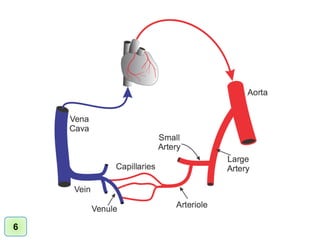
5
6
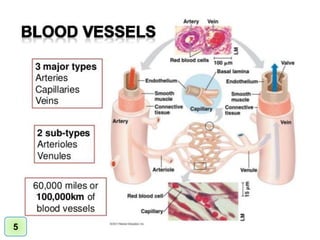
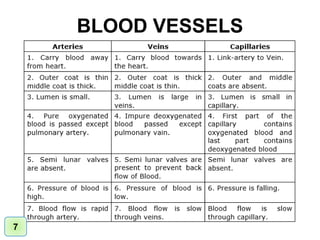
BLOOD VESSELS
7
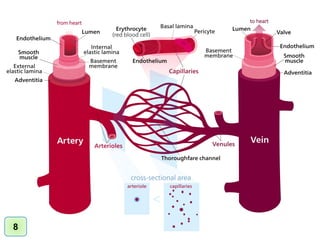
8
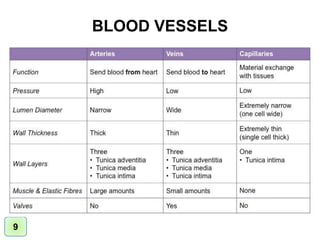
BLOOD VESSELS
9
VENOUS BLOOD
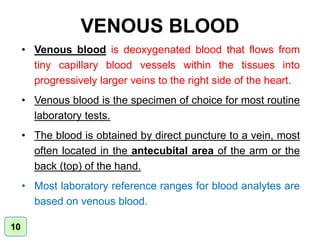
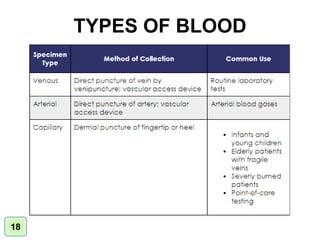
• Venous blood is deoxygenated blood that flows from
tiny capillary blood vessels within the tissues into
progressively larger veins to the right side of the heart.
• Venous blood is the specimen of choice for most routine
laboratory tests.
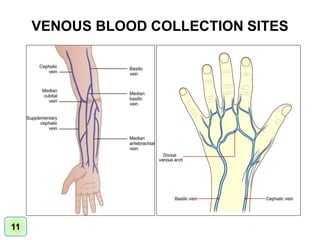
• The blood is obtained by direct puncture to a vein, most
often located in the antecubital area of the arm or the
back (top) of the hand.
• Most laboratory reference ranges for blood analytes are
based on venous blood.
10
VENOUS BLOOD COLLECTION SITES
11
ARTERIAL BLOOD
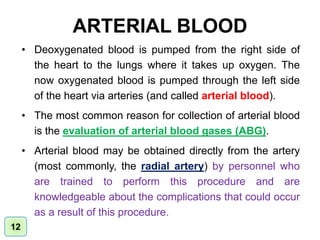
• Deoxygenated blood is pumped from the right side of
the heart to the lungs where it takes up oxygen. The
now oxygenated blood is pumped through the left side
of the heart via arteries (and called arterial blood).
• The most common reason for collection of arterial blood
is the evaluation of arterial blood gases (ABG).
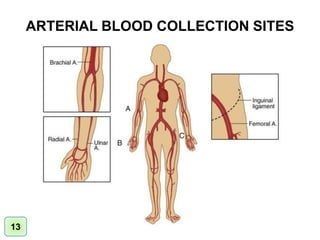
• Arterial blood may be obtained directly from the artery
(most commonly, the radial artery) by personnel who
are trained to perform this procedure and are
knowledgeable about the complications that could occur
as a result of this procedure.
12
ARTERIAL BLOOD COLLECTION SITES
13
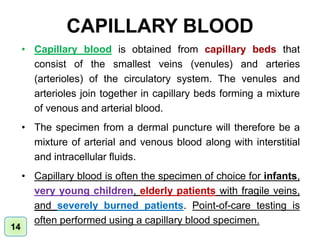
CAPILLARY BLOOD
• Capillary blood is obtained from capillary beds that
consist of the smallest veins (venules) and arteries
(arterioles) of the circulatory system. The venules and
arterioles join together in capillary beds forming a mixture
of venous and arterial blood.
• The specimen from a dermal puncture will therefore be a
mixture of arterial and venous blood along with interstitial
and intracellular fluids.
• Capillary blood is often the specimen of choice for infants,
very young children, elderly patients with fragile veins,
and severely burned patients. Point-of-care testing is
often performed using a capillary blood specimen.
14
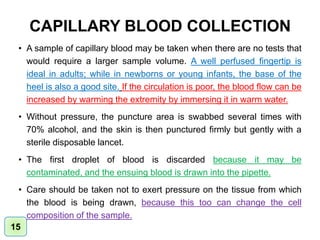
CAPILLARY BLOOD COLLECTION
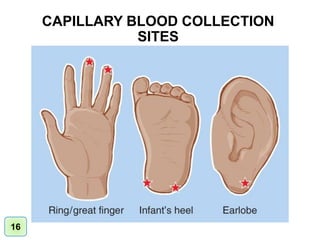
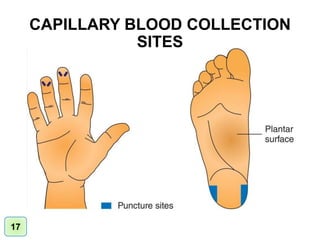
• A sample of capillary blood may be taken when there are no tests that
would require a larger sample volume. A well perfused fingertip is
ideal in adults; while in newborns or young infants, the base of the
heel is also a good site. If the circulation is poor, the blood flow can be
increased by warming the extremity by immersing it in warm water.
• Without pressure, the puncture area is swabbed several times with
70% alcohol, and the skin is then punctured firmly but gently with a
sterile disposable lancet.
• The first droplet of blood is discarded because it may be
contaminated, and the ensuing blood is drawn into the pipette.
• Care should be taken not to exert pressure on the tissue from which
the blood is being drawn, because this too can change the cell
composition of the sample.
15
CAPILLARY BLOOD COLLECTION
SITES
16
CAPILLARY BLOOD COLLECTION
SITES
17
TYPES OF BLOOD
18
VENOUS BLOOD
• It is the collection of blood from different superficial veins
by using a syringe when large volumes of blood are
required.
Site of Blood Collection:
• In adults: there are many sites to collect blood from, but
the most use is those of the cubital area [median cubital
vein], jugular, radial, saphenous, femoral, metacarpal
veins etc.
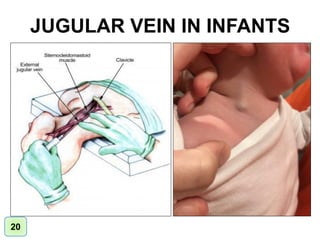
• In infants: it is better to use the veins that are away of
his vision and easy controlled sites [jugular].
19
JUGULAR VEIN IN INFANTS
20
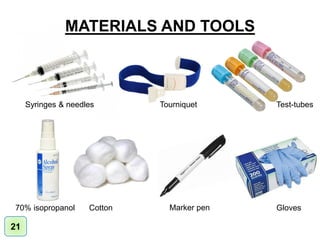
MATERIALS AND TOOLS
Syringes & needles
21
Tourniquet Test-tubes
70% isopropanol Cotton GlovesMarker pen
VENOUS BLOOD COLLECTION
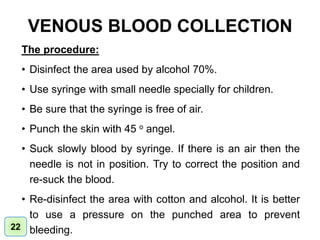
The procedure:
• Disinfect the area used by alcohol 70%.
• Use syringe with small needle specially for children.
• Be sure that the syringe is free of air.
• Punch the skin with 45 o angel.
• Suck slowly blood by syringe. If there is an air then the
needle is not in position. Try to correct the position and
re-suck the blood.
• Re-disinfect the area with cotton and alcohol. It is better
to use a pressure on the punched area to prevent
bleeding.22
23
RISK OF VENOUS BLOOD COLLECTION
• There is very little risk involved with having your blood taken.
Veins and arteries vary in size from one patient to another and
from one side of the body to the other.
• Taking blood from some people may be more difficult than
from others.
Other risks associated with having blood drawn are slight
but may include:
• Excessive bleeding
• Fainting or feeling light-headed
• Hematoma (blood accumulating under the skin)
• Infection (a slight risk any time the skin is broken)
PLASMA AND SERUM
• Blood plasma is a complex mixture of proteins,
enzymes, nutrients, wastes, hormones, and gases.
• If we allow blood to clot and then remove the solids, we
are left with a fluid called the blood serum, which is
essentially identical to plasma except for the absence of
clotting proteins.
24
ANTICOAGULANTS
• Most blood collection tubes contain an additive that
either accelerates clotting of the blood (clot activator) or
prevents the blood from clotting (anticoagulant).
• A tube that contains a clot activator (gel tubes) will
produce a serum sample when the blood is separated by
centrifugation and a tube that contains an anticoagulant
will produce a plasma sample after centrifugation.
• Some tests require the use of serum, some require
plasma, and other tests require anticoagulated whole
blood.
25
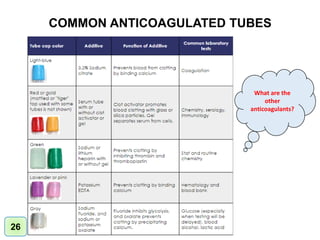
COMMON ANTICOAGULATED TUBES
26
What are the
other
anticoagulants?
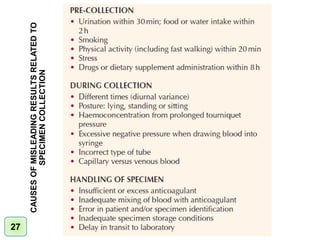
CAUSESOFMISLEADINGRESULTSRELATEDTO
SPECIMENCOLLECTION
27
POST-TEST
• What are the precaution you must consider when
you deal with blood?
• How you collect capillary blood sample in infants?
• Which site is ideal for collection of capillary blood in
adult?
• Which perfect site is ideal in collection of venous
blood in adult?
• How you prepare the site of blood collection?
• Why the first droplet of fingered blood is discarded?
• What is the top’s color of heparin contained test-
tube?
28

Blood sample collection

  • 1.
    BLOOD COLLECTION Hussein A.Abid Laboratory Medicine Specialist, Qualified Instructor Member at American Society for Microbiology (ASM), American Association of Biochemistry and Molecular Biology (AABM), and President of Iraqi Medical Laboratory Association (IMLA) Ministry of High Education & Scientific Research Middle Technical University Technical Institute of Baquba Medical Laboratory Technology Dept. Lab: 02 ‫العملي‬ ‫الدم‬ ‫أمراض‬/‫الثانية‬ ‫المرحلة‬–‫صباحي‬ ‫الثانية‬ ‫المحاضرة‬
  • 2.
    TESTS IN HAEMATOLOGY •Blood tests are performed as part of a physical examination because they provide a significant amount of information about the health of a patient. • In performing these test, care must be taken to avoid: 1. Self infection from environmental contaminations. 2. Transmission of blood borne infections (such as AIDS, hepatitis …etc.) from one person to other. 2
  • 3.
    PRECAUTIONS 1. Wear yourLab coat when you enter the Lab. 2. Wash your tabletop at the beginning of laboratory period with a suitable disinfectant. 3. Wash your hands with soap & water before and after doing the blood tests. 4. Avoid contact with blood of other students, by wearing protective disposable gloves. 5. Before piercing to collect blood, disinfect the skin with 70% alcohol. 6. Use disposable lancets or syringe for collecting blood. After using the lancets or syringe, deposit them immediately into disinfectant container. Never through them in waste basket or the floor. 3
  • 4.
    PRECAUTIONS 7. Disposable microscopeslides, glassware, paper towels, alcohol wipes, and similar items that may have been in contact with blood are to be placed immediately in the biohazard bag for autoclaving and disposal. 8. At the end of the experiment, wash the tabletop and equipment with a suitable disinfectant. Wash your hands with soap and water and then rinse them with a disinfectant. 4
  • 5.
  • 6.
  • 7.
  • 8.
  • 9.
  • 10.
    VENOUS BLOOD • Venousblood is deoxygenated blood that flows from tiny capillary blood vessels within the tissues into progressively larger veins to the right side of the heart. • Venous blood is the specimen of choice for most routine laboratory tests. • The blood is obtained by direct puncture to a vein, most often located in the antecubital area of the arm or the back (top) of the hand. • Most laboratory reference ranges for blood analytes are based on venous blood. 10
  • 11.
  • 12.
    ARTERIAL BLOOD • Deoxygenatedblood is pumped from the right side of the heart to the lungs where it takes up oxygen. The now oxygenated blood is pumped through the left side of the heart via arteries (and called arterial blood). • The most common reason for collection of arterial blood is the evaluation of arterial blood gases (ABG). • Arterial blood may be obtained directly from the artery (most commonly, the radial artery) by personnel who are trained to perform this procedure and are knowledgeable about the complications that could occur as a result of this procedure. 12
  • 13.
  • 14.
    CAPILLARY BLOOD • Capillaryblood is obtained from capillary beds that consist of the smallest veins (venules) and arteries (arterioles) of the circulatory system. The venules and arterioles join together in capillary beds forming a mixture of venous and arterial blood. • The specimen from a dermal puncture will therefore be a mixture of arterial and venous blood along with interstitial and intracellular fluids. • Capillary blood is often the specimen of choice for infants, very young children, elderly patients with fragile veins, and severely burned patients. Point-of-care testing is often performed using a capillary blood specimen. 14
  • 15.
    CAPILLARY BLOOD COLLECTION •A sample of capillary blood may be taken when there are no tests that would require a larger sample volume. A well perfused fingertip is ideal in adults; while in newborns or young infants, the base of the heel is also a good site. If the circulation is poor, the blood flow can be increased by warming the extremity by immersing it in warm water. • Without pressure, the puncture area is swabbed several times with 70% alcohol, and the skin is then punctured firmly but gently with a sterile disposable lancet. • The first droplet of blood is discarded because it may be contaminated, and the ensuing blood is drawn into the pipette. • Care should be taken not to exert pressure on the tissue from which the blood is being drawn, because this too can change the cell composition of the sample. 15
  • 16.
  • 17.
  • 18.
  • 19.
    VENOUS BLOOD • Itis the collection of blood from different superficial veins by using a syringe when large volumes of blood are required. Site of Blood Collection: • In adults: there are many sites to collect blood from, but the most use is those of the cubital area [median cubital vein], jugular, radial, saphenous, femoral, metacarpal veins etc. • In infants: it is better to use the veins that are away of his vision and easy controlled sites [jugular]. 19
  • 20.
    JUGULAR VEIN ININFANTS 20
  • 21.
    MATERIALS AND TOOLS Syringes& needles 21 Tourniquet Test-tubes 70% isopropanol Cotton GlovesMarker pen
  • 22.
    VENOUS BLOOD COLLECTION Theprocedure: • Disinfect the area used by alcohol 70%. • Use syringe with small needle specially for children. • Be sure that the syringe is free of air. • Punch the skin with 45 o angel. • Suck slowly blood by syringe. If there is an air then the needle is not in position. Try to correct the position and re-suck the blood. • Re-disinfect the area with cotton and alcohol. It is better to use a pressure on the punched area to prevent bleeding.22
  • 23.
    23 RISK OF VENOUSBLOOD COLLECTION • There is very little risk involved with having your blood taken. Veins and arteries vary in size from one patient to another and from one side of the body to the other. • Taking blood from some people may be more difficult than from others. Other risks associated with having blood drawn are slight but may include: • Excessive bleeding • Fainting or feeling light-headed • Hematoma (blood accumulating under the skin) • Infection (a slight risk any time the skin is broken)
  • 24.
    PLASMA AND SERUM •Blood plasma is a complex mixture of proteins, enzymes, nutrients, wastes, hormones, and gases. • If we allow blood to clot and then remove the solids, we are left with a fluid called the blood serum, which is essentially identical to plasma except for the absence of clotting proteins. 24
  • 25.
    ANTICOAGULANTS • Most bloodcollection tubes contain an additive that either accelerates clotting of the blood (clot activator) or prevents the blood from clotting (anticoagulant). • A tube that contains a clot activator (gel tubes) will produce a serum sample when the blood is separated by centrifugation and a tube that contains an anticoagulant will produce a plasma sample after centrifugation. • Some tests require the use of serum, some require plasma, and other tests require anticoagulated whole blood. 25
  • 26.
    COMMON ANTICOAGULATED TUBES 26 Whatare the other anticoagulants?
  • 27.
  • 28.
    POST-TEST • What arethe precaution you must consider when you deal with blood? • How you collect capillary blood sample in infants? • Which site is ideal for collection of capillary blood in adult? • Which perfect site is ideal in collection of venous blood in adult? • How you prepare the site of blood collection? • Why the first droplet of fingered blood is discarded? • What is the top’s color of heparin contained test- tube? 28