

PREPARED BY
DR.SHALI B.S
PROFESSOR
MAMATA COLLEGE OF
NURSING.KHAMMAM
 Mechanical ventilation may be required for a variety of
respirations during surgery or during treatment of severe
head injury, to oxygenate the blood when patient’s
ventilator efforts are inadequate.
 Nurses, physicians and respiratory therapists must
understand each patients specific pulmonary needs and
work together to set realistic goals
 Positive patient outcomes depend on an understanding
of the principles of mechanical ventilation and the
patients care needs as well as open communication
among members of the health care team about the goals
of therapy, weaning plans and the patient tolerance of
changes in ventilator settings.
 The mechanical ventilator is meant to
maintain ventilation automatically for
prolonged periods. It is indicated
when the patient is unable to
maintain safe levels of oxygen or
CO2 by spontaneous breathing even
with the assistance of other oxygen
delivery devices.
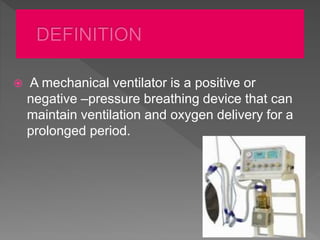
 A mechanical ventilator is a positive or
negative –pressure breathing device that can
maintain ventilation and oxygen delivery for a
prolonged period.
Negative Pressure Ventilators
 Applies negative pressure around
the chest wall. This causes intra-
airway pressure to become
negative, thus drawing air into the
lungs through the patient's nose and
mouth.
• No artificial airway is necessary;
Indicated for selected patients
with respiratory neuromuscular
problems.
During mechanical inspiration, air is
actively delivered to the patient's lungs under
positive pressure. Exhalation is passive.
Requires use of a cuffed artificial airway
Pressure limited
Time cycled ventilators
Time cycled ventilators terminate or control
inspiration after a preset time.
Most ventilators are a rate control that
determines the respiratory rate, but pure time
cycled is rarely used for adults. These
ventilators are used in newborns and infants.
 Mechanical Failure of Ventilation
• Neuromuscular disease
• Central nervous system (CNS) disease
• CNS depression (drug intoxication, respiratory depressants, cardiac arrest)
• Musculoskeletal disease
• Inefficiency of thoracic cage in generating pressure gradients necessary for
ventilation (chest injury, thoracic malformation)
Disorders of Pulmonary Gas Exchange
• Acute respiratory failure
• Chronic respiratory failure
• Left ventricular failure
• Pulmonary diseases resulting in diffusion abnormality
• Pulmonary diseases resulting in ventilation-perfusion mismatch.
• Inhalation injury multisystem failure and coma all may lead to respiratory
failure.
Variables that control ventilation and oxygenation include:
› Ventilator rate adjusted by rate setting
› Tidal volume (VT) adjusted by tidal volume setting; measured as
inhaled volume.
› Fraction inspired oxygen concentration (FIO2) set on ventilator
or with an oxygen blender; measured with an oxygen analyzer.
› Ventilator dead space circuitry (tubing) common to inhalation
and exhalation; tubing is calibrated.
› PEEP set within the ventilator or with the use of external PEEP
devices; measured at the proximal airway.
CO2 elimination is controlled by VT, rate, and dead space.
Oxygen tension is controlled by oxygen concentration and PEEP
(also by rate and VT).
 Controlled Ventilation
 Cycles automatically at rate selected by
operator.
 Provides a fixed level of ventilation, but will not
cycle or have gas available in circuitry to
respond to patient's own inspiratory efforts. This
typically increases work of breathing for patients
attempting to breathe spontaneously.
 Possibly indicated for patients whose
respiratory drive is absent
 Cycles automatically at rate selected by
operator.
 Provides a fixed level of ventilation, but will
not cycle or have gas available in circuitry to
respond to patient's own inspiratory efforts.
This typically increases work of breathing for
patients attempting to breathe
spontaneously.
 Possibly indicated for patients whose
respiratory drive is absent
 Intermittent Mandatory Ventilation
 Allows patient to breathe spontaneously
through ventilator circuitry.
 Periodically, at preselected rate and volume
or pressure, cycles to give a mandated
ventilator breath. A minimum level of
ventilation is provided.
 Indicated for patients who are breathing
spontaneously, but at a tidal volume and/or
rate less than adequate for their needs.
 Allows the patient to do some of the work of
breathing.
 Synchronized Intermittent Mandatory
Ventilation(SIMV)
 Allows patient to breathe spontaneously
through the ventilator circuitry.
 Periodically, at a preselected time, a
mandatory breath is delivered. The patient
may initiate the mandatory breath with own
inspiratory effort,
 The ventilator breath will be synchronized
with the patient's efforts, or will be assisted
 Pressure Support(ps)
 A positive pressure is set.
 During spontaneous inspiration, ventilator
circuitry is rapidly pressurized to the
predetermined pressure and held at this
pressure.
 When the inspiratory flow rate decreases to
a preset minimal level (20% to 25% of peak
inspiratory flow), the positive pressure
returns to baseline and the patient may
exhale.
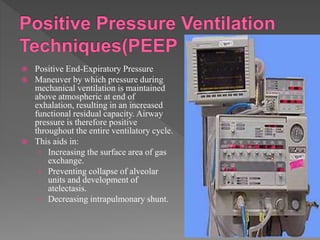
 Positive End-Expiratory Pressure
 Maneuver by which pressure during
mechanical ventilation is maintained
above atmospheric at end of
exhalation, resulting in an increased
functional residual capacity. Airway
pressure is therefore positive
throughout the entire ventilatory cycle.
 This aids in:
› Increasing the surface area of gas
exchange.
› Preventing collapse of alveolar
units and development of
atelectasis.
› Decreasing intrapulmonary shunt.
 Continuous Positive Airway Pressure(CPAP)
 Also provides for positive airway pressure
during all parts of a respiratory cycle, but refers
to spontaneous ventilation rather than
mechanical ventilation.
 May be delivered through ventilator circuitry
when ventilator rate is at or may be delivered
through a separate continuous positive airway
pressure (CPAP) circuitry that does not require
the ventilator.
 Indicated for patients who are capable of
maintaining an adequate tidal volume, but who
have pathology preventing maintenance of
adequate levels of tissue oxygenation or for
sleep apnea.
Newer Modes of Ventilation
 Inverse Ratio Ventilation
 Non invasive Positive Pressure Ventilation
 High-Frequency Ventilation.
 Obtain baseline samples for blood gas
determinations (pH, PaO2, Paco2, HCO3
-) and chest
X-ray.
 Give a brief explanation to the patient.
 Establish the airway by means of a cuffed
endotracheal or tracheostomy tube .
-
>
->
Set up desired circuitry.
Connect oxygen and compressed air source.
Turn on power.
Set tidal volume (usually 5-7 mL/kg body weight) or peak
pressure.
.
Set oxygen concentration.
.
Set ventilator sensitivity.
Set rate at 12-14 breaths/minute (variable).

 Adjust flow rate (velocity of gas flow during
inspiration). Usually set at 40-60 L/minute.
Depends on rate and tidal volume. Set to
avoid inverse inspiratory:expiratory (I:E)
ratio. Usual I:E ratio is 1:2.
 Select mode of ventilation.
 Check machine function measure tidal
volume, rate, I:E ratio, analyze oxygen,
check all alarms.
 Couple the patient's airway to the ventilator.
 Assess patient for adequate chest
movement and rate. Note peak airway
pressure and PEEP. Adjust gas flow if
necessary to provide safe I:E ratio.
 Set airway pressure alarms according to
patient's baseline:
 High pressure alarm
 Low pressure alarm
 Assess frequently for change in respiratory
status by way of ABGs, pulse oximetry,
spontaneous rate, use of accessory
muscles, breath sounds, and vital signs.
 Monitor and troubleshoot alarm conditions.
Ensure appropriate ventilation at all times.
 Turn patient from side to side every 2 hours, or
more frequently if possible.
 Lateral turns are desirable; from right semiprone to
left semiprone.
 Set the patient upright at regular intervals if
possible.
 Consider prone positioning to improve oxygenation.
› When secretions can be seen or sounds resulting from
secretions are heard with or without the use of a
stethoscope
› After chest physiotherapy
› After bronchodilator treatments
 After a sudden rise or the popping of the peak airway pressure
in mechanically ventilated patients
 Provide regular oral care to prevent ventilator-associated
pneumonia. Provide humidity and repositioning to mobilize
secretions.
› Assist with the weaning process, when indicated
› Patient must have acceptable abg values,
 Monitor very closely for change in pulse and blood pressure,
anxiety, and increased rate of respirations
 check the water level in the humidification reservoir
to ensure that the patient is never ventilated with
dry gas.
 Empty the water that condenses in the delivery and
exhalation tubing into a separate receptacle, not
into the humidifier. always wash hands after
emptying fluid from ventilator circuitry.
 Assess airway pressures at frequent intervals.
 Measure delivered tidal volume and analyze oxygen
concentration every 4 hours or more frequently if
indicated.
 Monitor pulse rate and arterial blood
pressure; intra-arterial pressure
monitoring may be carried out.
 Use pulmonary artery catheter to
monitor pulmonary capillary wedge
pressure (PCWP), mixed venous oxygen
saturation (SvO2), and cardiac output
(CO).
Monitor for pulmonary infection.
Evaluate need for sedation or
muscle relaxants
Report intake and output precisely
and obtain an accurate daily weight
to monitor fluid balance.
Test all stools and gastric
drainage for occult blood.
Measure abdominal girth daily.
Monitor nutritional status
Provide for care and
communication needs of
patient with an artificial
airway.
Provide psychological
support.
› Airway obstruction (thickened secretions,
mechanical problem with artificial airway or
ventilator circuitry)
› Tracheal damage
› Pulmonary infection
› Decreased cardiac output
› Atelectasis
› Alteration in GI function (dilation, bleeding)
› Alteration in renal function
› Alteration in cognitive-perceptual status
› Respiratory acidosis or alkalosis
 Maintain a flow sheet to record
ventilation patterns, abgs, venous
chemical determinations.
 Hemoglobin and hematocrit.
 Status of fluid balance, weight, and
assessment of the patient's condition.
Change ventilator circuitry every 24
hours.
Asses ventilator function every 4
hours or more frequently if problem
occurs.
• Caring for a patient on mechanical ventilation has
become an integral part of nursing care in critical
care or general medical-surgical units, extended
care facilities, and the home.
• Nurses, physicians, and respiratory therapists
must understand each patient’s specific
pulmonary needs and work together to set
realistic goals.
Mechanical ventilation

Mechanical ventilation

  • 1.
  • 2.
     Mechanical ventilationmay be required for a variety of respirations during surgery or during treatment of severe head injury, to oxygenate the blood when patient’s ventilator efforts are inadequate.  Nurses, physicians and respiratory therapists must understand each patients specific pulmonary needs and work together to set realistic goals  Positive patient outcomes depend on an understanding of the principles of mechanical ventilation and the patients care needs as well as open communication among members of the health care team about the goals of therapy, weaning plans and the patient tolerance of changes in ventilator settings.
  • 3.
     The mechanicalventilator is meant to maintain ventilation automatically for prolonged periods. It is indicated when the patient is unable to maintain safe levels of oxygen or CO2 by spontaneous breathing even with the assistance of other oxygen delivery devices.
  • 4.
     A mechanicalventilator is a positive or negative –pressure breathing device that can maintain ventilation and oxygen delivery for a prolonged period.
  • 5.
    Negative Pressure Ventilators Applies negative pressure around the chest wall. This causes intra- airway pressure to become negative, thus drawing air into the lungs through the patient's nose and mouth. • No artificial airway is necessary; Indicated for selected patients with respiratory neuromuscular problems.
  • 6.
    During mechanical inspiration,air is actively delivered to the patient's lungs under positive pressure. Exhalation is passive. Requires use of a cuffed artificial airway Pressure limited Time cycled ventilators Time cycled ventilators terminate or control inspiration after a preset time. Most ventilators are a rate control that determines the respiratory rate, but pure time cycled is rarely used for adults. These ventilators are used in newborns and infants.
  • 8.
     Mechanical Failureof Ventilation • Neuromuscular disease • Central nervous system (CNS) disease • CNS depression (drug intoxication, respiratory depressants, cardiac arrest) • Musculoskeletal disease • Inefficiency of thoracic cage in generating pressure gradients necessary for ventilation (chest injury, thoracic malformation) Disorders of Pulmonary Gas Exchange • Acute respiratory failure • Chronic respiratory failure • Left ventricular failure • Pulmonary diseases resulting in diffusion abnormality • Pulmonary diseases resulting in ventilation-perfusion mismatch. • Inhalation injury multisystem failure and coma all may lead to respiratory failure.
  • 9.
    Variables that controlventilation and oxygenation include: › Ventilator rate adjusted by rate setting › Tidal volume (VT) adjusted by tidal volume setting; measured as inhaled volume. › Fraction inspired oxygen concentration (FIO2) set on ventilator or with an oxygen blender; measured with an oxygen analyzer. › Ventilator dead space circuitry (tubing) common to inhalation and exhalation; tubing is calibrated. › PEEP set within the ventilator or with the use of external PEEP devices; measured at the proximal airway. CO2 elimination is controlled by VT, rate, and dead space. Oxygen tension is controlled by oxygen concentration and PEEP (also by rate and VT).
  • 10.
     Controlled Ventilation Cycles automatically at rate selected by operator.  Provides a fixed level of ventilation, but will not cycle or have gas available in circuitry to respond to patient's own inspiratory efforts. This typically increases work of breathing for patients attempting to breathe spontaneously.  Possibly indicated for patients whose respiratory drive is absent
  • 11.
     Cycles automaticallyat rate selected by operator.  Provides a fixed level of ventilation, but will not cycle or have gas available in circuitry to respond to patient's own inspiratory efforts. This typically increases work of breathing for patients attempting to breathe spontaneously.  Possibly indicated for patients whose respiratory drive is absent
  • 12.
     Intermittent MandatoryVentilation  Allows patient to breathe spontaneously through ventilator circuitry.  Periodically, at preselected rate and volume or pressure, cycles to give a mandated ventilator breath. A minimum level of ventilation is provided.  Indicated for patients who are breathing spontaneously, but at a tidal volume and/or rate less than adequate for their needs.  Allows the patient to do some of the work of breathing.
  • 13.
     Synchronized IntermittentMandatory Ventilation(SIMV)  Allows patient to breathe spontaneously through the ventilator circuitry.  Periodically, at a preselected time, a mandatory breath is delivered. The patient may initiate the mandatory breath with own inspiratory effort,  The ventilator breath will be synchronized with the patient's efforts, or will be assisted
  • 14.
     Pressure Support(ps) A positive pressure is set.  During spontaneous inspiration, ventilator circuitry is rapidly pressurized to the predetermined pressure and held at this pressure.  When the inspiratory flow rate decreases to a preset minimal level (20% to 25% of peak inspiratory flow), the positive pressure returns to baseline and the patient may exhale.
  • 15.
     Positive End-ExpiratoryPressure  Maneuver by which pressure during mechanical ventilation is maintained above atmospheric at end of exhalation, resulting in an increased functional residual capacity. Airway pressure is therefore positive throughout the entire ventilatory cycle.  This aids in: › Increasing the surface area of gas exchange. › Preventing collapse of alveolar units and development of atelectasis. › Decreasing intrapulmonary shunt.
  • 16.
     Continuous PositiveAirway Pressure(CPAP)  Also provides for positive airway pressure during all parts of a respiratory cycle, but refers to spontaneous ventilation rather than mechanical ventilation.  May be delivered through ventilator circuitry when ventilator rate is at or may be delivered through a separate continuous positive airway pressure (CPAP) circuitry that does not require the ventilator.  Indicated for patients who are capable of maintaining an adequate tidal volume, but who have pathology preventing maintenance of adequate levels of tissue oxygenation or for sleep apnea.
  • 17.
    Newer Modes ofVentilation  Inverse Ratio Ventilation  Non invasive Positive Pressure Ventilation  High-Frequency Ventilation.
  • 19.
     Obtain baselinesamples for blood gas determinations (pH, PaO2, Paco2, HCO3 -) and chest X-ray.  Give a brief explanation to the patient.  Establish the airway by means of a cuffed endotracheal or tracheostomy tube . - >
  • 20.
    -> Set up desiredcircuitry. Connect oxygen and compressed air source. Turn on power. Set tidal volume (usually 5-7 mL/kg body weight) or peak pressure. . Set oxygen concentration. . Set ventilator sensitivity. Set rate at 12-14 breaths/minute (variable). 
  • 21.
     Adjust flowrate (velocity of gas flow during inspiration). Usually set at 40-60 L/minute. Depends on rate and tidal volume. Set to avoid inverse inspiratory:expiratory (I:E) ratio. Usual I:E ratio is 1:2.  Select mode of ventilation.  Check machine function measure tidal volume, rate, I:E ratio, analyze oxygen, check all alarms.
  • 22.
     Couple thepatient's airway to the ventilator.  Assess patient for adequate chest movement and rate. Note peak airway pressure and PEEP. Adjust gas flow if necessary to provide safe I:E ratio.
  • 23.
     Set airwaypressure alarms according to patient's baseline:  High pressure alarm  Low pressure alarm
  • 24.
     Assess frequentlyfor change in respiratory status by way of ABGs, pulse oximetry, spontaneous rate, use of accessory muscles, breath sounds, and vital signs.  Monitor and troubleshoot alarm conditions. Ensure appropriate ventilation at all times.
  • 25.
     Turn patientfrom side to side every 2 hours, or more frequently if possible.  Lateral turns are desirable; from right semiprone to left semiprone.  Set the patient upright at regular intervals if possible.  Consider prone positioning to improve oxygenation.
  • 26.
    › When secretionscan be seen or sounds resulting from secretions are heard with or without the use of a stethoscope › After chest physiotherapy › After bronchodilator treatments  After a sudden rise or the popping of the peak airway pressure in mechanically ventilated patients  Provide regular oral care to prevent ventilator-associated pneumonia. Provide humidity and repositioning to mobilize secretions. › Assist with the weaning process, when indicated › Patient must have acceptable abg values,  Monitor very closely for change in pulse and blood pressure, anxiety, and increased rate of respirations
  • 27.
     check thewater level in the humidification reservoir to ensure that the patient is never ventilated with dry gas.  Empty the water that condenses in the delivery and exhalation tubing into a separate receptacle, not into the humidifier. always wash hands after emptying fluid from ventilator circuitry.  Assess airway pressures at frequent intervals.  Measure delivered tidal volume and analyze oxygen concentration every 4 hours or more frequently if indicated.
  • 28.
     Monitor pulserate and arterial blood pressure; intra-arterial pressure monitoring may be carried out.  Use pulmonary artery catheter to monitor pulmonary capillary wedge pressure (PCWP), mixed venous oxygen saturation (SvO2), and cardiac output (CO).
  • 29.
    Monitor for pulmonaryinfection. Evaluate need for sedation or muscle relaxants Report intake and output precisely and obtain an accurate daily weight to monitor fluid balance.
  • 30.
    Test all stoolsand gastric drainage for occult blood. Measure abdominal girth daily. Monitor nutritional status
  • 31.
    Provide for careand communication needs of patient with an artificial airway. Provide psychological support.
  • 32.
    › Airway obstruction(thickened secretions, mechanical problem with artificial airway or ventilator circuitry) › Tracheal damage › Pulmonary infection › Decreased cardiac output › Atelectasis › Alteration in GI function (dilation, bleeding) › Alteration in renal function › Alteration in cognitive-perceptual status › Respiratory acidosis or alkalosis
  • 34.
     Maintain aflow sheet to record ventilation patterns, abgs, venous chemical determinations.  Hemoglobin and hematocrit.  Status of fluid balance, weight, and assessment of the patient's condition.
  • 35.
    Change ventilator circuitryevery 24 hours. Asses ventilator function every 4 hours or more frequently if problem occurs.
  • 37.
    • Caring fora patient on mechanical ventilation has become an integral part of nursing care in critical care or general medical-surgical units, extended care facilities, and the home. • Nurses, physicians, and respiratory therapists must understand each patient’s specific pulmonary needs and work together to set realistic goals.