Basic Modes of
Mechanical Ventilation
Moderator : Dr. Vishal
PRESENTED BY : Dr. Kumar Abhinav
Dr. Anjali Sharma
INTRODUCTION
Ventilators:
are machines that generates a controlled flow
of gas into a patient’s airways,
Function:
they provide Supportive role to buy time to the
patient.
•Mechanical ventilation forms a mainstay of
critical care in patients with respiratory
insufficiency.
•Ventilator must generate inspiratory flow to
deliver tidal volume.
•Transairway pressure (PTA) = PAO – PALV
•PTA = 0, at the end of expiration and beginning
of inspiration.
•Mechanical ventilator produce either negative
or positive pressure gradient.
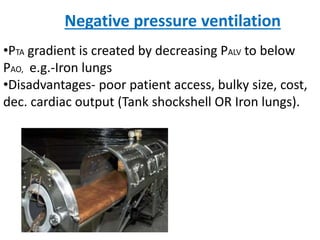
Negative pressure ventilation
•PTA gradient is created by decreasing PALV to below
PAO, e.g.-Iron lungs
•Disadvantages- poor patient access, bulky size, cost,
dec. cardiac output (Tank shockshell OR Iron lungs).
Positive pressure ventilation
•Achieved by applying positive pressure at
airway opening which produces PTA gradient that
generates inspiratory flow.
•Inspiratory flow results in the delivery of tidal
volume.
Parts of a Ventilator
1. Compressor
2. Control panel
3. Humidifier
i. Simple humidifier
ii. Servo-controlled humidifier with heated wire in
the tubings
4. Breathing circuit
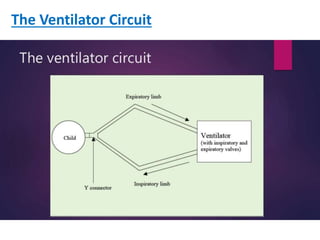
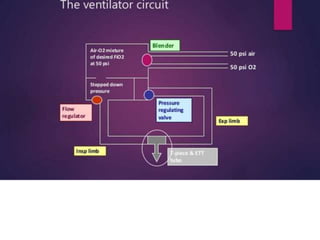
The Ventilator Circuit
Ventilatory Phases
• Inspiration: Inspiratory valve opens and
expiratory valve is closed
• Inspiratory pause: inspiratory valve and
expiratory valve closed
• Expiration: Inspiratory valve closed and
expiratory valve open
• Expiratory pause: Inspiratory valve and
expiratory (or PEEP) valve closed at end of
expiration
INDICATIONS OF MECHANICAL VENTILATION
Indications are mainly clinical although
objective lab parameters such as ABG can also
be used to decide it:-
Common indications include:
1. Respiratory Failure
a. Apnea/Respiratory Arrest
b. Inadequate ventilation
c. Inadequate oxygenation
d. Chronic respiratory insufficiency with failure
to thrive.
2. Cardiac Insufficiency/Shock
a. Eliminate work of breathing
b. Reduce oxygen consumption.
3. Neurologic dysfunction
a. Central hypoventilation/frequent apnea
b. Patient comatose, GCS (Glasgow Coma Score)
< 8
c. Inability to protect airway.
Basic Ventilator Parameters
•Tidal volume
•FiO2
• Frequency
• PIP
• PEEP
• Inspiratory Time
• Expiratory time
• I:E Ratio
•Mode
Tidal volume:- tidal volume of 6 to 8 ml/kg can be set,
or a particular flow rate and minute ventilation can be
set to get a particular tidal volume. If the difference
between inspired and expired TV >15% then circuit
leak is suspected.
FiO2:- Oxygenation can be improved either by
increasing the inspired oxygen concentration (FiO2) or
by different ventilator settings.
1. Increasing peak inspiratory pressure (PIP)
2. Increasing inspiratory/expiratory ratio
3. Applying a positive pressure before the end of
expiration (PEEP).
Frequency:- Respiratory rate, together with
tidal volume, determines the minute
ventilation.
High ventilator rates employ a lower tidal
volume and therefore lower inspiratory
pressures (PIP) are used to prevent barotrauma.
PIP:- major factor in determining tidal volume .
It is adjusted to produce adequate chest
expansion and breath sounds. Can improve
both oxygenation and ventilation.
Factors evaluated in determining PIP:- are the
I. infant’s weight,
II. gestational age (the degree of maturity),
III. the type and severity of the disease and
IV. lung mechanics - such as lung compliance
and airway resistance.
Positive End Expiratory Pressure
(PEEP)
•It increases the end expiratory or baseline
airway pressure greater than atmospheric
pressure.
•Used to treat refractory hypoxemia caused by
intrapulmonary shunting.
•It can be used in conjugation with other
modes.
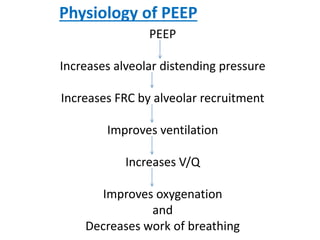
Physiology of PEEP
PEEP
Increases alveolar distending pressure
Increases FRC by alveolar recruitment
Improves ventilation
Increases V/Q
Improves oxygenation
and
Decreases work of breathing
Indications-
•Refractory hypoxemia d/t intrapulmonary
shunting.
•Decreased FRC and lung compliance
Complications
•Dec. venous return and cardiac output.
Barotrauma
•Increase ICP d/t impedance of venous return
from head.
•Alteration of renal function & water imbalance.
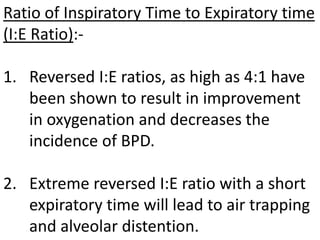
Ratio of Inspiratory Time to Expiratory time
(I:E Ratio):-
1. Reversed I:E ratios, as high as 4:1 have
been shown to result in improvement
in oxygenation and decreases the
incidence of BPD.
2. Extreme reversed I:E ratio with a short
expiratory time will lead to air trapping
and alveolar distention.
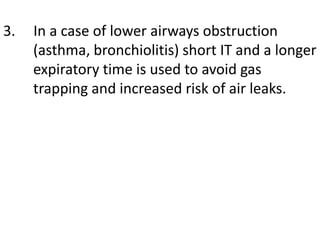
3. In a case of lower airways obstruction
(asthma, bronchiolitis) short IT and a longer
expiratory time is used to avoid gas
trapping and increased risk of air leaks.
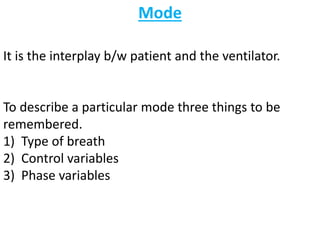
Mode
It is the interplay b/w patient and the ventilator.
To describe a particular mode three things to be
remembered.
1) Type of breath
2) Control variables
3) Phase variables
Phase variables
• Trigger : ventilator (time)- triggered or patient
(pressure or flow) triggered
• Limit: flow-limited or pressure-limited
• Cycling: volume, time, flow or pressure cycled
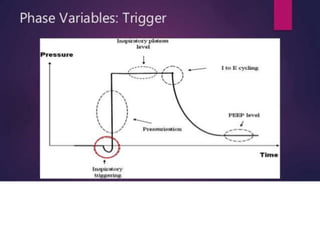
Phase variables: Trigger
•What causes the breath to begin (signal to open the
inspiratory valve)
i. Machine (controlled): -the ventilator will trigger
regular breaths at a frequency which will depend
on the set respiratory rate, ie, they will be
ventilator time triggered.
ii. Patient (assisted):- If the patient does make an
effort to breathe and the ventilator can sense it
(by either sensing a negative inspiratory pressure
or an inspiratory flow) and deliver a breath, it
will be called a patient triggered breath.
Phase variables: Limit
Factor which controls the inspiration inflow
Flow Limited: a fixed flow rate and pattern is set
and maintained throughout inspiration.
i. An adequate tidal volume (Ti dependent)
ii. Pressure will be variable (compliance and
resistance dependent)
 Pressure limited: the pressure is not allowed to go
above a preset limit.
i. The tidal volume will be variable (compliance and
resistance dependent)
Phase variables: Cycling
 Signal that stops the inspiration and starts the
expiration.
 Volume
 Time
 Flow
 Pressure:- back-up form of cycling when the airway
pressure reaches the set high-pressure alarm level.
Control variables
Pressure: Pressure signal is the feedback signal
(Pressure Preset)
Volume: Volume signal is the feedback signal.
Usually measure the flow and turn it into volume
signal electronically. (volume preset)
 Time
 Flow
Advantage
1) less risk of barotrauma
2) decelerating flow pattern more
effective in treating atelectatic lungs.
Disadvantages
1) variable tidal volume delivery
2)risk of volutrauma
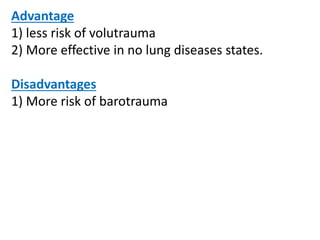
Advantage
1) less risk of volutrauma
2) More effective in no lung diseases states.
Disadvantages
1) More risk of barotrauma
Basic Modes of Ventilation
Controlled Mechanical Ventilation
Assist Control Ventilation
Intermittent Mandatory Ventilation
Synchronized Intermittent Mandatory
Ventilation
Pressure Support
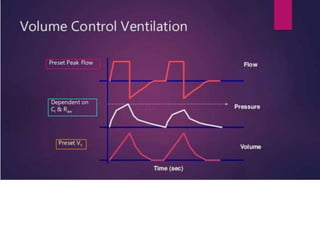
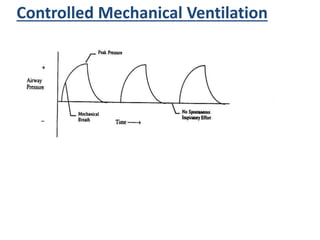
Controlled Mechanical Ventilation: Volume control
•The ventilator delivers a preset TV at a specific R/R
and inspiratory flow rate.
•It is irrespective of patients’ respiratory efforts.
•In between the ventilator delivered breaths the
inspiratory valve is closed so patient doesn’t take
additional breaths.
•PIP developed depends on lung compliance and
respiratory passage resistance.
Controlled Mechanical Ventilation
Volume controlled CMV
Indications-
• Tetanus or other seizure activity
• Crushed chest injury
Disadvantages-
• Asynchrony
• Barotrauma d/t high PAW & dec. lung compliance
• Haemodynamic disturbances
• V/Q mismatch
• Total dependence on ventilator
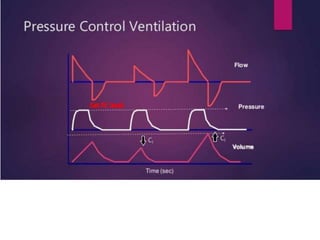
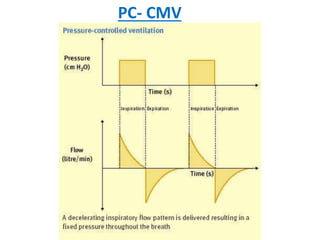
Pressure Controlled CMV
•Ventilator gives pressure limited, time cycled
breaths thus preset inspiratory pressure is
maintained.
•Decelerating flow pattern.
•Peak airway/alveolar pressure is controlled but
TV, minute volume & alveolar volume depends
on lung compliance, airway resistance, R/R & I:E
ratio.
PC- CMV
PC-CMV
Advantages-
•thus chances of barotrauma and hemodynamic
disturbances are less.
•Even distribution of gases in alveoli
•In case of leakage, compensation for loss of
ventilation is better as gaseous flow increases to
maintain preset pressure.
Disadvantages-
•Asynchrony
•TV dec. if there is dec. lung compliance or inc.
airway resistance,
•thus causes hypoventilation and alveolar
collapse.
•V/Q mismatch
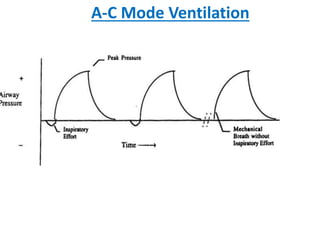
ASSIST-CONTROL MODE Ventilation
(A-C Mode)
•Ventilator assists patient’s initiated breath, but
if not triggered, it will deliver preset TV at a
preset respiratory rate (control).
•Mandatory mechanical breaths may be either
patient triggered (assist) or time triggered
(control)
•If R/R > preset rate, ventilator will assist,
otherwise it will control the ventilation.
A-C Mode Ventilation
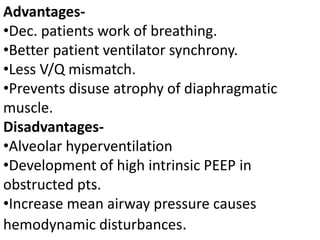
Advantages-
•Dec. patients work of breathing.
•Better patient ventilator synchrony.
•Less V/Q mismatch.
•Prevents disuse atrophy of diaphragmatic
muscle.
Disadvantages-
•Alveolar hyperventilation
•Development of high intrinsic PEEP in
obstructed pts.
•Increase mean airway pressure causes
hemodynamic disturbances.
Intermittent Mandatory Ventilation
(IMV)
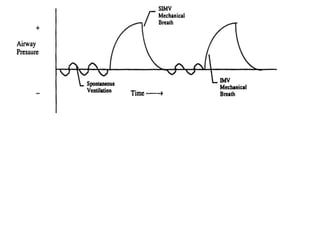
Ventilator delivers preset number of time cycled
mandatory breaths & allows patient to breath
spontaneously at any tidal volume in between.
Advantages-
•Lesser V/Q mismatch
•Lesser hemodynamic disturbances
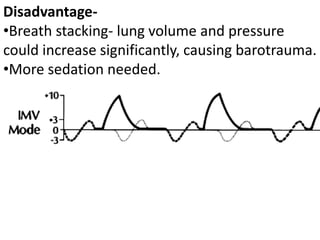
Disadvantage-
•Breath stacking- lung volume and pressure
could increase significantly, causing barotrauma.
•More sedation needed.
Synchronized Intermittent Mandatory Ventilation
(SIMV)
•Ventilator delivers either assisted breaths to
the patient at the beginning of a spontaneous
breath or time triggered mandatory breaths.
•Synchronization window- time interval just
prior to time triggering.
•Breath stacking is avoided as mandatory
breaths are synchronized with spontaneous
breaths.
•In between mandatory breaths patient is
allowed to take spontaneous breath at any TV.
SIMV
It provides partial ventilatory support
Advantages-
•Maintain respiratory muscle strength and avoid
atrophy.
•Reduce V/Q mismatch d/t spontaneous
ventilation.
•Decreases mean airway pressure d/t lower PIP
& inspiratory time
•Facilitates weaning.
Disadvantages-
•Desire to wean too rapidly results in high work
of spontaneous breathing & muscle fatigue &
thus weaning failure.
•Commonly applied to SIMV mode during
spontaneous ventilation to facilitate weaning
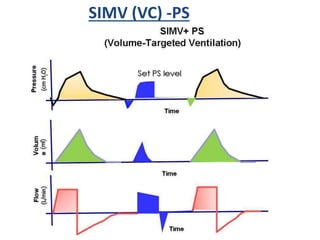
With SIMV, PS-
•Increase patient’s spontaneous tidal volume.
•Dec. spontaneous respiratory rate.
•Decreases work of breathing.
•Addition of extrinsic PEEP to PS increases its efficacy.
SIMV (VC) -PS
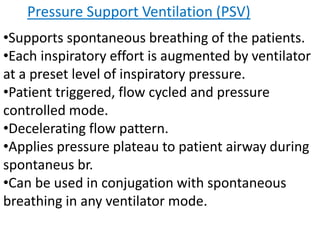
Pressure Support Ventilation (PSV)
•Supports spontaneous breathing of the patients.
•Each inspiratory effort is augmented by ventilator
at a preset level of inspiratory pressure.
•Patient triggered, flow cycled and pressure
controlled mode.
•Decelerating flow pattern.
•Applies pressure plateau to patient airway during
spontaneus br.
•Can be used in conjugation with spontaneous
breathing in any ventilator mode.
Disadvantages-
•Not suitable for patients with central apnea.
(hypoventilation)
•Development of high airway pressure.
(hemodynamic distubances)
•Hypoventilation, if inspiratory time is short.
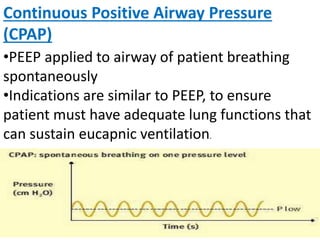
Continuous Positive Airway Pressure
(CPAP)
•PEEP applied to airway of patient breathing
spontaneously
•Indications are similar to PEEP, to ensure
patient must have adequate lung functions that
can sustain eucapnic ventilation.
THANK YOU

Basic modes of mv

  • 1.
    Basic Modes of MechanicalVentilation Moderator : Dr. Vishal PRESENTED BY : Dr. Kumar Abhinav Dr. Anjali Sharma
  • 2.
    INTRODUCTION Ventilators: are machines thatgenerates a controlled flow of gas into a patient’s airways, Function: they provide Supportive role to buy time to the patient.
  • 3.
    •Mechanical ventilation formsa mainstay of critical care in patients with respiratory insufficiency. •Ventilator must generate inspiratory flow to deliver tidal volume. •Transairway pressure (PTA) = PAO – PALV •PTA = 0, at the end of expiration and beginning of inspiration. •Mechanical ventilator produce either negative or positive pressure gradient.
  • 4.
    Negative pressure ventilation •PTAgradient is created by decreasing PALV to below PAO, e.g.-Iron lungs •Disadvantages- poor patient access, bulky size, cost, dec. cardiac output (Tank shockshell OR Iron lungs).
  • 5.
    Positive pressure ventilation •Achievedby applying positive pressure at airway opening which produces PTA gradient that generates inspiratory flow. •Inspiratory flow results in the delivery of tidal volume.
  • 6.
    Parts of aVentilator 1. Compressor 2. Control panel 3. Humidifier i. Simple humidifier ii. Servo-controlled humidifier with heated wire in the tubings 4. Breathing circuit
  • 7.
  • 9.
    Ventilatory Phases • Inspiration:Inspiratory valve opens and expiratory valve is closed • Inspiratory pause: inspiratory valve and expiratory valve closed • Expiration: Inspiratory valve closed and expiratory valve open • Expiratory pause: Inspiratory valve and expiratory (or PEEP) valve closed at end of expiration
  • 10.
    INDICATIONS OF MECHANICALVENTILATION Indications are mainly clinical although objective lab parameters such as ABG can also be used to decide it:- Common indications include: 1. Respiratory Failure a. Apnea/Respiratory Arrest b. Inadequate ventilation c. Inadequate oxygenation d. Chronic respiratory insufficiency with failure to thrive.
  • 11.
    2. Cardiac Insufficiency/Shock a.Eliminate work of breathing b. Reduce oxygen consumption. 3. Neurologic dysfunction a. Central hypoventilation/frequent apnea b. Patient comatose, GCS (Glasgow Coma Score) < 8 c. Inability to protect airway.
  • 12.
    Basic Ventilator Parameters •Tidalvolume •FiO2 • Frequency • PIP • PEEP • Inspiratory Time • Expiratory time • I:E Ratio •Mode
  • 13.
    Tidal volume:- tidalvolume of 6 to 8 ml/kg can be set, or a particular flow rate and minute ventilation can be set to get a particular tidal volume. If the difference between inspired and expired TV >15% then circuit leak is suspected. FiO2:- Oxygenation can be improved either by increasing the inspired oxygen concentration (FiO2) or by different ventilator settings. 1. Increasing peak inspiratory pressure (PIP) 2. Increasing inspiratory/expiratory ratio 3. Applying a positive pressure before the end of expiration (PEEP).
  • 14.
    Frequency:- Respiratory rate,together with tidal volume, determines the minute ventilation. High ventilator rates employ a lower tidal volume and therefore lower inspiratory pressures (PIP) are used to prevent barotrauma. PIP:- major factor in determining tidal volume . It is adjusted to produce adequate chest expansion and breath sounds. Can improve both oxygenation and ventilation.
  • 15.
    Factors evaluated indetermining PIP:- are the I. infant’s weight, II. gestational age (the degree of maturity), III. the type and severity of the disease and IV. lung mechanics - such as lung compliance and airway resistance.
  • 16.
    Positive End ExpiratoryPressure (PEEP) •It increases the end expiratory or baseline airway pressure greater than atmospheric pressure. •Used to treat refractory hypoxemia caused by intrapulmonary shunting. •It can be used in conjugation with other modes.
  • 17.
    Physiology of PEEP PEEP Increasesalveolar distending pressure Increases FRC by alveolar recruitment Improves ventilation Increases V/Q Improves oxygenation and Decreases work of breathing
  • 18.
    Indications- •Refractory hypoxemia d/tintrapulmonary shunting. •Decreased FRC and lung compliance
  • 19.
    Complications •Dec. venous returnand cardiac output. Barotrauma •Increase ICP d/t impedance of venous return from head. •Alteration of renal function & water imbalance.
  • 20.
    Ratio of InspiratoryTime to Expiratory time (I:E Ratio):- 1. Reversed I:E ratios, as high as 4:1 have been shown to result in improvement in oxygenation and decreases the incidence of BPD. 2. Extreme reversed I:E ratio with a short expiratory time will lead to air trapping and alveolar distention.
  • 21.
    3. In acase of lower airways obstruction (asthma, bronchiolitis) short IT and a longer expiratory time is used to avoid gas trapping and increased risk of air leaks.
  • 22.
    Mode It is theinterplay b/w patient and the ventilator. To describe a particular mode three things to be remembered. 1) Type of breath 2) Control variables 3) Phase variables
  • 24.
    Phase variables • Trigger: ventilator (time)- triggered or patient (pressure or flow) triggered • Limit: flow-limited or pressure-limited • Cycling: volume, time, flow or pressure cycled
  • 26.
    Phase variables: Trigger •Whatcauses the breath to begin (signal to open the inspiratory valve) i. Machine (controlled): -the ventilator will trigger regular breaths at a frequency which will depend on the set respiratory rate, ie, they will be ventilator time triggered. ii. Patient (assisted):- If the patient does make an effort to breathe and the ventilator can sense it (by either sensing a negative inspiratory pressure or an inspiratory flow) and deliver a breath, it will be called a patient triggered breath.
  • 27.
    Phase variables: Limit Factorwhich controls the inspiration inflow Flow Limited: a fixed flow rate and pattern is set and maintained throughout inspiration. i. An adequate tidal volume (Ti dependent) ii. Pressure will be variable (compliance and resistance dependent)  Pressure limited: the pressure is not allowed to go above a preset limit. i. The tidal volume will be variable (compliance and resistance dependent)
  • 28.
    Phase variables: Cycling Signal that stops the inspiration and starts the expiration.  Volume  Time  Flow  Pressure:- back-up form of cycling when the airway pressure reaches the set high-pressure alarm level.
  • 29.
    Control variables Pressure: Pressuresignal is the feedback signal (Pressure Preset) Volume: Volume signal is the feedback signal. Usually measure the flow and turn it into volume signal electronically. (volume preset)  Time  Flow
  • 31.
    Advantage 1) less riskof barotrauma 2) decelerating flow pattern more effective in treating atelectatic lungs. Disadvantages 1) variable tidal volume delivery 2)risk of volutrauma
  • 33.
    Advantage 1) less riskof volutrauma 2) More effective in no lung diseases states. Disadvantages 1) More risk of barotrauma
  • 34.
    Basic Modes ofVentilation Controlled Mechanical Ventilation Assist Control Ventilation Intermittent Mandatory Ventilation Synchronized Intermittent Mandatory Ventilation Pressure Support
  • 35.
    Controlled Mechanical Ventilation:Volume control •The ventilator delivers a preset TV at a specific R/R and inspiratory flow rate. •It is irrespective of patients’ respiratory efforts. •In between the ventilator delivered breaths the inspiratory valve is closed so patient doesn’t take additional breaths. •PIP developed depends on lung compliance and respiratory passage resistance.
  • 36.
  • 37.
    Volume controlled CMV Indications- •Tetanus or other seizure activity • Crushed chest injury Disadvantages- • Asynchrony • Barotrauma d/t high PAW & dec. lung compliance • Haemodynamic disturbances • V/Q mismatch • Total dependence on ventilator
  • 38.
    Pressure Controlled CMV •Ventilatorgives pressure limited, time cycled breaths thus preset inspiratory pressure is maintained. •Decelerating flow pattern. •Peak airway/alveolar pressure is controlled but TV, minute volume & alveolar volume depends on lung compliance, airway resistance, R/R & I:E ratio.
  • 39.
  • 40.
    PC-CMV Advantages- •thus chances ofbarotrauma and hemodynamic disturbances are less. •Even distribution of gases in alveoli •In case of leakage, compensation for loss of ventilation is better as gaseous flow increases to maintain preset pressure.
  • 41.
    Disadvantages- •Asynchrony •TV dec. ifthere is dec. lung compliance or inc. airway resistance, •thus causes hypoventilation and alveolar collapse. •V/Q mismatch
  • 42.
    ASSIST-CONTROL MODE Ventilation (A-CMode) •Ventilator assists patient’s initiated breath, but if not triggered, it will deliver preset TV at a preset respiratory rate (control). •Mandatory mechanical breaths may be either patient triggered (assist) or time triggered (control) •If R/R > preset rate, ventilator will assist, otherwise it will control the ventilation.
  • 43.
  • 44.
    Advantages- •Dec. patients workof breathing. •Better patient ventilator synchrony. •Less V/Q mismatch. •Prevents disuse atrophy of diaphragmatic muscle. Disadvantages- •Alveolar hyperventilation •Development of high intrinsic PEEP in obstructed pts. •Increase mean airway pressure causes hemodynamic disturbances.
  • 45.
    Intermittent Mandatory Ventilation (IMV) Ventilatordelivers preset number of time cycled mandatory breaths & allows patient to breath spontaneously at any tidal volume in between. Advantages- •Lesser V/Q mismatch •Lesser hemodynamic disturbances
  • 46.
    Disadvantage- •Breath stacking- lungvolume and pressure could increase significantly, causing barotrauma. •More sedation needed.
  • 47.
    Synchronized Intermittent MandatoryVentilation (SIMV) •Ventilator delivers either assisted breaths to the patient at the beginning of a spontaneous breath or time triggered mandatory breaths. •Synchronization window- time interval just prior to time triggering. •Breath stacking is avoided as mandatory breaths are synchronized with spontaneous breaths. •In between mandatory breaths patient is allowed to take spontaneous breath at any TV.
  • 49.
    SIMV It provides partialventilatory support Advantages- •Maintain respiratory muscle strength and avoid atrophy. •Reduce V/Q mismatch d/t spontaneous ventilation. •Decreases mean airway pressure d/t lower PIP & inspiratory time •Facilitates weaning.
  • 50.
    Disadvantages- •Desire to weantoo rapidly results in high work of spontaneous breathing & muscle fatigue & thus weaning failure.
  • 51.
    •Commonly applied toSIMV mode during spontaneous ventilation to facilitate weaning With SIMV, PS- •Increase patient’s spontaneous tidal volume. •Dec. spontaneous respiratory rate. •Decreases work of breathing. •Addition of extrinsic PEEP to PS increases its efficacy.
  • 52.
  • 53.
    Pressure Support Ventilation(PSV) •Supports spontaneous breathing of the patients. •Each inspiratory effort is augmented by ventilator at a preset level of inspiratory pressure. •Patient triggered, flow cycled and pressure controlled mode. •Decelerating flow pattern. •Applies pressure plateau to patient airway during spontaneus br. •Can be used in conjugation with spontaneous breathing in any ventilator mode.
  • 54.
    Disadvantages- •Not suitable forpatients with central apnea. (hypoventilation) •Development of high airway pressure. (hemodynamic distubances) •Hypoventilation, if inspiratory time is short.
  • 55.
    Continuous Positive AirwayPressure (CPAP) •PEEP applied to airway of patient breathing spontaneously •Indications are similar to PEEP, to ensure patient must have adequate lung functions that can sustain eucapnic ventilation.
  • 56.