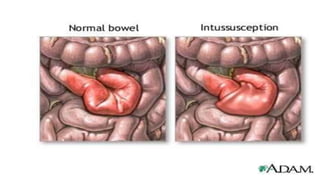
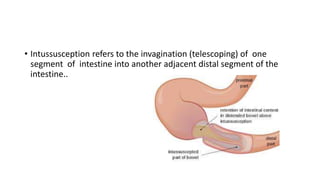
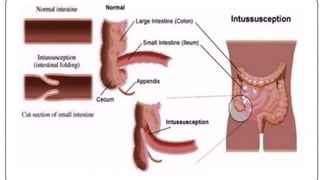
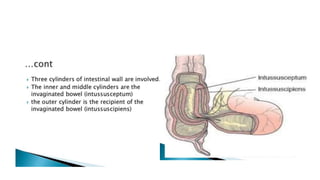
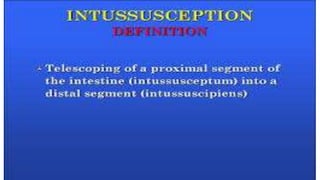
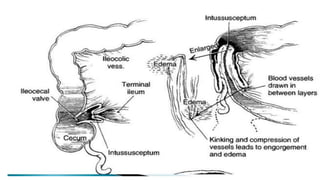
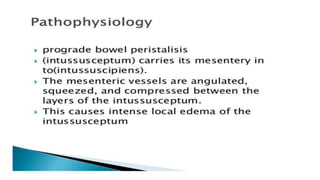
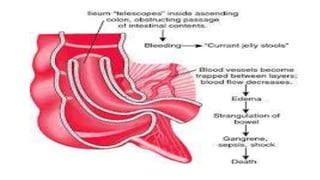
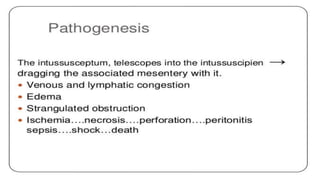
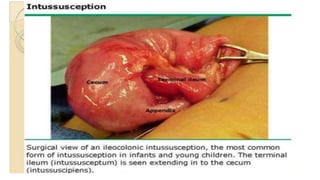

• Intussusception refers to the invagination (telescoping) of one
segment of intestine into another adjacent distal segment of the
intestine..
CAUSES
Unknown
Since the intestinal tract of infants is freely movable (especially
caecum and ileum) Hyperperistalsis due to gastroenteritis or a lesion
(polyp or tumour)
Children with cystic fibrosis or celiac disease.
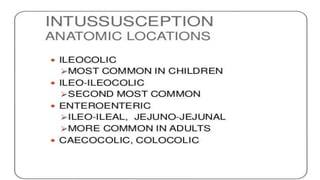
CLASSIFICATION
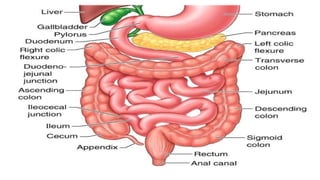
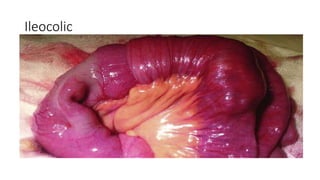
• Ileocolic : This is the commonest type where ileum invaginates into
the caecum and then into the ascending colon.
• Cecocolic:In this type ,the caecum invaginates into the colon.
• Ileoileal : In this type ,one portion of ileum invaginates into the other
portion of ileum.
Ileocolic
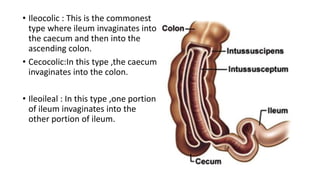
• Ileocolic : This is the commonest
type where ileum invaginates into
the caecum and then into the
ascending colon.
• Cecocolic:In this type ,the caecum
invaginates into the colon.
• Ileoileal : In this type ,one portion
of ileum invaginates into the
other portion of ileum.
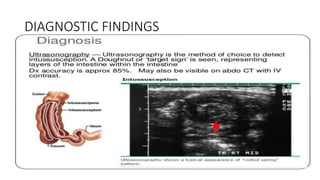
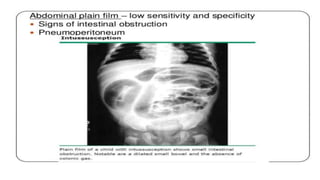
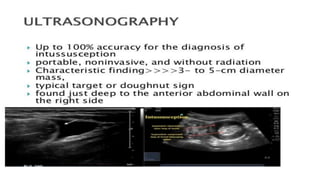
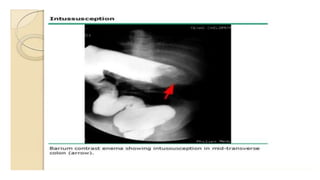
DIAGNOSTIC FINDINGS
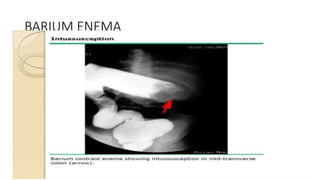
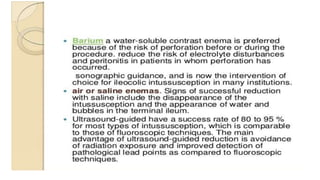
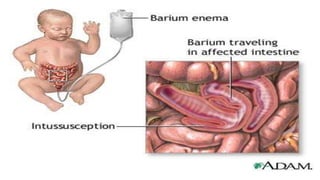
BARIUM ENEMA
MANAGEMENT
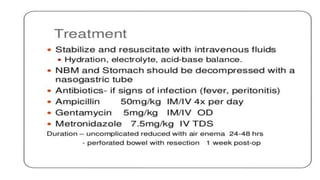
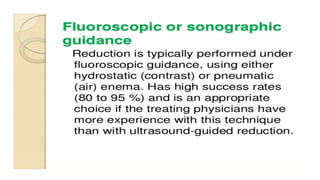
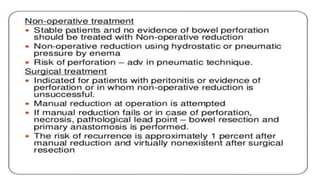
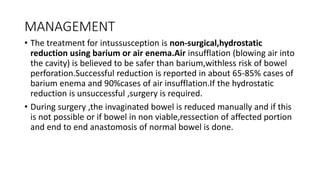
• The treatment for intussusception is non-surgical,hydrostatic
reduction using barium or air enema.Air insufflation (blowing air into
the cavity) is believed to be safer than barium,withless risk of bowel
perforation.Successful reduction is reported in about 65-85% cases of
barium enema and 90%cases of air insufflation.If the hydrostatic
reduction is unsuccessful ,surgery is required.
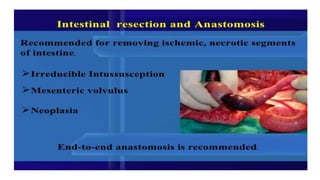
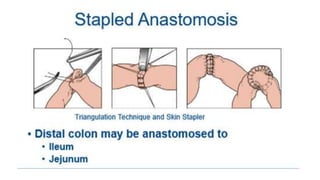
• During surgery ,the invaginated bowel is reduced manually and if this
is not possible or if bowel in non viable,ressection of affected portion
and end to end anastomosis of normal bowel is done.
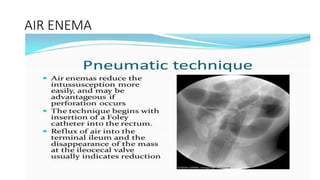
AIR ENEMA
PRE-OPERATIVE NURSING CARE
• Prepare parents for sudden hospital admission or surgery
• Help parents understand the disease and possible methods of
treatment.
• Answer the queries of parents.
• Encourage participation of parents in care giving as soon as possible.
• Pre-operative preparation of baby includes the following
Without oral fluids 6-8 hours prior to surgery.
If the infant has electrolyte imbalance or in shock,parenteral fluid
and electrolytes are administered and whole blood or plasma is given.
Nasogastric suction is done to decompress the bowel.
Enema is administered to clear the bowel prior to surgery.
Intake and output chart is to be maintained.
Antibiotics are administered as prescribed to treat infections due to
intestinal obstruction.
POST-OPERATIVE NURSING CARE
• Assess the general condition of the infant as recurrence occurs within
1or 2 days.
• Observe and record the passage of barium in stool.
• AFTER SURGERY
• Monitor the vital signs of the infant as the infant may have fever.
• Observe the incision site for any leakage or swelling.
• Dressing of the incision site is done using strict aseptic techniques.
• Monitor abdominal girth and observe for any abdominal distention ,In
case distention occurs notify the surgeon.
• Parenteral fluids are administered till the bowel sounds return and
oral feeds are started.
• Gastrointestinal suctioning is done to keep the stomach and intestine
empty so that healing may occur.
• Monitor urine output ,as manipulation of bladder during surgery may
lead to urinary retention.
• Palpate the bladder distention,If present, place toilet trained children
in normal voiding position so that they may be able to urinate.In non
toilet trained infants ,warm water may be poured on the pubic
area.This maneuver also helps in urination.
• Auscultate for bowel sounds ,every 4 hours and palpate the abdomen
and record whether it is soft or firm.
• After the bowel sounds have returned ,administer electrolyte solution
or glucose water,orally. If it is tolerated by the infant ,start breast feed
or formula feeding.
• Ambulate the child as soon as possible.
THANK YOU

Intessuception in children

  • 4.
    • Intussusception refersto the invagination (telescoping) of one segment of intestine into another adjacent distal segment of the intestine..
  • 13.
    CAUSES Unknown Since the intestinaltract of infants is freely movable (especially caecum and ileum) Hyperperistalsis due to gastroenteritis or a lesion (polyp or tumour) Children with cystic fibrosis or celiac disease.
  • 14.
    CLASSIFICATION • Ileocolic :This is the commonest type where ileum invaginates into the caecum and then into the ascending colon. • Cecocolic:In this type ,the caecum invaginates into the colon. • Ileoileal : In this type ,one portion of ileum invaginates into the other portion of ileum.
  • 15.
  • 16.
    • Ileocolic :This is the commonest type where ileum invaginates into the caecum and then into the ascending colon. • Cecocolic:In this type ,the caecum invaginates into the colon. • Ileoileal : In this type ,one portion of ileum invaginates into the other portion of ileum.
  • 29.
  • 31.
  • 38.
    MANAGEMENT • The treatmentfor intussusception is non-surgical,hydrostatic reduction using barium or air enema.Air insufflation (blowing air into the cavity) is believed to be safer than barium,withless risk of bowel perforation.Successful reduction is reported in about 65-85% cases of barium enema and 90%cases of air insufflation.If the hydrostatic reduction is unsuccessful ,surgery is required. • During surgery ,the invaginated bowel is reduced manually and if this is not possible or if bowel in non viable,ressection of affected portion and end to end anastomosis of normal bowel is done.
  • 40.
  • 44.
    PRE-OPERATIVE NURSING CARE •Prepare parents for sudden hospital admission or surgery • Help parents understand the disease and possible methods of treatment. • Answer the queries of parents. • Encourage participation of parents in care giving as soon as possible. • Pre-operative preparation of baby includes the following Without oral fluids 6-8 hours prior to surgery. If the infant has electrolyte imbalance or in shock,parenteral fluid and electrolytes are administered and whole blood or plasma is given.
  • 45.
    Nasogastric suction isdone to decompress the bowel. Enema is administered to clear the bowel prior to surgery. Intake and output chart is to be maintained. Antibiotics are administered as prescribed to treat infections due to intestinal obstruction.
  • 46.
    POST-OPERATIVE NURSING CARE •Assess the general condition of the infant as recurrence occurs within 1or 2 days. • Observe and record the passage of barium in stool. • AFTER SURGERY • Monitor the vital signs of the infant as the infant may have fever. • Observe the incision site for any leakage or swelling. • Dressing of the incision site is done using strict aseptic techniques. • Monitor abdominal girth and observe for any abdominal distention ,In case distention occurs notify the surgeon.
  • 47.
    • Parenteral fluidsare administered till the bowel sounds return and oral feeds are started. • Gastrointestinal suctioning is done to keep the stomach and intestine empty so that healing may occur. • Monitor urine output ,as manipulation of bladder during surgery may lead to urinary retention. • Palpate the bladder distention,If present, place toilet trained children in normal voiding position so that they may be able to urinate.In non toilet trained infants ,warm water may be poured on the pubic area.This maneuver also helps in urination.
  • 48.
    • Auscultate forbowel sounds ,every 4 hours and palpate the abdomen and record whether it is soft or firm. • After the bowel sounds have returned ,administer electrolyte solution or glucose water,orally. If it is tolerated by the infant ,start breast feed or formula feeding. • Ambulate the child as soon as possible.
  • 49.