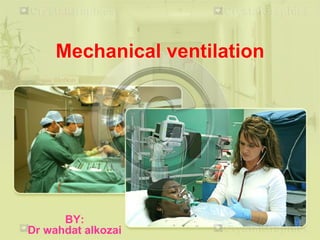
Mechanical ventilation
BY:
Dr wahdat alkozai
Ventilator
 It’s a automatic mechanical device designed to move gas into
and out of the lungs.
 The act of moving the air into and out of the lungs is called
breathing, or more formally ventilation.
 Breathing involves two stages — ventilation and gas exchange.
Ventilation is the movement of air in and out of lungs and gas
exchange is the absorption of oxygen from the lungs and
release of carbon dioxide.
 In 1908 George Poe demonstrated his mechanical respirator by
asphyxiating dogs and seemingly bringing them back to life.
MV was first introduced during polio epidemics in 1950
 bjorn ibsen recommended PPV via tracheotomies, thereby
reducing the mortality rate from 84% to 26% .
 the last three decades has seen tremendous technological
advances with the development of high frequency ventilators,
microprocessor and newer moods of ventilators.
HISTORY OF MECHANICAL VENTILATION
Parts of ventilators
1. Compressor
2. Control panel
3. Humidifier
4. Breathing circuits.
Terminology
 FiO2: inspired oxygen concentration
 PIP: peak inspiratory pressure
PEEP: positive end expiratory pressure
 RR: respiratory rate
 F: frequency
 I:E inspiratory/ expiratory ratio
 TV: tidal valium
Inspired oxygen concentration (FiO2)
• FiO2 is adjusted to maintain an adequate paO2.
• High concentration of oxygen can produce lung injury and
should be avoided.
• A FiO2 of (0,5) 50% is generally considered safe
• High oxygen concentration may play a role in the pathogenesis
of BPD and retinopathy of prematurity (ROP).
Peak inspiratory pressure (PIP)
• PIP is the major factor in determining tidal volume in a
pressure limited time cycled ventilators.
• Low PIP may not be able to provide adequate tidal volume
and can lead to hypoxia and hypercapnia.
• High PIP is associated with the risk of pulmonary barotraumas
• The increase in intra thoracic pressure may decrease Venus
return to the heart.
Positive end expiratory pressure (PEEP)
• PEEP applied at the end of expiration to prevent a fall in
pressure to zero is called positive end expiratory pressure.
• Low level of PEEP (2-3 cm H2O) are often used during
weaning from the ventilator.
• Medium level of PEEP (4-7 cm H2O) are commonly used in
moderately ill patients.
• High level of PEEP (8-15 cm H20) benefit oxygenation in ARDS.
• Very high level results in over distention and alveolar rupture.
Peak pressure and plateau pressure
Respiratory rate (RR) or frequency (F)
• RR with tidal valium determines the minute ventilation.
• Normal RR varies by age
 Neonates 40-60/m
 Early childhood 20-40/m
 Older children 15-25/m
• High rates may set in restrictive lung diseases. eg ARDS
• Lower rates are set in patients with high airway resistsnce.eg
Bronchial asthma or MAS
Inspiratory/expiratory ratio (I:E)
• The normal ratio of the inspiratory time to the expiratory time
is approximately 1:2.
• If IT is shorter than normal inspiration will be complete and TV
will be lower than expected.
• If ET is too short expiration will not be completed which will
lead to air trapping.
• Inspiratory time
Neonate 0.3-0.4
Infants 0.5-0.6
Older children 0.7-0.9
Tidal volume (TV)
• Amount of air delivered with each ventilator breath, usually
set at 6-8 ml/kg
• Low TV (< 3ml/kg) can lead to atelectasis, hypoxemia and
hypercarbai.
• High TV can cause volutrauma in children.
• If set tidal volume is significantly higher then expired TV
(more than 15%) then circuit leak or an endotracheal leak
should be looked.
 Minute Volume or Minute Ventilation (Ve)
• Respiratory rate times the tidal volume.
• RR x vt = Ve Normal minute volume for adults is 5-10 liters
• Volume
• Volumes go above or below
• preset levels
• (i.e. VT/ minute volume)
• Pressure
• Change in inspiratory or
• peak airway pressure above
• or below preset limits
CLASSIFICATION OF MECHANICAL
VENTILATION
A ventilator can be classified by describing
the following variables.
1- control variables
• Time
• Volume
• Pressure
• Flow
2- phase variable
• Trigger
• Limit
• Cycle
CONTROL VARIABLE
1.Pressure controller: The ventilator maintains the same
pressure waveform, at the mouth regardless of changes in
lung characteristics.
2. Flow controller: Ventilator volume delivery and volume
waveform remain constant and are not affected by changes in
lung characteristics. Flow is measured
3. Volume controller: Ventilator volume delivery and volume
waveform remain constant and are not affected by changes in
lung characteristics. Volume is measured
4.Time controller: Pressure, volume, and flow curves can
change as lung characteristics change. Time remains
constant.
PHASES OF VENTILATORY
CYCLES:
1. INITIATION OF INSPIRATION
(triggering)
2. INSPIRATORY (limit)
3. CHANGE OVER FROM INSPIRATION
TO EXPIRATION (cycling)
4. EXPIRATORY PHASE CYCLING
T
L C
INDICATIONS
1- Respiratory failure
• Apnea/ respiratory arrest
• Inadequate ventilation
• Inadequate oxygenation
2- Cardiac insufficiency/ shock
• Eliminate work of breathing
• Reduce O2 consumption
3- Neurologic dysfunction
• Central apnea (frequent)
• Coma GCS <8
• Inability to protect airway
4- Post operative ventilation.
MANDATORY A breath that is triggered, limited &
BREATH cycled by ventilator. Ventilator performs
all of the work of breathing.
ASSISTED A breath that is triggered by the patient,
BREATH then limited & cycled by the ventilator
MODES OF VENTILATION
PATIENT – CYCLED
SUPPORTED A breath that is triggered by the patient,
BREATH limited by the ventilator and cycled by
patient. A spontaneous breath with an
inspiratory pressure greater than baseline.
SPONTANEOUS A breath that is triggered , limited and
BREATH cycled by the patient .The patient performs
all of the work of ventilation
ADVANCED MODES
• Pressure-regulated volume control (PRVC)
• Volume support
• Airway pressure release ventilation (IPRV)
• Bi-level positive airway pressure (BIPAP)
• High frequency ventilation (HFV)
Patient ventilator dysynchrony
• Incoordination between the patient and ventilator; patient
fighting the ventilator!
• Common causes include hypoventilation, hypoxemia, tube
block/ displacement, pneumothorax, silent aspiration,
inadequate sedation.
• If the patient fighting the ventilator and desaturating:
immediate measures
• USE MNEMONIC: DOPE
• D- displacement O- obstruction P- pneumothorax E-
equipment failure.
SEDATION AND MUSCLE RELAXANT DURING
VENTILATION
• Most patient can be managed by titration of sedation without
muscle relaxation
• Midazolam (0.1-0.2 mg/kg/h and vecuronium drip (0.1-0.2
mg/kg/h)
• Morphine or fantanyl can also be used if painful procedures are
anticipated
• Don’t muscle relax a patient without adequate sedation.
Initiation of ventilation
• For controlled intubation, use sedation and muscle relaxation
(short acting MR such as succinyl choline)
• Use cuffed endotracheal tube if feasible
• Ketamine with midazolam are good sedative for initiation and
maintenance of mechanical ventilation.
• Risk involved include Barotrauma due to dynamic
hyperinflation impaired Venus return and low cardiac out put
due to hyperinflation.
Strategy that minimize PEEP and maximize expiratory time ,
lower TV and respiratory rate.
Monitoring the ventilated patient
Physical examination:
• HR, evidence of respiratory distress, air entry and vent-
patient synchrony should be observed.
• Rapid shallow breathing and the presence of subcostal or
intercostals retraction in ventilated babies may suggest air
hunger.
• Cardiovascular parameters monitored include skin color, HR,
CRT, BP and urine output
Monitoring oxygenation and ventilation:
• ABG analysis has remained the gold standard for monitoring
the adequacy of gas exchange.
• Pulse oximeter is a simple bed side non invasive tool that
allow continues monitoring of arterial oxygen saturation.
• In infants and older children who are mechanically ventilated
its acceptable to target SaO2 between 92-95%.
• In children with cyanotic heart disease SaO2 between 70-75%
are acceptable if tissue oxygenation is good.
Physiotherapy:
• Despite the extensive use of chest physiotherapy in pediatric
practice, there is very scant information available on its use in
mechanically ventilated children.
• The physiotherapy rationale behind CPT is to mobilize
secretions, prevent pneumonia and reduce hospital stay.
• CPT consists of a series of maneuvers such as positioning,
percussion, vibration and manual hyperinflation.
Chest radiography
• Chest radiography is the most commonly used imaging
modality in the intensive care units for the diagnosis of
complications during assist ventilation.
• The finding to look for in a chest radiograph include position
of the endotracheal tube, central line, umbilical catheters.
Endotracheal suctioning:
• Suction can be done using the open or closed suctioning
system.
• In suctioning taking care Its important to remember that
mucosal injury can occur. Hence, gentle suctioning taking care
not to be push the catheter upto the carina.
Eye care:
• A ventilated patient is often heavily sedated and may be even
muscle relaxed. This predisposes the individual to exposure
keratitis, corneal ulceration and infection.
• Passive closure of the eyelid and using lubricants at scheduled
intervals had been shown to provide protection from above
mentioned problems.
Routine ventilator management
protocol
• Wean FiO2 for SpO2 above 93-94
• ABG one hour after intubation, then am-pm schedule
(12hourly) and 20 minutes after extubation
• Pulse oximetry on all patients
• Frequent clinical examination for respiratory rate, breath
sounds, retraction, auscultation for equal air entry and color
• Chest x-ray every day/ alternate day/ as needed.
RESPIRATORY CARE PROTOCOL
1. Change position 2 hourly right chest tilt/ left chest tilt/ supine
position
2. Suction 4 hourly and as needed
3. Physiotherapy 8 hourly. Percussion, vibration and postural
drainage
4. Nebulization, metered dose inhaler can also be used
5. Disposable circuit change if visible soiling
6. Humidification/ inline disposable humidifier.
Airleak syndrome
• Low MAP, low PIP, low TV, low PEEP, lower TV and lower
inspiratory time are needed.
• Other modes useful in airleak syndrome are:
 High frequency oscillatory ventilator (HFOV)
 Patient has to be muscle relaxed
 Patient can not be suctioned frequently as disconnecting the
patient from the oscillator can result in volume loss in the lung
 Patient should be turned and suctioned 1-2 times/day, if he/she
can tolerate it.
WEANING
ESSENTIAL TO BEGIN WEANING
Patient should be assessed for their readiness to wean by
considering the following parameters
• improving general condition, fever etc
• decreasing FiO2 requirement
• improving breath sounds
• decreasing endotracheal secretion
• improving chest x-ray
• decrease chest tube drainage, bleeding/air bubble
• improved fluid and electrolyte status
• improving hemodynamic status
• improving neurologic status
CONVENTIONAL MODES NEWER MODES
MODES OF WEANING
Extubation can generally be perform when the following criteria
are met.
1. Control of airway reflexes, minimal secretions
2. Patent upper airway
3. Good breath sounds
4. Minimal oxygen requirement < 0.3 with SpO2 >94%
5. Minimal rate 5/min
6. Minimal pressure support ( 5-10 above the PEEP)
7. Awake patient.
Extubation
Post extubation care
After extubation close monitoring and following care should be
provided.
a) CPAP to stabilize the upper airway, improve lung function and
reduce apnea
b) Nasal cannula or oxygen hood if there is oxygen requirement
c) Preterm babies at risk of apnea of prematurity may benefit
from caffeine at least 2 hours before extubation
d) For control of post extubation laryngeal edema following
medication can be used.
• Epinephrine: 0.5 ml by nebulizer
• Corticosteroids: dexamethasone 0.5mg/kg begun 6-12 hours
prior and then every 6 hourly total 6 doses.
Complication of MV
1. Related to increased airway pressure and lung volume
• Barotrauma/ volutrauma
• Decreased cardiac filling and poor perfusion
• Other organ dysfunction: renal, hepatic and CNS
• Pulmonary parenchymal damage
• Increased extravascular lung water
2. Related to endotracheal tube
• Tracheal mucosa swelling, ulceration or damage
• Laryngeal edema, subgluttic stenosis
• Granoloma formation leading airway obstruction
Complication cont…..
3. Nasocomial infections
• Ventilator associated pneumonia
• Sepsis
4. Mechanical operational problems
• Mechanical ventilator / compressor failure/ alarm failure
• Inadequate humidification
5. Other systems
• Decreased hepatic blood flow
• Decreased cerebral venous drainage
References:
1. Pediatric and neonatal mechanical ventilation
2013, PARVEEN KHILNSNI
2. Pediatric intensive care 2013 , DR. NITIN K
SHAH
3. Pediatric intensive care 4th edition 2011, DAVID
G NICHOLS
4. Medical emergencies in children 5th edition,
MEHRABAN SINGH
5. Internet references
mechanical ventilation

mechanical ventilation

  • 1.
  • 2.
    Ventilator  It’s aautomatic mechanical device designed to move gas into and out of the lungs.  The act of moving the air into and out of the lungs is called breathing, or more formally ventilation.  Breathing involves two stages — ventilation and gas exchange. Ventilation is the movement of air in and out of lungs and gas exchange is the absorption of oxygen from the lungs and release of carbon dioxide.
  • 3.
     In 1908George Poe demonstrated his mechanical respirator by asphyxiating dogs and seemingly bringing them back to life. MV was first introduced during polio epidemics in 1950  bjorn ibsen recommended PPV via tracheotomies, thereby reducing the mortality rate from 84% to 26% .  the last three decades has seen tremendous technological advances with the development of high frequency ventilators, microprocessor and newer moods of ventilators. HISTORY OF MECHANICAL VENTILATION
  • 4.
    Parts of ventilators 1.Compressor 2. Control panel 3. Humidifier 4. Breathing circuits.
  • 5.
    Terminology  FiO2: inspiredoxygen concentration  PIP: peak inspiratory pressure PEEP: positive end expiratory pressure  RR: respiratory rate  F: frequency  I:E inspiratory/ expiratory ratio  TV: tidal valium
  • 6.
    Inspired oxygen concentration(FiO2) • FiO2 is adjusted to maintain an adequate paO2. • High concentration of oxygen can produce lung injury and should be avoided. • A FiO2 of (0,5) 50% is generally considered safe • High oxygen concentration may play a role in the pathogenesis of BPD and retinopathy of prematurity (ROP).
  • 7.
    Peak inspiratory pressure(PIP) • PIP is the major factor in determining tidal volume in a pressure limited time cycled ventilators. • Low PIP may not be able to provide adequate tidal volume and can lead to hypoxia and hypercapnia. • High PIP is associated with the risk of pulmonary barotraumas • The increase in intra thoracic pressure may decrease Venus return to the heart.
  • 8.
    Positive end expiratorypressure (PEEP) • PEEP applied at the end of expiration to prevent a fall in pressure to zero is called positive end expiratory pressure. • Low level of PEEP (2-3 cm H2O) are often used during weaning from the ventilator. • Medium level of PEEP (4-7 cm H2O) are commonly used in moderately ill patients. • High level of PEEP (8-15 cm H20) benefit oxygenation in ARDS. • Very high level results in over distention and alveolar rupture.
  • 9.
    Peak pressure andplateau pressure
  • 10.
    Respiratory rate (RR)or frequency (F) • RR with tidal valium determines the minute ventilation. • Normal RR varies by age  Neonates 40-60/m  Early childhood 20-40/m  Older children 15-25/m • High rates may set in restrictive lung diseases. eg ARDS • Lower rates are set in patients with high airway resistsnce.eg Bronchial asthma or MAS
  • 11.
    Inspiratory/expiratory ratio (I:E) •The normal ratio of the inspiratory time to the expiratory time is approximately 1:2. • If IT is shorter than normal inspiration will be complete and TV will be lower than expected. • If ET is too short expiration will not be completed which will lead to air trapping. • Inspiratory time Neonate 0.3-0.4 Infants 0.5-0.6 Older children 0.7-0.9
  • 12.
    Tidal volume (TV) •Amount of air delivered with each ventilator breath, usually set at 6-8 ml/kg • Low TV (< 3ml/kg) can lead to atelectasis, hypoxemia and hypercarbai. • High TV can cause volutrauma in children. • If set tidal volume is significantly higher then expired TV (more than 15%) then circuit leak or an endotracheal leak should be looked.
  • 13.
     Minute Volumeor Minute Ventilation (Ve) • Respiratory rate times the tidal volume. • RR x vt = Ve Normal minute volume for adults is 5-10 liters • Volume • Volumes go above or below • preset levels • (i.e. VT/ minute volume) • Pressure • Change in inspiratory or • peak airway pressure above • or below preset limits
  • 14.
    CLASSIFICATION OF MECHANICAL VENTILATION Aventilator can be classified by describing the following variables. 1- control variables • Time • Volume • Pressure • Flow 2- phase variable • Trigger • Limit • Cycle
  • 15.
  • 16.
    1.Pressure controller: Theventilator maintains the same pressure waveform, at the mouth regardless of changes in lung characteristics. 2. Flow controller: Ventilator volume delivery and volume waveform remain constant and are not affected by changes in lung characteristics. Flow is measured 3. Volume controller: Ventilator volume delivery and volume waveform remain constant and are not affected by changes in lung characteristics. Volume is measured 4.Time controller: Pressure, volume, and flow curves can change as lung characteristics change. Time remains constant.
  • 17.
    PHASES OF VENTILATORY CYCLES: 1.INITIATION OF INSPIRATION (triggering) 2. INSPIRATORY (limit) 3. CHANGE OVER FROM INSPIRATION TO EXPIRATION (cycling) 4. EXPIRATORY PHASE CYCLING T L C
  • 19.
    INDICATIONS 1- Respiratory failure •Apnea/ respiratory arrest • Inadequate ventilation • Inadequate oxygenation 2- Cardiac insufficiency/ shock • Eliminate work of breathing • Reduce O2 consumption 3- Neurologic dysfunction • Central apnea (frequent) • Coma GCS <8 • Inability to protect airway 4- Post operative ventilation.
  • 20.
    MANDATORY A breaththat is triggered, limited & BREATH cycled by ventilator. Ventilator performs all of the work of breathing. ASSISTED A breath that is triggered by the patient, BREATH then limited & cycled by the ventilator MODES OF VENTILATION
  • 21.
    PATIENT – CYCLED SUPPORTEDA breath that is triggered by the patient, BREATH limited by the ventilator and cycled by patient. A spontaneous breath with an inspiratory pressure greater than baseline. SPONTANEOUS A breath that is triggered , limited and BREATH cycled by the patient .The patient performs all of the work of ventilation
  • 23.
    ADVANCED MODES • Pressure-regulatedvolume control (PRVC) • Volume support • Airway pressure release ventilation (IPRV) • Bi-level positive airway pressure (BIPAP) • High frequency ventilation (HFV)
  • 24.
    Patient ventilator dysynchrony •Incoordination between the patient and ventilator; patient fighting the ventilator! • Common causes include hypoventilation, hypoxemia, tube block/ displacement, pneumothorax, silent aspiration, inadequate sedation. • If the patient fighting the ventilator and desaturating: immediate measures • USE MNEMONIC: DOPE • D- displacement O- obstruction P- pneumothorax E- equipment failure.
  • 25.
    SEDATION AND MUSCLERELAXANT DURING VENTILATION • Most patient can be managed by titration of sedation without muscle relaxation • Midazolam (0.1-0.2 mg/kg/h and vecuronium drip (0.1-0.2 mg/kg/h) • Morphine or fantanyl can also be used if painful procedures are anticipated • Don’t muscle relax a patient without adequate sedation.
  • 26.
    Initiation of ventilation •For controlled intubation, use sedation and muscle relaxation (short acting MR such as succinyl choline) • Use cuffed endotracheal tube if feasible • Ketamine with midazolam are good sedative for initiation and maintenance of mechanical ventilation. • Risk involved include Barotrauma due to dynamic hyperinflation impaired Venus return and low cardiac out put due to hyperinflation. Strategy that minimize PEEP and maximize expiratory time , lower TV and respiratory rate.
  • 27.
    Monitoring the ventilatedpatient Physical examination: • HR, evidence of respiratory distress, air entry and vent- patient synchrony should be observed. • Rapid shallow breathing and the presence of subcostal or intercostals retraction in ventilated babies may suggest air hunger. • Cardiovascular parameters monitored include skin color, HR, CRT, BP and urine output
  • 28.
    Monitoring oxygenation andventilation: • ABG analysis has remained the gold standard for monitoring the adequacy of gas exchange. • Pulse oximeter is a simple bed side non invasive tool that allow continues monitoring of arterial oxygen saturation. • In infants and older children who are mechanically ventilated its acceptable to target SaO2 between 92-95%. • In children with cyanotic heart disease SaO2 between 70-75% are acceptable if tissue oxygenation is good.
  • 29.
    Physiotherapy: • Despite theextensive use of chest physiotherapy in pediatric practice, there is very scant information available on its use in mechanically ventilated children. • The physiotherapy rationale behind CPT is to mobilize secretions, prevent pneumonia and reduce hospital stay. • CPT consists of a series of maneuvers such as positioning, percussion, vibration and manual hyperinflation.
  • 30.
    Chest radiography • Chestradiography is the most commonly used imaging modality in the intensive care units for the diagnosis of complications during assist ventilation. • The finding to look for in a chest radiograph include position of the endotracheal tube, central line, umbilical catheters.
  • 31.
    Endotracheal suctioning: • Suctioncan be done using the open or closed suctioning system. • In suctioning taking care Its important to remember that mucosal injury can occur. Hence, gentle suctioning taking care not to be push the catheter upto the carina.
  • 32.
    Eye care: • Aventilated patient is often heavily sedated and may be even muscle relaxed. This predisposes the individual to exposure keratitis, corneal ulceration and infection. • Passive closure of the eyelid and using lubricants at scheduled intervals had been shown to provide protection from above mentioned problems.
  • 33.
    Routine ventilator management protocol •Wean FiO2 for SpO2 above 93-94 • ABG one hour after intubation, then am-pm schedule (12hourly) and 20 minutes after extubation • Pulse oximetry on all patients • Frequent clinical examination for respiratory rate, breath sounds, retraction, auscultation for equal air entry and color • Chest x-ray every day/ alternate day/ as needed.
  • 34.
    RESPIRATORY CARE PROTOCOL 1.Change position 2 hourly right chest tilt/ left chest tilt/ supine position 2. Suction 4 hourly and as needed 3. Physiotherapy 8 hourly. Percussion, vibration and postural drainage 4. Nebulization, metered dose inhaler can also be used 5. Disposable circuit change if visible soiling 6. Humidification/ inline disposable humidifier.
  • 35.
    Airleak syndrome • LowMAP, low PIP, low TV, low PEEP, lower TV and lower inspiratory time are needed. • Other modes useful in airleak syndrome are:  High frequency oscillatory ventilator (HFOV)  Patient has to be muscle relaxed  Patient can not be suctioned frequently as disconnecting the patient from the oscillator can result in volume loss in the lung  Patient should be turned and suctioned 1-2 times/day, if he/she can tolerate it.
  • 36.
  • 37.
    ESSENTIAL TO BEGINWEANING Patient should be assessed for their readiness to wean by considering the following parameters • improving general condition, fever etc • decreasing FiO2 requirement • improving breath sounds • decreasing endotracheal secretion • improving chest x-ray • decrease chest tube drainage, bleeding/air bubble • improved fluid and electrolyte status • improving hemodynamic status • improving neurologic status
  • 38.
    CONVENTIONAL MODES NEWERMODES MODES OF WEANING
  • 39.
    Extubation can generallybe perform when the following criteria are met. 1. Control of airway reflexes, minimal secretions 2. Patent upper airway 3. Good breath sounds 4. Minimal oxygen requirement < 0.3 with SpO2 >94% 5. Minimal rate 5/min 6. Minimal pressure support ( 5-10 above the PEEP) 7. Awake patient. Extubation
  • 40.
    Post extubation care Afterextubation close monitoring and following care should be provided. a) CPAP to stabilize the upper airway, improve lung function and reduce apnea b) Nasal cannula or oxygen hood if there is oxygen requirement c) Preterm babies at risk of apnea of prematurity may benefit from caffeine at least 2 hours before extubation d) For control of post extubation laryngeal edema following medication can be used. • Epinephrine: 0.5 ml by nebulizer • Corticosteroids: dexamethasone 0.5mg/kg begun 6-12 hours prior and then every 6 hourly total 6 doses.
  • 41.
    Complication of MV 1.Related to increased airway pressure and lung volume • Barotrauma/ volutrauma • Decreased cardiac filling and poor perfusion • Other organ dysfunction: renal, hepatic and CNS • Pulmonary parenchymal damage • Increased extravascular lung water 2. Related to endotracheal tube • Tracheal mucosa swelling, ulceration or damage • Laryngeal edema, subgluttic stenosis • Granoloma formation leading airway obstruction
  • 42.
    Complication cont….. 3. Nasocomialinfections • Ventilator associated pneumonia • Sepsis 4. Mechanical operational problems • Mechanical ventilator / compressor failure/ alarm failure • Inadequate humidification 5. Other systems • Decreased hepatic blood flow • Decreased cerebral venous drainage
  • 43.
    References: 1. Pediatric andneonatal mechanical ventilation 2013, PARVEEN KHILNSNI 2. Pediatric intensive care 2013 , DR. NITIN K SHAH 3. Pediatric intensive care 4th edition 2011, DAVID G NICHOLS 4. Medical emergencies in children 5th edition, MEHRABAN SINGH 5. Internet references