Mechanical Ventilation
Dr. Abhijit Diwate
(Associate Professor)
Cardio-Vascular & Respiratory PT
DVVPF College of Physiotherapy,
Ahmednagar 414111
Objectives
Indications
Goals
Physiology of breathing
Principles of mechanical ventilation
 modes of ventilators
Settings of ventilators
Ventilator complications
Weaning criteria
Indications
Acute Respiratory Failure
Hypoxemia
Neuromuscular Disorders
Pulmonary edema
Over Sedation
reduce ICP
stabilize the chest wall
Aspiration
ARDS
Pulmonary embolism
Goals
Increase efficiency of breathing
Increase oxygenation
Improve ventilation/perfusion relationships
Decrease work of breathing
PHYSIOLOGY OF NORMAL BREATHING V/S
MECHANICAL VENTILATION
Normal breathing
1. Breathing by muscles is governed by
requirement of body.
2. Initiation and termination of breathing depend
on levels of PO2, PCO2, PH and lung inflation.
3. Air gets sucked in because of negative intra
pleural pressure created by the respiratory
muscles
4. Increase in pulmonary pressures are in the
range of 3to 5cms. Of water.
5. Venous return increases during respiration
6. Expiration is passive.
Mechanical ventilation
1 work of the respiratory muscles is done by
ventilator
2 Initiation, termination may be machine
determined (mandatory breath) or patient
determined (spontaneous breath).
3 Air is pushed in by positive pressure given
by the ventilator.
4 Pressures generated are in the range of 15
to 40cms of water
5 Venous return decreases during respiration
6 Expiration is passive
PRINCIPLES OF MECHANICAL
VENTILATION
A ventilator is a machine that generates the
pressure necessary to cause a flow of gas
that increases the volume of the lungs.
The three variables involved are
- Pressure
- Volume
- Flow
- One can be fixed or pre determined and the
other two will depend on the compliance of
the lungs and the chest wall and the
resistance offered by the airways.
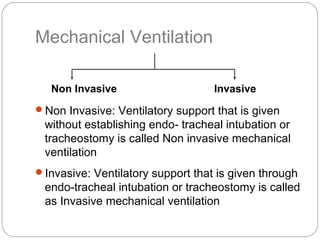
Mechanical Ventilation
Non Invasive: Ventilatory support that is given
without establishing endo- tracheal intubation or
tracheostomy is called Non invasive mechanical
ventilation
Invasive: Ventilatory support that is given through
endo-tracheal intubation or tracheostomy is called
as Invasive mechanical ventilation
Non Invasive Invasive
NON INVASIVE
Negative
pressure
Producing Neg.
pressure intermittently
in the pleural space/
around the thoracic
cage
Positive pressure
Delivering air/gas with
positive pressure to
the airway
Invasive
Positive Pressure
Pressure cycle Volume cycle Time cycle
Positive Pressure Ventilators
Pressure Cycled
A pre determined and preset pressure terminates
inspiration. Pressure is constant and volume is
variable.
Small, portable, inexpensive
Ventilation volume can vary with changes in airway
resistance, pulmonary compliance
Used for short-term support of patients with no pre-
existing thoracic or pulmonary problems
Positive Pressure Ventilators
Volume cycled
Most widely used system
A pre determined and preset volume -on
completion of its delivery , terminates the
inspiration. Pressure is variable and volume is
constant
Delivers volume at whatever pressure is required
up to specified peak pressure
May produce dangerously high intrathoracic
pressures
Positive Pressure Ventilators
Time cycled
Delivers air/gas over a set time (Insp. Time) after
which the inspiration ends.
Volume determined by
Length of inspiratory time
Pressure limit set
Patient airway resistance
Patient lung compliance
Common in neonatal units
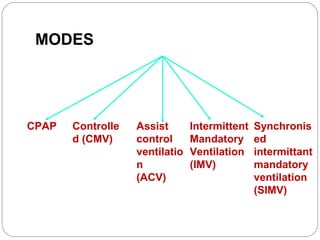
MODES
Synchronis
ed
intermittant
mandatory
ventilation
(SIMV)
CPAP Controlle
d (CMV)
Assist
control
ventilatio
n
(ACV)
Intermittent
Mandatory
Ventilation
(IMV)
Controlled Mechanical Ventilation
Patient does not participate in ventilations
Machine initiates inspiration, does work of breathing,
controls tidal volume and rate
Useful in apneic or heavily sedated patients
Useful when inspiratory effort contraindicated (flail chest)
Patient must be incapable of initiating breaths
Rarely used
Assist/Control (A/C)
Patient triggers machine to deliver breaths but machine
has preset backup rate
Patient initiates breath--machine delivers tidal volume
If patient does not breathe fast enough, machine takes
over at preset rate
Tachypneic patients may hyperventilate dangerously
Assist Mode
Intermittent Mandatory Ventilation (IMV)
Patient breathes on own
Machine delivers breaths at preset intervals
Patient determines tidal volume of spontaneous
breaths
Used to “wean” patients from ventilators
Patients with weak respiratory muscles may tire
from breathing against machine’s resistance
Assist Mode
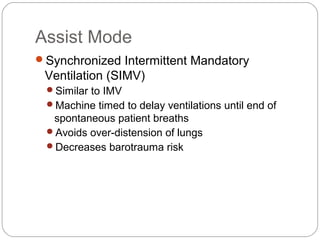
Synchronized Intermittent Mandatory
Ventilation (SIMV)
Similar to IMV
Machine timed to delay ventilations until end of
spontaneous patient breaths
Avoids over-distension of lungs
Decreases barotrauma risk
Positive End Expiratory Pressure
(PEEP)
Positive pressure in airway throughout expiration
Holds alveoli open
Improves ventilation/perfusion match
Decreases FiO2 needed to correct hypoxemia
Useful in maintaining pulmonary function in non-
cardiogenic pulmonary edema, especially ARDS
Positive End Expiratory Pressure
(PEEP)
High intrathoracic pressures can cause decreased
venous return and decreased cardiac output
May produce pulmonary barotrauma
May worsen air-trapping in obstructive pulmonary
disease
DANGERS
Continuous Positive Airway Pressure
(CPAP)
PEEP without preset ventilator rate or volume
Physiologically similar to PEEP
May be applied with or without use of a
ventilator or artificial airway
Requires patient to be breathing spontaneously
Does not require a ventilator but can be performed
with some ventilators
Noninvasive pressure support
ventilation
Bi-level positive airway pressure ventilation
Set level of inspiratory positive airway pressure
and expiratory positive airway pressure
Flow triggered system
Applied through nasal mask
Tidal vol., flow rate, insp. Time vary with pt. effort,
set pressure and changes in compliance and
resistant
Pressure control
Pressure control with inverse inspiratory to
expiratory ratio ventilation
High Frequency Ventilation (HFV)
Small volumes, high rates
Allows gas exchange at low peak pressures
High Frequency Ventilation (HFV)
Useful in managing:
Tracheobronchial or bronchopleural fistulas
Severe obstructive airway disease
Patients who develop barotrauma or decreased
cardiac output with more conventional methods
Patients with head trauma who develop increased
ICP with conventional methods
Patients under general anesthesia in whom
ventilator movement would be undesirable
Ventilator Settings
Tidal volume--10 to 15ml/kg (std = 12 ml/kg)
Respiratory rate--initially 10 to 16/minute
FiO2--0.21 to 1.0 depending on disease process
100% causes oxygen toxicity and atelectasis in less than 24
hours
40% is safe indefinitely
PEEP can be added to stay below 40%
Goal is to achieve a PaO2 >60
I:E Ratio--1:2 is good starting point
Obstructive disease requires longer expirations
Restrictive disease requires longer inspirations
Ventilator Settings
Ancillary adjustments
Inspiratory flow time
Temperature adjustments
Humidity
Trigger sensitivity
Peak airway pressure limits
Sighs
Ventilator Complications
Mechanical malfunction
Keep all alarms activated at all times
If malfunction occurs, disconnect ventilator and
ventilate manually
Ventilator Complications
Airway malfunction
Suction patient as needed
Keep condensation build-up out of connecting tubes
Auscultate chest frequently
End tidal CO2 monitoring
Maintain desired end-tidal CO2
Assess tube placement
Ventilator Complications
Pulmonary barotrauma
Avoid high-pressure settings for high-risk patients
(COPD)
Monitor for pneumothorax
Anticipate need to decompress tension
pneumothorax
Ventilator Complications
Hemodynamic alterations
Decreased cardiac output, decreased venous return
Observe for:
Decreased BP
Restlessness, decreased LOC
Decreased urine output
Decreased peripheral pulses
Slow capillary refill
Pallor
Increasing Tachycardia
Ventilator Complications
Renal malfunction
Gastric hemorrhage
Pulmonary atelectasis
Infection
Oxygen toxicity
Loss of respiratory muscle tone
Weaning
Is the cause of respiratory failure gone
or getting better ?
Is the patient well oxygenated and
ventilated ?
Can the heart tolerate the increased
work of breathing ?
Weaning Criteria
Clinical assessment
Investigation
Mode and parameter change
CPAP
Venturi
Physiological parameters
Ventilatory pump
TV > 5ml/kg body wt.
RR </= 30
Driving force
Pressure inspiratory = -20 to -30 mm of Hg
Compliance <25 ml/ cm H2O
Breathing pattern – synchronous stable
WOB – near to normal
Oxygen status PaO2 > 60 mm of Hg
Carbondioxide PaCO2 < 50 mm Hg
WEANING PROCEDURE
T- tube trials
SIMV
Pressure support
Summary
Indications
Goals
Physiology of breathing
Principles of mechanical ventilation
 modes of ventilators
Settings of ventilators
Ventilator complications
Weaning criteria
QUESTIONS
1. WRITE THE INDICATIONS AND GOALS OF
MECHANICAL VENTILATION. 5MARKS
2. WRITE THE PRINCIPLES OF MECHANICAL
VENTILATIONS. 3 MERKS
Mechanical ventlation

Mechanical ventlation

  • 1.
    Mechanical Ventilation Dr. AbhijitDiwate (Associate Professor) Cardio-Vascular & Respiratory PT DVVPF College of Physiotherapy, Ahmednagar 414111
  • 2.
    Objectives Indications Goals Physiology of breathing Principlesof mechanical ventilation  modes of ventilators Settings of ventilators Ventilator complications Weaning criteria
  • 3.
    Indications Acute Respiratory Failure Hypoxemia NeuromuscularDisorders Pulmonary edema Over Sedation reduce ICP stabilize the chest wall Aspiration ARDS Pulmonary embolism
  • 4.
    Goals Increase efficiency ofbreathing Increase oxygenation Improve ventilation/perfusion relationships Decrease work of breathing
  • 5.
    PHYSIOLOGY OF NORMALBREATHING V/S MECHANICAL VENTILATION Normal breathing 1. Breathing by muscles is governed by requirement of body. 2. Initiation and termination of breathing depend on levels of PO2, PCO2, PH and lung inflation. 3. Air gets sucked in because of negative intra pleural pressure created by the respiratory muscles 4. Increase in pulmonary pressures are in the range of 3to 5cms. Of water. 5. Venous return increases during respiration 6. Expiration is passive.
  • 6.
    Mechanical ventilation 1 workof the respiratory muscles is done by ventilator 2 Initiation, termination may be machine determined (mandatory breath) or patient determined (spontaneous breath). 3 Air is pushed in by positive pressure given by the ventilator. 4 Pressures generated are in the range of 15 to 40cms of water 5 Venous return decreases during respiration 6 Expiration is passive
  • 7.
    PRINCIPLES OF MECHANICAL VENTILATION Aventilator is a machine that generates the pressure necessary to cause a flow of gas that increases the volume of the lungs. The three variables involved are - Pressure - Volume - Flow - One can be fixed or pre determined and the other two will depend on the compliance of the lungs and the chest wall and the resistance offered by the airways.
  • 8.
    Mechanical Ventilation Non Invasive:Ventilatory support that is given without establishing endo- tracheal intubation or tracheostomy is called Non invasive mechanical ventilation Invasive: Ventilatory support that is given through endo-tracheal intubation or tracheostomy is called as Invasive mechanical ventilation Non Invasive Invasive
  • 9.
    NON INVASIVE Negative pressure Producing Neg. pressureintermittently in the pleural space/ around the thoracic cage Positive pressure Delivering air/gas with positive pressure to the airway
  • 10.
  • 11.
    Positive Pressure Ventilators PressureCycled A pre determined and preset pressure terminates inspiration. Pressure is constant and volume is variable. Small, portable, inexpensive Ventilation volume can vary with changes in airway resistance, pulmonary compliance Used for short-term support of patients with no pre- existing thoracic or pulmonary problems
  • 12.
    Positive Pressure Ventilators Volumecycled Most widely used system A pre determined and preset volume -on completion of its delivery , terminates the inspiration. Pressure is variable and volume is constant Delivers volume at whatever pressure is required up to specified peak pressure May produce dangerously high intrathoracic pressures
  • 13.
    Positive Pressure Ventilators Timecycled Delivers air/gas over a set time (Insp. Time) after which the inspiration ends. Volume determined by Length of inspiratory time Pressure limit set Patient airway resistance Patient lung compliance Common in neonatal units
  • 16.
  • 17.
    Controlled Mechanical Ventilation Patientdoes not participate in ventilations Machine initiates inspiration, does work of breathing, controls tidal volume and rate Useful in apneic or heavily sedated patients Useful when inspiratory effort contraindicated (flail chest) Patient must be incapable of initiating breaths Rarely used
  • 18.
    Assist/Control (A/C) Patient triggersmachine to deliver breaths but machine has preset backup rate Patient initiates breath--machine delivers tidal volume If patient does not breathe fast enough, machine takes over at preset rate Tachypneic patients may hyperventilate dangerously
  • 19.
    Assist Mode Intermittent MandatoryVentilation (IMV) Patient breathes on own Machine delivers breaths at preset intervals Patient determines tidal volume of spontaneous breaths Used to “wean” patients from ventilators Patients with weak respiratory muscles may tire from breathing against machine’s resistance
  • 20.
    Assist Mode Synchronized IntermittentMandatory Ventilation (SIMV) Similar to IMV Machine timed to delay ventilations until end of spontaneous patient breaths Avoids over-distension of lungs Decreases barotrauma risk
  • 21.
    Positive End ExpiratoryPressure (PEEP) Positive pressure in airway throughout expiration Holds alveoli open Improves ventilation/perfusion match Decreases FiO2 needed to correct hypoxemia Useful in maintaining pulmonary function in non- cardiogenic pulmonary edema, especially ARDS
  • 22.
    Positive End ExpiratoryPressure (PEEP) High intrathoracic pressures can cause decreased venous return and decreased cardiac output May produce pulmonary barotrauma May worsen air-trapping in obstructive pulmonary disease DANGERS
  • 23.
    Continuous Positive AirwayPressure (CPAP) PEEP without preset ventilator rate or volume Physiologically similar to PEEP May be applied with or without use of a ventilator or artificial airway Requires patient to be breathing spontaneously Does not require a ventilator but can be performed with some ventilators
  • 24.
    Noninvasive pressure support ventilation Bi-levelpositive airway pressure ventilation Set level of inspiratory positive airway pressure and expiratory positive airway pressure Flow triggered system Applied through nasal mask Tidal vol., flow rate, insp. Time vary with pt. effort, set pressure and changes in compliance and resistant
  • 25.
    Pressure control Pressure controlwith inverse inspiratory to expiratory ratio ventilation
  • 26.
    High Frequency Ventilation(HFV) Small volumes, high rates Allows gas exchange at low peak pressures
  • 27.
    High Frequency Ventilation(HFV) Useful in managing: Tracheobronchial or bronchopleural fistulas Severe obstructive airway disease Patients who develop barotrauma or decreased cardiac output with more conventional methods Patients with head trauma who develop increased ICP with conventional methods Patients under general anesthesia in whom ventilator movement would be undesirable
  • 28.
    Ventilator Settings Tidal volume--10to 15ml/kg (std = 12 ml/kg) Respiratory rate--initially 10 to 16/minute FiO2--0.21 to 1.0 depending on disease process 100% causes oxygen toxicity and atelectasis in less than 24 hours 40% is safe indefinitely PEEP can be added to stay below 40% Goal is to achieve a PaO2 >60 I:E Ratio--1:2 is good starting point Obstructive disease requires longer expirations Restrictive disease requires longer inspirations
  • 29.
    Ventilator Settings Ancillary adjustments Inspiratoryflow time Temperature adjustments Humidity Trigger sensitivity Peak airway pressure limits Sighs
  • 30.
    Ventilator Complications Mechanical malfunction Keepall alarms activated at all times If malfunction occurs, disconnect ventilator and ventilate manually
  • 31.
    Ventilator Complications Airway malfunction Suctionpatient as needed Keep condensation build-up out of connecting tubes Auscultate chest frequently End tidal CO2 monitoring Maintain desired end-tidal CO2 Assess tube placement
  • 32.
    Ventilator Complications Pulmonary barotrauma Avoidhigh-pressure settings for high-risk patients (COPD) Monitor for pneumothorax Anticipate need to decompress tension pneumothorax
  • 33.
    Ventilator Complications Hemodynamic alterations Decreasedcardiac output, decreased venous return Observe for: Decreased BP Restlessness, decreased LOC Decreased urine output Decreased peripheral pulses Slow capillary refill Pallor Increasing Tachycardia
  • 34.
    Ventilator Complications Renal malfunction Gastrichemorrhage Pulmonary atelectasis Infection Oxygen toxicity Loss of respiratory muscle tone
  • 35.
    Weaning Is the causeof respiratory failure gone or getting better ? Is the patient well oxygenated and ventilated ? Can the heart tolerate the increased work of breathing ?
  • 36.
  • 37.
    Physiological parameters Ventilatory pump TV> 5ml/kg body wt. RR </= 30 Driving force Pressure inspiratory = -20 to -30 mm of Hg Compliance <25 ml/ cm H2O Breathing pattern – synchronous stable WOB – near to normal Oxygen status PaO2 > 60 mm of Hg Carbondioxide PaCO2 < 50 mm Hg
  • 38.
    WEANING PROCEDURE T- tubetrials SIMV Pressure support
  • 39.
    Summary Indications Goals Physiology of breathing Principlesof mechanical ventilation  modes of ventilators Settings of ventilators Ventilator complications Weaning criteria
  • 40.
    QUESTIONS 1. WRITE THEINDICATIONS AND GOALS OF MECHANICAL VENTILATION. 5MARKS 2. WRITE THE PRINCIPLES OF MECHANICAL VENTILATIONS. 3 MERKS