
PREPARED BY
DR.SHALI B.S
PROFESSOR
MAMATA COLLEGE OF NURSING.KHAMMAM
“ All babies deserve the natural protections of
breastfeeding. It's the best way to ensure the
proper nutrition and bonding for women who
are able to breastfeed.”
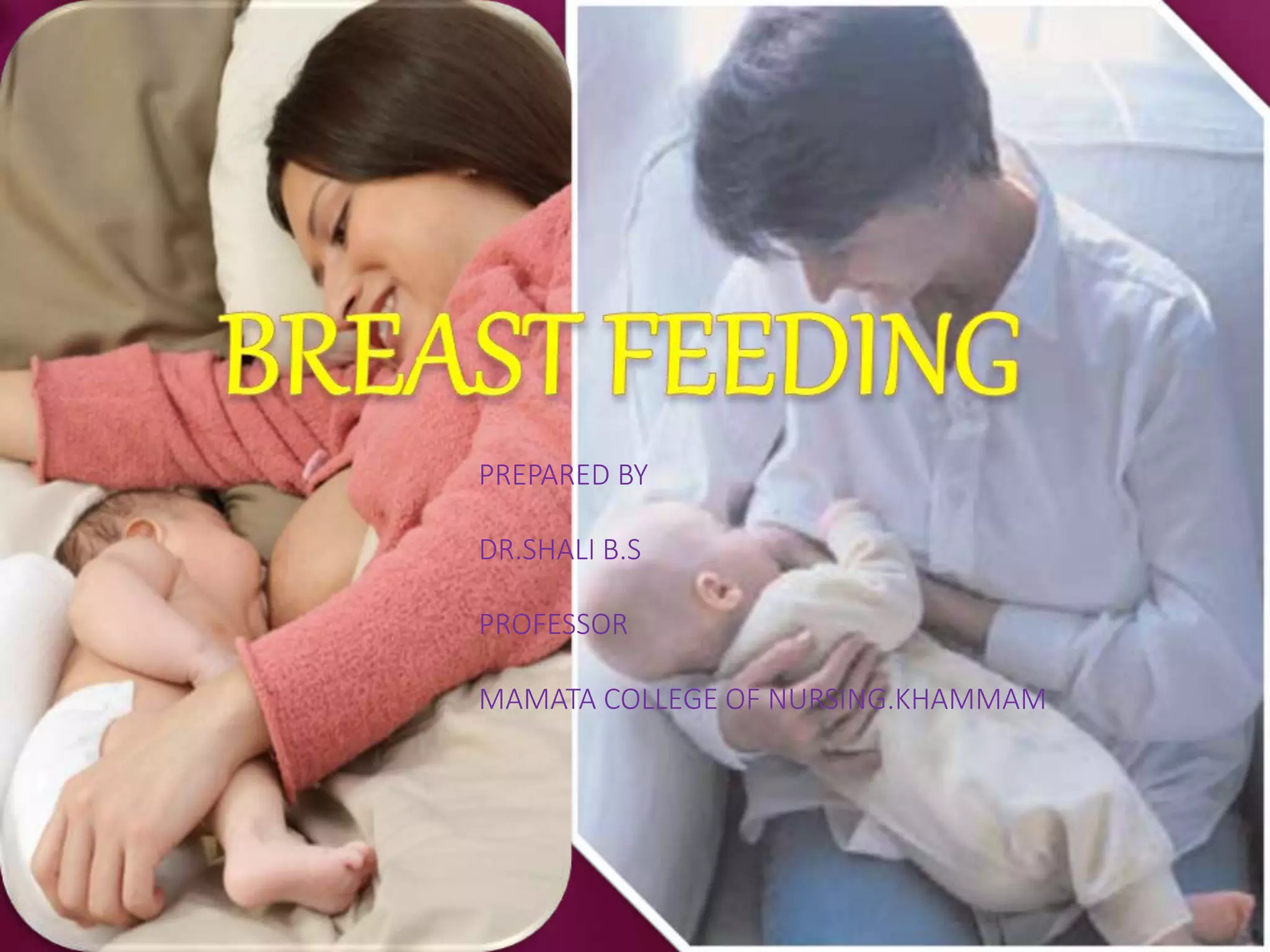
Brest feeding is the natural feeding and best milk. It
provides immunologic factors to certain diseases
and protection from the environment. Almost every
delay or deficiency in host defense maturation is
countered by a factor in breast milk that
compensates for it.
• Breastfeeding is the ideal way to feed babies.
It also helps keep your baby from getting sick
as often. Breastfeeding is a special time for
you and your baby to get to know one another.
It is also convenient, inexpensive and good for
your health.
COMPOSITION OF
HUMAN &COW’S
MILK
COMPOSITION ‘S HUMAN MILK COW’S MILK
Water (g) 88 87.5
Energy(kcal) 65 67
Protein (g) 1.1 3.2
Carbohydrate(g) 7.4 4.4
Fat(g) 3.4 4.1
Calcium(mg) 28 120
Phosphrous(mg) 11 90
Iron (mg) ……. 0.2
Carotene (g) 137 174
Thiamine (mg) 0.02 0.05
riboflavin(mg) 0.02 0.19
Cont..
Vitamin c(g) 3 2
Caseinogens-lactaibumin
ratio
1.2 3.1
COMPOSITION OF BREAST MILK
• COLOSTRUM
• TRANSITIONAL MILK
• MATURE MILK
• PRETERM MILK
• FORE MILK
• HIND MILK
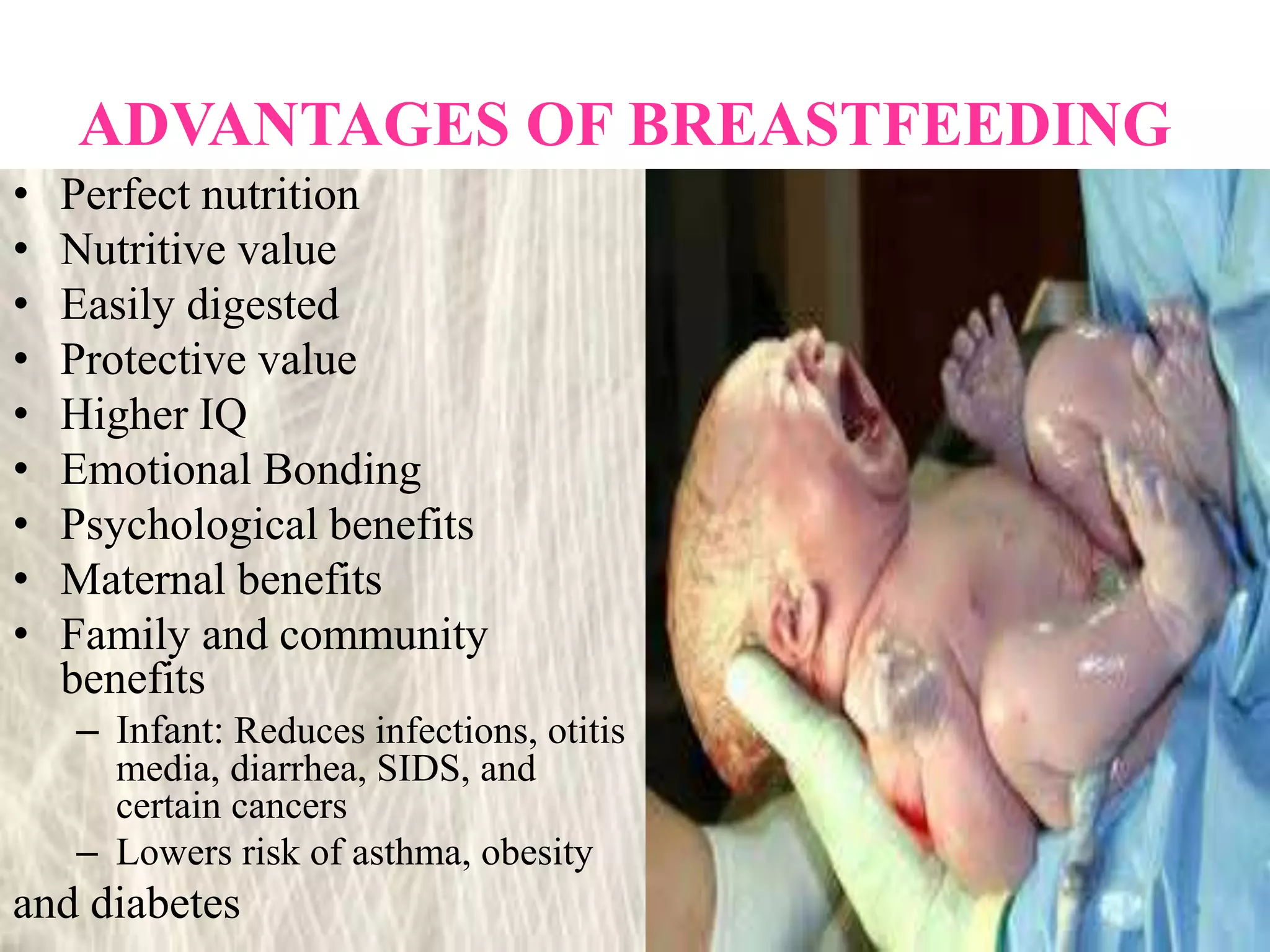
ADVANTAGES OF BREASTFEEDING
• Perfect nutrition
• Nutritive value
• Easily digested
• Protective value
• Higher IQ
• Emotional Bonding
• Psychological benefits
• Maternal benefits
• Family and community
benefits
– Infant: Reduces infections, otitis
media, diarrhea, SIDS, and
certain cancers
– Lowers risk of asthma, obesity
and diabetes
TO THE MOTHER
• Helps delay next pregnancy
• Weight loss
• Bonding
• Hormone release
• Long-term health effects
• Less risk of breast cancer, ovarian
cancer, and endometrial cancer.
• Breastfeeding diabetic mothers
require less insulin.
• Reduced risk of post-partum
bleeding.
• Breast milk saves money and
time.
TO THE FAMILY
• Reduces absenteeism of mothers from work as they
are less prone to disease.
• Economical
MANAGEMENT OF BREAST FEEDING
ANTENATAL PREPARATION
– Massage breasts and rub nipples gently
– Avoid using soap on nipples
– Expose nipples to air and briefly to sunlight
THE FIRST FEED
• In the half hour after birth, the baby's suckling reflex
is strongest, and the baby is more alert, so it is the
ideal time to start breastfeeding.
• Breast feeding should be initiated with in first half
hour to one hour or as soon as possible.
• It should be initiated within 2-4 hr after cesarean
section
LATCHING ON FEEDING AND
POSITIONING
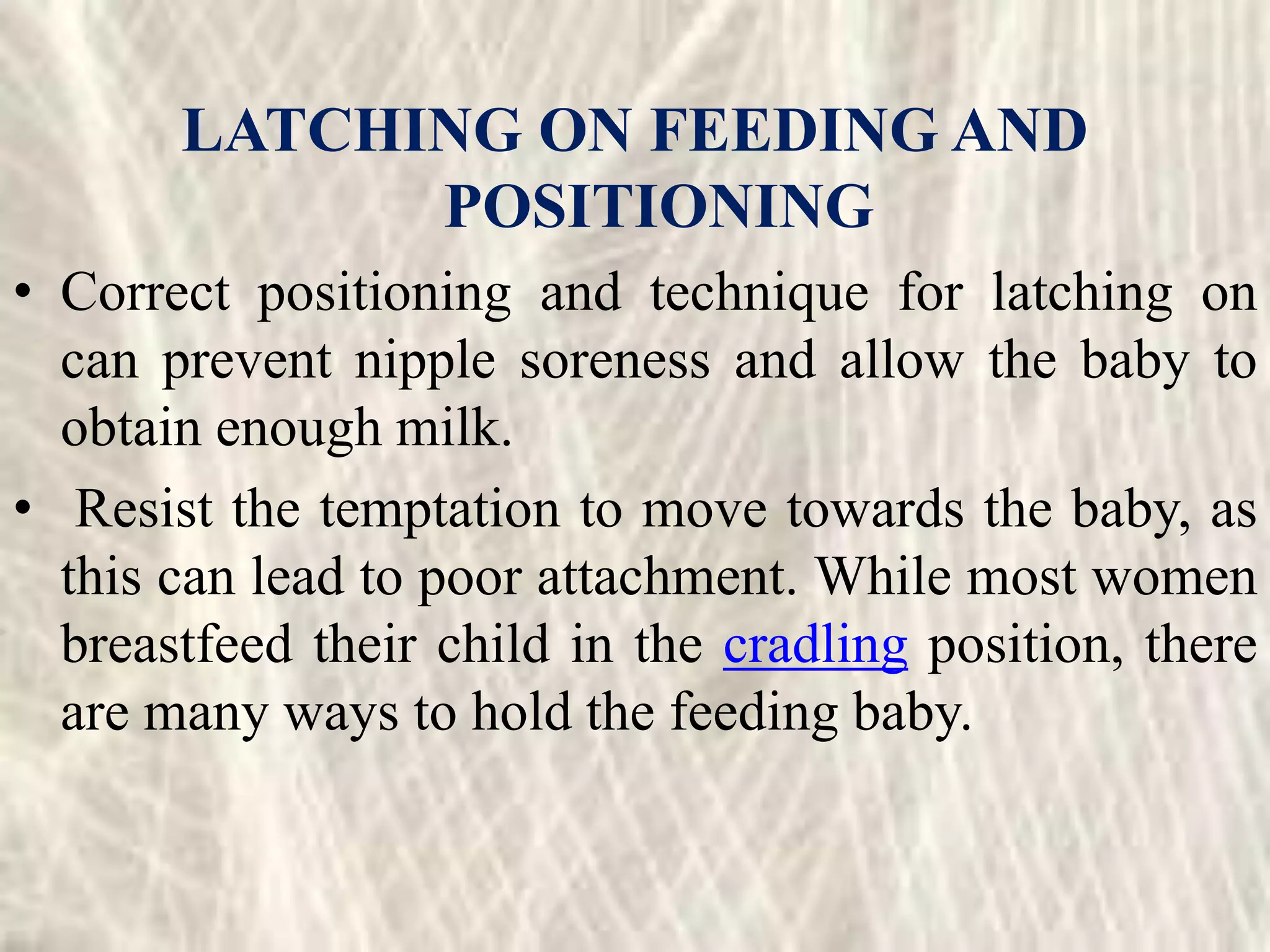
• Correct positioning and technique for latching on
can prevent nipple soreness and allow the baby to
obtain enough milk.
• Resist the temptation to move towards the baby, as
this can lead to poor attachment. While most women
breastfeed their child in the cradling position, there
are many ways to hold the feeding baby.
• Mother aligns baby so that baby’s nose is in line
with mothers nipple. Mother supports baby’s neck
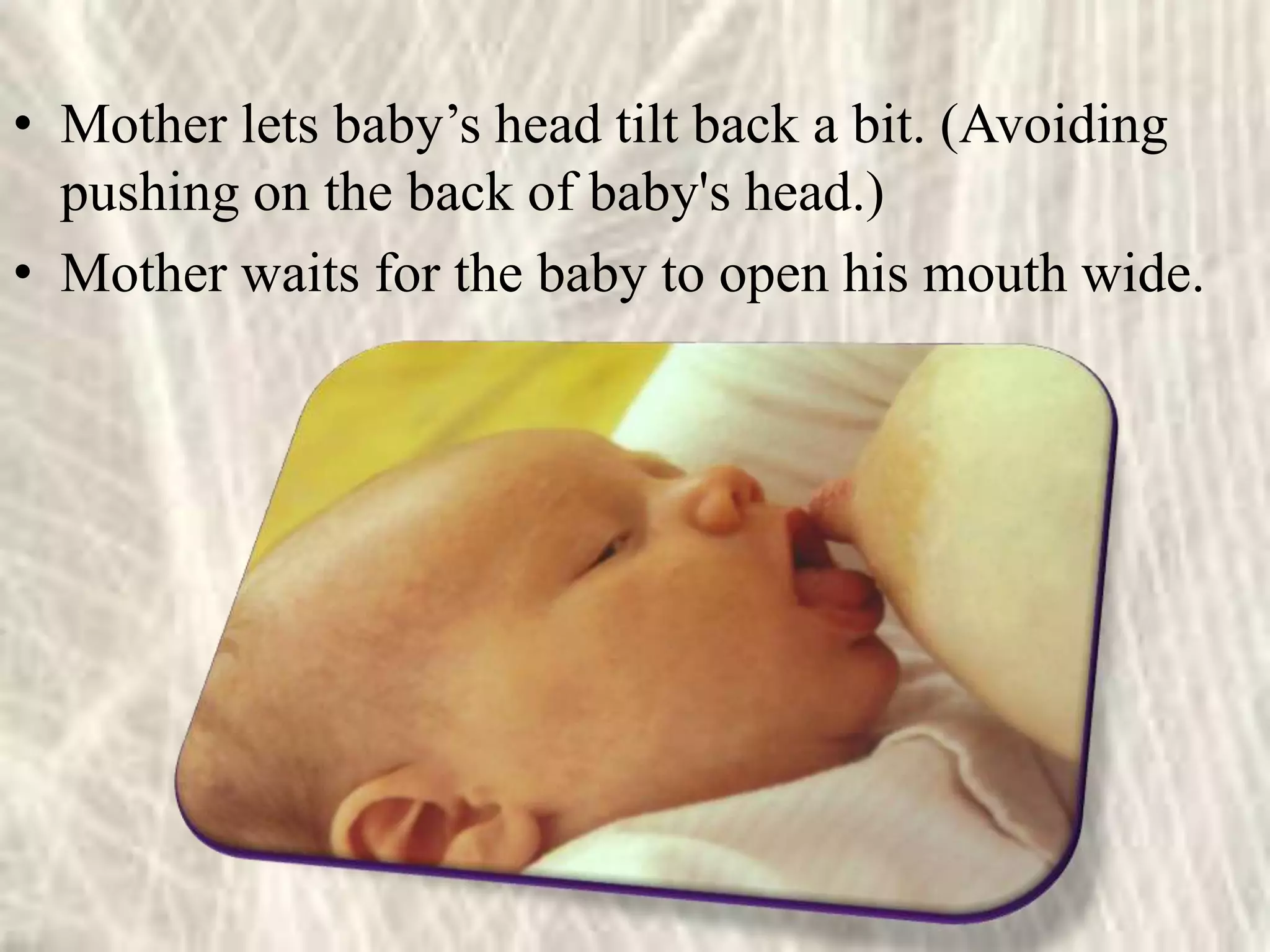
• Mother lets baby’s head tilt back a bit. (Avoiding
pushing on the back of baby's head.)
• Mother waits for the baby to open his mouth wide.
• Mother moves baby quickly
towards the breast leading
with the baby’s chin.
• Mother aims for baby’s bottom
lip to touch the breast well
away from the base of the
nipple and aims the nipple
towards the roof of the baby’s
mouth.
• As baby lunges for the breast,
mother gives a gentle but firm
push on the back of baby’s
shoulders.
Baby is now latched on to the breast.
• Pulling the baby away without breaking suction
could be painful and lead to sore nipples.
• After burping the baby, mother should offer the
other breast.
• There are several positions for burping (bubbling)
the baby.
SIGNS OF GOOD ATTACHMENT
• Mouth wide open
• Lower lip is turned outside
• If seen, more of areola visible above top lip than
below bottom lip
• Rounded cheeks
• Chin touching the breast
• Rapid sucks initially turning to slow deep sucks with
swallows
• Contented baby who stays on breast
• No pain for the mother
• Tongue under the teat
INCORRECT SUCKING POSITION
• Mouth is not wide open
• Chin is away from the breast
• Baby is sucking only nipple
• Most black portion of the breast is outside the baby’s
mouth
• Tongue away from the teat
COMMON POSITIONS FOR
BREASTFEEDING
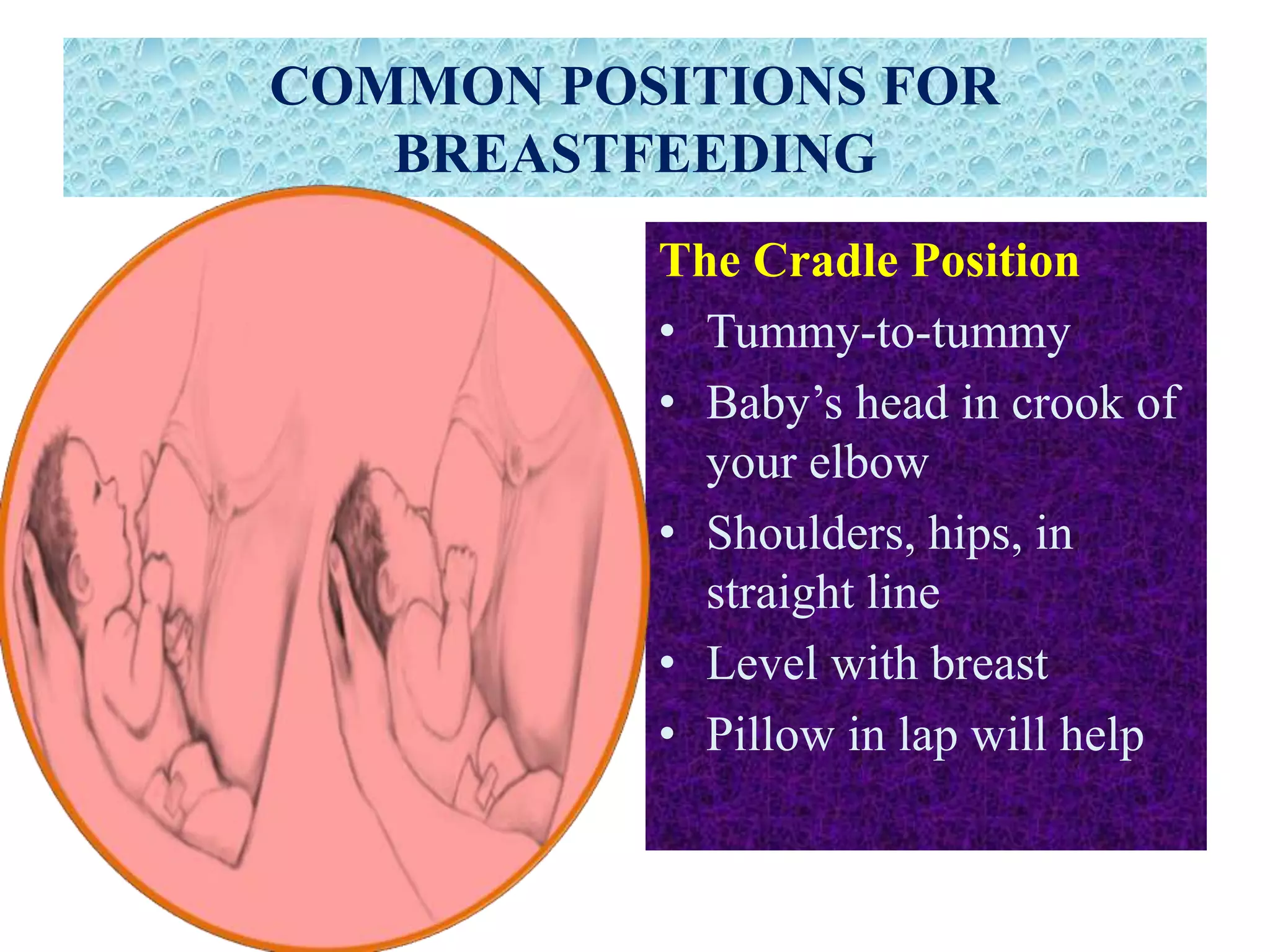
The Cradle Position
• Tummy-to-tummy
• Baby’s head in crook of
your elbow
• Shoulders, hips, in
straight line
• Level with breast
• Pillow in lap will help
The Football Position
• Baby’s legs are under your
arm
• Use pillows
• Helpful for baby’s who are
having trouble latching on
The Side-lying Position
• Lie on your side
• Use pillows
• Tummy-to-tummy
• Baby’s mouth in
line with nipple
COMMON POSITIONS FOR
BREASTFEEDING TWIN BABIES
THE IMPORTANCE OF GOOD POSITIONING
AND ATTACHMENT
• Ensures Efficient Milk Transfer
• Relaxed Mother
• Prevents Mother Becoming Sore
• Ensures Sufficient milk Supply
EXCLUSIVE BREASTFEEDING
• National and international guidelines recommend
that all infants be breastfed exclusively for the first
six months of life.
• Breastfeeding may continue with the addition of
appropriate foods, for two years or more.
• Exclusively breastfed infants feed anywhere from 6
to 14 times a day.
• Newborns consume from 30 to 90 ml per feed. After
the age of four weeks, babies consume about 120ml
per feed.
• Each baby is different, but as it grows the amount
will increase.
• Is important to recognize the baby's hunger signs.
• If necessary, it is possible to estimate feeding from
wet and soiled nappies (diapers): 8 wet cloth or 5–6
wet disposable, and 2–5 soiled per 24 hours suggests
an acceptable amount of input for newborns older
than 5–6 days old.
• After 2–3 months, stool frequency is a less accurate
measure of adequate input as some normal infants
may go up to 10 days between stools.
• Babies can also be weighed before and after feeds.
It is important for the mother to:
• Exclusive breastfeeding for 6
months
• Continue breastfeeding for up to 2
years or beyond.
• Introduce nutritionally adequate
and safe complementary foods
after the infant reaches 6 months
of age, while continuing to
breastfeed for 2 years or beyond.
EXPRESSION OF BREAST MILK
BREAST PROBLEMS
Engorgement
• May occur between 2nd and 6th day when the milk
“comes in”
• Occurs more frequently in first-time mothers
Mastitis
• Occurs when plugged duct is not treated
• Flu-like symptoms (tired, aches, fever)
• Start treatment immediately
– Contact physician for antibiotics
– Apply heat
– Breastfeed frequently
– Rest
• Sore or Cracked nipple
– properly position infant
– Use pillows
– Check for good latch on
• Do not use ointments or creams
• Express a few drops of milk onto nipple after
feeding (antibacterial properties)
• Allow nipples to air dry
• Breast abscess
• Inverted nipple
• Fullness
CONTRAINDICATIONS TO BREASTFEEDING
Maternal disease
• Anthrax
• HIV
Maternal medications
• Street drugs
• Some anti-neoplastics
Infant
• Severe illness
• Inborn errors of metabolism
I’m Learning to Breastfeed
Take me to my MOM when I am Hungry!

Breast feeding ppt

  • 1.
  • 2.
    “ All babiesdeserve the natural protections of breastfeeding. It's the best way to ensure the proper nutrition and bonding for women who are able to breastfeed.”
  • 3.
    Brest feeding isthe natural feeding and best milk. It provides immunologic factors to certain diseases and protection from the environment. Almost every delay or deficiency in host defense maturation is countered by a factor in breast milk that compensates for it.
  • 4.
    • Breastfeeding isthe ideal way to feed babies. It also helps keep your baby from getting sick as often. Breastfeeding is a special time for you and your baby to get to know one another. It is also convenient, inexpensive and good for your health.
  • 5.
  • 6.
    COMPOSITION ‘S HUMANMILK COW’S MILK Water (g) 88 87.5 Energy(kcal) 65 67 Protein (g) 1.1 3.2 Carbohydrate(g) 7.4 4.4 Fat(g) 3.4 4.1 Calcium(mg) 28 120 Phosphrous(mg) 11 90 Iron (mg) ……. 0.2 Carotene (g) 137 174 Thiamine (mg) 0.02 0.05 riboflavin(mg) 0.02 0.19
  • 7.
    Cont.. Vitamin c(g) 32 Caseinogens-lactaibumin ratio 1.2 3.1
  • 8.
    COMPOSITION OF BREASTMILK • COLOSTRUM • TRANSITIONAL MILK • MATURE MILK • PRETERM MILK • FORE MILK • HIND MILK
  • 9.
    ADVANTAGES OF BREASTFEEDING •Perfect nutrition • Nutritive value • Easily digested • Protective value • Higher IQ • Emotional Bonding • Psychological benefits • Maternal benefits • Family and community benefits – Infant: Reduces infections, otitis media, diarrhea, SIDS, and certain cancers – Lowers risk of asthma, obesity and diabetes
  • 10.
    TO THE MOTHER •Helps delay next pregnancy • Weight loss • Bonding • Hormone release • Long-term health effects • Less risk of breast cancer, ovarian cancer, and endometrial cancer. • Breastfeeding diabetic mothers require less insulin. • Reduced risk of post-partum bleeding. • Breast milk saves money and time.
  • 11.
    TO THE FAMILY •Reduces absenteeism of mothers from work as they are less prone to disease. • Economical MANAGEMENT OF BREAST FEEDING ANTENATAL PREPARATION – Massage breasts and rub nipples gently – Avoid using soap on nipples – Expose nipples to air and briefly to sunlight
  • 12.
    THE FIRST FEED •In the half hour after birth, the baby's suckling reflex is strongest, and the baby is more alert, so it is the ideal time to start breastfeeding. • Breast feeding should be initiated with in first half hour to one hour or as soon as possible. • It should be initiated within 2-4 hr after cesarean section
  • 13.
    LATCHING ON FEEDINGAND POSITIONING • Correct positioning and technique for latching on can prevent nipple soreness and allow the baby to obtain enough milk. • Resist the temptation to move towards the baby, as this can lead to poor attachment. While most women breastfeed their child in the cradling position, there are many ways to hold the feeding baby.
  • 14.
    • Mother alignsbaby so that baby’s nose is in line with mothers nipple. Mother supports baby’s neck
  • 15.
    • Mother letsbaby’s head tilt back a bit. (Avoiding pushing on the back of baby's head.) • Mother waits for the baby to open his mouth wide.
  • 16.
    • Mother movesbaby quickly towards the breast leading with the baby’s chin. • Mother aims for baby’s bottom lip to touch the breast well away from the base of the nipple and aims the nipple towards the roof of the baby’s mouth. • As baby lunges for the breast, mother gives a gentle but firm push on the back of baby’s shoulders.
  • 17.
    Baby is nowlatched on to the breast.
  • 18.
    • Pulling thebaby away without breaking suction could be painful and lead to sore nipples. • After burping the baby, mother should offer the other breast. • There are several positions for burping (bubbling) the baby.
  • 19.
    SIGNS OF GOODATTACHMENT • Mouth wide open • Lower lip is turned outside • If seen, more of areola visible above top lip than below bottom lip • Rounded cheeks • Chin touching the breast • Rapid sucks initially turning to slow deep sucks with swallows • Contented baby who stays on breast • No pain for the mother • Tongue under the teat
  • 20.
    INCORRECT SUCKING POSITION •Mouth is not wide open • Chin is away from the breast • Baby is sucking only nipple • Most black portion of the breast is outside the baby’s mouth • Tongue away from the teat
  • 21.
    COMMON POSITIONS FOR BREASTFEEDING TheCradle Position • Tummy-to-tummy • Baby’s head in crook of your elbow • Shoulders, hips, in straight line • Level with breast • Pillow in lap will help
  • 22.
    The Football Position •Baby’s legs are under your arm • Use pillows • Helpful for baby’s who are having trouble latching on
  • 23.
    The Side-lying Position •Lie on your side • Use pillows • Tummy-to-tummy • Baby’s mouth in line with nipple
  • 24.
  • 25.
    THE IMPORTANCE OFGOOD POSITIONING AND ATTACHMENT • Ensures Efficient Milk Transfer • Relaxed Mother • Prevents Mother Becoming Sore • Ensures Sufficient milk Supply
  • 26.
  • 27.
    • National andinternational guidelines recommend that all infants be breastfed exclusively for the first six months of life. • Breastfeeding may continue with the addition of appropriate foods, for two years or more.
  • 28.
    • Exclusively breastfedinfants feed anywhere from 6 to 14 times a day. • Newborns consume from 30 to 90 ml per feed. After the age of four weeks, babies consume about 120ml per feed. • Each baby is different, but as it grows the amount will increase. • Is important to recognize the baby's hunger signs.
  • 29.
    • If necessary,it is possible to estimate feeding from wet and soiled nappies (diapers): 8 wet cloth or 5–6 wet disposable, and 2–5 soiled per 24 hours suggests an acceptable amount of input for newborns older than 5–6 days old. • After 2–3 months, stool frequency is a less accurate measure of adequate input as some normal infants may go up to 10 days between stools. • Babies can also be weighed before and after feeds.
  • 30.
    It is importantfor the mother to: • Exclusive breastfeeding for 6 months • Continue breastfeeding for up to 2 years or beyond. • Introduce nutritionally adequate and safe complementary foods after the infant reaches 6 months of age, while continuing to breastfeed for 2 years or beyond.
  • 31.
  • 32.
    BREAST PROBLEMS Engorgement • Mayoccur between 2nd and 6th day when the milk “comes in” • Occurs more frequently in first-time mothers Mastitis • Occurs when plugged duct is not treated • Flu-like symptoms (tired, aches, fever) • Start treatment immediately – Contact physician for antibiotics – Apply heat
  • 33.
    – Breastfeed frequently –Rest • Sore or Cracked nipple – properly position infant – Use pillows – Check for good latch on • Do not use ointments or creams • Express a few drops of milk onto nipple after feeding (antibacterial properties) • Allow nipples to air dry
  • 34.
    • Breast abscess •Inverted nipple • Fullness CONTRAINDICATIONS TO BREASTFEEDING Maternal disease • Anthrax • HIV Maternal medications • Street drugs • Some anti-neoplastics Infant • Severe illness • Inborn errors of metabolism
  • 35.
    I’m Learning toBreastfeed Take me to my MOM when I am Hungry!