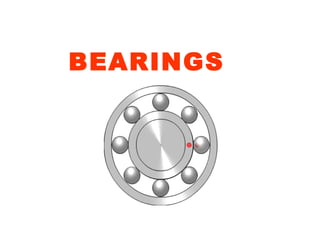
BEARINGS
A bearing is a device to permit constrained
relative motion between two parts, typically rotation
or linear movement.
Bearings may be classified broadly according to
the motions they allow and according to their
principle of operation
BEARINGS
FUNCTION OF A BEARING
• The main function of a rotating shaft is to transmit
power from one end of the line to the other.
• It needs a good supportsupport to ensure stabilitystability and
frictionless rotation. The supportsupport for the shaft is
known as “bearing”.
• The shaft has a “running fit” in a bearing. All bearing
are provided some lubrication arrangement to
reduced friction between shaft and bearing.
• Hold &Guide to shaft
• Smooth & Free motion to Save power
Types of Bearings
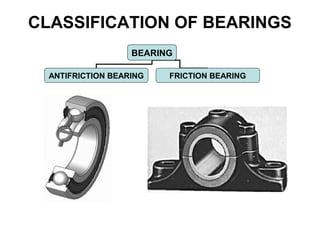
CLASSIFICATION OF BEARINGS
BEARING
ANTIFRICTION BEARING FRICTION BEARING
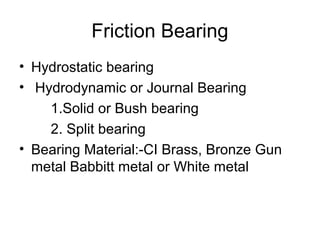
Friction Bearing
• Hydrostatic bearing
• Hydrodynamic or Journal Bearing
1.Solid or Bush bearing
2. Split bearing
• Bearing Material:-CI Brass, Bronze Gun
metal Babbitt metal or White metal
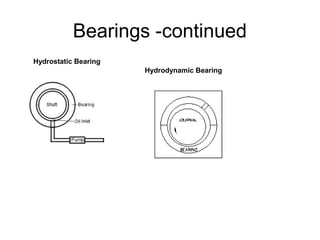
Bearings -continued
Hydrostatic Bearing
Hydrodynamic Bearing
ANTI FRICTION BEARING
• BALL BEARING
• ROLLER BEARING
• THRUST BEARING
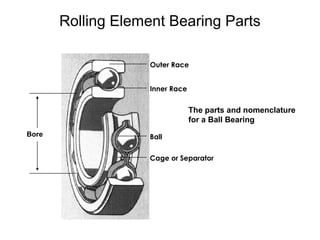
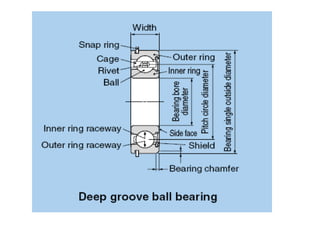
Rolling Element Bearing Parts
The parts and nomenclature
for a Ball Bearing
Outer Race
Inner Race
Ball
Cage or Separator
Bore
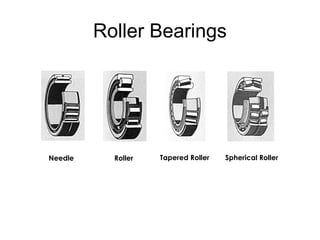
Roller Bearings
Needle Roller Tapered Roller Spherical Roller
BALL BEARING
• Deep Groove Ball Bearings
• Self Aligning Ball Bearings
• Angular Contact Ball Bearings
ROLLER BEARING
•Cylindrical Roller Bearings
•Needle Roller Bearings
•Spherical Roller Bearings
•Taper Roller Bearings
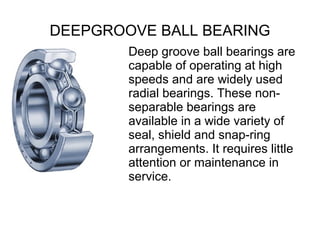
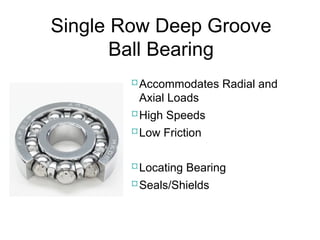
DEEPGROOVE BALL BEARING
Deep groove ball bearings are
capable of operating at high
speeds and are widely used
radial bearings. These non-
separable bearings are
available in a wide variety of
seal, shield and snap-ring
arrangements. It requires little
attention or maintenance in
service.
Accommodates Radial and
Axial Loads
High Speeds
Low Friction
Locating Bearing
Seals/Shields
Single Row Deep Groove
Ball Bearing
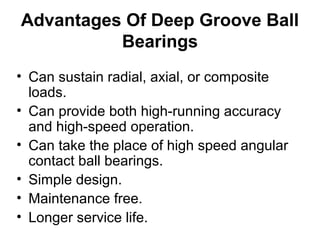
Advantages Of Deep Groove Ball
Bearings
• Can sustain radial, axial, or composite
loads.
• Can provide both high-running accuracy
and high-speed operation.
• Can take the place of high speed angular
contact ball bearings.
• Simple design.
• Maintenance free.
• Longer service life.
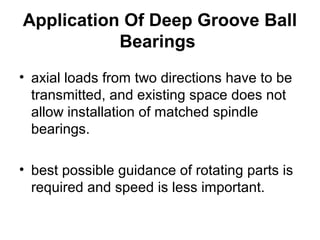
Application Of Deep Groove Ball
Bearings
• axial loads from two directions have to be
transmitted, and existing space does not
allow installation of matched spindle
bearings.
• best possible guidance of rotating parts is
required and speed is less important.
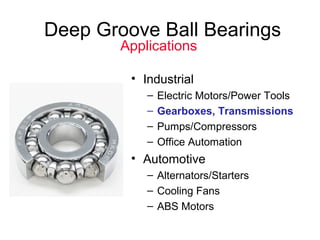
Deep Groove Ball Bearings
• Industrial
– Electric Motors/Power Tools
– Gearboxes, Transmissions
– Pumps/Compressors
– Office Automation
• Automotive
– Alternators/Starters
– Cooling Fans
– ABS Motors
Applications
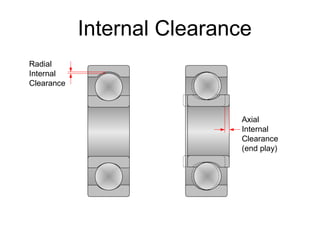
Internal Clearance
Radial
Internal
Clearance
Axial
Internal
Clearance
(end play)
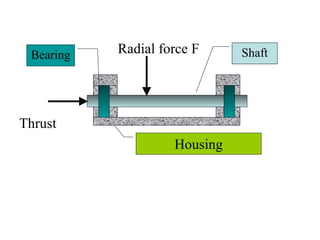
Bearing Basics
Thrust
Radial force F ShaftBearing
Housing
Axial
Radial
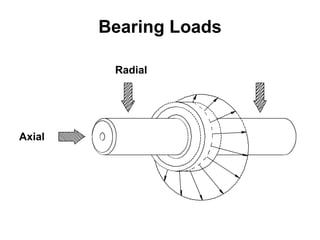
Bearing Loads
Radial loads originate from the
• Weight of the shaft
• Weight of the pulley
• Tension of the belt
• Weight of the propeller
• Propeller rotation
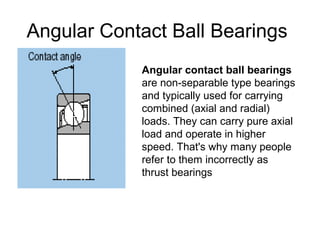
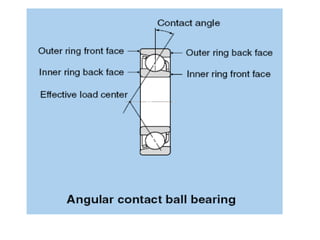
Angular Contact Ball Bearings
Angular contact ball bearings
are non-separable type bearings
and typically used for carrying
combined (axial and radial)
loads. They can carry pure axial
load and operate in higher
speed. That's why many people
refer to them incorrectly as
thrust bearings
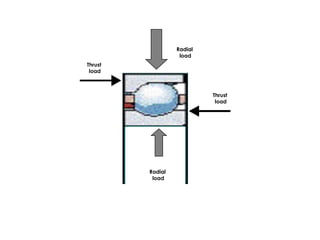
Thrust
load
Radial
load
Radial
load
Thrust
load
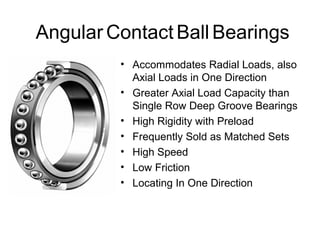
Angular Contact Ball Bearings
• Accommodates Radial Loads, also
Axial Loads in One Direction
• Greater Axial Load Capacity than
Single Row Deep Groove Bearings
• High Rigidity with Preload
• Frequently Sold as Matched Sets
• High Speed
• Low Friction
• Locating In One Direction
Types Of Angular contact ball
bearings
• Single Row Bearings
• Double Row Bearings
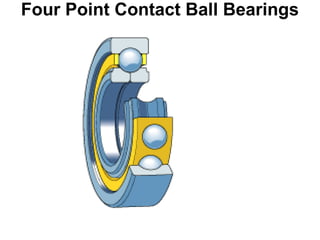
• Four Point Contact Ball Bearings
There are three basic types of angular contact ball bearings
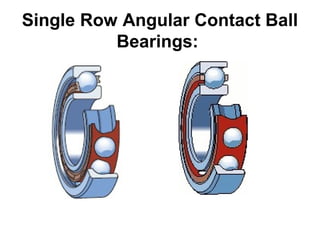
Single Row Angular Contact Ball
Bearings:
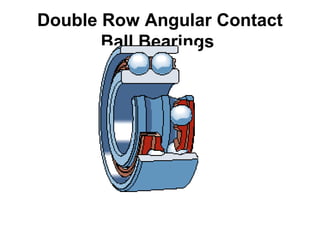
Double Row Angular Contact
Ball Bearings
Four Point Contact Ball Bearings
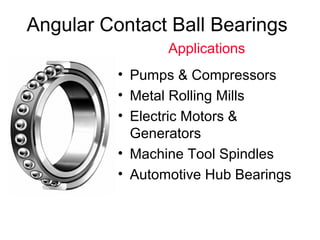
Angular Contact Ball Bearings
• Pumps & Compressors
• Metal Rolling Mills
• Electric Motors &
Generators
• Machine Tool Spindles
• Automotive Hub Bearings
Applications
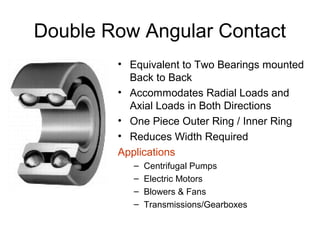
Double Row Angular Contact
• Equivalent to Two Bearings mounted
Back to Back
• Accommodates Radial Loads and
Axial Loads in Both Directions
• One Piece Outer Ring / Inner Ring
• Reduces Width Required
Applications
– Centrifugal Pumps
– Electric Motors
– Blowers & Fans
– Transmissions/Gearboxes
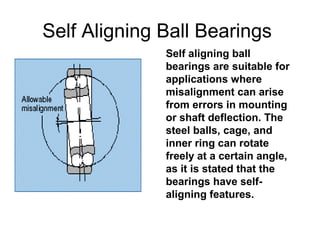
Self Aligning Ball Bearings
Self aligning ball
bearings are suitable for
applications where
misalignment can arise
from errors in mounting
or shaft deflection. The
steel balls, cage, and
inner ring can rotate
freely at a certain angle,
as it is stated that the
bearings have self-
aligning features.
Self Aligning Ball Bearings
Specifications & Standards
• Standard cage types - All bearing series
are equipped with a pressed cage, except
2322S, which is equipped with a machined
cage.
• Misalignment - They are designed to
adjust to the angular misalignment from
one bearing to the other within the
permissible limits.
• Cages - There are standard cages but
some may have pressed steel cage, glass
fiber reinforced, or machined brass cages
Advantages Of Self Aligning Ball
Bearings
• Have the lowest friction of all rolling
bearings.
• Run cooler even at high speeds.
• Easy mounting and dismounting.
• The permissible operating speed is not
dependent on the common criteria like
heat generation or cage stability and
strength.
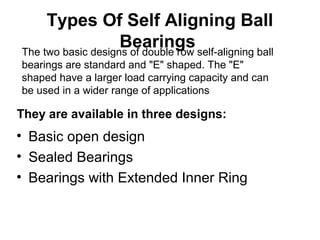
Types Of Self Aligning Ball
Bearings
• Basic open design
• Sealed Bearings
• Bearings with Extended Inner Ring
The two basic designs of double row self-aligning ball
bearings are standard and "E" shaped. The "E"
shaped have a larger load carrying capacity and can
be used in a wider range of applications
They are available in three designs:
Application Of Self Aligning Ball
Bearings
• Self-aligning ball bearings are used for
commercial ground shafting applications.
• Since axial load capacity is limited, self-
aligning ball bearings are not suitable for
applications with heavy axial loads.
• Furthermore, if an adapter is used on the
tapered bore of the inner diameter,
installation and disassembly are much
simpler and for this reason adapters are
often used on equipment with drive shafts.
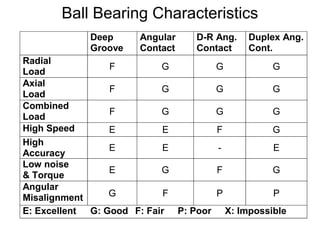
Ball Bearing Characteristics
Deep
Groove
Angular
Contact
D-R Ang.
Contact
Duplex Ang.
Cont.
Radial
Load
F G G G
Axial
Load
F G G G
Combined
Load
F G G G
High Speed E E F G
High
Accuracy
E E - E
Low noise
& Torque
E G F G
Angular
Misalignment G F P P
E: Excellent G: Good F: Fair P: Poor X: Impossible
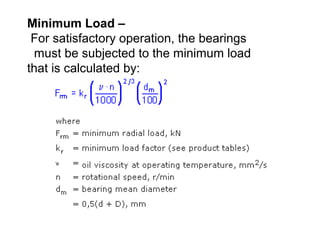
Minimum Load –
For satisfactory operation, the bearings
must be subjected to the minimum load
that is calculated by:
Buying Tips
Selecting Deep Groove Ball Bearings
Before selecting a deep groove ball bearing you
should take note of the followings:
•Material - Chrome steel, High temperature steel,
ball material
•Maintenance requirements bearing applications
•Service life
•Bearing clearance
•Sealing efficiency
•Contamination exclusion and grease retention
•Low-friction seals for energy saving
Types Of Cylindrical Roller
Bearings
• Single or Double Row Bearings
• Full Complement Cylindrical Roller
Bearings
• Crossed Cylindrical Roller Bearing
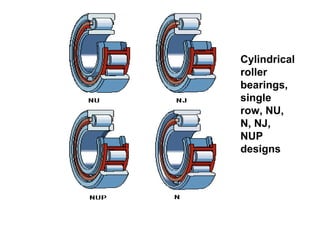
Cylindrical
roller
bearings,
single
row, NU,
N, NJ,
NUP
designs
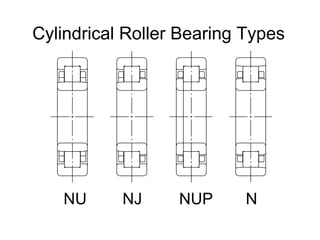
Cylindrical Roller Bearing Types
NU NJ NUP N
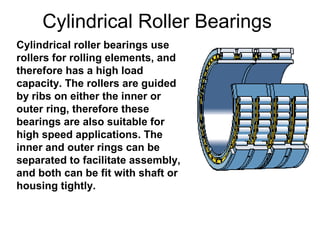
Cylindrical Roller Bearings
Cylindrical roller bearings use
rollers for rolling elements, and
therefore has a high load
capacity. The rollers are guided
by ribs on either the inner or
outer ring, therefore these
bearings are also suitable for
high speed applications. The
inner and outer rings can be
separated to facilitate assembly,
and both can be fit with shaft or
housing tightly.
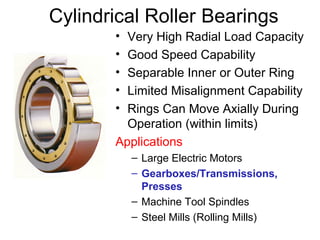
Cylindrical Roller Bearings
• Very High Radial Load Capacity
• Good Speed Capability
• Separable Inner or Outer Ring
• Limited Misalignment Capability
• Rings Can Move Axially During
Operation (within limits)
Applications
– Large Electric Motors
– Gearboxes/Transmissions,
Presses
– Machine Tool Spindles
– Steel Mills (Rolling Mills)
Physical Characteristics
Although the rolling elements in cylindrical roller
bearings are called "cylindrical," they are not true
cylinders. True cylinders would produce stress
concentrations at the ends of the roller-race contact,
resulting in high wear and high sensitivity to
misalignment. Instead, rollers are usually crowned or
end relieved.
Application Of Cylindrical Roller Bearings
Cylindrical roller bearings are used in power generation,
oilfield, mining and aggregate processing, gear drives,
rolling mills, machine tools, transmissions, vibration
machines and as wheelset bearings for rail vehicles.
Needle Roller Bearings
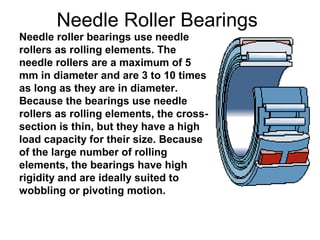
Needle roller bearings use needle
rollers as rolling elements. The
needle rollers are a maximum of 5
mm in diameter and are 3 to 10 times
as long as they are in diameter.
Because the bearings use needle
rollers as rolling elements, the cross-
section is thin, but they have a high
load capacity for their size. Because
of the large number of rolling
elements, the bearings have high
rigidity and are ideally suited to
wobbling or pivoting motion.
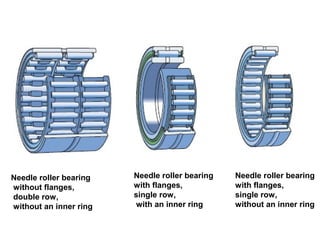
Needle roller bearing
without flanges,
double row,
without an inner ring
Needle roller bearing
with flanges,
single row,
with an inner ring
Needle roller bearing
with flanges,
single row,
without an inner ring
Physical Characteristics
• referred to as needle rollers.
• Needle Rollers are used for needle roller
bearings and are rigid and highly accurate.
• In spite of their low cross section the
bearings have a high load carrying
capacity.
• Available with or without an inner ring.
• The needle rollers are a maximum of 5
mm in diameter and are 3 to 10 times as
long as they are in diameter.
Advantages of Needle Roller
Bearings
• Due to the smaller cross-section, greater rigidity,
higher load-carrying capacity and lower inertia of
the needle roller bearings help size and weight
reductions in the machinery.
• Though they are less wide, their load carrying
capacity is high and is most suitable for
applications where the load is high and the radial
space is less.
• Needle roller bearings, which are designed to
withstand oscillation can operate under severe
conditions and interchange with sliding bearings.
Typical Applications
• Transmissions, transfer cases, engines
and valve trains
• Steering and braking systems
• Axle support
• Power tools
• Copiers, fax machines, paper-moving
equipment
• Appliances
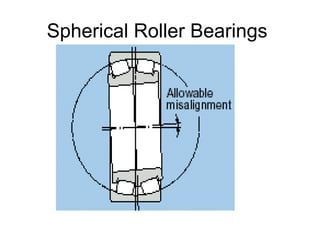
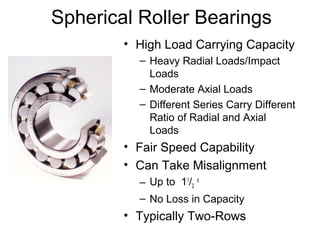
Spherical Roller Bearings
• High Load Carrying Capacity
– Heavy Radial Loads/Impact
Loads
– Moderate Axial Loads
– Different Series Carry Different
Ratio of Radial and Axial
Loads
• Fair Speed Capability
• Can Take Misalignment
– Up to 11
/2
o
– No Loss in Capacity
• Typically Two-Rows
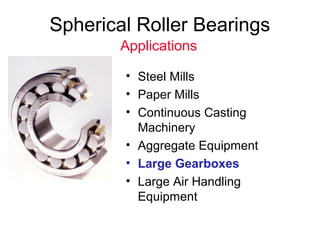
Spherical Roller Bearings
• Steel Mills
• Paper Mills
• Continuous Casting
Machinery
• Aggregate Equipment
• Large Gearboxes
• Large Air Handling
Equipment
Applications
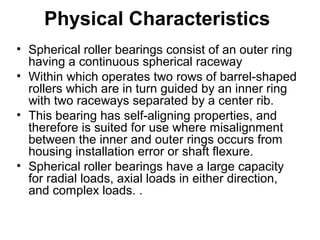
Physical Characteristics
• Spherical roller bearings consist of an outer ring
having a continuous spherical raceway
• Within which operates two rows of barrel-shaped
rollers which are in turn guided by an inner ring
with two raceways separated by a center rib.
• This bearing has self-aligning properties, and
therefore is suited for use where misalignment
between the inner and outer rings occurs from
housing installation error or shaft flexure.
• Spherical roller bearings have a large capacity
for radial loads, axial loads in either direction,
and complex loads. .
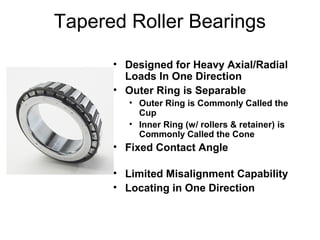
Tapered Roller Bearings
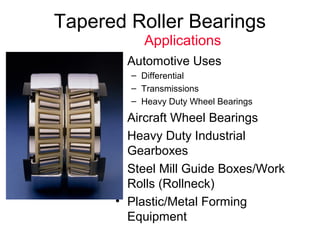
• Designed for Heavy Axial/Radial
Loads In One Direction
• Outer Ring is Separable
• Outer Ring is Commonly Called the
Cup
• Inner Ring (w/ rollers & retainer) is
Commonly Called the Cone
• Fixed Contact Angle
• Limited Misalignment Capability
• Locating in One Direction
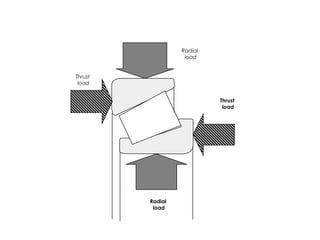
Radial
load
Radial
load
Thrust
load
Thrust
load
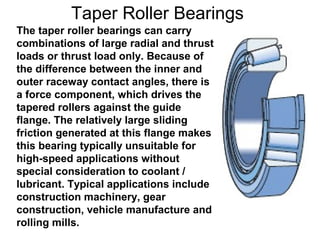
Taper Roller Bearings
The taper roller bearings can carry
combinations of large radial and thrust
loads or thrust load only. Because of
the difference between the inner and
outer raceway contact angles, there is
a force component, which drives the
tapered rollers against the guide
flange. The relatively large sliding
friction generated at this flange makes
this bearing typically unsuitable for
high-speed applications without
special consideration to coolant /
lubricant. Typical applications include
construction machinery, gear
construction, vehicle manufacture and
rolling mills.
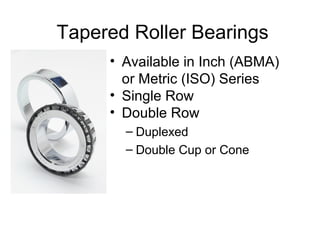
Tapered Roller Bearings
• Available in Inch (ABMA)
or Metric (ISO) Series
• Single Row
• Double Row
– Duplexed
– Double Cup or Cone
Advantages Of Taper roller
bearings
• Dimensional Stability
• Long Life Even In Contaminated Lubricant
• Durable Steel Cage
• Dimensionally Interchangeable With Other
Bearing Manufacturers
Types Of Taper Roller
Bearings
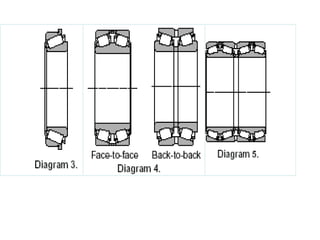
• Single-row tapered roller bearings
• Double-row tapered roller bearings
• Four row tapered roller bearings
Minimum load - For satisfactory operation, the bearings must
be subjected to the minimum load that is calculated by
Frm = 0,02 C
where
Frm , =, minimum radial load, kN
C, =, basic dynamic load rating
Physical Characteristics
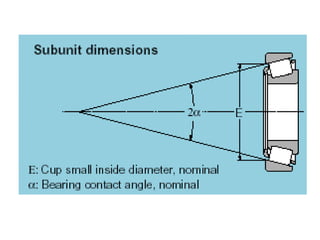
• Taper roller bearings have tapered inner and
outer ring raceways between which tapered
rollers are arranged.
• The projection lines of all the tapered surfaces
meet at a common point on the bearing axis.
Their design makes taper roller bearings
particularly suitable for the accommodation of
combined (radial and axial) loads.
• The axial load carrying capacity of the bearings
is largely determined by the contact angle. The
larger the angle, the higher the axial load
carrying capacity.
Tapered Roller Bearings
• Automotive Uses
– Differential
– Transmissions
– Heavy Duty Wheel Bearings
• Aircraft Wheel Bearings
• Heavy Duty Industrial
Gearboxes
• Steel Mill Guide Boxes/Work
Rolls (Rollneck)
• Plastic/Metal Forming
Equipment
Applications
Applications Of Taper Roller
Bearings
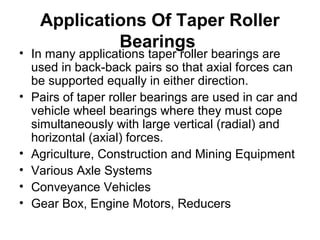
• In many applications taper roller bearings are
used in back-back pairs so that axial forces can
be supported equally in either direction.
• Pairs of taper roller bearings are used in car and
vehicle wheel bearings where they must cope
simultaneously with large vertical (radial) and
horizontal (axial) forces.
• Agriculture, Construction and Mining Equipment
• Various Axle Systems
• Conveyance Vehicles
• Gear Box, Engine Motors, Reducers
Thrust Bearings
• Thrust Ball Bearings
• Angular Contact Thrust Ball Bearings
• Cylindrical Roller Thrust Bearings
• Needle Roller Thrust Bearings
• Spherical Roller Thrust Bearings
• Taper Roller Thrust Bearings
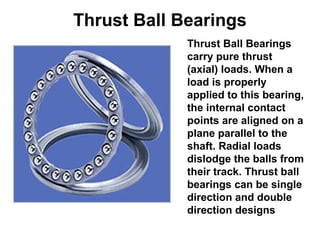
Thrust Ball Bearings
carry pure thrust
(axial) loads. When a
load is properly
applied to this bearing,
the internal contact
points are aligned on a
plane parallel to the
shaft. Radial loads
dislodge the balls from
their track. Thrust ball
bearings can be single
direction and double
direction designs
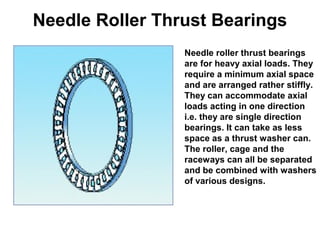
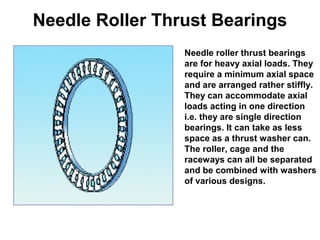
Needle Roller Thrust Bearings
Needle roller thrust bearings
are for heavy axial loads. They
require a minimum axial space
and are arranged rather stiffly.
They can accommodate axial
loads acting in one direction
i.e. they are single direction
bearings. It can take as less
space as a thrust washer can.
The roller, cage and the
raceways can all be separated
and be combined with washers
of various designs.
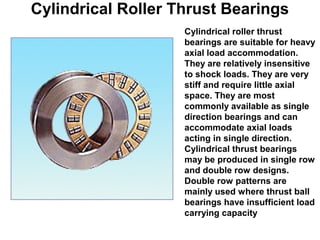
Cylindrical Roller Thrust Bearings
Cylindrical roller thrust
bearings are suitable for heavy
axial load accommodation.
They are relatively insensitive
to shock loads. They are very
stiff and require little axial
space. They are most
commonly available as single
direction bearings and can
accommodate axial loads
acting in single direction.
Cylindrical thrust bearings
may be produced in single row
and double row designs.
Double row patterns are
mainly used where thrust ball
bearings have insufficient load
carrying capacity
Needle Roller Thrust Bearings
Needle roller thrust bearings
are for heavy axial loads. They
require a minimum axial space
and are arranged rather stiffly.
They can accommodate axial
loads acting in one direction
i.e. they are single direction
bearings. It can take as less
space as a thrust washer can.
The roller, cage and the
raceways can all be separated
and be combined with washers
of various designs.
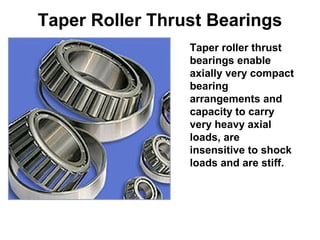
Taper Roller Thrust Bearings
Taper roller thrust
bearings enable
axially very compact
bearing
arrangements and
capacity to carry
very heavy axial
loads, are
insensitive to shock
loads and are stiff.
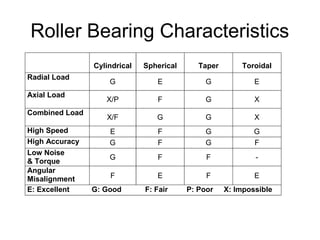
Roller Bearing Characteristics
Cylindrical Spherical Taper Toroidal
Radial Load
G E G E
Axial Load
X/P F G X
Combined Load
X/F G G X
High Speed E F G G
High Accuracy G F G F
Low Noise
& Torque
G F F -
Angular
Misalignment F E F E
E: Excellent G: Good F: Fair P: Poor X: Impossible
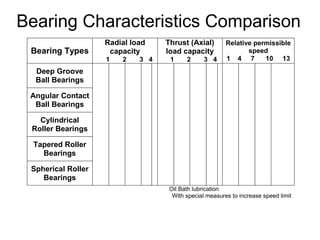
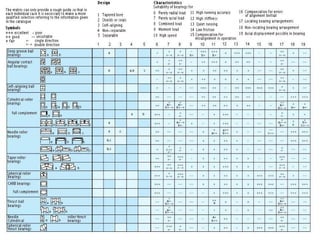
Bearing Characteristics Comparison
Bearing Types
Radial load
capacity
1 2 3 4
Thrust (Axial)
load capacity
1 2 3 4
Relative permissible
speed
1 4 7 10 13
Deep Groove
Ball Bearings
Angular Contact
Ball Bearings
Cylindrical
Roller Bearings
Tapered Roller
Bearings
Spherical Roller
Bearings
Oil Bath lubrication
With special measures to increase speed limit
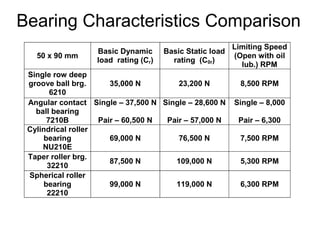
Bearing Characteristics Comparison
50 x 90 mm
Basic Dynamic
load rating (Cr)
Basic Static load
rating (C0r)
Limiting Speed
(Open with oil
lub.) RPM
Single row deep
groove ball brg.
6210
35,000 N 23,200 N 8,500 RPM
Angular contact
ball bearing
7210B
Single – 37,500 N
Pair – 60,500 N
Single – 28,600 N
Pair – 57,000 N
Single – 8,000
Pair – 6,300
Cylindrical roller
bearing
NU210E
69,000 N 76,500 N 7,500 RPM
Taper roller brg.
32210
87,500 N 109,000 N 5,300 RPM
Spherical roller
bearing
22210
99,000 N 119,000 N 6,300 RPM
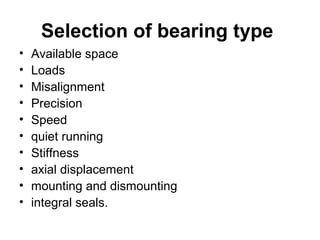
Selection of bearing type
• Available space
• Loads
• Misalignment
• Precision
• Speed
• quiet running
• Stiffness
• axial displacement
• mounting and dismounting
• integral seals.
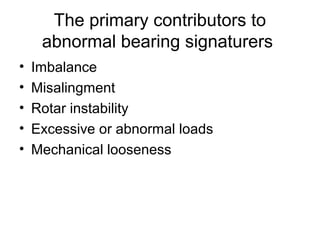
The primary contributors to
abnormal bearing signaturers
• Imbalance
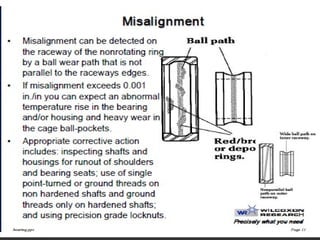
• Misalingment
• Rotar instability
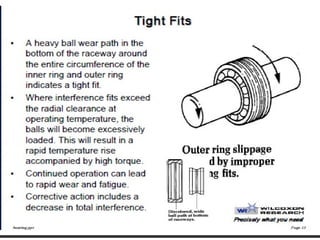
• Excessive or abnormal loads
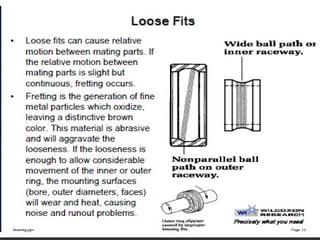
• Mechanical looseness
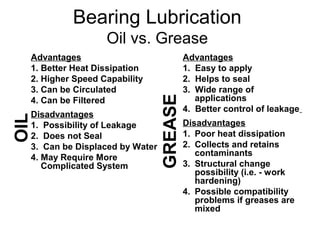
Bearing Lubrication
Oil vs. Grease
Advantages
1. Better Heat Dissipation
2. Higher Speed Capability
3. Can be Circulated
4. Can be Filtered
Disadvantages
1. Possibility of Leakage
2. Does not Seal
3. Can be Displaced by Water
4. May Require More
Complicated System
Advantages
1. Easy to apply
2. Helps to seal
3. Wide range of
applications
4. Better control of leakage
Disadvantages
1. Poor heat dissipation
2. Collects and retains
contaminants
3. Structural change
possibility (i.e. - work
hardening)
4. Possible compatibility
problems if greases are
mixed
OIL
GREASE
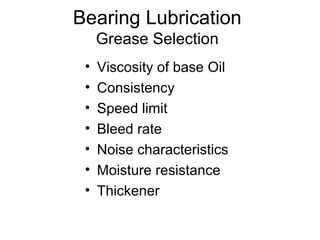
Bearing Lubrication
Grease Selection
• Viscosity of base Oil
• Consistency
• Speed limit
• Bleed rate
• Noise characteristics
• Moisture resistance
• Thickener
Bearing Description about basic, types, failure causes

Bearing Description about basic, types, failure causes

  • 1.
  • 2.
    A bearing isa device to permit constrained relative motion between two parts, typically rotation or linear movement. Bearings may be classified broadly according to the motions they allow and according to their principle of operation BEARINGS
  • 3.
    FUNCTION OF ABEARING • The main function of a rotating shaft is to transmit power from one end of the line to the other. • It needs a good supportsupport to ensure stabilitystability and frictionless rotation. The supportsupport for the shaft is known as “bearing”. • The shaft has a “running fit” in a bearing. All bearing are provided some lubrication arrangement to reduced friction between shaft and bearing. • Hold &Guide to shaft • Smooth & Free motion to Save power
  • 4.
  • 5.
  • 6.
    Friction Bearing • Hydrostaticbearing • Hydrodynamic or Journal Bearing 1.Solid or Bush bearing 2. Split bearing • Bearing Material:-CI Brass, Bronze Gun metal Babbitt metal or White metal
  • 7.
  • 8.
    ANTI FRICTION BEARING •BALL BEARING • ROLLER BEARING • THRUST BEARING
  • 9.
    Rolling Element BearingParts The parts and nomenclature for a Ball Bearing Outer Race Inner Race Ball Cage or Separator Bore
  • 11.
    Roller Bearings Needle RollerTapered Roller Spherical Roller
  • 12.
    BALL BEARING • DeepGroove Ball Bearings • Self Aligning Ball Bearings • Angular Contact Ball Bearings ROLLER BEARING •Cylindrical Roller Bearings •Needle Roller Bearings •Spherical Roller Bearings •Taper Roller Bearings
  • 13.
    DEEPGROOVE BALL BEARING Deepgroove ball bearings are capable of operating at high speeds and are widely used radial bearings. These non- separable bearings are available in a wide variety of seal, shield and snap-ring arrangements. It requires little attention or maintenance in service.
  • 14.
    Accommodates Radial and AxialLoads High Speeds Low Friction Locating Bearing Seals/Shields Single Row Deep Groove Ball Bearing
  • 15.
    Advantages Of DeepGroove Ball Bearings • Can sustain radial, axial, or composite loads. • Can provide both high-running accuracy and high-speed operation. • Can take the place of high speed angular contact ball bearings. • Simple design. • Maintenance free. • Longer service life.
  • 16.
    Application Of DeepGroove Ball Bearings • axial loads from two directions have to be transmitted, and existing space does not allow installation of matched spindle bearings. • best possible guidance of rotating parts is required and speed is less important.
  • 17.
    Deep Groove BallBearings • Industrial – Electric Motors/Power Tools – Gearboxes, Transmissions – Pumps/Compressors – Office Automation • Automotive – Alternators/Starters – Cooling Fans – ABS Motors Applications
  • 18.
  • 20.
  • 21.
    Thrust Radial force FShaftBearing Housing
  • 22.
  • 23.
    Radial loads originatefrom the • Weight of the shaft • Weight of the pulley • Tension of the belt • Weight of the propeller • Propeller rotation
  • 24.
    Angular Contact BallBearings Angular contact ball bearings are non-separable type bearings and typically used for carrying combined (axial and radial) loads. They can carry pure axial load and operate in higher speed. That's why many people refer to them incorrectly as thrust bearings
  • 25.
  • 26.
    Angular Contact BallBearings • Accommodates Radial Loads, also Axial Loads in One Direction • Greater Axial Load Capacity than Single Row Deep Groove Bearings • High Rigidity with Preload • Frequently Sold as Matched Sets • High Speed • Low Friction • Locating In One Direction
  • 28.
    Types Of Angularcontact ball bearings • Single Row Bearings • Double Row Bearings • Four Point Contact Ball Bearings There are three basic types of angular contact ball bearings
  • 29.
    Single Row AngularContact Ball Bearings:
  • 30.
    Double Row AngularContact Ball Bearings
  • 31.
    Four Point ContactBall Bearings
  • 32.
    Angular Contact BallBearings • Pumps & Compressors • Metal Rolling Mills • Electric Motors & Generators • Machine Tool Spindles • Automotive Hub Bearings Applications
  • 33.
    Double Row AngularContact • Equivalent to Two Bearings mounted Back to Back • Accommodates Radial Loads and Axial Loads in Both Directions • One Piece Outer Ring / Inner Ring • Reduces Width Required Applications – Centrifugal Pumps – Electric Motors – Blowers & Fans – Transmissions/Gearboxes
  • 34.
    Self Aligning BallBearings Self aligning ball bearings are suitable for applications where misalignment can arise from errors in mounting or shaft deflection. The steel balls, cage, and inner ring can rotate freely at a certain angle, as it is stated that the bearings have self- aligning features.
  • 35.
    Self Aligning BallBearings Specifications & Standards • Standard cage types - All bearing series are equipped with a pressed cage, except 2322S, which is equipped with a machined cage. • Misalignment - They are designed to adjust to the angular misalignment from one bearing to the other within the permissible limits. • Cages - There are standard cages but some may have pressed steel cage, glass fiber reinforced, or machined brass cages
  • 36.
    Advantages Of SelfAligning Ball Bearings • Have the lowest friction of all rolling bearings. • Run cooler even at high speeds. • Easy mounting and dismounting. • The permissible operating speed is not dependent on the common criteria like heat generation or cage stability and strength.
  • 37.
    Types Of SelfAligning Ball Bearings • Basic open design • Sealed Bearings • Bearings with Extended Inner Ring The two basic designs of double row self-aligning ball bearings are standard and "E" shaped. The "E" shaped have a larger load carrying capacity and can be used in a wider range of applications They are available in three designs:
  • 38.
    Application Of SelfAligning Ball Bearings • Self-aligning ball bearings are used for commercial ground shafting applications. • Since axial load capacity is limited, self- aligning ball bearings are not suitable for applications with heavy axial loads. • Furthermore, if an adapter is used on the tapered bore of the inner diameter, installation and disassembly are much simpler and for this reason adapters are often used on equipment with drive shafts.
  • 39.
    Ball Bearing Characteristics Deep Groove Angular Contact D-RAng. Contact Duplex Ang. Cont. Radial Load F G G G Axial Load F G G G Combined Load F G G G High Speed E E F G High Accuracy E E - E Low noise & Torque E G F G Angular Misalignment G F P P E: Excellent G: Good F: Fair P: Poor X: Impossible
  • 40.
    Minimum Load – Forsatisfactory operation, the bearings must be subjected to the minimum load that is calculated by:
  • 41.
    Buying Tips Selecting DeepGroove Ball Bearings Before selecting a deep groove ball bearing you should take note of the followings: •Material - Chrome steel, High temperature steel, ball material •Maintenance requirements bearing applications •Service life •Bearing clearance •Sealing efficiency •Contamination exclusion and grease retention •Low-friction seals for energy saving
  • 42.
    Types Of CylindricalRoller Bearings • Single or Double Row Bearings • Full Complement Cylindrical Roller Bearings • Crossed Cylindrical Roller Bearing
  • 43.
  • 44.
    Cylindrical Roller BearingTypes NU NJ NUP N
  • 45.
    Cylindrical Roller Bearings Cylindricalroller bearings use rollers for rolling elements, and therefore has a high load capacity. The rollers are guided by ribs on either the inner or outer ring, therefore these bearings are also suitable for high speed applications. The inner and outer rings can be separated to facilitate assembly, and both can be fit with shaft or housing tightly.
  • 46.
    Cylindrical Roller Bearings •Very High Radial Load Capacity • Good Speed Capability • Separable Inner or Outer Ring • Limited Misalignment Capability • Rings Can Move Axially During Operation (within limits) Applications – Large Electric Motors – Gearboxes/Transmissions, Presses – Machine Tool Spindles – Steel Mills (Rolling Mills)
  • 47.
    Physical Characteristics Although therolling elements in cylindrical roller bearings are called "cylindrical," they are not true cylinders. True cylinders would produce stress concentrations at the ends of the roller-race contact, resulting in high wear and high sensitivity to misalignment. Instead, rollers are usually crowned or end relieved. Application Of Cylindrical Roller Bearings Cylindrical roller bearings are used in power generation, oilfield, mining and aggregate processing, gear drives, rolling mills, machine tools, transmissions, vibration machines and as wheelset bearings for rail vehicles.
  • 48.
    Needle Roller Bearings Needleroller bearings use needle rollers as rolling elements. The needle rollers are a maximum of 5 mm in diameter and are 3 to 10 times as long as they are in diameter. Because the bearings use needle rollers as rolling elements, the cross- section is thin, but they have a high load capacity for their size. Because of the large number of rolling elements, the bearings have high rigidity and are ideally suited to wobbling or pivoting motion.
  • 49.
    Needle roller bearing withoutflanges, double row, without an inner ring Needle roller bearing with flanges, single row, with an inner ring Needle roller bearing with flanges, single row, without an inner ring
  • 50.
    Physical Characteristics • referredto as needle rollers. • Needle Rollers are used for needle roller bearings and are rigid and highly accurate. • In spite of their low cross section the bearings have a high load carrying capacity. • Available with or without an inner ring. • The needle rollers are a maximum of 5 mm in diameter and are 3 to 10 times as long as they are in diameter.
  • 51.
    Advantages of NeedleRoller Bearings • Due to the smaller cross-section, greater rigidity, higher load-carrying capacity and lower inertia of the needle roller bearings help size and weight reductions in the machinery. • Though they are less wide, their load carrying capacity is high and is most suitable for applications where the load is high and the radial space is less. • Needle roller bearings, which are designed to withstand oscillation can operate under severe conditions and interchange with sliding bearings.
  • 52.
    Typical Applications • Transmissions,transfer cases, engines and valve trains • Steering and braking systems • Axle support • Power tools • Copiers, fax machines, paper-moving equipment • Appliances
  • 53.
  • 54.
    Spherical Roller Bearings •High Load Carrying Capacity – Heavy Radial Loads/Impact Loads – Moderate Axial Loads – Different Series Carry Different Ratio of Radial and Axial Loads • Fair Speed Capability • Can Take Misalignment – Up to 11 /2 o – No Loss in Capacity • Typically Two-Rows
  • 55.
    Spherical Roller Bearings •Steel Mills • Paper Mills • Continuous Casting Machinery • Aggregate Equipment • Large Gearboxes • Large Air Handling Equipment Applications
  • 56.
    Physical Characteristics • Sphericalroller bearings consist of an outer ring having a continuous spherical raceway • Within which operates two rows of barrel-shaped rollers which are in turn guided by an inner ring with two raceways separated by a center rib. • This bearing has self-aligning properties, and therefore is suited for use where misalignment between the inner and outer rings occurs from housing installation error or shaft flexure. • Spherical roller bearings have a large capacity for radial loads, axial loads in either direction, and complex loads. .
  • 57.
    Tapered Roller Bearings •Designed for Heavy Axial/Radial Loads In One Direction • Outer Ring is Separable • Outer Ring is Commonly Called the Cup • Inner Ring (w/ rollers & retainer) is Commonly Called the Cone • Fixed Contact Angle • Limited Misalignment Capability • Locating in One Direction
  • 59.
  • 60.
    Taper Roller Bearings Thetaper roller bearings can carry combinations of large radial and thrust loads or thrust load only. Because of the difference between the inner and outer raceway contact angles, there is a force component, which drives the tapered rollers against the guide flange. The relatively large sliding friction generated at this flange makes this bearing typically unsuitable for high-speed applications without special consideration to coolant / lubricant. Typical applications include construction machinery, gear construction, vehicle manufacture and rolling mills.
  • 61.
    Tapered Roller Bearings •Available in Inch (ABMA) or Metric (ISO) Series • Single Row • Double Row – Duplexed – Double Cup or Cone
  • 62.
    Advantages Of Taperroller bearings • Dimensional Stability • Long Life Even In Contaminated Lubricant • Durable Steel Cage • Dimensionally Interchangeable With Other Bearing Manufacturers
  • 63.
    Types Of TaperRoller Bearings • Single-row tapered roller bearings • Double-row tapered roller bearings • Four row tapered roller bearings Minimum load - For satisfactory operation, the bearings must be subjected to the minimum load that is calculated by Frm = 0,02 C where Frm , =, minimum radial load, kN C, =, basic dynamic load rating
  • 64.
    Physical Characteristics • Taperroller bearings have tapered inner and outer ring raceways between which tapered rollers are arranged. • The projection lines of all the tapered surfaces meet at a common point on the bearing axis. Their design makes taper roller bearings particularly suitable for the accommodation of combined (radial and axial) loads. • The axial load carrying capacity of the bearings is largely determined by the contact angle. The larger the angle, the higher the axial load carrying capacity.
  • 66.
    Tapered Roller Bearings •Automotive Uses – Differential – Transmissions – Heavy Duty Wheel Bearings • Aircraft Wheel Bearings • Heavy Duty Industrial Gearboxes • Steel Mill Guide Boxes/Work Rolls (Rollneck) • Plastic/Metal Forming Equipment Applications
  • 67.
    Applications Of TaperRoller Bearings • In many applications taper roller bearings are used in back-back pairs so that axial forces can be supported equally in either direction. • Pairs of taper roller bearings are used in car and vehicle wheel bearings where they must cope simultaneously with large vertical (radial) and horizontal (axial) forces. • Agriculture, Construction and Mining Equipment • Various Axle Systems • Conveyance Vehicles • Gear Box, Engine Motors, Reducers
  • 68.
    Thrust Bearings • ThrustBall Bearings • Angular Contact Thrust Ball Bearings • Cylindrical Roller Thrust Bearings • Needle Roller Thrust Bearings • Spherical Roller Thrust Bearings • Taper Roller Thrust Bearings
  • 69.
    Thrust Ball Bearings ThrustBall Bearings carry pure thrust (axial) loads. When a load is properly applied to this bearing, the internal contact points are aligned on a plane parallel to the shaft. Radial loads dislodge the balls from their track. Thrust ball bearings can be single direction and double direction designs
  • 70.
    Needle Roller ThrustBearings Needle roller thrust bearings are for heavy axial loads. They require a minimum axial space and are arranged rather stiffly. They can accommodate axial loads acting in one direction i.e. they are single direction bearings. It can take as less space as a thrust washer can. The roller, cage and the raceways can all be separated and be combined with washers of various designs.
  • 71.
    Cylindrical Roller ThrustBearings Cylindrical roller thrust bearings are suitable for heavy axial load accommodation. They are relatively insensitive to shock loads. They are very stiff and require little axial space. They are most commonly available as single direction bearings and can accommodate axial loads acting in single direction. Cylindrical thrust bearings may be produced in single row and double row designs. Double row patterns are mainly used where thrust ball bearings have insufficient load carrying capacity
  • 72.
    Needle Roller ThrustBearings Needle roller thrust bearings are for heavy axial loads. They require a minimum axial space and are arranged rather stiffly. They can accommodate axial loads acting in one direction i.e. they are single direction bearings. It can take as less space as a thrust washer can. The roller, cage and the raceways can all be separated and be combined with washers of various designs.
  • 73.
    Taper Roller ThrustBearings Taper roller thrust bearings enable axially very compact bearing arrangements and capacity to carry very heavy axial loads, are insensitive to shock loads and are stiff.
  • 74.
    Roller Bearing Characteristics CylindricalSpherical Taper Toroidal Radial Load G E G E Axial Load X/P F G X Combined Load X/F G G X High Speed E F G G High Accuracy G F G F Low Noise & Torque G F F - Angular Misalignment F E F E E: Excellent G: Good F: Fair P: Poor X: Impossible
  • 75.
    Bearing Characteristics Comparison BearingTypes Radial load capacity 1 2 3 4 Thrust (Axial) load capacity 1 2 3 4 Relative permissible speed 1 4 7 10 13 Deep Groove Ball Bearings Angular Contact Ball Bearings Cylindrical Roller Bearings Tapered Roller Bearings Spherical Roller Bearings Oil Bath lubrication With special measures to increase speed limit
  • 76.
    Bearing Characteristics Comparison 50x 90 mm Basic Dynamic load rating (Cr) Basic Static load rating (C0r) Limiting Speed (Open with oil lub.) RPM Single row deep groove ball brg. 6210 35,000 N 23,200 N 8,500 RPM Angular contact ball bearing 7210B Single – 37,500 N Pair – 60,500 N Single – 28,600 N Pair – 57,000 N Single – 8,000 Pair – 6,300 Cylindrical roller bearing NU210E 69,000 N 76,500 N 7,500 RPM Taper roller brg. 32210 87,500 N 109,000 N 5,300 RPM Spherical roller bearing 22210 99,000 N 119,000 N 6,300 RPM
  • 78.
    Selection of bearingtype • Available space • Loads • Misalignment • Precision • Speed • quiet running • Stiffness • axial displacement • mounting and dismounting • integral seals.
  • 79.
    The primary contributorsto abnormal bearing signaturers • Imbalance • Misalingment • Rotar instability • Excessive or abnormal loads • Mechanical looseness
  • 80.
    Bearing Lubrication Oil vs.Grease Advantages 1. Better Heat Dissipation 2. Higher Speed Capability 3. Can be Circulated 4. Can be Filtered Disadvantages 1. Possibility of Leakage 2. Does not Seal 3. Can be Displaced by Water 4. May Require More Complicated System Advantages 1. Easy to apply 2. Helps to seal 3. Wide range of applications 4. Better control of leakage Disadvantages 1. Poor heat dissipation 2. Collects and retains contaminants 3. Structural change possibility (i.e. - work hardening) 4. Possible compatibility problems if greases are mixed OIL GREASE
  • 81.
    Bearing Lubrication Grease Selection •Viscosity of base Oil • Consistency • Speed limit • Bleed rate • Noise characteristics • Moisture resistance • Thickener