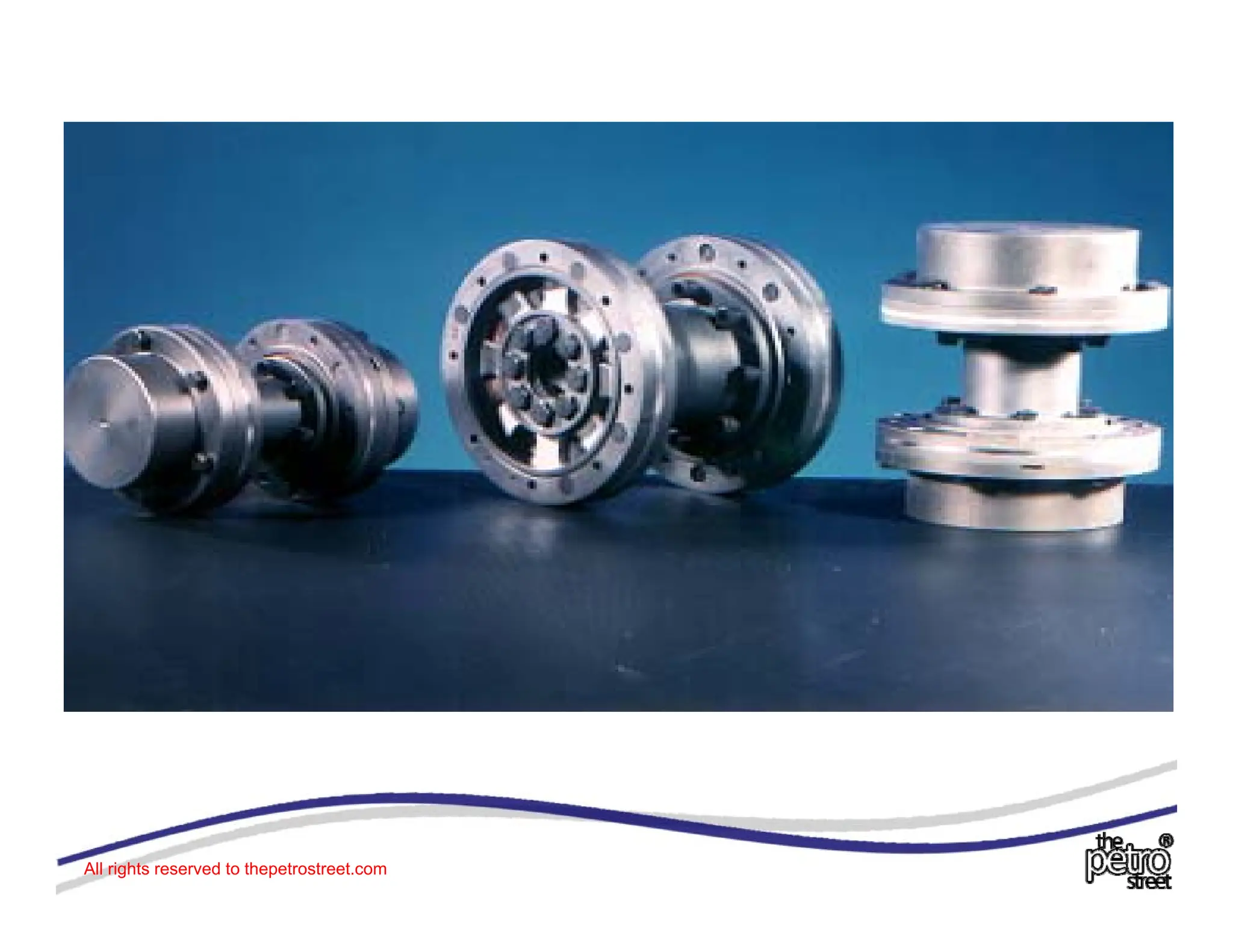
Flexible Couplings
up g
All rights reserved to thepetrostreet.com
Prepared by: Fraz
CONTENTS
• Purpose of Coupling
• Types of Couplings
• Rigid Couplings
• Functions of Flexible coupling
u ct o s o e b e coup g
• Types of Flexible Couplings
• Coupling selection chart
Coupling balancing requirements
• Coupling balancing requirements
All rights reserved to thepetrostreet.com
PURPOSE OF COUPLING
PURPOSE OF COUPLING
The coupling must be capable of
• Transmitting design torque.
• Operating at maximum continuous speed
Ope at g at a u co t uous speed
• Handling speed and load transients
• Having minimum reactions on the drive
system
system
All rights reserved to thepetrostreet.com
TYPES OF COUPLINGS
TYPES OF COUPLINGS
• TYPES OF COUPLINGS:
1. Rigid Couplings
2. Flexible Couplings
e b e Coup gs
All rights reserved to thepetrostreet.com
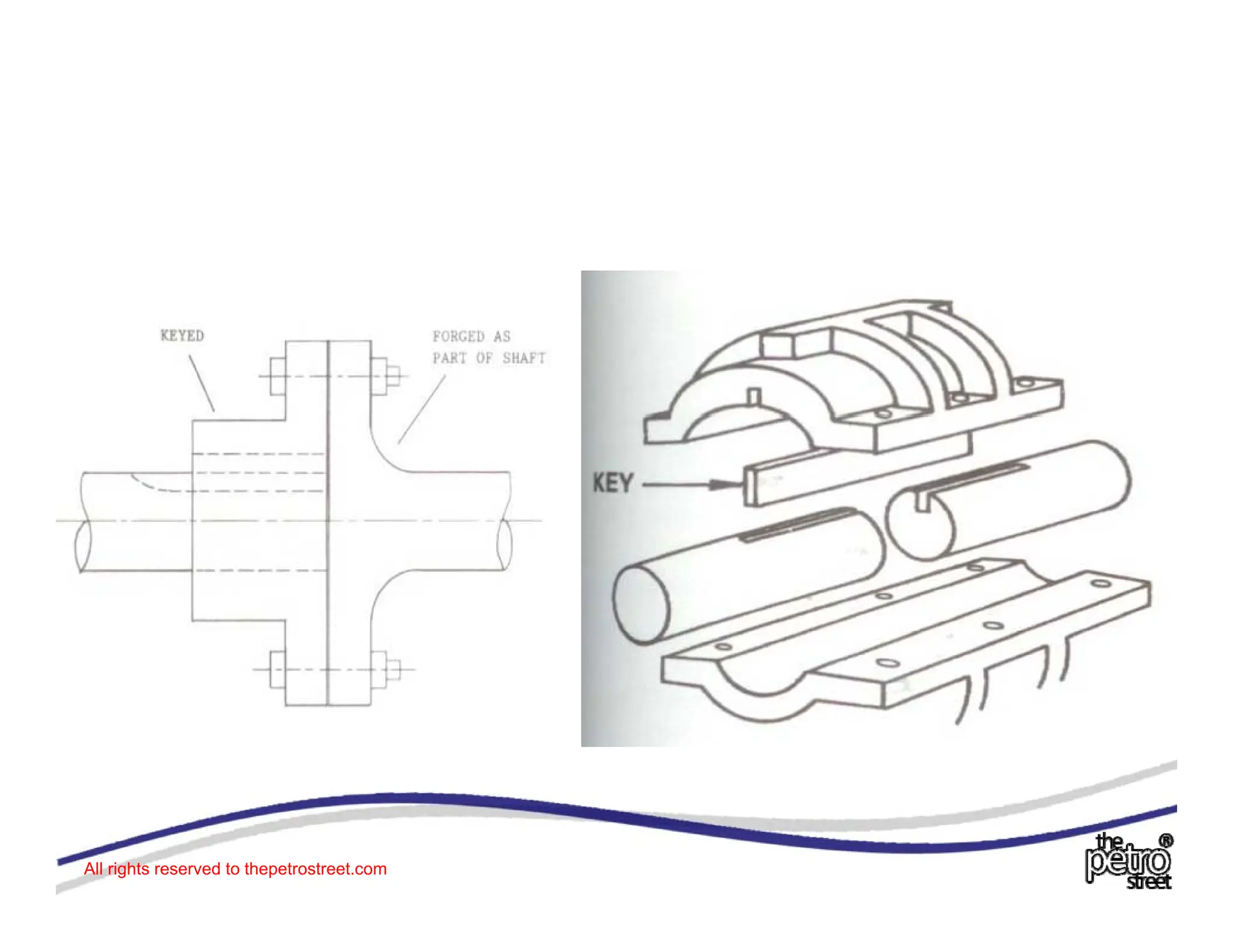
TYPES OF RIGID COUPLINGS:
Rigid Cylinder:
ƒ The cylinder can be solid , or ribbed.
The cylinder can be solid , or ribbed.
ƒ A key is always used that spans keyways
machined in both shafts.
Rigid Flanges:
Rigid Flanges:
ƒ Coupling halves are keyed onto the
shafts, and then the flanges are bolted
together.
All rights reserved to thepetrostreet.com
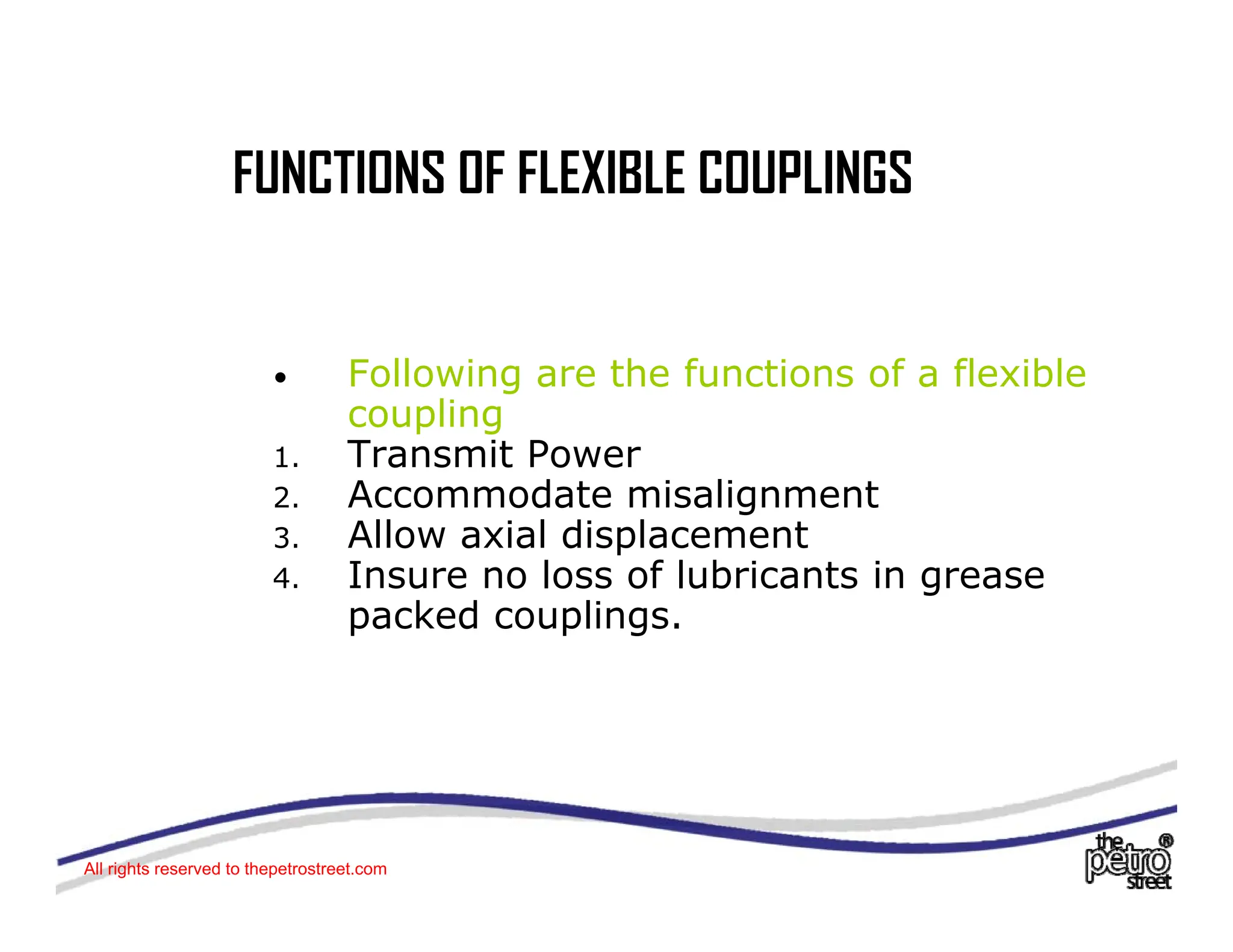
FUNCTIONS OF FLEXIBLE COUPLINGS
• Following are the functions of a flexible
coupling
coupling
1. Transmit Power
2. Accommodate misalignment
3 Allow axial displacement
3. Allow axial displacement
4. Insure no loss of lubricants in grease
packed couplings.
All rights reserved to thepetrostreet.com
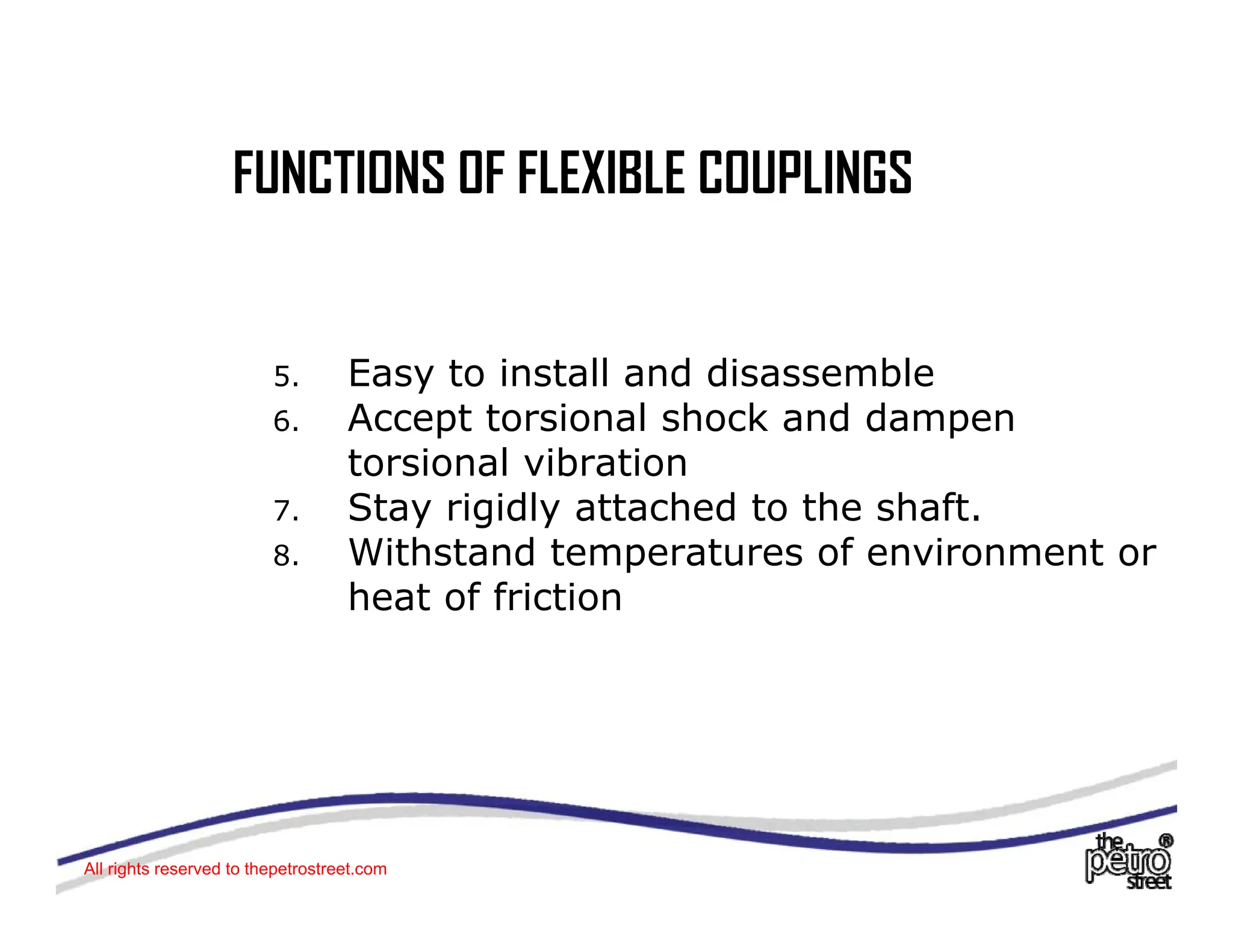
FUNCTIONS OF FLEXIBLE COUPLINGS
5. Easy to install and disassemble
6 Accept torsional shock and dampen
6. Accept torsional shock and dampen
torsional vibration
7. Stay rigidly attached to the shaft.
8. Withstand temperatures of environment or
heat of friction
All rights reserved to thepetrostreet.com
TYPES OF FLEXIBLE COUPLINGS
• TYPES OF FLEXIBLE COUPLINGS:
1. Mechanical Element
2. Elastomeric Element
3. Metallic Membrane / Disk Type
3 eta c e b a e / s ype
All rights reserved to thepetrostreet.com
MECH ELEMENT COUPLING:
Chain Couplings:
ƒ Two gear sprockets with hardened
Two gear sprockets with hardened
sprocket teeth connected by a double
width chain
ƒ Capacity : 3000 hp @ 1800 rpm
Capacity : 3000 hp @ 1800 rpm
ƒ Max Speed : up to 5000rpm
All rights reserved to thepetrostreet.com
MECH ELEMENT COUPLING:
Chain Couplings:
Advantages:
Advantages:
ƒ Easy to disassemble and reassemble
ƒ Fewer number of parts
Disadvantages:
Disadvantages:
ƒ Speed limited due to difficulties in
maintaining balancing requirements
ƒ Requires lubrication
ƒ Limited allowable axial displacement
All rights reserved to thepetrostreet.com
MECH ELEMENT COUPLING:
Gear Couplings:
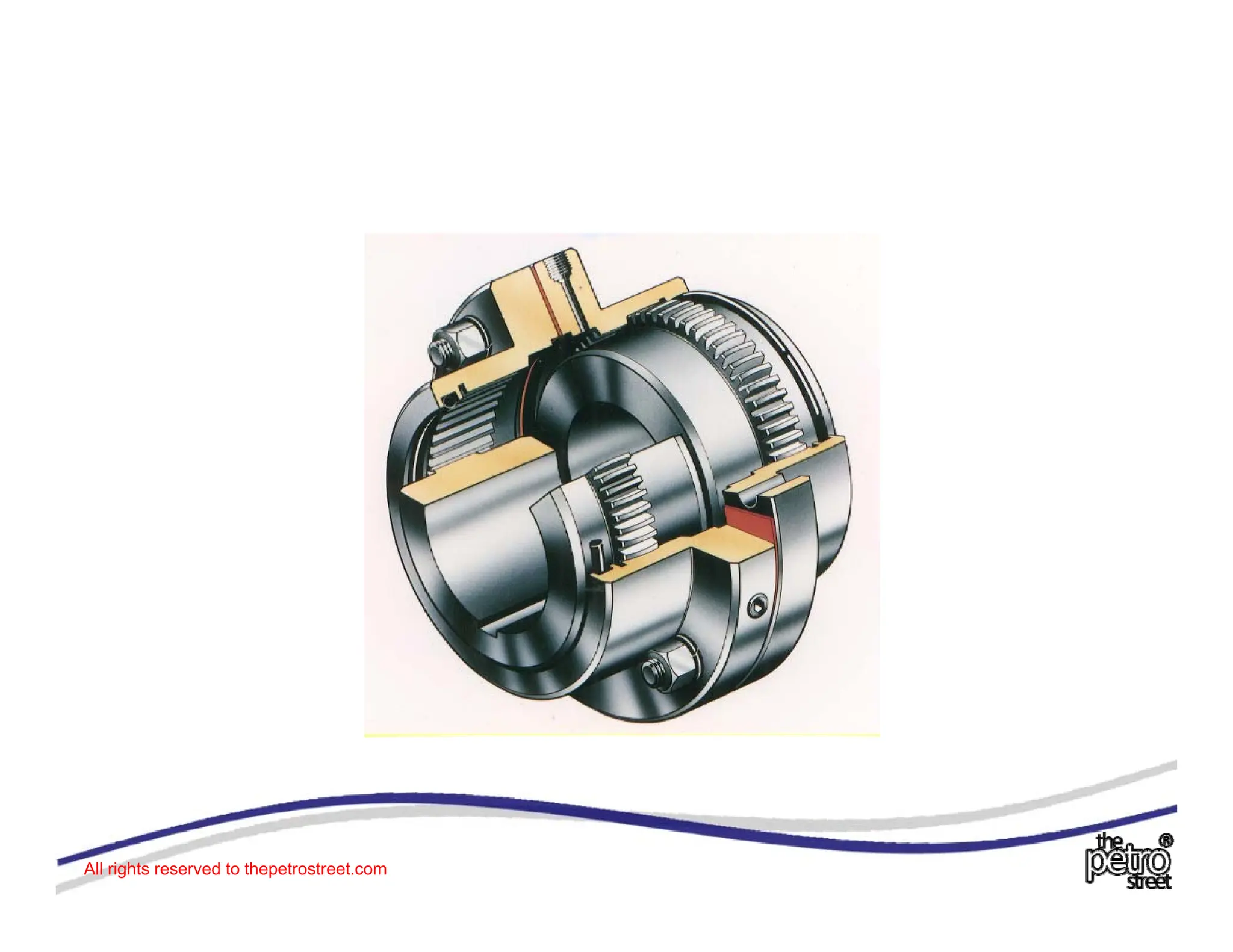
The gear coupling consists of two hubs
ƒ The gear coupling consists of two hubs
with external gear teeth that are attached
to the shaft
ƒ A hub cover or sleeve with internal gear
teeth engage with the shaft hubs to
provide the transmission of power
p p
ƒ Lubrication of gear teeth is required.
All rights reserved to thepetrostreet.com
MECH ELEMENT COUPLING:
G C li
Gear Couplings:
ƒ Capacity : up to 70,000 hp
M S d t 50 000
ƒ Max Speed : up to 50,000rpm
ƒ Backlash should be minimum and will be in
accordance to the permissible misalignment
C li bl h ld h i i
ƒ Coupling assembly should have minimum
6mm of axial displacement
ƒ Hardness of gear teeth<45Rc (Rockwell)
C li d h ld b i ti ht
ƒ Coupling guards should be air tight
All rights reserved to thepetrostreet.com
MECH ELEMENT COUPLING:
Gear Couplings:
Torsional Tuning
ƒ Shifting of one or more torsional natural
frequencies of a coupled system to avoid
system resonance at a known excitation
ƒ Torsional tuning is accomplished by varying
th t i l tiff f th li
the torsional stiffness of the coupling
All rights reserved to thepetrostreet.com
MECH ELEMENT COUPLING:
Gear Couplings:
Advantages:
ƒ Allows freedom of axial movement
Capable of operating at high speeds
ƒ Capable of operating at high speeds
ƒ Low overhung weight
ƒ Good balance characteristics.
L hi t f f l li ti
ƒ Long history of successful applications
Disadvantages:
ƒ Requires lubrication.
ƒ Separation of greases into soaps and oils.
ƒ Centrifugal effect on oils / sludge formation.
ƒ Temperature limitation due to lubricant
p
All rights reserved to thepetrostreet.com
MECH ELEMENT COUPLING:
Gear Couplings:
Th l t t th i
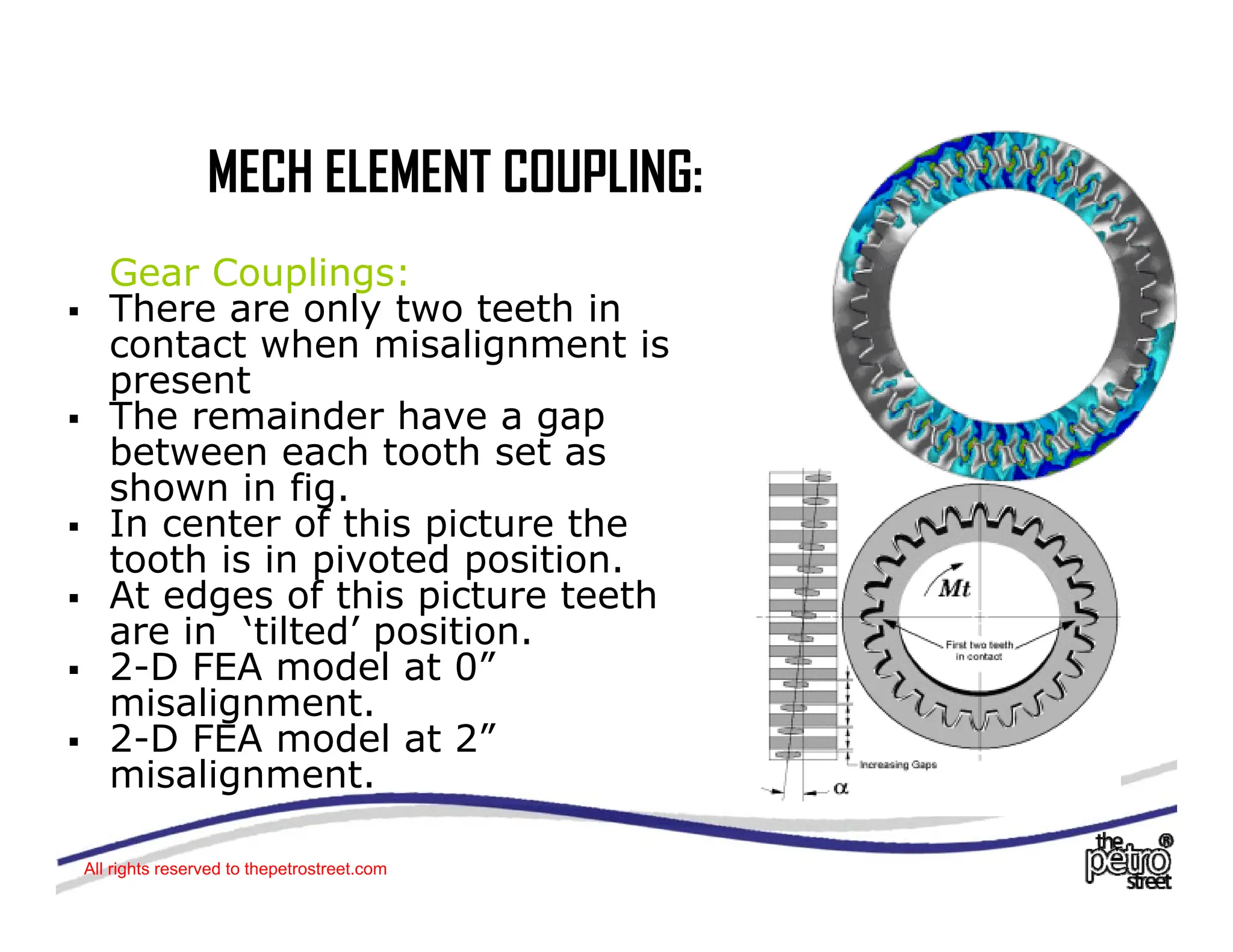
ƒ There are only two teeth in
contact when misalignment is
present
ƒ The remainder have a gap
between each tooth set as
shown in fig.
ƒ In center of this picture the
In center of this picture the
tooth is in pivoted position.
ƒ At edges of this picture teeth
are in ‘tilted’ position.
2 D FEA d l t 0”
ƒ 2-D FEA model at 0”
misalignment.
ƒ 2-D FEA model at 2”
misalignment
misalignment.
All rights reserved to thepetrostreet.com
METALLIC ELEMENT COUPLING:
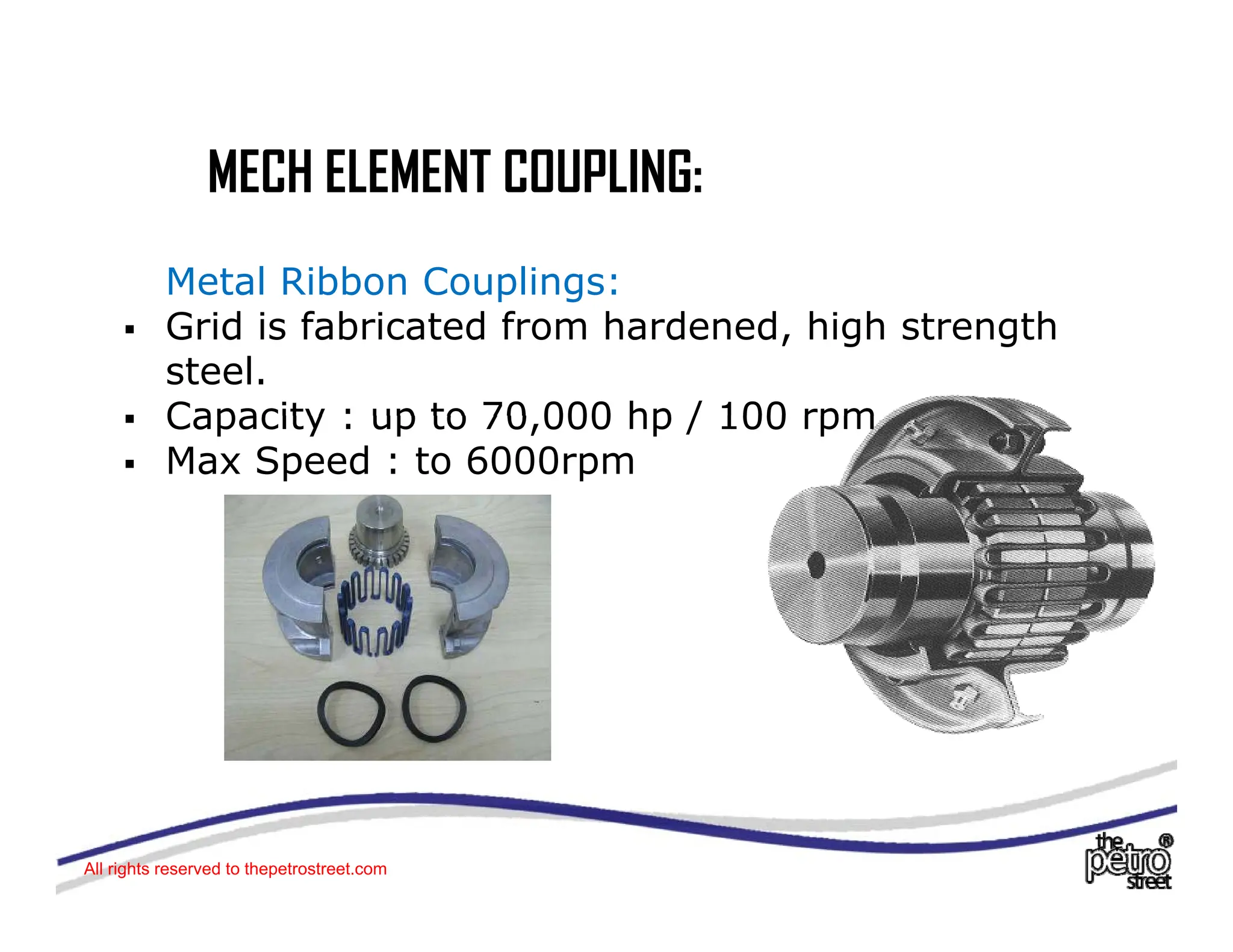
Metal Ribbon Couplings:
ƒ Consist of two hubs with axial ‘grooves’ on
th t di t f th h b
the outer diameter of the hub
ƒ A continuous ‘S’ shaped grid meshes into
the grooves.
ƒ Misalignment and axial movement is
achieved by flexing and sliding of the grid
member
member
ƒ Lubrication of gear teeth is required.
All rights reserved to thepetrostreet.com
MECH ELEMENT COUPLING:
Metal Ribbon Couplings:
p g
ƒ Grid is fabricated from hardened, high strength
steel.
ƒ Capacity : up to 70 000 hp / 100 rpm
ƒ Capacity : up to 70,000 hp / 100 rpm
ƒ Max Speed : to 6000rpm
All rights reserved to thepetrostreet.com
MECH ELEMENT COUPLING:
Metal Ribbon Couplings:
Advantages:
ƒ Easy to assemble and disassemble.
ƒ Long history of successful applications.
Long history of successful applications.
ƒ Torsionally soft.
Disadvantages:
ƒ Requires lubrication.
l d
ƒ Temperature limited.
ƒ Speed limited
All rights reserved to thepetrostreet.com
MECH ELEMENT COUPLING:
Flexible Link Coupling
ƒ The flexible link coupling utilizes a series of
cross laced, metallic links with one end of
h li k tt h d t di t d
each link attached to a disc mounted on
the driver shaft, and the other end of each
link attached to a disc mounted on the
driver shaft
driver shaft.
ƒ The links are matched in pairs so that
when one is in tension, the other is in
compression.
p
ƒ Misalignment and axial displacement is
accomplished by a flexing action in the
series of cross links.
All rights reserved to thepetrostreet.com
MECH ELEMENT COUPLING:
ƒ Capacity : up to 30,000 hp
ƒ Max Speed : up to 30,000rpm
ƒ Shaft Bores : up to 7 in.
ƒ Shaft Spacing: 2 to 200 in.
Shaft Spacing: 2 to 200 in.
All rights reserved to thepetrostreet.com
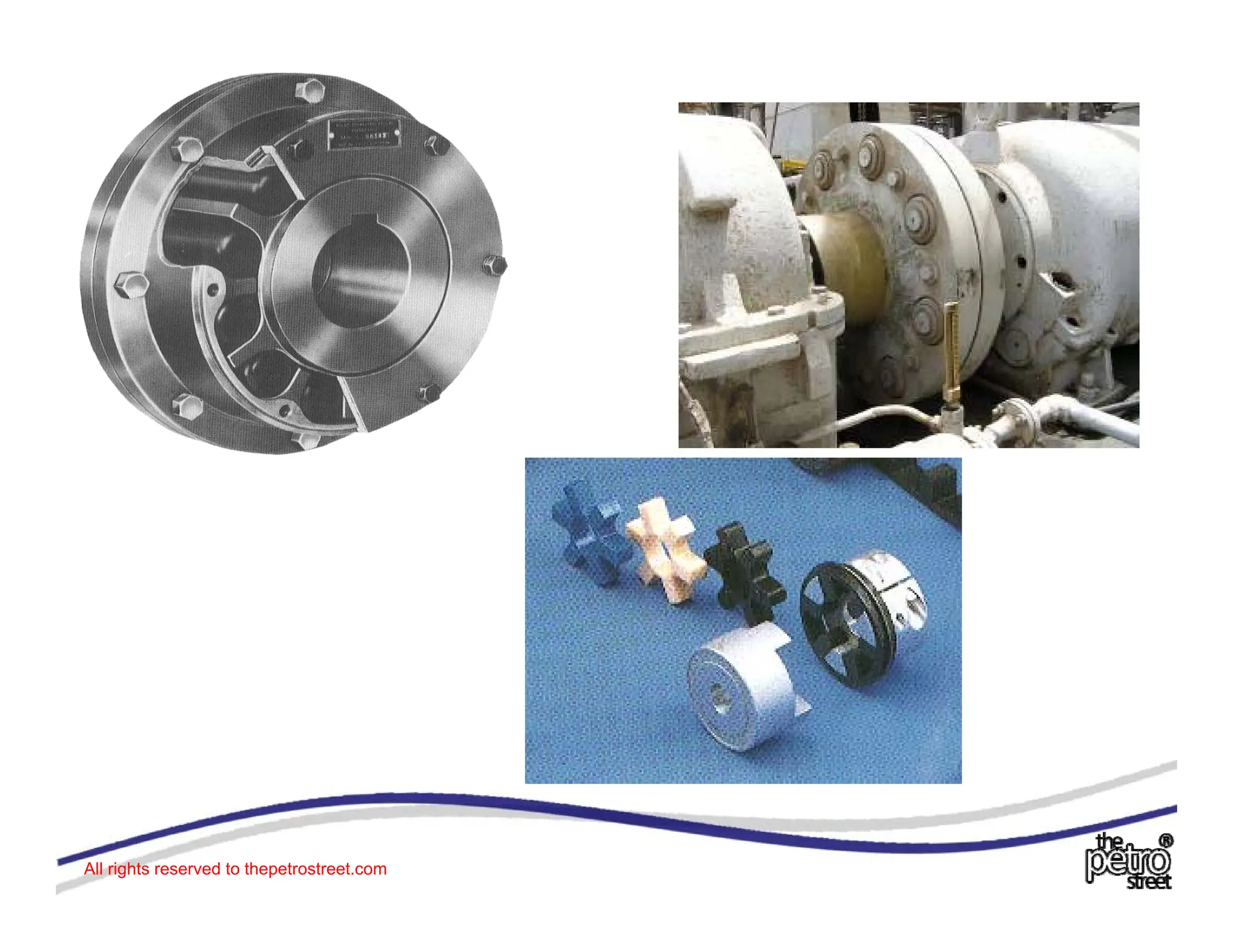
ELASTOMERIC COUPLING:
El t i C i
Elastomeric Compression:
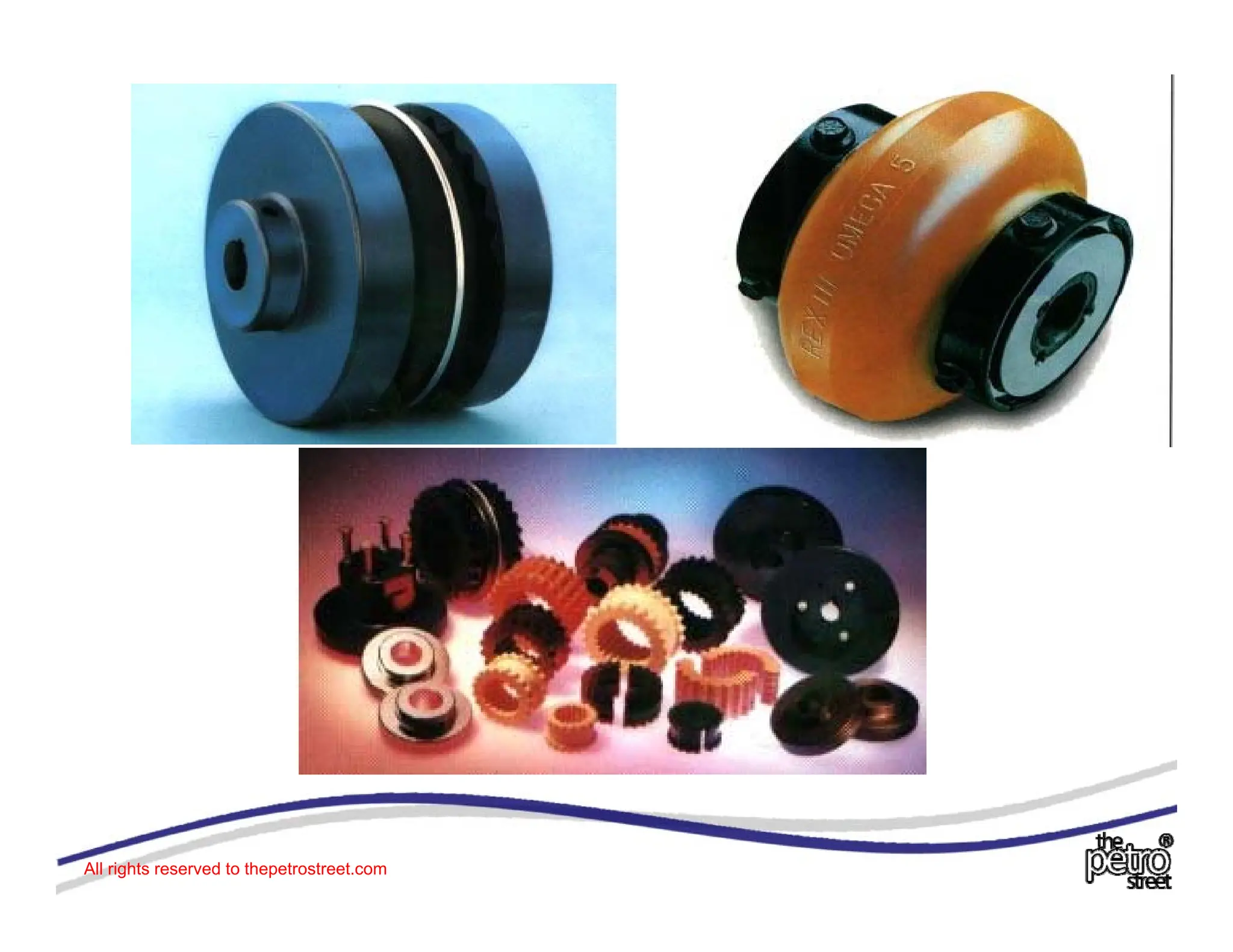
ƒ An elastomeric medium used to transmit
torque and accommodate misalignment.
ƒ Torsionally ‘soft’ to absorb high starting
ƒ Torsionally soft to absorb high starting
torques.
ƒ The spider is generally natural or synthetic
rubber, urethane, nylon and teflon.
ƒ Capacity : up to 67,000 hp / 100 rpm
ƒ Max Speed : approx. 5000rpm
All rights reserved to thepetrostreet.com
ELASTOMERIC COUPLING:
Elastomeric Compression:
Ad t
Advantages:
ƒ Minimal wear in coupling.
ƒ Act as vibration damper and isolator.
ƒ Acts as electrical shaft current insulator
Acts as electrical shaft current insulator.
ƒ Torsionally soft.
ƒ Allows axial movement and dampens axial
vibration.
N l b i ti i d
ƒ No lubrication required.
Disadvantages:
ƒ Speed limited (Cannot be balanced perfectly)
ƒ Speed limited (Cannot be balanced perfectly).
ƒ Temp, oxidation of rubber and corrosive attack.
ƒ Undesirable axial forces.
ƒ Heat generation due to cyclic flexing.
All rights reserved to thepetrostreet.com
ELASTOMERIC COUPLING:
Elastomeric Compression:
p
Failure modes:
ƒ Abrasion: Rubber is a high friction
t i l d i d t i d d
material, and minor dust is produced.
ƒ Temperature deformation:
ƒ Rubber aging (drying):
ƒ Consumption: Rubber and plastic are
organic materials, and there are some
creatures that eat them
All rights reserved to thepetrostreet.com
ELASTOMERIC COUPLING:
Elastomeric shear:
T th d h It i t i t ll d
1. Toothed shear: It is easy to install and
maintain, and handle large misalignment.
2. Tire type: Tire beads are clamped to a hub
on either side. Torque is transmitted by
the tire in shear.
3 Friction Disk: A rubber or suitable plastic
3. Friction Disk: A rubber or suitable plastic
bonded to a steel disk is pressed against
another disk.
All rights reserved to thepetrostreet.com
METALLIC MEMBRANE / DISK TYPE:
Diaphragm Couplings:
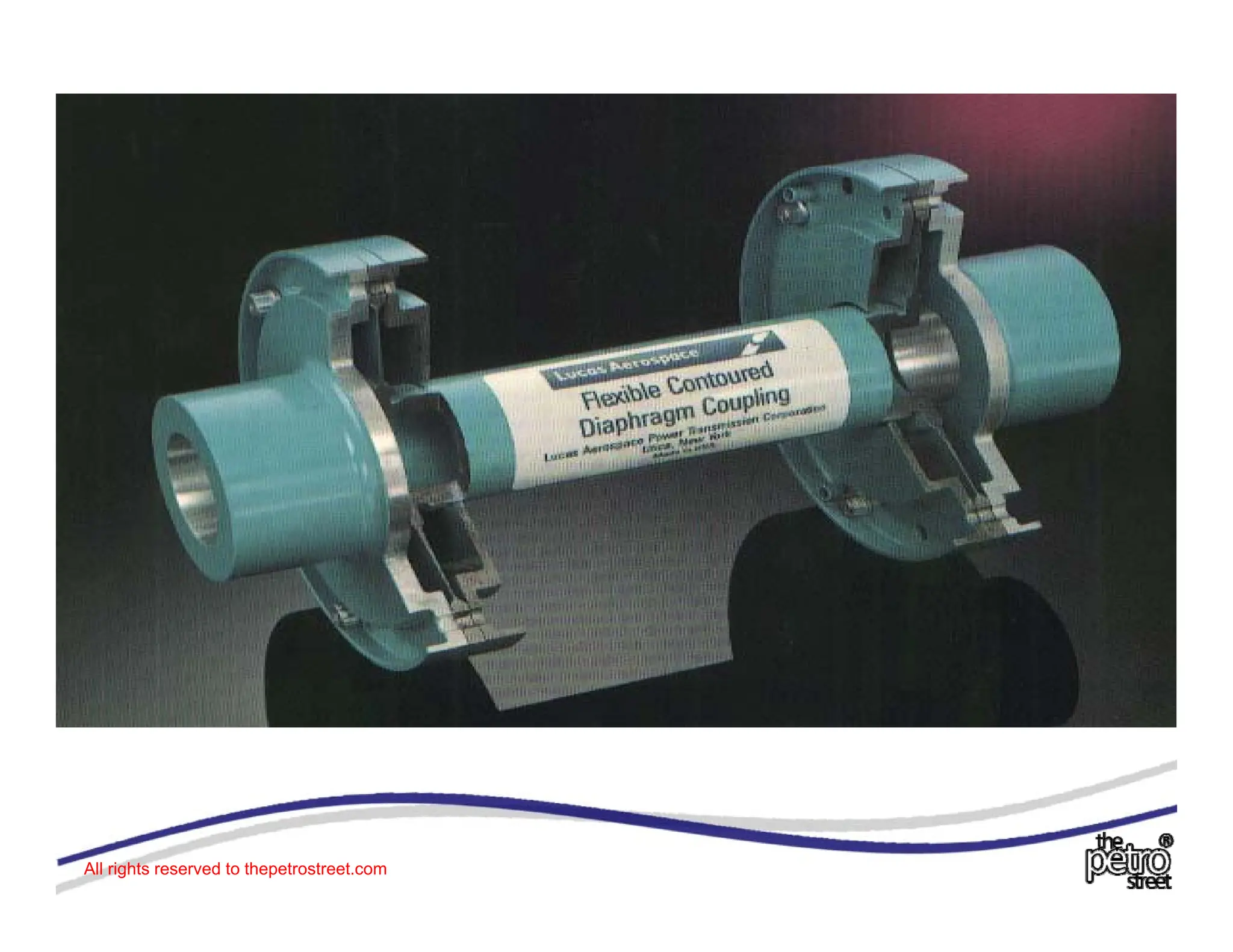
ƒ Transmission of power through two flexible
metal diaphragms.
metal diaphragms.
ƒ Bolted to the outer rim of the shaft hubs
and connected via a spacer tube.
ƒ Misalignment and axial displacement is
Misalignment and axial displacement is
absorbed by flexing of the diaphragm
members.
All rights reserved to thepetrostreet.com
METALLIC MEMBRANE / DISK TYPE:
Di h C li
Diaphragm Couplings:
ƒ Diaphragm has an effect of a spring
ƒ Coupling natural frequency does not match
rotating speeds or harmonics in the drive
system.
ƒ Frequently used at gas turbines and
compressors.
ƒ Capacity : up to 30,000 hp
ƒ Max Speed : to 100 000rpm (only coupling)
ƒ Max Speed : to 100,000rpm (only coupling)
All rights reserved to thepetrostreet.com
METALLIC MEMBRANE / DISK TYPE:
Diaphragm Couplings:
Advantages:
ƒ Excellent balance characteristics.
ƒ No lubrication required
ƒ No lubrication required.
ƒ Low coupling weight and bending forces.
ƒ Accepts high temperature environment.
Disadvantages:
Disadvantages:
ƒ Limited axial displacements and oscillation.
ƒ Proper shaft spacing requirements.
ƒ Excessive misalignment will transmit high
loads to shafting.
All rights reserved to thepetrostreet.com
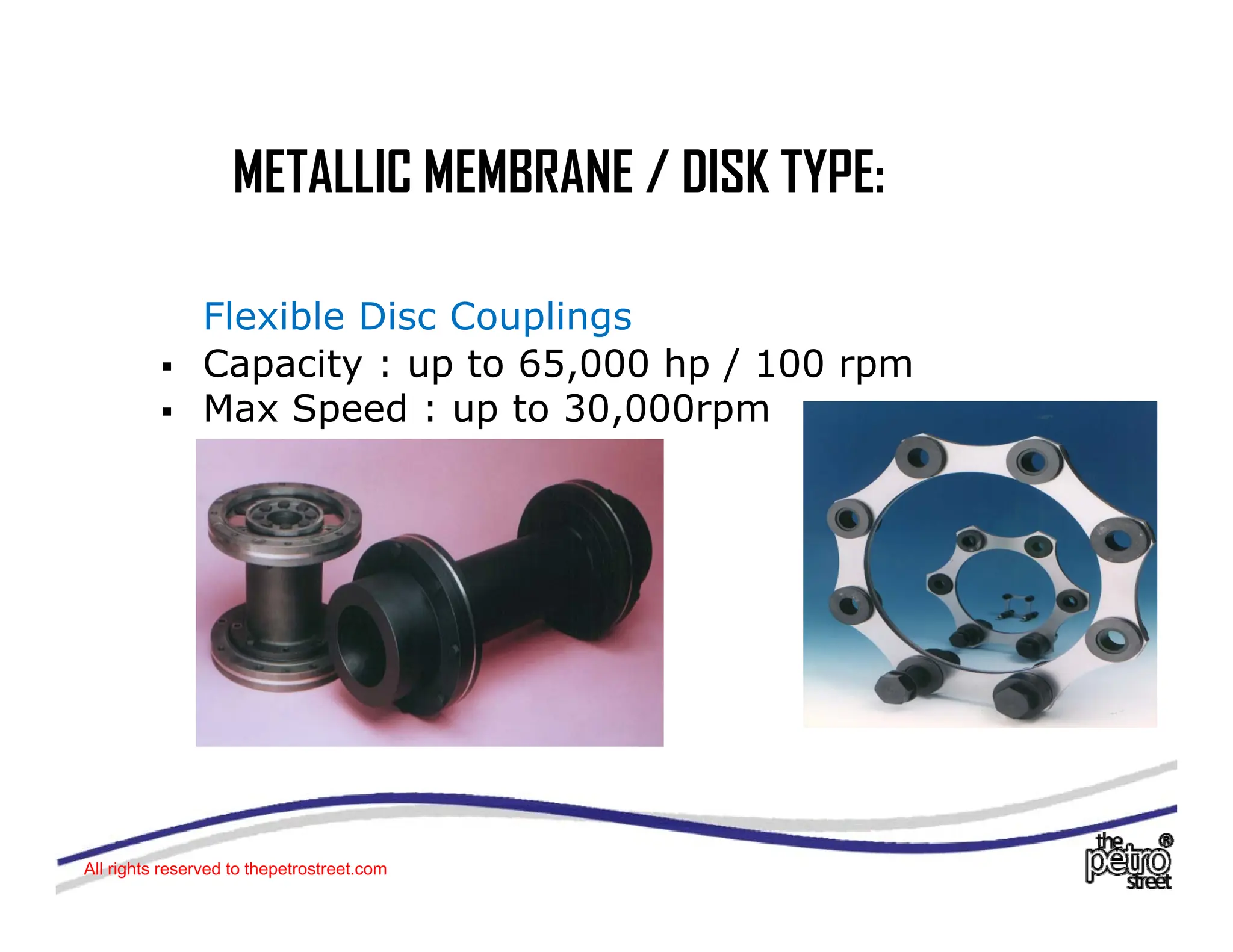
METALLIC MEMBRANE / DISK TYPE:
Flexible Disc Couplings
ƒ The flexible disk coupling is very similar to
p g y
the diaphragm coupling
ƒ Multiple, thinner discs are used as the flexing
element instead of circular contoured
element instead of circular, contoured
diaphragm elements.
ƒ Two disc packs (or diaphragms) are needed
t d t ll l i li t
to accommodate parallel misalignment.
ƒ A single disc can only handle pure angular
misalignment.
g
All rights reserved to thepetrostreet.com
METALLIC MEMBRANE / DISK TYPE:
Flexible Disc Couplings
ƒ Capacity : up to 65,000 hp / 100 rpm
ƒ Max Speed : up to 30 000rpm
Max Speed : up to 30,000rpm
All rights reserved to thepetrostreet.com
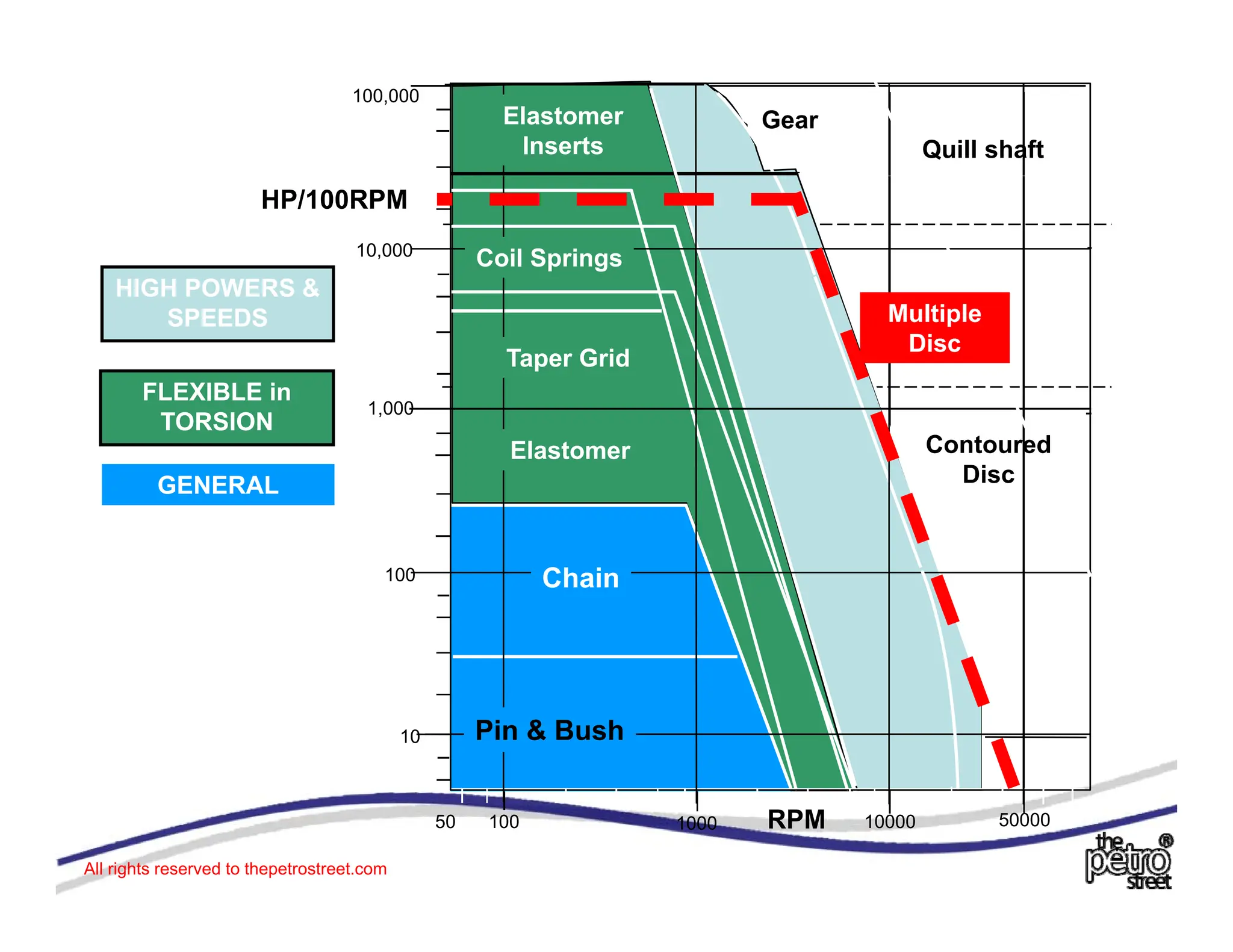
Gear
100,000
Quill shaft
Elastomer
Inserts
HIGH POWERS &
10,000
Coil Springs
HP/100RPM
FLEXIBLE in
TORSION
HIGH POWERS &
SPEEDS
1,000
Taper Grid
Multiple
Disc
TORSION
GENERAL
,
Contoured
Disc
Elastomer
100 Chain
10 Pin & Bush
100 1000
50 10000 50000
RPM
All rights reserved to thepetrostreet.com
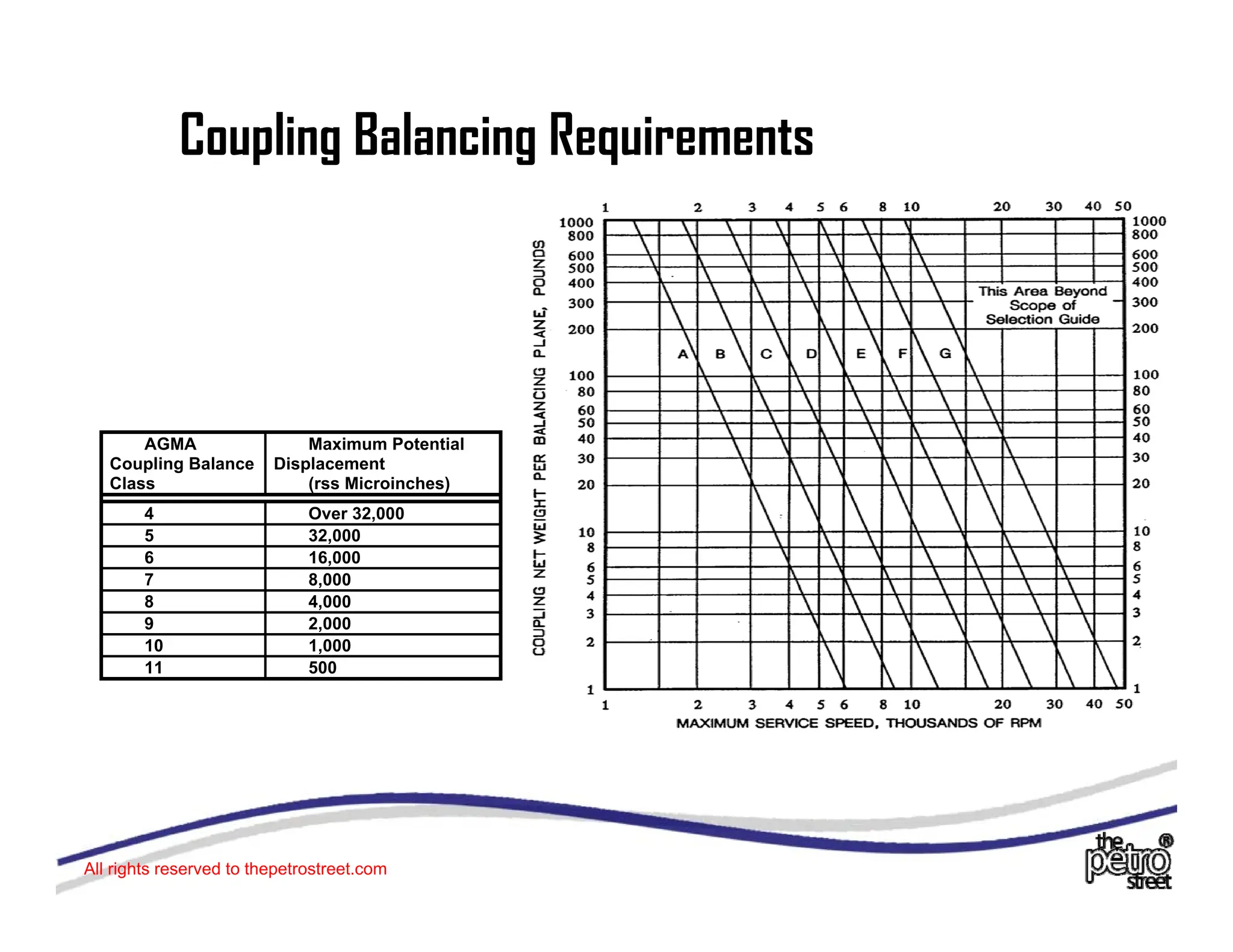
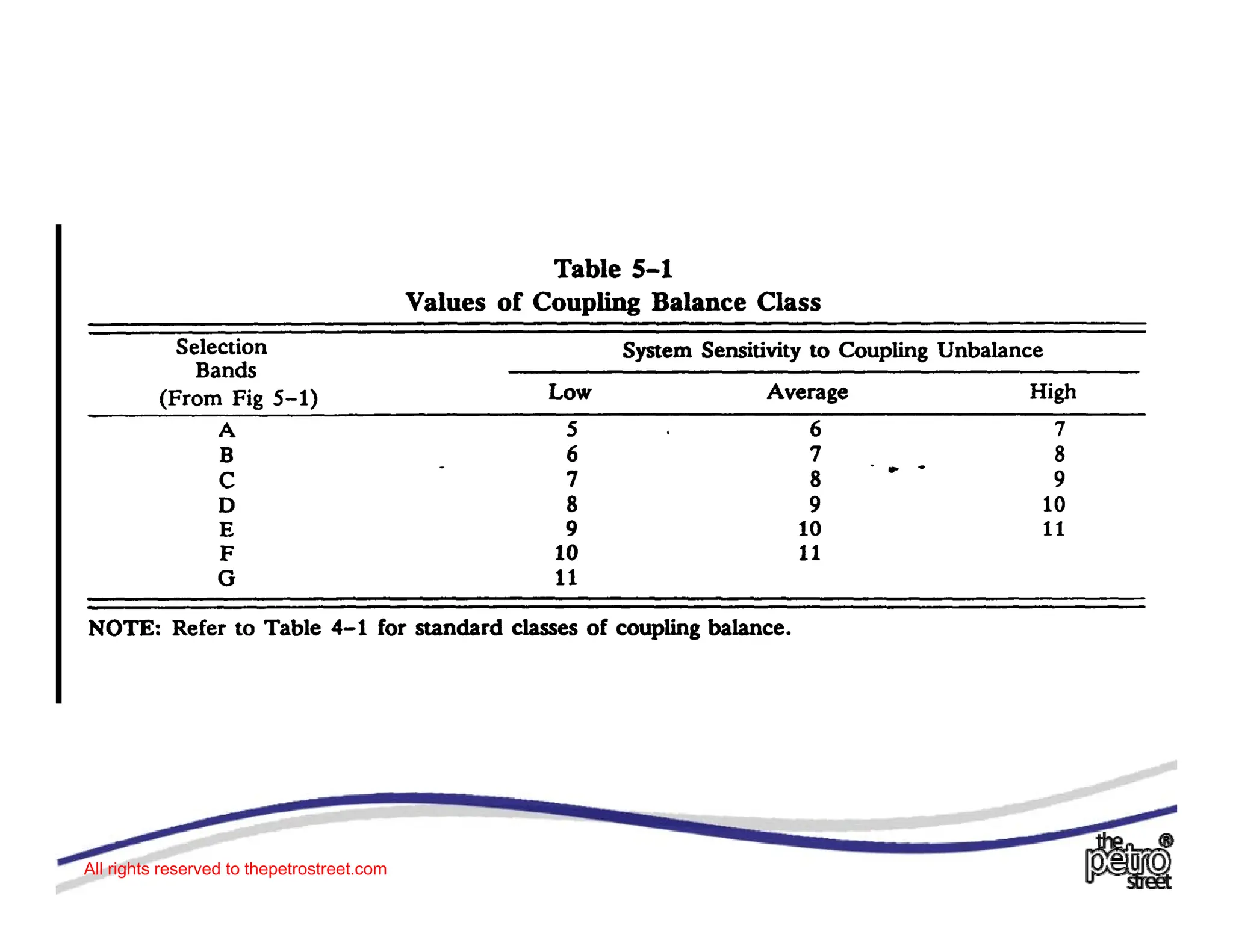
Coupling Balancing Requirements
AGMA
Coupling Balance
Class
Maximum Potential
Displacement
(rss Microinches)
4 Over 32,000
5 32 000
5 32,000
6 16,000
7 8,000
8 4,000
9 2,000
10 1,000
11 500
All rights reserved to thepetrostreet.com
THANKS
THANKS
‐ thePetroStreet team
All rights reserved to thepetrostreet.com

Introduction Couplings Types Presentation.pdf

  • 1.
    Flexible Couplings up g Allrights reserved to thepetrostreet.com Prepared by: Fraz
  • 2.
    CONTENTS • Purpose ofCoupling • Types of Couplings • Rigid Couplings • Functions of Flexible coupling u ct o s o e b e coup g • Types of Flexible Couplings • Coupling selection chart Coupling balancing requirements • Coupling balancing requirements All rights reserved to thepetrostreet.com
  • 3.
    PURPOSE OF COUPLING PURPOSEOF COUPLING The coupling must be capable of • Transmitting design torque. • Operating at maximum continuous speed Ope at g at a u co t uous speed • Handling speed and load transients • Having minimum reactions on the drive system system All rights reserved to thepetrostreet.com
  • 4.
    TYPES OF COUPLINGS TYPESOF COUPLINGS • TYPES OF COUPLINGS: 1. Rigid Couplings 2. Flexible Couplings e b e Coup gs All rights reserved to thepetrostreet.com
  • 5.
    TYPES OF RIGIDCOUPLINGS: TYPES OF RIGID COUPLINGS: Rigid Cylinder: ƒ The cylinder can be solid , or ribbed. The cylinder can be solid , or ribbed. ƒ A key is always used that spans keyways machined in both shafts. Rigid Flanges: Rigid Flanges: ƒ Coupling halves are keyed onto the shafts, and then the flanges are bolted shafts, and then the flanges are bolted together. All rights reserved to thepetrostreet.com
  • 6.
    All rights reservedto thepetrostreet.com
  • 7.
    FUNCTIONS OF FLEXIBLECOUPLINGS FUNCTIONS OF FLEXIBLE COUPLINGS • Following are the functions of a flexible coupling coupling 1. Transmit Power 2. Accommodate misalignment 3 Allow axial displacement 3. Allow axial displacement 4. Insure no loss of lubricants in grease packed couplings. All rights reserved to thepetrostreet.com
  • 8.
    FUNCTIONS OF FLEXIBLECOUPLINGS FUNCTIONS OF FLEXIBLE COUPLINGS 5. Easy to install and disassemble 6 Accept torsional shock and dampen 6. Accept torsional shock and dampen torsional vibration 7. Stay rigidly attached to the shaft. 8. Withstand temperatures of environment or heat of friction All rights reserved to thepetrostreet.com
  • 9.
    TYPES OF FLEXIBLECOUPLINGS • TYPES OF FLEXIBLE COUPLINGS: 1. Mechanical Element 2. Elastomeric Element 3. Metallic Membrane / Disk Type 3 eta c e b a e / s ype All rights reserved to thepetrostreet.com
  • 10.
    MECH ELEMENT COUPLING: MECHELEMENT COUPLING: Chain Couplings: ƒ Two gear sprockets with hardened Two gear sprockets with hardened sprocket teeth connected by a double width chain ƒ Capacity : 3000 hp @ 1800 rpm Capacity : 3000 hp @ 1800 rpm ƒ Max Speed : up to 5000rpm All rights reserved to thepetrostreet.com
  • 11.
    MECH ELEMENT COUPLING: MECHELEMENT COUPLING: Chain Couplings: Advantages: Advantages: ƒ Easy to disassemble and reassemble ƒ Fewer number of parts Disadvantages: Disadvantages: ƒ Speed limited due to difficulties in maintaining balancing requirements ƒ Requires lubrication ƒ Requires lubrication ƒ Limited allowable axial displacement All rights reserved to thepetrostreet.com
  • 12.
    MECH ELEMENT COUPLING: MECHELEMENT COUPLING: Gear Couplings: The gear coupling consists of two hubs ƒ The gear coupling consists of two hubs with external gear teeth that are attached to the shaft ƒ A hub cover or sleeve with internal gear teeth engage with the shaft hubs to provide the transmission of power p p ƒ Lubrication of gear teeth is required. All rights reserved to thepetrostreet.com
  • 13.
    All rights reservedto thepetrostreet.com
  • 14.
    MECH ELEMENT COUPLING: MECHELEMENT COUPLING: G C li Gear Couplings: ƒ Capacity : up to 70,000 hp M S d t 50 000 ƒ Max Speed : up to 50,000rpm ƒ Backlash should be minimum and will be in accordance to the permissible misalignment C li bl h ld h i i ƒ Coupling assembly should have minimum 6mm of axial displacement ƒ Hardness of gear teeth<45Rc (Rockwell) C li d h ld b i ti ht ƒ Coupling guards should be air tight All rights reserved to thepetrostreet.com
  • 15.
    MECH ELEMENT COUPLING: MECHELEMENT COUPLING: Gear Couplings: Torsional Tuning ƒ Shifting of one or more torsional natural frequencies of a coupled system to avoid frequencies of a coupled system to avoid system resonance at a known excitation ƒ Torsional tuning is accomplished by varying th t i l tiff f th li the torsional stiffness of the coupling All rights reserved to thepetrostreet.com
  • 16.
    MECH ELEMENT COUPLING: MECHELEMENT COUPLING: Gear Couplings: Advantages: ƒ Allows freedom of axial movement Capable of operating at high speeds ƒ Capable of operating at high speeds ƒ Low overhung weight ƒ Good balance characteristics. L hi t f f l li ti ƒ Long history of successful applications Disadvantages: ƒ Requires lubrication. ƒ Separation of greases into soaps and oils. ƒ Centrifugal effect on oils / sludge formation. ƒ Temperature limitation due to lubricant p All rights reserved to thepetrostreet.com
  • 17.
    MECH ELEMENT COUPLING: MECHELEMENT COUPLING: Gear Couplings: Th l t t th i ƒ There are only two teeth in contact when misalignment is present ƒ The remainder have a gap ƒ The remainder have a gap between each tooth set as shown in fig. ƒ In center of this picture the In center of this picture the tooth is in pivoted position. ƒ At edges of this picture teeth are in ‘tilted’ position. 2 D FEA d l t 0” ƒ 2-D FEA model at 0” misalignment. ƒ 2-D FEA model at 2” misalignment misalignment. All rights reserved to thepetrostreet.com
  • 18.
    METALLIC ELEMENT COUPLING: METALLICELEMENT COUPLING: Metal Ribbon Couplings: ƒ Consist of two hubs with axial ‘grooves’ on th t di t f th h b the outer diameter of the hub ƒ A continuous ‘S’ shaped grid meshes into the grooves. ƒ Misalignment and axial movement is achieved by flexing and sliding of the grid member member ƒ Lubrication of gear teeth is required. All rights reserved to thepetrostreet.com
  • 19.
    MECH ELEMENT COUPLING: MECHELEMENT COUPLING: Metal Ribbon Couplings: p g ƒ Grid is fabricated from hardened, high strength steel. ƒ Capacity : up to 70 000 hp / 100 rpm ƒ Capacity : up to 70,000 hp / 100 rpm ƒ Max Speed : to 6000rpm All rights reserved to thepetrostreet.com
  • 20.
    MECH ELEMENT COUPLING: MECHELEMENT COUPLING: Metal Ribbon Couplings: Advantages: ƒ Easy to assemble and disassemble. ƒ Long history of successful applications. Long history of successful applications. ƒ Torsionally soft. Disadvantages: ƒ Requires lubrication. l d ƒ Temperature limited. ƒ Speed limited All rights reserved to thepetrostreet.com
  • 21.
    MECH ELEMENT COUPLING: MECHELEMENT COUPLING: Flexible Link Coupling ƒ The flexible link coupling utilizes a series of cross laced, metallic links with one end of h li k tt h d t di t d each link attached to a disc mounted on the driver shaft, and the other end of each link attached to a disc mounted on the driver shaft driver shaft. ƒ The links are matched in pairs so that when one is in tension, the other is in compression. p ƒ Misalignment and axial displacement is accomplished by a flexing action in the series of cross links. All rights reserved to thepetrostreet.com
  • 22.
    MECH ELEMENT COUPLING: MECHELEMENT COUPLING: ƒ Capacity : up to 30,000 hp ƒ Max Speed : up to 30,000rpm ƒ Shaft Bores : up to 7 in. ƒ Shaft Spacing: 2 to 200 in. Shaft Spacing: 2 to 200 in. All rights reserved to thepetrostreet.com
  • 23.
    ELASTOMERIC COUPLING: ELASTOMERIC COUPLING: Elt i C i Elastomeric Compression: ƒ An elastomeric medium used to transmit torque and accommodate misalignment. ƒ Torsionally ‘soft’ to absorb high starting ƒ Torsionally soft to absorb high starting torques. ƒ The spider is generally natural or synthetic rubber, urethane, nylon and teflon. rubber, urethane, nylon and teflon. ƒ Capacity : up to 67,000 hp / 100 rpm ƒ Max Speed : approx. 5000rpm All rights reserved to thepetrostreet.com
  • 24.
    All rights reservedto thepetrostreet.com
  • 25.
    ELASTOMERIC COUPLING: ELASTOMERIC COUPLING: ElastomericCompression: Ad t Advantages: ƒ Minimal wear in coupling. ƒ Act as vibration damper and isolator. ƒ Acts as electrical shaft current insulator Acts as electrical shaft current insulator. ƒ Torsionally soft. ƒ Allows axial movement and dampens axial vibration. N l b i ti i d ƒ No lubrication required. Disadvantages: ƒ Speed limited (Cannot be balanced perfectly) ƒ Speed limited (Cannot be balanced perfectly). ƒ Temp, oxidation of rubber and corrosive attack. ƒ Undesirable axial forces. ƒ Heat generation due to cyclic flexing. All rights reserved to thepetrostreet.com
  • 26.
    ELASTOMERIC COUPLING: ELASTOMERIC COUPLING: ElastomericCompression: p Failure modes: ƒ Abrasion: Rubber is a high friction t i l d i d t i d d material, and minor dust is produced. ƒ Temperature deformation: ƒ Rubber aging (drying): ƒ Consumption: Rubber and plastic are ƒ Consumption: Rubber and plastic are organic materials, and there are some creatures that eat them All rights reserved to thepetrostreet.com
  • 27.
    ELASTOMERIC COUPLING: ELASTOMERIC COUPLING: Elastomericshear: T th d h It i t i t ll d 1. Toothed shear: It is easy to install and maintain, and handle large misalignment. 2. Tire type: Tire beads are clamped to a hub on either side. Torque is transmitted by the tire in shear. 3 Friction Disk: A rubber or suitable plastic 3. Friction Disk: A rubber or suitable plastic bonded to a steel disk is pressed against another disk. All rights reserved to thepetrostreet.com
  • 28.
    All rights reservedto thepetrostreet.com
  • 29.
    METALLIC MEMBRANE /DISK TYPE: METALLIC MEMBRANE / DISK TYPE: Diaphragm Couplings: ƒ Transmission of power through two flexible metal diaphragms. metal diaphragms. ƒ Bolted to the outer rim of the shaft hubs and connected via a spacer tube. ƒ Misalignment and axial displacement is Misalignment and axial displacement is absorbed by flexing of the diaphragm members. All rights reserved to thepetrostreet.com
  • 30.
    All rights reservedto thepetrostreet.com
  • 31.
    METALLIC MEMBRANE /DISK TYPE: METALLIC MEMBRANE / DISK TYPE: Di h C li Diaphragm Couplings: ƒ Diaphragm has an effect of a spring ƒ Coupling natural frequency does not match ƒ Coupling natural frequency does not match rotating speeds or harmonics in the drive system. ƒ Frequently used at gas turbines and ƒ Frequently used at gas turbines and compressors. ƒ Capacity : up to 30,000 hp ƒ Max Speed : to 100 000rpm (only coupling) ƒ Max Speed : to 100,000rpm (only coupling) All rights reserved to thepetrostreet.com
  • 32.
    METALLIC MEMBRANE /DISK TYPE: METALLIC MEMBRANE / DISK TYPE: Diaphragm Couplings: Advantages: ƒ Excellent balance characteristics. ƒ No lubrication required ƒ No lubrication required. ƒ Low coupling weight and bending forces. ƒ Accepts high temperature environment. Disadvantages: Disadvantages: ƒ Limited axial displacements and oscillation. ƒ Proper shaft spacing requirements. ƒ Excessive misalignment will transmit high ƒ Excessive misalignment will transmit high loads to shafting. All rights reserved to thepetrostreet.com
  • 33.
    METALLIC MEMBRANE /DISK TYPE: METALLIC MEMBRANE / DISK TYPE: Flexible Disc Couplings ƒ The flexible disk coupling is very similar to p g y the diaphragm coupling ƒ Multiple, thinner discs are used as the flexing element instead of circular contoured element instead of circular, contoured diaphragm elements. ƒ Two disc packs (or diaphragms) are needed t d t ll l i li t to accommodate parallel misalignment. ƒ A single disc can only handle pure angular misalignment. g All rights reserved to thepetrostreet.com
  • 34.
    All rights reservedto thepetrostreet.com
  • 35.
    METALLIC MEMBRANE /DISK TYPE: METALLIC MEMBRANE / DISK TYPE: Flexible Disc Couplings ƒ Capacity : up to 65,000 hp / 100 rpm ƒ Max Speed : up to 30 000rpm Max Speed : up to 30,000rpm All rights reserved to thepetrostreet.com
  • 36.
    Gear 100,000 Quill shaft Elastomer Inserts HIGH POWERS& 10,000 Coil Springs HP/100RPM FLEXIBLE in TORSION HIGH POWERS & SPEEDS 1,000 Taper Grid Multiple Disc TORSION GENERAL , Contoured Disc Elastomer 100 Chain 10 Pin & Bush 100 1000 50 10000 50000 RPM All rights reserved to thepetrostreet.com
  • 37.
    Coupling Balancing Requirements AGMA CouplingBalance Class Maximum Potential Displacement (rss Microinches) 4 Over 32,000 5 32 000 5 32,000 6 16,000 7 8,000 8 4,000 9 2,000 10 1,000 11 500 All rights reserved to thepetrostreet.com
  • 38.
    All rights reservedto thepetrostreet.com
  • 39.
    THANKS THANKS ‐ thePetroStreet team Allrights reserved to thepetrostreet.com