1. REPORT ON COUPLINGS
A coupling is a device used to connect two shafts together at their ends for the purpose of
transmitting power. Couplings do not normally allow disconnection of shafts during
operation, however there are torque limiting couplings which can slip or disconnect when
some torque limit is exceeded.
The primary purpose of couplings is to join two pieces of rotating equipment while
permitting some degree of misalignment or end movement or both. By careful selection,
installation and maintenance of couplings, substantial savings can be made in reduced
maintenance costs and downtime.
Couplings are used to connect two shafts for torque transmission in varied applications. It
may be to connect two units such as a motor and a generator or it may be to form a long
line shaft by connecting shafts of standard lengths say 6-8m by couplings. Coupling may
be rigid or they
may provide flexibility and compensate for misalignment. They may also reduce shock
loading and vibration. A wide variety of commercial shaft couplings are available
ranging from a simple keyed coupling to one which requires a complex design procedure
using gears or fluid drives etc.
However there are two main types of couplings:
Rigid couplings
Flexible couplings
Rigid couplings are used for shafts having no misalignment while the flexible couplings
can absorb some amount of misalignment in the shafts to be connected. In the next
section we shall discuss different types of couplings and their uses under these two broad
headings.
2. Types and uses of shaft couplings
2.1 RIGID COUPLING
A rigid coupling is a unit of hardware used to join two shafts within a motor or
mechanical system. It may be used to connect two separate systems, such as a motor and
a generator, or to repair a connection within a single system. A rigid coupling may also
be added between shafts to reduce shock and wear at the point where the shafts meet.
When joining shafts within a machine, mechanics can choose between flexible and rigid
couplings. While flexible units offer some movement and give between the shafts, rigid
couplings are the most effective choice for precise alignment and secure hold. By
precisely aligning the two shafts and holding them firmly in place, rigid couplings help to
maximize performance and increase the expected life of the machine. These rigid
couplings are available in two basic designs to fit the needs of different applications.
Sleeve-style couplings are the most affordable and easiest to use. They consist of a single
tube of material with an inner diameter that's equal in size to the shafts. The sleeve slips
over the shafts so they meet in the middle of the coupling. A series of set screws can be
tightened so they touch the top of each shaft and hold them in place without passing all
the way through the coupling.
Clamped or compression rigid couplings come in two parts and fit together around the
shafts to form a sleeve. They offer more flexibility than sleeved models, and can be used
on shafts that are fixed in place. They generally are large enough so that screws can pass
all the way through the coupling and into the second half to ensure a secure hold. Flanged
rigid couplings are designed for heavy loads or industrial equipment. They consist of
short sleeves surrounded by a perpendicular flange. One coupling is placed on each shaft
so the two flanges line up face to face. A series of screws or bolts can then be installed in
the flanges to hold them together. Because of their size and durability, flanged units can
be used to bring shafts into alignment before they are joined together. Rigid couplings are
used when precise shaft alignment is required; shaft misalignment will affect the
coupling's performance as well as its life.
Since these couplings cannot absorb any misalignment the shafts to be connected by a
rigid coupling must have good lateral and angular alignment. The types of misalignments
are shown schematically in Fig.1 below
Fig.1 Types of misalignments in shafts
2.1.1 Sleeve coupling
A sleeve coupling consists of a pipe whose bore is finished to the required tolerance
based on the shaft size. Based on the usage of the coupling a keyway is made in the bore
in order to transmit the torque by means of the key. Two threaded holes are provided in
order to lock the coupling in position.
Sleeve couplings are also known as Box Couplings. In this case shaft ends are coupled
together and abutted against each other which are enveloped by muff or sleeve. A gib
head sunk keys hold the two shafts and sleeve together.Fig.2 elaborates a view of typical
sleeve coupling.
Fig 2.A typical sleeve coupling
2.1.2 Clamp or split-muff coupling
A clamp coupling is different from the sleeve coupling in that the sleeve used in this type
is split from one side. The shafts are entered and keyed to this sleeve and then split sides
are screwed together.
A typical clamp coupling is shown in fig.3. It essentially consists of two half cylinders
which are placed over the ends of the shafts to be coupled and are held together by
through bolt.
The length of these couplings ‘L’ usually vary between 3.5 to 5 times the and the outside
diameter ‘d0’ of the coupling sleeve between 2 to 4 times the shaft diameter d. It is
assumed that even with a key the torque is transmitted due to the friction grip. If now the
number of bolt on each half is n, its core diameter is dc and the coefficient of friction
between the shaft and sleeve material is μ.
The representation of Clamp or split-muff coupling is shown in fig.3 below
Fig.3 Representation of Clamp Coupling.
3. Flexible Coupling
Flexible couplings are used to transmit torque from one shaft to another when the two
shafts are slightly misaligned. Flexible couplings can accommodate varying degrees of
misalignment up to 3° and some parallel misalignment. In addition, they can also be used
for vibration damping or noise reduction. The material used to manufacture the beam
coupling also affects its performance and suitability for specific applications such as
food, medical and aerospace. Materials are typically aluminum alloy and stainless steel,
but they can also be made in acetal, maraging steeland titanium. The most common
applications are attaching encoders to shafts and motion control for robotics.
3.1 Beam Coupling
A beam coupling, also known as helical coupling, is a flexible coupling for
transmitting torque between two shafts while allowing for angular misalignment,
parallel offset and even axial motion, of one shaft relative to the other. This
design utilizes a single piece of material and becomes flexible by removal of
material along a spiral path resulting in a curved flexible beam of helical shape.
Since it is made from a single piece of material, the Beam Style coupling does
not exhibit the backlash found in some multi-piece couplings. Another advantage
of being an all machined coupling is the possibility to incorporate features into the
final product while still keeps the single piece integrity.
Changes to the lead of the helical beam provide changes to misalignment
capabilities as well as other performance characteristics such as torque capacity
and torsional stiffness. It is even possible to have multiple starts within the same
helix. The simple beam coupling is shown in Fig.4 Below.
The material used to manufacture the beam coupling also affects its performance
and suitability for specific applications such as food, medical and aerospace.
Materials are typically aluminum alloy and stainless steel, but they can also be
made in acetal, maraging steeland titanium. The most common applications are
attaching encoders to shafts and motion control for robotics.
Fig. 4 A Beam Coupling
3.2 Flange Coupling
It is a very widely used rigid coupling and consists of two flanges keyed to
the shafts and bolted. This is illustrated in Fig.5 below
Fig 5 A typical flange coupling
3.3 Oldham coupling
An Oldham coupling has three discs, one coupled to the input, one coupled to the output,
and a middle disc that is joined to the first two by tongue and groove. The tongue and
groove on one side is perpendicular to the tongue and groove on the other. The middle
disc rotates around its center at the same speed as the input and output shafts. Its center
traces a circular orbit, twice per rotation, around the midpoint between input and output
shafts. Often springs are used to reduce backlash of the mechanism. An advantage to this
type of coupling, as compared to two universal joints, is its compact size. The coupler is
named for John Oldham who invented it in Ireland, in 1821, to solve a paddle placement
problem in a paddle steamer design.
These couplings can accommodate both lateral and angular misalignment to some extent.
An Oldham coupling consists of two flanges with slots on the faces and the flanges are
keyed or screwed to the shafts. A cylindrical piece, called the disc, has a narrow
rectangular raised portion running across each face but at right angle to each other. The
disc is placed between the flanges such that the raised portions fit into the slots in the
flanges. The disc may be made of flexible materials and this absorbs some misalignment.
A schematic representation is shown in Fig 6.
Fig. 6 A schematic diagram of an Oldham coupling
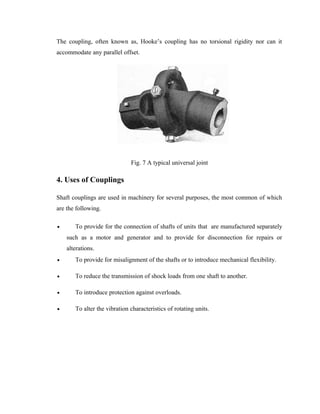
3.4 Hook’s Coupling or Universal Joints
A universal joint, universal coupling, U-joint, Cardan joint, Hardy-Spicerjoint,
or Hooke's joint is a joint or coupling in a rigid rod that allows the rod to 'bend' in any
direction, and is commonly used in shafts that transmit rotary motion. It consists of a pair
of hinges located close together, oriented at 90° to each other, connected by a cross shaft.
These joints are capable of handling relatively large angular misalignment and they are
widely used in agricultural machinery, machine tools and automobiles.A typical universal
joint is shown in figure- 7.There are many forms of these couplings, available
commercially but they essentially consist of two forks keyed or screwed to the shaft.
There is a center piece through which pass two pins with mutually perpendicular axes and
they connect the two fork ends such that a large angular misalignment can be
accommodated.
The coupling, often known as, Hooke’s coupling has no torsional rigidity nor can it
accommodate any parallel offset.
Fig. 7 A typical universal joint
4. Uses of Couplings
Shaft couplings are used in machinery for several purposes, the most common of which
are the following.
• To provide for the connection of shafts of units that are manufactured separately
such as a motor and generator and to provide for disconnection for repairs or
alterations.
• To provide for misalignment of the shafts or to introduce mechanical flexibility.
• To reduce the transmission of shock loads from one shaft to another.
• To introduce protection against overloads.
• To alter the vibration characteristics of rotating units.
5. Coupling Maintenance and failure.
Coupling maintenance is generally a simple matter, requiring a regularly scheduled
inspection of each coupling. It consists of:
• Performing visual inspections, checking for signs of wear or fatigue, and cleaning
couplings regularly.
• Checking and changing lubricant regularly if the coupling is lubricated. This
maintenance is required annually for most couplings and more frequently for couplings in
adverse environments or in demanding operating conditions.
• Documenting the maintenance performed on each coupling, along with the date.[2]
Even with proper maintenance, however, couplings can fail. Underlying reasons for failure,
other than maintenance, include:
• Improper installation
• Poor coupling selection
• Operation beyond design capabilities.
The only way to improve coupling life is to understand what caused the failure and to correct
it prior to installing a new coupling. Some external signs that indicate potential coupling
failure include:
• Abnormal noise, such as screeching, squealing or chattering
• Excessive vibration or wobble
• Failed seals indicated by lubricant leakage or contamination.
5. Requirement of good shaft alignment/good coupling set-up
• it should be easy to connect or disconnect the coupling.
• it does allow some misalignment between the two adjacent shaft rotation axes.
• it is the goal to minimize the remaining misalignment in running operation to
maximize power transmission and to maximize machine runtime (coupling and
bearing and sealing’s lifetime).
• it should have no projecting parts.
• it is recommended to use manufacturer's alignment target values to set up the
machine train to a defined non-zero alignment, due to the fact that later when the
machine is at operation temperature the alignment condition is perfect

Report on couplings

  • 1.
    1. REPORT ONCOUPLINGS A coupling is a device used to connect two shafts together at their ends for the purpose of transmitting power. Couplings do not normally allow disconnection of shafts during operation, however there are torque limiting couplings which can slip or disconnect when some torque limit is exceeded. The primary purpose of couplings is to join two pieces of rotating equipment while permitting some degree of misalignment or end movement or both. By careful selection, installation and maintenance of couplings, substantial savings can be made in reduced maintenance costs and downtime. Couplings are used to connect two shafts for torque transmission in varied applications. It may be to connect two units such as a motor and a generator or it may be to form a long line shaft by connecting shafts of standard lengths say 6-8m by couplings. Coupling may be rigid or they may provide flexibility and compensate for misalignment. They may also reduce shock loading and vibration. A wide variety of commercial shaft couplings are available ranging from a simple keyed coupling to one which requires a complex design procedure using gears or fluid drives etc. However there are two main types of couplings: Rigid couplings Flexible couplings Rigid couplings are used for shafts having no misalignment while the flexible couplings can absorb some amount of misalignment in the shafts to be connected. In the next section we shall discuss different types of couplings and their uses under these two broad headings.
  • 2.
    2. Types anduses of shaft couplings 2.1 RIGID COUPLING A rigid coupling is a unit of hardware used to join two shafts within a motor or mechanical system. It may be used to connect two separate systems, such as a motor and a generator, or to repair a connection within a single system. A rigid coupling may also be added between shafts to reduce shock and wear at the point where the shafts meet. When joining shafts within a machine, mechanics can choose between flexible and rigid couplings. While flexible units offer some movement and give between the shafts, rigid couplings are the most effective choice for precise alignment and secure hold. By precisely aligning the two shafts and holding them firmly in place, rigid couplings help to maximize performance and increase the expected life of the machine. These rigid couplings are available in two basic designs to fit the needs of different applications. Sleeve-style couplings are the most affordable and easiest to use. They consist of a single tube of material with an inner diameter that's equal in size to the shafts. The sleeve slips over the shafts so they meet in the middle of the coupling. A series of set screws can be tightened so they touch the top of each shaft and hold them in place without passing all the way through the coupling. Clamped or compression rigid couplings come in two parts and fit together around the shafts to form a sleeve. They offer more flexibility than sleeved models, and can be used on shafts that are fixed in place. They generally are large enough so that screws can pass all the way through the coupling and into the second half to ensure a secure hold. Flanged rigid couplings are designed for heavy loads or industrial equipment. They consist of short sleeves surrounded by a perpendicular flange. One coupling is placed on each shaft so the two flanges line up face to face. A series of screws or bolts can then be installed in the flanges to hold them together. Because of their size and durability, flanged units can be used to bring shafts into alignment before they are joined together. Rigid couplings are
  • 3.
    used when preciseshaft alignment is required; shaft misalignment will affect the coupling's performance as well as its life. Since these couplings cannot absorb any misalignment the shafts to be connected by a rigid coupling must have good lateral and angular alignment. The types of misalignments are shown schematically in Fig.1 below Fig.1 Types of misalignments in shafts 2.1.1 Sleeve coupling A sleeve coupling consists of a pipe whose bore is finished to the required tolerance based on the shaft size. Based on the usage of the coupling a keyway is made in the bore in order to transmit the torque by means of the key. Two threaded holes are provided in order to lock the coupling in position. Sleeve couplings are also known as Box Couplings. In this case shaft ends are coupled together and abutted against each other which are enveloped by muff or sleeve. A gib head sunk keys hold the two shafts and sleeve together.Fig.2 elaborates a view of typical sleeve coupling.
  • 4.
    Fig 2.A typicalsleeve coupling 2.1.2 Clamp or split-muff coupling A clamp coupling is different from the sleeve coupling in that the sleeve used in this type is split from one side. The shafts are entered and keyed to this sleeve and then split sides are screwed together. A typical clamp coupling is shown in fig.3. It essentially consists of two half cylinders which are placed over the ends of the shafts to be coupled and are held together by through bolt. The length of these couplings ‘L’ usually vary between 3.5 to 5 times the and the outside diameter ‘d0’ of the coupling sleeve between 2 to 4 times the shaft diameter d. It is assumed that even with a key the torque is transmitted due to the friction grip. If now the number of bolt on each half is n, its core diameter is dc and the coefficient of friction between the shaft and sleeve material is μ. The representation of Clamp or split-muff coupling is shown in fig.3 below
  • 5.
    Fig.3 Representation ofClamp Coupling. 3. Flexible Coupling Flexible couplings are used to transmit torque from one shaft to another when the two shafts are slightly misaligned. Flexible couplings can accommodate varying degrees of misalignment up to 3° and some parallel misalignment. In addition, they can also be used for vibration damping or noise reduction. The material used to manufacture the beam coupling also affects its performance and suitability for specific applications such as food, medical and aerospace. Materials are typically aluminum alloy and stainless steel, but they can also be made in acetal, maraging steeland titanium. The most common applications are attaching encoders to shafts and motion control for robotics.
  • 6.
    3.1 Beam Coupling Abeam coupling, also known as helical coupling, is a flexible coupling for transmitting torque between two shafts while allowing for angular misalignment, parallel offset and even axial motion, of one shaft relative to the other. This design utilizes a single piece of material and becomes flexible by removal of material along a spiral path resulting in a curved flexible beam of helical shape. Since it is made from a single piece of material, the Beam Style coupling does not exhibit the backlash found in some multi-piece couplings. Another advantage of being an all machined coupling is the possibility to incorporate features into the final product while still keeps the single piece integrity. Changes to the lead of the helical beam provide changes to misalignment capabilities as well as other performance characteristics such as torque capacity and torsional stiffness. It is even possible to have multiple starts within the same helix. The simple beam coupling is shown in Fig.4 Below. The material used to manufacture the beam coupling also affects its performance and suitability for specific applications such as food, medical and aerospace. Materials are typically aluminum alloy and stainless steel, but they can also be made in acetal, maraging steeland titanium. The most common applications are attaching encoders to shafts and motion control for robotics. Fig. 4 A Beam Coupling
  • 7.
    3.2 Flange Coupling Itis a very widely used rigid coupling and consists of two flanges keyed to the shafts and bolted. This is illustrated in Fig.5 below Fig 5 A typical flange coupling 3.3 Oldham coupling An Oldham coupling has three discs, one coupled to the input, one coupled to the output, and a middle disc that is joined to the first two by tongue and groove. The tongue and groove on one side is perpendicular to the tongue and groove on the other. The middle disc rotates around its center at the same speed as the input and output shafts. Its center traces a circular orbit, twice per rotation, around the midpoint between input and output shafts. Often springs are used to reduce backlash of the mechanism. An advantage to this type of coupling, as compared to two universal joints, is its compact size. The coupler is named for John Oldham who invented it in Ireland, in 1821, to solve a paddle placement problem in a paddle steamer design. These couplings can accommodate both lateral and angular misalignment to some extent. An Oldham coupling consists of two flanges with slots on the faces and the flanges are
  • 8.
    keyed or screwedto the shafts. A cylindrical piece, called the disc, has a narrow rectangular raised portion running across each face but at right angle to each other. The disc is placed between the flanges such that the raised portions fit into the slots in the flanges. The disc may be made of flexible materials and this absorbs some misalignment. A schematic representation is shown in Fig 6. Fig. 6 A schematic diagram of an Oldham coupling 3.4 Hook’s Coupling or Universal Joints A universal joint, universal coupling, U-joint, Cardan joint, Hardy-Spicerjoint, or Hooke's joint is a joint or coupling in a rigid rod that allows the rod to 'bend' in any direction, and is commonly used in shafts that transmit rotary motion. It consists of a pair of hinges located close together, oriented at 90° to each other, connected by a cross shaft. These joints are capable of handling relatively large angular misalignment and they are widely used in agricultural machinery, machine tools and automobiles.A typical universal joint is shown in figure- 7.There are many forms of these couplings, available commercially but they essentially consist of two forks keyed or screwed to the shaft. There is a center piece through which pass two pins with mutually perpendicular axes and they connect the two fork ends such that a large angular misalignment can be accommodated.
  • 9.
    The coupling, oftenknown as, Hooke’s coupling has no torsional rigidity nor can it accommodate any parallel offset. Fig. 7 A typical universal joint 4. Uses of Couplings Shaft couplings are used in machinery for several purposes, the most common of which are the following. • To provide for the connection of shafts of units that are manufactured separately such as a motor and generator and to provide for disconnection for repairs or alterations. • To provide for misalignment of the shafts or to introduce mechanical flexibility. • To reduce the transmission of shock loads from one shaft to another. • To introduce protection against overloads. • To alter the vibration characteristics of rotating units.
  • 10.
    5. Coupling Maintenanceand failure. Coupling maintenance is generally a simple matter, requiring a regularly scheduled inspection of each coupling. It consists of: • Performing visual inspections, checking for signs of wear or fatigue, and cleaning couplings regularly. • Checking and changing lubricant regularly if the coupling is lubricated. This maintenance is required annually for most couplings and more frequently for couplings in adverse environments or in demanding operating conditions. • Documenting the maintenance performed on each coupling, along with the date.[2] Even with proper maintenance, however, couplings can fail. Underlying reasons for failure, other than maintenance, include: • Improper installation • Poor coupling selection • Operation beyond design capabilities. The only way to improve coupling life is to understand what caused the failure and to correct it prior to installing a new coupling. Some external signs that indicate potential coupling failure include: • Abnormal noise, such as screeching, squealing or chattering • Excessive vibration or wobble • Failed seals indicated by lubricant leakage or contamination.
  • 11.
    5. Requirement ofgood shaft alignment/good coupling set-up • it should be easy to connect or disconnect the coupling. • it does allow some misalignment between the two adjacent shaft rotation axes. • it is the goal to minimize the remaining misalignment in running operation to maximize power transmission and to maximize machine runtime (coupling and bearing and sealing’s lifetime). • it should have no projecting parts. • it is recommended to use manufacturer's alignment target values to set up the machine train to a defined non-zero alignment, due to the fact that later when the machine is at operation temperature the alignment condition is perfect