GEAR
29-11-20161
Lecture notes on Gear
by Prem Kumar Soni
CONTENTS
POWER TRANSMISSION
GEAR
TYPES OF GEARS
NOMENCLATURE
APPLICATIONS OF GEARS
VELOCITY RATIO
GEAR TRAINS
EXAMPLE PROBLEMS AND QUESTIONS
29-11-20162
Lecture notes on Gear
by Prem Kumar Soni
GEAR…..
Power transmission is the movement of energy from its
place of generation to a location where it is applied to
performing useful work
A gear is a component within a transmission device
that transmits rotational force to another gear or
device
29-11-20163
Lecture notes on Gear
by Prem Kumar Soni
29-11-2016
Lecture notes on Gear
by Prem Kumar Soni4
A gear or cogwheel is a rotating machine part having
cut teeth, or cogs, which mesh with another toothed part
to transmit torque.
Geared devices can change the speed, torque, and
direction of a power source.
Gears almost always produce a change in torque, creating
a mechanical advantage, through their gear ratio, and
thus may be considered a simple machine.
The teeth on the two meshing gears all have the same
shape. Two or more meshing gears, working in a
sequence, are called a gear train or a transmission.
A gear can mesh with a linear toothed part, called a rack,
thereby producing translation instead of rotation.

TYPES OF GEARS
1. According to the position of axes of the shafts.
a. Parallel
1.Spur Gear
2.Helical Gear
3.Rack and Pinion
b. Intersecting
Bevel Gear
c. Non-intersecting and Non-parallel
worm and worm gears
29-11-20165
Lecture notes on Gear
by Prem Kumar Soni
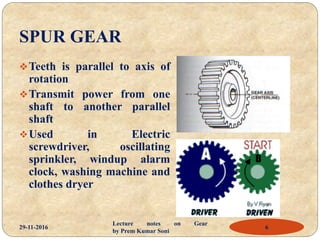
SPUR GEAR
Teeth is parallel to axis of
rotation
Transmit power from one
shaft to another parallel
shaft
Used in Electric
screwdriver, oscillating
sprinkler, windup alarm
clock, washing machine and
clothes dryer
29-11-2016 6
Lecture notes on Gear
by Prem Kumar Soni
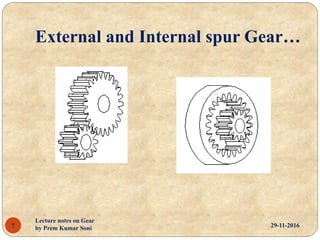
External and Internal spur Gear…
29-11-20167
Lecture notes on Gear
by Prem Kumar Soni
Helical Gear
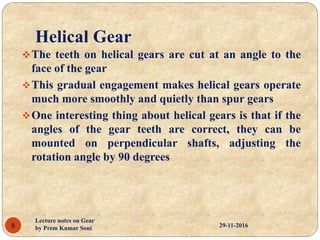
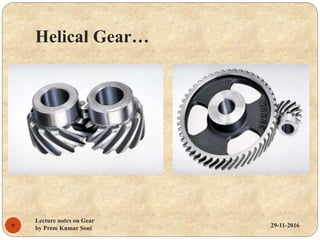
The teeth on helical gears are cut at an angle to the
face of the gear
This gradual engagement makes helical gears operate
much more smoothly and quietly than spur gears
One interesting thing about helical gears is that if the
angles of the gear teeth are correct, they can be
mounted on perpendicular shafts, adjusting the
rotation angle by 90 degrees
29-11-20168
Lecture notes on Gear
by Prem Kumar Soni
Helical Gear…
29-11-20169
Lecture notes on Gear
by Prem Kumar Soni
Herringbone gears
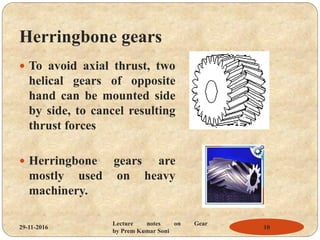
 To avoid axial thrust, two
helical gears of opposite
hand can be mounted side
by side, to cancel resulting
thrust forces
 Herringbone gears are
mostly used on heavy
machinery.
29-11-2016 10
Lecture notes on Gear
by Prem Kumar Soni
Rack and pinion
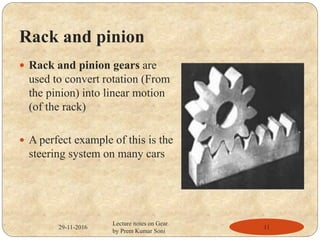
 Rack and pinion gears are
used to convert rotation (From
the pinion) into linear motion
(of the rack)
 A perfect example of this is the
steering system on many cars
29-11-2016 11
Lecture notes on Gear
by Prem Kumar Soni
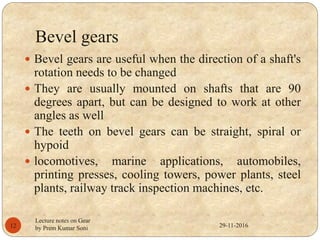
Bevel gears
 Bevel gears are useful when the direction of a shaft's
rotation needs to be changed
 They are usually mounted on shafts that are 90
degrees apart, but can be designed to work at other
angles as well
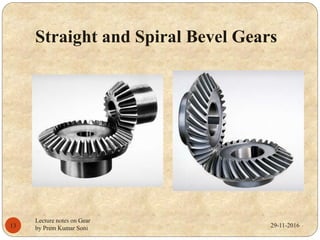
 The teeth on bevel gears can be straight, spiral or
hypoid
 locomotives, marine applications, automobiles,
printing presses, cooling towers, power plants, steel
plants, railway track inspection machines, etc.
29-11-201612
Lecture notes on Gear
by Prem Kumar Soni
Straight and Spiral Bevel Gears
29-11-201613
Lecture notes on Gear
by Prem Kumar Soni
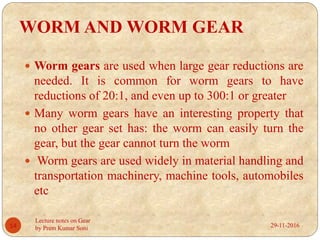
WORM AND WORM GEAR
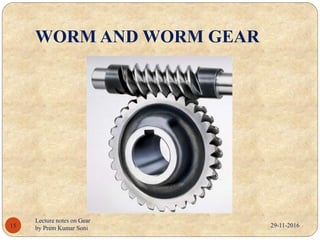
 Worm gears are used when large gear reductions are
needed. It is common for worm gears to have
reductions of 20:1, and even up to 300:1 or greater
 Many worm gears have an interesting property that
no other gear set has: the worm can easily turn the
gear, but the gear cannot turn the worm
 Worm gears are used widely in material handling and
transportation machinery, machine tools, automobiles
etc
29-11-201614
Lecture notes on Gear
by Prem Kumar Soni
WORM AND WORM GEAR
29-11-201615
Lecture notes on Gear
by Prem Kumar Soni
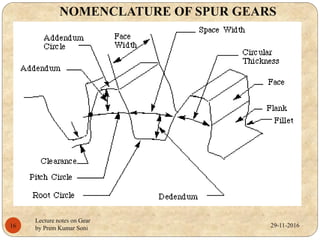
NOMENCLATURE OF SPUR GEARS
29-11-201616
Lecture notes on Gear
by Prem Kumar Soni
NOMENCLATURE….
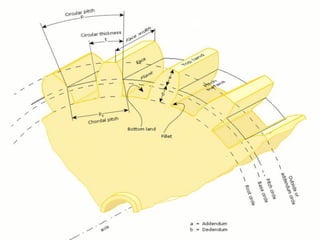
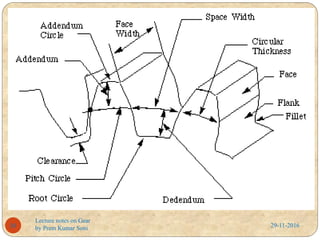
 Pitch surface: The surface of the imaginary rolling
cylinder (cone, etc.) that the toothed gear may be
considered to replace.
 Pitch circle: A right section of the pitch surface.
 Addendum circle: A circle bounding the ends of the teeth,
in a right section of the gear.
 Root (or dedendum) circle: The circle bounding the
spaces between the teeth, in a right section of the gear.
 Addendum: The radial distance between the pitch circle
and the addendum circle.
 Dedendum: The radial distance between the pitch circle
and the root circle.
 Clearance: The difference between the dedendum of one
gear and the addendum of the mating gear.
29-11-201617
Lecture notes on Gear
by Prem Kumar Soni
NOMENCLATURE….
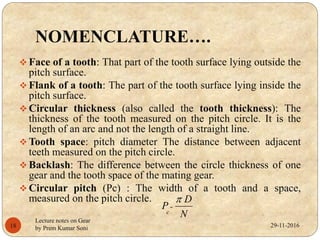
 Face of a tooth: That part of the tooth surface lying outside the
pitch surface.
 Flank of a tooth: The part of the tooth surface lying inside the
pitch surface.
 Circular thickness (also called the tooth thickness): The
thickness of the tooth measured on the pitch circle. It is the
length of an arc and not the length of a straight line.
 Tooth space: pitch diameter The distance between adjacent
teeth measured on the pitch circle.
 Backlash: The difference between the circle thickness of one
gear and the tooth space of the mating gear.
 Circular pitch (Pc) : The width of a tooth and a space,
measured on the pitch circle.
N
D
Pc

29-11-201618
Lecture notes on Gear
by Prem Kumar Soni
29-11-2016
Lecture notes on Gear
by Prem Kumar Soni19
29-11-2016
Lecture notes on Gear
by Prem Kumar Soni20
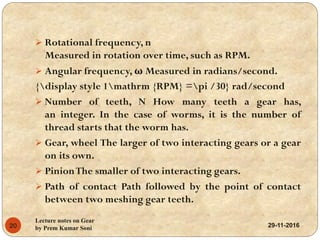
 Rotational frequency, n
Measured in rotation over time, such as RPM.
 Angular frequency, ω Measured in radians/second.
{display style 1mathrm {RPM} =pi /30} rad/second
 Number of teeth, N How many teeth a gear has,
an integer. In the case of worms, it is the number of
thread starts that the worm has.
 Gear, wheel The larger of two interacting gears or a gear
on its own.
 PinionThe smaller of two interacting gears.
 Path of contact Path followed by the point of contact
between two meshing gear teeth.
NOMENCLATURE….
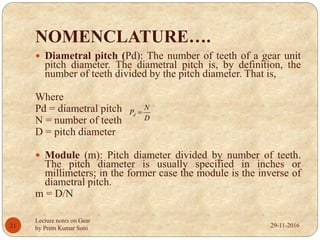
 Diametral pitch (Pd): The number of teeth of a gear unit
pitch diameter. The diametral pitch is, by definition, the
number of teeth divided by the pitch diameter. That is,
Where
Pd = diametral pitch
N = number of teeth
D = pitch diameter
 Module (m): Pitch diameter divided by number of teeth.
The pitch diameter is usually specified in inches or
millimeters; in the former case the module is the inverse of
diametral pitch.
m = D/N
D
N
Pd 
29-11-201621
Lecture notes on Gear
by Prem Kumar Soni
29-11-2016
Lecture notes on Gear
by Prem Kumar Soni22
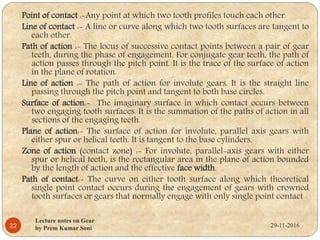
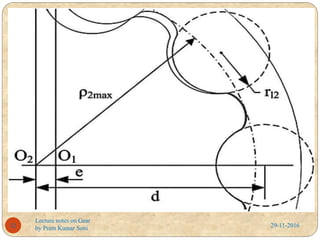
Point of contact :-Any point at which two tooth profiles touch each other.
Line of contact :- A line or curve along which two tooth surfaces are tangent to
each other.
Path of action :- The locus of successive contact points between a pair of gear
teeth, during the phase of engagement. For conjugate gear teeth, the path of
action passes through the pitch point. It is the trace of the surface of action
in the plane of rotation.
Line of action :- The path of action for involute gears. It is the straight line
passing through the pitch point and tangent to both base circles.
Surface of action:- The imaginary surface in which contact occurs between
two engaging tooth surfaces. It is the summation of the paths of action in all
sections of the engaging teeth.
Plane of action:- The surface of action for involute, parallel axis gears with
either spur or helical teeth. It is tangent to the base cylinders.
Zone of action (contact zone) :- For involute, parallel-axis gears with either
spur or helical teeth, is the rectangular area in the plane of action bounded
by the length of action and the effective face width.
Path of contact:- The curve on either tooth surface along which theoretical
single point contact occurs during the engagement of gears with crowned
tooth surfaces or gears that normally engage with only single point contact
29-11-2016
Lecture notes on Gear
by Prem Kumar Soni23
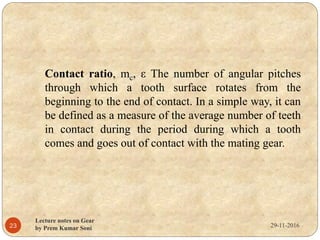
Contact ratio, mc, ε The number of angular pitches
through which a tooth surface rotates from the
beginning to the end of contact. In a simple way, it can
be defined as a measure of the average number of teeth
in contact during the period during which a tooth
comes and goes out of contact with the mating gear.
Backlash
29-11-2016
Lecture notes on Gear
by Prem Kumar Soni24
 Backlash is the error in motion that occurs when gears
change direction. It exists because there is always
some gap between the trailing face of the driving tooth
and the leading face of the tooth behind it on the
driven gear, and that gap must be closed before force
can be transferred in the new direction.
 The term "backlash" can also be used to refer to the
size of the gap, not just the phenomenon it causes;
thus, one could speak of a pair of gears as having, for
example, "0.1 mm of backlash."
29-11-2016
Lecture notes on Gear
by Prem Kumar Soni25
 For situations that require precision, such as
instrumentation and control, backlash can be minimized
through one of several techniques.
 For instance, the gear can be split along a plane
perpendicular to the axis, one half fixed to the shaft in the
usual manner, the other half placed alongside it, free to
rotate about the shaft, but with springs between the two
halves providing relative torque between them, so that one
achieves, in effect, a single gear with expanding teeth.
 Another method involves tapering the teeth in the axial
direction and letting the gear slide in the axial direction to
take up slack.
29-11-2016
Lecture notes on Gear
by Prem Kumar Soni26
 A pair of gears could be designed to have zero backlash,
but this would presuppose perfection in manufacturing,
uniform thermal expansion characteristics throughout the
system, and no lubricant. Therefore, gear pairs are designed
to have some backlash.
 It is usually provided by reducing the tooth thickness of
each gear by half the desired gap distance. In the case of a
large gear and a small pinion, however, the backlash is
usually taken entirely off the gear and the pinion is given
full sized teeth.
 Backlash can also be provided by moving the gears further
apart. The backlash of a gear train equals the sum of the
backlash of each pair of gears, so in long trains backlash
can become a problem.
Shifting of gears
29-11-2016
Lecture notes on Gear
by Prem Kumar Soni27
 In some machines (e.g., automobiles) it is necessary to
alter the gear ratio to suit the task, a process known as
gear shifting or changing gear. There are several ways
of shifting gears, for example:
 Manual transmission
 Automatic transmission
 Derailleur gears, which are actually sprockets in
combination with a roller chain
 Hub gears (also called epicyclical gearing or sun-and-
planet gears)
29-11-2016
Lecture notes on Gear
by Prem Kumar Soni28
 There are several outcomes of gear shifting in motor
vehicles. In the case of vehicle noise emissions, there
are higher sound levels emitted when the vehicle is
engaged in lower gears.
 The design life of the lower ratio gears is shorter, so
cheaper gears may be used, which tend to generate
more noise due to smaller overlap ratio and a lower
mesh stiffness etc. than the helical gears used for the
high ratios.
 This fact has been used to analyze vehicle-generated
sound since the late 1960s, and has been incorporated
into the simulation of urban roadway noise and
corresponding design of urban noise barriers along
roadways.
Tooth Profiles
29-11-2016
Lecture notes on Gear
by Prem Kumar Soni29
Involute Gear Profile:
Pressure angle remains same throughout the
operation.
Teeths are weaker.
It is easier to manufacture due to convex surface.
The velocity is not affected due to variation in
centre distance.
Interference takes place.
More wear and tear as contact takes place between
convex surfaces.
29-11-2016
Lecture notes on Gear
by Prem Kumar Soni30
Cycloidal Gear Profile
29-11-2016
Lecture notes on Gear
by Prem Kumar Soni31
Cycloid Gear Profile:
Pressure angle keeps on changing during the operation.
The angle is maximum at the start and end of
engagement. It is zero at pitch point.
Teeth are stronger.
It is difficult to manufacture due to requirement of
hypocycloid and epicycloids..
The centre distance should remains the same.
There is no interference.
Less wear and tear as concave flank makes contact
with convex flank.
29-11-2016
Lecture notes on Gear
by Prem Kumar Soni32
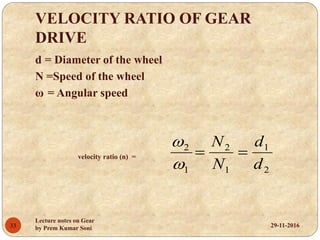
VELOCITY RATIO OF GEAR
DRIVE
d = Diameter of the wheel
N =Speed of the wheel
ω = Angular speed
velocity ratio (n) =
2
1
1
2
1
2
d
d
N
N



29-11-201633
Lecture notes on Gear
by Prem Kumar Soni
GEAR TRAINS
A gear train is two or more gear working together by
meshing their teeth and turning each other in a system to
generate power and speed
It reduces speed and increases torque
Electric motors are used with the gear systems to reduce
the speed and increase the torque
29-11-201634
Lecture notes on Gear
by Prem Kumar Soni
Types of Gear Trains
 Simple gear train
 Compound gear train
 Planetary gear train
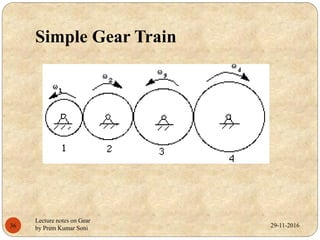
 Simple Gear Train
 The most common of the gear train is the gear pair
connecting parallel shafts. The teeth of this type can
be spur, helical or herringbone.
 Only one gear may rotate about a single axis
29-11-201635
Lecture notes on Gear
by Prem Kumar Soni
Simple Gear Train
29-11-201636
Lecture notes on Gear
by Prem Kumar Soni
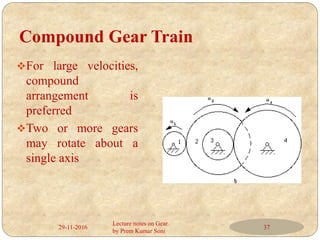
Compound Gear Train
For large velocities,
compound
arrangement is
preferred
Two or more gears
may rotate about a
single axis
29-11-2016 37
Lecture notes on Gear
by Prem Kumar Soni
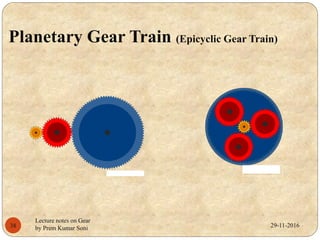
Planetary Gear Train (Epicyclic Gear Train)
29-11-201638
Lecture notes on Gear
by Prem Kumar Soni
Planetary Gear Train…
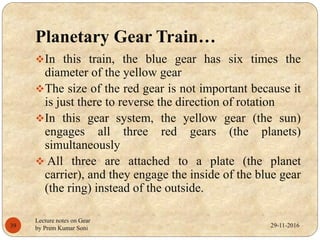
In this train, the blue gear has six times the
diameter of the yellow gear
The size of the red gear is not important because it
is just there to reverse the direction of rotation
In this gear system, the yellow gear (the sun)
engages all three red gears (the planets)
simultaneously
 All three are attached to a plate (the planet
carrier), and they engage the inside of the blue gear
(the ring) instead of the outside.
29-11-201639
Lecture notes on Gear
by Prem Kumar Soni
Planetary Gear Train…
Because there are three red gears instead of one, this
gear train is extremely rugged.
planetary gear sets is that they can produce different
gear ratios depending on which gear you use as the
input, which gear you use as the output, and which one
you hold still.
29-11-201640
Lecture notes on Gear
by Prem Kumar Soni
Planetary Gear Train…
 They have higher gear ratios.
 They are popular for automatic transmissions in
automobiles.
 They are also used in bicycles for controlling power of
pedaling automatically or manually.
 They are also used for power train between internal
combustion engine and an electric motor
29-11-201641
Lecture notes on Gear
by Prem Kumar Soni
Thank You
29-11-2016
Lecture notes on Gear
by Prem Kumar Soni42

Gear

  • 1.
    GEAR 29-11-20161 Lecture notes onGear by Prem Kumar Soni
  • 2.
    CONTENTS POWER TRANSMISSION GEAR TYPES OFGEARS NOMENCLATURE APPLICATIONS OF GEARS VELOCITY RATIO GEAR TRAINS EXAMPLE PROBLEMS AND QUESTIONS 29-11-20162 Lecture notes on Gear by Prem Kumar Soni
  • 3.
    GEAR….. Power transmission isthe movement of energy from its place of generation to a location where it is applied to performing useful work A gear is a component within a transmission device that transmits rotational force to another gear or device 29-11-20163 Lecture notes on Gear by Prem Kumar Soni
  • 4.
    29-11-2016 Lecture notes onGear by Prem Kumar Soni4 A gear or cogwheel is a rotating machine part having cut teeth, or cogs, which mesh with another toothed part to transmit torque. Geared devices can change the speed, torque, and direction of a power source. Gears almost always produce a change in torque, creating a mechanical advantage, through their gear ratio, and thus may be considered a simple machine. The teeth on the two meshing gears all have the same shape. Two or more meshing gears, working in a sequence, are called a gear train or a transmission. A gear can mesh with a linear toothed part, called a rack, thereby producing translation instead of rotation. 
  • 5.
    TYPES OF GEARS 1.According to the position of axes of the shafts. a. Parallel 1.Spur Gear 2.Helical Gear 3.Rack and Pinion b. Intersecting Bevel Gear c. Non-intersecting and Non-parallel worm and worm gears 29-11-20165 Lecture notes on Gear by Prem Kumar Soni
  • 6.
    SPUR GEAR Teeth isparallel to axis of rotation Transmit power from one shaft to another parallel shaft Used in Electric screwdriver, oscillating sprinkler, windup alarm clock, washing machine and clothes dryer 29-11-2016 6 Lecture notes on Gear by Prem Kumar Soni
  • 7.
    External and Internalspur Gear… 29-11-20167 Lecture notes on Gear by Prem Kumar Soni
  • 8.
    Helical Gear The teethon helical gears are cut at an angle to the face of the gear This gradual engagement makes helical gears operate much more smoothly and quietly than spur gears One interesting thing about helical gears is that if the angles of the gear teeth are correct, they can be mounted on perpendicular shafts, adjusting the rotation angle by 90 degrees 29-11-20168 Lecture notes on Gear by Prem Kumar Soni
  • 9.
  • 10.
    Herringbone gears  Toavoid axial thrust, two helical gears of opposite hand can be mounted side by side, to cancel resulting thrust forces  Herringbone gears are mostly used on heavy machinery. 29-11-2016 10 Lecture notes on Gear by Prem Kumar Soni
  • 11.
    Rack and pinion Rack and pinion gears are used to convert rotation (From the pinion) into linear motion (of the rack)  A perfect example of this is the steering system on many cars 29-11-2016 11 Lecture notes on Gear by Prem Kumar Soni
  • 12.
    Bevel gears  Bevelgears are useful when the direction of a shaft's rotation needs to be changed  They are usually mounted on shafts that are 90 degrees apart, but can be designed to work at other angles as well  The teeth on bevel gears can be straight, spiral or hypoid  locomotives, marine applications, automobiles, printing presses, cooling towers, power plants, steel plants, railway track inspection machines, etc. 29-11-201612 Lecture notes on Gear by Prem Kumar Soni
  • 13.
    Straight and SpiralBevel Gears 29-11-201613 Lecture notes on Gear by Prem Kumar Soni
  • 14.
    WORM AND WORMGEAR  Worm gears are used when large gear reductions are needed. It is common for worm gears to have reductions of 20:1, and even up to 300:1 or greater  Many worm gears have an interesting property that no other gear set has: the worm can easily turn the gear, but the gear cannot turn the worm  Worm gears are used widely in material handling and transportation machinery, machine tools, automobiles etc 29-11-201614 Lecture notes on Gear by Prem Kumar Soni
  • 15.
    WORM AND WORMGEAR 29-11-201615 Lecture notes on Gear by Prem Kumar Soni
  • 16.
    NOMENCLATURE OF SPURGEARS 29-11-201616 Lecture notes on Gear by Prem Kumar Soni
  • 17.
    NOMENCLATURE….  Pitch surface:The surface of the imaginary rolling cylinder (cone, etc.) that the toothed gear may be considered to replace.  Pitch circle: A right section of the pitch surface.  Addendum circle: A circle bounding the ends of the teeth, in a right section of the gear.  Root (or dedendum) circle: The circle bounding the spaces between the teeth, in a right section of the gear.  Addendum: The radial distance between the pitch circle and the addendum circle.  Dedendum: The radial distance between the pitch circle and the root circle.  Clearance: The difference between the dedendum of one gear and the addendum of the mating gear. 29-11-201617 Lecture notes on Gear by Prem Kumar Soni
  • 18.
    NOMENCLATURE….  Face ofa tooth: That part of the tooth surface lying outside the pitch surface.  Flank of a tooth: The part of the tooth surface lying inside the pitch surface.  Circular thickness (also called the tooth thickness): The thickness of the tooth measured on the pitch circle. It is the length of an arc and not the length of a straight line.  Tooth space: pitch diameter The distance between adjacent teeth measured on the pitch circle.  Backlash: The difference between the circle thickness of one gear and the tooth space of the mating gear.  Circular pitch (Pc) : The width of a tooth and a space, measured on the pitch circle. N D Pc  29-11-201618 Lecture notes on Gear by Prem Kumar Soni
  • 19.
    29-11-2016 Lecture notes onGear by Prem Kumar Soni19
  • 20.
    29-11-2016 Lecture notes onGear by Prem Kumar Soni20  Rotational frequency, n Measured in rotation over time, such as RPM.  Angular frequency, ω Measured in radians/second. {display style 1mathrm {RPM} =pi /30} rad/second  Number of teeth, N How many teeth a gear has, an integer. In the case of worms, it is the number of thread starts that the worm has.  Gear, wheel The larger of two interacting gears or a gear on its own.  PinionThe smaller of two interacting gears.  Path of contact Path followed by the point of contact between two meshing gear teeth.
  • 21.
    NOMENCLATURE….  Diametral pitch(Pd): The number of teeth of a gear unit pitch diameter. The diametral pitch is, by definition, the number of teeth divided by the pitch diameter. That is, Where Pd = diametral pitch N = number of teeth D = pitch diameter  Module (m): Pitch diameter divided by number of teeth. The pitch diameter is usually specified in inches or millimeters; in the former case the module is the inverse of diametral pitch. m = D/N D N Pd  29-11-201621 Lecture notes on Gear by Prem Kumar Soni
  • 22.
    29-11-2016 Lecture notes onGear by Prem Kumar Soni22 Point of contact :-Any point at which two tooth profiles touch each other. Line of contact :- A line or curve along which two tooth surfaces are tangent to each other. Path of action :- The locus of successive contact points between a pair of gear teeth, during the phase of engagement. For conjugate gear teeth, the path of action passes through the pitch point. It is the trace of the surface of action in the plane of rotation. Line of action :- The path of action for involute gears. It is the straight line passing through the pitch point and tangent to both base circles. Surface of action:- The imaginary surface in which contact occurs between two engaging tooth surfaces. It is the summation of the paths of action in all sections of the engaging teeth. Plane of action:- The surface of action for involute, parallel axis gears with either spur or helical teeth. It is tangent to the base cylinders. Zone of action (contact zone) :- For involute, parallel-axis gears with either spur or helical teeth, is the rectangular area in the plane of action bounded by the length of action and the effective face width. Path of contact:- The curve on either tooth surface along which theoretical single point contact occurs during the engagement of gears with crowned tooth surfaces or gears that normally engage with only single point contact
  • 23.
    29-11-2016 Lecture notes onGear by Prem Kumar Soni23 Contact ratio, mc, ε The number of angular pitches through which a tooth surface rotates from the beginning to the end of contact. In a simple way, it can be defined as a measure of the average number of teeth in contact during the period during which a tooth comes and goes out of contact with the mating gear.
  • 24.
    Backlash 29-11-2016 Lecture notes onGear by Prem Kumar Soni24  Backlash is the error in motion that occurs when gears change direction. It exists because there is always some gap between the trailing face of the driving tooth and the leading face of the tooth behind it on the driven gear, and that gap must be closed before force can be transferred in the new direction.  The term "backlash" can also be used to refer to the size of the gap, not just the phenomenon it causes; thus, one could speak of a pair of gears as having, for example, "0.1 mm of backlash."
  • 25.
    29-11-2016 Lecture notes onGear by Prem Kumar Soni25  For situations that require precision, such as instrumentation and control, backlash can be minimized through one of several techniques.  For instance, the gear can be split along a plane perpendicular to the axis, one half fixed to the shaft in the usual manner, the other half placed alongside it, free to rotate about the shaft, but with springs between the two halves providing relative torque between them, so that one achieves, in effect, a single gear with expanding teeth.  Another method involves tapering the teeth in the axial direction and letting the gear slide in the axial direction to take up slack.
  • 26.
    29-11-2016 Lecture notes onGear by Prem Kumar Soni26  A pair of gears could be designed to have zero backlash, but this would presuppose perfection in manufacturing, uniform thermal expansion characteristics throughout the system, and no lubricant. Therefore, gear pairs are designed to have some backlash.  It is usually provided by reducing the tooth thickness of each gear by half the desired gap distance. In the case of a large gear and a small pinion, however, the backlash is usually taken entirely off the gear and the pinion is given full sized teeth.  Backlash can also be provided by moving the gears further apart. The backlash of a gear train equals the sum of the backlash of each pair of gears, so in long trains backlash can become a problem.
  • 27.
    Shifting of gears 29-11-2016 Lecturenotes on Gear by Prem Kumar Soni27  In some machines (e.g., automobiles) it is necessary to alter the gear ratio to suit the task, a process known as gear shifting or changing gear. There are several ways of shifting gears, for example:  Manual transmission  Automatic transmission  Derailleur gears, which are actually sprockets in combination with a roller chain  Hub gears (also called epicyclical gearing or sun-and- planet gears)
  • 28.
    29-11-2016 Lecture notes onGear by Prem Kumar Soni28  There are several outcomes of gear shifting in motor vehicles. In the case of vehicle noise emissions, there are higher sound levels emitted when the vehicle is engaged in lower gears.  The design life of the lower ratio gears is shorter, so cheaper gears may be used, which tend to generate more noise due to smaller overlap ratio and a lower mesh stiffness etc. than the helical gears used for the high ratios.  This fact has been used to analyze vehicle-generated sound since the late 1960s, and has been incorporated into the simulation of urban roadway noise and corresponding design of urban noise barriers along roadways.
  • 29.
    Tooth Profiles 29-11-2016 Lecture noteson Gear by Prem Kumar Soni29 Involute Gear Profile: Pressure angle remains same throughout the operation. Teeths are weaker. It is easier to manufacture due to convex surface. The velocity is not affected due to variation in centre distance. Interference takes place. More wear and tear as contact takes place between convex surfaces.
  • 30.
    29-11-2016 Lecture notes onGear by Prem Kumar Soni30
  • 31.
    Cycloidal Gear Profile 29-11-2016 Lecturenotes on Gear by Prem Kumar Soni31 Cycloid Gear Profile: Pressure angle keeps on changing during the operation. The angle is maximum at the start and end of engagement. It is zero at pitch point. Teeth are stronger. It is difficult to manufacture due to requirement of hypocycloid and epicycloids.. The centre distance should remains the same. There is no interference. Less wear and tear as concave flank makes contact with convex flank.
  • 32.
    29-11-2016 Lecture notes onGear by Prem Kumar Soni32
  • 33.
    VELOCITY RATIO OFGEAR DRIVE d = Diameter of the wheel N =Speed of the wheel ω = Angular speed velocity ratio (n) = 2 1 1 2 1 2 d d N N    29-11-201633 Lecture notes on Gear by Prem Kumar Soni
  • 34.
    GEAR TRAINS A geartrain is two or more gear working together by meshing their teeth and turning each other in a system to generate power and speed It reduces speed and increases torque Electric motors are used with the gear systems to reduce the speed and increase the torque 29-11-201634 Lecture notes on Gear by Prem Kumar Soni
  • 35.
    Types of GearTrains  Simple gear train  Compound gear train  Planetary gear train  Simple Gear Train  The most common of the gear train is the gear pair connecting parallel shafts. The teeth of this type can be spur, helical or herringbone.  Only one gear may rotate about a single axis 29-11-201635 Lecture notes on Gear by Prem Kumar Soni
  • 36.
    Simple Gear Train 29-11-201636 Lecturenotes on Gear by Prem Kumar Soni
  • 37.
    Compound Gear Train Forlarge velocities, compound arrangement is preferred Two or more gears may rotate about a single axis 29-11-2016 37 Lecture notes on Gear by Prem Kumar Soni
  • 38.
    Planetary Gear Train(Epicyclic Gear Train) 29-11-201638 Lecture notes on Gear by Prem Kumar Soni
  • 39.
    Planetary Gear Train… Inthis train, the blue gear has six times the diameter of the yellow gear The size of the red gear is not important because it is just there to reverse the direction of rotation In this gear system, the yellow gear (the sun) engages all three red gears (the planets) simultaneously  All three are attached to a plate (the planet carrier), and they engage the inside of the blue gear (the ring) instead of the outside. 29-11-201639 Lecture notes on Gear by Prem Kumar Soni
  • 40.
    Planetary Gear Train… Becausethere are three red gears instead of one, this gear train is extremely rugged. planetary gear sets is that they can produce different gear ratios depending on which gear you use as the input, which gear you use as the output, and which one you hold still. 29-11-201640 Lecture notes on Gear by Prem Kumar Soni
  • 41.
    Planetary Gear Train… They have higher gear ratios.  They are popular for automatic transmissions in automobiles.  They are also used in bicycles for controlling power of pedaling automatically or manually.  They are also used for power train between internal combustion engine and an electric motor 29-11-201641 Lecture notes on Gear by Prem Kumar Soni
  • 42.
    Thank You 29-11-2016 Lecture noteson Gear by Prem Kumar Soni42