RAJ. S. SAITAVADEKAR
ABHISHEK BHOSALE
SANTOSH GURKHE
SUMEED RAMTEKE
COUPLING- TYPES AND ITS
APPLICATIONS
WHAT IS COUPLING ?
 A coupling is a device used to connect two shafts together at their ends
for the purpose of transmitting power. Couplings do not normally
allow disconnection of shafts during operation, however there
are tourque limiting couplings which can slip or disconnect when some
torque limit is exceeded.
 The primary purpose of couplings is to join two pieces of rotating
equipment while permitting some degree of misalignment or end
movement or both. By careful selection, installation and maintenance
of couplings, substantial savings can be made in reduced maintenance
costs and downtime.
TYPES OF COUPLING:
 RIGID COUPLING
 SLEEVE COUPLING
 FLANGE COUPLING
 CLAMP OR SPLIT-MUFF COUPLING
 GEISLINGER COUPLING
 MAGNETIC COUPLING
 SAGA COUPLING
 DELTAFLEX COUPLING
 TORSIONAL COUPLING
RIGID COUPLING
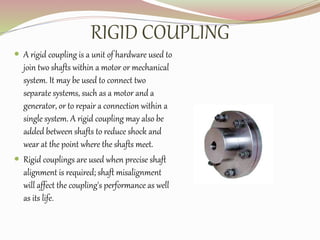
 A rigid coupling is a unit of hardware used to
join two shafts within a motor or mechanical
system. It may be used to connect two
separate systems, such as a motor and a
generator, or to repair a connection within a
single system. A rigid coupling may also be
added between shafts to reduce shock and
wear at the point where the shafts meet.
 Rigid couplings are used when precise shaft
alignment is required; shaft misalignment
will affect the coupling's performance as well
as its life.
SLEEVE COUPLING
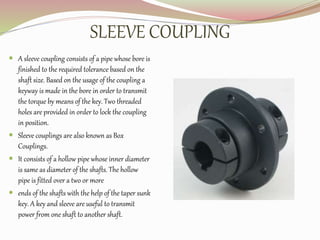
 A sleeve coupling consists of a pipe whose bore is
finished to the required tolerance based on the
shaft size. Based on the usage of the coupling a
keyway is made in the bore in order to transmit
the torque by means of the key. Two threaded
holes are provided in order to lock the coupling
in position.
 Sleeve couplings are also known as Box
Couplings.
 It consists of a hollow pipe whose inner diameter
is same as diameter of the shafts. The hollow
pipe is fitted over a two or more
 ends of the shafts with the help of the taper sunk
key. A key and sleeve are useful to transmit
power from one shaft to another shaft.
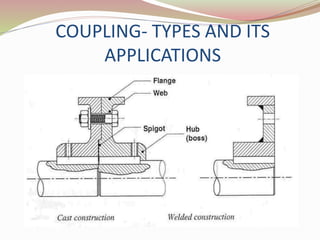
FLANGE COUPLING
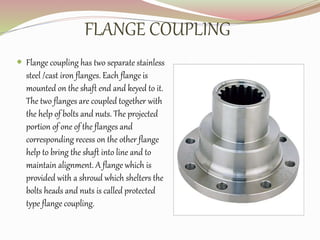
 Flange coupling has two separate stainless
steel /cast iron flanges. Each flange is
mounted on the shaft end and keyed to it.
The two flanges are coupled together with
the help of bolts and nuts. The projected
portion of one of the flanges and
corresponding recess on the other flange
help to bring the shaft into line and to
maintain alignment. A flange which is
provided with a shroud which shelters the
bolts heads and nuts is called protected
type flange coupling.
CLAMP OR SPLIT-MUFF COUPLING
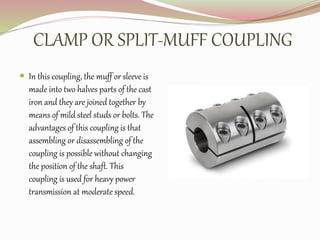
 In this coupling, the muff or sleeve is
made into two halves parts of the cast
iron and they are joined together by
means of mild steel studs or bolts. The
advantages of this coupling is that
assembling or disassembling of the
coupling is possible without changing
the position of the shaft. This
coupling is used for heavy power
transmission at moderate speed.
GEISLINGER COUPLING
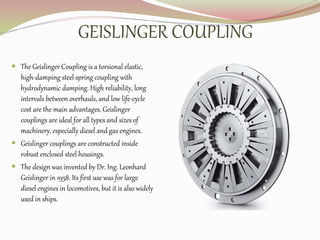
 The Geislinger Coupling is a torsional elastic,
high-damping steel spring coupling with
hydrodynamic damping. High reliability, long
intervals between overhauls, and low life-cycle
cost are the main advantages. Geislinger
couplings are ideal for all types and sizes of
machinery, especially diesel and gas engines.
 Geislinger couplings are constructed inside
robust enclosed steel housings.
 The design was invented by Dr. Ing. Leonhard
Geislinger in 1958. Its first use was for large
diesel engines in locomotives, but it is also widely
used in ships.
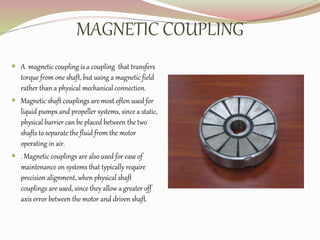
MAGNETIC COUPLING
 A magnetic coupling is a coupling that transfers
torque from one shaft, but using a magnetic field
rather than a physical mechanical connection.
 Magnetic shaft couplings are most often used for
liquid pumps and propeller systems, since a static,
physical barrier can be placed between the two
shafts to separate the fluid from the motor
operating in air.
 . Magnetic couplings are also used for ease of
maintenance on systems that typically require
precision alignment, when physical shaft
couplings are used, since they allow a greater off
axis error between the motor and driven shaft.
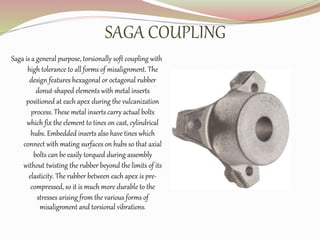
SAGA COUPLING
Saga is a general purpose, torsionally soft coupling with
high tolerance to all forms of misalignment. The
design features hexagonal or octagonal rubber
donut-shaped elements with metal inserts
positioned at each apex during the vulcanization
process. These metal inserts carry actual bolts
which fix the element to tines on cast, cylindrical
hubs. Embedded inserts also have tines which
connect with mating surfaces on hubs so that axial
bolts can be easily torqued during assembly
without twisting the rubber beyond the limits of its
elasticity. The rubber between each apex is pre-
compressed, so it is much more durable to the
stresses arising from the various forms of
misalignment and torsional vibrations.
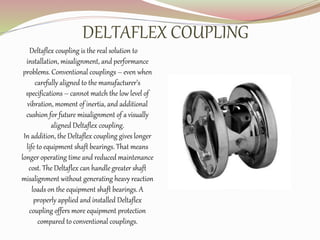
DELTAFLEX COUPLING
Deltaflex coupling is the real solution to
installation, misalignment, and performance
problems. Conventional couplings – even when
carefully aligned to the manufacturer’s
specifications – cannot match the low level of
vibration, moment of inertia, and additional
cushion for future misalignment of a visually
aligned Deltaflex coupling.
In addition, the Deltaflex coupling gives longer
life to equipment shaft bearings. That means
longer operating time and reduced maintenance
cost. The Deltaflex can handle greater shaft
misalignment without generating heavy reaction
loads on the equipment shaft bearings. A
properly applied and installed Deltaflex
coupling offers more equipment protection
compared to conventional couplings.
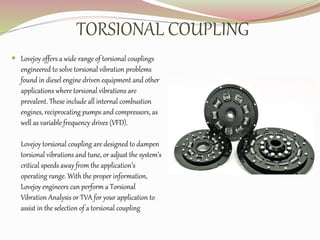
TORSIONAL COUPLING
 Lovejoy offers a wide range of torsional couplings
engineered to solve torsional vibration problems
found in diesel engine driven equipment and other
applications where torsional vibrations are
prevalent. These include all internal combustion
engines, reciprocating pumps and compressors, as
well as variable frequency drives (VFD).
Lovejoy torsional coupling are designed to dampen
torsional vibrations and tune, or adjust the system’s
critical speeds away from the application’s
operating range. With the proper information,
Lovejoy engineers can perform a Torsional
Vibration Analysis or TVA for your application to
assist in the selection of a torsional coupling
THANK YOU..

Coupling

  • 1.
    RAJ. S. SAITAVADEKAR ABHISHEKBHOSALE SANTOSH GURKHE SUMEED RAMTEKE
  • 2.
    COUPLING- TYPES ANDITS APPLICATIONS
  • 3.
    WHAT IS COUPLING?  A coupling is a device used to connect two shafts together at their ends for the purpose of transmitting power. Couplings do not normally allow disconnection of shafts during operation, however there are tourque limiting couplings which can slip or disconnect when some torque limit is exceeded.  The primary purpose of couplings is to join two pieces of rotating equipment while permitting some degree of misalignment or end movement or both. By careful selection, installation and maintenance of couplings, substantial savings can be made in reduced maintenance costs and downtime.
  • 4.
    TYPES OF COUPLING: RIGID COUPLING  SLEEVE COUPLING  FLANGE COUPLING  CLAMP OR SPLIT-MUFF COUPLING  GEISLINGER COUPLING  MAGNETIC COUPLING  SAGA COUPLING  DELTAFLEX COUPLING  TORSIONAL COUPLING
  • 5.
    RIGID COUPLING  Arigid coupling is a unit of hardware used to join two shafts within a motor or mechanical system. It may be used to connect two separate systems, such as a motor and a generator, or to repair a connection within a single system. A rigid coupling may also be added between shafts to reduce shock and wear at the point where the shafts meet.  Rigid couplings are used when precise shaft alignment is required; shaft misalignment will affect the coupling's performance as well as its life.
  • 6.
    SLEEVE COUPLING  Asleeve coupling consists of a pipe whose bore is finished to the required tolerance based on the shaft size. Based on the usage of the coupling a keyway is made in the bore in order to transmit the torque by means of the key. Two threaded holes are provided in order to lock the coupling in position.  Sleeve couplings are also known as Box Couplings.  It consists of a hollow pipe whose inner diameter is same as diameter of the shafts. The hollow pipe is fitted over a two or more  ends of the shafts with the help of the taper sunk key. A key and sleeve are useful to transmit power from one shaft to another shaft.
  • 7.
    FLANGE COUPLING  Flangecoupling has two separate stainless steel /cast iron flanges. Each flange is mounted on the shaft end and keyed to it. The two flanges are coupled together with the help of bolts and nuts. The projected portion of one of the flanges and corresponding recess on the other flange help to bring the shaft into line and to maintain alignment. A flange which is provided with a shroud which shelters the bolts heads and nuts is called protected type flange coupling.
  • 8.
    CLAMP OR SPLIT-MUFFCOUPLING  In this coupling, the muff or sleeve is made into two halves parts of the cast iron and they are joined together by means of mild steel studs or bolts. The advantages of this coupling is that assembling or disassembling of the coupling is possible without changing the position of the shaft. This coupling is used for heavy power transmission at moderate speed.
  • 9.
    GEISLINGER COUPLING  TheGeislinger Coupling is a torsional elastic, high-damping steel spring coupling with hydrodynamic damping. High reliability, long intervals between overhauls, and low life-cycle cost are the main advantages. Geislinger couplings are ideal for all types and sizes of machinery, especially diesel and gas engines.  Geislinger couplings are constructed inside robust enclosed steel housings.  The design was invented by Dr. Ing. Leonhard Geislinger in 1958. Its first use was for large diesel engines in locomotives, but it is also widely used in ships.
  • 10.
    MAGNETIC COUPLING  Amagnetic coupling is a coupling that transfers torque from one shaft, but using a magnetic field rather than a physical mechanical connection.  Magnetic shaft couplings are most often used for liquid pumps and propeller systems, since a static, physical barrier can be placed between the two shafts to separate the fluid from the motor operating in air.  . Magnetic couplings are also used for ease of maintenance on systems that typically require precision alignment, when physical shaft couplings are used, since they allow a greater off axis error between the motor and driven shaft.
  • 11.
    SAGA COUPLING Saga isa general purpose, torsionally soft coupling with high tolerance to all forms of misalignment. The design features hexagonal or octagonal rubber donut-shaped elements with metal inserts positioned at each apex during the vulcanization process. These metal inserts carry actual bolts which fix the element to tines on cast, cylindrical hubs. Embedded inserts also have tines which connect with mating surfaces on hubs so that axial bolts can be easily torqued during assembly without twisting the rubber beyond the limits of its elasticity. The rubber between each apex is pre- compressed, so it is much more durable to the stresses arising from the various forms of misalignment and torsional vibrations.
  • 12.
    DELTAFLEX COUPLING Deltaflex couplingis the real solution to installation, misalignment, and performance problems. Conventional couplings – even when carefully aligned to the manufacturer’s specifications – cannot match the low level of vibration, moment of inertia, and additional cushion for future misalignment of a visually aligned Deltaflex coupling. In addition, the Deltaflex coupling gives longer life to equipment shaft bearings. That means longer operating time and reduced maintenance cost. The Deltaflex can handle greater shaft misalignment without generating heavy reaction loads on the equipment shaft bearings. A properly applied and installed Deltaflex coupling offers more equipment protection compared to conventional couplings.
  • 13.
    TORSIONAL COUPLING  Lovejoyoffers a wide range of torsional couplings engineered to solve torsional vibration problems found in diesel engine driven equipment and other applications where torsional vibrations are prevalent. These include all internal combustion engines, reciprocating pumps and compressors, as well as variable frequency drives (VFD). Lovejoy torsional coupling are designed to dampen torsional vibrations and tune, or adjust the system’s critical speeds away from the application’s operating range. With the proper information, Lovejoy engineers can perform a Torsional Vibration Analysis or TVA for your application to assist in the selection of a torsional coupling
  • 14.