Matter
 and
Change           P Squires
         General Chemistry
                2005-2006
Observing Chemical
       Change

• Open book to page 55 and
   conduct Discovery Lab
         • (50 pts)
Properties of Matter

•What is a substance?

• Physical Properties

• Chemical Properties
Physical States

Solid           What are some
     Liquid     characteristics
                      of each?
              Gas
                  Plasma
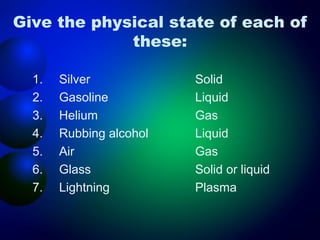
Give the physical state of each of
             these:

  1.   Silver            Solid
  2.   Gasoline          Liquid
  3.   Helium            Gas
  4.   Rubbing alcohol   Liquid
  5.   Air               Gas
  6.   Glass             Solid or liquid
  7.   Lightning         Plasma
Plas
ma
Physical Changes

   • Physical changes only
  involve changes in state or
         appearance.

• What are some examples of
      physical change?
Catch words for Physical
       Change
• Boil       •Split
• Freeze     •Grind
• Melt       •Cut
• Condense
             •Crush
• Break
             •Bend
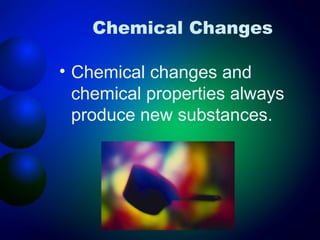
Chemical Changes

• Chemical changes and
  chemical properties always
  produce new substances.
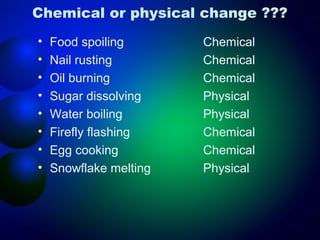
Chemical or physical change ???
•   Food spoiling       Chemical
•   Nail rusting        Chemical
•   Oil burning         Chemical
•   Sugar dissolving    Physical
•   Water boiling       Physical
•   Firefly flashing    Chemical
•   Egg cooking         Chemical
•   Snowflake melting   Physical
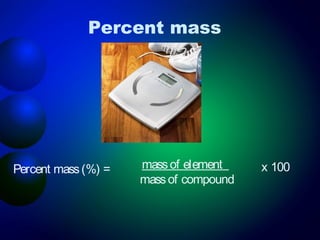
Percent mass


Percent mass (%) =   mass of element_   x 100
                     mass of compound
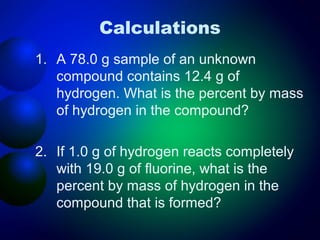
Calculations
1. A 78.0 g sample of an unknown
   compound contains 12.4 g of
   hydrogen. What is the percent by mass
   of hydrogen in the compound?

2. If 1.0 g of hydrogen reacts completely
   with 19.0 g of fluorine, what is the
   percent by mass of hydrogen in the
   compound that is formed?
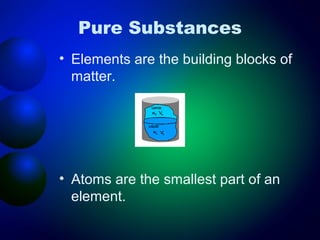
Pure Substances
• Elements are the building blocks of
  matter.


• Atoms are the smallest part of an
  element.
Mixtures
… do not have a definite
 composition
… are either heterogeneous,
with clearly visible components
… or homogeneous,
      which are uniform in
           appearance
Solutions
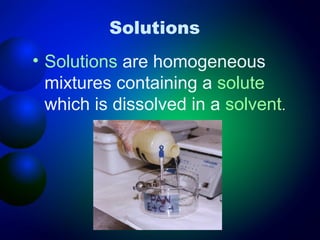
• Solutions are homogeneous
  mixtures containing a solute
  which is dissolved in a solvent.
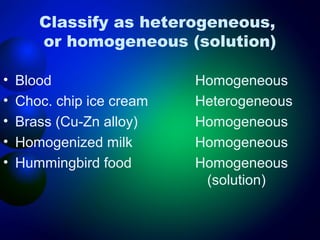
Classify as heterogeneous,
       or homogeneous (solution)

•   Blood                  Homogeneous
•   Choc. chip ice cream   Heterogeneous
•   Brass (Cu-Zn alloy)    Homogeneous
•   Homogenized milk       Homogeneous
•   Hummingbird food       Homogeneous
                            (solution)
We separate mixtures …

… based on differences in the
    chemical and physical
properties of the components in
          the mixture.
Separating Mixtures
• Quick Lab Handout
• (50 points)
How would you separate the
       following?
Aluminum filings and iron filings?

      Saw dust and sand?

  Salt and powdered charcoal?

      Water and alcohol?
Elements
• A pure substance that can not be
  separated into simpler substance by
  physical or chemical means.
Compounds
• A combination of two or more different
  elements that are combined
  chemically.


• What are some examples
  of compounds?
The Law of Conservation of
           Mass


Matter can neither be
 created or destroyed
  during a chemical
      reaction.
Law of Definite Proportions

 Elements comprise
compounds in definite
 proportions by mass.
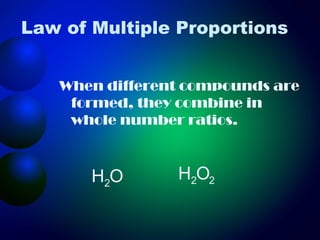
Law of Multiple Proportions


   When different compounds are
    formed, they combine in
    whole number ratios.


       H2O      H2O2
ChemLab

• Read and complete ChemLab
     page 78. (100 points)

 • Answer Questions at end:
   Analyze and Conclude.
Structure of the
     Atom
Part of the Atom
• Electron

• Proton
             What charge does each have?
• Neutron
             Where are they found?

             Which ones make up the mass of the
             atom?

             Which ones make up the size of the
             atom?
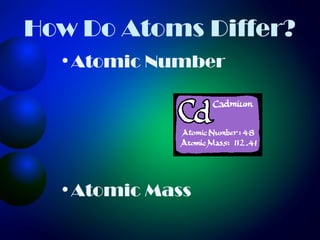
How Do Atoms Differ?
  •Atomic Number


  •Atomic Mass
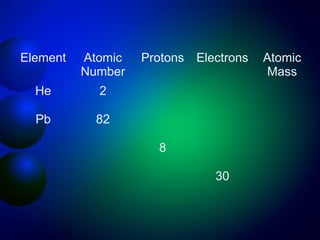
Element   Atomic   Protons Electrons   Atomic
          Number                        Mass
  He        2

  Pb        82

                     8

                              30
Mass Number

 Number of neutrons =
mass number – atomic number
Isotopes …
…of the same element have the
same number of protons and
electrons but different numbers of
neutrons.
   Therefore, isotopes of the same
   element have different masses.
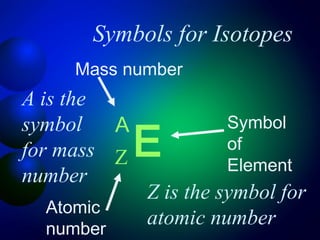
Symbols for Isotopes
    Mass number
A is the
         A            Symbol
             E
symbol
for mass Z            of
                      Element
number
             Z is the symbol for
  Atomic
  number
             atomic number
MiniLab
• Do modeling isotope lab on
        page 102.
Energy
   and
Electrons
Light and Energy
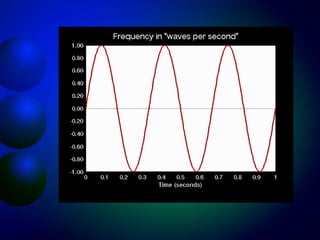
• Frequency = f or f with units of
 Hertz (Hz)


• Wavelength = λ with units of
  meters (m)
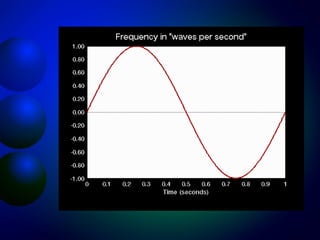
What is the relationship
between frequency and
     wavelength?
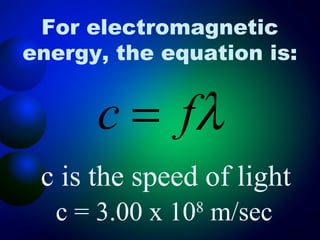
For electromagnetic
energy, the equation is:


      c = fλ
 c is the speed of light
  c = 3.00 x 10 m/sec
               8
Electromagnetic
   Spectrum
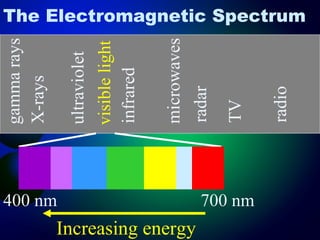
• Electromagnetic waves
       carry energy.

   • Light is part of the
electromagnetic spectrum
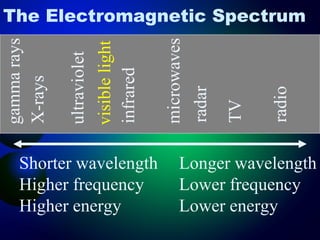
The Electromagnetic Spectrum
gamma rays


                             microwaves
             visible light
             ultraviolet

             infrared
X-rays


                             radar


                                               radio
                                          TV
   Shorter wavelength           Longer wavelength
   Higher frequency             Lower frequency
   Higher energy                Lower energy
gamma rays
                             X-rays


                    400 nm
                             ultraviolet
                             visible light
                             infrared

                             microwaves


Increasing energy
                             radar
                             TV
                    700 nm


                             radio
                                             The Electromagnetic Spectrum
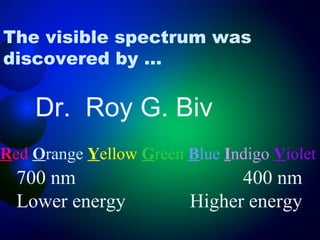
The visible spectrum was
discovered by …

    Dr. Roy G. Biv
Red Orange Yellow Green Blue Indigo Violet
  700 nm                       400 nm
  Lower energy           Higher energy
Niels Bohr
Bohr said that electrons could exist only
 in certain discrete energy levels …

 … and that electrons can only change
 energy levels when they absorb or give
 off a certain amount of energy. (1913)
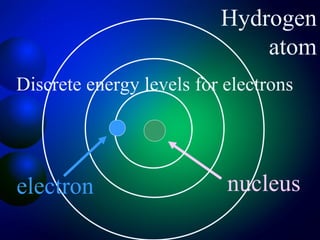
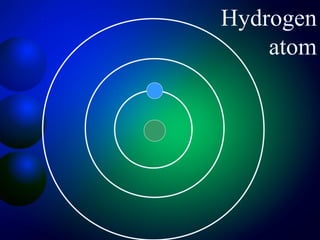
Hydrogen
                              atom
Discrete energy levels for electrons


electron                   nucleus
Hydrogen
                              atom
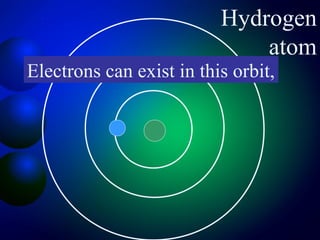
Electrons can exist in this orbit,
Hydrogen
                         atom
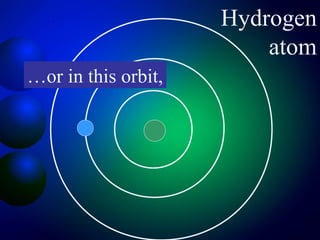
…or in this orbit,
Hydrogen
                  atom
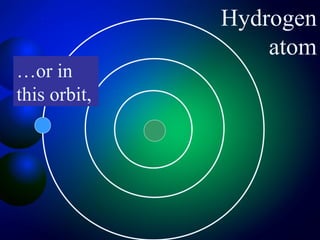
…or in
this orbit,
Hydrogen
                             atom
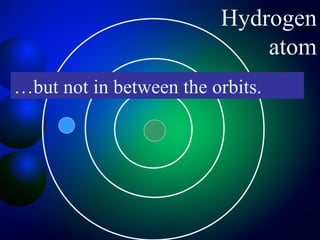
…but not in between the orbits.
Hydrogen
                             atom
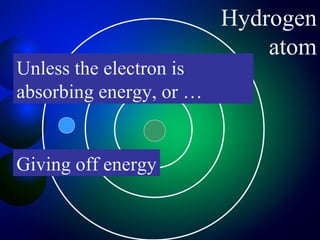
Unless the electron is
absorbing energy, or …


Giving off energy
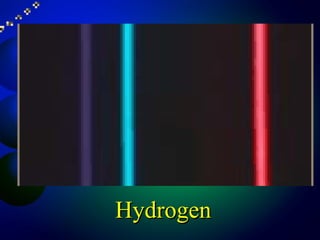
When high voltage is connected to
 the hydrogen discharge tube, a
 bluish light is given off.

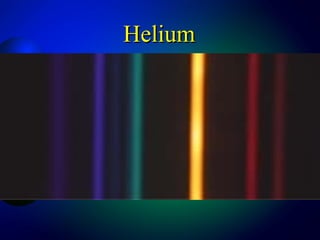
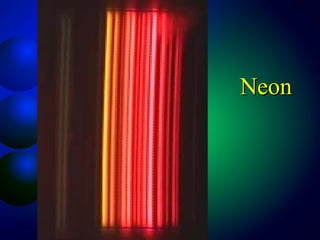
When observed through a
 diffraction grating, specific lines
 of color are observed.
The electron in a hydrogen
 atom gains energy from the
 electricity passing thru the
 tube and …
… the electron moves up to a
 higher energy level.
The electron in the excited
 state is “unstable”.
The electron drops to a lower
 energy level, and …
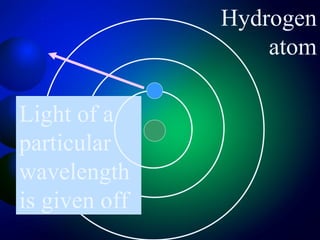
… gives off light of a certain
 energy and wavelength.
Hydrogen
    atom
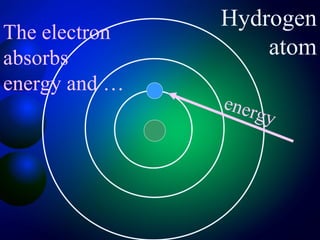
Hydrogen
The electron
absorbs            atom
energy and …
               ener
                   g   y
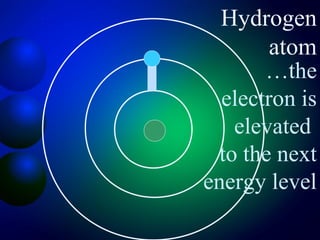
Hydrogen
        atom
       …the
  electron is
    elevated
  to the next
energy level
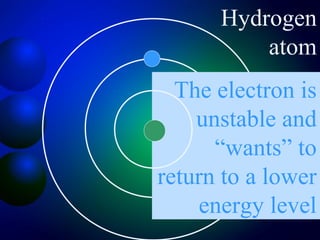
Hydrogen
          atom
  The electron is
    unstable and
      “wants” to
return to a lower
     energy level
Hydrogen
                   atom

Light of a
particular
wavelength
is given off
Helium
Neon
Hydrogen
“Regardless of it’s
   shortcomings and the
modifications that were later
applied, Bohr’s model of the
     atom was the first
successful attempt to make
the internal structure of the
      atom agree with
   spectroscopic data.”
                      Asimov, 1964
Quantum
Mechanical Model of
    the Atom
1. A small, dense positively
   charged nucleus which
   contains protons and neutrons.
2. Electrons which exist outside of
   the nucleus at …
  – various distances from the nucleus,
    and at …
  – various energy levels.
The Electrons
3. The electrons can have both a mass,
   as does matter, and a wavelength,
   as does light energy.
4. The electrons themselves are not
   little solid spheres in orbit around the
   nucleus, but exist as a “fog” of half-
   energy, half-matter. The electrons
   can behave as either matter or
   energy, depending on the
   experiment.
Energy Levels

5. Based on the ideas of Bohr, the
   electrons are located …
  – … in major energy levels,
  – … in energy sublevels within major
    energy levels,
  – … in orbitals within each sublevel.
Next up….

The Periodic Table

Matter and change

  • 1.
    Matter and Change P Squires General Chemistry 2005-2006
  • 2.
    Observing Chemical Change • Open book to page 55 and conduct Discovery Lab • (50 pts)
  • 3.
    Properties of Matter •Whatis a substance? • Physical Properties • Chemical Properties
  • 4.
    Physical States Solid What are some Liquid characteristics of each? Gas Plasma
  • 5.
    Give the physicalstate of each of these: 1. Silver Solid 2. Gasoline Liquid 3. Helium Gas 4. Rubbing alcohol Liquid 5. Air Gas 6. Glass Solid or liquid 7. Lightning Plasma
  • 6.
  • 7.
    Physical Changes • Physical changes only involve changes in state or appearance. • What are some examples of physical change?
  • 8.
    Catch words forPhysical Change • Boil •Split • Freeze •Grind • Melt •Cut • Condense •Crush • Break •Bend
  • 9.
    Chemical Changes • Chemicalchanges and chemical properties always produce new substances.
  • 10.
    Chemical or physicalchange ??? • Food spoiling Chemical • Nail rusting Chemical • Oil burning Chemical • Sugar dissolving Physical • Water boiling Physical • Firefly flashing Chemical • Egg cooking Chemical • Snowflake melting Physical
  • 11.
    Percent mass Percent mass(%) = mass of element_ x 100 mass of compound
  • 12.
    Calculations 1. A 78.0g sample of an unknown compound contains 12.4 g of hydrogen. What is the percent by mass of hydrogen in the compound? 2. If 1.0 g of hydrogen reacts completely with 19.0 g of fluorine, what is the percent by mass of hydrogen in the compound that is formed?
  • 13.
    Pure Substances • Elementsare the building blocks of matter. • Atoms are the smallest part of an element.
  • 14.
    Mixtures … do nothave a definite composition … are either heterogeneous, with clearly visible components … or homogeneous, which are uniform in appearance
  • 15.
    Solutions • Solutions arehomogeneous mixtures containing a solute which is dissolved in a solvent.
  • 16.
    Classify as heterogeneous, or homogeneous (solution) • Blood Homogeneous • Choc. chip ice cream Heterogeneous • Brass (Cu-Zn alloy) Homogeneous • Homogenized milk Homogeneous • Hummingbird food Homogeneous (solution)
  • 17.
    We separate mixtures… … based on differences in the chemical and physical properties of the components in the mixture.
  • 18.
    Separating Mixtures • QuickLab Handout • (50 points)
  • 19.
    How would youseparate the following? Aluminum filings and iron filings? Saw dust and sand? Salt and powdered charcoal? Water and alcohol?
  • 20.
    Elements • A puresubstance that can not be separated into simpler substance by physical or chemical means.
  • 21.
    Compounds • A combinationof two or more different elements that are combined chemically. • What are some examples of compounds?
  • 22.
    The Law ofConservation of Mass Matter can neither be created or destroyed during a chemical reaction.
  • 23.
    Law of DefiniteProportions Elements comprise compounds in definite proportions by mass.
  • 24.
    Law of MultipleProportions When different compounds are formed, they combine in whole number ratios. H2O H2O2
  • 25.
    ChemLab • Read andcomplete ChemLab page 78. (100 points) • Answer Questions at end: Analyze and Conclude.
  • 26.
  • 27.
    Part of theAtom • Electron • Proton What charge does each have? • Neutron Where are they found? Which ones make up the mass of the atom? Which ones make up the size of the atom?
  • 28.
    How Do AtomsDiffer? •Atomic Number •Atomic Mass
  • 29.
    Element Atomic Protons Electrons Atomic Number Mass He 2 Pb 82 8 30
  • 30.
    Mass Number Numberof neutrons = mass number – atomic number
  • 31.
    Isotopes … …of thesame element have the same number of protons and electrons but different numbers of neutrons. Therefore, isotopes of the same element have different masses.
  • 32.
    Symbols for Isotopes Mass number A is the A Symbol E symbol for mass Z of Element number Z is the symbol for Atomic number atomic number
  • 33.
    MiniLab • Do modelingisotope lab on page 102.
  • 34.
    Energy and Electrons
  • 35.
    Light and Energy •Frequency = f or f with units of Hertz (Hz) • Wavelength = λ with units of meters (m)
  • 36.
    What is therelationship between frequency and wavelength?
  • 39.
    For electromagnetic energy, theequation is: c = fλ c is the speed of light c = 3.00 x 10 m/sec 8
  • 40.
    Electromagnetic Spectrum • Electromagnetic waves carry energy. • Light is part of the electromagnetic spectrum
  • 41.
    The Electromagnetic Spectrum gammarays microwaves visible light ultraviolet infrared X-rays radar radio TV Shorter wavelength Longer wavelength Higher frequency Lower frequency Higher energy Lower energy
  • 42.
    gamma rays X-rays 400 nm ultraviolet visible light infrared microwaves Increasing energy radar TV 700 nm radio The Electromagnetic Spectrum
  • 43.
    The visible spectrumwas discovered by … Dr. Roy G. Biv Red Orange Yellow Green Blue Indigo Violet 700 nm 400 nm Lower energy Higher energy
  • 44.
    Niels Bohr Bohr saidthat electrons could exist only in certain discrete energy levels … … and that electrons can only change energy levels when they absorb or give off a certain amount of energy. (1913)
  • 45.
    Hydrogen atom Discrete energy levels for electrons electron nucleus
  • 46.
    Hydrogen atom Electrons can exist in this orbit,
  • 47.
    Hydrogen atom …or in this orbit,
  • 48.
    Hydrogen atom …or in this orbit,
  • 49.
    Hydrogen atom …but not in between the orbits.
  • 50.
    Hydrogen atom Unless the electron is absorbing energy, or … Giving off energy
  • 51.
    When high voltageis connected to the hydrogen discharge tube, a bluish light is given off. When observed through a diffraction grating, specific lines of color are observed.
  • 52.
    The electron ina hydrogen atom gains energy from the electricity passing thru the tube and … … the electron moves up to a higher energy level.
  • 53.
    The electron inthe excited state is “unstable”. The electron drops to a lower energy level, and … … gives off light of a certain energy and wavelength.
  • 54.
  • 55.
    Hydrogen The electron absorbs atom energy and … ener g y
  • 56.
    Hydrogen atom …the electron is elevated to the next energy level
  • 57.
    Hydrogen atom The electron is unstable and “wants” to return to a lower energy level
  • 58.
    Hydrogen atom Light of a particular wavelength is given off
  • 59.
  • 60.
  • 61.
  • 62.
    “Regardless of it’s shortcomings and the modifications that were later applied, Bohr’s model of the atom was the first successful attempt to make the internal structure of the atom agree with spectroscopic data.” Asimov, 1964
  • 63.
    Quantum Mechanical Model of the Atom 1. A small, dense positively charged nucleus which contains protons and neutrons. 2. Electrons which exist outside of the nucleus at … – various distances from the nucleus, and at … – various energy levels.
  • 64.
    The Electrons 3. Theelectrons can have both a mass, as does matter, and a wavelength, as does light energy. 4. The electrons themselves are not little solid spheres in orbit around the nucleus, but exist as a “fog” of half- energy, half-matter. The electrons can behave as either matter or energy, depending on the experiment.
  • 65.
    Energy Levels 5. Basedon the ideas of Bohr, the electrons are located … – … in major energy levels, – … in energy sublevels within major energy levels, – … in orbitals within each sublevel.
  • 66.

Editor's Notes

  • #4 Substance – matter that has uniform and unchanging composition (pure substance) – table salt, water, sea water Physical properties – observed and measured without changing the composition – density, color, odor, taste, hardness, melting point, boiling point Chemical Properties – Ability of a substance to combine with or change into one or more other substances – iron rust, reactions.
  • #16 Solute can differ. Solvent is usually water.
  • #22 Table salt, water, sugar, aspirin. 10 million known compounds. Medicines.
  • #25 Distinctly different properties – water and peroxide
  • #29 Atomic Number – number of protons in an atom. On top. Atomic Mass – number on bottom.