Nuclear Chemistry


                      P Squires
               Basic Chemistry
                     2005-2006
Isotopes …
…have the same number of
protons and electrons but
different numbers of
neutrons.
Isotopes …
…have different mass
 numbers but the same atomic
 number.
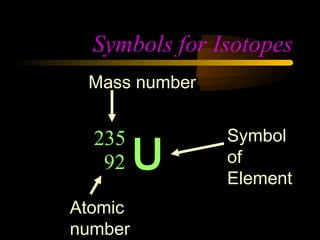
Symbols for Isotopes
 Mass number


               Symbol
         U
  235
   92          of
               Element
Atomic
number
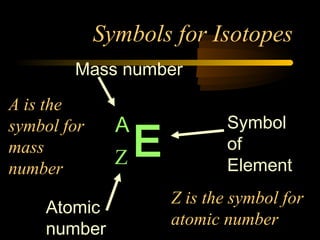
Symbols for Isotopes
        Mass number
A is the
               A             Symbol
                 E
symbol for
mass                         of
number
               Z             Element
                     Z is the symbol for
    Atomic
                     atomic number
    number
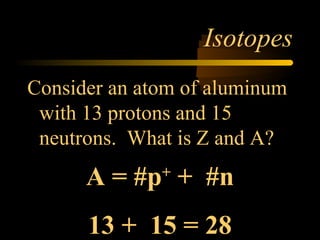
Isotopes
Consider an atom of aluminum
 with 13 protons and 15
 neutrons. What is Z and A?
      A = #p + #n
              +


      13 + 15 = 28
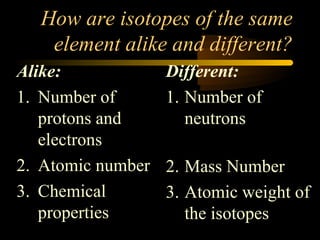
How are isotopes of the same
   element alike and different?
Alike:             Different:
1. Number of       1. Number of
   protons and        neutrons
   electrons
2. Atomic number   2. Mass Number
3. Chemical        3. Atomic weight of
   properties         the isotopes
Isotopes

 See Illustrated
Isotope example
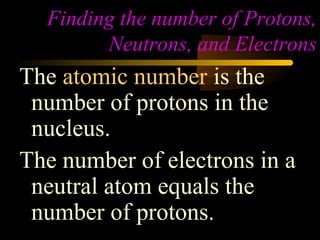
Finding the number of Protons,
        Neutrons, and Electrons
The atomic number is the
 number of protons in the
 nucleus.
The number of electrons in a
 neutral atom equals the
 number of protons.
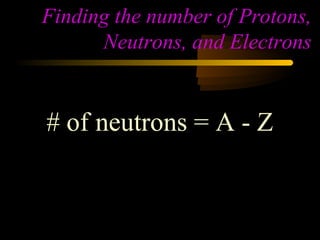
Finding the number of Protons,
      Neutrons, and Electrons


# of neutrons = A - Z
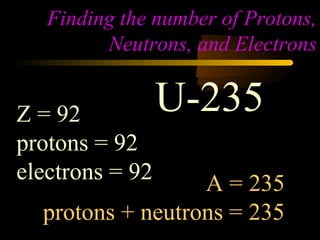
Finding the number of Protons,
         Neutrons, and Electrons


Z = 92           U-235
protons = 92
electrons = 92    A = 235
  protons + neutrons = 235
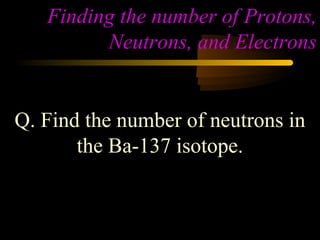
Finding the number of Protons,
         Neutrons, and Electrons


Q. Find the number of neutrons in
       the Ba-137 isotope.
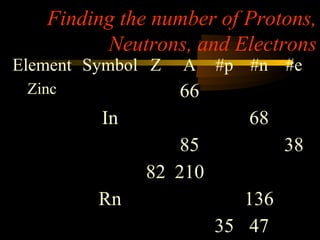
Finding the number of Protons,
         Neutrons, and Electrons
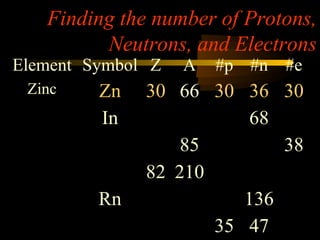
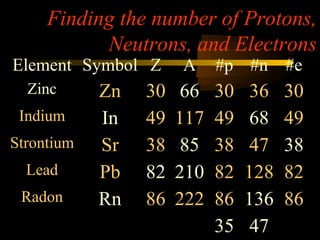
Element Symbol Z   A    #p #n #e
 Zinc              66
         In                68
                  85             38
              82 210
         Rn                136
                        35 47
Finding the number of Protons,
         Neutrons, and Electrons
Element Symbol Z   A   #p #n #e
 Zinc    Zn   30 66 30 36 30
         In             68
                  85        38
              82 210
         Rn             136
                     35 47
Finding the number of Protons,
         Neutrons, and Electrons
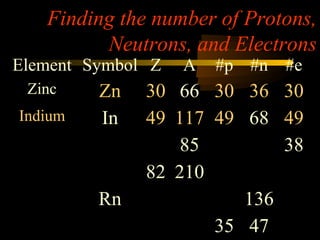
Element Symbol Z   A   #p #n #e
 Zinc    Zn   30 66 30 36 30
Indium   In   49 117 49 68 49
                  85        38
              82 210
         Rn             136
                     35 47
Finding the number of Protons,
           Neutrons, and Electrons
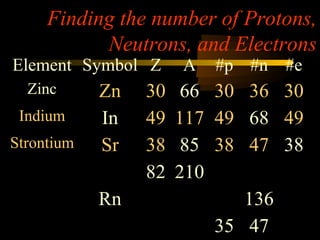
Element Symbol Z      A   #p #n #e
  Zinc      Zn   30    66 30 36 30
 Indium     In   49   117 49 68 49
Strontium   Sr   38    85 38 47 38
                 82   210
            Rn               136
                          35 47
Finding the number of Protons,
           Neutrons, and Electrons
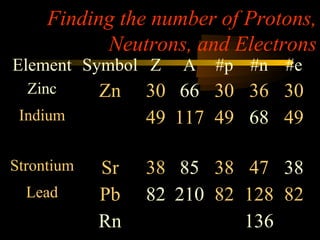
Element Symbol Z    A   #p #n #e
  Zinc      Zn   30 66 30 36 30
 Indium          49 117 49 68 49

Strontium   Sr   38 85 38 47 38
  Lead      Pb   82 210 82 128 82
            Rn             136
Finding the number of Protons,
           Neutrons, and Electrons
Element Symbol Z      A     #p #n #e
  Zinc      Zn   30    66   30   36    30
 Indium     In   49   117   49   68    49
Strontium   Sr   38    85   38   47    38
  Lead      Pb   82   210   82   128   82
 Radon      Rn   86   222   86   136   86
                            35   47
Finding the number of Protons,
           Neutrons, and Electrons
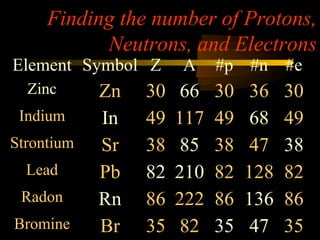
Element Symbol Z      A     #p #n #e
  Zinc      Zn   30    66   30   36    30
 Indium     In   49   117   49   68    49
Strontium   Sr   38    85   38   47    38
  Lead      Pb   82   210   82   128   82
 Radon      Rn   86   222   86   136   86
Bromine     Br   35    82   35   47    35
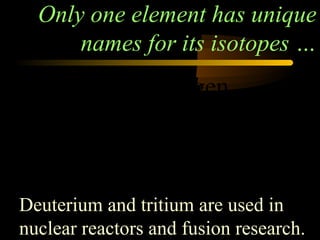
Only one element has unique
      names for its isotopes …
        1
        1   H = hydrogen
        2
        1   H = deuterium
        3
        1   H = tritium
Deuterium and tritium are used in
nuclear reactors and fusion research.
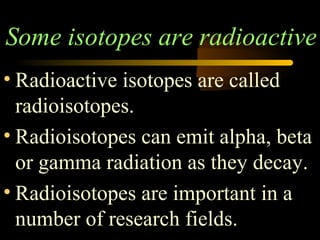
Some isotopes are radioactive
• Radioactive isotopes are called
  radioisotopes.
• Radioisotopes can emit alpha, beta
  or gamma radiation as they decay.
• Radioisotopes are important in a
  number of research fields.
Protection from radiation
1. Shielding


2. Distance
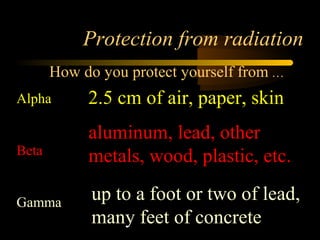
Protection from radiation
       How do you protect yourself from …
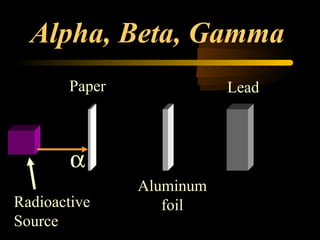
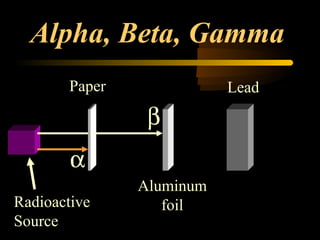
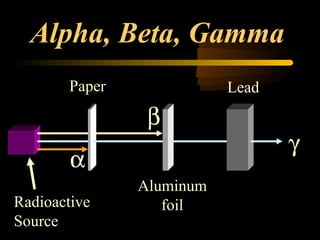
Alpha       2.5 cm of air, paper, skin
            aluminum, lead, other
Beta        metals, wood, plastic, etc.

Gamma        up to a foot or two of lead,
             many feet of concrete
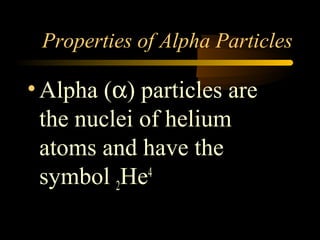
Properties of Alpha Particles

• Alpha (α) particles are
  the nuclei of helium
  atoms and have the
  symbol 2He  4
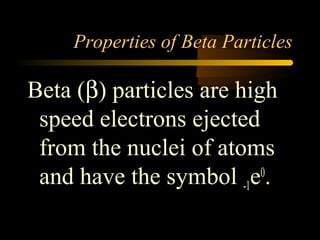
Properties of Beta Particles

Beta (β) particles are high
 speed electrons ejected
 from the nuclei of atoms
 and have the symbol -1e .0
Properties of Gamma Rays

• Gamma (γ) rays are high energy
  electromagnetic waves, not
  particles.
• Gamma rays have short
  wavelengths and high energies
  and travel at the speed of light.
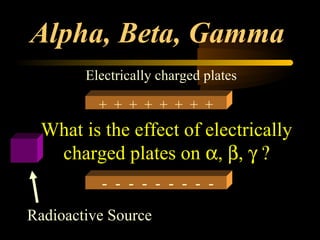
Alpha, Beta, Gamma
        Electrically charged plates

          + + + + + + + +
 What is the effect of electrically
  charged plates on α, β, γ ?
          - - - - - - - - -

Radioactive Source
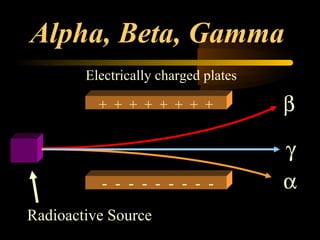
Alpha, Beta, Gamma
        Electrically charged plates

          + + + + + + + +             β

                                      γ
          - - - - - - - - -           α
Radioactive Source
Alpha, Beta, Gamma

 Why do the α, β and
 γ rays take the paths
 that they do?
Alpha, Beta, Gamma
        Paper              Lead


        α
                Aluminum
Radioactive        foil
Source
Alpha, Beta, Gamma
        Paper              Lead

                 β
        α
                Aluminum
Radioactive        foil
Source
Alpha, Beta, Gamma
        Paper              Lead

                 β
                                  γ
        α
                Aluminum
Radioactive        foil
Source
Decay
equations
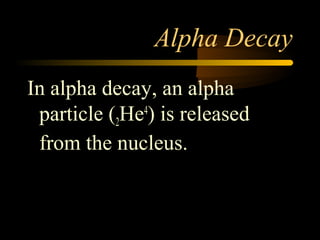
Alpha Decay
In alpha decay, an alpha
 particle (2He4) is released
 from the nucleus.
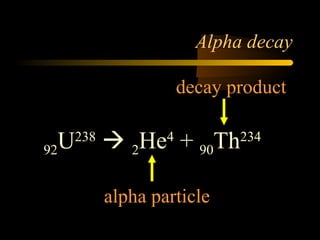
Alpha decay

                           decay product


92   U   238
                2He + 90Th
                       4          234


               alpha particle
Alpha decay
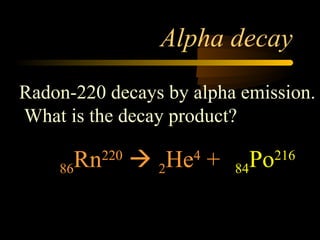
Radon-220 decays by alpha emission.
What is the decay product?

    86 Rn   220
                   2He +
                      4
                            84 Po
                             ???216
Alpha decay
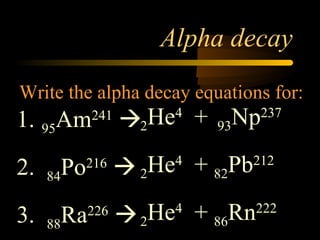
Write the alpha decay equations for:
1. 95Am     241
                  2He + 93Np
                       4          237


2.   84Po
        216
                   2He + 82Pb
                       4         212


3.   88Ra
            226
                   2He + 86Rn
                       4         222
Beta Decay
Beta decay occurs because of
 the instability of a neutron.

Neutrons are a little more massive
 than protons; and neutrons are
 neutral.
Beta decay
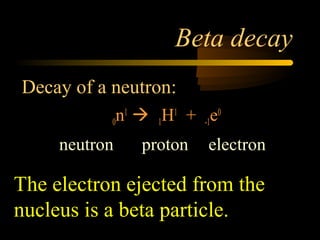
Decay of a neutron:
           0n1  1H1 + -1e0
     neutron   proton    electron

The electron ejected from the
nucleus is a beta particle.
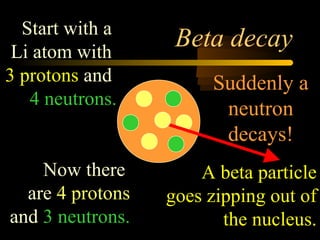
Start with a
 Li atom with
                   Beta decay
3 protons and          Suddenly a
   4 neutrons.
                        neutron
                        decays!
    Now there         A beta particle
  are 4 protons   goes zipping out of
and 3 neutrons.          the nucleus.
Beta decay
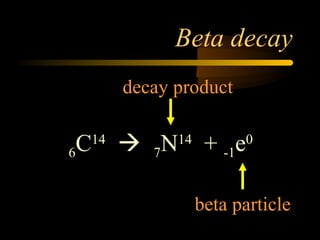
           decay product


6 C   14
            7N   14
                        + -1e   0


                       beta particle
Beta decay
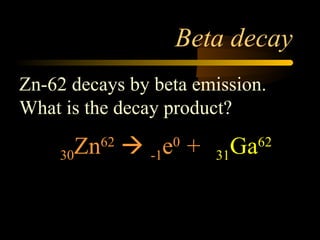
Zn-62 decays by beta emission.
What is the decay product?

    30   Zn  -1e +
           62     0
                        ???
                       31Ga   62
Beta decay
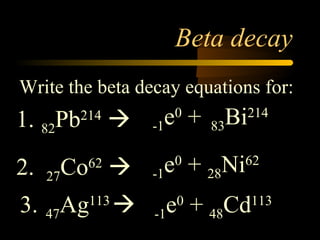
Write the beta decay equations for:
1. 82Pb214
                  -1 e + 83Bi
                        0        214


2.   27Co 
          62
                   -1 e + 28Ni
                        0        62


3. 47??? 
     Ag   113
                   -1   e + 48Cd
                         0         113
Gamma Decay

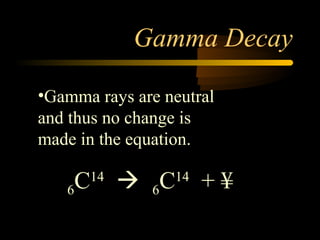
•Gamma rays are neutral
and thus no change is
made in the equation.

   6 C   14
               6C   14
                          +¥
Half life
What is half life?

Half life is the time needed for
 one half of a radioisotope to
 decay.
Half Life
• Take 100 pennies and throw them on the
  floor.
• Remove those that are heads up.
• Count remaining pennies.
• Continue until only one penny remains.


 What can this tell us about Half Life?
What is half life?

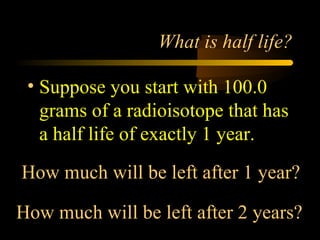
 • Suppose you start with 100.0
   grams of a radioisotope that has
   a half life of exactly 1 year.
How much will be left after 1 year?

How much will be left after 2 years?
Half life project
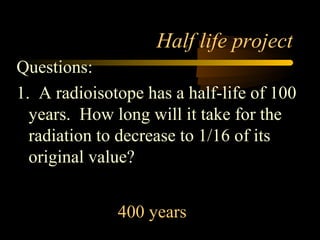
Questions:
1. A radioisotope has a half-life of 100
  years. How long will it take for the
  radiation to decrease to 1/16 of its
  original value?


              400 years
Half life project
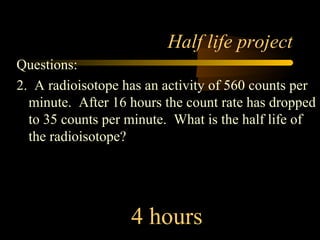
Questions:
2. A radioisotope has an activity of 560 counts per
  minute. After 16 hours the count rate has dropped
  to 35 counts per minute. What is the half life of
  the radioisotope?


                   4 hours
Nuclear Fission
Nuclear fission

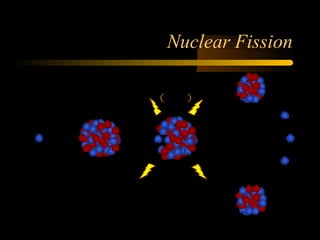
Fission – the splitting of an atom
 after being struck by a neutron.
Nuclear Fission
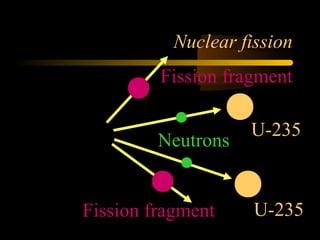
Nuclear fission
                   Fission fragment
   U-235
                              U-235
                   Neutrons
Neutron

          Fission fragment     U-235
Nuclear fission
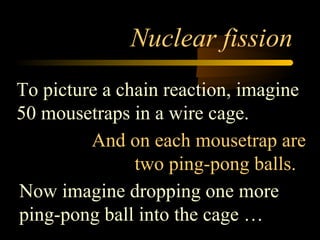
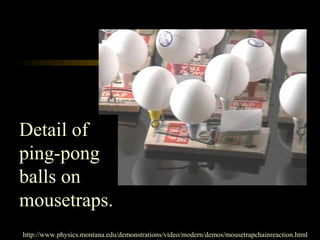
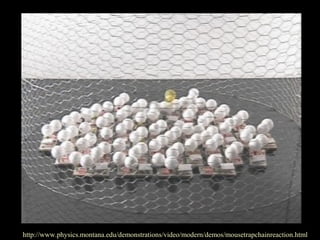
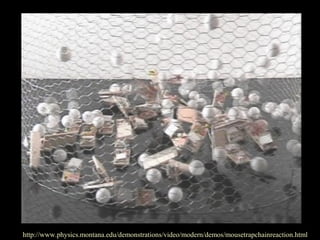
To picture a chain reaction, imagine
50 mousetraps in a wire cage.
         And on each mousetrap are
               two ping-pong balls.
Now imagine dropping one more
ping-pong ball into the cage …
Detail of
ping-pong
balls on
mousetraps.
http://www.physics.montana.edu/demonstrations/video/modern/demos/mousetrapchainreaction.html
Nuclear fission
 This heat energy can be harnessed
            to boil water,
creating steam,
      that can turn a generator,
                  creating electricity.
Nuclear Fusion
Nuclear fusion
         A day
        without
   sunshine is a
    day without
        fusion.
Nuclear Fusion
How do we detect
      radiation?
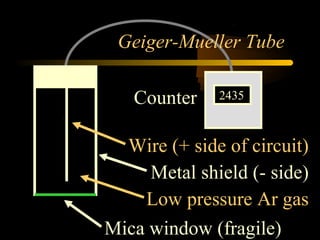
Geiger-Mueller Tube

   Counter    2435


  Wire (+ side of circuit)
     Metal shield (- side)
    Low pressure Ar gas
Mica window (fragile)
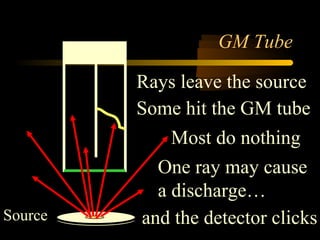
GM Tube

         Rays leave the source
         Some hit the GM tube
             Most do nothing
           One ray may cause
           a discharge…
Source   and the detector clicks
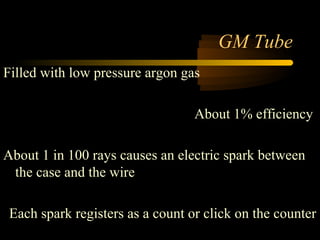
GM Tube
Filled with low pressure argon gas

                                  About 1% efficiency

About 1 in 100 rays causes an electric spark between
 the case and the wire

 Each spark registers as a count or click on the counter
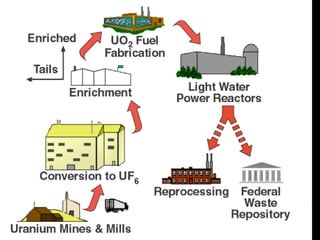
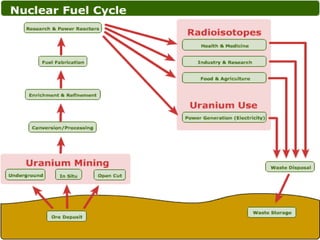
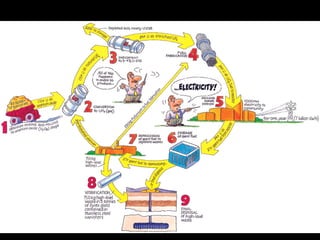
Nuclear Fuel Cycle
Nuclear Fuel Cycle

• The Nuclear Fuel Cycle consists of
  sequence of steps in which uranium ore is
  mined, milled, enriched, and fabricated into
  nuclear fuel and then irradiated in a reactor
  for several years.
• The entire fuel cycle lifetime from mining
  to discharge is about 8 years.
Where is Nuclear Waste Kept?

• After irradiation the fuel is cooled in the
  spent fuel pit for several years and then
  moved to dry cask storage on the reactor
  site.
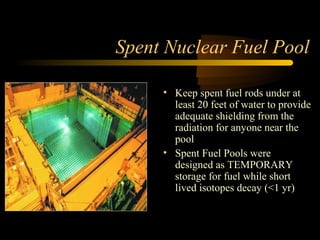
Spent Nuclear Fuel Pool

     • Keep spent fuel rods under at
       least 20 feet of water to provide
       adequate shielding from the
       radiation for anyone near the
       pool
     • Spent Fuel Pools were
       designed as TEMPORARY
       storage for fuel while short
       lived isotopes decay (<1 yr)
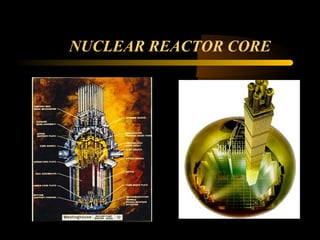
NUCLEAR REACTOR CORE
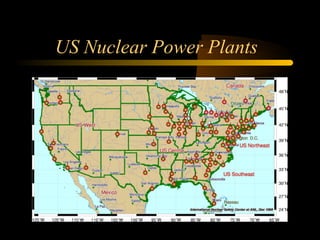
US Nuclear Power Plants
Radioactive
     Decay
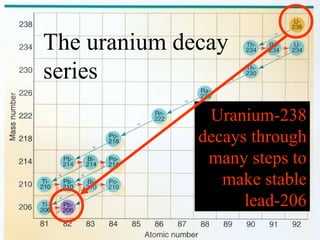
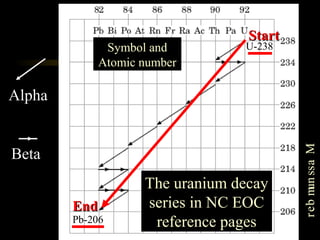
The uranium decay
series
               Uranium-238
              decays through
               many steps to
                 make stable
                    lead-206
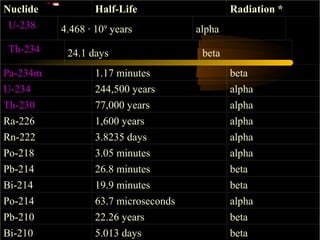
Nuclide           Half-Life                   Radiation *
 U-238    4.468 · 109 years           alpha
 Th-234    24.1 days                   beta
Pa-234m           1.17 minutes                beta
U-234             244,500 years               alpha
Th-230            77,000 years                alpha
Ra-226            1,600 years                 alpha
Rn-222            3.8235 days                 alpha
Po-218            3.05 minutes                alpha
Pb-214            26.8 minutes                beta
Bi-214            19.9 minutes                beta
Po-214            63.7 microseconds           alpha
Pb-210            22.26 years                 beta
Bi-210            5.013 days                  beta
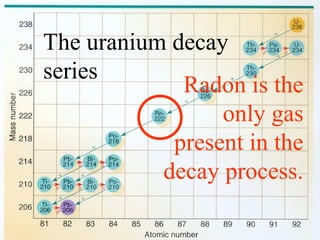
The uranium decay
series
             Radon is the
                 only gas
            present in the
           decay process.
Start
             Symbol and         U-238
            Atomic number

Alpha


                                         r e b m n ss a M
Beta
                   The uranium decay


                                                u
        End        series in NC EOC
        Pb-206      reference pages
Hazards from radon

• Radon gas works its way up
  through the ground and into
  your basements and crawl
  spaces.
• You breathe radon into your
  lungs.
Hazards from radon

• When a radon atom decays it
  releases an alpha particle …
      …which travels only a short
  distance before it is absorbed by
       your lungs, and transfers its
                            energy.
Hazards from radon

This ionizing radiation in your
lungs can cause lung cancer.
  Smoking cigarettes and breathing
       radon really increases your
    chances of getting lung cancer.
Half Life Project
Half life project
1. Pick a mass between 10g and 50g.
2. Decide on a half life – any time.
3. Scale your graph – mass on y-axis
   and at least six (6) half-lives on the x-
   axis.
4. Plot the masses after intervals of one
   half-life.
Half life project
5. What shape is the graph?
6. When will the mass of the
   radioisotope fall to zero?
7. When is the radioactivity no longer a
   problem?
8. What mathematical function
   describes radioactive decay?

Nuclear chemistry

  • 1.
    Nuclear Chemistry P Squires Basic Chemistry 2005-2006
  • 2.
    Isotopes … …have thesame number of protons and electrons but different numbers of neutrons.
  • 3.
    Isotopes … …have differentmass numbers but the same atomic number.
  • 4.
    Symbols for Isotopes Mass number Symbol U 235 92 of Element Atomic number
  • 5.
    Symbols for Isotopes Mass number A is the A Symbol E symbol for mass of number Z Element Z is the symbol for Atomic atomic number number
  • 6.
    Isotopes Consider an atomof aluminum with 13 protons and 15 neutrons. What is Z and A? A = #p + #n + 13 + 15 = 28
  • 7.
    How are isotopesof the same element alike and different? Alike: Different: 1. Number of 1. Number of protons and neutrons electrons 2. Atomic number 2. Mass Number 3. Chemical 3. Atomic weight of properties the isotopes
  • 8.
  • 9.
    Finding the numberof Protons, Neutrons, and Electrons The atomic number is the number of protons in the nucleus. The number of electrons in a neutral atom equals the number of protons.
  • 10.
    Finding the numberof Protons, Neutrons, and Electrons # of neutrons = A - Z
  • 11.
    Finding the numberof Protons, Neutrons, and Electrons Z = 92 U-235 protons = 92 electrons = 92 A = 235 protons + neutrons = 235
  • 12.
    Finding the numberof Protons, Neutrons, and Electrons Q. Find the number of neutrons in the Ba-137 isotope.
  • 13.
    Finding the numberof Protons, Neutrons, and Electrons Element Symbol Z A #p #n #e Zinc 66 In 68 85 38 82 210 Rn 136 35 47
  • 14.
    Finding the numberof Protons, Neutrons, and Electrons Element Symbol Z A #p #n #e Zinc Zn 30 66 30 36 30 In 68 85 38 82 210 Rn 136 35 47
  • 15.
    Finding the numberof Protons, Neutrons, and Electrons Element Symbol Z A #p #n #e Zinc Zn 30 66 30 36 30 Indium In 49 117 49 68 49 85 38 82 210 Rn 136 35 47
  • 16.
    Finding the numberof Protons, Neutrons, and Electrons Element Symbol Z A #p #n #e Zinc Zn 30 66 30 36 30 Indium In 49 117 49 68 49 Strontium Sr 38 85 38 47 38 82 210 Rn 136 35 47
  • 17.
    Finding the numberof Protons, Neutrons, and Electrons Element Symbol Z A #p #n #e Zinc Zn 30 66 30 36 30 Indium 49 117 49 68 49 Strontium Sr 38 85 38 47 38 Lead Pb 82 210 82 128 82 Rn 136
  • 18.
    Finding the numberof Protons, Neutrons, and Electrons Element Symbol Z A #p #n #e Zinc Zn 30 66 30 36 30 Indium In 49 117 49 68 49 Strontium Sr 38 85 38 47 38 Lead Pb 82 210 82 128 82 Radon Rn 86 222 86 136 86 35 47
  • 19.
    Finding the numberof Protons, Neutrons, and Electrons Element Symbol Z A #p #n #e Zinc Zn 30 66 30 36 30 Indium In 49 117 49 68 49 Strontium Sr 38 85 38 47 38 Lead Pb 82 210 82 128 82 Radon Rn 86 222 86 136 86 Bromine Br 35 82 35 47 35
  • 20.
    Only one elementhas unique names for its isotopes … 1 1 H = hydrogen 2 1 H = deuterium 3 1 H = tritium Deuterium and tritium are used in nuclear reactors and fusion research.
  • 21.
    Some isotopes areradioactive • Radioactive isotopes are called radioisotopes. • Radioisotopes can emit alpha, beta or gamma radiation as they decay. • Radioisotopes are important in a number of research fields.
  • 22.
    Protection from radiation 1.Shielding 2. Distance
  • 23.
    Protection from radiation How do you protect yourself from … Alpha 2.5 cm of air, paper, skin aluminum, lead, other Beta metals, wood, plastic, etc. Gamma up to a foot or two of lead, many feet of concrete
  • 24.
    Properties of AlphaParticles • Alpha (α) particles are the nuclei of helium atoms and have the symbol 2He 4
  • 25.
    Properties of BetaParticles Beta (β) particles are high speed electrons ejected from the nuclei of atoms and have the symbol -1e .0
  • 26.
    Properties of GammaRays • Gamma (γ) rays are high energy electromagnetic waves, not particles. • Gamma rays have short wavelengths and high energies and travel at the speed of light.
  • 27.
    Alpha, Beta, Gamma Electrically charged plates + + + + + + + + What is the effect of electrically charged plates on α, β, γ ? - - - - - - - - - Radioactive Source
  • 28.
    Alpha, Beta, Gamma Electrically charged plates + + + + + + + + β γ - - - - - - - - - α Radioactive Source
  • 29.
    Alpha, Beta, Gamma Why do the α, β and γ rays take the paths that they do?
  • 30.
    Alpha, Beta, Gamma Paper Lead α Aluminum Radioactive foil Source
  • 31.
    Alpha, Beta, Gamma Paper Lead β α Aluminum Radioactive foil Source
  • 32.
    Alpha, Beta, Gamma Paper Lead β γ α Aluminum Radioactive foil Source
  • 33.
  • 34.
    Alpha Decay In alphadecay, an alpha particle (2He4) is released from the nucleus.
  • 35.
    Alpha decay decay product 92 U 238  2He + 90Th 4 234 alpha particle
  • 36.
    Alpha decay Radon-220 decaysby alpha emission. What is the decay product? 86 Rn 220  2He + 4 84 Po ???216
  • 37.
    Alpha decay Write thealpha decay equations for: 1. 95Am 241 2He + 93Np 4 237 2. 84Po 216  2He + 82Pb 4 212 3. 88Ra 226  2He + 86Rn 4 222
  • 38.
    Beta Decay Beta decayoccurs because of the instability of a neutron. Neutrons are a little more massive than protons; and neutrons are neutral.
  • 39.
    Beta decay Decay ofa neutron: 0n1  1H1 + -1e0 neutron proton electron The electron ejected from the nucleus is a beta particle.
  • 40.
    Start with a Li atom with Beta decay 3 protons and Suddenly a 4 neutrons. neutron decays! Now there A beta particle are 4 protons goes zipping out of and 3 neutrons. the nucleus.
  • 41.
    Beta decay decay product 6 C 14  7N 14 + -1e 0 beta particle
  • 42.
    Beta decay Zn-62 decaysby beta emission. What is the decay product? 30 Zn  -1e + 62 0 ??? 31Ga 62
  • 43.
    Beta decay Write thebeta decay equations for: 1. 82Pb214  -1 e + 83Bi 0 214 2. 27Co  62 -1 e + 28Ni 0 62 3. 47???  Ag 113 -1 e + 48Cd 0 113
  • 44.
    Gamma Decay •Gamma raysare neutral and thus no change is made in the equation. 6 C 14  6C 14 +¥
  • 45.
  • 46.
    What is halflife? Half life is the time needed for one half of a radioisotope to decay.
  • 47.
    Half Life • Take100 pennies and throw them on the floor. • Remove those that are heads up. • Count remaining pennies. • Continue until only one penny remains. What can this tell us about Half Life?
  • 48.
    What is halflife? • Suppose you start with 100.0 grams of a radioisotope that has a half life of exactly 1 year. How much will be left after 1 year? How much will be left after 2 years?
  • 49.
    Half life project Questions: 1.A radioisotope has a half-life of 100 years. How long will it take for the radiation to decrease to 1/16 of its original value? 400 years
  • 50.
    Half life project Questions: 2.A radioisotope has an activity of 560 counts per minute. After 16 hours the count rate has dropped to 35 counts per minute. What is the half life of the radioisotope? 4 hours
  • 51.
  • 52.
    Nuclear fission Fission –the splitting of an atom after being struck by a neutron.
  • 53.
  • 54.
    Nuclear fission Fission fragment U-235 U-235 Neutrons Neutron Fission fragment U-235
  • 55.
    Nuclear fission To picturea chain reaction, imagine 50 mousetraps in a wire cage. And on each mousetrap are two ping-pong balls. Now imagine dropping one more ping-pong ball into the cage …
  • 56.
  • 57.
  • 58.
  • 59.
    Nuclear fission Thisheat energy can be harnessed to boil water, creating steam, that can turn a generator, creating electricity.
  • 60.
  • 61.
    Nuclear fusion A day without sunshine is a day without fusion.
  • 62.
  • 63.
    How do wedetect radiation?
  • 64.
    Geiger-Mueller Tube Counter 2435 Wire (+ side of circuit) Metal shield (- side) Low pressure Ar gas Mica window (fragile)
  • 65.
    GM Tube Rays leave the source Some hit the GM tube Most do nothing One ray may cause a discharge… Source and the detector clicks
  • 66.
    GM Tube Filled withlow pressure argon gas About 1% efficiency About 1 in 100 rays causes an electric spark between the case and the wire Each spark registers as a count or click on the counter
  • 67.
  • 69.
    Nuclear Fuel Cycle •The Nuclear Fuel Cycle consists of sequence of steps in which uranium ore is mined, milled, enriched, and fabricated into nuclear fuel and then irradiated in a reactor for several years. • The entire fuel cycle lifetime from mining to discharge is about 8 years.
  • 71.
    Where is NuclearWaste Kept? • After irradiation the fuel is cooled in the spent fuel pit for several years and then moved to dry cask storage on the reactor site.
  • 72.
    Spent Nuclear FuelPool • Keep spent fuel rods under at least 20 feet of water to provide adequate shielding from the radiation for anyone near the pool • Spent Fuel Pools were designed as TEMPORARY storage for fuel while short lived isotopes decay (<1 yr)
  • 73.
  • 75.
  • 76.
  • 77.
    The uranium decay series Uranium-238 decays through many steps to make stable lead-206
  • 78.
    Nuclide Half-Life Radiation * U-238 4.468 · 109 years alpha Th-234 24.1 days beta Pa-234m 1.17 minutes beta U-234 244,500 years alpha Th-230 77,000 years alpha Ra-226 1,600 years alpha Rn-222 3.8235 days alpha Po-218 3.05 minutes alpha Pb-214 26.8 minutes beta Bi-214 19.9 minutes beta Po-214 63.7 microseconds alpha Pb-210 22.26 years beta Bi-210 5.013 days beta
  • 79.
    The uranium decay series Radon is the only gas present in the decay process.
  • 80.
    Start Symbol and U-238 Atomic number Alpha r e b m n ss a M Beta The uranium decay u End series in NC EOC Pb-206 reference pages
  • 81.
    Hazards from radon •Radon gas works its way up through the ground and into your basements and crawl spaces. • You breathe radon into your lungs.
  • 82.
    Hazards from radon •When a radon atom decays it releases an alpha particle … …which travels only a short distance before it is absorbed by your lungs, and transfers its energy.
  • 83.
    Hazards from radon Thisionizing radiation in your lungs can cause lung cancer. Smoking cigarettes and breathing radon really increases your chances of getting lung cancer.
  • 84.
  • 85.
    Half life project 1.Pick a mass between 10g and 50g. 2. Decide on a half life – any time. 3. Scale your graph – mass on y-axis and at least six (6) half-lives on the x- axis. 4. Plot the masses after intervals of one half-life.
  • 86.
    Half life project 5.What shape is the graph? 6. When will the mass of the radioisotope fall to zero? 7. When is the radioactivity no longer a problem? 8. What mathematical function describes radioactive decay?

Editor's Notes

  • #49 50 after 1 year. 25 after 2 years.