PHOTOSYNTHESIS CHAPTER 7
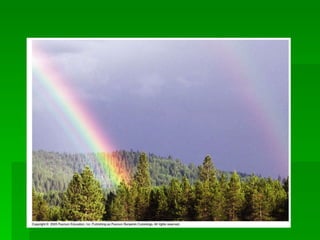
THE PROCESS THAT FEEDS THE BIOSPHERE Photosynthesis is a process that converts solar energy into chemical energy. Directly or indirectly, photosynthesis nourishes almost the entire living world.
Autotrophs sustain themselves without eating anything derived from other organisms. Autrophs are producers of our biosphere. Almost all plants are photoautotrophs, using sunlight to make organic  molecules from inorganic  molecules. Monotropa uniflora
 
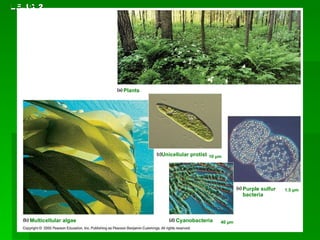
Photosynthesis occurs in plants, algae, certain other protists, and some prokaryotes. These organisms not only feed themselves but also the entire living planet.
LE 10-2 LE 10-2 Plants Unicellular protist Multicellular algae Cyanobacteria Purple sulfur bacteria 10 µm 1.5 µm 40 µm
Heterotrophs obtain their organic matter from other organisms. Heterotrophs are consumers of the biosphere. Almost all heterotrophs, including humans, depend on photoautrophs for food and oxygen.
Converting Light Energy to the Chemical Energy of Food Chloroplasts are organelles that are responsible for feeding the vast majority of organisms. Chloroplasts are present in a variety of photosynthesizing organisms.
Leaves are the organs of plants that play a major role in photosynthesis. Typical Leaf Structure:
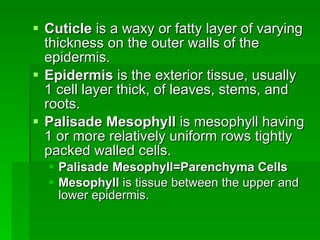
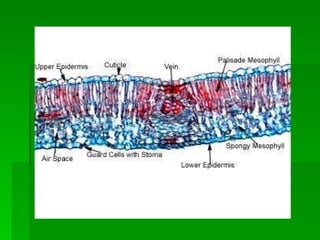
Cuticle  is a waxy or fatty layer of varying thickness on the outer walls of the epidermis. Epidermis  is the exterior tissue, usually 1 cell layer thick, of leaves, stems, and roots. Palisade Mesophyll  is mesophyll having 1 or more relatively uniform rows tightly packed walled cells.  Palisade Mesophyll=Parenchyma Cells Mesophyll  is tissue between the upper and lower epidermis.
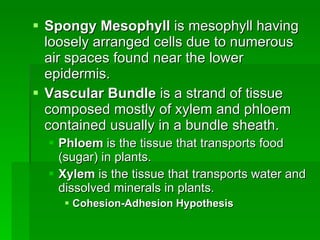
Spongy Mesophyll  is mesophyll having loosely arranged cells due to numerous air spaces found near the lower epidermis. Vascular Bundle  is a strand of tissue composed mostly of xylem and phloem contained usually in a bundle sheath. Phloem  is the tissue that transports food (sugar) in plants. Xylem  is the tissue that transports water and dissolved minerals in plants. Cohesion-Adhesion Hypothesis
Stomata  are pores or openings in the lower epidermis of leaves that regulate gas exchange between plants and the atmosphere. Stomata are controlled by specialized cells called  guard cells,  that expand and contract via osmosis.
 
Chloroplasts Chloroplasts are found mainly in cells of the mesophyll. A typical mesophyll cells has 30-40 chloroplasts.
Stroma  is a region containing the bulk volume of chloroplasts’, and contains enzymes that play a role in the carbon-fixation reactions (carbohydrate synthesis) Thylakoids  are coin-shaped membranous sacks whose contents include pigments that play a role in light reactions. Grana  are stacks of thylakoids
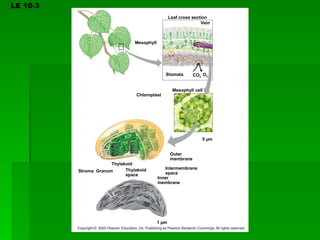
LE 10-3 Leaf cross section Vein Mesophyll Stomata CO 2 O 2 Mesophyll cell Chloroplast 5 µm Outer membrane Intermembrane space Inner membrane Thylakoid space Thylakoid Granum Stroma 1 µm
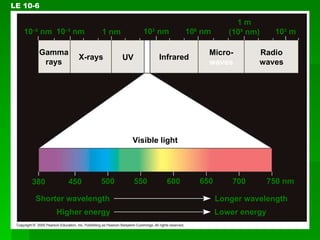
The Nature of Light Chloroplast are solar powered chemical factories. Light is a form of electromagnetic energy (electromagnetic radiation); that travels in rythmic waves. Wavelength  is the distance between crests of waves; determines the type of electromagnetic energy
Light also behaves it consists of discrete particles called  photons. The electromagnetic spectrum is the entire range of electromagnetic energy (radiation).  Visible light, colors we can see, drives photosynthesis.
 
LE 10-6 Visible   light Gamma rays X-rays UV Infrared Micro- waves Radio waves 10 –5  nm 10 –3  nm 1 nm 10 3  nm 10 6  nm 1 m (10 9  nm) 10 3  m 380 450 500 550 600 650 700 750 nm Longer wavelength Lower energy Shorter wavelength Higher energy
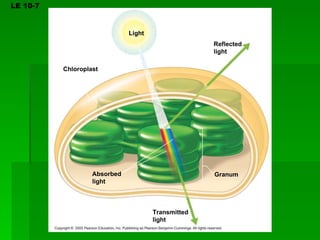
Photosynthetic Pigments Pigments are substances that absorb light Different pigments absorb different wavelengths of light.  Some light is reflected or transmitted. Ex: Leaves are green because chlorophyll reflects and transmits green light.
LE 10-7 Chloroplast Light Reflected  light Absorbed  light Transmitted  light Granum
Chlorophyll a Primary photosynthetic pigment of all higher plants, blue-green algae, and cyanobacter. Blue-Green in color. Chlorophyll b An accessory pigment found in virtually all higher plants and green algae. Broadens the spectrum of color for photosynthesis Yellow-Green in color Carotenoids Accessory pigments that absorb excessive light that would damage chlorophyll Carotenes-orange, reds, yellows Xanthophylls-yellow
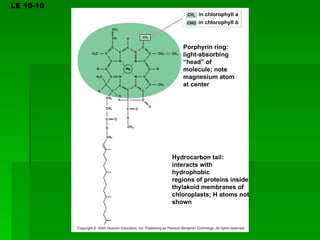
LE 10-10 CH 3 CHO in chlorophyll  a in chlorophyll  b Porphyrin ring: light-absorbing “ head” of molecule; note magnesium atom at center Hydrocarbon tail: interacts with hydrophobic regions of proteins inside thylakoid membranes of chloroplasts; H atoms not shown
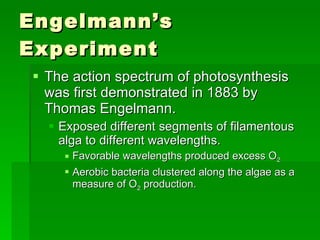
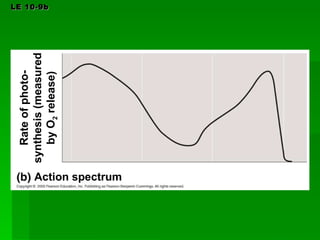
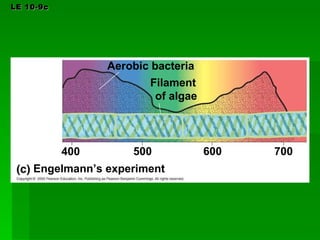
Engelmann’s Experiment The action spectrum of photosynthesis was first demonstrated in 1883 by Thomas Engelmann. Exposed different segments of filamentous alga to different wavelengths. Favorable wavelengths produced excess O 2 Aerobic bacteria clustered along the algae as a measure of O 2  production.
LE 10-9a Chlorophyll  a Chlorophyll  b Carotenoids Wavelength of light (nm) Absorption spectra Absorption of light by chloroplast pigments 400 500 600 700
LE 10-9b Action spectrum Rate of photo- synthesis (measured by O 2  release)
LE 10-9c Engelmann’s experiment 400 500 600 700 Aerobic bacteria Filament of algae
The Reactions Scientist’s and their contributions Helmont Ingenhousz Priestly Photosynthesis can be summarized using the following equation: 6 CO 2  + 6 H 2 O + Light energy    C 6 H 12 O 6  + 6 O 2
The Reactions Photosynthesis is a biochemical pathways involving a series of redox reactions. Water is oxidized and carbon dioxide is reduced. Two reactions occur: Light Reactions (thylakoids) “Photo” Calvin Cycle (Stroma) “synthesis”
The Reactions The light reactions (in the thylakoids): Split water Produced oxygen gas Produced ATP (via chemiosmosis) Form NADPH, an electron carrier The Calvin Cycle (in the stroma): Forms the sugar from carbon dioxide using ATP and NADPH.
LE 10-5_3 H 2 O LIGHT REACTIONS Chloroplast Light ATP NADPH O 2 NADP + CO 2 ADP P + i CALVIN CYCLE [CH 2 O] (sugar)
Excitation of Chlorophyll by Light When a pigment absorbs light, it goes from a ground state to an excited state, which is unstable When excited electrons fall back to the ground state, photons are given off, an afterglow called  fluorescence. If illuminated, an isolated solution of chlorophyll will fluoresce, giving off light and heat
LE 10-11 Excited state Heat Photon (fluorescence) Ground state Chlorophyll molecule Photon Excitation of isolated chlorophyll molecule Fluorescence Energy of electron e –
What is a photosystem? A  photosystem  consists of a reaction center surrounded by light-harvesting complexes The light-harvesting complexes (pigment molecules bound to proteins) funnel the energy of photons to the reaction center
A primary electron acceptor in the reaction center accepts an excited electron from chlorophyll  a Solar-powered transfer of an electron from a chlorophyll  a  molecule to the primary electron acceptor is the first step of the light reactions
LE 10-12 Thylakoid Photon Light-harvesting complexes Photosystem Reaction center STROMA Primary electron acceptor e – Transfer of energy Special chlorophyll  a molecules Pigment molecules THYLAKOID SPACE (INTERIOR OF THYLAKOID) Thylakoid membrane
There are two types of photosystems: Photosystem II  functions first (the numbers reflect order of discovery) and is best at absorbing a wavelength of 680 nm  Photosystem I  is best at absorbing a wavelength of 700 nm The two photosystems work together to use light energy to generate ATP and NADPH
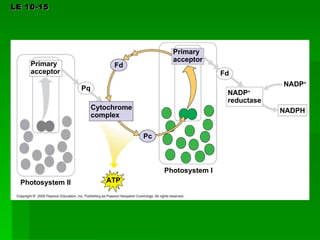
Noncyclic Electron Flow During the light reactions, there are two possible routes for electron flow: cyclic and noncyclic Noncyclic electron flow, the primary pathway, involves both photosystems and produces ATP and NADPH
LE 10-13_5 Light P680 e – Photosystem II (PS II) Primary acceptor [CH 2 O] (sugar) NADPH ATP ADP CALVIN CYCLE LIGHT REACTIONS NADP + Light H 2 O CO 2 Energy of electrons O 2 e – e – + 2 H + H 2 O O 2 1 / 2 Pq Cytochrome complex Electron transport chain Pc ATP P700 e – Primary acceptor Photosystem I (PS I) e – e – Electron Transport chain NADP + reductase Fd NADP + NADPH + H + + 2 H + Light
Cyclic Electron Flow Cyclic electron flow uses only photosystem I  and produces only ATP Cyclic electron flow generates surplus ATP, satisfying the higher demand in the Calvin cycle
LE 10-15 Photosystem I Photosystem II ATP Pc Fd Cytochrome complex Pq Primary acceptor Fd NADP + reductase NADP + NADPH Primary acceptor
Chemiosmosis  Chloroplasts and mitochondria generate ATP by chemiosmosis, but use different sources of energy Mitochondria transfer chemical energy from food to ATP; chloroplasts transform light energy into the chemical energy of ATP The spatial organization of chemiosmosis differs in chloroplasts and mitochondria
LE 10-16 MITOCHONDRION STRUCTURE Intermembrane space Membrane Electron transport chain Mitochondrion Chloroplast CHLOROPLAST STRUCTURE Thylakoid space Stroma ATP Matrix ATP synthase Key H + Diffusion ADP + P H + i Higher [H + ] Lower [H + ]
Water is split by photosystem II on the side of the membrane facing the thylakoid space The diffusion of H +  from the thylakoid space back to the stroma powers ATP synthase ATP and NADPH are produced on the side facing the stroma, where the Calvin cycle takes place
LE 10-17 STROMA (Low H +  concentration) Light Photosystem II Cytochrome complex 2 H + Light Photosystem I NADP + reductase Fd Pc Pq H 2 O O 2 +2 H + 1 / 2 2 H + NADP +  + 2H + + H + NADPH To Calvin cycle THYLAKOID SPACE (High H +  concentration) STROMA (Low H +  concentration) Thylakoid membrane ATP synthase ATP ADP + P H + i [CH 2 O] (sugar) O 2 NADPH ATP ADP NADP + CO 2 H 2 O LIGHT REACTIONS CALVIN CYCLE Light
The Calvin Cycle The Calvin cycle, regenerates its starting material after molecules enter and leave the cycle The cycle builds sugar from smaller molecules by using ATP and the reducing power of electrons carried by NADPH Carbon enters the cycle as CO 2  and leaves as a sugar named glyceraldehyde-3-phospate (G3P) or PGAL
The Calvin cycle has three phases: Carbon fixation (catalyzed by rubisco) Reduction Regeneration of the CO 2  acceptor (RuBP)
LE 10-18_1 [CH 2 O] (sugar) O 2 NADPH ATP ADP NADP + CO 2 H 2 O LIGHT REACTIONS CALVIN CYCLE Light Input 3 CO 2 (Entering one at a time) Rubisco 3 P P Short-lived intermediate Phase 1: Carbon fixation 6 P 3-Phosphoglycerate 6 ATP 6 ADP CALVIN CYCLE 3 P P Ribulose bisphosphate (RuBP)
LE 10-18_2 [CH 2 O] (sugar) O 2 NADPH ATP ADP NADP + CO 2 H 2 O LIGHT REACTIONS CALVIN CYCLE Light Input CO 2 (Entering one at a time) Rubisco 3 P P Short-lived intermediate Phase 1: Carbon fixation 6 P 3-Phosphoglycerate 6 ATP 6 ADP CALVIN CYCLE 3 P P Ribulose bisphosphate (RuBP) 3 6 NADP + 6 6 NADPH P i 6 P 1,3-Bisphosphoglycerate P 6 P Glyceraldehyde-3-phosphate (G3P) P 1 G3P (a sugar) Output Phase 2: Reduction Glucose and other organic compounds
LE 10-18_3 [CH 2 O] (sugar) O 2 NADPH ATP ADP NADP + CO 2 H 2 O LIGHT REACTIONS CALVIN CYCLE Light Input CO 2 (Entering one at a time) Rubisco 3 P P Short-lived intermediate Phase 1: Carbon fixation 6 P 3-Phosphoglycerate 6 ATP 6 ADP CALVIN CYCLE 3 P P Ribulose bisphosphate (RuBP) 3 6 NADP + 6 6 NADPH P i 6 P 1,3-Bisphosphoglycerate P 6 P Glyceraldehyde-3-phosphate (G3P) P 1 G3P (a sugar) Output Phase 2: Reduction Glucose and other organic compounds 3 3 ADP ATP Phase 3: Regeneration of the CO 2  acceptor (RuBP) P 5 G3P
Alternative mechanisms Dehydration is a problem for plants, sometimes requiring tradeoffs with other metabolic processes, especially photosynthesis On hot, dry days, plants close stomata, which conserves water but also limits photosynthesis The closing of stomata reduces access to CO 2  and causes O 2  to build up These conditions favor a seemingly wasteful process called photorespiration
Photorespiration: An Evolutionary Relic? In most plants (C 3  plants), initial fixation of CO 2 , via rubisco, forms a three-carbon compound In photorespiration, rubisco adds O 2  to the Calvin cycle instead of CO 2 Photorespiration consumes O 2  and organic fuel and releases CO 2  without producing ATP or sugar
Photorespiration may be an evolutionary relic because rubisco first evolved at a time when the atmosphere had far less O 2  and more CO 2   In many plants, photorespiration is a problem because on a hot, dry day it can drain as much as 50% of the carbon fixed by the Calvin cycle
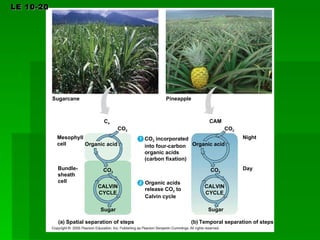
C 4  Plants C 4  plants minimize the cost of photorespiration by incorporating CO 2  into four-carbon compounds in mesophyll cells These four-carbon compounds are exported to bundle-sheath cells, where they release CO 2  that is then used in the Calvin cycle
LE 10-19 Photosynthetic cells of C 4  plant leaf Mesophyll cell Bundle- sheath cell Vein (vascular tissue) C 4  leaf anatomy Stoma Bundle- sheath cell Pyruvate (3 C) CO 2 Sugar Vascular tissue CALVIN CYCLE PEP (3 C) ATP ADP Malate (4 C) Oxaloacetate (4 C) The C 4  pathway CO 2 PEP carboxylase Mesophyll cell
CAM Plants CAM plants open their stomata at night, incorporating CO 2  into organic acids Stomata close during the day, and CO 2  is released from organic acids and used in the Calvin cycle
LE 10-20 Bundle- sheath cell Mesophyll cell Organic acid C 4 CO 2 CO 2 CALVIN CYCLE Sugarcane Pineapple Organic acids release CO 2  to Calvin cycle CO 2  incorporated into four-carbon organic acids (carbon fixation) Organic acid CAM CO 2 CO 2 CALVIN CYCLE Sugar Spatial separation of steps Temporal separation of steps Sugar Day Night
The Importance of Photosynthesis:  A Review The energy entering chloroplasts as sunlight gets stored as chemical energy in organic compounds Sugar made in the chloroplasts supplies chemical energy and carbon skeletons to synthesize the organic molecules of cells In addition to food production, photosynthesis produces the oxygen in our atmosphere

Photosynthesis

  • 1.
  • 2.
    THE PROCESS THATFEEDS THE BIOSPHERE Photosynthesis is a process that converts solar energy into chemical energy. Directly or indirectly, photosynthesis nourishes almost the entire living world.
  • 3.
    Autotrophs sustain themselveswithout eating anything derived from other organisms. Autrophs are producers of our biosphere. Almost all plants are photoautotrophs, using sunlight to make organic molecules from inorganic molecules. Monotropa uniflora
  • 4.
  • 5.
    Photosynthesis occurs inplants, algae, certain other protists, and some prokaryotes. These organisms not only feed themselves but also the entire living planet.
  • 6.
    LE 10-2 LE10-2 Plants Unicellular protist Multicellular algae Cyanobacteria Purple sulfur bacteria 10 µm 1.5 µm 40 µm
  • 7.
    Heterotrophs obtain theirorganic matter from other organisms. Heterotrophs are consumers of the biosphere. Almost all heterotrophs, including humans, depend on photoautrophs for food and oxygen.
  • 8.
    Converting Light Energyto the Chemical Energy of Food Chloroplasts are organelles that are responsible for feeding the vast majority of organisms. Chloroplasts are present in a variety of photosynthesizing organisms.
  • 9.
    Leaves are theorgans of plants that play a major role in photosynthesis. Typical Leaf Structure:
  • 10.
    Cuticle isa waxy or fatty layer of varying thickness on the outer walls of the epidermis. Epidermis is the exterior tissue, usually 1 cell layer thick, of leaves, stems, and roots. Palisade Mesophyll is mesophyll having 1 or more relatively uniform rows tightly packed walled cells. Palisade Mesophyll=Parenchyma Cells Mesophyll is tissue between the upper and lower epidermis.
  • 11.
    Spongy Mesophyll is mesophyll having loosely arranged cells due to numerous air spaces found near the lower epidermis. Vascular Bundle is a strand of tissue composed mostly of xylem and phloem contained usually in a bundle sheath. Phloem is the tissue that transports food (sugar) in plants. Xylem is the tissue that transports water and dissolved minerals in plants. Cohesion-Adhesion Hypothesis
  • 12.
    Stomata arepores or openings in the lower epidermis of leaves that regulate gas exchange between plants and the atmosphere. Stomata are controlled by specialized cells called guard cells, that expand and contract via osmosis.
  • 13.
  • 14.
    Chloroplasts Chloroplasts arefound mainly in cells of the mesophyll. A typical mesophyll cells has 30-40 chloroplasts.
  • 15.
    Stroma isa region containing the bulk volume of chloroplasts’, and contains enzymes that play a role in the carbon-fixation reactions (carbohydrate synthesis) Thylakoids are coin-shaped membranous sacks whose contents include pigments that play a role in light reactions. Grana are stacks of thylakoids
  • 16.
    LE 10-3 Leafcross section Vein Mesophyll Stomata CO 2 O 2 Mesophyll cell Chloroplast 5 µm Outer membrane Intermembrane space Inner membrane Thylakoid space Thylakoid Granum Stroma 1 µm
  • 17.
    The Nature ofLight Chloroplast are solar powered chemical factories. Light is a form of electromagnetic energy (electromagnetic radiation); that travels in rythmic waves. Wavelength is the distance between crests of waves; determines the type of electromagnetic energy
  • 18.
    Light also behavesit consists of discrete particles called photons. The electromagnetic spectrum is the entire range of electromagnetic energy (radiation). Visible light, colors we can see, drives photosynthesis.
  • 19.
  • 20.
    LE 10-6 Visible light Gamma rays X-rays UV Infrared Micro- waves Radio waves 10 –5 nm 10 –3 nm 1 nm 10 3 nm 10 6 nm 1 m (10 9 nm) 10 3 m 380 450 500 550 600 650 700 750 nm Longer wavelength Lower energy Shorter wavelength Higher energy
  • 21.
    Photosynthetic Pigments Pigmentsare substances that absorb light Different pigments absorb different wavelengths of light. Some light is reflected or transmitted. Ex: Leaves are green because chlorophyll reflects and transmits green light.
  • 22.
    LE 10-7 ChloroplastLight Reflected light Absorbed light Transmitted light Granum
  • 23.
    Chlorophyll a Primaryphotosynthetic pigment of all higher plants, blue-green algae, and cyanobacter. Blue-Green in color. Chlorophyll b An accessory pigment found in virtually all higher plants and green algae. Broadens the spectrum of color for photosynthesis Yellow-Green in color Carotenoids Accessory pigments that absorb excessive light that would damage chlorophyll Carotenes-orange, reds, yellows Xanthophylls-yellow
  • 24.
    LE 10-10 CH3 CHO in chlorophyll a in chlorophyll b Porphyrin ring: light-absorbing “ head” of molecule; note magnesium atom at center Hydrocarbon tail: interacts with hydrophobic regions of proteins inside thylakoid membranes of chloroplasts; H atoms not shown
  • 25.
    Engelmann’s Experiment Theaction spectrum of photosynthesis was first demonstrated in 1883 by Thomas Engelmann. Exposed different segments of filamentous alga to different wavelengths. Favorable wavelengths produced excess O 2 Aerobic bacteria clustered along the algae as a measure of O 2 production.
  • 26.
    LE 10-9a Chlorophyll a Chlorophyll b Carotenoids Wavelength of light (nm) Absorption spectra Absorption of light by chloroplast pigments 400 500 600 700
  • 27.
    LE 10-9b Actionspectrum Rate of photo- synthesis (measured by O 2 release)
  • 28.
    LE 10-9c Engelmann’sexperiment 400 500 600 700 Aerobic bacteria Filament of algae
  • 29.
    The Reactions Scientist’sand their contributions Helmont Ingenhousz Priestly Photosynthesis can be summarized using the following equation: 6 CO 2 + 6 H 2 O + Light energy  C 6 H 12 O 6 + 6 O 2
  • 30.
    The Reactions Photosynthesisis a biochemical pathways involving a series of redox reactions. Water is oxidized and carbon dioxide is reduced. Two reactions occur: Light Reactions (thylakoids) “Photo” Calvin Cycle (Stroma) “synthesis”
  • 31.
    The Reactions Thelight reactions (in the thylakoids): Split water Produced oxygen gas Produced ATP (via chemiosmosis) Form NADPH, an electron carrier The Calvin Cycle (in the stroma): Forms the sugar from carbon dioxide using ATP and NADPH.
  • 32.
    LE 10-5_3 H2 O LIGHT REACTIONS Chloroplast Light ATP NADPH O 2 NADP + CO 2 ADP P + i CALVIN CYCLE [CH 2 O] (sugar)
  • 33.
    Excitation of Chlorophyllby Light When a pigment absorbs light, it goes from a ground state to an excited state, which is unstable When excited electrons fall back to the ground state, photons are given off, an afterglow called fluorescence. If illuminated, an isolated solution of chlorophyll will fluoresce, giving off light and heat
  • 34.
    LE 10-11 Excitedstate Heat Photon (fluorescence) Ground state Chlorophyll molecule Photon Excitation of isolated chlorophyll molecule Fluorescence Energy of electron e –
  • 35.
    What is aphotosystem? A photosystem consists of a reaction center surrounded by light-harvesting complexes The light-harvesting complexes (pigment molecules bound to proteins) funnel the energy of photons to the reaction center
  • 36.
    A primary electronacceptor in the reaction center accepts an excited electron from chlorophyll a Solar-powered transfer of an electron from a chlorophyll a molecule to the primary electron acceptor is the first step of the light reactions
  • 37.
    LE 10-12 ThylakoidPhoton Light-harvesting complexes Photosystem Reaction center STROMA Primary electron acceptor e – Transfer of energy Special chlorophyll a molecules Pigment molecules THYLAKOID SPACE (INTERIOR OF THYLAKOID) Thylakoid membrane
  • 38.
    There are twotypes of photosystems: Photosystem II functions first (the numbers reflect order of discovery) and is best at absorbing a wavelength of 680 nm Photosystem I is best at absorbing a wavelength of 700 nm The two photosystems work together to use light energy to generate ATP and NADPH
  • 39.
    Noncyclic Electron FlowDuring the light reactions, there are two possible routes for electron flow: cyclic and noncyclic Noncyclic electron flow, the primary pathway, involves both photosystems and produces ATP and NADPH
  • 40.
    LE 10-13_5 LightP680 e – Photosystem II (PS II) Primary acceptor [CH 2 O] (sugar) NADPH ATP ADP CALVIN CYCLE LIGHT REACTIONS NADP + Light H 2 O CO 2 Energy of electrons O 2 e – e – + 2 H + H 2 O O 2 1 / 2 Pq Cytochrome complex Electron transport chain Pc ATP P700 e – Primary acceptor Photosystem I (PS I) e – e – Electron Transport chain NADP + reductase Fd NADP + NADPH + H + + 2 H + Light
  • 41.
    Cyclic Electron FlowCyclic electron flow uses only photosystem I and produces only ATP Cyclic electron flow generates surplus ATP, satisfying the higher demand in the Calvin cycle
  • 42.
    LE 10-15 PhotosystemI Photosystem II ATP Pc Fd Cytochrome complex Pq Primary acceptor Fd NADP + reductase NADP + NADPH Primary acceptor
  • 43.
    Chemiosmosis Chloroplastsand mitochondria generate ATP by chemiosmosis, but use different sources of energy Mitochondria transfer chemical energy from food to ATP; chloroplasts transform light energy into the chemical energy of ATP The spatial organization of chemiosmosis differs in chloroplasts and mitochondria
  • 44.
    LE 10-16 MITOCHONDRIONSTRUCTURE Intermembrane space Membrane Electron transport chain Mitochondrion Chloroplast CHLOROPLAST STRUCTURE Thylakoid space Stroma ATP Matrix ATP synthase Key H + Diffusion ADP + P H + i Higher [H + ] Lower [H + ]
  • 45.
    Water is splitby photosystem II on the side of the membrane facing the thylakoid space The diffusion of H + from the thylakoid space back to the stroma powers ATP synthase ATP and NADPH are produced on the side facing the stroma, where the Calvin cycle takes place
  • 46.
    LE 10-17 STROMA(Low H + concentration) Light Photosystem II Cytochrome complex 2 H + Light Photosystem I NADP + reductase Fd Pc Pq H 2 O O 2 +2 H + 1 / 2 2 H + NADP + + 2H + + H + NADPH To Calvin cycle THYLAKOID SPACE (High H + concentration) STROMA (Low H + concentration) Thylakoid membrane ATP synthase ATP ADP + P H + i [CH 2 O] (sugar) O 2 NADPH ATP ADP NADP + CO 2 H 2 O LIGHT REACTIONS CALVIN CYCLE Light
  • 47.
    The Calvin CycleThe Calvin cycle, regenerates its starting material after molecules enter and leave the cycle The cycle builds sugar from smaller molecules by using ATP and the reducing power of electrons carried by NADPH Carbon enters the cycle as CO 2 and leaves as a sugar named glyceraldehyde-3-phospate (G3P) or PGAL
  • 48.
    The Calvin cyclehas three phases: Carbon fixation (catalyzed by rubisco) Reduction Regeneration of the CO 2 acceptor (RuBP)
  • 49.
    LE 10-18_1 [CH2 O] (sugar) O 2 NADPH ATP ADP NADP + CO 2 H 2 O LIGHT REACTIONS CALVIN CYCLE Light Input 3 CO 2 (Entering one at a time) Rubisco 3 P P Short-lived intermediate Phase 1: Carbon fixation 6 P 3-Phosphoglycerate 6 ATP 6 ADP CALVIN CYCLE 3 P P Ribulose bisphosphate (RuBP)
  • 50.
    LE 10-18_2 [CH2 O] (sugar) O 2 NADPH ATP ADP NADP + CO 2 H 2 O LIGHT REACTIONS CALVIN CYCLE Light Input CO 2 (Entering one at a time) Rubisco 3 P P Short-lived intermediate Phase 1: Carbon fixation 6 P 3-Phosphoglycerate 6 ATP 6 ADP CALVIN CYCLE 3 P P Ribulose bisphosphate (RuBP) 3 6 NADP + 6 6 NADPH P i 6 P 1,3-Bisphosphoglycerate P 6 P Glyceraldehyde-3-phosphate (G3P) P 1 G3P (a sugar) Output Phase 2: Reduction Glucose and other organic compounds
  • 51.
    LE 10-18_3 [CH2 O] (sugar) O 2 NADPH ATP ADP NADP + CO 2 H 2 O LIGHT REACTIONS CALVIN CYCLE Light Input CO 2 (Entering one at a time) Rubisco 3 P P Short-lived intermediate Phase 1: Carbon fixation 6 P 3-Phosphoglycerate 6 ATP 6 ADP CALVIN CYCLE 3 P P Ribulose bisphosphate (RuBP) 3 6 NADP + 6 6 NADPH P i 6 P 1,3-Bisphosphoglycerate P 6 P Glyceraldehyde-3-phosphate (G3P) P 1 G3P (a sugar) Output Phase 2: Reduction Glucose and other organic compounds 3 3 ADP ATP Phase 3: Regeneration of the CO 2 acceptor (RuBP) P 5 G3P
  • 52.
    Alternative mechanisms Dehydrationis a problem for plants, sometimes requiring tradeoffs with other metabolic processes, especially photosynthesis On hot, dry days, plants close stomata, which conserves water but also limits photosynthesis The closing of stomata reduces access to CO 2 and causes O 2 to build up These conditions favor a seemingly wasteful process called photorespiration
  • 53.
    Photorespiration: An EvolutionaryRelic? In most plants (C 3 plants), initial fixation of CO 2 , via rubisco, forms a three-carbon compound In photorespiration, rubisco adds O 2 to the Calvin cycle instead of CO 2 Photorespiration consumes O 2 and organic fuel and releases CO 2 without producing ATP or sugar
  • 54.
    Photorespiration may bean evolutionary relic because rubisco first evolved at a time when the atmosphere had far less O 2 and more CO 2 In many plants, photorespiration is a problem because on a hot, dry day it can drain as much as 50% of the carbon fixed by the Calvin cycle
  • 55.
    C 4 Plants C 4 plants minimize the cost of photorespiration by incorporating CO 2 into four-carbon compounds in mesophyll cells These four-carbon compounds are exported to bundle-sheath cells, where they release CO 2 that is then used in the Calvin cycle
  • 56.
    LE 10-19 Photosyntheticcells of C 4 plant leaf Mesophyll cell Bundle- sheath cell Vein (vascular tissue) C 4 leaf anatomy Stoma Bundle- sheath cell Pyruvate (3 C) CO 2 Sugar Vascular tissue CALVIN CYCLE PEP (3 C) ATP ADP Malate (4 C) Oxaloacetate (4 C) The C 4 pathway CO 2 PEP carboxylase Mesophyll cell
  • 57.
    CAM Plants CAMplants open their stomata at night, incorporating CO 2 into organic acids Stomata close during the day, and CO 2 is released from organic acids and used in the Calvin cycle
  • 58.
    LE 10-20 Bundle-sheath cell Mesophyll cell Organic acid C 4 CO 2 CO 2 CALVIN CYCLE Sugarcane Pineapple Organic acids release CO 2 to Calvin cycle CO 2 incorporated into four-carbon organic acids (carbon fixation) Organic acid CAM CO 2 CO 2 CALVIN CYCLE Sugar Spatial separation of steps Temporal separation of steps Sugar Day Night
  • 59.
    The Importance ofPhotosynthesis: A Review The energy entering chloroplasts as sunlight gets stored as chemical energy in organic compounds Sugar made in the chloroplasts supplies chemical energy and carbon skeletons to synthesize the organic molecules of cells In addition to food production, photosynthesis produces the oxygen in our atmosphere