Origins of the Atomic
      Theory
Physical Science
2009-2010
psquires
The Development of the
    Atomic Theory
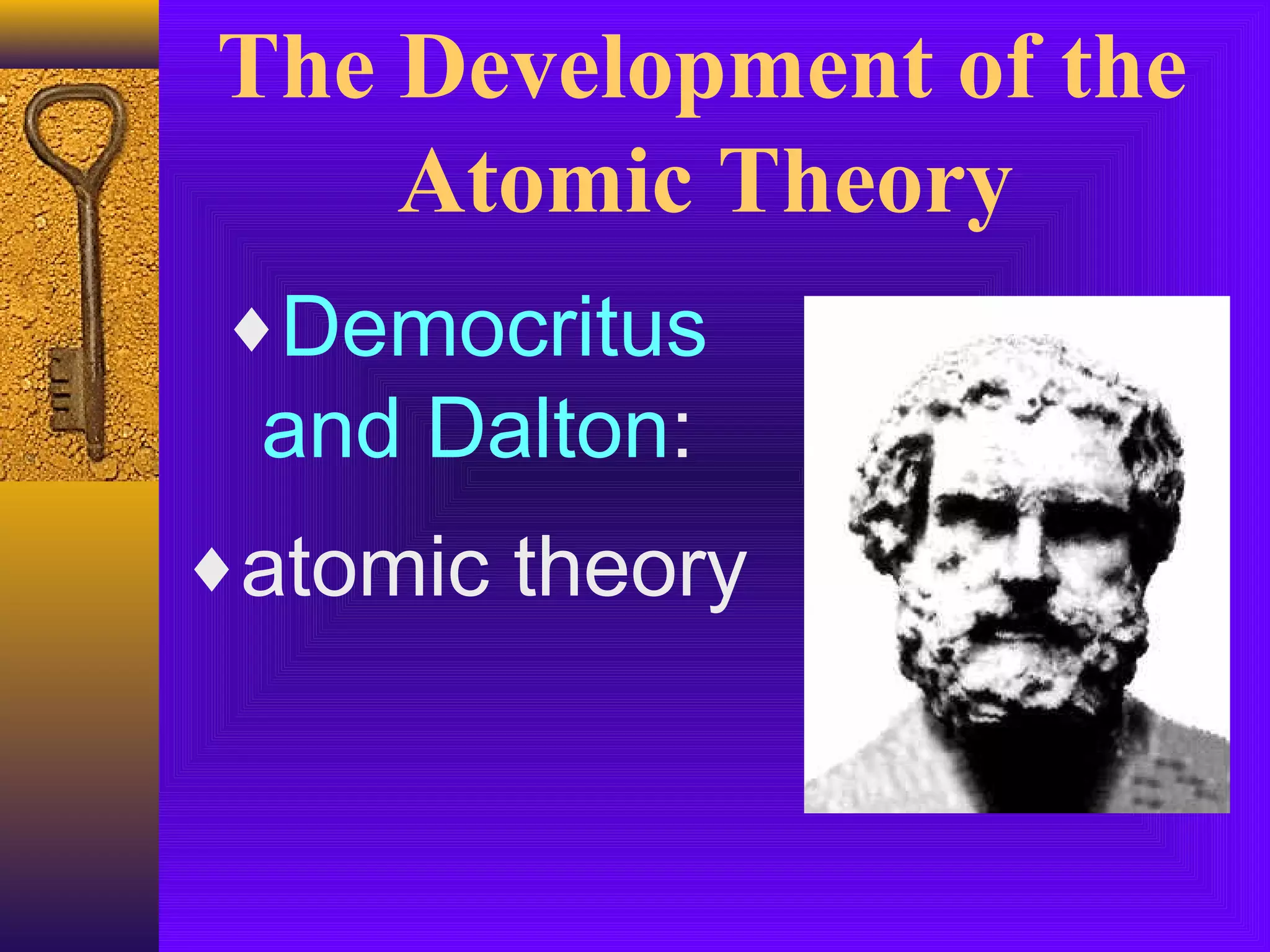
♦Democritus
 and Dalton:
♦atomic theory
Democritus
♦Greek philosopher ~ 300 BC
♦Limit to “smallness”
♦All matter consists of tiny,
 indestructible particles called
 atoms
♦Atomos – indestructible
John Dalton
 First serious atomic theory
♦English scientist
♦Studied the properties of gases
♦“Reinvented” the idea of atoms
♦Published in 1803
Dalton’s atomic theory - 1803


 1. Elements are composed
 of tiny, discrete, particles
 called atoms.
Dalton’s atomic theory - 1803


2. Atoms are indivisible
and indestructible and do
not change their identity
during reactions.
Dalton’s atomic theory - 1803

3. Atoms of the same
element are identical in
mass and chemical and
physical properties. Atoms
of different elements are
different.
Dalton’s atomic theory - 1803


4. Atoms combine to form
compounds in simple,
whole-number ratios.

Law of Definite Proportions
Dalton’s atomic theory - 1803


5. Atoms combine in
different ratios to make
two or more compounds.
Law of Multiple Proportions
The Development of the
Atomic Theory
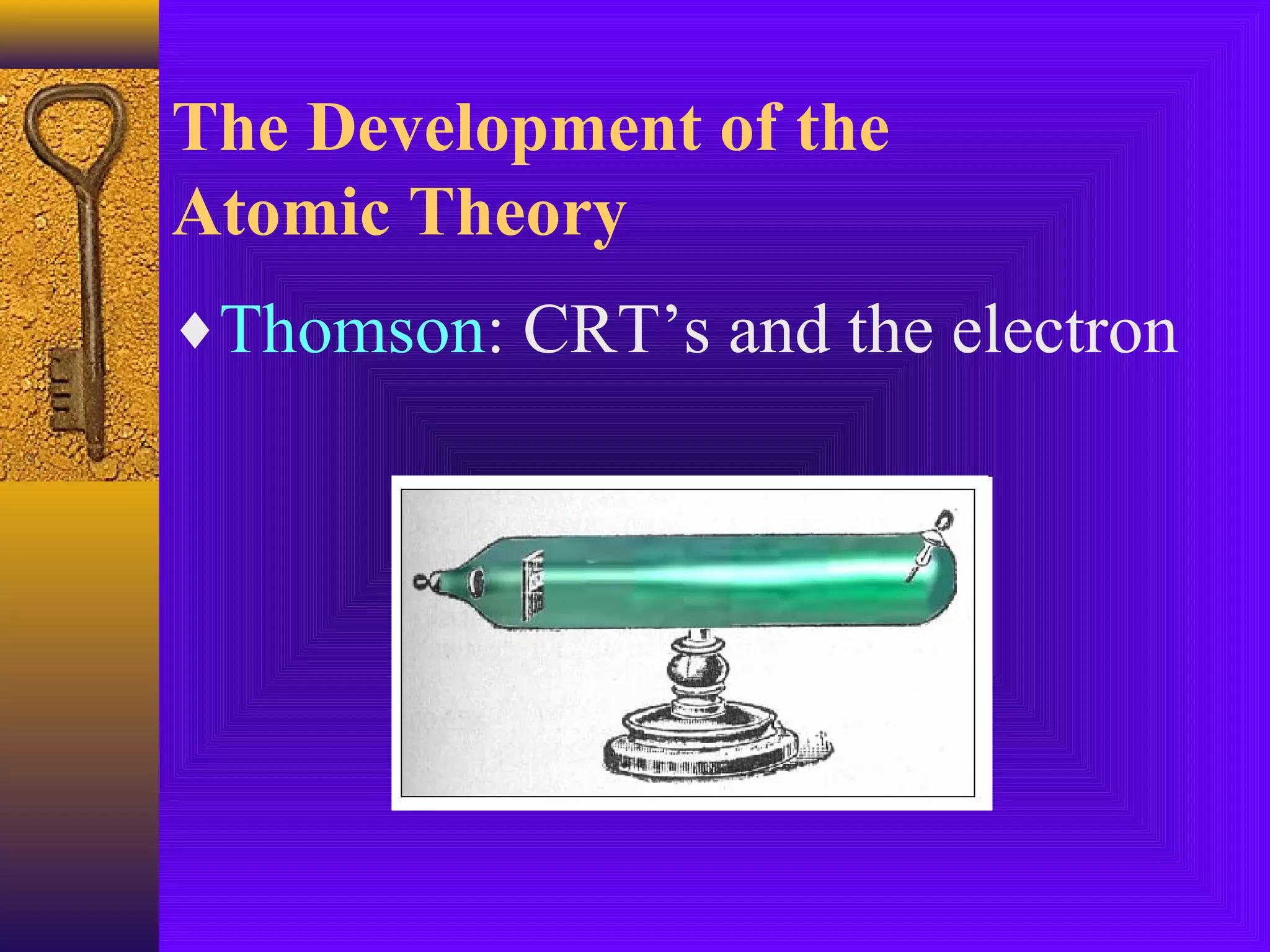
♦Thomson: CRT’s and the electron
J. J. Thomson
♦Cathode rays - cathode ray tube
♦Attracted to positive electrode
♦Thought they might be atoms
♦Had same charge to mass ratio
 regardless of metal in the cathode
♦Particle must be common to all
 matter, a subatomic particle
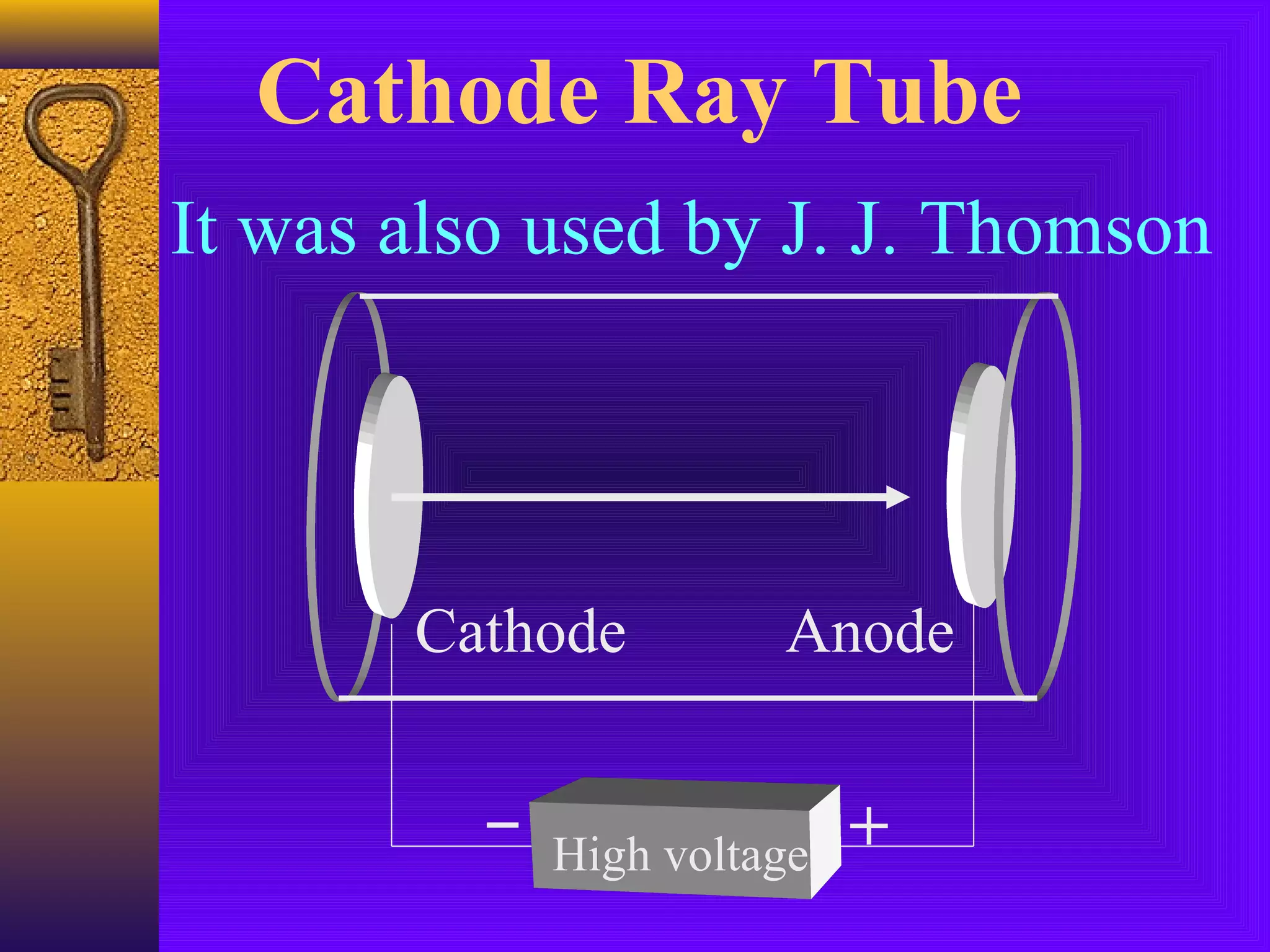
Cathode Ray Tube
It was also used by J. J. Thomson


       Cathode        Anode


            High voltage   +
That particle was
 called the …
       The
The electron electron
  The Electron
        The electron
The electron
 Discovered in 1897
          The electron
 By J. J. Thompson
J. J. Thomson
If that were the case, then the
electron would be much smaller
than the smallest atom,
        … showing for the first time
           that matter is made up of
       particles smaller than atoms.
Thomson tried to measure the
fundamental charge on the electron.
The Development of the
Atomic Theory
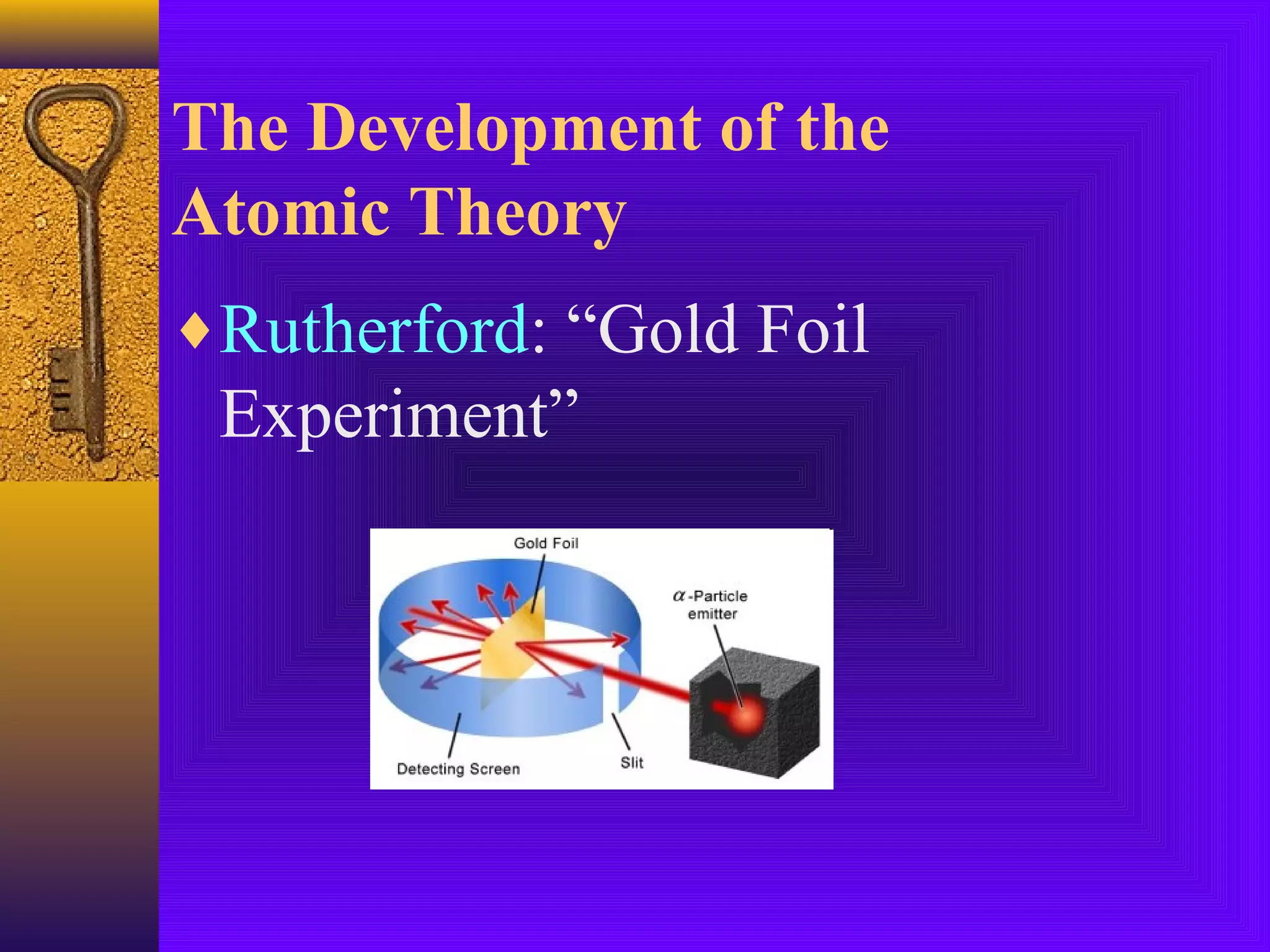
♦Rutherford: “Gold Foil
 Experiment”
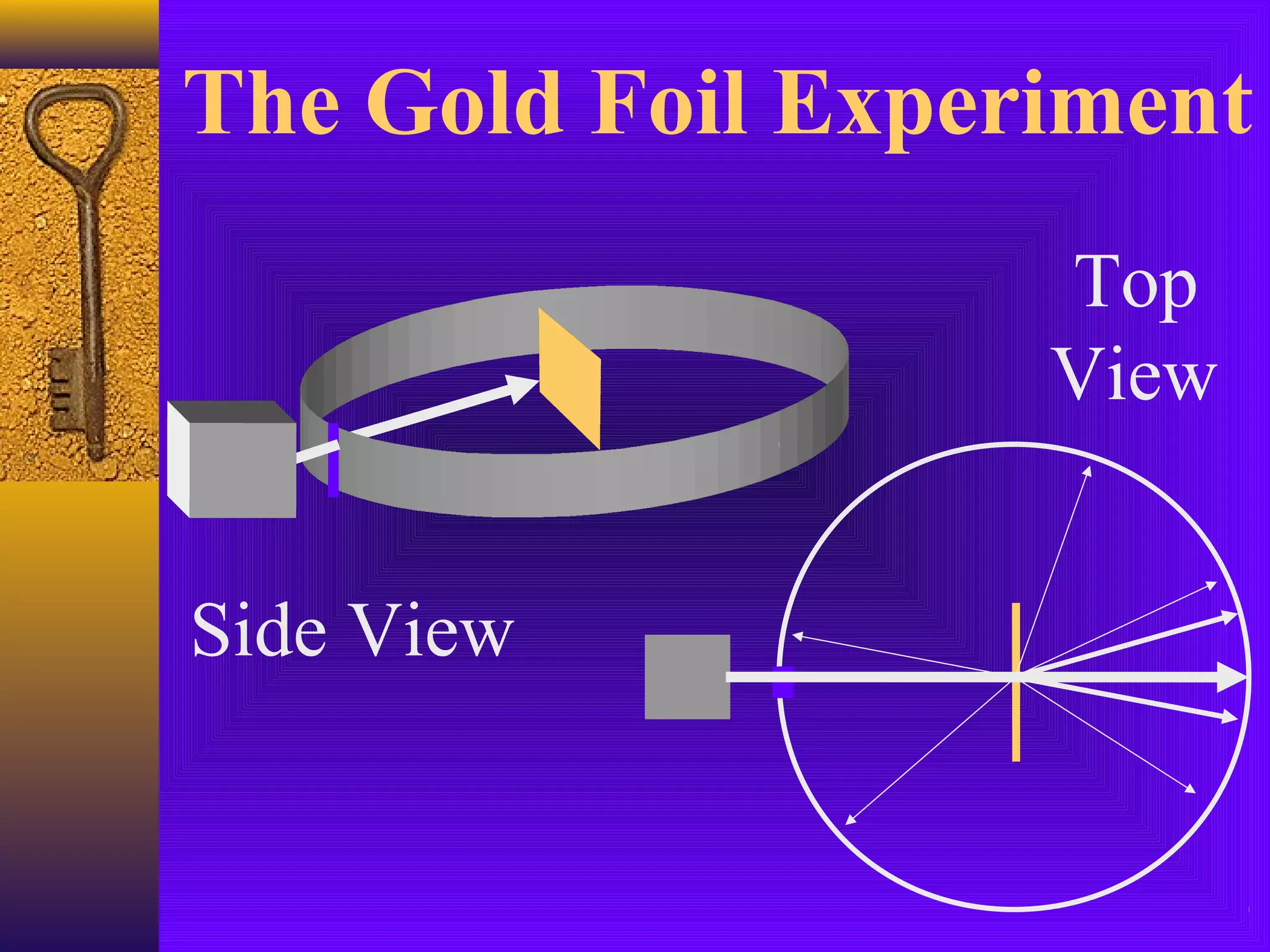
The Gold Foil Experiment
                   Top
                   View


Side View
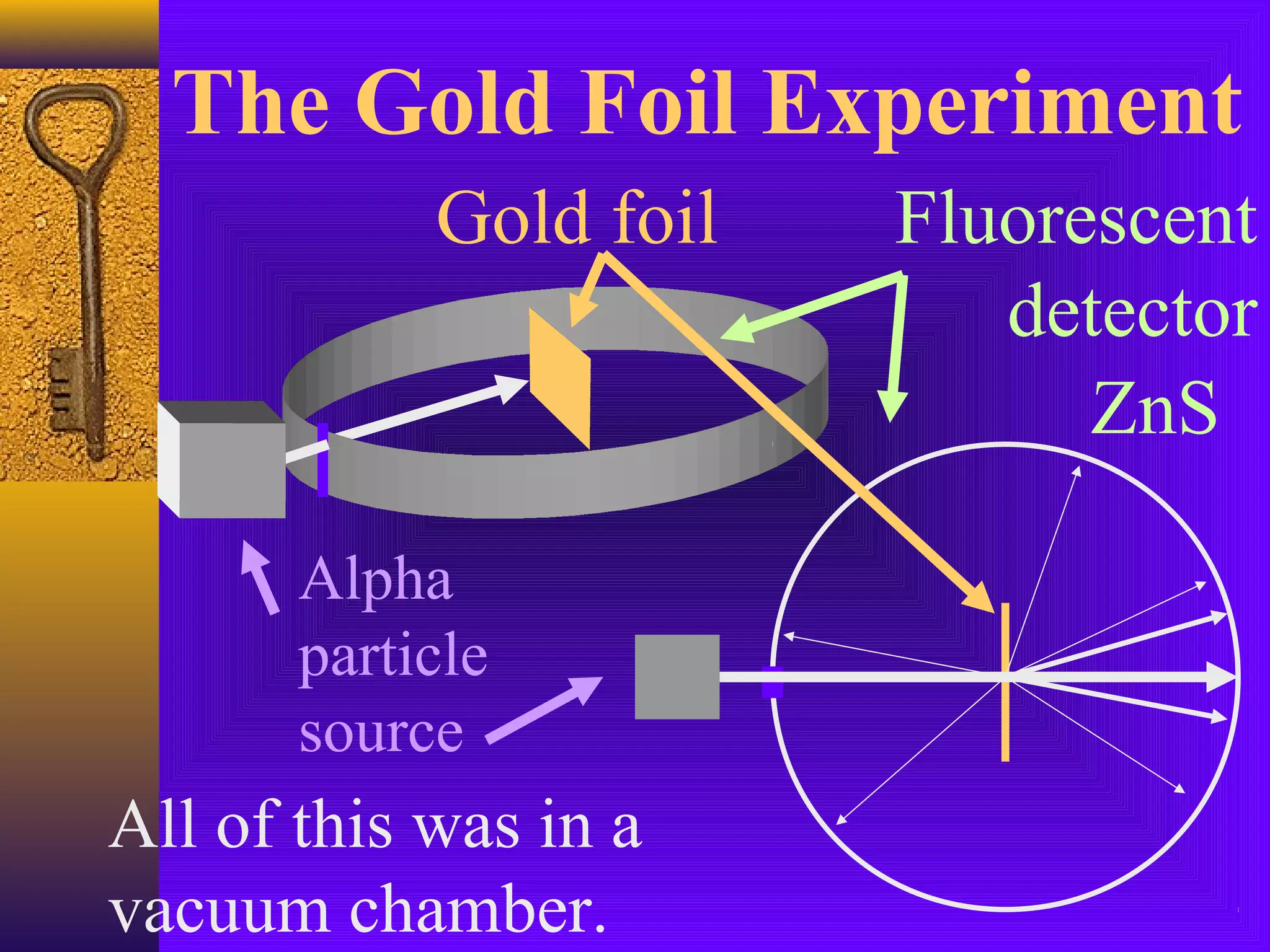
The Gold Foil Experiment
            Gold foil   Fluorescent
                           detector
                              ZnS

       Alpha
       particle
       source
All of this was in a
vacuum chamber.
The Gold Foil Experiment
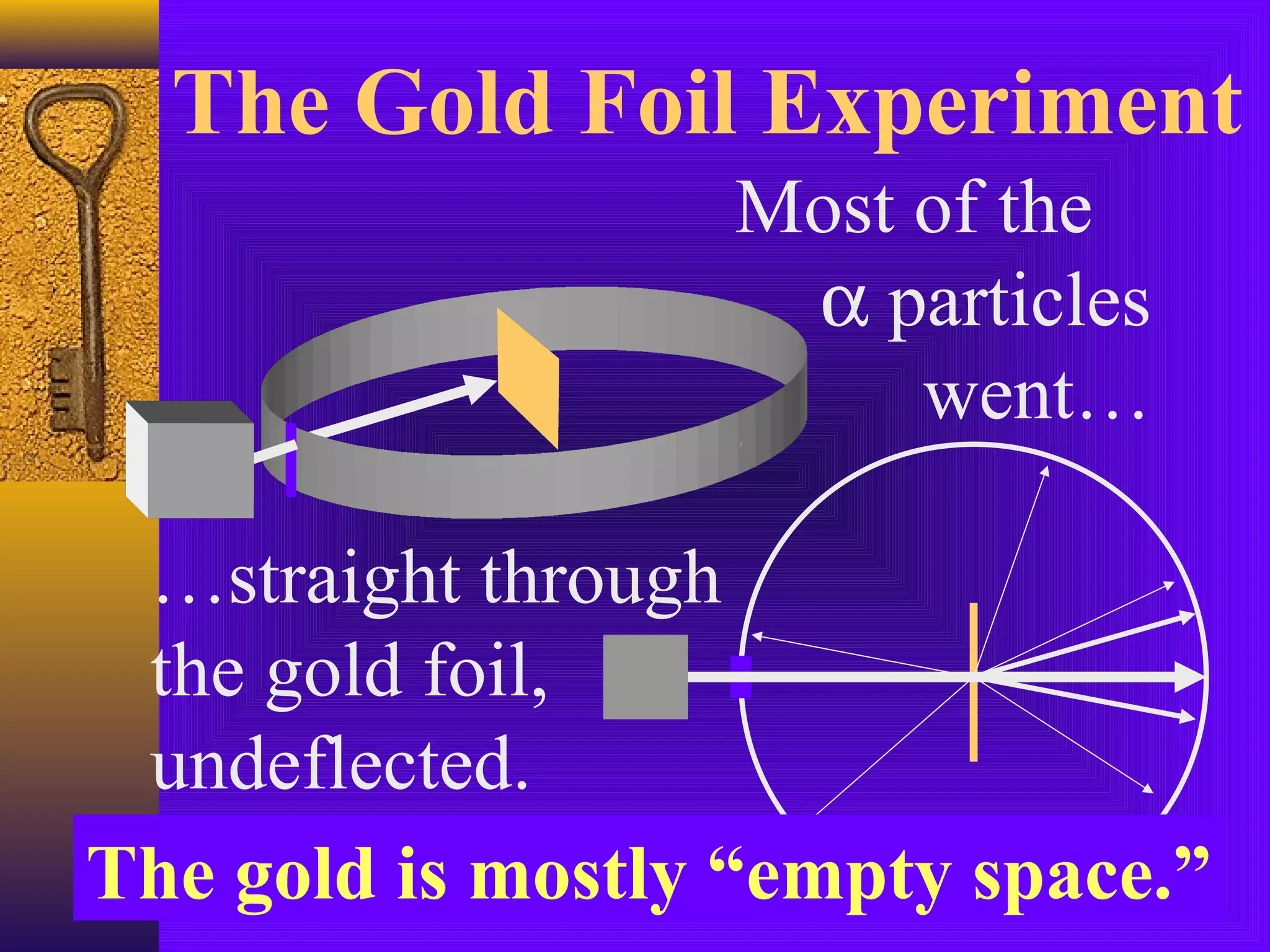
                   Most of the
                    α particles
                        went…

 …straight through
 the gold foil,
 undeflected.
The gold is mostly “empty space.”
Alpha Particles

     Alpha particles are helium nuclei.
                Two protons
          +         and
          +     two neutrons.

The alpha particle is positively charged.
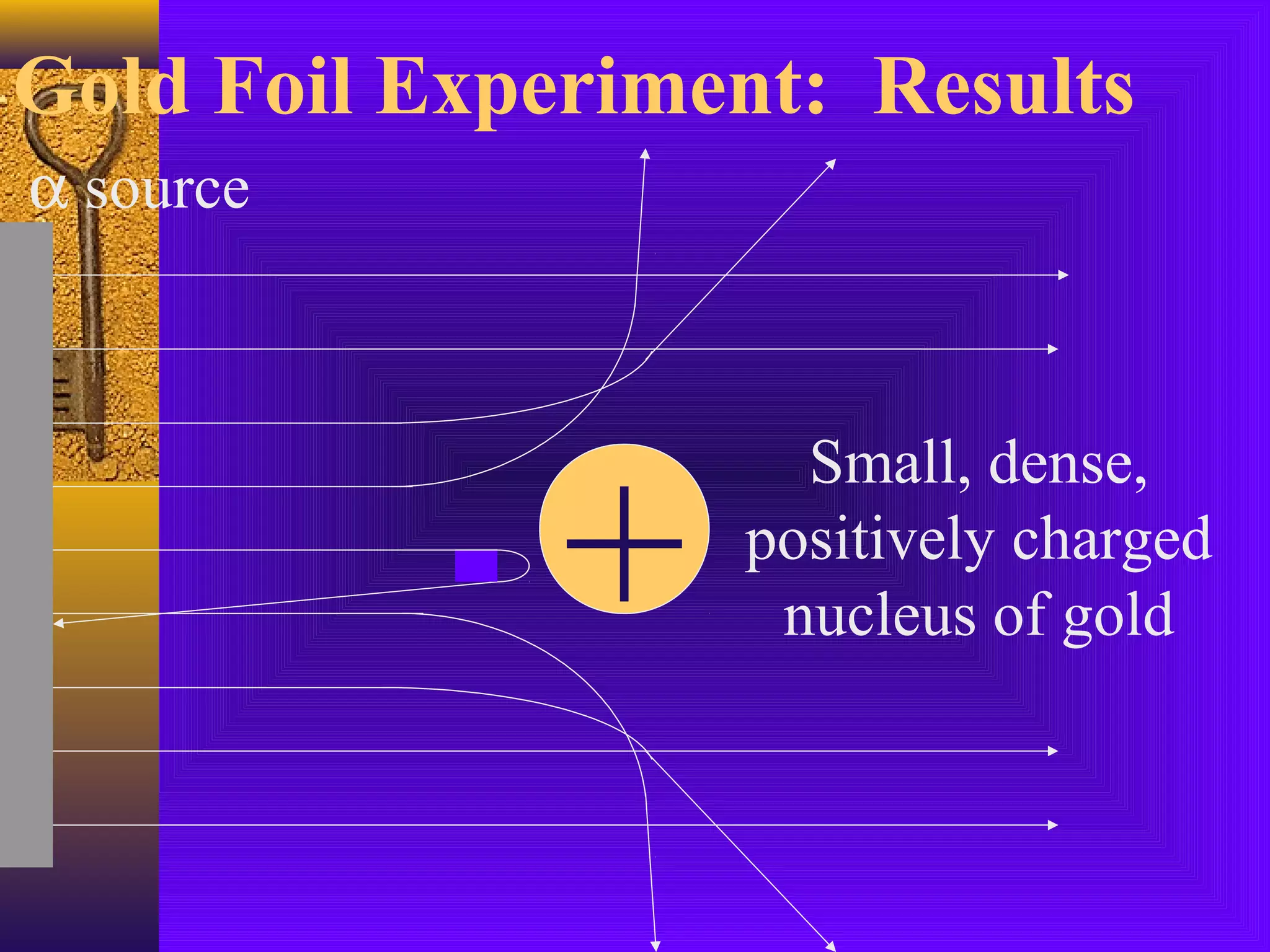
Gold Foil Experiment: Results
α source


              +
                    Small, dense,
                  positively charged
                   nucleus of gold
Rutherford’s Nuclear Atom
Alpha particles were repelled by…
… a small, dense, positively
charged nucleus.
        Almost all the mass of an
           atom is in the nucleus.
Electrons are located outside the
nucleus.
Niels Bohr
♦ Electrons travel in fixed orbits around the atom’s
  nucleus.
♦ Bohr also described the way atoms emit radiation
  by suggesting that when an electron jumps from
  an outer orbit to an inner one, that it emits light.
♦ Later other physicists expanded his theory into
  quantum mechanics.
♦ This theory explains the structure and actions of
  complex atoms.
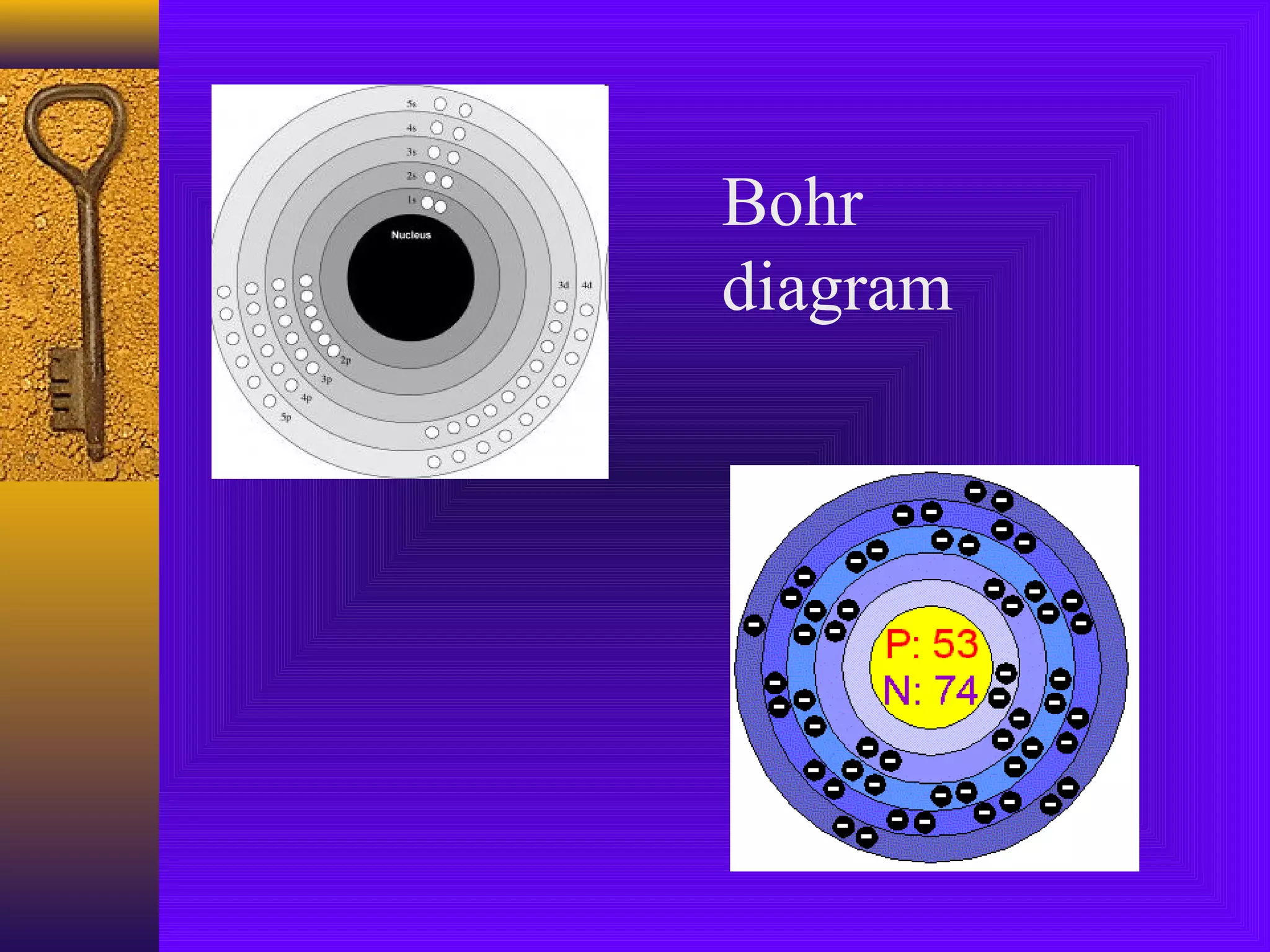
Bohr
diagram

Origins of the atomic theory

  • 1.
    Origins of theAtomic Theory Physical Science 2009-2010 psquires
  • 2.
    The Development ofthe Atomic Theory ♦Democritus and Dalton: ♦atomic theory
  • 3.
    Democritus ♦Greek philosopher ~300 BC ♦Limit to “smallness” ♦All matter consists of tiny, indestructible particles called atoms ♦Atomos – indestructible
  • 4.
    John Dalton Firstserious atomic theory ♦English scientist ♦Studied the properties of gases ♦“Reinvented” the idea of atoms ♦Published in 1803
  • 5.
    Dalton’s atomic theory- 1803 1. Elements are composed of tiny, discrete, particles called atoms.
  • 6.
    Dalton’s atomic theory- 1803 2. Atoms are indivisible and indestructible and do not change their identity during reactions.
  • 7.
    Dalton’s atomic theory- 1803 3. Atoms of the same element are identical in mass and chemical and physical properties. Atoms of different elements are different.
  • 8.
    Dalton’s atomic theory- 1803 4. Atoms combine to form compounds in simple, whole-number ratios. Law of Definite Proportions
  • 9.
    Dalton’s atomic theory- 1803 5. Atoms combine in different ratios to make two or more compounds. Law of Multiple Proportions
  • 10.
    The Development ofthe Atomic Theory ♦Thomson: CRT’s and the electron
  • 11.
    J. J. Thomson ♦Cathoderays - cathode ray tube ♦Attracted to positive electrode ♦Thought they might be atoms ♦Had same charge to mass ratio regardless of metal in the cathode ♦Particle must be common to all matter, a subatomic particle
  • 12.
    Cathode Ray Tube Itwas also used by J. J. Thomson Cathode Anode High voltage +
  • 13.
    That particle was called the … The The electron electron The Electron The electron The electron Discovered in 1897 The electron By J. J. Thompson
  • 14.
    J. J. Thomson Ifthat were the case, then the electron would be much smaller than the smallest atom, … showing for the first time that matter is made up of particles smaller than atoms. Thomson tried to measure the fundamental charge on the electron.
  • 15.
    The Development ofthe Atomic Theory ♦Rutherford: “Gold Foil Experiment”
  • 16.
    The Gold FoilExperiment Top View Side View
  • 17.
    The Gold FoilExperiment Gold foil Fluorescent detector ZnS Alpha particle source All of this was in a vacuum chamber.
  • 18.
    The Gold FoilExperiment Most of the α particles went… …straight through the gold foil, undeflected. The gold is mostly “empty space.”
  • 19.
    Alpha Particles Alpha particles are helium nuclei. Two protons + and + two neutrons. The alpha particle is positively charged.
  • 20.
    Gold Foil Experiment:Results α source + Small, dense, positively charged nucleus of gold
  • 21.
    Rutherford’s Nuclear Atom Alphaparticles were repelled by… … a small, dense, positively charged nucleus. Almost all the mass of an atom is in the nucleus. Electrons are located outside the nucleus.
  • 22.
    Niels Bohr ♦ Electronstravel in fixed orbits around the atom’s nucleus. ♦ Bohr also described the way atoms emit radiation by suggesting that when an electron jumps from an outer orbit to an inner one, that it emits light. ♦ Later other physicists expanded his theory into quantum mechanics. ♦ This theory explains the structure and actions of complex atoms.
  • 23.