What are atoms?
An atom is the smallest identifiable unit of an
element.
There are approximately 91 different elements
in nature.
Scientists have synthesized about 20 synthetic
elements
3.
Atom History
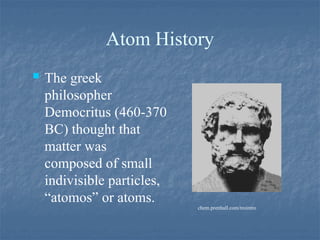
Thegreek
philosopher
Democritus (460-370
BC) thought that
matter was
composed of small
indivisible particles,
“atomos” or atoms.
chem.prenhall.com/trointro
4.
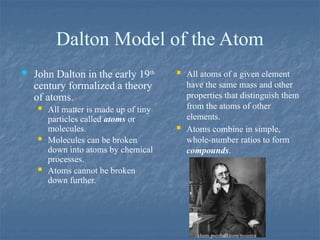
Dalton Model ofthe Atom
John Dalton in the early 19th
century formalized a theory
of atoms.
All matter is made up of tiny
particles called atoms or
molecules.
Molecules can be broken
down into atoms by chemical
processes.
Atoms cannot be broken
down further.
All atoms of a given element
have the same mass and other
properties that distinguish them
from the atoms of other
elements.
Atoms combine in simple,
whole-number ratios to form
compounds.
chem.prenhall.com/trointro
5.
Dalton Model ofthe Atom - 2
Dalton relied upon the law of conservation of mass and the law of
conservation definite composition in the development of his theory.
According to the law of definite composition, the mass ratio of
carbon to oxygen in carbon dioxide was always the same.
Carbon dioxide was composed 1 carbon atom and 2 oxygen
atoms - CO2
Similarly, 2 atoms of hydrogen and 1 atom of oxygen combine
to give water – H2O
Dalton proposed that 2 hydrogen atoms could substitute for
each oxygen atom in carbon dioxide to make methane with 1
carbon atom and 4 hydrogen atoms. Indeed, methane is CH4!
6.
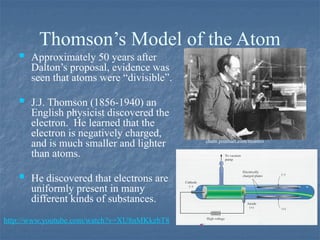
Thomson’s Model ofthe Atom
Approximately 50 years after
Dalton’s proposal, evidence was
seen that atoms were “divisible”.
J.J. Thomson (1856-1940) an
English physicist discovered the
electron. He learned that the
electron is negatively charged,
and is much smaller and lighter
than atoms.
He discovered that electrons are
uniformly present in many
different kinds of substances.
chem.prenhall.com/trointro
http://www.youtube.com/watch?v=XU8nMKkzbT8
7.
Thomson’s Model ofthe Atom - 2
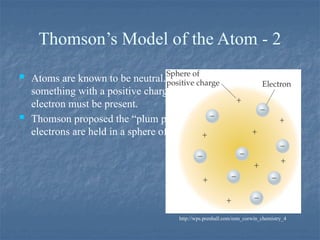
Atoms are known to be neutral. If electrons are negative then
something with a positive charge equal in magnitude to the
electron must be present.
Thomson proposed the “plum pudding model,” where
electrons are held in a sphere of positive charge.
http://wps.prenhall.com/esm_corwin_chemistry_4
8.
Mass of SubatomicParticles
Originally, Thomson could only calculate the mass-
to-charge ratio of a proton and an electron.
Robert Millikan determined the charge of an electron
in 1911.
Thomson calculated the masses of a proton and
electron:
An electron has a mass of 9.11 × 10⁻²⁸
g
A proton has a mass of 1.67 × 10⁻²⁴
g
9.
Rutherford Model ofthe Atom
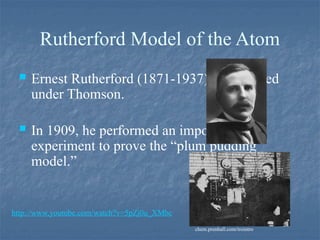
Ernest Rutherford (1871-1937) had worked
under Thomson.
In 1909, he performed an important
experiment to prove the “plum pudding
model.”
chem.prenhall.com/trointro
http://www.youtube.com/watch?v=5pZj0u_XMbc
10.
Rutherford’s Experiment
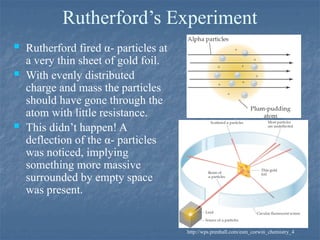
Rutherfordfired α- particles at
a very thin sheet of gold foil.
With evenly distributed
charge and mass the particles
should have gone through the
atom with little resistance.
This didn’t happen! A
deflection of the α- particles
was noticed, implying
something more massive
surrounded by empty space
was present.
http://wps.prenhall.com/esm_corwin_chemistry_4
11.
Why did thishappen?
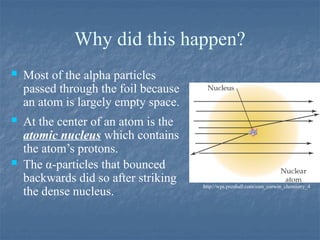
Most of the alpha particles
passed through the foil because
an atom is largely empty space.
At the center of an atom is the
atomic nucleus which contains
the atom’s protons.
The α-particles that bounced
backwards did so after striking
the dense nucleus.
http://wps.prenhall.com/esm_corwin_chemistry_4
12.
Rutherford’s New Modelof the Atom
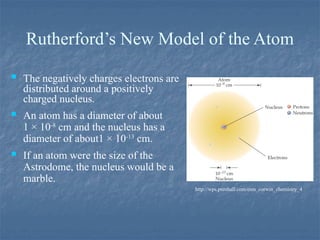
The negatively charges electrons are
distributed around a positively
charged nucleus.
An atom has a diameter of about
1 × 10⁻⁸
cm and the nucleus has a
diameter of about1 × 10-13
cm.
If an atom were the size of the
Astrodome, the nucleus would be a
marble.
http://wps.prenhall.com/esm_corwin_chemistry_4
13.
Subatomic Particles Revisited
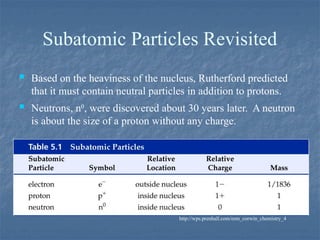
Based on the heaviness of the nucleus, Rutherford predicted
that it must contain neutral particles in addition to protons.
Neutrons, n0
, were discovered about 30 years later. A neutron
is about the size of a proton without any charge.
http://wps.prenhall.com/esm_corwin_chemistry_4
14.
14
Atomic Notation
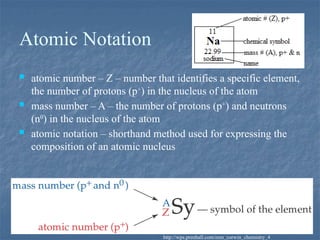
atomicnumber – Z – number that identifies a specific element,
the number of protons (p+
) in the nucleus of the atom
mass number – A – the number of protons (p+
) and neutrons
(n0
) in the nucleus of the atom
atomic notation – shorthand method used for expressing the
composition of an atomic nucleus
http://wps.prenhall.com/esm_corwin_chemistry_4
15.
Using Atomic Notation
Sodium
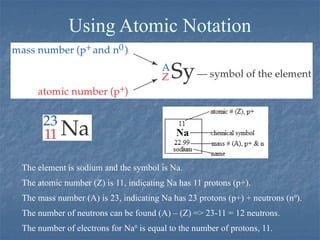
The element is sodium and the symbol is Na.
The atomic number (Z) is 11, indicating Na has 11 protons (p+).
The mass number (A) is 23, indicating Na has 23 protons (p+) + neutrons (n0
).
The number of neutrons can be found (A) – (Z) => 23-11 = 12 neutrons.
The number of electrons for Na0
is equal to the number of protons, 11.
Try these…
Writethe atomic notation for the following
neutral elements.
Chlorine, Cadmium, Manganese
18.
Isotopes
An elementhas a fixed number of protons. All atoms of that
element have the same number of protons. However, the
number of neutrons may vary.
Atoms of the same element that have a different
number of neutrons in the nucleus are called isotopes.
Isotopes have the same atomic number but different
mass numbers.
Isotopes are written by stating the name of the
element followed by its mass number.
19.
Hydrogen Isotopes
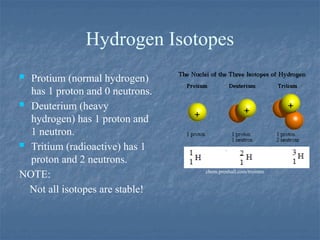
Protium(normal hydrogen)
has 1 proton and 0 neutrons.
Deuterium (heavy
hydrogen) has 1 proton and
1 neutron.
Tritium (radioactive) has 1
proton and 2 neutrons.
NOTE:
Not all isotopes are stable!
chem.prenhall.com/trointro
20.
Carbon Isotopes
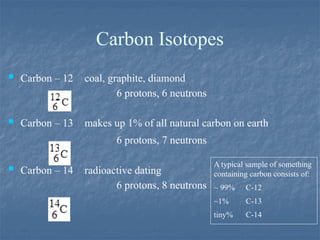
Carbon– 12 coal, graphite, diamond
6 protons, 6 neutrons
Carbon – 13 makes up 1% of all natural carbon on earth
6 protons, 7 neutrons
Carbon – 14 radioactive dating
6 protons, 8 neutrons
A typical sample of something
containing carbon consists of:
~ 99% C-12
~1% C-13
tiny% C-14
Atomic Mass
Theweighted average mass of all naturally occurring isotopes is the
atomic mass.
The symbol for atomic mass is amu (atomic mass unit).
Atomic mass = (fraction of isotope 1 x mass of isotope 1) + (fraction of
isotope 2 x mass of isotope 2) + …
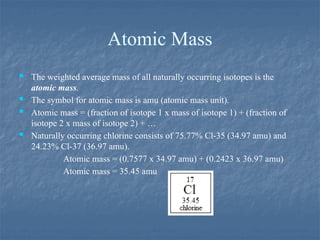
Naturally occurring chlorine consists of 75.77% Cl-35 (34.97 amu) and
24.23% Cl-37 (36.97 amu).
Atomic mass = (0.7577 x 34.97 amu) + (0.2423 x 36.97 amu)
Atomic mass = 35.45 amu
23.
Try this…
Anew element Floridium has been discovered.
It is made up of 3 isotopes.
Fl-315 (315.00 amu) has a natural abundance of 46.700%
Fl-317 (317.00 amu) has a natural abundance of 31.000%
Fl-320 (320.00 amu) has a natural abundance of 22.300%
What is the atomic mass of Floridium?
24.
Mendeleev’s Periodic Table
Mendeleev - architect of the modern periodic table
arranged elements in table in order of increasing atomic mass
elements with similar properties were grouped together in same row or
column
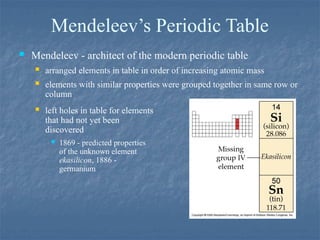
left holes in table for elements
that had not yet been
discovered
1869 - predicted properties
of the unknown element
ekasilicon, 1886 -
germanium
25.
Occurrence of theElements
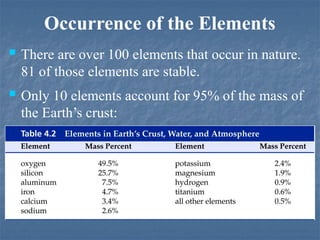
There are over 100 elements that occur in nature.
81 of those elements are stable.
Only 10 elements account for 95% of the mass of
the Earth’s crust:
26.
Elements in theHuman Body
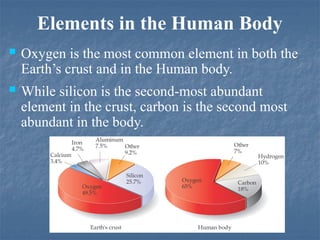
Oxygen is the most common element in both the
Earth’s crust and in the Human body.
While silicon is the second-most abundant
element in the crust, carbon is the second most
abundant in the body.
27.
Names of theElements
Each element has a unique name.
Names have several origins:
Hydrogen is derived from Greek
Carbon is derived from Latin
Scandium is named for Scandinavia
Nobelium is named for Alfred Nobel.
28.
Element Symbols
Eachelement is abbreviated using a chemical symbol.
The symbols are 1 or 2 letters long.
Most of the time, the symbol is derived from the name of
the element.
C is the symbol for carbon
Cd is the symbol for cadmium
When a symbol has one letter, it is capitalized.
When a symbol has a two letters, the first is capitalized
and the second is lower case.
29.
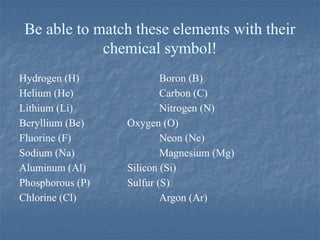
Be able tomatch these elements with their
chemical symbol!
Hydrogen (H) Boron (B)
Helium (He) Carbon (C)
Lithium (Li) Nitrogen (N)
Beryllium (Be) Oxygen (O)
Fluorine (F) Neon (Ne)
Sodium (Na) Magnesium (Mg)
Aluminum (Al) Silicon (Si)
Phosphorous (P) Sulfur (S)
Chlorine (Cl) Argon (Ar)
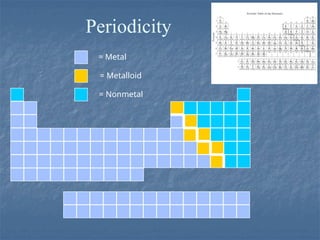
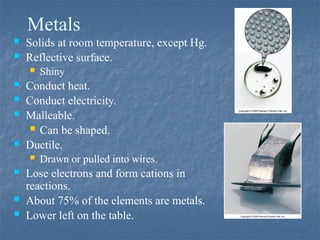
Metals
Solids atroom temperature, except Hg.
Reflective surface.
Shiny
Conduct heat.
Conduct electricity.
Malleable.
Can be shaped.
Ductile.
Drawn or pulled into wires.
Lose electrons and form cations in
reactions.
About 75% of the elements are metals.
Lower left on the table.
32.
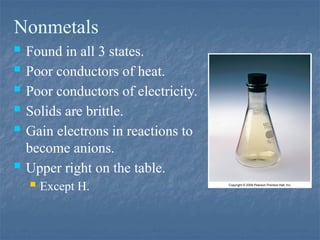
Nonmetals
Found inall 3 states.
Poor conductors of heat.
Poor conductors of electricity.
Solids are brittle.
Gain electrons in reactions to
become anions.
Upper right on the table.
Except H.
33.
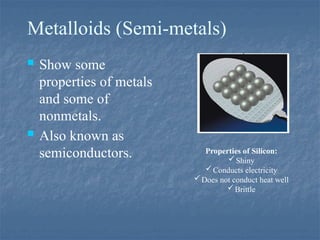
Metalloids (Semi-metals)
Showsome
properties of metals
and some of
nonmetals.
Also known as
semiconductors. Properties of Silicon:
Shiny
Conducts electricity
Does not conduct heat well
Brittle
34.
Periodic Law
1913- H. G. J. Moseley arranged elements in order of
increasing atomic number, Z
Recall, Z = # protons
Periodic Law- properties occur in repeating pattern
when elements are arranged according to increasing
atomic number
atomic mass increases when number of protons increase
EXCEPTIONS: Ni & Co, Ar & K, Te & I
Bohr’s electron energy levels altered shape of
periodic table
modern periodic table - s, p, d, & f sublevels
35.
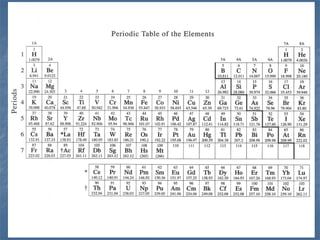
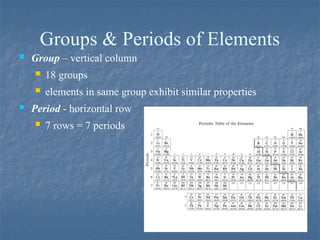
Groups & Periodsof Elements
Group – vertical column
18 groups
elements in same group exhibit similar properties
Period - horizontal row
7 rows = 7 periods
36.
Group A elements
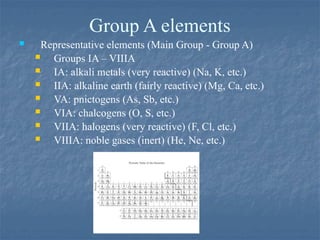
Representative elements (Main Group - Group A)
Groups IA – VIIIA
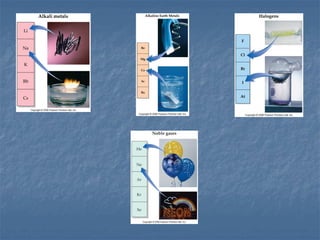
IA: alkali metals (very reactive) (Na, K, etc.)
IIA: alkaline earth (fairly reactive) (Mg, Ca, etc.)
VA: pnictogens (As, Sb, etc.)
VIA: chalcogens (O, S, etc.)
VIIA: halogens (very reactive) (F, Cl, etc.)
VIIIA: noble gases (inert) (He, Ne, etc.)
38.
Group B elements
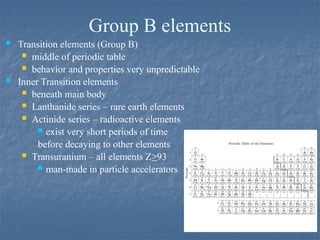
Transition elements (Group B)
middle of periodic table
behavior and properties very unpredictable
Inner Transition elements
beneath main body
Lanthanide series – rare earth elements
Actinide series – radioactive elements
exist very short periods of time
before decaying to other elements
Transuranium – all elements Z>93
man-made in particle accelerators
39.
Which element amI?
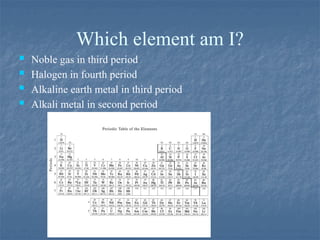
Noble gas in third period
Halogen in fourth period
Alkaline earth metal in third period
Alkali metal in second period
40.
Ionic Charge
metalstend to lose electrons and nonmetals tend to gain
electrons to be stable (achieve noble gas configuration)
The charge of an ion is related to the number of valence
electrons on the atom.
Group IA metals lose their one valence electron to form +1
ions
Na Na+
+ e-
(lost one electron)
Group VIA nonmetals gain two valence electrons to form -2
ions
S + 2e-
S-2
(gain two electrons)
charges on ions can be shown as either Mg+2
or Mg2+
omit the 1 for ions with +1 or -1 charge
41.
Metals & IonicCharge
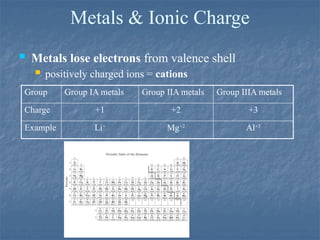
Metals lose electrons from valence shell
positively charged ions = cations
Group Group IA metals Group IIA metals Group IIIA metals
Charge +1 +2 +3
Example Li+
Mg+2
Al+3
42.
Nonmetals and IonicCharge
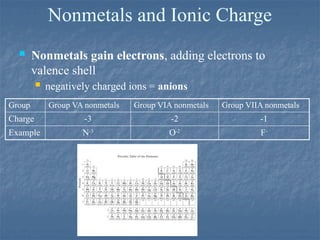
Nonmetals gain electrons, adding electrons to
valence shell
negatively charged ions = anions
Group Group VA nonmetals Group VIA nonmetals Group VIIA nonmetals
Charge -3 -2 -1
Example N-3
O-2
F-
43.
Give the formulafor the ion
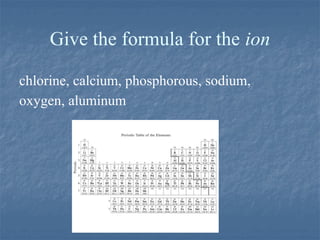
chlorine, calcium, phosphorous, sodium,
oxygen, aluminum