1. Describe the energy transfers
      that occur in a light bulb.

2. Describe the energy transfers
   that occur when the body is
             powered by food.
Wt=50N


         1. What is the KE at point A? Why?
         2. What is the PE at point A?
         3. What is the ME at point A?
         4. What is the PE at point C?
         5. What is the KE at point C?
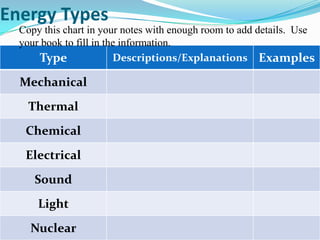
Energy Types
  Copy this chart in your notes with enough room to add details. Use
  your book to fill in the information.
      Type               Descriptions/Explanations Examples

  Mechanical
    Thermal
   Chemical
   Electrical
     Sound
      Light
    Nuclear
1. Describe the energy transfers
                 in a hairdryer.

       2. What is the difference
       between renewable and
         nonrenewable energy
                   resources?
Forms           Explanation       Example


               Total energy of
Mechanical
             motion and position
             Total kinetic energy
Thermal
                 of particles
              Energy stored in
Chemical
             rearranging atoms
Energy of moving
Electrical
                   electrons
               Energy of vibrating
Sound
                   particles
             Vibrations of electrically
Light
                charged particles
             Energy in the nucleus of
Nuclear
                     an atom
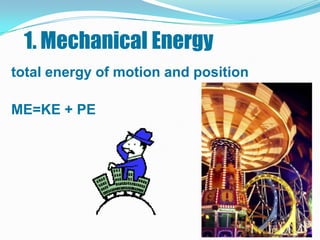
1. Mechanical Energy
total energy of motion and position

ME=KE + PE
An object on the top of a hill has
 high ____ energy and low ____
 energy.

As the object rolls down, what
 happens?

Why does there seem to be less
 energy at the bottom of the hill
 than at the top?
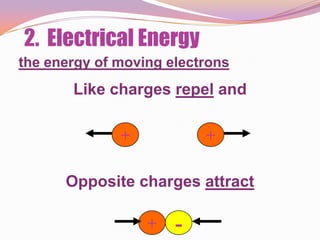
2. Electrical Energy
the energy of moving electrons
       Like charges repel and

              +           +

      Opposite charges attract

                  +   -
Two Types of Electricity
Static Electricity


Current Electricity
The Power of Electricity
  Can be turned into other kinds of energy
  Can do work
    Hairdryer converts electric to thermal
    Alarm clock converts electric to sound and
    light
3. Nuclear Energy
  the energy of the nucleus of an atom


   Fission
   Fusion
Pros and Cons of Nuclear Energy
     Fission                 Fusion
 + make electrical        + fuel is plentiful
   energy                 + only small amounts
 + no carbon dioxide or     of radioactive waste
   other gases              products

 - limited fuel supply    - not currently
 - radioactive waste        practical
   products               - large amount of
 - possible release of      energy needed to
   radioactive material     heat and contain the
                            hydrogen plasma
The Sun

Giant nuclear fusion
reactor
Ultimate source of
energy for our planet
4. Chemical Energy
 the energy of rearranging atoms
 Is photosynthesis endothermic or
 exothermic?

 Is respiration endothermic or
 exothermic?
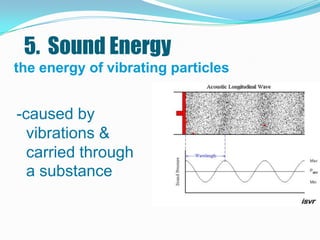
5. Sound Energy
the energy of vibrating particles


-caused by
  vibrations &
  carried through
  a substance.
Making Sound vs. Hearing Sound
            Have you heard this riddle?

 If a tree falls in the forest and no one is around to
          hear it, does the tree make a sound?


                        0


              What do you think?
When a tree falls and hits the ground, the tree and
    the ground vibrate. These vibrations are
        transferred to the surrounding air.


                      0


       So there would be a sound!!!
Change Frequency = Change Pitch


         TRY IT! – Vocal cords
       WATCH IT! – Jars vs. Bottles
TRY IT!
 Hold the cut rubber band stretched tight.

 Have a partner pluck the rubber band with
 their finger.

 Notice the pitch.

 Shorten the length of rubber band by
 holding it in the middle.

 What was different??
Echolocation
6. Light Energy
the vibrations of electrically charged particles


               Called PHOTONS 
The EM Spectrum
 Visible light is one portion of
  the Electromagnetic Spectrum.

 All of these waves are energy-
  filled waves.

 Insects, like bees, see shorter
 wavelengths than humans.
 What type of EM waves do
 they see?


     WATCH IT! - prism
Possibilities of Light
 Light rays move away from their source in straight lines.
 When they hit something, they are either


  Absorbed             Reflected            Refracted
  (stopped)            (bounced off)        (bent)

                    WATCH IT! - Mirror
TRY IT!
  Fill beaker half full of water.
  Put a pencil in the glass.
  Look at the pencil through the side of the
   glass.
  How does the pencil look different than it did
   before you put it in the water?
  This is an example of ______________.
TRY IT!
  Prop up the card with the arrow on it.

  Place a glass of water a little to one side of the
  card and a few inches in front of it.

  Now stoop down until your eyes are level with
  arrow.

  Slide the glass between the card and your
  eyes. Try sliding it back and forth a few times.

  What happened? What causes this?
Light Source or Not?
  You can see a light source even in the dark
  because its light passes directly into your
  eyes. Most things around you are not light
  sources. Why can you still see them?


 You can still see them because light from
 light sources reflects off the objects and
 then travels to your eyes.
The Speed of Light
 Watch this clip to learn more about the speed of
  light.
Check your Light Understanding
What is a photon?
On the EM spectrum, what type of EM radiation
 has the highest energy – radio waves, gamma
 rays, or x-rays?
What are 3 possible things that can happen to
 light rays after they leave the source?
Sound & Light:        Alike, but Different


        Sound                           Light
       *vibration                  *does NOT
    *needs a medium              need a medium
     *longitudinal                  *transverse
7. Thermal Energy
the total kinetic energy of the particles

 more thermal energy
  = faster moving
  particles
 less thermal energy
  = slower moving
  particles
Thermal Energy vs. Heat
 Heat is the transfer of energy between
 objects that are at different
 temperatures.
Three Kinds of Heat
 Conduction Convection Radiation
  (touch)   (current)  (rays)


  Hot      Cold


        Common
Check your Thermal Understanding
   Is thermal energy kinetic or potential?

   If you touch something in which the particles are
      moving faster than the particles in your skin, how
      would it feel?

   When objects have more thermal energy than their
    surroundings, what do you predict will happen in
    terms of heat?
1. What is heat?


2. How does thermal energy play
           a role in the Law of
       Conservation of Energy?
Bill Nye; Heat
   BEFORE: List the forms of energy that you know
    and understand

   DURING: Write notes about heat, conduction,
    convection, radiation

   AFTER: Write a paragraph that describes thermal
    energy, heat, and the processes of conduction,
    convection, and radiation.
Roller Coaster Energy Problems
           HT=250 m
           WT=200N
                                    HT=20 m
                                    WT=200N
                         M=20kg
                         V=200m/s


1.   Find the PE at point A.
2.   Find the KE at point A.          Answer the
3.   Find the ME at point A.         problems on
4.   Find the KE at point B.        the left on your
                                    sheet under the
5.   What is the ME at point C?      roller coaster
6.   Find the PE at point C.            picture.
7.   Find the KE at point C.

Energy types

  • 1.
    1. Describe theenergy transfers that occur in a light bulb. 2. Describe the energy transfers that occur when the body is powered by food.
  • 2.
    Wt=50N 1. What is the KE at point A? Why? 2. What is the PE at point A? 3. What is the ME at point A? 4. What is the PE at point C? 5. What is the KE at point C?
  • 3.
    Energy Types Copy this chart in your notes with enough room to add details. Use your book to fill in the information. Type Descriptions/Explanations Examples Mechanical Thermal Chemical Electrical Sound Light Nuclear
  • 4.
    1. Describe theenergy transfers in a hairdryer. 2. What is the difference between renewable and nonrenewable energy resources?
  • 5.
    Forms Explanation Example Total energy of Mechanical motion and position Total kinetic energy Thermal of particles Energy stored in Chemical rearranging atoms
  • 6.
    Energy of moving Electrical electrons Energy of vibrating Sound particles Vibrations of electrically Light charged particles Energy in the nucleus of Nuclear an atom
  • 7.
    1. Mechanical Energy totalenergy of motion and position ME=KE + PE
  • 8.
    An object onthe top of a hill has high ____ energy and low ____ energy. As the object rolls down, what happens? Why does there seem to be less energy at the bottom of the hill than at the top?
  • 9.
    2. Electrical Energy theenergy of moving electrons Like charges repel and + + Opposite charges attract + -
  • 10.
    Two Types ofElectricity Static Electricity Current Electricity
  • 11.
    The Power ofElectricity  Can be turned into other kinds of energy  Can do work  Hairdryer converts electric to thermal  Alarm clock converts electric to sound and light
  • 12.
    3. Nuclear Energy the energy of the nucleus of an atom  Fission  Fusion
  • 13.
    Pros and Consof Nuclear Energy Fission Fusion + make electrical + fuel is plentiful energy + only small amounts + no carbon dioxide or of radioactive waste other gases products - limited fuel supply - not currently - radioactive waste practical products - large amount of - possible release of energy needed to radioactive material heat and contain the hydrogen plasma
  • 14.
    The Sun Giant nuclearfusion reactor Ultimate source of energy for our planet
  • 15.
    4. Chemical Energy the energy of rearranging atoms  Is photosynthesis endothermic or exothermic?  Is respiration endothermic or exothermic?
  • 16.
    5. Sound Energy theenergy of vibrating particles -caused by vibrations & carried through a substance.
  • 17.
    Making Sound vs.Hearing Sound Have you heard this riddle? If a tree falls in the forest and no one is around to hear it, does the tree make a sound? 0 What do you think?
  • 18.
    When a treefalls and hits the ground, the tree and the ground vibrate. These vibrations are transferred to the surrounding air. 0 So there would be a sound!!!
  • 19.
    Change Frequency =Change Pitch TRY IT! – Vocal cords WATCH IT! – Jars vs. Bottles
  • 20.
    TRY IT!  Holdthe cut rubber band stretched tight.  Have a partner pluck the rubber band with their finger.  Notice the pitch.  Shorten the length of rubber band by holding it in the middle.  What was different??
  • 21.
  • 22.
    6. Light Energy thevibrations of electrically charged particles Called PHOTONS 
  • 23.
    The EM Spectrum Visible light is one portion of the Electromagnetic Spectrum.  All of these waves are energy- filled waves.  Insects, like bees, see shorter wavelengths than humans. What type of EM waves do they see? WATCH IT! - prism
  • 24.
    Possibilities of Light Light rays move away from their source in straight lines. When they hit something, they are either Absorbed Reflected Refracted (stopped) (bounced off) (bent) WATCH IT! - Mirror
  • 25.
    TRY IT! Fill beaker half full of water.  Put a pencil in the glass.  Look at the pencil through the side of the glass.  How does the pencil look different than it did before you put it in the water?  This is an example of ______________.
  • 26.
    TRY IT! Prop up the card with the arrow on it.  Place a glass of water a little to one side of the card and a few inches in front of it.  Now stoop down until your eyes are level with arrow.  Slide the glass between the card and your eyes. Try sliding it back and forth a few times.  What happened? What causes this?
  • 27.
    Light Source orNot? You can see a light source even in the dark because its light passes directly into your eyes. Most things around you are not light sources. Why can you still see them? You can still see them because light from light sources reflects off the objects and then travels to your eyes.
  • 28.
    The Speed ofLight Watch this clip to learn more about the speed of light.
  • 29.
    Check your LightUnderstanding What is a photon? On the EM spectrum, what type of EM radiation has the highest energy – radio waves, gamma rays, or x-rays? What are 3 possible things that can happen to light rays after they leave the source?
  • 30.
    Sound & Light: Alike, but Different Sound Light *vibration *does NOT *needs a medium need a medium *longitudinal *transverse
  • 31.
    7. Thermal Energy thetotal kinetic energy of the particles  more thermal energy = faster moving particles  less thermal energy = slower moving particles
  • 32.
    Thermal Energy vs.Heat Heat is the transfer of energy between objects that are at different temperatures.
  • 33.
    Three Kinds ofHeat Conduction Convection Radiation (touch) (current) (rays) Hot Cold Common
  • 34.
    Check your ThermalUnderstanding Is thermal energy kinetic or potential? If you touch something in which the particles are moving faster than the particles in your skin, how would it feel? When objects have more thermal energy than their surroundings, what do you predict will happen in terms of heat?
  • 35.
    1. What isheat? 2. How does thermal energy play a role in the Law of Conservation of Energy?
  • 36.
    Bill Nye; Heat  BEFORE: List the forms of energy that you know and understand  DURING: Write notes about heat, conduction, convection, radiation  AFTER: Write a paragraph that describes thermal energy, heat, and the processes of conduction, convection, and radiation.
  • 37.
    Roller Coaster EnergyProblems HT=250 m WT=200N HT=20 m WT=200N M=20kg V=200m/s 1. Find the PE at point A. 2. Find the KE at point A. Answer the 3. Find the ME at point A. problems on 4. Find the KE at point B. the left on your sheet under the 5. What is the ME at point C? roller coaster 6. Find the PE at point C. picture. 7. Find the KE at point C.