Gas Laws
           PSquires
              2011
Properties of Gases
   Gases expand to fill the container.
   Gases take on the shape of the container.
   Gases are highly compressible.
    (Can be liquefied at high pressure).
   Gases have low densities.
   Gases mix uniformly.
Kinetic Molecular Theory
  1. Molecules are in constant random motion

  2. A gas is mostly empty space
  3. No intermolecular forces

4. Collisions are elastic. No change in energy.
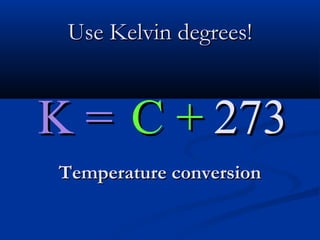
Use Kelvin degrees!


K = C + 273
Temperature conversion
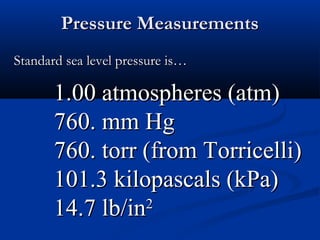
Pressure Measurements
Standard sea level pressure is…

       1.00 atmospheres (atm)
       760. mm Hg
       760. torr (from Torricelli)
       101.3 kilopascals (kPa)
       14.7 lb/in 2
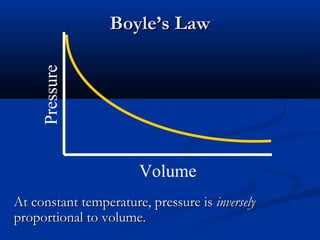
Boyle’s Law
     Pressure


                       Volume
At constant temperature, pressure is inversely
proportional to volume.
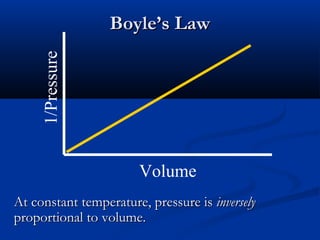
Boyle’s Law
     1/Pressure


                       Volume
At constant temperature, pressure is inversely
proportional to volume.
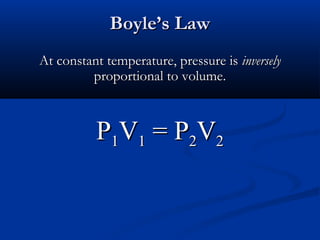
Boyle’s Law
At constant temperature, pressure is inversely
         proportional to volume.


          P1V1 = P2V2
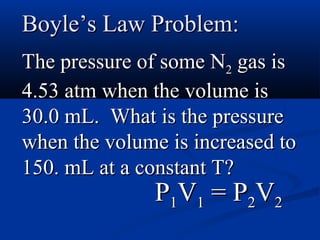
Boyle’s Law Problem:
The pressure of some N2 gas is
4.53 atm when the volume is
30.0 mL. What is the pressure
when the volume is increased to
150. mL at a constant T?
              P1V1 = P2V2
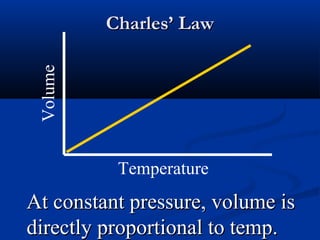
Charles’ Law
 Volume


           Temperature
At constant pressure, volume is
directly proportional to temp.
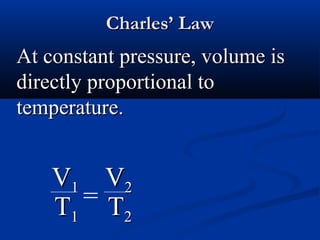
Charles’ Law
At constant pressure, volume is
directly proportional to
temperature.


    V1 V2
    T1 =T
          2
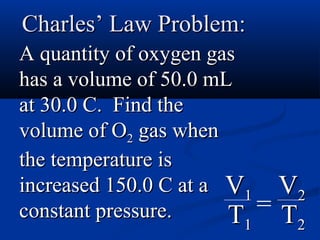
Charles’ Law Problem:
A quantity of oxygen gas
has a volume of 50.0 mL
at 30.0 C. Find the
volume of O2 gas when
the temperature is
increased 150.0 C at a V1     V2
constant pressure.     T  =   T2
                        1
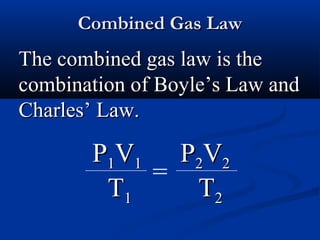
Combined Gas Law
The combined gas law is the
combination of Boyle’s Law and
Charles’ Law.

       P1V1 P2V2
           =
        T1   T2

Gas laws

  • 1.
    Gas Laws PSquires 2011
  • 2.
    Properties of Gases  Gases expand to fill the container.  Gases take on the shape of the container.  Gases are highly compressible. (Can be liquefied at high pressure).  Gases have low densities.  Gases mix uniformly.
  • 3.
    Kinetic Molecular Theory 1. Molecules are in constant random motion 2. A gas is mostly empty space 3. No intermolecular forces 4. Collisions are elastic. No change in energy.
  • 4.
    Use Kelvin degrees! K= C + 273 Temperature conversion
  • 5.
    Pressure Measurements Standard sealevel pressure is… 1.00 atmospheres (atm) 760. mm Hg 760. torr (from Torricelli) 101.3 kilopascals (kPa) 14.7 lb/in 2
  • 6.
    Boyle’s Law Pressure Volume At constant temperature, pressure is inversely proportional to volume.
  • 7.
    Boyle’s Law 1/Pressure Volume At constant temperature, pressure is inversely proportional to volume.
  • 8.
    Boyle’s Law At constanttemperature, pressure is inversely proportional to volume. P1V1 = P2V2
  • 9.
    Boyle’s Law Problem: Thepressure of some N2 gas is 4.53 atm when the volume is 30.0 mL. What is the pressure when the volume is increased to 150. mL at a constant T? P1V1 = P2V2
  • 10.
    Charles’ Law Volume Temperature At constant pressure, volume is directly proportional to temp.
  • 11.
    Charles’ Law At constantpressure, volume is directly proportional to temperature. V1 V2 T1 =T 2
  • 12.
    Charles’ Law Problem: Aquantity of oxygen gas has a volume of 50.0 mL at 30.0 C. Find the volume of O2 gas when the temperature is increased 150.0 C at a V1 V2 constant pressure. T = T2 1
  • 13.
    Combined Gas Law Thecombined gas law is the combination of Boyle’s Law and Charles’ Law. P1V1 P2V2 = T1 T2