MAPLESON CIRCUITS 
By, 
Dr. Arun Kumar 
Dept of Anesthesiology 
Columbia Asia Referral Hospital, 
Bangalore.
DEFINITION 
 Circuit: a round course. 
 Breathing circuit: a pathway in which volatile 
agents and oxygen is delivered and Co2 is 
removed, 2types non-circle, circle. 
 Co Axial: it is where these is two coduits for 
inhaled and exhaled gases, where one coduit is 
inside the other. 
 Magills circuit: a circuit in which has reservoir 
bag a corrugated tube and spring loaded 
expiratory valve, rebreathing prevented by 
keeping fresh gas flow more than the patients 
minute respiratory volume.
 Mapleson circuits: a circuit in which the fresh 
gas flow is used to remove the exhaled Co2 .
ADVANTAGES/NEED 
 Simple, inexpensive and rugged, parts easy to 
dismantle and sterilize. 
 Variation in minute volume affects end tidal co2 
less than in circle systems. 
 In co axial, warm expired gas heats the 
inspiratory limb. 
 Resistance low at flows in practice. 
 Lightweight, easy to position. 
 Compression and compliance loss less. 
 Change in FGF, rapid change in ins., gas 
composition. 
 No co2 abs, possible toxic byproducts not formed.
HISTORY 
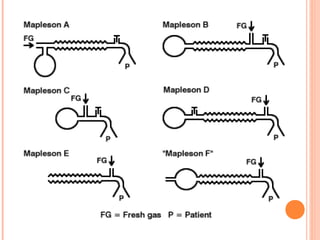
 1954 Mapleson studied and described 5 different 
semiclosed anesthetic breathing systems. 
 These are refered as mapleson systems A-E. 
 Later on Willis et al, added one more system 
Mapleson F.
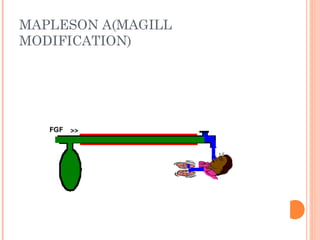
MAPLESON A(MAGILL 
MODIFICATION)
MAPLESON A 
 Differs from other circuits, fresh gas flow is not 
at the patient’s end but on the other side. 
 At the reservoir bag, a corrugated rubber tubing 
connects the bag to the patient’s end where there 
is a adjustable pressure valve. 
 Lacks modification: in this he has added a 
expiratory limb in the tube. 
 makes adjusting gases easy but increases the 
work of breathing.
MAPLESON A 
 technique of use: 
 For spontaneous breathing, the apl valve is left 
open. 
 For controlled ventilation the valve is half closed, 
so that when given positive pressure adequate 
expansion of lungs is achieved. 
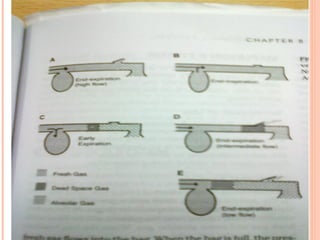
 Spontaneous respiration: 
 As the patient exhales, first dead space gas then 
alveolar gas flows towards the bag, the same 
time fresh gas flows into the bag. 
 When bag pressure is full APL valve opens.
MAPLESON A 
 Fresh gas flow reverses the direction of exhaled 
gas which vents out through the APL valve. 
 In the inspiration end, first gas is alveolar gas, 
then dead space gas, finally fresh gas flow. 
 Controlled ventilation: during exhalation the 
pressure in the system is low and no gas escapes 
through APL valve, unless bag distends, all 
exhaled gas remains in the tubing. 
 at inspiration most of the gases are re breathed 
into the system.
MAPLESON B
MAPLESON B 
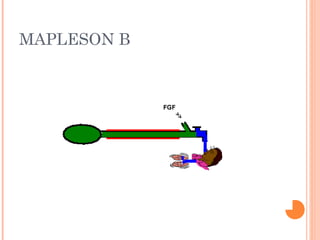
 The fresh gas inlet and APL valve is near 
patient’s end. 
 Technique of use: for spontanoeus APL valve is 
left open. 
 in controlled ventilation APL is closed 
sufficiently to allow inflation of lungs. 
 Spontaneous: as Pt exhales the gas moves 
through the corrugated tube with FGF, when bag 
fills up, APL valve open exits exhaled gas with 
little FGF. On inspiration valve closes, FGF and 
gas from the tubing is taken in.
MAPLESON B 
 To prevent rebreathing FGF must be equal to 
peak inspiratory flow(20-25l/min). 
 Controlled : similar to Mapleson A but more 
efficient since FGF is near patient end. 
 a fresh gas flow of 2- 2.5 times minute volume is 
recommended.
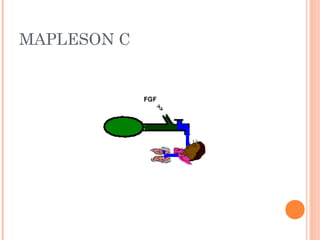
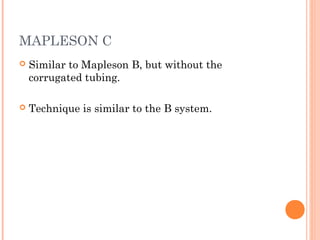
MAPLESON C
MAPLESON C 
 Similar to Mapleson B, but without the 
corrugated tubing. 
 Technique is similar to the B system.
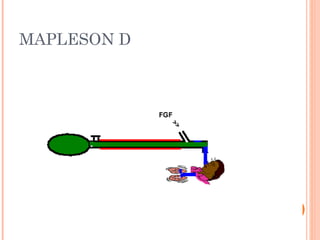
MAPLESON D
MAPLESON D 
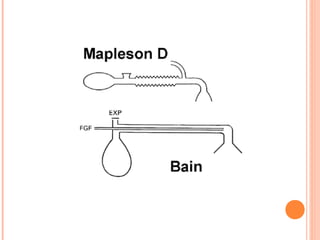
 Mapleson D,E,F all have T piece at the patient 
end, all function similiarly. 
 classic form: a length of tubing connects T 
piece to the APL valve and reservoir bag next to 
it. 
 Bain modification: fresh gas supply runs 
coaxially inside the corrugated tubing, and ends 
at a point where the fresh gas would have flown 
if classic mapleson D was used. 
 The outer tubing is clear so the inner tube can be 
inspected.
MAPLESON D 
 technique of use: 
 spontaneous: the APL valve is left open and the 
gas is vented. 
 Assisted: the valve is partially closed, and the 
bag squeezed. 
 Mech of use: 
 Spontanoeous: pt., exhaled gas chanelled back to 
reservoir where it gets mixed with fresh gas flow. 
 FGF required is 150-200ml/kg/min. 1.5-2 times 
alveolar minute volume. 
 Inefficient and uneconomical.
 Controlled ventilation: efficient flow of 70- 
100ml/kg/min maintains normocapnia. 
 Exhalation gas flows from pt to tubing, even 
fresh gas enters tubing. 
 Inspiration: fresh gas and tubing air flows, if 
FGF is low then exhaled gas may be inhaled. 
 Can be connected to ventilator.
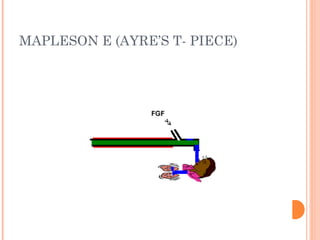
MAPLESON E (AYRE’S T- PIECE)
MAPLESON E 
 This is used in children upto 25-30kg body 
weight. 
 A T shaped tubing with 3 open ports, one fresh 
gas, second patient end, third reservoir tubing. 
 Designed to provide spontaneous ventilation, 
since there is almost no resistance to expiration. 
 Not popular as there is no scope for cotrol of gas 
flows.
MAPLESON E 
 Advantage: lightweight. 
 minimal resistance to flow 
 can be used for spont/ controlled 
vent. 
 simple design. 
 Disadvantage: exhaust gas not easy to scavenge. 
 obs to expiratory limb : high 
pressure to patient. 
 no scope to artificially ventilate 
pts.
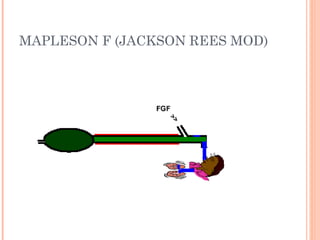
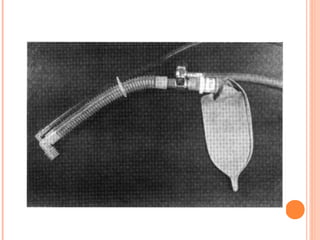
MAPLESON F (JACKSON REES MOD)
MAPLESON F 
 It is mapleson E with a reservoir bag added at 
the expiratory limb. 
 Hence monitoring patient’s breathing was 
possible. 
 reservoir bag has a valve outlet at the end. 
 Using which for spontaneous vent can be kept 
open, 
 While for controlled can be partially closed.
DISADVANTAGES. 
 Requires high gas flows. 
 Due to this inspired heat and humidity tends to 
be low. 
 In mapleson A,B,C Apl valve is in the pt’s end: 
inaccessible. 
 In mapleson E,F difficult to scavenge.
REFERENCES 
 Dorsch, understanding of anaesthetic 
equipments. Seventh edition. 
 Whylie, a practice of Anesthesia. Seventh edition. 
 Al- shaikh, Stacey, essentials of Anesthetic 
equipments. Third edition. 
 World wide web.

Mapleson circuits

  • 1.
    MAPLESON CIRCUITS By, Dr. Arun Kumar Dept of Anesthesiology Columbia Asia Referral Hospital, Bangalore.
  • 3.
    DEFINITION  Circuit:a round course.  Breathing circuit: a pathway in which volatile agents and oxygen is delivered and Co2 is removed, 2types non-circle, circle.  Co Axial: it is where these is two coduits for inhaled and exhaled gases, where one coduit is inside the other.  Magills circuit: a circuit in which has reservoir bag a corrugated tube and spring loaded expiratory valve, rebreathing prevented by keeping fresh gas flow more than the patients minute respiratory volume.
  • 4.
     Mapleson circuits:a circuit in which the fresh gas flow is used to remove the exhaled Co2 .
  • 5.
    ADVANTAGES/NEED  Simple,inexpensive and rugged, parts easy to dismantle and sterilize.  Variation in minute volume affects end tidal co2 less than in circle systems.  In co axial, warm expired gas heats the inspiratory limb.  Resistance low at flows in practice.  Lightweight, easy to position.  Compression and compliance loss less.  Change in FGF, rapid change in ins., gas composition.  No co2 abs, possible toxic byproducts not formed.
  • 6.
    HISTORY  1954Mapleson studied and described 5 different semiclosed anesthetic breathing systems.  These are refered as mapleson systems A-E.  Later on Willis et al, added one more system Mapleson F.
  • 7.
  • 8.
    MAPLESON A Differs from other circuits, fresh gas flow is not at the patient’s end but on the other side.  At the reservoir bag, a corrugated rubber tubing connects the bag to the patient’s end where there is a adjustable pressure valve.  Lacks modification: in this he has added a expiratory limb in the tube.  makes adjusting gases easy but increases the work of breathing.
  • 9.
    MAPLESON A technique of use:  For spontaneous breathing, the apl valve is left open.  For controlled ventilation the valve is half closed, so that when given positive pressure adequate expansion of lungs is achieved.  Spontaneous respiration:  As the patient exhales, first dead space gas then alveolar gas flows towards the bag, the same time fresh gas flows into the bag.  When bag pressure is full APL valve opens.
  • 11.
    MAPLESON A Fresh gas flow reverses the direction of exhaled gas which vents out through the APL valve.  In the inspiration end, first gas is alveolar gas, then dead space gas, finally fresh gas flow.  Controlled ventilation: during exhalation the pressure in the system is low and no gas escapes through APL valve, unless bag distends, all exhaled gas remains in the tubing.  at inspiration most of the gases are re breathed into the system.
  • 12.
  • 13.
    MAPLESON B The fresh gas inlet and APL valve is near patient’s end.  Technique of use: for spontanoeus APL valve is left open.  in controlled ventilation APL is closed sufficiently to allow inflation of lungs.  Spontaneous: as Pt exhales the gas moves through the corrugated tube with FGF, when bag fills up, APL valve open exits exhaled gas with little FGF. On inspiration valve closes, FGF and gas from the tubing is taken in.
  • 14.
    MAPLESON B To prevent rebreathing FGF must be equal to peak inspiratory flow(20-25l/min).  Controlled : similar to Mapleson A but more efficient since FGF is near patient end.  a fresh gas flow of 2- 2.5 times minute volume is recommended.
  • 15.
  • 16.
    MAPLESON C Similar to Mapleson B, but without the corrugated tubing.  Technique is similar to the B system.
  • 17.
  • 18.
    MAPLESON D Mapleson D,E,F all have T piece at the patient end, all function similiarly.  classic form: a length of tubing connects T piece to the APL valve and reservoir bag next to it.  Bain modification: fresh gas supply runs coaxially inside the corrugated tubing, and ends at a point where the fresh gas would have flown if classic mapleson D was used.  The outer tubing is clear so the inner tube can be inspected.
  • 19.
    MAPLESON D technique of use:  spontaneous: the APL valve is left open and the gas is vented.  Assisted: the valve is partially closed, and the bag squeezed.  Mech of use:  Spontanoeous: pt., exhaled gas chanelled back to reservoir where it gets mixed with fresh gas flow.  FGF required is 150-200ml/kg/min. 1.5-2 times alveolar minute volume.  Inefficient and uneconomical.
  • 20.
     Controlled ventilation:efficient flow of 70- 100ml/kg/min maintains normocapnia.  Exhalation gas flows from pt to tubing, even fresh gas enters tubing.  Inspiration: fresh gas and tubing air flows, if FGF is low then exhaled gas may be inhaled.  Can be connected to ventilator.
  • 22.
  • 23.
    MAPLESON E This is used in children upto 25-30kg body weight.  A T shaped tubing with 3 open ports, one fresh gas, second patient end, third reservoir tubing.  Designed to provide spontaneous ventilation, since there is almost no resistance to expiration.  Not popular as there is no scope for cotrol of gas flows.
  • 24.
    MAPLESON E Advantage: lightweight.  minimal resistance to flow  can be used for spont/ controlled vent.  simple design.  Disadvantage: exhaust gas not easy to scavenge.  obs to expiratory limb : high pressure to patient.  no scope to artificially ventilate pts.
  • 25.
  • 26.
    MAPLESON F It is mapleson E with a reservoir bag added at the expiratory limb.  Hence monitoring patient’s breathing was possible.  reservoir bag has a valve outlet at the end.  Using which for spontaneous vent can be kept open,  While for controlled can be partially closed.
  • 28.
    DISADVANTAGES.  Requireshigh gas flows.  Due to this inspired heat and humidity tends to be low.  In mapleson A,B,C Apl valve is in the pt’s end: inaccessible.  In mapleson E,F difficult to scavenge.
  • 29.
    REFERENCES  Dorsch,understanding of anaesthetic equipments. Seventh edition.  Whylie, a practice of Anesthesia. Seventh edition.  Al- shaikh, Stacey, essentials of Anesthetic equipments. Third edition.  World wide web.