1
z
ANAESTHESIA
CIRCUITS
Presenter: Dr. V.Hemant (PG 1)
Moderator: Dr. Pooja Ahuja (AP)
OBJECTIVES
o Definition
o History
o Function
o Classification
o Components
o Functional Analysis
o Circuit Checks
o Closed Circuit
DEFINITION
o An Assembly of components connecting
patient’s airway to anesthesia machine.
o Delivers the anesthetic gas mixture from
anesthesia machine to patient’s alveoli in a
• set concentration
• shortest possible time
• minimal rebreathing
• minimal resistance
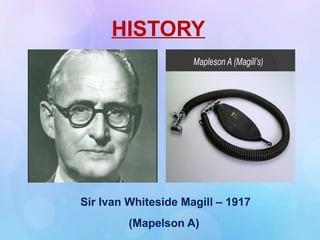
HISTORY
Sir Ivan Whiteside Magill – 1917
(Mapelson A)
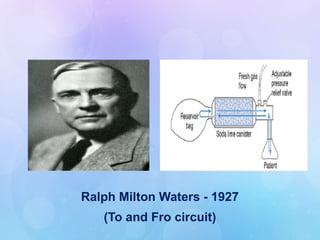
Ralph Milton Waters - 1927
(To and Fro circuit)
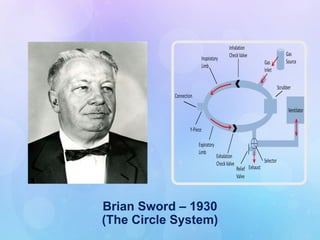
Brian Sword – 1930
(The Circle System)
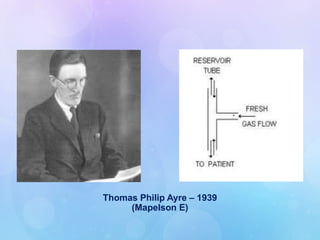
Thomas Philip Ayre – 1939
(Mapelson E)
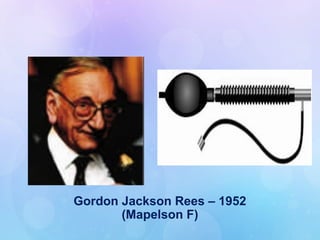
Gordon Jackson Rees – 1952
(Mapelson F)
William W Mapelson -1954
(Classification of Mapelson Circuits)
ESSENTIAL FUNCTIONS
o Delivery of anesthetic gases mixture.
o Effective elimination of CO2.
o Conservation of heat and moisture.
o Used in spontaneous/assisted/ controlled
respiration.
IDEAL CIRCUIT
o Quick & accurate delivery of anesthetic gas mixture
o Effective elimination of carbon dioxide
o Conserve heat & moisture
o Minimal resistance
o Minimal dead space
o Most economic
o Easy to use & sterilize
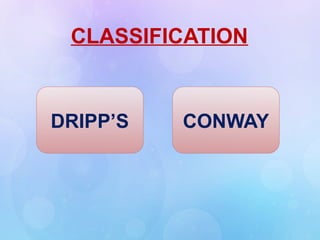
CLASSIFICATION
DRIPP’S CONWAY
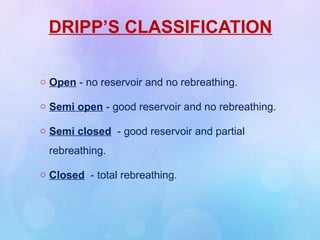
DRIPP’S CLASSIFICATION
o Open - no reservoir and no rebreathing.
o Semi open - good reservoir and no rebreathing.
o Semi closed - good reservoir and partial
rebreathing.
o Closed - total rebreathing.
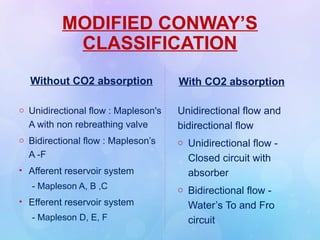
MODIFIED CONWAY’S
CLASSIFICATION
Without CO2 absorption
o Unidirectional flow : Mapleson's
A with non rebreathing valve
o Bidirectional flow : Mapleson’s
A -F
• Afferent reservoir system
- Mapleson A, B ,C
• Efferent reservoir system
- Mapleson D, E, F
With CO2 absorption
Unidirectional flow and
bidirectional flow
o Unidirectional flow -
Closed circuit with
absorber
o Bidirectional flow -
Water’s To and Fro
circuit
COMPONENTS OF MAPLESON
SYSTEMS
22/02/2020
ADJUSTABLE
PRESSURE
LIMITING VALVE
CONNECTORS
AND
ADAPTERS
BREATHING
TUBES
RESERVOIR
BAG
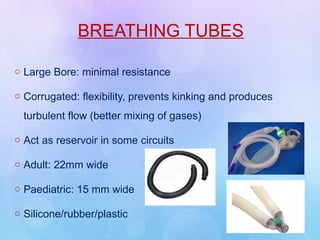
BREATHING TUBES
o Large Bore: minimal resistance
o Corrugated: flexibility, prevents kinking and produces
turbulent flow (better mixing of gases)
o Act as reservoir in some circuits
o Adult: 22mm wide
o Paediatric: 15 mm wide
o Silicone/rubber/plastic
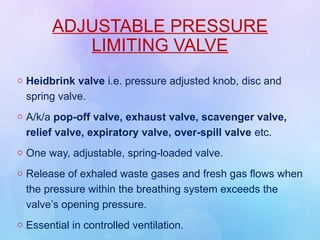
ADJUSTABLE PRESSURE
LIMITING VALVE
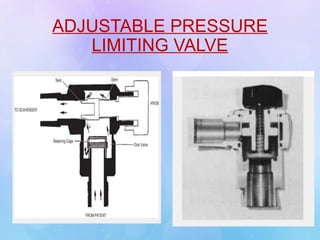
o Heidbrink valve i.e. pressure adjusted knob, disc and
spring valve.
o A/k/a pop-off valve, exhaust valve, scavenger valve,
relief valve, expiratory valve, over-spill valve etc.
o One way, adjustable, spring-loaded valve.
o Release of exhaled waste gases and fresh gas flows when
the pressure within the breathing system exceeds the
valve’s opening pressure.
o Essential in controlled ventilation.
ADJUSTABLE PRESSURE
LIMITING VALVE
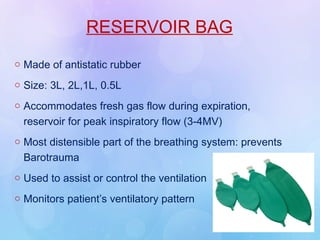
RESERVOIR BAG
o Made of antistatic rubber
o Size: 3L, 2L,1L, 0.5L
o Accommodates fresh gas flow during expiration,
reservoir for peak inspiratory flow (3-4MV)
o Most distensible part of the breathing system: prevents
Barotrauma
o Used to assist or control the ventilation
o Monitors patient’s ventilatory pattern
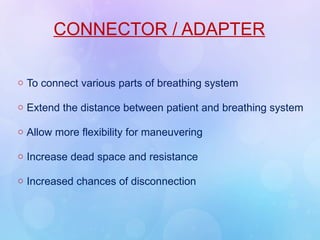
CONNECTOR / ADAPTER
o To connect various parts of breathing system
o Extend the distance between patient and breathing system
o Allow more flexibility for maneuvering
o Increase dead space and resistance
o Increased chances of disconnection
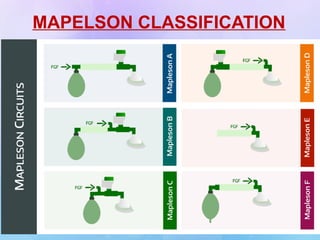
MAPELSON CLASSIFICATION
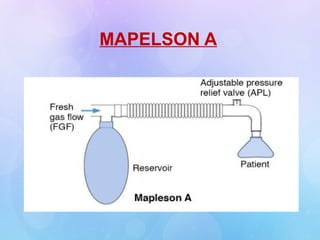
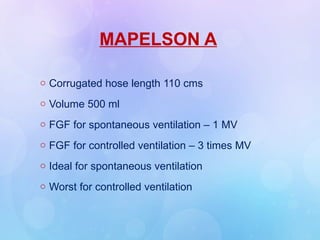
MAPELSON A
MAPELSON A
o Corrugated hose length 110 cms
o Volume 500 ml
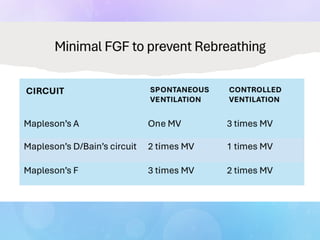
o FGF for spontaneous ventilation – 1 MV
o FGF for controlled ventilation – 3 times MV
o Ideal for spontaneous ventilation
o Worst for controlled ventilation
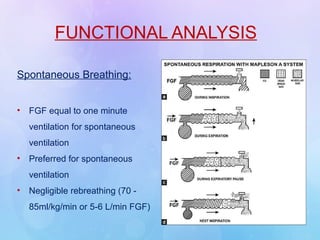
FUNCTIONAL ANALYSIS
Spontaneous Breathing:
• FGF equal to one minute
ventilation for spontaneous
ventilation
• Preferred for spontaneous
ventilation
• Negligible rebreathing (70 -
85ml/kg/min or 5-6 L/min FGF)
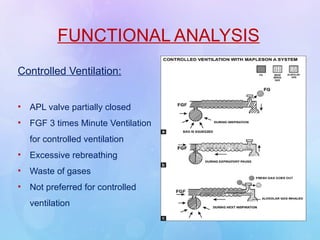
FUNCTIONAL ANALYSIS
Controlled Ventilation:
• APL valve partially closed
• FGF 3 times Minute Ventilation
for controlled ventilation
• Excessive rebreathing
• Waste of gases
• Not preferred for controlled
ventilation
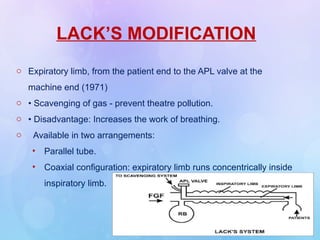
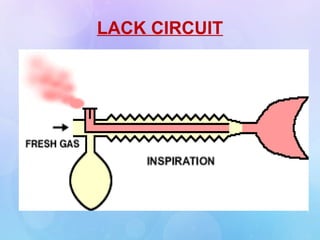
LACK’S MODIFICATION
o Expiratory limb, from the patient end to the APL valve at the
machine end (1971)
o • Scavenging of gas - prevent theatre pollution.
o • Disadvantage: Increases the work of breathing.
o Available in two arrangements:
• Parallel tube.
• Coaxial configuration: expiratory limb runs concentrically inside
inspiratory limb.
LACK CIRCUIT
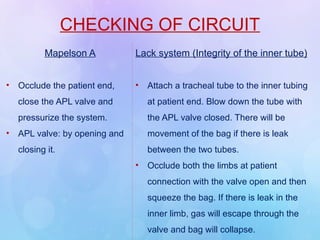
CHECKING OF CIRCUIT
Mapelson A
• Occlude the patient end,
close the APL valve and
pressurize the system.
• APL valve: by opening and
closing it.
Lack system (Integrity of the inner tube)
• Attach a tracheal tube to the inner tubing
at patient end. Blow down the tube with
the APL valve closed. There will be
movement of the bag if there is leak
between the two tubes.
• Occlude both the limbs at patient
connection with the valve open and then
squeeze the bag. If there is leak in the
inner limb, gas will escape through the
valve and bag will collapse.
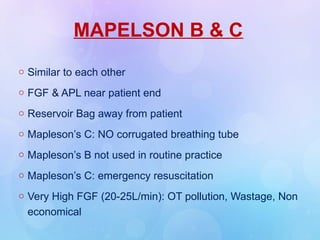
MAPELSON B & C
o Similar to each other
o FGF & APL near patient end
o Reservoir Bag away from patient
o Mapleson’s C: NO corrugated breathing tube
o Mapleson’s B not used in routine practice
o Mapleson’s C: emergency resuscitation
o Very High FGF (20-25L/min): OT pollution, Wastage, Non
economical
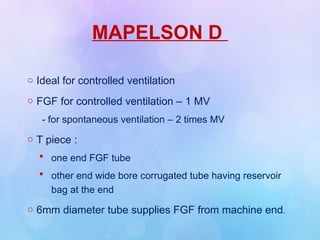
MAPELSON D
o Ideal for controlled ventilation
o FGF for controlled ventilation – 1 MV
- for spontaneous ventilation – 2 times MV
o T piece :
 one end FGF tube
 other end wide bore corrugated tube having reservoir
bag at the end
o 6mm diameter tube supplies FGF from machine end.
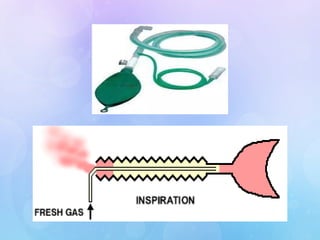
BAINS CIRCUIT
o Fresh gas supply tube runs coaxially inside the
corrugated tubing.
o Diameter
 outer tubing: 22 mm
 inner tube is 6 mm.
o Length:1.8m (volume >500 ml)
o Outer tube: transparent so that inner tube can be seen
for any disconnection or kinking.
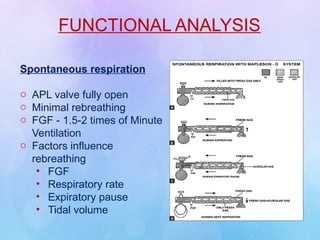
FUNCTIONAL ANALYSIS
Spontaneous respiration
o APL valve fully open
o Minimal rebreathing
o FGF - 1.5-2 times of Minute
Ventilation
o Factors influence
rebreathing
• FGF
• Respiratory rate
• Expiratory pause
• Tidal volume
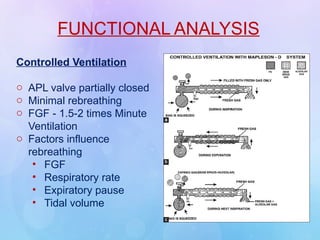
FUNCTIONAL ANALYSIS
Controlled Ventilation
o APL valve partially closed
o Minimal rebreathing
o FGF - 1.5-2 times Minute
Ventilation
o Factors influence
rebreathing
• FGF
• Respiratory rate
• Expiratory pause
• Tidal volume
ADVANTAGES OF BAIN’S
CIRCUIT
o Light weight : Minimal drag.
o Low resistance.
o Used for both spontaneous and controlled ventilation.
o Length: long where patient is not accessible as in MRI
suites.
o Minimal rebreathing: OT pollution.
o Warming of the inspired fresh gas by the exhaled gas
present in outer tubing.
DISADVANTAGES OF BAIN’S
CIRCUIT
o Multiple connections: risk of disconnections.
o Wrong assembling: malfunction of the circuit.
o High fresh gas flow: theatre pollution & increased cost.
o Damaged fresh gas supply inner tube blocking:
Hypoxia/Hypercarbia
o Cannot be used in paediatric patients (weight less than
20 kg)
CHECKING MAPELSON D
o Leaks: Occlude the patient end, close the APL valve
and pressurize the system. Open the APL Valve: The
bag should deflate easily.
o Outer tube integrity: Wet the hands with spirit. Blow
air through the tube. Wipe the tube with wet hands.
Leak will produce chillness in the hands.
CHECKING BAIN’S CIRCUIT
o Foex Crompton Smith Test:
 Integrity of inner tube
 Set flow on the oxygen flowmeter (4-6l/min).
 Occlude the inner tube at the patient end.
 Observe the flow meter indicator.
If the inner tube is intact and correctly connected, the
indicator will fall.
CHECKING BAIN’S CIRCUIT
o Pethik’s test:
• Activate the oxygen flush and observe the bag.
• Due to venturi effect the high flow from the inner
tube at the patient end will create a negative pressure
in the outer exhalation tubing and this will suck gas
from the bag and bag will deflate.
• If the inner tube is not intact, the bag will inflate
slightly.
MAPELSON E
o Ayre’s T piece: Philips Ayre 1937
o Components:
• light metal tube 1 cm in diameter,
• 5 cm in length with a side arm
o Functional Analysis:
• Functions as a non-rebreathing system.
• FGF enters through the side arm
• Expired gas is vented into the atmosphere
• No rebreathing.
• Requires high FGF
o Reservoir tubing at the expiration port (volume 150 ml)
o Acts as a fresh gas reservoir during inspiration.
o Capacity more than the expected tidal volume.
o Used in neonates, infants and paediatric patient (<20kg
weight or <5 years).
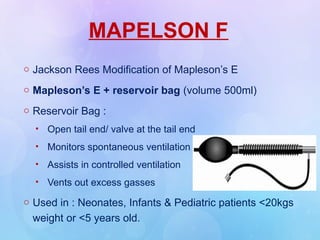
MAPELSON F
o Jackson Rees Modification of Mapleson’s E
o Mapleson’s E + reservoir bag (volume 500ml)
o Reservoir Bag :
• Open tail end/ valve at the tail end
• Monitors spontaneous ventilation
• Assists in controlled ventilation
• Vents out excess gasses
o Used in : Neonates, Infants & Pediatric patients <20kgs
weight or <5 years old.
FUNCTIONAL ANALYSIS
o Spontaneous Ventilation:
• Expiratory limb open to atmosphere
• FGF: 2-3 times minute ventilation
o Controlled ventilation:
• Occlude expiratory limb intermittently, allowing
fresh gas to inflate lungs.
• FGF: 2-3 times minute ventilation
FUNCTIONAL ANALYSIS
o Inspiration: fresh gas from inlet and from expiratory limb
o Expiration: fresh gas & exhaled gas collect in the bag.
o Expiratory pause: the expired gases replaced by fresh
gas in the expiratory limb.
o Heat and moisture exchanger NOT to be used as it
increases resistance.
o Rebreathing and air dilution
o Air Dilution prevented: volume of expiratory limb > tidal
volume of patient
o Advantages:
• Easy to assemble
• Inexpensive.
• Low resistance system due to the absence of valves.
• Light weight.
o Disadvantages:
• High fresh gas flows: Atmospheric pollution.
• No Humidification of gases.
• Barotrauma: overinflation during controlled ventilation.
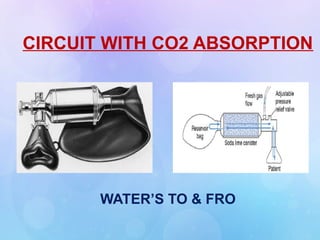
CIRCUIT WITH CO2 ABSORPTION
WATER’S TO & FRO
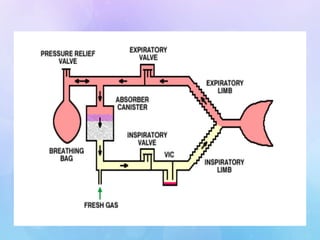
CIRCLE SYSTEM
The Circle system can be either:
o Closed:- Fresh gas inflow exactly equal to patient
uptake, complete rebreathing after carbon dioxide
absorbed, and APL closed.
o Semi-closed :- Some rebreathing occurs, FGF and APL
settings at intermediate values .
o Semi-open :- No rebreathing, high fresh gas flow
[higher than minute ventilation].
CIRCLE SYSTEM WITH ABSORBER
Characteristics:
o Circle System – Unidirectional valves separate limb
for inspiration and expiration.
o Low flow of gases - CO2 absorber – minimal to low
flow with retained moisture, heat, economical and
less pollution.
o Monitoring
o Denitrogenation & offloading.
o Advantages:
 Conservation of Heat & Humidity
 Cost Effective
 Reduces Atmospheric/OT pollution
o Disadvantages:
 Vigilance
 Extensive monitoring of gases
 Accumulation of by products
BREATHING CIRCUIT
o Mapleson’s A Circuit: spontaneous ventilation
o Bain’s Circuit: Universal Circuit
o Closed Circuit: economical & prevents
pollution
53
z
THANK YOU

Anaesthesia Breathing Circuits ppt Hemant

  • 1.
    1 z ANAESTHESIA CIRCUITS Presenter: Dr. V.Hemant(PG 1) Moderator: Dr. Pooja Ahuja (AP)
  • 2.
    OBJECTIVES o Definition o History oFunction o Classification o Components o Functional Analysis o Circuit Checks o Closed Circuit
  • 3.
    DEFINITION o An Assemblyof components connecting patient’s airway to anesthesia machine. o Delivers the anesthetic gas mixture from anesthesia machine to patient’s alveoli in a • set concentration • shortest possible time • minimal rebreathing • minimal resistance
  • 4.
    HISTORY Sir Ivan WhitesideMagill – 1917 (Mapelson A)
  • 5.
    Ralph Milton Waters- 1927 (To and Fro circuit)
  • 6.
    Brian Sword –1930 (The Circle System)
  • 7.
    Thomas Philip Ayre– 1939 (Mapelson E)
  • 8.
    Gordon Jackson Rees– 1952 (Mapelson F)
  • 9.
    William W Mapelson-1954 (Classification of Mapelson Circuits)
  • 10.
    ESSENTIAL FUNCTIONS o Deliveryof anesthetic gases mixture. o Effective elimination of CO2. o Conservation of heat and moisture. o Used in spontaneous/assisted/ controlled respiration.
  • 11.
    IDEAL CIRCUIT o Quick& accurate delivery of anesthetic gas mixture o Effective elimination of carbon dioxide o Conserve heat & moisture o Minimal resistance o Minimal dead space o Most economic o Easy to use & sterilize
  • 12.
  • 13.
    DRIPP’S CLASSIFICATION o Open- no reservoir and no rebreathing. o Semi open - good reservoir and no rebreathing. o Semi closed - good reservoir and partial rebreathing. o Closed - total rebreathing.
  • 14.
    MODIFIED CONWAY’S CLASSIFICATION Without CO2absorption o Unidirectional flow : Mapleson's A with non rebreathing valve o Bidirectional flow : Mapleson’s A -F • Afferent reservoir system - Mapleson A, B ,C • Efferent reservoir system - Mapleson D, E, F With CO2 absorption Unidirectional flow and bidirectional flow o Unidirectional flow - Closed circuit with absorber o Bidirectional flow - Water’s To and Fro circuit
  • 15.
    COMPONENTS OF MAPLESON SYSTEMS 22/02/2020 ADJUSTABLE PRESSURE LIMITINGVALVE CONNECTORS AND ADAPTERS BREATHING TUBES RESERVOIR BAG
  • 16.
    BREATHING TUBES o LargeBore: minimal resistance o Corrugated: flexibility, prevents kinking and produces turbulent flow (better mixing of gases) o Act as reservoir in some circuits o Adult: 22mm wide o Paediatric: 15 mm wide o Silicone/rubber/plastic
  • 17.
    ADJUSTABLE PRESSURE LIMITING VALVE oHeidbrink valve i.e. pressure adjusted knob, disc and spring valve. o A/k/a pop-off valve, exhaust valve, scavenger valve, relief valve, expiratory valve, over-spill valve etc. o One way, adjustable, spring-loaded valve. o Release of exhaled waste gases and fresh gas flows when the pressure within the breathing system exceeds the valve’s opening pressure. o Essential in controlled ventilation.
  • 18.
  • 19.
    RESERVOIR BAG o Madeof antistatic rubber o Size: 3L, 2L,1L, 0.5L o Accommodates fresh gas flow during expiration, reservoir for peak inspiratory flow (3-4MV) o Most distensible part of the breathing system: prevents Barotrauma o Used to assist or control the ventilation o Monitors patient’s ventilatory pattern
  • 20.
    CONNECTOR / ADAPTER oTo connect various parts of breathing system o Extend the distance between patient and breathing system o Allow more flexibility for maneuvering o Increase dead space and resistance o Increased chances of disconnection
  • 21.
  • 22.
  • 23.
    MAPELSON A o Corrugatedhose length 110 cms o Volume 500 ml o FGF for spontaneous ventilation – 1 MV o FGF for controlled ventilation – 3 times MV o Ideal for spontaneous ventilation o Worst for controlled ventilation
  • 24.
    FUNCTIONAL ANALYSIS Spontaneous Breathing: •FGF equal to one minute ventilation for spontaneous ventilation • Preferred for spontaneous ventilation • Negligible rebreathing (70 - 85ml/kg/min or 5-6 L/min FGF)
  • 25.
    FUNCTIONAL ANALYSIS Controlled Ventilation: •APL valve partially closed • FGF 3 times Minute Ventilation for controlled ventilation • Excessive rebreathing • Waste of gases • Not preferred for controlled ventilation
  • 26.
    LACK’S MODIFICATION o Expiratorylimb, from the patient end to the APL valve at the machine end (1971) o • Scavenging of gas - prevent theatre pollution. o • Disadvantage: Increases the work of breathing. o Available in two arrangements: • Parallel tube. • Coaxial configuration: expiratory limb runs concentrically inside inspiratory limb.
  • 27.
  • 28.
    CHECKING OF CIRCUIT MapelsonA • Occlude the patient end, close the APL valve and pressurize the system. • APL valve: by opening and closing it. Lack system (Integrity of the inner tube) • Attach a tracheal tube to the inner tubing at patient end. Blow down the tube with the APL valve closed. There will be movement of the bag if there is leak between the two tubes. • Occlude both the limbs at patient connection with the valve open and then squeeze the bag. If there is leak in the inner limb, gas will escape through the valve and bag will collapse.
  • 29.
    MAPELSON B &C o Similar to each other o FGF & APL near patient end o Reservoir Bag away from patient o Mapleson’s C: NO corrugated breathing tube o Mapleson’s B not used in routine practice o Mapleson’s C: emergency resuscitation o Very High FGF (20-25L/min): OT pollution, Wastage, Non economical
  • 30.
    MAPELSON D o Idealfor controlled ventilation o FGF for controlled ventilation – 1 MV - for spontaneous ventilation – 2 times MV o T piece :  one end FGF tube  other end wide bore corrugated tube having reservoir bag at the end o 6mm diameter tube supplies FGF from machine end.
  • 31.
    BAINS CIRCUIT o Freshgas supply tube runs coaxially inside the corrugated tubing. o Diameter  outer tubing: 22 mm  inner tube is 6 mm. o Length:1.8m (volume >500 ml) o Outer tube: transparent so that inner tube can be seen for any disconnection or kinking.
  • 33.
    FUNCTIONAL ANALYSIS Spontaneous respiration oAPL valve fully open o Minimal rebreathing o FGF - 1.5-2 times of Minute Ventilation o Factors influence rebreathing • FGF • Respiratory rate • Expiratory pause • Tidal volume
  • 34.
    FUNCTIONAL ANALYSIS Controlled Ventilation oAPL valve partially closed o Minimal rebreathing o FGF - 1.5-2 times Minute Ventilation o Factors influence rebreathing • FGF • Respiratory rate • Expiratory pause • Tidal volume
  • 35.
    ADVANTAGES OF BAIN’S CIRCUIT oLight weight : Minimal drag. o Low resistance. o Used for both spontaneous and controlled ventilation. o Length: long where patient is not accessible as in MRI suites. o Minimal rebreathing: OT pollution. o Warming of the inspired fresh gas by the exhaled gas present in outer tubing.
  • 36.
    DISADVANTAGES OF BAIN’S CIRCUIT oMultiple connections: risk of disconnections. o Wrong assembling: malfunction of the circuit. o High fresh gas flow: theatre pollution & increased cost. o Damaged fresh gas supply inner tube blocking: Hypoxia/Hypercarbia o Cannot be used in paediatric patients (weight less than 20 kg)
  • 37.
    CHECKING MAPELSON D oLeaks: Occlude the patient end, close the APL valve and pressurize the system. Open the APL Valve: The bag should deflate easily. o Outer tube integrity: Wet the hands with spirit. Blow air through the tube. Wipe the tube with wet hands. Leak will produce chillness in the hands.
  • 38.
    CHECKING BAIN’S CIRCUIT oFoex Crompton Smith Test:  Integrity of inner tube  Set flow on the oxygen flowmeter (4-6l/min).  Occlude the inner tube at the patient end.  Observe the flow meter indicator. If the inner tube is intact and correctly connected, the indicator will fall.
  • 39.
    CHECKING BAIN’S CIRCUIT oPethik’s test: • Activate the oxygen flush and observe the bag. • Due to venturi effect the high flow from the inner tube at the patient end will create a negative pressure in the outer exhalation tubing and this will suck gas from the bag and bag will deflate. • If the inner tube is not intact, the bag will inflate slightly.
  • 40.
    MAPELSON E o Ayre’sT piece: Philips Ayre 1937 o Components: • light metal tube 1 cm in diameter, • 5 cm in length with a side arm o Functional Analysis: • Functions as a non-rebreathing system. • FGF enters through the side arm • Expired gas is vented into the atmosphere • No rebreathing. • Requires high FGF
  • 41.
    o Reservoir tubingat the expiration port (volume 150 ml) o Acts as a fresh gas reservoir during inspiration. o Capacity more than the expected tidal volume. o Used in neonates, infants and paediatric patient (<20kg weight or <5 years).
  • 42.
    MAPELSON F o JacksonRees Modification of Mapleson’s E o Mapleson’s E + reservoir bag (volume 500ml) o Reservoir Bag : • Open tail end/ valve at the tail end • Monitors spontaneous ventilation • Assists in controlled ventilation • Vents out excess gasses o Used in : Neonates, Infants & Pediatric patients <20kgs weight or <5 years old.
  • 43.
    FUNCTIONAL ANALYSIS o SpontaneousVentilation: • Expiratory limb open to atmosphere • FGF: 2-3 times minute ventilation o Controlled ventilation: • Occlude expiratory limb intermittently, allowing fresh gas to inflate lungs. • FGF: 2-3 times minute ventilation
  • 44.
    FUNCTIONAL ANALYSIS o Inspiration:fresh gas from inlet and from expiratory limb o Expiration: fresh gas & exhaled gas collect in the bag. o Expiratory pause: the expired gases replaced by fresh gas in the expiratory limb. o Heat and moisture exchanger NOT to be used as it increases resistance. o Rebreathing and air dilution o Air Dilution prevented: volume of expiratory limb > tidal volume of patient
  • 45.
    o Advantages: • Easyto assemble • Inexpensive. • Low resistance system due to the absence of valves. • Light weight. o Disadvantages: • High fresh gas flows: Atmospheric pollution. • No Humidification of gases. • Barotrauma: overinflation during controlled ventilation.
  • 47.
    CIRCUIT WITH CO2ABSORPTION WATER’S TO & FRO
  • 48.
    CIRCLE SYSTEM The Circlesystem can be either: o Closed:- Fresh gas inflow exactly equal to patient uptake, complete rebreathing after carbon dioxide absorbed, and APL closed. o Semi-closed :- Some rebreathing occurs, FGF and APL settings at intermediate values . o Semi-open :- No rebreathing, high fresh gas flow [higher than minute ventilation].
  • 49.
    CIRCLE SYSTEM WITHABSORBER Characteristics: o Circle System – Unidirectional valves separate limb for inspiration and expiration. o Low flow of gases - CO2 absorber – minimal to low flow with retained moisture, heat, economical and less pollution. o Monitoring o Denitrogenation & offloading.
  • 51.
    o Advantages:  Conservationof Heat & Humidity  Cost Effective  Reduces Atmospheric/OT pollution o Disadvantages:  Vigilance  Extensive monitoring of gases  Accumulation of by products
  • 52.
    BREATHING CIRCUIT o Mapleson’sA Circuit: spontaneous ventilation o Bain’s Circuit: Universal Circuit o Closed Circuit: economical & prevents pollution
  • 53.

Editor's Notes

  • #3 It creates an artificial environment for the patient to breath.
  • #11 Light weight, convenient to use, Less theater pollution
  • #14 ARS – Reservoir is the afferent limb ERS - Reservoir is the efferent limb
  • #16 Distensibility but cannot prevent excessive pressure. Adv of plastic tubing: Transparent - better visualization of interior Light weight Cause less drag on endotracheal tube Absorb less halogenated agents Lower compliance – Decreased compressible volume Compliance of the plastic tubings - 0.7ml/cmH2O/m Resistance <0.5cmH2O/30 L flow 1m of 22 mm hose = 450ml of volume
  • #17 Mechanism – user adjustable valve that releases gases to a scavenging system. Other names – dump valve, overflow valve, blow off valve, safety relief valve, excess valve
  • #18 APL with stem & seat – Rotation of the control knob causes the opening between the stem and the seat to change. The disc ensures that the reservoir bag will fill before the valve opens. It also prevents transmission of positive pressure or gas from the scavenging system to the breathing system. APL with spring loaded disc – Gas from the breathing system enters at the base and passes into the gas collecting assembly at left. Turning the control knob varies the tension in the spring and the pressure necessary to lift the disc off its seat.
  • #19 Based on the inspiratory capacity : 30 -35 ml/kg Maximum pressure (distended 4 times it’s volume) in >1.5 litre bag – 60cm H2O <1.5 litre bag – 50cm H20
  • #21 Difference b/w cicuits – evolve Dead space – D F
  • #24 Adv.: Best for spontaneous respiration as minimal rebreathing Less fresh gas flow for spontaneous breathing
  • #25 Disadv.: • Rebreathing • Waste of gasses • OT Pollution • Not suitable for controlled ventilation
  • #26 Functional Analysis of Lack’s modification: • Similar to Mapleson’s A for both spontaneous & Controlled ventilation • Expired gas - carried by an efferent tube placed coaxially and vented through the valve placed near the machine end. • FGF: more than minute ventilation.
  • #31 Described by Bain & Spoerel in 1972 Modification of Mapelson D system Added one more tube; arranged coaxially Inner tube inspiratory; outer tube expiratory + Inspiratory
  • #47 Bidirectional flow
  • #50 Principle 1. Unidirectional valves must be placed between patient & the bag 2. Fresh Gas Flow either upstream or downstream of inspiratory unidirectional valve 3. APL Valve must be between expiratory unidirectional valve and the canister
  • #52 Spontaneous ventilation: • All Dogs Can Bark – ADBC Controlled ventilation • Dead Bodies Cannot Argue – DBCA Mapleson A – no humidification Bains circuit – 40% Closed circuit – 100%