ANAESTHESIA
BREATHING
CIRCUIT
DR ZIKRULLAH
The Ideal Breathing System
• Simple and safe to use
• Delivers the right gas mixture
• Allows all methods of ventilation in all age
groups
• Efficient
• Pressure relief
• Sturdy, small and light
• Allows easy removal of waste gases
• Easy to maintain with low running costs
Breathing System Components
• Fresh Gas connection
• Patient connection
• Adjustable Pressure Limiting (APL)
Valve
• Reservoir (Bag or bellows)
• Tubing
• Waste gas connection
Open, semi open, semi closed?
• Open is the old fashioned method of dropping
ether or chloroform over a gauze or lint. Later
modernised by the likes of the
Schimmelbusch mask.
• Semi-open I classify as systems used today
such as the Mapleson systems.
• Semi-closed and Closed systems use a CO2
absorbent so that the gases are re-circulated,
the classification is defined by the amount of
fresh gas flow.
Semi-open Systems
• In the early 1950’s, Prof. WW Mapleson
from University of Wales, Cardiff,
classified the several breathing systems
around depending on what components
they contained and what position they
took in the system.
• It is known today as
‘The Mapleson Alphabet’
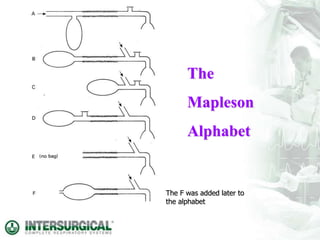
The
Mapleson
Alphabet
The F was added later to
the alphabet
Semi-open Circuit Anaesthesia
• This is typically used for induction of the
patient. It is usually a single limb system that
uses an APL valve to control the pressure of
the gas, and allows for waste gas to leave the
system.
• High fresh gas flows (more than patients
minute volume) are required with these
systems to stop rebreathing of expired CO2.
Types of Semi-open Circuit
Systems
• Mapleson D or Bain System
• Mapleson A or Magill System
• Mapleson A or Lack System
• Mapleson F or Ayres T Piece System
• Mapleson F with APL Valve
• Mapleson C Bagging System
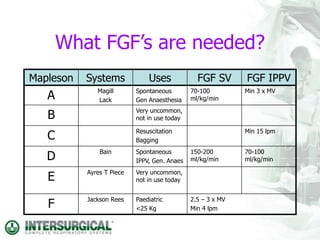
What FGF’s are needed?
Mapleson Systems Uses FGF SV FGF IPPV
A Magill
Lack
Spontaneous
Gen Anaesthesia
70-100
ml/kg/min
Min 3 x MV
B Very uncommon,
not in use today
C Resuscitation
Bagging
Min 15 lpm
D Bain Spontaneous
IPPV, Gen. Anaes
150-200
ml/kg/min
70-100
ml/kg/min
E Ayres T Piece Very uncommon,
not in use today
F Jackson Rees Paediatric
<25 Kg
2.5 – 3 x MV
Min 4 lpm
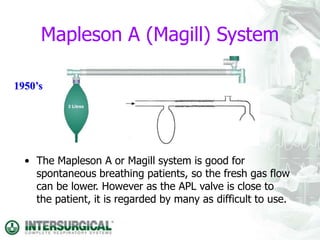
Mapleson A (Magill) System
• The Mapleson A or Magill system is good for
spontaneous breathing patients, so the fresh gas flow
can be lower. However as the APL valve is close to
the patient, it is regarded by many as difficult to use.
1950’s
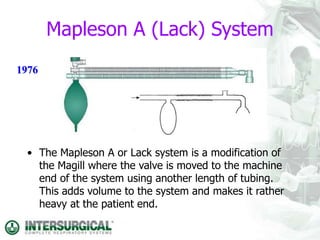
Mapleson A (Lack) System
• The Mapleson A or Lack system is a modification of
the Magill where the valve is moved to the machine
end of the system using another length of tubing.
This adds volume to the system and makes it rather
heavy at the patient end.
1976
Mapleson D (Bain)
• The Mapleson D or Bain System is a co-axial system
where the fresh gas is delivered directly to the
patient. It requires very high fresh gas flows to
prevent rebreathing of CO2. It is very convenient to
use, thus is very popular especially for induction, in
the UK!
1972
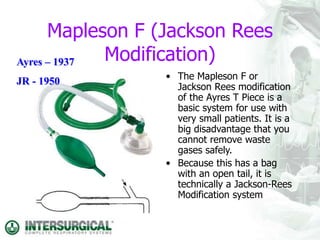
Mapleson F (Jackson Rees
Modification)
• The Mapleson F or
Jackson Rees modification
of the Ayres T Piece is a
basic system for use with
very small patients. It is a
big disadvantage that you
cannot remove waste
gases safely.
• Because this has a bag
with an open tail, it is
technically a Jackson-Rees
Modification system
Ayres – 1937
JR - 1950
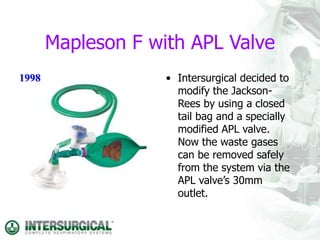
Mapleson F with APL Valve
• Intersurgical decided to
modify the Jackson-
Rees by using a closed
tail bag and a specially
modified APL valve.
Now the waste gases
can be removed safely
from the system via the
APL valve’s 30mm
outlet.
1998
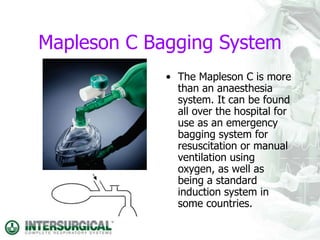
Mapleson C Bagging System
• The Mapleson C is more
than an anaesthesia
system. It can be found
all over the hospital for
use as an emergency
bagging system for
resuscitation or manual
ventilation using
oxygen, as well as
being a standard
induction system in
some countries.
Semi Closed Circuit
Anaesthesia
• This type of General Anaesthesia is used mainly
for maintenance of anaesthesia following
induction. It can be used for induction of
anaesthesia, but this is a slower process.
• It requires an absorber system containing a CO2
Absorbent to remove CO2 from the expired
patient gases, and a high degree level of patient
monitoring, especially respiratory gas monitoring
to measure levels of inspired and expired CO2
and the volatile agent.
Semi Closed Anaesthesia
Explained
• Semi Closed Anaesthesia is where the expired
gases from the patient pass through a
canister in the breathing system which
contains a CO2 absorbent. This absorbent by
an exothermic chemical reaction removes the
CO2, so the patients expired gases can be
rebreathed. Because of this exothermic
chemical reaction, some warmth and humidity
is added to the inspired gases.
Semi Closed Anaesthesia
Explained
• Because the patients expired gases are re circulated
(where the ‘circle’ comes from), this means that we
do not have to add so much fresh gas to the system
like an open system. So the fresh gas flow rate can
be reduced to low flow, i.e., 1 litre per minute. If the
flows were as low as a few hundred cc’s of gas,
equivalent to the patients metabolic uptake of gases,
this would be closed circuit anaesthesia, or metabolic
(basal) flow, or minimal flow.
• Circle systems were first used back in 1930 by Brian
Sword in the USA
Types of Semi Closed Circuit
System
• Standard Parallel Y System
• Extendible Parallel Y System
• Complete Semi Closed Circuit Systems
• Co-Axial Semi Closed Circuit Systems
‘Tight Connections’
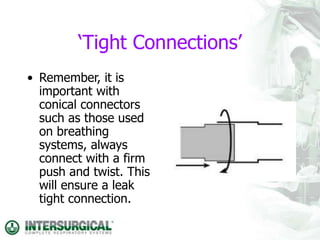
• Remember, it is
important with
conical connectors
such as those used
on breathing
systems, always
connect with a firm
push and twist. This
will ensure a leak
tight connection.
•The silver ion based anti-microbial
additive reduced the potential risk of
cross contamination from the outside of
the breathing system
Conclusion
•This means that the anti-microbial
additive in Breathing Systems not only
inhibits bacterial growth but will reduce
colonisation on the circuit, and
therefore can reduce cross infection in
the ITU and the operating theatre
Well that’s it!
I hope you now have a clearer
understanding of Breathing Systems
and Filtration. It really only leaves
me one thing to say:
‘TIGHT CONNECTIONS’

Anaesthesia breathing systems

  • 1.
  • 2.
    The Ideal BreathingSystem • Simple and safe to use • Delivers the right gas mixture • Allows all methods of ventilation in all age groups • Efficient • Pressure relief • Sturdy, small and light • Allows easy removal of waste gases • Easy to maintain with low running costs
  • 3.
    Breathing System Components •Fresh Gas connection • Patient connection • Adjustable Pressure Limiting (APL) Valve • Reservoir (Bag or bellows) • Tubing • Waste gas connection
  • 4.
    Open, semi open,semi closed? • Open is the old fashioned method of dropping ether or chloroform over a gauze or lint. Later modernised by the likes of the Schimmelbusch mask. • Semi-open I classify as systems used today such as the Mapleson systems. • Semi-closed and Closed systems use a CO2 absorbent so that the gases are re-circulated, the classification is defined by the amount of fresh gas flow.
  • 5.
    Semi-open Systems • Inthe early 1950’s, Prof. WW Mapleson from University of Wales, Cardiff, classified the several breathing systems around depending on what components they contained and what position they took in the system. • It is known today as ‘The Mapleson Alphabet’
  • 6.
    The Mapleson Alphabet The F wasadded later to the alphabet
  • 7.
    Semi-open Circuit Anaesthesia •This is typically used for induction of the patient. It is usually a single limb system that uses an APL valve to control the pressure of the gas, and allows for waste gas to leave the system. • High fresh gas flows (more than patients minute volume) are required with these systems to stop rebreathing of expired CO2.
  • 8.
    Types of Semi-openCircuit Systems • Mapleson D or Bain System • Mapleson A or Magill System • Mapleson A or Lack System • Mapleson F or Ayres T Piece System • Mapleson F with APL Valve • Mapleson C Bagging System
  • 9.
    What FGF’s areneeded? Mapleson Systems Uses FGF SV FGF IPPV A Magill Lack Spontaneous Gen Anaesthesia 70-100 ml/kg/min Min 3 x MV B Very uncommon, not in use today C Resuscitation Bagging Min 15 lpm D Bain Spontaneous IPPV, Gen. Anaes 150-200 ml/kg/min 70-100 ml/kg/min E Ayres T Piece Very uncommon, not in use today F Jackson Rees Paediatric <25 Kg 2.5 – 3 x MV Min 4 lpm
  • 10.
    Mapleson A (Magill)System • The Mapleson A or Magill system is good for spontaneous breathing patients, so the fresh gas flow can be lower. However as the APL valve is close to the patient, it is regarded by many as difficult to use. 1950’s
  • 11.
    Mapleson A (Lack)System • The Mapleson A or Lack system is a modification of the Magill where the valve is moved to the machine end of the system using another length of tubing. This adds volume to the system and makes it rather heavy at the patient end. 1976
  • 12.
    Mapleson D (Bain) •The Mapleson D or Bain System is a co-axial system where the fresh gas is delivered directly to the patient. It requires very high fresh gas flows to prevent rebreathing of CO2. It is very convenient to use, thus is very popular especially for induction, in the UK! 1972
  • 13.
    Mapleson F (JacksonRees Modification) • The Mapleson F or Jackson Rees modification of the Ayres T Piece is a basic system for use with very small patients. It is a big disadvantage that you cannot remove waste gases safely. • Because this has a bag with an open tail, it is technically a Jackson-Rees Modification system Ayres – 1937 JR - 1950
  • 14.
    Mapleson F withAPL Valve • Intersurgical decided to modify the Jackson- Rees by using a closed tail bag and a specially modified APL valve. Now the waste gases can be removed safely from the system via the APL valve’s 30mm outlet. 1998
  • 15.
    Mapleson C BaggingSystem • The Mapleson C is more than an anaesthesia system. It can be found all over the hospital for use as an emergency bagging system for resuscitation or manual ventilation using oxygen, as well as being a standard induction system in some countries.
  • 16.
    Semi Closed Circuit Anaesthesia •This type of General Anaesthesia is used mainly for maintenance of anaesthesia following induction. It can be used for induction of anaesthesia, but this is a slower process. • It requires an absorber system containing a CO2 Absorbent to remove CO2 from the expired patient gases, and a high degree level of patient monitoring, especially respiratory gas monitoring to measure levels of inspired and expired CO2 and the volatile agent.
  • 17.
    Semi Closed Anaesthesia Explained •Semi Closed Anaesthesia is where the expired gases from the patient pass through a canister in the breathing system which contains a CO2 absorbent. This absorbent by an exothermic chemical reaction removes the CO2, so the patients expired gases can be rebreathed. Because of this exothermic chemical reaction, some warmth and humidity is added to the inspired gases.
  • 18.
    Semi Closed Anaesthesia Explained •Because the patients expired gases are re circulated (where the ‘circle’ comes from), this means that we do not have to add so much fresh gas to the system like an open system. So the fresh gas flow rate can be reduced to low flow, i.e., 1 litre per minute. If the flows were as low as a few hundred cc’s of gas, equivalent to the patients metabolic uptake of gases, this would be closed circuit anaesthesia, or metabolic (basal) flow, or minimal flow. • Circle systems were first used back in 1930 by Brian Sword in the USA
  • 19.
    Types of SemiClosed Circuit System • Standard Parallel Y System • Extendible Parallel Y System • Complete Semi Closed Circuit Systems • Co-Axial Semi Closed Circuit Systems
  • 20.
    ‘Tight Connections’ • Remember,it is important with conical connectors such as those used on breathing systems, always connect with a firm push and twist. This will ensure a leak tight connection.
  • 21.
    •The silver ionbased anti-microbial additive reduced the potential risk of cross contamination from the outside of the breathing system Conclusion
  • 22.
    •This means thatthe anti-microbial additive in Breathing Systems not only inhibits bacterial growth but will reduce colonisation on the circuit, and therefore can reduce cross infection in the ITU and the operating theatre
  • 23.
    Well that’s it! Ihope you now have a clearer understanding of Breathing Systems and Filtration. It really only leaves me one thing to say: ‘TIGHT CONNECTIONS’