• Medical Gas supply
•Anaesthetic machine
• Humidification and filtration
• Breathing systems
• Airways
• Tracheal intubation equipment
• Masks and oxygen delivery devices
• Ventilators
Anaesthetic Equipment
√
√
√
Breathing systems
Chapter three
Yohannes Molla (Bsc, Msc)
Department of Anaeathesia
April, 2013
Why is this knowledge relevant?
Breathing systems
•There are several different types of breathing circuit
•Here, circle and humphrey ADE circuits are used currently
•There are benefits and disadvantages to any breathing system
•Knowing about the different systems will allow you to make
informed choices about which system is best for a given
situation
•Also, it is important to know the limitations of the system you
are using
What is the ideal breathing system?
Breathing systems
Simple and safe to use
Delivers the intended gas mixture
Permits spontaneous, manual and controlled ventilation
Suitable for all age groups
Efficient (uses low gas flow rates  saves halothane)
Protects the patient from barotrauma
Compact, lightweight and durable design
Permits easy removal of waste gases
Easy to maintain
A few definitions
Breathing systems
Tidal volume
Minute volume
The volume of gas inspired & expired with each breath
Typically ≈7 mL / kg
(or 500 mL for 70 kg patient)
The total volume breathed in a minute
Typically ≈100 mL / kg / min
(or 7000 mL / min for 70 kg patient)
Alveolar minute volume
The volume undergoing gas exchange per minute
( = RR x [tidal vol – dead space] )
Typically ≈70 mL / kg / min
(or 5000 mL / min for 70 kg patient)
A few definitions
Breathing systems
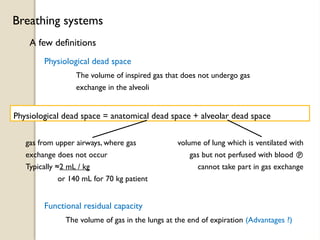
Physiological dead space
The volume of inspired gas that does not undergo gas
exchange in the alveoli
Physiological dead space = anatomical dead space + alveolar dead space
Functional residual capacity
The volume of gas in the lungs at the end of expiration (Advantages ?)
volume of lung which is ventilated with
gas but not perfused with blood 
cannot take part in gas exchange
gas from upper airways, where gas
exchange does not occur
Typically ≈2 mL / kg
or 140 mL for 70 kg patient
A few definitions
Breathing systems
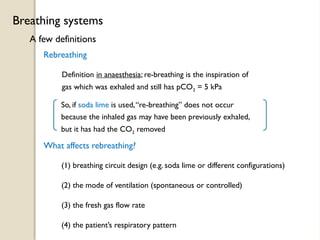
Rebreathing
Definition in anaesthesia; re-breathing is the inspiration of
gas which was exhaled and still has pCO2 = 5 kPa
So, if soda lime is used,“re-breathing” does not occur
because the inhaled gas may have been previously exhaled,
but it has had the CO2 removed
What affects rebreathing?
(1) breathing circuit design (e.g. soda lime or different configurations)
(2) the mode of ventilation (spontaneous or controlled)
(3) the fresh gas flow rate
(4) the patient’s respiratory pattern
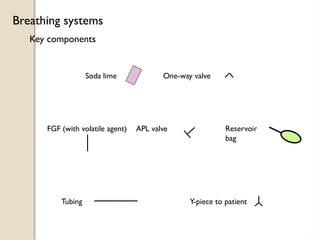
Key components
Breathing systems
Y-piece to patient
Reservoir
bag
APL valve
One-way valve
Soda lime
FGF (with volatile agent)
Tubing
Key components (cont.)
Breathing systems
The APL valve = the Adjustable Pressure Limiting valve
Also called a Heidbrink valve, spill valve, relief valve, expiratory valve
3 ports;
inlet port
patient port
exhaust port  can be open to atmosphere or to scavenging
system
In open position, < 1 cm H2O (< 0.1 kPa) required to allow gas escape
In closed position, gas can escape at 60 cm H2O (to avoid barotrauma)
Key components (cont.)
Breathing systems
The reservoir bag
Standard adult size is 2L
Smallest paediatric bag is 500 mL
Roles of reservoir bag:
(1) Accommodates fresh gas flow during expiration
(2) Acts as a monitor of respiratory pattern (& “feel” of ventilation)
(3) Can be used to assist ventilation (hand ventilation)
(4) In a Mapleson F (Jackson-Rees modification of an Ayre’sT-piece), the
bag is double ended and acts as the expiratory outflow
(5) As bag expands, it reaches a maximal pressure of 40 cm H2O;
protects the patient from barotrauma
Which breathing systems are we going to discuss?
Breathing systems
(3) Circle system
(1) Mapleson systems
A
(2) Humphrey ADE breathing system
B
C
D
E & F
vaporiser out of circle (VOC) or
vaporiser in circle (VIC)
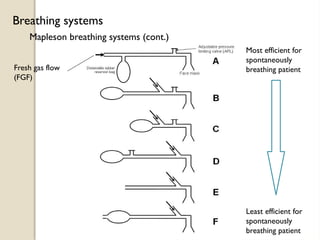
Mapleson breathing systems
Breathing systems
Mapleson introduced a classification for anaesthetic circuits in 1954
It does not include systems with internal valves or soda lime
The circuits are labeled A to F
The order is from most efficient least efficient
→ for a spontaneously
breathing patient
The efficiency of the circuits is defined as the fresh gas flow required to
avoid rebreathing
The relative efficiency of each circuit is different for ventilated patients
Mapleson breathing systems (cont.)
Breathing systems
Most efficient for
spontaneously
breathing patient
Least efficient for
spontaneously
breathing patient
Fresh gas flow
(FGF)
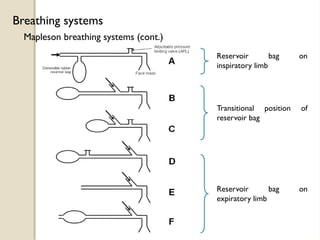
Mapleson breathing systems (cont.)
Breathing systems
Reservoir bag on
inspiratory limb
Transitional position of
reservoir bag
Reservoir bag on
expiratory limb
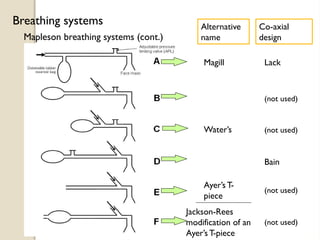
Mapleson breathing systems (cont.)
Breathing systems Alternative
name
Co-axial
design
Lack
Ayer’s T-
piece
Jackson-Rees
modification of an
Ayer’s T-piece
Bain
Magill
Water’s
(not used)
(not used)
(not used)
(not used)
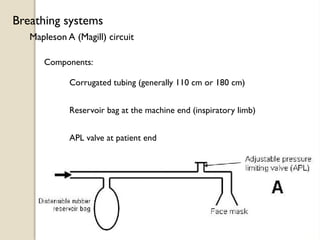
Mapleson A (Magill) circuit
Breathing systems
Components:
Reservoir bag at the machine end (inspiratory limb)
Corrugated tubing (generally 110 cm or 180 cm)
APL valve at patient end
Mapleson A (Magill) circuit
Breathing systems
Mode of action during
spontaneous ventilation
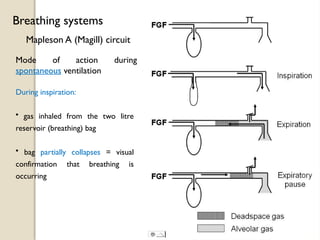
During inspiration:
• gas inhaled from the two litre
reservoir (breathing) bag
• bag partially collapses = visual
confirmation that breathing is
occurring
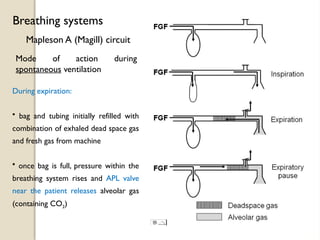
During expiration:
• bag and tubing initially refilled with
combination of exhaled dead space gas
and fresh gas from machine
• once bag is full, pressure within the
breathing system rises and APL valve
near the patient releases alveolar gas
(containing CO2)
Mapleson A (Magill) circuit
Breathing systems
Mode of action during
spontaneous ventilation
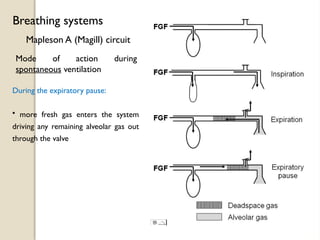
During the expiratory pause:
• more fresh gas enters the system
driving any remaining alveolar gas out
through the valve
Mapleson A (Magill) circuit
Breathing systems
Mode of action during
spontaneous ventilation
Mapleson A (Magill) circuit
Breathing systems
Mode of action during
spontaneous ventilation
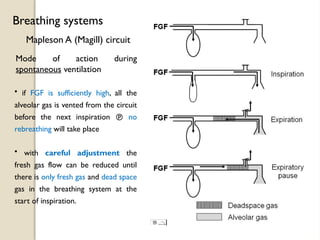
• if FGF is sufficiently high, all the
alveolar gas is vented from the circuit
before the next inspiration  no
rebreathing will take place
• with careful adjustment the
fresh gas flow can be reduced until
there is only fresh gas and dead space
gas in the breathing system at the
start of inspiration.
Mapleson A (Magill) circuit
Breathing systems
So, a Mapleson A is very efficient for spontaneous ventilation
In theory, FGF equal to the patient’s alveolar minute ventilation is sufficient to
prevent rebreathing
So,
a sensible FGF = 85 mL / kg / minute
or, ≈ 6 L / min for a 70 kg man
In practice, FGF closer to the patient’s total minute ventilation is usually selected
(=margin of safety)
for
spontaneous
ventilation
Mapleson A (Magill) circuit
Breathing systems
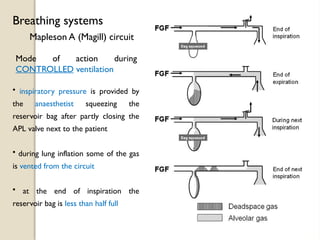
• inspiratory pressure is provided by
the anaesthetist squeezing the
reservoir bag after partly closing the
APL valve next to the patient
• during lung inflation some of the gas
is vented from the circuit
• at the end of inspiration the
reservoir bag is less than half full
Mode of action during
CONTROLLED ventilation
Mapleson A (Magill) circuit
Breathing systems
Mode of action during
CONTROLLED ventilation
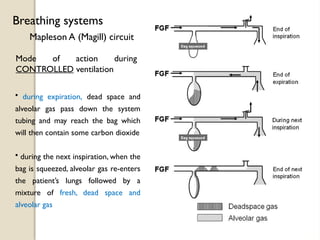
• during expiration, dead space and
alveolar gas pass down the system
tubing and may reach the bag which
will then contain some carbon dioxide
• during the next inspiration, when the
bag is squeezed, alveolar gas re-enters
the patient’s lungs followed by a
mixture of fresh, dead space and
alveolar gas
A FGF of two and a half times the patient’s minute volume is required to vent
enough alveolar gas to minimise rebreathing
Mapleson A (Magill) circuit
Breathing systems
So, a Mapleson A is very inefficient for CONTROLLED ventilation
In practice, the Magill circuit should not be used for positive pressure ventilation
except for short periods of a few minutes
In theory, this would be 2.5 x 100 mL / kg / min
= 250 mL / kg / min
or 17 L / min for a 70 kg patient
Mapleson A (Magill) circuit
Breathing systems
Summary:
• Efficient for spontaneous ventilation
• Very inefficient for controlled ventilation
• APL is at patient end; bulky, heavy and awkward
• Not suitable for paediatrics < 25 kg due to excessive dead
space in circuit
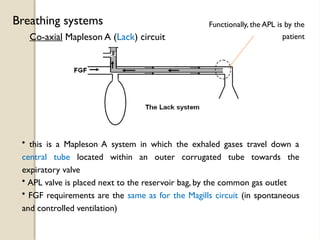
Co-axial Mapleson A (Lack) circuit
Breathing systems
• this is a Mapleson A system in which the exhaled gases travel down a
central tube located within an outer corrugated tube towards the
expiratory valve
• APL valve is placed next to the reservoir bag, by the common gas outlet
• FGF requirements are the same as for the Magills circuit (in spontaneous
and controlled ventilation)
Functionally, the APL is by the
patient
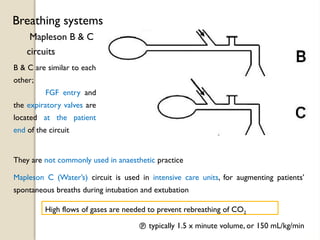
Mapleson B & C
circuits
Breathing systems
B & C are similar to each
other;
FGF entry and
the expiratory valves are
located at the patient
end of the circuit
They are not commonly used in anaesthetic practice
High flows of gases are needed to prevent rebreathing of CO2
Mapleson C (Water’s) circuit is used in intensive care units, for augmenting patients’
spontaneous breaths during intubation and extubation
 typically 1.5 x minute volume, or 150 mL/kg/min
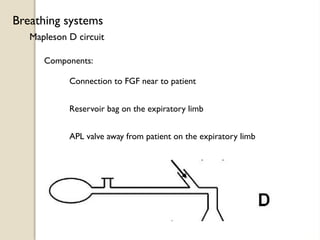
Mapleson D circuit
Breathing systems
Components:
Reservoir bag on the expiratory limb
Connection to FGF near to patient
APL valve away from patient on the expiratory limb
Mapleson D
Breathing systems
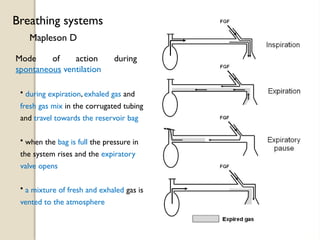
Mode of action during
spontaneous ventilation
• during expiration, exhaled gas and
fresh gas mix in the corrugated tubing
and travel towards the reservoir bag
• when the bag is full the pressure in
the system rises and the expiratory
valve opens
• a mixture of fresh and exhaled gas is
vented to the atmosphere
Mapleson D
Breathing systems
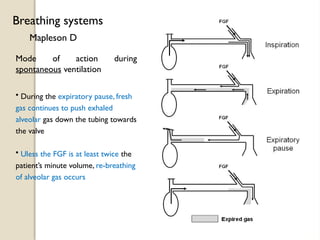
Mode of action during
spontaneous ventilation
• During the expiratory pause, fresh
gas continues to push exhaled
alveolar gas down the tubing towards
the valve
• Uless the FGF is at least twice the
patient’s minute volume, re-breathing
of alveolar gas occurs
Mapleson D circuit
Breathing systems
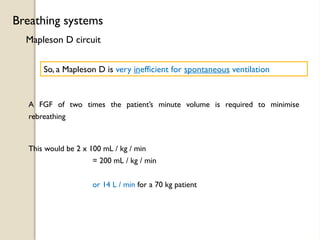
So, a Mapleson D is very inefficient for spontaneous ventilation
A FGF of two times the patient’s minute volume is required to minimise
rebreathing
This would be 2 x 100 mL / kg / min
= 200 mL / kg / min
or 14 L / min for a 70 kg patient
Mapleson D
Breathing systems
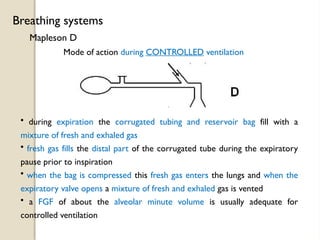
Mode of action during CONTROLLED ventilation
• during expiration the corrugated tubing and reservoir bag fill with a
mixture of fresh and exhaled gas
• fresh gas fills the distal part of the corrugated tube during the expiratory
pause prior to inspiration
• when the bag is compressed this fresh gas enters the lungs and when the
expiratory valve opens a mixture of fresh and exhaled gas is vented
• a FGF of about the alveolar minute volume is usually adequate for
controlled ventilation
Mapleson D circuit
Breathing systems
So, a Mapleson D is very efficient for CONTROLLED ventilation
A FGF of just above the patient’s alveolar minute volume is required
(the alveolar minute volume is about 70 mL / kg / min)
The FGF required is about 85 mL / kg / min
or 6 L / min for a 70 kg patient
A FGF of 100ml/kg/min will result in a degree of hypocapnia (too low CO2
level in the blood)
Mapleson D
Breathing systems
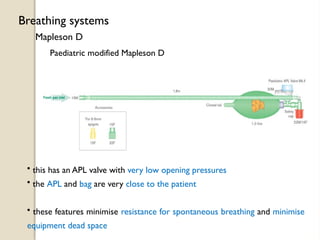
Paediatric modified Mapleson D
• this has an APL valve with very low opening pressures
• the APL and bag are very close to the patient
• these features minimise resistance for spontaneous breathing and minimise
equipment dead space
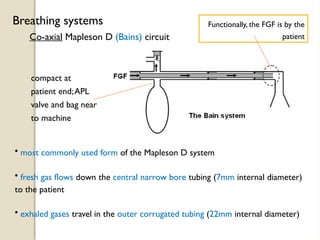
Co-axial Mapleson D (Bains) circuit
Breathing systems
• most commonly used form of the Mapleson D system
• fresh gas flows down the central narrow bore tubing (7mm internal diameter)
to the patient
• exhaled gases travel in the outer corrugated tubing (22mm internal diameter)
compact at
patient end;APL
valve and bag near
to machine
Functionally, the FGF is by the
patient
Co-axial Mapleson D (Bains) circuit (cont.)
Breathing systems
• before use, the Bain circuit should be carefully checked
• the outer tubing of a Bain circuit is made of clear plastic and the inner green
or black
• if a leak develops in the inner tubing or it becomes detached from the fresh
gas port, a huge increase in apparatus dead space occurs
• in order to check for this, the lumen of the inner tubing should be occluded
with a finger or the plunger of a 2ml syringe, demonstrating a rise in gas
pressure within the anaesthetic circuit
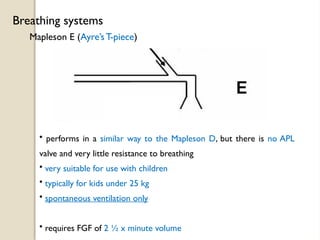
Mapleson E (Ayre’s T-piece)
Breathing systems
• performs in a similar way to the Mapleson D, but there is no APL
valve and very little resistance to breathing
• very suitable for use with children
• typically for kids under 25 kg
• spontaneous ventilation only
• requires FGF of 2 ½ x minute volume
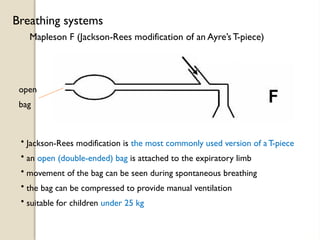
Mapleson F (Jackson-Rees modification of an Ayre’sT-piece)
Breathing systems
• Jackson-Rees modification is the most commonly used version of a T-piece
• an open (double-ended) bag is attached to the expiratory limb
• movement of the bag can be seen during spontaneous breathing
• the bag can be compressed to provide manual ventilation
• suitable for children under 25 kg
open
bag
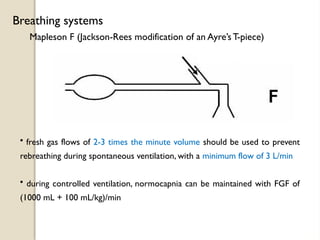
Mapleson F (Jackson-Rees modification of an Ayre’sT-piece)
Breathing systems
• fresh gas flows of 2-3 times the minute volume should be used to prevent
rebreathing during spontaneous ventilation, with a minimum flow of 3 L/min
• during controlled ventilation, normocapnia can be maintained with FGF of
(1000 mL + 100 mL/kg)/min
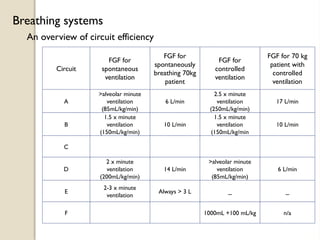
An overview of circuit efficiency
Breathing systems
Circuit
FGF for
spontaneous
ventilation
FGF for
spontaneously
breathing 70kg
patient
FGF for
controlled
ventilation
FGF for 70 kg
patient with
controlled
ventilation
A
>alveolar minute
ventilation
(85mL/kg/min)
6 L/min
2.5 x minute
ventilation
(250mL/kg/min)
17 L/min
B
1.5 x minute
ventilation
(150mL/kg/min)
10 L/min
1.5 x minute
ventilation
(150mL/kg/min
10 L/min
C
D
2 x minute
ventilation
(200mL/kg/min)
14 L/min
>alveolar minute
ventilation
(85mL/kg/min)
6 L/min
E
2-3 x minute
ventilation
Always > 3 L _ _
F 1000mL +100 mL/kg n/a
Humphrey ADE breathing systems
Breathing systems
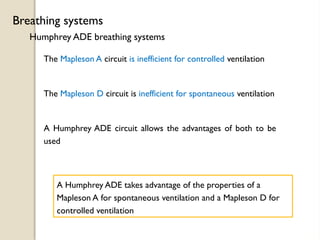
The Mapleson A circuit is inefficient for controlled ventilation
The Mapleson D circuit is inefficient for spontaneous ventilation
A Humphrey ADE circuit allows the advantages of both to be
used
A Humphrey ADE takes advantage of the properties of a
Mapleson A for spontaneous ventilation and a Mapleson D for
controlled ventilation
Humphrey ADE breathing systems
Breathing systems
Humphrey ADE breathing systems
Breathing systems
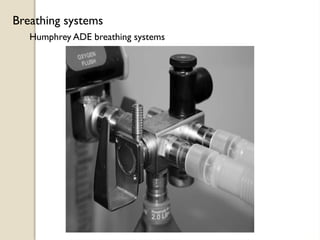
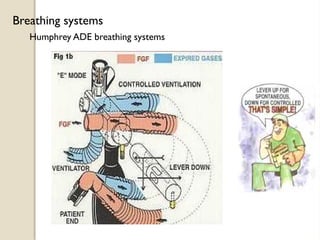
• reservoir bag is situated at the fresh gas inlet end of the circuit
• gas is conducted to and from the patient down the inspiratory and
expiratory limbs of the circuit
• depending on the position of the control lever at the Humphrey block,
gases either pass through the expiratory valve or the ventilator port
• when the lever is ‘up’ the reservoir bag and the expiratory valve are used,
creating a Mapleson A type circuit
• when the lever is in the ‘down’ position the bag and valve are bypassed and
the ventilator port is opened, creating a Mapleson D system for controlled
ventilation
• if no ventilator is attached and the port is left open, the system functions
like an Ayre’s T piece
Humphrey ADE breathing systems
Breathing systems
Humphrey ADE breathing systems
Breathing systems
So, the FGF rate with the Humphrey ADE are typically;
Spontaneous  Mapleson A  85 mL/kg/min
(or 6 L/min for 70 kg patient)
Controlled  Mapleson D  85 mL/kg/min
(or 6 L/min for 70 kg patient)
Humphrey ADE breathing systems
Breathing systems
• it is essential that the anaesthetist fully understands the function of this
circuit
• if the lever on the Humphrey block is moved from ‘up’ to ‘down’ while gases
are flowing, the breathing bag will remain full of gas but manual ventilation of
the patient’s lungs by compressing the bag will be impossible and may
resemble complete obstruction of the breathing circuit
The circle breathing system
Breathing systems
• an alternative to using high flow circuits is to absorb CO2 from the
expired gases which are then recirculated to the patient
• this saves on gases and also on volatile anaesthetic agent
• the reaction of CO2 with soda lime generates some water and
considerable heat  the gases are warmed and humidified prior to
inspiration
circle circuits are potentially very efficient and cause minimal pollution
(however, they are expensive to buy and require soda lime)
The circle breathing system
Breathing systems
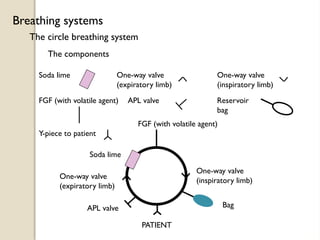
Y-piece to patient
Reservoir
bag
APL valve
One-way valve
(inspiratory limb)
One-way valve
(expiratory limb)
Soda lime
FGF (with volatile agent)
The components
PATIENT
Bag
APL valve
One-way valve
(inspiratory limb)
One-way valve
(expiratory limb)
Soda lime
FGF (with volatile agent)
The circle breathing system
Breathing systems
The soda lime
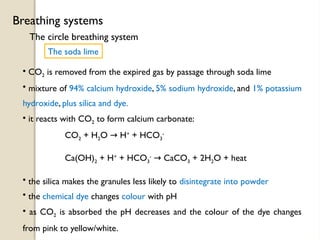
• CO2 is removed from the expired gas by passage through soda lime
• mixture of 94% calcium hydroxide, 5% sodium hydroxide, and 1% potassium
hydroxide, plus silica and dye.
• it reacts with CO2 to form calcium carbonate:
CO2 + H2O H
→ +
+ HCO3
-
Ca(OH)2 + H+
+ HCO3
-
CaCO
→ 3 + 2H2O + heat
• the silica makes the granules less likely to disintegrate into powder
• the chemical dye changes colour with pH
• as CO2 is absorbed the pH decreases and the colour of the dye changes
from pink to yellow/white.
The circle breathing system
Breathing systems
The soda lime (cont.)
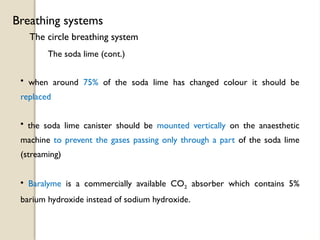
• when around 75% of the soda lime has changed colour it should be
replaced
• the soda lime canister should be mounted vertically on the anaesthetic
machine to prevent the gases passing only through a part of the soda lime
(streaming)
• Baralyme is a commercially available CO2 absorber which contains 5%
barium hydroxide instead of sodium hydroxide.
The circle breathing system
Breathing systems
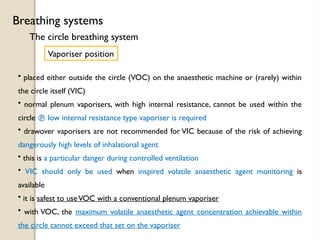
Vaporiser position
• placed either outside the circle (VOC) on the anaesthetic machine or (rarely) within
the circle itself (VIC)
• normal plenum vaporisers, with high internal resistance, cannot be used within the
circle  low internal resistance type vaporiser is required
• drawover vaporisers are not recommended for VIC because of the risk of achieving
dangerously high levels of inhalational agent
• this is a particular danger during controlled ventilation
• VIC should only be used when inspired volatile anaesthetic agent monitoring is
available
• it is safest to useVOC with a conventional plenum vaporiser
• with VOC, the maximum volatile anaesthetic agent concentration achievable within
the circle cannot exceed that set on the vaporiser
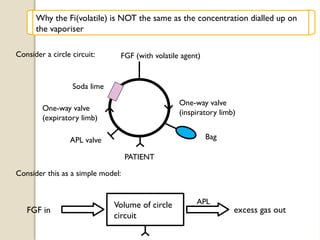
PATIENT
Bag
APL valve
One-way valve
(inspiratory limb)
One-way valve
(expiratory limb)
Soda lime
FGF (with volatile agent)
Consider this as a simple model:
Consider a circle circuit:
FGF in excess gas out
Volume of circle
circuit
APL
Why the Fi(volatile) is NOT the same as the concentration dialled up on
the vaporiser
5 L in 5 L out
5 L volume
Let the FGF = 5 L / min
and the circle circuit volume = 5 L
In one minute:
This is like diluting the circle circuit (5 L) with a further 5 L every minute
Suppose the dialed [halothane] = 1 % (the vaporiser setting)
5 L in
(1 % Hal)
5 L out
(0.5%Hal)
5 L volume + 5L
FGF
These are approximately
correct
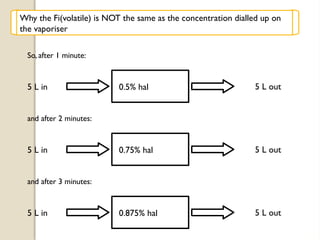
Why the Fi(volatile) is NOT the same as the concentration dialled up on
the vaporiser
5 L in 5 L out
0.5% hal
So, after 1 minute:
and after 2 minutes:
5 L in 5 L out
0.75% hal
and after 3 minutes:
5 L in 5 L out
0.875% hal
Why the Fi(volatile) is NOT the same as the concentration dialled up on
the vaporiser
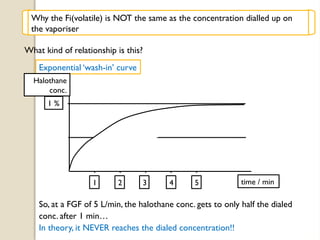
What kind of relationship is this?
Exponential ‘wash-in’ curve
So, at a FGF of 5 L/min, the halothane conc. gets to only half the dialed
conc. after 1 min…
In theory, it NEVER reaches the dialed concentration!!
1 %
time / min
Halothane
conc.
1 2 3 4 5
Why the Fi(volatile) is NOT the same as the concentration dialled up on
the vaporiser
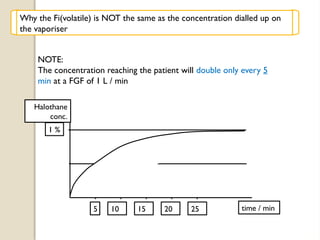
NOTE:
The concentration reaching the patient will double only every 5
min at a FGF of 1 L / min
1 %
time / min
Halothane
conc.
5 10 15 20 25
Why the Fi(volatile) is NOT the same as the concentration dialled up on
the vaporiser
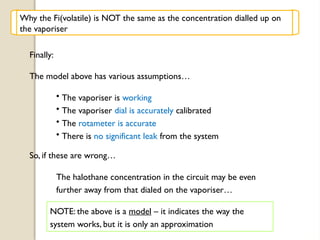
Finally:
The model above has various assumptions…
• The vaporiser is working
• The vaporiser dial is accurately calibrated
• The rotameter is accurate
• There is no significant leak from the system
So, if these are wrong…
The halothane concentration in the circuit may be even
further away from that dialed on the vaporiser…
NOTE: the above is a model – it indicates the way the
system works, but it is only an approximation
Why the Fi(volatile) is NOT the same as the concentration dialled up on
the vaporiser
The circle breathing system
Breathing systems
“De-nitrogenation” (getting rid of N2)
• in the same way that there is a ‘wash-in’ curve for the volatile agent, there
is a ‘wash-out’ curve for the air (mainly N2) in the circuit
• this means that the FiO2 will not be 100% for some time after the start
of an anaesthetic with 100% O2 in the FGF
• this has practical implications for use of a circle circuit…
The circle breathing system
Breathing systems
Practical use
• during the first five to ten minutes of anaesthesia using a volatile anaesthetic agent in
oxygen, a large amount of the agent is taken up by the patient, causing a reduction in
the agent concentration within the system
• in addition, the total volume of the circle system (tubing and soda lime canister) is a
reservoir of air that needs to be replaced with anaesthetic agent and fresh gas
• high fresh gas flows (roughly equivalent to the patient’s minute volume) ensure that
this wash-out of air from the system and the patient’s functional residual capacity
occurs rapidly (i.e. 6-8 L/min)
The circle breathing system
Breathing systems
Practical use
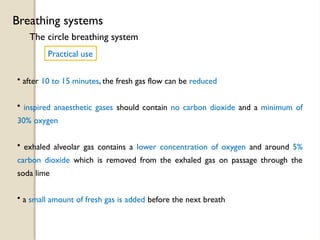
• after 10 to 15 minutes, the fresh gas flow can be reduced
• inspired anaesthetic gases should contain no carbon dioxide and a minimum of
30% oxygen
• exhaled alveolar gas contains a lower concentration of oxygen and around 5%
carbon dioxide which is removed from the exhaled gas on passage through the
soda lime
• a small amount of fresh gas is added before the next breath
The circle breathing system
Breathing systems
Practical use
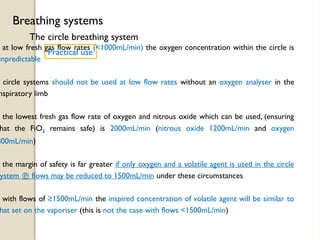
at low fresh gas flow rates (<1000mL/min) the oxygen concentration within the circle is
unpredictable
circle systems should not be used at low flow rates without an oxygen analyser in the
nspiratory limb
the lowest fresh gas flow rate of oxygen and nitrous oxide which can be used, (ensuring
hat the FiO2 remains safe) is 2000mL/min (nitrous oxide 1200mL/min and oxygen
800mL/min)
the margin of safety is far greater if only oxygen and a volatile agent is used in the circle
ystem  flows may be reduced to 1500mL/min under these circumstances
with flows of ≥1500mL/min the inspired concentration of volatile agent will be similar to
hat set on the vaporiser (this is not the case with flows <1500mL/min)
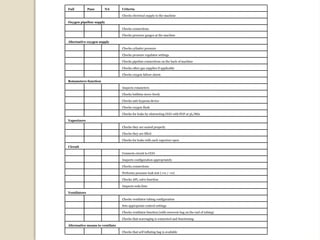
Fail Pass NA Criteria
Checks electrical supply to the machine
Oxygen pipeline supply
Checks connections
Checks pressure gauges at the machine
Alternative oxygen supply
Checks cylinder pressure
Checks pressure regulator settings
Checks pipeline connections on the back of machine
Checks other gas supplies if applicable
Checks oxygen failure alarm
Rotameters function
Inspects rotameters
Checks bobbins move freely
Checks anti-hypoxia device
Checks oxygen flush
Checks for leaks by obstructing CGO with FGF at 5L/Min
Vaporizers
Checks they are seated properly
Checks they are filled
Checks for leaks with each vaporizer open
Circuit
Connects circuit to CGO
Inspects configuration appropriately
Checks connections
Performs pressure leak test (+ve / -ve)
Checks APL valve function
Inspects soda lime
Ventilators
Checks ventilator tubing configuration
Sets appropriate control settings
Checks ventilator function (with reservoir bag on the end of tubing)
Checks that scavenging is connected and functioning
Alternative means to ventilate
Checks that self inflating bag is available
• Medical Gas supply
•Anaesthetic machine
• Humidification and filtration
• Breathing systems
• Airways
• Tracheal intubation equipment
• Masks and oxygen delivery devices
• Ventilators
Anaesthetic Equipment
√
√
√
√
C u later !!!

3.different types of breathing system pptx

  • 1.
    • Medical Gassupply •Anaesthetic machine • Humidification and filtration • Breathing systems • Airways • Tracheal intubation equipment • Masks and oxygen delivery devices • Ventilators Anaesthetic Equipment √ √ √
  • 2.
    Breathing systems Chapter three YohannesMolla (Bsc, Msc) Department of Anaeathesia April, 2013
  • 3.
    Why is thisknowledge relevant? Breathing systems •There are several different types of breathing circuit •Here, circle and humphrey ADE circuits are used currently •There are benefits and disadvantages to any breathing system •Knowing about the different systems will allow you to make informed choices about which system is best for a given situation •Also, it is important to know the limitations of the system you are using
  • 4.
    What is theideal breathing system? Breathing systems Simple and safe to use Delivers the intended gas mixture Permits spontaneous, manual and controlled ventilation Suitable for all age groups Efficient (uses low gas flow rates  saves halothane) Protects the patient from barotrauma Compact, lightweight and durable design Permits easy removal of waste gases Easy to maintain
  • 5.
    A few definitions Breathingsystems Tidal volume Minute volume The volume of gas inspired & expired with each breath Typically ≈7 mL / kg (or 500 mL for 70 kg patient) The total volume breathed in a minute Typically ≈100 mL / kg / min (or 7000 mL / min for 70 kg patient) Alveolar minute volume The volume undergoing gas exchange per minute ( = RR x [tidal vol – dead space] ) Typically ≈70 mL / kg / min (or 5000 mL / min for 70 kg patient)
  • 6.
    A few definitions Breathingsystems Physiological dead space The volume of inspired gas that does not undergo gas exchange in the alveoli Physiological dead space = anatomical dead space + alveolar dead space Functional residual capacity The volume of gas in the lungs at the end of expiration (Advantages ?) volume of lung which is ventilated with gas but not perfused with blood  cannot take part in gas exchange gas from upper airways, where gas exchange does not occur Typically ≈2 mL / kg or 140 mL for 70 kg patient
  • 7.
    A few definitions Breathingsystems Rebreathing Definition in anaesthesia; re-breathing is the inspiration of gas which was exhaled and still has pCO2 = 5 kPa So, if soda lime is used,“re-breathing” does not occur because the inhaled gas may have been previously exhaled, but it has had the CO2 removed What affects rebreathing? (1) breathing circuit design (e.g. soda lime or different configurations) (2) the mode of ventilation (spontaneous or controlled) (3) the fresh gas flow rate (4) the patient’s respiratory pattern
  • 8.
    Key components Breathing systems Y-pieceto patient Reservoir bag APL valve One-way valve Soda lime FGF (with volatile agent) Tubing
  • 9.
    Key components (cont.) Breathingsystems The APL valve = the Adjustable Pressure Limiting valve Also called a Heidbrink valve, spill valve, relief valve, expiratory valve 3 ports; inlet port patient port exhaust port  can be open to atmosphere or to scavenging system In open position, < 1 cm H2O (< 0.1 kPa) required to allow gas escape In closed position, gas can escape at 60 cm H2O (to avoid barotrauma)
  • 10.
    Key components (cont.) Breathingsystems The reservoir bag Standard adult size is 2L Smallest paediatric bag is 500 mL Roles of reservoir bag: (1) Accommodates fresh gas flow during expiration (2) Acts as a monitor of respiratory pattern (& “feel” of ventilation) (3) Can be used to assist ventilation (hand ventilation) (4) In a Mapleson F (Jackson-Rees modification of an Ayre’sT-piece), the bag is double ended and acts as the expiratory outflow (5) As bag expands, it reaches a maximal pressure of 40 cm H2O; protects the patient from barotrauma
  • 11.
    Which breathing systemsare we going to discuss? Breathing systems (3) Circle system (1) Mapleson systems A (2) Humphrey ADE breathing system B C D E & F vaporiser out of circle (VOC) or vaporiser in circle (VIC)
  • 12.
    Mapleson breathing systems Breathingsystems Mapleson introduced a classification for anaesthetic circuits in 1954 It does not include systems with internal valves or soda lime The circuits are labeled A to F The order is from most efficient least efficient → for a spontaneously breathing patient The efficiency of the circuits is defined as the fresh gas flow required to avoid rebreathing The relative efficiency of each circuit is different for ventilated patients
  • 13.
    Mapleson breathing systems(cont.) Breathing systems Most efficient for spontaneously breathing patient Least efficient for spontaneously breathing patient Fresh gas flow (FGF)
  • 14.
    Mapleson breathing systems(cont.) Breathing systems Reservoir bag on inspiratory limb Transitional position of reservoir bag Reservoir bag on expiratory limb
  • 15.
    Mapleson breathing systems(cont.) Breathing systems Alternative name Co-axial design Lack Ayer’s T- piece Jackson-Rees modification of an Ayer’s T-piece Bain Magill Water’s (not used) (not used) (not used) (not used)
  • 16.
    Mapleson A (Magill)circuit Breathing systems Components: Reservoir bag at the machine end (inspiratory limb) Corrugated tubing (generally 110 cm or 180 cm) APL valve at patient end
  • 17.
    Mapleson A (Magill)circuit Breathing systems Mode of action during spontaneous ventilation During inspiration: • gas inhaled from the two litre reservoir (breathing) bag • bag partially collapses = visual confirmation that breathing is occurring
  • 18.
    During expiration: • bagand tubing initially refilled with combination of exhaled dead space gas and fresh gas from machine • once bag is full, pressure within the breathing system rises and APL valve near the patient releases alveolar gas (containing CO2) Mapleson A (Magill) circuit Breathing systems Mode of action during spontaneous ventilation
  • 19.
    During the expiratorypause: • more fresh gas enters the system driving any remaining alveolar gas out through the valve Mapleson A (Magill) circuit Breathing systems Mode of action during spontaneous ventilation
  • 20.
    Mapleson A (Magill)circuit Breathing systems Mode of action during spontaneous ventilation • if FGF is sufficiently high, all the alveolar gas is vented from the circuit before the next inspiration  no rebreathing will take place • with careful adjustment the fresh gas flow can be reduced until there is only fresh gas and dead space gas in the breathing system at the start of inspiration.
  • 21.
    Mapleson A (Magill)circuit Breathing systems So, a Mapleson A is very efficient for spontaneous ventilation In theory, FGF equal to the patient’s alveolar minute ventilation is sufficient to prevent rebreathing So, a sensible FGF = 85 mL / kg / minute or, ≈ 6 L / min for a 70 kg man In practice, FGF closer to the patient’s total minute ventilation is usually selected (=margin of safety) for spontaneous ventilation
  • 22.
    Mapleson A (Magill)circuit Breathing systems • inspiratory pressure is provided by the anaesthetist squeezing the reservoir bag after partly closing the APL valve next to the patient • during lung inflation some of the gas is vented from the circuit • at the end of inspiration the reservoir bag is less than half full Mode of action during CONTROLLED ventilation
  • 23.
    Mapleson A (Magill)circuit Breathing systems Mode of action during CONTROLLED ventilation • during expiration, dead space and alveolar gas pass down the system tubing and may reach the bag which will then contain some carbon dioxide • during the next inspiration, when the bag is squeezed, alveolar gas re-enters the patient’s lungs followed by a mixture of fresh, dead space and alveolar gas
  • 24.
    A FGF oftwo and a half times the patient’s minute volume is required to vent enough alveolar gas to minimise rebreathing Mapleson A (Magill) circuit Breathing systems So, a Mapleson A is very inefficient for CONTROLLED ventilation In practice, the Magill circuit should not be used for positive pressure ventilation except for short periods of a few minutes In theory, this would be 2.5 x 100 mL / kg / min = 250 mL / kg / min or 17 L / min for a 70 kg patient
  • 25.
    Mapleson A (Magill)circuit Breathing systems Summary: • Efficient for spontaneous ventilation • Very inefficient for controlled ventilation • APL is at patient end; bulky, heavy and awkward • Not suitable for paediatrics < 25 kg due to excessive dead space in circuit
  • 26.
    Co-axial Mapleson A(Lack) circuit Breathing systems • this is a Mapleson A system in which the exhaled gases travel down a central tube located within an outer corrugated tube towards the expiratory valve • APL valve is placed next to the reservoir bag, by the common gas outlet • FGF requirements are the same as for the Magills circuit (in spontaneous and controlled ventilation) Functionally, the APL is by the patient
  • 27.
    Mapleson B &C circuits Breathing systems B & C are similar to each other; FGF entry and the expiratory valves are located at the patient end of the circuit They are not commonly used in anaesthetic practice High flows of gases are needed to prevent rebreathing of CO2 Mapleson C (Water’s) circuit is used in intensive care units, for augmenting patients’ spontaneous breaths during intubation and extubation  typically 1.5 x minute volume, or 150 mL/kg/min
  • 28.
    Mapleson D circuit Breathingsystems Components: Reservoir bag on the expiratory limb Connection to FGF near to patient APL valve away from patient on the expiratory limb
  • 29.
    Mapleson D Breathing systems Modeof action during spontaneous ventilation • during expiration, exhaled gas and fresh gas mix in the corrugated tubing and travel towards the reservoir bag • when the bag is full the pressure in the system rises and the expiratory valve opens • a mixture of fresh and exhaled gas is vented to the atmosphere
  • 30.
    Mapleson D Breathing systems Modeof action during spontaneous ventilation • During the expiratory pause, fresh gas continues to push exhaled alveolar gas down the tubing towards the valve • Uless the FGF is at least twice the patient’s minute volume, re-breathing of alveolar gas occurs
  • 31.
    Mapleson D circuit Breathingsystems So, a Mapleson D is very inefficient for spontaneous ventilation A FGF of two times the patient’s minute volume is required to minimise rebreathing This would be 2 x 100 mL / kg / min = 200 mL / kg / min or 14 L / min for a 70 kg patient
  • 32.
    Mapleson D Breathing systems Modeof action during CONTROLLED ventilation • during expiration the corrugated tubing and reservoir bag fill with a mixture of fresh and exhaled gas • fresh gas fills the distal part of the corrugated tube during the expiratory pause prior to inspiration • when the bag is compressed this fresh gas enters the lungs and when the expiratory valve opens a mixture of fresh and exhaled gas is vented • a FGF of about the alveolar minute volume is usually adequate for controlled ventilation
  • 33.
    Mapleson D circuit Breathingsystems So, a Mapleson D is very efficient for CONTROLLED ventilation A FGF of just above the patient’s alveolar minute volume is required (the alveolar minute volume is about 70 mL / kg / min) The FGF required is about 85 mL / kg / min or 6 L / min for a 70 kg patient A FGF of 100ml/kg/min will result in a degree of hypocapnia (too low CO2 level in the blood)
  • 34.
    Mapleson D Breathing systems Paediatricmodified Mapleson D • this has an APL valve with very low opening pressures • the APL and bag are very close to the patient • these features minimise resistance for spontaneous breathing and minimise equipment dead space
  • 35.
    Co-axial Mapleson D(Bains) circuit Breathing systems • most commonly used form of the Mapleson D system • fresh gas flows down the central narrow bore tubing (7mm internal diameter) to the patient • exhaled gases travel in the outer corrugated tubing (22mm internal diameter) compact at patient end;APL valve and bag near to machine Functionally, the FGF is by the patient
  • 36.
    Co-axial Mapleson D(Bains) circuit (cont.) Breathing systems • before use, the Bain circuit should be carefully checked • the outer tubing of a Bain circuit is made of clear plastic and the inner green or black • if a leak develops in the inner tubing or it becomes detached from the fresh gas port, a huge increase in apparatus dead space occurs • in order to check for this, the lumen of the inner tubing should be occluded with a finger or the plunger of a 2ml syringe, demonstrating a rise in gas pressure within the anaesthetic circuit
  • 37.
    Mapleson E (Ayre’sT-piece) Breathing systems • performs in a similar way to the Mapleson D, but there is no APL valve and very little resistance to breathing • very suitable for use with children • typically for kids under 25 kg • spontaneous ventilation only • requires FGF of 2 ½ x minute volume
  • 38.
    Mapleson F (Jackson-Reesmodification of an Ayre’sT-piece) Breathing systems • Jackson-Rees modification is the most commonly used version of a T-piece • an open (double-ended) bag is attached to the expiratory limb • movement of the bag can be seen during spontaneous breathing • the bag can be compressed to provide manual ventilation • suitable for children under 25 kg open bag
  • 39.
    Mapleson F (Jackson-Reesmodification of an Ayre’sT-piece) Breathing systems • fresh gas flows of 2-3 times the minute volume should be used to prevent rebreathing during spontaneous ventilation, with a minimum flow of 3 L/min • during controlled ventilation, normocapnia can be maintained with FGF of (1000 mL + 100 mL/kg)/min
  • 40.
    An overview ofcircuit efficiency Breathing systems Circuit FGF for spontaneous ventilation FGF for spontaneously breathing 70kg patient FGF for controlled ventilation FGF for 70 kg patient with controlled ventilation A >alveolar minute ventilation (85mL/kg/min) 6 L/min 2.5 x minute ventilation (250mL/kg/min) 17 L/min B 1.5 x minute ventilation (150mL/kg/min) 10 L/min 1.5 x minute ventilation (150mL/kg/min 10 L/min C D 2 x minute ventilation (200mL/kg/min) 14 L/min >alveolar minute ventilation (85mL/kg/min) 6 L/min E 2-3 x minute ventilation Always > 3 L _ _ F 1000mL +100 mL/kg n/a
  • 41.
    Humphrey ADE breathingsystems Breathing systems The Mapleson A circuit is inefficient for controlled ventilation The Mapleson D circuit is inefficient for spontaneous ventilation A Humphrey ADE circuit allows the advantages of both to be used A Humphrey ADE takes advantage of the properties of a Mapleson A for spontaneous ventilation and a Mapleson D for controlled ventilation
  • 42.
    Humphrey ADE breathingsystems Breathing systems
  • 43.
    Humphrey ADE breathingsystems Breathing systems • reservoir bag is situated at the fresh gas inlet end of the circuit • gas is conducted to and from the patient down the inspiratory and expiratory limbs of the circuit • depending on the position of the control lever at the Humphrey block, gases either pass through the expiratory valve or the ventilator port • when the lever is ‘up’ the reservoir bag and the expiratory valve are used, creating a Mapleson A type circuit • when the lever is in the ‘down’ position the bag and valve are bypassed and the ventilator port is opened, creating a Mapleson D system for controlled ventilation • if no ventilator is attached and the port is left open, the system functions like an Ayre’s T piece
  • 44.
    Humphrey ADE breathingsystems Breathing systems
  • 45.
    Humphrey ADE breathingsystems Breathing systems So, the FGF rate with the Humphrey ADE are typically; Spontaneous  Mapleson A  85 mL/kg/min (or 6 L/min for 70 kg patient) Controlled  Mapleson D  85 mL/kg/min (or 6 L/min for 70 kg patient)
  • 46.
    Humphrey ADE breathingsystems Breathing systems • it is essential that the anaesthetist fully understands the function of this circuit • if the lever on the Humphrey block is moved from ‘up’ to ‘down’ while gases are flowing, the breathing bag will remain full of gas but manual ventilation of the patient’s lungs by compressing the bag will be impossible and may resemble complete obstruction of the breathing circuit
  • 47.
    The circle breathingsystem Breathing systems • an alternative to using high flow circuits is to absorb CO2 from the expired gases which are then recirculated to the patient • this saves on gases and also on volatile anaesthetic agent • the reaction of CO2 with soda lime generates some water and considerable heat  the gases are warmed and humidified prior to inspiration circle circuits are potentially very efficient and cause minimal pollution (however, they are expensive to buy and require soda lime)
  • 48.
    The circle breathingsystem Breathing systems Y-piece to patient Reservoir bag APL valve One-way valve (inspiratory limb) One-way valve (expiratory limb) Soda lime FGF (with volatile agent) The components PATIENT Bag APL valve One-way valve (inspiratory limb) One-way valve (expiratory limb) Soda lime FGF (with volatile agent)
  • 49.
    The circle breathingsystem Breathing systems The soda lime • CO2 is removed from the expired gas by passage through soda lime • mixture of 94% calcium hydroxide, 5% sodium hydroxide, and 1% potassium hydroxide, plus silica and dye. • it reacts with CO2 to form calcium carbonate: CO2 + H2O H → + + HCO3 - Ca(OH)2 + H+ + HCO3 - CaCO → 3 + 2H2O + heat • the silica makes the granules less likely to disintegrate into powder • the chemical dye changes colour with pH • as CO2 is absorbed the pH decreases and the colour of the dye changes from pink to yellow/white.
  • 50.
    The circle breathingsystem Breathing systems The soda lime (cont.) • when around 75% of the soda lime has changed colour it should be replaced • the soda lime canister should be mounted vertically on the anaesthetic machine to prevent the gases passing only through a part of the soda lime (streaming) • Baralyme is a commercially available CO2 absorber which contains 5% barium hydroxide instead of sodium hydroxide.
  • 51.
    The circle breathingsystem Breathing systems Vaporiser position • placed either outside the circle (VOC) on the anaesthetic machine or (rarely) within the circle itself (VIC) • normal plenum vaporisers, with high internal resistance, cannot be used within the circle  low internal resistance type vaporiser is required • drawover vaporisers are not recommended for VIC because of the risk of achieving dangerously high levels of inhalational agent • this is a particular danger during controlled ventilation • VIC should only be used when inspired volatile anaesthetic agent monitoring is available • it is safest to useVOC with a conventional plenum vaporiser • with VOC, the maximum volatile anaesthetic agent concentration achievable within the circle cannot exceed that set on the vaporiser
  • 52.
    PATIENT Bag APL valve One-way valve (inspiratorylimb) One-way valve (expiratory limb) Soda lime FGF (with volatile agent) Consider this as a simple model: Consider a circle circuit: FGF in excess gas out Volume of circle circuit APL Why the Fi(volatile) is NOT the same as the concentration dialled up on the vaporiser
  • 53.
    5 L in5 L out 5 L volume Let the FGF = 5 L / min and the circle circuit volume = 5 L In one minute: This is like diluting the circle circuit (5 L) with a further 5 L every minute Suppose the dialed [halothane] = 1 % (the vaporiser setting) 5 L in (1 % Hal) 5 L out (0.5%Hal) 5 L volume + 5L FGF These are approximately correct Why the Fi(volatile) is NOT the same as the concentration dialled up on the vaporiser
  • 54.
    5 L in5 L out 0.5% hal So, after 1 minute: and after 2 minutes: 5 L in 5 L out 0.75% hal and after 3 minutes: 5 L in 5 L out 0.875% hal Why the Fi(volatile) is NOT the same as the concentration dialled up on the vaporiser
  • 55.
    What kind ofrelationship is this? Exponential ‘wash-in’ curve So, at a FGF of 5 L/min, the halothane conc. gets to only half the dialed conc. after 1 min… In theory, it NEVER reaches the dialed concentration!! 1 % time / min Halothane conc. 1 2 3 4 5 Why the Fi(volatile) is NOT the same as the concentration dialled up on the vaporiser
  • 56.
    NOTE: The concentration reachingthe patient will double only every 5 min at a FGF of 1 L / min 1 % time / min Halothane conc. 5 10 15 20 25 Why the Fi(volatile) is NOT the same as the concentration dialled up on the vaporiser
  • 57.
    Finally: The model abovehas various assumptions… • The vaporiser is working • The vaporiser dial is accurately calibrated • The rotameter is accurate • There is no significant leak from the system So, if these are wrong… The halothane concentration in the circuit may be even further away from that dialed on the vaporiser… NOTE: the above is a model – it indicates the way the system works, but it is only an approximation Why the Fi(volatile) is NOT the same as the concentration dialled up on the vaporiser
  • 58.
    The circle breathingsystem Breathing systems “De-nitrogenation” (getting rid of N2) • in the same way that there is a ‘wash-in’ curve for the volatile agent, there is a ‘wash-out’ curve for the air (mainly N2) in the circuit • this means that the FiO2 will not be 100% for some time after the start of an anaesthetic with 100% O2 in the FGF • this has practical implications for use of a circle circuit…
  • 59.
    The circle breathingsystem Breathing systems Practical use • during the first five to ten minutes of anaesthesia using a volatile anaesthetic agent in oxygen, a large amount of the agent is taken up by the patient, causing a reduction in the agent concentration within the system • in addition, the total volume of the circle system (tubing and soda lime canister) is a reservoir of air that needs to be replaced with anaesthetic agent and fresh gas • high fresh gas flows (roughly equivalent to the patient’s minute volume) ensure that this wash-out of air from the system and the patient’s functional residual capacity occurs rapidly (i.e. 6-8 L/min)
  • 60.
    The circle breathingsystem Breathing systems Practical use • after 10 to 15 minutes, the fresh gas flow can be reduced • inspired anaesthetic gases should contain no carbon dioxide and a minimum of 30% oxygen • exhaled alveolar gas contains a lower concentration of oxygen and around 5% carbon dioxide which is removed from the exhaled gas on passage through the soda lime • a small amount of fresh gas is added before the next breath
  • 61.
    The circle breathingsystem Breathing systems Practical use at low fresh gas flow rates (<1000mL/min) the oxygen concentration within the circle is unpredictable circle systems should not be used at low flow rates without an oxygen analyser in the nspiratory limb the lowest fresh gas flow rate of oxygen and nitrous oxide which can be used, (ensuring hat the FiO2 remains safe) is 2000mL/min (nitrous oxide 1200mL/min and oxygen 800mL/min) the margin of safety is far greater if only oxygen and a volatile agent is used in the circle ystem  flows may be reduced to 1500mL/min under these circumstances with flows of ≥1500mL/min the inspired concentration of volatile agent will be similar to hat set on the vaporiser (this is not the case with flows <1500mL/min)
  • 62.
    Fail Pass NACriteria Checks electrical supply to the machine Oxygen pipeline supply Checks connections Checks pressure gauges at the machine Alternative oxygen supply Checks cylinder pressure Checks pressure regulator settings Checks pipeline connections on the back of machine Checks other gas supplies if applicable Checks oxygen failure alarm Rotameters function Inspects rotameters Checks bobbins move freely Checks anti-hypoxia device Checks oxygen flush Checks for leaks by obstructing CGO with FGF at 5L/Min Vaporizers Checks they are seated properly Checks they are filled Checks for leaks with each vaporizer open Circuit Connects circuit to CGO Inspects configuration appropriately Checks connections Performs pressure leak test (+ve / -ve) Checks APL valve function Inspects soda lime Ventilators Checks ventilator tubing configuration Sets appropriate control settings Checks ventilator function (with reservoir bag on the end of tubing) Checks that scavenging is connected and functioning Alternative means to ventilate Checks that self inflating bag is available
  • 63.
    • Medical Gassupply •Anaesthetic machine • Humidification and filtration • Breathing systems • Airways • Tracheal intubation equipment • Masks and oxygen delivery devices • Ventilators Anaesthetic Equipment √ √ √ √
  • 64.