Breathing Systems
Mr. Harshad Khade
MSc. Medical Technology (OTA)
Symbiosis International university, Pune.
Introduction
• A breathing system is a device that conducts gases such as oxygen and
anesthetic agents to the patient and conducts waste gases such as CO2
away.
• Breathing systems are classified as
Open,
Semi-open,
Semi-closed
Closed.
• Semi-closed systems are further divided into
Rebreathing Systems With CO2 Absorption,
Rebreathing Systems Without CO2 Absorption
Non-rebreathing Systems.
• More simply, systems can be classified in two groups:
systems with CO2 washout (includes open and semi-open systems)
systems with CO2 absorption (includes closed and semi-closed systems).
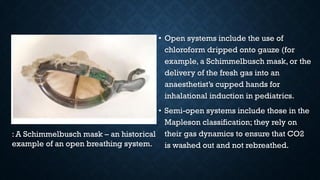
• Open systems include the use of
chloroform dripped onto gauze (for
example, a Schimmelbusch mask, or the
delivery of the fresh gas into an
anaesthetist’s cupped hands for
inhalational induction in pediatrics.
• Semi-open systems include those in the
Mapleson classification; they rely on
their gas dynamics to ensure that CO2
is washed out and not rebreathed.
: A Schimmelbusch mask – an historical
example of an open breathing system.
• The circle system incorporates a soda lime canister for CO2
absorption. It usually functions as a semi-closed system.
• When the fresh gas flow is greater than the patient’s gas uptake, some
gas is vented via the adjustable pressure limiting (APL) valve, and the
circle behaves as a semi-closed system. It is possible to use a circle as
a fully closed system.
• To do this, the APL valve is closed and the fresh gas flow is set equal to
the uptake by the patient so that the overall volume of gas in the system
is constant.
• It is difficult to estimate the patient’s oxygen uptake accurately and
therefore fully closed systems are rarely used in practice.
Efficiency
• The efficiency of a breathing system is defined by the lowest fresh gas
flow that prevents the patient rebreathing CO2.
• Low fresh gas flows are desirable to reduce the amount of expensive
(and polluting) volatile anaesthetic that is used.
• In an inefficient open system, most anaesthetic will be vented into the
atmosphere, whereas in a closed system, only the amount taken up by
the patient is required.
An Ideal Breathing System
Be simple and portable
Be safe to use in all age groups
Reliably deliver the intended gas mixture
Be efficient in both spontaneous and controlled ventilation
Protect patients from barotrauma
Permit scavenging of waste gases
Offer low resistance to gas flow
 Conserve heat and moisture.
• Unfortunately, no system fits all criteria and a compromise is therefore
made depending on the situation.
Bag Valve Mask
• The bag valve mask was first brought to market in 1956 by AMBU ; these
systems are therefore AMBU bags.
• The primary benefit of bag valve masks over other breathing systems is their
self-inflating bag, which enables them to be used without a pressurized gas
supply.
• Uses
• Bag valve masks are used for emergency ventilation, with or without a
pressurized gas supply.
• The bag and valve may also be used to ventilate via an ETT.
• The self-inflating bag is usually made of clear silicone and returns to its
original shape when squeezed.
• Advantages
May be used to deliver room air without a pressurized gas supply.
Self-contained and widely available.
• Disadvantages
There is little tactile feedback during ventilation.
There is no visual indication of spontaneous ventilation
Adjustable Pressure Limiting Valve
• The APL valve is a spring-loaded pressure release valve in which the release
pressure can be varied to suit the situation.
• Uses
• APL valves are an essential component of most breathing systems (except
the Mapleson E or F) allowing control of the pressure within the breathing
system and therefore the airway.
• The valve consists of a lightweight disc which is held against the base by a
spring, closing the valve.
• The pressure exerted by the spring may be adjusted by screwing the valve
cap.When the pressure beneath the disc exceeds the pressure exerted by the
spring, the valve will open, allowing gas to escape.
• Advantages
Permits control of the airway pressure during positive pressure ventilation.
Permits application of PEEP.
Facilitates scavenging.
• Disadvantages
Water vapour may condense on the disc, causing it to stick. Discs are made
of a hydrophobic material to reduce the likelihood of this.
Valves introduce greater resistance and are less suitable for small children.
This is the reason the APL valve is absent from the Mapleson E and F
systems.
Barotrauma may result from inadvertent closure of the APL valve.
Adds bulk to the breathing system.
Reservoir Bag
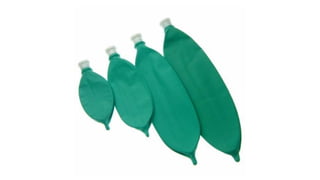
• The reservoir bag is an essential component of most breathing systems
because it improves efficiency and permits manual ventilation.
• Bags are available in both rubber and latex-free versions.
• The standard adult size is liters, with pediatric sizes down to 0.5 litres. Larger
sizes are occasionally used for inhalational induction in adults.
• Uses
• 2 A component of most anaesthetic breathing systems.
• The reservoir bag has a number of useful properties.
It acts as a reservoir for oxygen and anaesthetic gases, which enter
the bag from the fresh gas flow during expiration and are drawn
upon during inspiration, thus allowing lower fresh gas flows to be
used.
Manual ventilation is achieved by squeezing the bag.
It acts as a visual indicator of spontaneous ventilation.
In the event of a valve becoming stuck or being left unintentionally
closed, pressure will build up in the breathing system.
The reservoir bag will then distend, limiting the pressure to around
60cmH2O and thus reducing barotrauma.
• According to the law of Laplace, the pressure will fall as the bag’s radius
increases – an effect that can be demonstrated using the pressure gauge
on an anaesthetic machine.
• The law of Laplace P = 2T / r
• where P = pressure,T = tension in the wall of a sphere, r = radius.
• Advantages
• An essential component of anaesthetic breathing systems.
• Permits tactile feedback.
• Disadvantages
• It is relatively easy to tear the bag.
• It is not self-inflating and must therefore be used with a pressurized
gas supply
The Mapleson Classification
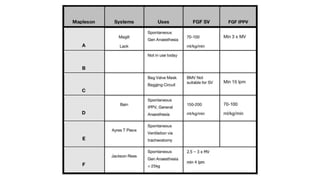
• In 1954, Mapleson performed mathematical modelling of the semi-
open breathing systems available to him.
• He classified them into five breathing systems (A–E) and a sixth (F)
was added later.
• Systems are classified according to the relative positions of three
components: the fresh gas flow (FGF), the APL valve and a gas
reservoir.
• Variable lengths of corrugated tubing connect the components.
• Mapleson systems are semi-open and rely on sufficient fresh gas
flow to wash out exhaled gas and prevent rebreathing.
• Uses
In comparison with a circle system, Mapleson breathing systems are
inefficient (meaning that higher FGFs are required to prevent
rebreathing) and are therefore expensive to use with volatile
anaesthetics.
They are therefore not used for anaesthetic delivery to adult patients
in theatre – circle systems are used instead.
Mapleson systems continue to be used in the anaesthetic room (D
and, occasionally, A), for transfers or management of critically ill
patients outside of theatre (C), and for paediatric patients (F and,
occasionally, E).
• Advantages
• Mapleson systems remain in use because they:
• Are simple and cheap
• Do not require CO2 absorption
• Are easily portable (particularly C, E and F)
• Have some specific advantages in pediatric anaesthesia (F).
• Disadvantages
• Compared with a circle system, all mapleson systems are inefficient.
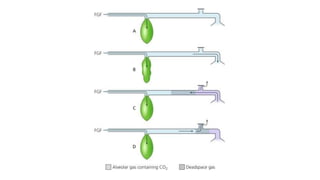
Magill System (Mapleson A)
• Fresh gas flow enters at the machine end, just proximal to the reservoir bag,
which is connected by approximately 1.6 m of tubing to the APL valve at the
patient end.
• The volume of this tubing must exceed one tidal volume to ensure efficient
spontaneous ventilation.
• Advantages
• Efficient for spontaneous ventilation.
• Disadvantages
• Inefficient for controlled ventilation.
• The APL valve at the patient end adds bulk and drags on breathing circuit
connections, particularly if connected to scavenging.
• Not suitable for paediatrics.
• Spontaneous ventilation (efficient)
During inspiration, the APL valve closes and the patient inspires fresh gas from
the tubing.
During expiration, the expiratory gas initially enters the reservoir tubing until the
bag fills and the pressure opens the APL valve allowing gas to escape.
During the expiratory pause, fresh gas displaces the remaining expired gas out
of the APL valve.
At flows equal ling MV, no rebreathing occurs.
• Controlled ventilation (inefficient)
Venting of FGF occurs during positive pressure inspiration and exhaled gas is not
vented until the APL valve reopens (a higher APL valve opening pressure has to
be set than during spontaneous ventilation).
Rebreathing of expired gas therefore occurs unless FGF exceeds 3 times MV.
Lack System (Coaxial Mapleson A)
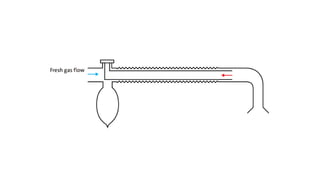
• The Lack system is a modification of the Magill system, designed to
eliminate the problem of having the APL valve at the patient end.
• It consists of a 30mm outer tube for inspiration, and a 14mm innertube
for expiration.
• This wider bore tubing is required in order to reduce resistance to
expiration.
• The Lack system has similar characteristics to the Magill system, being
efficient for spontaneous ventilation and inefficient for controlled
ventilation
• Advantages
• Efficient for spontaneous ventilation.
• Bulky components are all at the machine end.
• Disadvantages
• Inefficient for controlled ventilation.
• If the inner tube develops a leak, the entire system becomes dead
space and CO2 rapidly builds up
Mapleson B
• This circuit is not in common usage.
• The FGF and APL valve are at the patient end of the tubing, which
causes complete mixing of fresh and expired gas.
• It is therefore inefficient for both spontaneous and controlled
ventilation.
• Fresh gas flows of 2–3 times MV are required ( this is slightly more
efficient than Mapleson A for controlled ventilation, but significantly
worse during spontaneous ventilation).
Mapleson C
• This system is similar to a Mapleson B system, but without the reservoir
tubing.
• The bag, FGF and APL valve are all at the patient end.
• It is inefficient for both spontaneous and controlled ventilation and
requires FGFs of 2–3 times minute volume (15 l.min-1 is therefore
appropriate).
• It is used in resuscitation situations as an alternative to a self-inflating bag.
• In these situations, volatile anaesthetics are not used and therefore
efficiency is less important than portability
• Advantages
• Simple and lightweight.
• Useful for resuscitation, allowing PEEP to be applied and giving a visual
and tactile indication of ventilation.
• Disadvantages
• Inefficient, CO2 accumulates over time.
• APL valve adds bulk at the patient end.
Bain System (Coaxial Mapleson D)
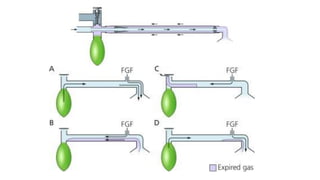
• In a Mapleson D system, the FGF enters at the patient end, with the APL
valve and bag being located at the machine end.
• Most Mapleson D systems in use are the coaxial Bain modification, in
which fresh gas flows down a narrow (6 mm) inner tube and exhaled
gas passes down the 22 mm outer tube.
• This is the reverse arrangement to the co-axial Mapleson A.
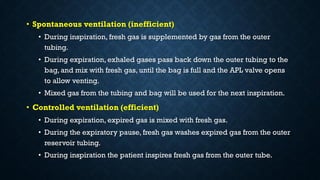
• Spontaneous ventilation (inefficient)
• During inspiration, fresh gas is supplemented by gas from the outer
tubing.
• During expiration, exhaled gases pass back down the outer tubing to the
bag, and mix with fresh gas, until the bag is full and the APL valve opens
to allow venting.
• Mixed gas from the tubing and bag will be used for the next inspiration.
• Controlled ventilation (efficient)
• During expiration, expired gas is mixed with fresh gas.
• During the expiratory pause, fresh gas washes expired gas from the outer
reservoir tubing.
• During inspiration the patient inspires fresh gas from the outer tube.
• Advantages
• Compact system with all the major components at the machine end,
facilitating scavenging.
• Low dead space because the APL valve is at the machine end.
• May be used with a Penl on Nuffield 200 ventilator (see Section 4.5).
• Disadvantages
• Inefficient for spontaneous ventilation.
• If the inner tube becomes disconnected or breaks, the entire system
becomes dead space.
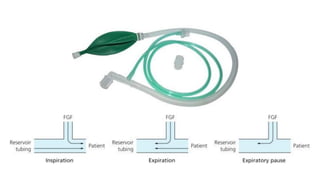
Ayre’s T-piece (Mapleson E)
• A Mapleson E system consists of a T-shaped rigid tube, with connections
forthe FGF, the patient, and a variable length of reservoir tubing.
• It is a valveless, bag less breathing system.
• Whilst intermittent positive pressure ventilation (IPPV) is possible by
intermittently occluding the expiratory limb,
• this affords little control and there is the risk of high pressures occurring.
• Mapleson E systems have been superseded in clinical use by the
Mapleson F system
• Advantages
• There is minimal dead space.
• It is a valveles system.There is therefore minimal resistance to breathing,
and the high pressures that would be encountered in the event of valve
failure, are avoided.
• It is suitable for pediatric patients (up to 25 kg).
• Disadvantages
• Application of PEEP is not possible. This is particularly important in
anaesthetized pediatric patients who are dependent on positive airways
pressure to maintain functional residual capacity (FRC).
• Positive pressure ventilation is difficult and potentially hazardous.
• Scavenging is difficult.
Jackson–rees Modification (Mapleson F)
• The Jackson–Rees modification of Ayre’s T-piece incorporates an open-
ended bag attached to the end of the reservoir tubing.
• Partially occluding the ‘tail’of the bag permits positive pressure
ventilation or the application of PEEP.
• The bag also gives a visual indication of ventilation.
• Gas dynamics during spontaneous or controlled ventilation are similar
to Mapleson E systems.
• FGF of 2–3 times MV is required.
• Advantages
• As for Mapleson E.
• Positive pressure ventilation and PEEP are possible.
• More suitable for inhalational induction than a circle system.
• This is the standard breathing system for pediatric patients (up to 25kg)
although a small calibre circle system may also be used.
• Disadvantages
• Scavenging is difficult.
• The system is inefficient, requiring high FGFs.
• Partially occluding the tail, whilst at the same time squeezing the bag is a
moderately skilled technique.
Humphrey ADE Block
• The Humphrey ADE block was designed and introduced into anaesthetic
practice by David Humphrey in 1983.
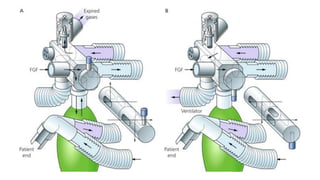
• Its design allows the anaesthetist to switch between Mapleson A, D and E
systems quickly and easily, without the need to disconnect from the fresh gas
flow or change the breathing tubing that goes to and from the patient; this is
achieved in part simply by switching a lever on the block.
• The system can be used in the Mapleson A configuration to improve
efficiency during spontaneous breathing and the Mapleson D mode to
improve efficiency during positive pressure ventilation.
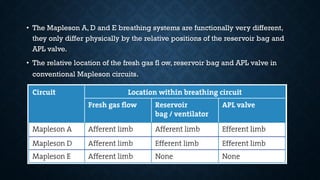
• The Mapleson A, D and E breathing systems are functionally very different,
they only differ physically by the relative positions of the reservoir bag and
APL valve.
• The relative location of the fresh gas fl ow, reservoir bag and APL valve in
conventional Mapleson circuits.
• Uses
A block that connects to the common gas outlet of an anaesthetic machine
and allows the efficiency of the breathing system to be maintained when
switching between spontaneous and controlled ventilation.
It can be used in adults and children.
• Advantages
Versatile: may be used in adults and children.
Switches instantly between three different breathing system
configurations.
• Disadvantages
Not immediately intuitive to use.
Heavy block may dislodge easily from common gas outlet.
• When the lever is up (spontaneous and manual bag ventilation)
• Port 2 is disconnected from the system, but the FGF and APL valve remain
connected.
• The system therefore acts as a Mapleson A.
• In fact, due to its design and the use of low resistance tubing, studies have
shown it to be more efficient than a standard Mapleson A circuit during
spontaneous ventilation, requiring FGFs as low as 50 ,
• Bag ventilation is also possible with the lever in this position.
• Waste gases can be scavenged through the exhaust valve.
When the lever is down (controlled ventilation or T-piece)
• Port 1 and the APL valve are disconnected from the system whilst port 2
remains connected.
• If port 2 is left open to the atmosphere, it behaves as a Mapleson E (T-
piece) system.
• If a ventilator is attached to port 2, the system then operates as a
Mapleson D, although, because the APL valve is redundant, it is not strictly
a Mapleson D.
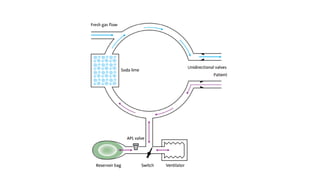
The Circle System
• The circle system is a highly efficient breathing system that conserves
anaesthetic gases, heat and moisture.
• By actively removing carbon dioxide from exhaled gas, the circle system
allows re-breathing of anaesthetic gases.
• In theory, the fresh gas flow (FGF) that is added to the circle system need only
match the oxygen consumption of the patient and any anaesthetic losses
through leaks, absorption or metabolism; i.e. it can operate as a closed
breathing system.
• However, in practice the circle system is almost always used as a semi-closed
system, because the FGF is usually greater than the patient’s gas uptake
• Uses
• This breathing system is particularly useful for long cases because it
efficiently conserves anaesthetic gases, heat and moisture.
• It is the main alternative to the Mapleson systems for conveying gas to
and from the patient in theatre, and often in the anaesthetic room.
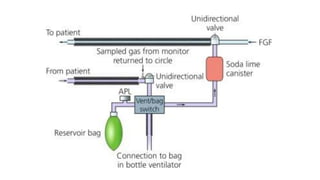
• A circle system comprises:
• A fresh gas inlet
• A reservoir bag
• Two one-way valves (one in each of the inspiratory and expiratory limbs)
• A y-piece connector from the one-way valves to the patient
• An APL valve
• A soda lime canister that absorbs carbon dioxide
• Lengths of corrugated (kink-resistant) tubing to connect the components to one
other and the patient.
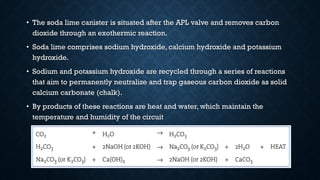
• The soda lime canister is situated after the APL valve and removes carbon
dioxide through an exothermic reaction.
• Soda lime comprises sodium hydroxide, calcium hydroxide and potassium
hydroxide.
• Sodium and potassium hydroxide are recycled through a series of reactions
that aim to permanently neutralize and trap gaseous carbon dioxide as solid
calcium carbonate (chalk).
• By products of these reactions are heat and water, which maintain the
temperature and humidity of the circuit
• Advantages
• The circle system conserves anaesthetic gases, heat and moisture.
• Low flow anaesthesia is possible provided concentrations are monitored.
• There is a low dead space.The Y-piece tubing between the patient and the
inspiratory and expiratory valves creates mechanical dead space, but this
is no greater than in non-rebreathing circuits.
• The soda lime canister is distant from the patient’s airway, reducing the
risk of soda lime dust inhalation.
• Reduced atmospheric pollution because anaesthetic gases can be
recycled.
• Disadvantages
• Changes made at the vaporizer dial take a long time to equilibrate with
the circle system, especially at low flows.
• The circle system apparatus is bulkier than Mapleson breathing systems.
• Complexity of connections mean that leaks and disconnections are more
difficult to identify quickly.
• The extra valves, tubing and soda lime canister increase the resistance.
• At low flows, recycled expired gases progressively dilute the fresh gas
flow risking hypoxia and awareness.
“
”
Thank You
(+91) 8087788417

Breathing systems - Mapleson Classification

  • 1.
    Breathing Systems Mr. HarshadKhade MSc. Medical Technology (OTA) Symbiosis International university, Pune.
  • 2.
    Introduction • A breathingsystem is a device that conducts gases such as oxygen and anesthetic agents to the patient and conducts waste gases such as CO2 away. • Breathing systems are classified as Open, Semi-open, Semi-closed Closed.
  • 3.
    • Semi-closed systemsare further divided into Rebreathing Systems With CO2 Absorption, Rebreathing Systems Without CO2 Absorption Non-rebreathing Systems. • More simply, systems can be classified in two groups: systems with CO2 washout (includes open and semi-open systems) systems with CO2 absorption (includes closed and semi-closed systems).
  • 4.
    • Open systemsinclude the use of chloroform dripped onto gauze (for example, a Schimmelbusch mask, or the delivery of the fresh gas into an anaesthetist’s cupped hands for inhalational induction in pediatrics. • Semi-open systems include those in the Mapleson classification; they rely on their gas dynamics to ensure that CO2 is washed out and not rebreathed. : A Schimmelbusch mask – an historical example of an open breathing system.
  • 5.
    • The circlesystem incorporates a soda lime canister for CO2 absorption. It usually functions as a semi-closed system. • When the fresh gas flow is greater than the patient’s gas uptake, some gas is vented via the adjustable pressure limiting (APL) valve, and the circle behaves as a semi-closed system. It is possible to use a circle as a fully closed system. • To do this, the APL valve is closed and the fresh gas flow is set equal to the uptake by the patient so that the overall volume of gas in the system is constant. • It is difficult to estimate the patient’s oxygen uptake accurately and therefore fully closed systems are rarely used in practice.
  • 6.
    Efficiency • The efficiencyof a breathing system is defined by the lowest fresh gas flow that prevents the patient rebreathing CO2. • Low fresh gas flows are desirable to reduce the amount of expensive (and polluting) volatile anaesthetic that is used. • In an inefficient open system, most anaesthetic will be vented into the atmosphere, whereas in a closed system, only the amount taken up by the patient is required.
  • 7.
    An Ideal BreathingSystem Be simple and portable Be safe to use in all age groups Reliably deliver the intended gas mixture Be efficient in both spontaneous and controlled ventilation Protect patients from barotrauma Permit scavenging of waste gases Offer low resistance to gas flow  Conserve heat and moisture. • Unfortunately, no system fits all criteria and a compromise is therefore made depending on the situation.
  • 9.
    Bag Valve Mask •The bag valve mask was first brought to market in 1956 by AMBU ; these systems are therefore AMBU bags. • The primary benefit of bag valve masks over other breathing systems is their self-inflating bag, which enables them to be used without a pressurized gas supply. • Uses • Bag valve masks are used for emergency ventilation, with or without a pressurized gas supply. • The bag and valve may also be used to ventilate via an ETT. • The self-inflating bag is usually made of clear silicone and returns to its original shape when squeezed.
  • 10.
    • Advantages May beused to deliver room air without a pressurized gas supply. Self-contained and widely available. • Disadvantages There is little tactile feedback during ventilation. There is no visual indication of spontaneous ventilation
  • 12.
    Adjustable Pressure LimitingValve • The APL valve is a spring-loaded pressure release valve in which the release pressure can be varied to suit the situation. • Uses • APL valves are an essential component of most breathing systems (except the Mapleson E or F) allowing control of the pressure within the breathing system and therefore the airway. • The valve consists of a lightweight disc which is held against the base by a spring, closing the valve. • The pressure exerted by the spring may be adjusted by screwing the valve cap.When the pressure beneath the disc exceeds the pressure exerted by the spring, the valve will open, allowing gas to escape.
  • 13.
    • Advantages Permits controlof the airway pressure during positive pressure ventilation. Permits application of PEEP. Facilitates scavenging. • Disadvantages Water vapour may condense on the disc, causing it to stick. Discs are made of a hydrophobic material to reduce the likelihood of this. Valves introduce greater resistance and are less suitable for small children. This is the reason the APL valve is absent from the Mapleson E and F systems. Barotrauma may result from inadvertent closure of the APL valve. Adds bulk to the breathing system.
  • 15.
    Reservoir Bag • Thereservoir bag is an essential component of most breathing systems because it improves efficiency and permits manual ventilation. • Bags are available in both rubber and latex-free versions. • The standard adult size is liters, with pediatric sizes down to 0.5 litres. Larger sizes are occasionally used for inhalational induction in adults. • Uses • 2 A component of most anaesthetic breathing systems.
  • 16.
    • The reservoirbag has a number of useful properties. It acts as a reservoir for oxygen and anaesthetic gases, which enter the bag from the fresh gas flow during expiration and are drawn upon during inspiration, thus allowing lower fresh gas flows to be used. Manual ventilation is achieved by squeezing the bag. It acts as a visual indicator of spontaneous ventilation. In the event of a valve becoming stuck or being left unintentionally closed, pressure will build up in the breathing system. The reservoir bag will then distend, limiting the pressure to around 60cmH2O and thus reducing barotrauma.
  • 18.
    • According tothe law of Laplace, the pressure will fall as the bag’s radius increases – an effect that can be demonstrated using the pressure gauge on an anaesthetic machine. • The law of Laplace P = 2T / r • where P = pressure,T = tension in the wall of a sphere, r = radius. • Advantages • An essential component of anaesthetic breathing systems. • Permits tactile feedback. • Disadvantages • It is relatively easy to tear the bag. • It is not self-inflating and must therefore be used with a pressurized gas supply
  • 20.
    The Mapleson Classification •In 1954, Mapleson performed mathematical modelling of the semi- open breathing systems available to him. • He classified them into five breathing systems (A–E) and a sixth (F) was added later. • Systems are classified according to the relative positions of three components: the fresh gas flow (FGF), the APL valve and a gas reservoir. • Variable lengths of corrugated tubing connect the components. • Mapleson systems are semi-open and rely on sufficient fresh gas flow to wash out exhaled gas and prevent rebreathing.
  • 21.
    • Uses In comparisonwith a circle system, Mapleson breathing systems are inefficient (meaning that higher FGFs are required to prevent rebreathing) and are therefore expensive to use with volatile anaesthetics. They are therefore not used for anaesthetic delivery to adult patients in theatre – circle systems are used instead. Mapleson systems continue to be used in the anaesthetic room (D and, occasionally, A), for transfers or management of critically ill patients outside of theatre (C), and for paediatric patients (F and, occasionally, E).
  • 22.
    • Advantages • Maplesonsystems remain in use because they: • Are simple and cheap • Do not require CO2 absorption • Are easily portable (particularly C, E and F) • Have some specific advantages in pediatric anaesthesia (F). • Disadvantages • Compared with a circle system, all mapleson systems are inefficient.
  • 24.
    Magill System (MaplesonA) • Fresh gas flow enters at the machine end, just proximal to the reservoir bag, which is connected by approximately 1.6 m of tubing to the APL valve at the patient end. • The volume of this tubing must exceed one tidal volume to ensure efficient spontaneous ventilation. • Advantages • Efficient for spontaneous ventilation. • Disadvantages • Inefficient for controlled ventilation. • The APL valve at the patient end adds bulk and drags on breathing circuit connections, particularly if connected to scavenging. • Not suitable for paediatrics.
  • 26.
    • Spontaneous ventilation(efficient) During inspiration, the APL valve closes and the patient inspires fresh gas from the tubing. During expiration, the expiratory gas initially enters the reservoir tubing until the bag fills and the pressure opens the APL valve allowing gas to escape. During the expiratory pause, fresh gas displaces the remaining expired gas out of the APL valve. At flows equal ling MV, no rebreathing occurs. • Controlled ventilation (inefficient) Venting of FGF occurs during positive pressure inspiration and exhaled gas is not vented until the APL valve reopens (a higher APL valve opening pressure has to be set than during spontaneous ventilation). Rebreathing of expired gas therefore occurs unless FGF exceeds 3 times MV.
  • 28.
    Lack System (CoaxialMapleson A) • The Lack system is a modification of the Magill system, designed to eliminate the problem of having the APL valve at the patient end. • It consists of a 30mm outer tube for inspiration, and a 14mm innertube for expiration. • This wider bore tubing is required in order to reduce resistance to expiration. • The Lack system has similar characteristics to the Magill system, being efficient for spontaneous ventilation and inefficient for controlled ventilation
  • 30.
    • Advantages • Efficientfor spontaneous ventilation. • Bulky components are all at the machine end. • Disadvantages • Inefficient for controlled ventilation. • If the inner tube develops a leak, the entire system becomes dead space and CO2 rapidly builds up
  • 32.
    Mapleson B • Thiscircuit is not in common usage. • The FGF and APL valve are at the patient end of the tubing, which causes complete mixing of fresh and expired gas. • It is therefore inefficient for both spontaneous and controlled ventilation. • Fresh gas flows of 2–3 times MV are required ( this is slightly more efficient than Mapleson A for controlled ventilation, but significantly worse during spontaneous ventilation).
  • 34.
    Mapleson C • Thissystem is similar to a Mapleson B system, but without the reservoir tubing. • The bag, FGF and APL valve are all at the patient end. • It is inefficient for both spontaneous and controlled ventilation and requires FGFs of 2–3 times minute volume (15 l.min-1 is therefore appropriate). • It is used in resuscitation situations as an alternative to a self-inflating bag. • In these situations, volatile anaesthetics are not used and therefore efficiency is less important than portability
  • 35.
    • Advantages • Simpleand lightweight. • Useful for resuscitation, allowing PEEP to be applied and giving a visual and tactile indication of ventilation. • Disadvantages • Inefficient, CO2 accumulates over time. • APL valve adds bulk at the patient end.
  • 37.
    Bain System (CoaxialMapleson D) • In a Mapleson D system, the FGF enters at the patient end, with the APL valve and bag being located at the machine end. • Most Mapleson D systems in use are the coaxial Bain modification, in which fresh gas flows down a narrow (6 mm) inner tube and exhaled gas passes down the 22 mm outer tube. • This is the reverse arrangement to the co-axial Mapleson A.
  • 39.
    • Spontaneous ventilation(inefficient) • During inspiration, fresh gas is supplemented by gas from the outer tubing. • During expiration, exhaled gases pass back down the outer tubing to the bag, and mix with fresh gas, until the bag is full and the APL valve opens to allow venting. • Mixed gas from the tubing and bag will be used for the next inspiration. • Controlled ventilation (efficient) • During expiration, expired gas is mixed with fresh gas. • During the expiratory pause, fresh gas washes expired gas from the outer reservoir tubing. • During inspiration the patient inspires fresh gas from the outer tube.
  • 40.
    • Advantages • Compactsystem with all the major components at the machine end, facilitating scavenging. • Low dead space because the APL valve is at the machine end. • May be used with a Penl on Nuffield 200 ventilator (see Section 4.5). • Disadvantages • Inefficient for spontaneous ventilation. • If the inner tube becomes disconnected or breaks, the entire system becomes dead space.
  • 42.
    Ayre’s T-piece (MaplesonE) • A Mapleson E system consists of a T-shaped rigid tube, with connections forthe FGF, the patient, and a variable length of reservoir tubing. • It is a valveless, bag less breathing system. • Whilst intermittent positive pressure ventilation (IPPV) is possible by intermittently occluding the expiratory limb, • this affords little control and there is the risk of high pressures occurring. • Mapleson E systems have been superseded in clinical use by the Mapleson F system
  • 44.
    • Advantages • Thereis minimal dead space. • It is a valveles system.There is therefore minimal resistance to breathing, and the high pressures that would be encountered in the event of valve failure, are avoided. • It is suitable for pediatric patients (up to 25 kg). • Disadvantages • Application of PEEP is not possible. This is particularly important in anaesthetized pediatric patients who are dependent on positive airways pressure to maintain functional residual capacity (FRC). • Positive pressure ventilation is difficult and potentially hazardous. • Scavenging is difficult.
  • 46.
    Jackson–rees Modification (MaplesonF) • The Jackson–Rees modification of Ayre’s T-piece incorporates an open- ended bag attached to the end of the reservoir tubing. • Partially occluding the ‘tail’of the bag permits positive pressure ventilation or the application of PEEP. • The bag also gives a visual indication of ventilation. • Gas dynamics during spontaneous or controlled ventilation are similar to Mapleson E systems. • FGF of 2–3 times MV is required.
  • 48.
    • Advantages • Asfor Mapleson E. • Positive pressure ventilation and PEEP are possible. • More suitable for inhalational induction than a circle system. • This is the standard breathing system for pediatric patients (up to 25kg) although a small calibre circle system may also be used. • Disadvantages • Scavenging is difficult. • The system is inefficient, requiring high FGFs. • Partially occluding the tail, whilst at the same time squeezing the bag is a moderately skilled technique.
  • 52.
    Humphrey ADE Block •The Humphrey ADE block was designed and introduced into anaesthetic practice by David Humphrey in 1983. • Its design allows the anaesthetist to switch between Mapleson A, D and E systems quickly and easily, without the need to disconnect from the fresh gas flow or change the breathing tubing that goes to and from the patient; this is achieved in part simply by switching a lever on the block. • The system can be used in the Mapleson A configuration to improve efficiency during spontaneous breathing and the Mapleson D mode to improve efficiency during positive pressure ventilation.
  • 54.
    • The MaplesonA, D and E breathing systems are functionally very different, they only differ physically by the relative positions of the reservoir bag and APL valve. • The relative location of the fresh gas fl ow, reservoir bag and APL valve in conventional Mapleson circuits.
  • 55.
    • Uses A blockthat connects to the common gas outlet of an anaesthetic machine and allows the efficiency of the breathing system to be maintained when switching between spontaneous and controlled ventilation. It can be used in adults and children. • Advantages Versatile: may be used in adults and children. Switches instantly between three different breathing system configurations. • Disadvantages Not immediately intuitive to use. Heavy block may dislodge easily from common gas outlet.
  • 56.
    • When thelever is up (spontaneous and manual bag ventilation) • Port 2 is disconnected from the system, but the FGF and APL valve remain connected. • The system therefore acts as a Mapleson A. • In fact, due to its design and the use of low resistance tubing, studies have shown it to be more efficient than a standard Mapleson A circuit during spontaneous ventilation, requiring FGFs as low as 50 , • Bag ventilation is also possible with the lever in this position. • Waste gases can be scavenged through the exhaust valve.
  • 57.
    When the leveris down (controlled ventilation or T-piece) • Port 1 and the APL valve are disconnected from the system whilst port 2 remains connected. • If port 2 is left open to the atmosphere, it behaves as a Mapleson E (T- piece) system. • If a ventilator is attached to port 2, the system then operates as a Mapleson D, although, because the APL valve is redundant, it is not strictly a Mapleson D.
  • 59.
    The Circle System •The circle system is a highly efficient breathing system that conserves anaesthetic gases, heat and moisture. • By actively removing carbon dioxide from exhaled gas, the circle system allows re-breathing of anaesthetic gases. • In theory, the fresh gas flow (FGF) that is added to the circle system need only match the oxygen consumption of the patient and any anaesthetic losses through leaks, absorption or metabolism; i.e. it can operate as a closed breathing system. • However, in practice the circle system is almost always used as a semi-closed system, because the FGF is usually greater than the patient’s gas uptake
  • 61.
    • Uses • Thisbreathing system is particularly useful for long cases because it efficiently conserves anaesthetic gases, heat and moisture. • It is the main alternative to the Mapleson systems for conveying gas to and from the patient in theatre, and often in the anaesthetic room. • A circle system comprises: • A fresh gas inlet • A reservoir bag • Two one-way valves (one in each of the inspiratory and expiratory limbs) • A y-piece connector from the one-way valves to the patient • An APL valve • A soda lime canister that absorbs carbon dioxide • Lengths of corrugated (kink-resistant) tubing to connect the components to one other and the patient.
  • 63.
    • The sodalime canister is situated after the APL valve and removes carbon dioxide through an exothermic reaction. • Soda lime comprises sodium hydroxide, calcium hydroxide and potassium hydroxide. • Sodium and potassium hydroxide are recycled through a series of reactions that aim to permanently neutralize and trap gaseous carbon dioxide as solid calcium carbonate (chalk). • By products of these reactions are heat and water, which maintain the temperature and humidity of the circuit
  • 64.
    • Advantages • Thecircle system conserves anaesthetic gases, heat and moisture. • Low flow anaesthesia is possible provided concentrations are monitored. • There is a low dead space.The Y-piece tubing between the patient and the inspiratory and expiratory valves creates mechanical dead space, but this is no greater than in non-rebreathing circuits. • The soda lime canister is distant from the patient’s airway, reducing the risk of soda lime dust inhalation. • Reduced atmospheric pollution because anaesthetic gases can be recycled.
  • 65.
    • Disadvantages • Changesmade at the vaporizer dial take a long time to equilibrate with the circle system, especially at low flows. • The circle system apparatus is bulkier than Mapleson breathing systems. • Complexity of connections mean that leaks and disconnections are more difficult to identify quickly. • The extra valves, tubing and soda lime canister increase the resistance. • At low flows, recycled expired gases progressively dilute the fresh gas flow risking hypoxia and awareness.
  • 66.