Why learn to manage conflict? Managing conflict: a workshop facilitated by  Charles Miller and  Nancy Stetson, Experts on Call  The following slides are a combination/abbreviated version of conflict workshops developed by these two experts.
How well do you already know how to... 1. Sort out conflicts in task, process or method, and relationship? 2. Decide which of five conflict management strategies will be the most effective one to apply in a given situation? 3. Manage your  own  interpersonal conflicts?
4. Help other individuals manage their interpersonal conflicts? 5. Help a group manage its conflicts?
Positive aspects of conflict Can stimulate creativity, innovation, and change
Managing conflict: your preferred style Next to each of the following 16 items, indicate how often you do the following when you differ with someone: Usually :  give yourself a 5 Sometimes : give yourself a 3 Seldom:  give yourself a  1 Be honest! This is a self-assessment; you don’t need to share your results!
When I differ with someone: 1. I explore our differences, not backing down, but not imposing my view either  2. I disagree openly, then invite more discussion about our differences 3. I look for a mutually satisfactory solution 4. Rather than let the other person make a decision without my input, I make sure I am heard and also that I hear the other out
When I differ with someone: 5. I agree to a middle ground rather than look for a completely satisfying solution 6. I admit I am half wrong rather than explore our differences 7. I have a reputation for meeting a person halfway 8. I expect to get out about half of what I really want to say
When I differ with someone: 9. I give in totally rather than try to change another’s opinion 10. I put aside any controversial aspects of an issue 11. I agree early on, rather than argue about a point 12. I give in as soon as the other party gets emotional about an issue
When I differ with someone: 13. I try to win the other person over 14. I work to come out victorious, no matter what 15. I never back away from a good argument 16. I would rather win than end up compromising
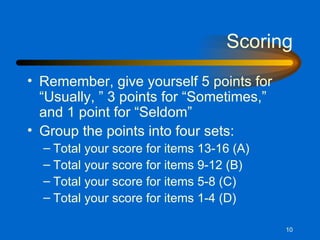
Scoring Remember, give yourself 5 points for “Usually, ” 3 points for “Sometimes,” and 1 point for “Seldom” Group the points into four sets: Total your score for items 13-16 (A) Total your score for items 9-12 (B) Total your score for items 5-8 (C) Total your score for items 1-4 (D)
For each set (A, B, C, and D): Scores of 17 or above are considered high Scores of 8-16 are considered moderate Scores of 7 or less are considered low The one with the highest score would indicate your conflict style preference. But with scores in each, you have the ability to use all the styles. Now which is best to use? It all depends…..
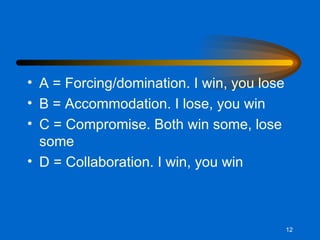
A = Forcing/domination. I win, you lose B = Accommodation. I lose, you win C = Compromise. Both win some, lose some D = Collaboration. I win, you win
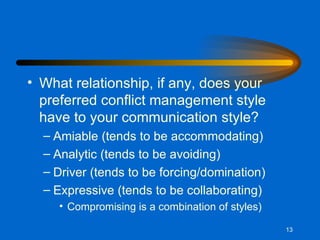
What relationship, if any, does your preferred conflict management style have to your communication style? Amiable (tends to be accommodating) Analytic (tends to be avoiding) Driver (tends to be forcing/domination) Expressive (tends to be collaborating) Compromising is a combination of styles)
Conflict Occurs Due To: Confusion or disagreement on: Task Process or method Relationship
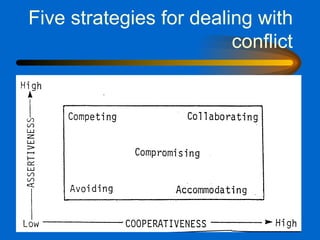
Five strategies for dealing with conflict Avoidance Accommodation Forcing Compromise Collaboration
Five strategies for dealing with conflict
Factors in selecting the appropriate strategy Importance  of the conflict issue Concern over maintaining long-term interpersonal  relationships Speed  with which you need to resolve the conflict
When to use  avoidance When the conflict issue is trivial When emotions are running high and time is needed to cool them down When the potential disruption from a more assertive action outweighs the benefit of resolution Easy for Analytics
When to use  accommodation When maintaining a harmonious relationship  is more important than resolving the conflict When the issue under dispute isn’t that important to you When you want to build up credits for later issues Easy for Amiables
When to use  forcing  (or formal authority) When you need a quick resolution, on important issues where unpopular actions must be taken Where commitment by others to your solution is not critical Easy for Drivers
When to use  compromise When conflicting parties are about equal in power When it is desirable to achieve a temporary solution to a complex issue When time pressures demand an expedient solution Not easy for ANY particular style
When to use  collaboration When time pressures are minimal When all parties seriously want a win-win solution When the issue is too important to be compromised Easy for Expressives
Managing conflict: three approaches Managing your  own  interpersonal conflicts Helping two other  individuals  manage their interpersonal conflicts Helping a  group  manage its conflicts
Position versus interest Position = what the two or more parties each want Interest  = why each of the parties want it; motivation or reason It’s important to talk about  interests , not positions
Guidelines for managing your  own  interpersonal conflicts 1. State your problem or  interest  (not position); ask the other party to do likewise
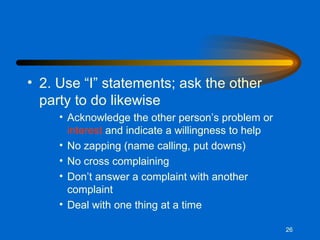
2. Use “I” statements; ask the other party to do likewise Acknowledge the other person’s problem or  interest  and indicate a willingness to help No zapping (name calling, put downs) No cross complaining Don’t answer a complaint with another complaint Deal with one thing at a time
3. Let the other party talk; listen Don’t interrupt Acknowledge Restate what you’ve heard Offer an apology when appropriate
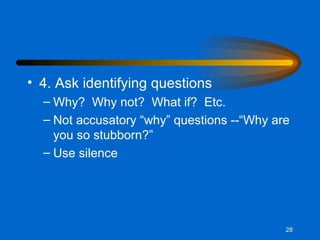
4. Ask identifying questions Why?  Why not?  What if?  Etc. Not accusatory “why” questions --“Why are you so stubborn?” Use silence
5. Stay in the present and the future, not the past 6. Stick to the topic at hand 7. Look for areas of disagreement 8. If the discussion escalates, withdraw, but not before scheduling the next discussion
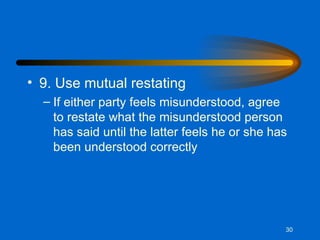
9. Use mutual restating If either party feels misunderstood, agree to restate what the misunderstood person has said until the latter feels he or she has been understood correctly
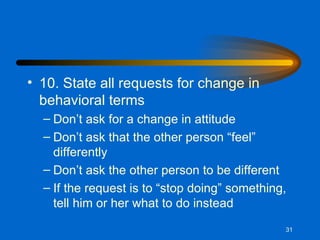
10. State all requests for change in behavioral terms Don’t ask for a change in attitude Don’t ask that the other person “feel” differently Don’t ask the other person to be different If the request is to “stop doing” something, tell him or her what to do instead
11. Use appropriate tone of voice and body language Be consistent with verbal and nonverbal messages Rely more on words when communicating negative feelings Show confidence:  relax, don’t  fidget; use good eye contact; show interest and optimism, etc.
Bibliography Ollander-Krane, J. N. & Johnson, “Common Ground: Intervening in Interpersonal Conflict,”  The 1995 Annual: Volume 2, Consulting . San Diego: Pfeiffer & Company
Robbins, S.P., & P. L. Hunsaker,  Training in Interpersonal Skills: Tips for Managing People at Work . Upper Saddle River, NJ: Prentice Hall, 1996 Von der Embse, T.J.,  Supervision: Managerial Skills for a New Era , Macmillan, 1987

Managing conflict

  • 1.
    Why learn tomanage conflict? Managing conflict: a workshop facilitated by Charles Miller and Nancy Stetson, Experts on Call The following slides are a combination/abbreviated version of conflict workshops developed by these two experts.
  • 2.
    How well doyou already know how to... 1. Sort out conflicts in task, process or method, and relationship? 2. Decide which of five conflict management strategies will be the most effective one to apply in a given situation? 3. Manage your own interpersonal conflicts?
  • 3.
    4. Help otherindividuals manage their interpersonal conflicts? 5. Help a group manage its conflicts?
  • 4.
    Positive aspects ofconflict Can stimulate creativity, innovation, and change
  • 5.
    Managing conflict: yourpreferred style Next to each of the following 16 items, indicate how often you do the following when you differ with someone: Usually : give yourself a 5 Sometimes : give yourself a 3 Seldom: give yourself a 1 Be honest! This is a self-assessment; you don’t need to share your results!
  • 6.
    When I differwith someone: 1. I explore our differences, not backing down, but not imposing my view either 2. I disagree openly, then invite more discussion about our differences 3. I look for a mutually satisfactory solution 4. Rather than let the other person make a decision without my input, I make sure I am heard and also that I hear the other out
  • 7.
    When I differwith someone: 5. I agree to a middle ground rather than look for a completely satisfying solution 6. I admit I am half wrong rather than explore our differences 7. I have a reputation for meeting a person halfway 8. I expect to get out about half of what I really want to say
  • 8.
    When I differwith someone: 9. I give in totally rather than try to change another’s opinion 10. I put aside any controversial aspects of an issue 11. I agree early on, rather than argue about a point 12. I give in as soon as the other party gets emotional about an issue
  • 9.
    When I differwith someone: 13. I try to win the other person over 14. I work to come out victorious, no matter what 15. I never back away from a good argument 16. I would rather win than end up compromising
  • 10.
    Scoring Remember, giveyourself 5 points for “Usually, ” 3 points for “Sometimes,” and 1 point for “Seldom” Group the points into four sets: Total your score for items 13-16 (A) Total your score for items 9-12 (B) Total your score for items 5-8 (C) Total your score for items 1-4 (D)
  • 11.
    For each set(A, B, C, and D): Scores of 17 or above are considered high Scores of 8-16 are considered moderate Scores of 7 or less are considered low The one with the highest score would indicate your conflict style preference. But with scores in each, you have the ability to use all the styles. Now which is best to use? It all depends…..
  • 12.
    A = Forcing/domination.I win, you lose B = Accommodation. I lose, you win C = Compromise. Both win some, lose some D = Collaboration. I win, you win
  • 13.
    What relationship, ifany, does your preferred conflict management style have to your communication style? Amiable (tends to be accommodating) Analytic (tends to be avoiding) Driver (tends to be forcing/domination) Expressive (tends to be collaborating) Compromising is a combination of styles)
  • 14.
    Conflict Occurs DueTo: Confusion or disagreement on: Task Process or method Relationship
  • 15.
    Five strategies fordealing with conflict Avoidance Accommodation Forcing Compromise Collaboration
  • 16.
    Five strategies fordealing with conflict
  • 17.
    Factors in selectingthe appropriate strategy Importance of the conflict issue Concern over maintaining long-term interpersonal relationships Speed with which you need to resolve the conflict
  • 18.
    When to use avoidance When the conflict issue is trivial When emotions are running high and time is needed to cool them down When the potential disruption from a more assertive action outweighs the benefit of resolution Easy for Analytics
  • 19.
    When to use accommodation When maintaining a harmonious relationship is more important than resolving the conflict When the issue under dispute isn’t that important to you When you want to build up credits for later issues Easy for Amiables
  • 20.
    When to use forcing (or formal authority) When you need a quick resolution, on important issues where unpopular actions must be taken Where commitment by others to your solution is not critical Easy for Drivers
  • 21.
    When to use compromise When conflicting parties are about equal in power When it is desirable to achieve a temporary solution to a complex issue When time pressures demand an expedient solution Not easy for ANY particular style
  • 22.
    When to use collaboration When time pressures are minimal When all parties seriously want a win-win solution When the issue is too important to be compromised Easy for Expressives
  • 23.
    Managing conflict: threeapproaches Managing your own interpersonal conflicts Helping two other individuals manage their interpersonal conflicts Helping a group manage its conflicts
  • 24.
    Position versus interestPosition = what the two or more parties each want Interest = why each of the parties want it; motivation or reason It’s important to talk about interests , not positions
  • 25.
    Guidelines for managingyour own interpersonal conflicts 1. State your problem or interest (not position); ask the other party to do likewise
  • 26.
    2. Use “I”statements; ask the other party to do likewise Acknowledge the other person’s problem or interest and indicate a willingness to help No zapping (name calling, put downs) No cross complaining Don’t answer a complaint with another complaint Deal with one thing at a time
  • 27.
    3. Let theother party talk; listen Don’t interrupt Acknowledge Restate what you’ve heard Offer an apology when appropriate
  • 28.
    4. Ask identifyingquestions Why? Why not? What if? Etc. Not accusatory “why” questions --“Why are you so stubborn?” Use silence
  • 29.
    5. Stay inthe present and the future, not the past 6. Stick to the topic at hand 7. Look for areas of disagreement 8. If the discussion escalates, withdraw, but not before scheduling the next discussion
  • 30.
    9. Use mutualrestating If either party feels misunderstood, agree to restate what the misunderstood person has said until the latter feels he or she has been understood correctly
  • 31.
    10. State allrequests for change in behavioral terms Don’t ask for a change in attitude Don’t ask that the other person “feel” differently Don’t ask the other person to be different If the request is to “stop doing” something, tell him or her what to do instead
  • 32.
    11. Use appropriatetone of voice and body language Be consistent with verbal and nonverbal messages Rely more on words when communicating negative feelings Show confidence: relax, don’t fidget; use good eye contact; show interest and optimism, etc.
  • 33.
    Bibliography Ollander-Krane, J.N. & Johnson, “Common Ground: Intervening in Interpersonal Conflict,” The 1995 Annual: Volume 2, Consulting . San Diego: Pfeiffer & Company
  • 34.
    Robbins, S.P., &P. L. Hunsaker, Training in Interpersonal Skills: Tips for Managing People at Work . Upper Saddle River, NJ: Prentice Hall, 1996 Von der Embse, T.J., Supervision: Managerial Skills for a New Era , Macmillan, 1987