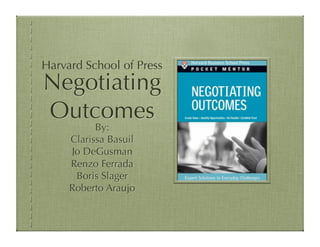
Harvard School of Press
Negotiating
Outcomes
           By:
     Clarissa Basuil
     Jo DeGusman
     Renzo Ferrada
      Boris Slager
     Roberto Araujo
Negotiating Outcomes

          Presentation Contents
•  Why we chose this book - By Jo

•  Chap. 1-2. Types of Negotiations  Four key concepts - by
  Clarissa

•  Chap. 3-4. Four Key Concepts  The Nine Steps to a Deal - by
  Boris

•  Chap. 5-6. Tactics for Getting Off To a Good Start  Barriers to
  Agreement - by Jo

•  Chap. 7-8. Cognitive Traps  Skill of Effective Negotiators - by
  Renzo

•  Chap. 9-10. Tools for Negotiating Outcomes  Test Yourself -
  by Roberto
Negotiating Outcomes

             Why This Book...
•  Involved Numerous Situations:

   A. Work   B)Home       C) Recreation

•  Prepare for, conduct, and close negotiations

•  Negotiating and resolving conflict throughout your personal
  and professional life

•  Negotiation skills among most significant determinants of
  career success

•  Brief but complete book.
Negotiating Outcomes Ch. 1

    Types of Negotiations
•  Negotiation is the process by with people deal with
  their differences

•  2 Types of Negotiations:
      •  Distributive Negotiation: “Who will claim the most
         value?”

      •  Integrative Negotiation: the goal is of each side to
         “create”as much value as possible for itself and for the
         other side
Negotiating Outcomes Ch. 2
         Multiphase and Multiparty
               Negotiations
• Multiphase negotiations are implemented over
  time in different phase
      •  Example: Architectural design contract

• In Multiparty negotiations, coalitions or alliances
  can form among the parties and influence the
  process or outcome

• Coalition: temporary alliance of separate entities
  or individuals who join together to seek a
  common purpose

• 2 Types of Coalitions:
      • Natural Coalition
      • Single Issues Coalitions
Negotiating Outcomes Ch. 3


      Four Key Concepts
•  BATNA - Best Alternative To a Negotiated Agreement

     •  Reservation Price: walk away price

•  ZOPA - Zone Of Possible Agreement

     •  Value Creation Through Trades
Negotiating Outcomes Ch. 4


The Nine Steps to a Deal
1.  Determine Satisfactory Outcomes

2.  Identify opportunities to create value

3.  Identify your BATNA and reservation price

4.  Improve your BATNA

5.  Determine who has authority

6.  Study the other side

7.  Prepare for flexibility in the process

8.  Gather objective criteria to establish fairness
Negotiating Outcomes Ch. 5

              Negotiation Tactics
   •  Tactics for getting off a good start

   •  Tips for establishing the right one

   •  Tactics for distributive negotiations

   •  Steps for closing a deal

   •  Tips for listening actively

   •  Framing the solution
Negotiating Outcomes Ch. 6


    Barriers To Agreement
      •  Die-hard bargainers

      •  Lack of trust

      •  Dealing with Saboteurs

      •  Difference in gender and culture

      •  Communication problems
Negotiating Outcomes Ch. 7


        Cognitive Traps
•  Irrational Escalation

•  Partisan Perception

•  Unreasonable Expectation

•  Overconfidence

•  Unchecked Emotions
Negotiating Outcomes Ch. 8

    The Skills Of Effective Negotiators
•  Align negotiating goals with organizational goals

•  Be thoroughly prepared

•  Determine the other side’s   BATNA and reservation price

•  Identify the interests of both sides and develop value-
  creating options

•  Separate personal issues from negotiating essues

•  Develop a reputation for reliability and trustworthiness

•  Recognize relationship value
Negotiating Outcomes Ch. 9

    Tools for Negotiating
         Outcomes
 •  Several Forms to fill out:

    •  Determining Your Reservation Price

    •  Assessing the Other Side’s Interests

    •  Identifying and Improving your BATNA

    •  Evaluating Your Authority and That of the Other
       Side

    •  Sales Negotiation Planning Form
Negotiating Outcomes Ch. 10

                           Test Yourself
   • Multiple Choice Questions
   • Answers Provided
Example:

I. Why is it important to know your BATNA before walking
into A.  negotiation? you to create value through trades.
     a Your BATNA enables
   B.  Your BATNA determines the point at which you can say no to an unfavorable
       proposal. B.  Your BATNA determines the point at which
                     you can say no to an unfavorable proposal.
   C.  Your BATNA helps you identify when it is advantageous to form a coalition.

   D.  Because BATNA will always stick-out for friend Robin.
Negotiating Outcomes


        Skit On Negotiations
•  Scene: Business partners go to the “Bank Of Loans”
   branch and look to get a business loan. They want to
   buy a Bagel Shop. Actual price of the shop is
   $80,000.
                            Cast
•  Narrator: Clarissa

•  Bank Manager: Boris

•  Bank Employee: Renzo

•  Business Partner 1: Jo

•  Business Partner 2: Roberto
THE END
(Autographs will be provided at the end of the class)

Negotiating outcomes presentation pp

  • 1.
    Harvard School ofPress Negotiating Outcomes By: Clarissa Basuil Jo DeGusman Renzo Ferrada Boris Slager Roberto Araujo
  • 2.
    Negotiating Outcomes Presentation Contents •  Why we chose this book - By Jo •  Chap. 1-2. Types of Negotiations Four key concepts - by Clarissa •  Chap. 3-4. Four Key Concepts The Nine Steps to a Deal - by Boris •  Chap. 5-6. Tactics for Getting Off To a Good Start Barriers to Agreement - by Jo •  Chap. 7-8. Cognitive Traps Skill of Effective Negotiators - by Renzo •  Chap. 9-10. Tools for Negotiating Outcomes Test Yourself - by Roberto
  • 3.
    Negotiating Outcomes Why This Book... •  Involved Numerous Situations: A. Work B)Home C) Recreation •  Prepare for, conduct, and close negotiations •  Negotiating and resolving conflict throughout your personal and professional life •  Negotiation skills among most significant determinants of career success •  Brief but complete book.
  • 4.
    Negotiating Outcomes Ch.1 Types of Negotiations •  Negotiation is the process by with people deal with their differences •  2 Types of Negotiations: •  Distributive Negotiation: “Who will claim the most value?” •  Integrative Negotiation: the goal is of each side to “create”as much value as possible for itself and for the other side
  • 5.
    Negotiating Outcomes Ch.2 Multiphase and Multiparty Negotiations • Multiphase negotiations are implemented over time in different phase •  Example: Architectural design contract • In Multiparty negotiations, coalitions or alliances can form among the parties and influence the process or outcome • Coalition: temporary alliance of separate entities or individuals who join together to seek a common purpose • 2 Types of Coalitions: • Natural Coalition • Single Issues Coalitions
  • 6.
    Negotiating Outcomes Ch.3 Four Key Concepts •  BATNA - Best Alternative To a Negotiated Agreement •  Reservation Price: walk away price •  ZOPA - Zone Of Possible Agreement •  Value Creation Through Trades
  • 7.
    Negotiating Outcomes Ch.4 The Nine Steps to a Deal 1.  Determine Satisfactory Outcomes 2.  Identify opportunities to create value 3.  Identify your BATNA and reservation price 4.  Improve your BATNA 5.  Determine who has authority 6.  Study the other side 7.  Prepare for flexibility in the process 8.  Gather objective criteria to establish fairness
  • 8.
    Negotiating Outcomes Ch.5 Negotiation Tactics •  Tactics for getting off a good start •  Tips for establishing the right one •  Tactics for distributive negotiations •  Steps for closing a deal •  Tips for listening actively •  Framing the solution
  • 9.
    Negotiating Outcomes Ch.6 Barriers To Agreement •  Die-hard bargainers •  Lack of trust •  Dealing with Saboteurs •  Difference in gender and culture •  Communication problems
  • 10.
    Negotiating Outcomes Ch.7 Cognitive Traps •  Irrational Escalation •  Partisan Perception •  Unreasonable Expectation •  Overconfidence •  Unchecked Emotions
  • 11.
    Negotiating Outcomes Ch.8 The Skills Of Effective Negotiators •  Align negotiating goals with organizational goals •  Be thoroughly prepared •  Determine the other side’s BATNA and reservation price •  Identify the interests of both sides and develop value- creating options •  Separate personal issues from negotiating essues •  Develop a reputation for reliability and trustworthiness •  Recognize relationship value
  • 12.
    Negotiating Outcomes Ch.9 Tools for Negotiating Outcomes •  Several Forms to fill out: •  Determining Your Reservation Price •  Assessing the Other Side’s Interests •  Identifying and Improving your BATNA •  Evaluating Your Authority and That of the Other Side •  Sales Negotiation Planning Form
  • 13.
    Negotiating Outcomes Ch.10 Test Yourself • Multiple Choice Questions • Answers Provided Example: I. Why is it important to know your BATNA before walking into A.  negotiation? you to create value through trades. a Your BATNA enables B.  Your BATNA determines the point at which you can say no to an unfavorable proposal. B.  Your BATNA determines the point at which you can say no to an unfavorable proposal. C.  Your BATNA helps you identify when it is advantageous to form a coalition. D.  Because BATNA will always stick-out for friend Robin.
  • 14.
    Negotiating Outcomes Skit On Negotiations •  Scene: Business partners go to the “Bank Of Loans” branch and look to get a business loan. They want to buy a Bagel Shop. Actual price of the shop is $80,000. Cast •  Narrator: Clarissa •  Bank Manager: Boris •  Bank Employee: Renzo •  Business Partner 1: Jo •  Business Partner 2: Roberto
  • 15.
    THE END (Autographs willbe provided at the end of the class)