Conflict Management  Toolkit
Table of Contents Determining the current level of conflict level in my work life (self-assessment) Determining my conflict style (self assessment) Resolving a conflict with one other person Resolving a group conflict. Supervisor’s role in resolving employee conflict
Conflict is the result of differing perceptions, assumptions, and/or values. What is conflict resolution? Conflict resolution is a process of working through opposing views in order to reach a common goal or mutual purpose
Determining the source of conflict At times you may sense conflict at work, but not know exactly why. The conflict self-assessment will help you to pinpoint the specific area in which you are experiencing conflict so that you can begin to resolve it. The areas addressed are supervisor, self, peers, employees, and productivity.
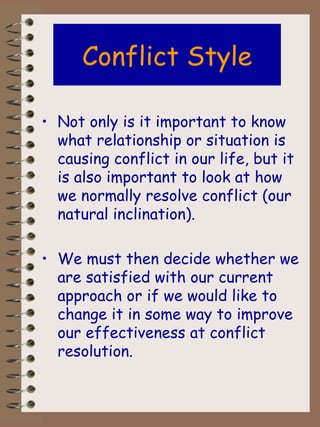
Conflict Style Not only is it important to know what relationship or situation is causing conflict in our life, but it is also important to look at how we normally resolve conflict (our natural inclination).  We must then decide whether we are satisfied with our current approach or if we would like to change it in some way to improve our effectiveness at conflict resolution.
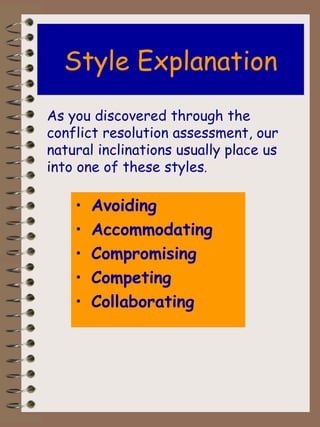
Style Explanation Avoiding Accommodating Compromising Competing Collaborating As you discovered through the conflict resolution assessment, our natural inclinations usually place us into one of these styles .
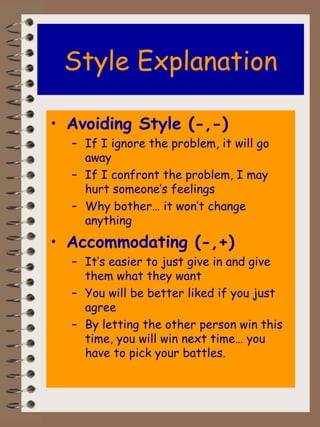
Style Explanation Avoiding Style (-,-) If I ignore the problem, it will go away If I confront the problem, I may hurt someone’s feelings Why bother… it won’t change anything Accommodating (-,+) It’s easier to just give in and give them what they want You will be better liked if you just agree By letting the other person win this time, you will win next time… you have to pick your battles.
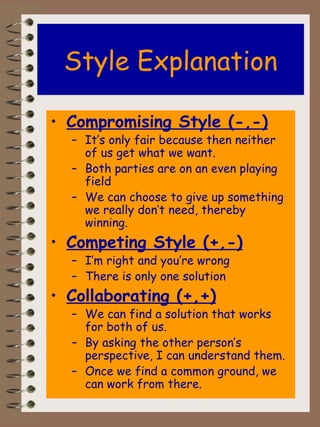
Style Explanation Compromising Style (-,-) It’s only fair because then neither of us get what we want. Both parties are on an even playing field We can choose to give up something we really don’t need, thereby winning. Competing Style (+,-) I’m right and you’re wrong There is only one solution Collaborating (+,+) We can find a solution that works for both of us. By asking the other person’s perspective, I can understand them. Once we find a common ground, we can work from there.
Conflict Style If you find yourself adopting a conflict style that you’re not happy about… Analyze why you have adopted that style. Develop some simple action steps that will help you break your habit.
One-to-one  Conflict   Conflict Management Toolkit Part VI
If you want to constructively resolve a conflict with another person… FIRST ,  get into the right frame of mind for a positive discussion, always remembering to treat the other person with respect SECOND , agree on the best time and place for both of you to discuss the conflict with each other. THIRD , Set some ground rules. FOURTH , have a discussion .
Step 1: Adopt the right frame of mind
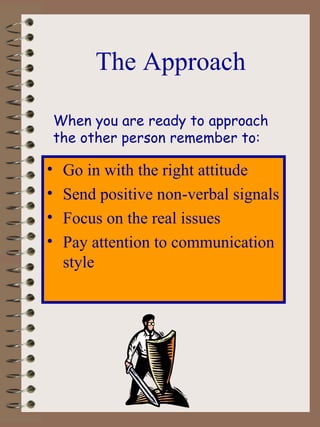
The Approach Go in with the right attitude Send positive non-verbal signals Focus on the real issues Pay attention to communication style When you are ready to approach  the other person remember to:
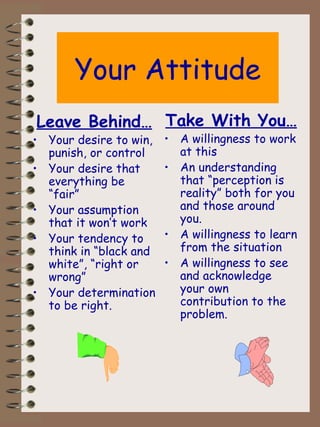
Your Attitude Leave Behind… Your desire to win, punish, or control Your desire that everything be “fair” Your assumption that it won’t work Your tendency to think in “black and white”, “right or wrong” Your determination to be right. Take With You… A willingness to work at this An understanding that “perception is reality” both for you and those around you. A willingness to learn from the situation A willingness to see and acknowledge your own contribution to the problem.
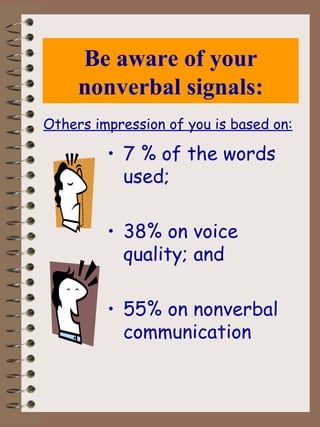
Be aware of your nonverbal signals: 7 % of the words used; 38% on voice quality; and 55% on nonverbal communication Others impression of you is based on:
Focus on underlying Issues What happened ? Difference in expectations: What did I expect to happen?; What actually happened? Who did what? Intention inventory (Who meant what?) Feelings Don’t ignore or fail to acknowledge Feelings make relationships enjoyable and difficult conversations difficult (can’t have one without the other!) Identity Must face ourselves as well as other person Am I competent?; Am I a good person?; Am I worthy of love?
Communication Tips Avoid   “you”  statements Focus on  behavior , not employee Focus on  actions , not intent Be descriptive and  specific   (bring data) Practice active   listening  skills Ask open and closed  questions   to clarify points
Step 2 : Consider time factors
Be Timely :  talk to the other person while the issues are still current Anger and negative feelings tend to fester if not dealt with quickly!!
Consider the other person’s time needs Don’t interrupt the other person’s schedule and state that you need to talk Agree on a time to meet with the other person and inform him/her of the topic. Give him/her time to prepare mentally.
Step 3 : Set some ground rules!
3 “Golden” Rules Everyone tells it like  they  see it. Get  everything  on the table. Focus on the  future .
Sample Rules for discussion No interruptions No yelling Time limit on certain topics of discussion Words to avoid Agreement on what to do if you can’t agree ahead of time In addition to general rules, it is helpful to agree on how you will talk with each other
Step 4 : The Actual Discussion
The Actual Conversation Define the conflict. Communicate understanding. Explore alternative solutions. Agree on most workable solution. Evaluate after time.
Define the Conflict Describe the problem in clear, concrete terms.  Be specific (use “I” not “you”) Focus on behaviors or problems, not people Talk about the impact on you Define the conflict as a problem to solve together, not a battle to be won
2. Communicate Understanding Listen to really understand the other person’s feelings, needs,  Reflect back. Explain how you see the problem after you have heard them. Identify your contribution to the situation. Describe feelings (not judgments or accusations)
3.   Explore   alternative solutions - Take turns offering alternative solutions.  List them all. Be nonjudgmental of other’s ideas. Examine the consequence of each solution. Think and talk positively.
4. Agree on most workable solution - Agree on a solution you both understand and can live with. Be committed to resolving the conflict
5. Evaluate after time Get together after some time and see how the new  arrangement is working for both parties
Resolving Group Conflict Workforce Development Toolkit Part VII
Meeting   Conflict 1.  If you sense a spoken or unspoken conflict in a meeting over an issue, address it.   “ There seems to be some disagreement over this issue.  Can we take a few minutes to clarify the issue. 2.  Clarify the conflict. “ O.K. so there seems to be some disagreement over…….” Decide if there is time to deal with it today or if another meeting needs to be set up to give it full attention. “ Since this seems to be quite an important issue and we don’t have much time today.  Let’s agree to meet again to discuss it further.  Can we meet on….” 4.  If another meeting is necessary, assign responsibility for gathering more information on the subject to staff. “ Sue, can you please research information on…. And Diane can you please check on that State mandate.” Insist employees let it go until the next meeting. “ We have a lot of other issues to discuss today so let’s free our minds of this issue until the set meeting and move on.”
Group Resolution Restate the issue to ensure clarity. Have each group member, share information gathered and give his/her opinion. Make sure  everything  is put on the table (no unresolved feelings popping up later) Brainstorm alternatives Agree on best solution using team decision-making steps (see reference list at end) Develop action steps. Agree on follow-up session.
Supervisor’s role in resolving conflict Conflict Management Toolkit Part IV
Your Role as a Supervisor Looking for ways to reduce and prevent conflict in your work area Handling conflict as a third party Handling grievances as they come to you Involves:
You can reduce conflict by: Being a good leader Being aware of your management style Training yourself and your staff on conflict resolution Looking out for signs
Be a Good Leader Set a good example Communicate clear standards Set ground rules Provide clear rationale for decisions Ensure employees have resources and training to do their jobs Get to know your employees
Be a Good Leader Conduct performance counseling Assist employees who have performance problems Address misconduct promptly Get advice from HR when you have questions or concerns prior to the need to pursue disciplinary actions Treat employees fairly and equitably, applying rules consistently
Be aware of your own behavior Allowing  aggressive or inappropriate conduct  without  taking action can foster a hostile or intimidating work environment. Decision-making without employee input or participation can lead to frustrated employees who don’t feel valued as anything but “worker bees.” Your staff looks to you to assist in resolving conflicts.  You are better equipped to resolve conflicts if both  you  and your staff have had conflict resolution training. If you are inconsistent or unpredictable, your employees will be unsure of your expectations and become frustrated. Engaging in relationships with your employees that are personal or too informal may lead to misunderstandings, as well as other employees feeling alienated.
Lookout for Signs of discontentment A usually outgoing, communicative employee becomes withdrawn and quiet. An employee frequently comes in late for work. An employee is more argumentative and erratic than usual. An employee suddenly takes no interest in maintaining his or her personal appearance or hygiene. An employee makes comments about violent means of dealing with, or coping with, a particular situation. An employee talks about “having nothing to lose” or not caring about anything anymore.
If an employee comes to you with a possible grievance : Take the complaint seriously Set a professional tone for the interview– put the complainant at ease Provide assurance of confidentiality & non-retaliation Ask for– but do not require- a written statement. Gather facts, do not make judgments. Listen and get answers to: “who, what, when, where, why, how.” Communicate your concern and describe the available options.
Handling a formal complaint cont… Ask how the complainant would like to proceed. Tell the complainant that prompt action will be taken. Ask about the person (s) need for immediate assistance. Set a time for a follow-up meeting and/or refer the person to the HR office  Document and contact HR.
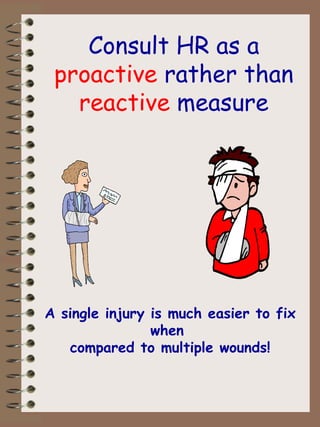
Consult HR as a  proactive  rather than  reactive  measure A single injury is much easier to fix when  compared to multiple wounds!

Conflict management

  • 1.
  • 2.
    Table of ContentsDetermining the current level of conflict level in my work life (self-assessment) Determining my conflict style (self assessment) Resolving a conflict with one other person Resolving a group conflict. Supervisor’s role in resolving employee conflict
  • 3.
    Conflict is theresult of differing perceptions, assumptions, and/or values. What is conflict resolution? Conflict resolution is a process of working through opposing views in order to reach a common goal or mutual purpose
  • 4.
    Determining the sourceof conflict At times you may sense conflict at work, but not know exactly why. The conflict self-assessment will help you to pinpoint the specific area in which you are experiencing conflict so that you can begin to resolve it. The areas addressed are supervisor, self, peers, employees, and productivity.
  • 5.
    Conflict Style Notonly is it important to know what relationship or situation is causing conflict in our life, but it is also important to look at how we normally resolve conflict (our natural inclination). We must then decide whether we are satisfied with our current approach or if we would like to change it in some way to improve our effectiveness at conflict resolution.
  • 6.
    Style Explanation AvoidingAccommodating Compromising Competing Collaborating As you discovered through the conflict resolution assessment, our natural inclinations usually place us into one of these styles .
  • 7.
    Style Explanation AvoidingStyle (-,-) If I ignore the problem, it will go away If I confront the problem, I may hurt someone’s feelings Why bother… it won’t change anything Accommodating (-,+) It’s easier to just give in and give them what they want You will be better liked if you just agree By letting the other person win this time, you will win next time… you have to pick your battles.
  • 8.
    Style Explanation CompromisingStyle (-,-) It’s only fair because then neither of us get what we want. Both parties are on an even playing field We can choose to give up something we really don’t need, thereby winning. Competing Style (+,-) I’m right and you’re wrong There is only one solution Collaborating (+,+) We can find a solution that works for both of us. By asking the other person’s perspective, I can understand them. Once we find a common ground, we can work from there.
  • 9.
    Conflict Style Ifyou find yourself adopting a conflict style that you’re not happy about… Analyze why you have adopted that style. Develop some simple action steps that will help you break your habit.
  • 10.
    One-to-one Conflict Conflict Management Toolkit Part VI
  • 11.
    If you wantto constructively resolve a conflict with another person… FIRST , get into the right frame of mind for a positive discussion, always remembering to treat the other person with respect SECOND , agree on the best time and place for both of you to discuss the conflict with each other. THIRD , Set some ground rules. FOURTH , have a discussion .
  • 12.
    Step 1: Adoptthe right frame of mind
  • 13.
    The Approach Goin with the right attitude Send positive non-verbal signals Focus on the real issues Pay attention to communication style When you are ready to approach the other person remember to:
  • 14.
    Your Attitude LeaveBehind… Your desire to win, punish, or control Your desire that everything be “fair” Your assumption that it won’t work Your tendency to think in “black and white”, “right or wrong” Your determination to be right. Take With You… A willingness to work at this An understanding that “perception is reality” both for you and those around you. A willingness to learn from the situation A willingness to see and acknowledge your own contribution to the problem.
  • 15.
    Be aware ofyour nonverbal signals: 7 % of the words used; 38% on voice quality; and 55% on nonverbal communication Others impression of you is based on:
  • 16.
    Focus on underlyingIssues What happened ? Difference in expectations: What did I expect to happen?; What actually happened? Who did what? Intention inventory (Who meant what?) Feelings Don’t ignore or fail to acknowledge Feelings make relationships enjoyable and difficult conversations difficult (can’t have one without the other!) Identity Must face ourselves as well as other person Am I competent?; Am I a good person?; Am I worthy of love?
  • 17.
    Communication Tips Avoid “you” statements Focus on behavior , not employee Focus on actions , not intent Be descriptive and specific (bring data) Practice active listening skills Ask open and closed questions to clarify points
  • 18.
    Step 2 :Consider time factors
  • 19.
    Be Timely : talk to the other person while the issues are still current Anger and negative feelings tend to fester if not dealt with quickly!!
  • 20.
    Consider the otherperson’s time needs Don’t interrupt the other person’s schedule and state that you need to talk Agree on a time to meet with the other person and inform him/her of the topic. Give him/her time to prepare mentally.
  • 21.
    Step 3 :Set some ground rules!
  • 22.
    3 “Golden” RulesEveryone tells it like they see it. Get everything on the table. Focus on the future .
  • 23.
    Sample Rules fordiscussion No interruptions No yelling Time limit on certain topics of discussion Words to avoid Agreement on what to do if you can’t agree ahead of time In addition to general rules, it is helpful to agree on how you will talk with each other
  • 24.
    Step 4 :The Actual Discussion
  • 25.
    The Actual ConversationDefine the conflict. Communicate understanding. Explore alternative solutions. Agree on most workable solution. Evaluate after time.
  • 26.
    Define the ConflictDescribe the problem in clear, concrete terms. Be specific (use “I” not “you”) Focus on behaviors or problems, not people Talk about the impact on you Define the conflict as a problem to solve together, not a battle to be won
  • 27.
    2. Communicate UnderstandingListen to really understand the other person’s feelings, needs, Reflect back. Explain how you see the problem after you have heard them. Identify your contribution to the situation. Describe feelings (not judgments or accusations)
  • 28.
    3. Explore alternative solutions - Take turns offering alternative solutions. List them all. Be nonjudgmental of other’s ideas. Examine the consequence of each solution. Think and talk positively.
  • 29.
    4. Agree onmost workable solution - Agree on a solution you both understand and can live with. Be committed to resolving the conflict
  • 30.
    5. Evaluate aftertime Get together after some time and see how the new arrangement is working for both parties
  • 31.
    Resolving Group ConflictWorkforce Development Toolkit Part VII
  • 32.
    Meeting Conflict 1. If you sense a spoken or unspoken conflict in a meeting over an issue, address it. “ There seems to be some disagreement over this issue. Can we take a few minutes to clarify the issue. 2. Clarify the conflict. “ O.K. so there seems to be some disagreement over…….” Decide if there is time to deal with it today or if another meeting needs to be set up to give it full attention. “ Since this seems to be quite an important issue and we don’t have much time today. Let’s agree to meet again to discuss it further. Can we meet on….” 4. If another meeting is necessary, assign responsibility for gathering more information on the subject to staff. “ Sue, can you please research information on…. And Diane can you please check on that State mandate.” Insist employees let it go until the next meeting. “ We have a lot of other issues to discuss today so let’s free our minds of this issue until the set meeting and move on.”
  • 33.
    Group Resolution Restatethe issue to ensure clarity. Have each group member, share information gathered and give his/her opinion. Make sure everything is put on the table (no unresolved feelings popping up later) Brainstorm alternatives Agree on best solution using team decision-making steps (see reference list at end) Develop action steps. Agree on follow-up session.
  • 34.
    Supervisor’s role inresolving conflict Conflict Management Toolkit Part IV
  • 35.
    Your Role asa Supervisor Looking for ways to reduce and prevent conflict in your work area Handling conflict as a third party Handling grievances as they come to you Involves:
  • 36.
    You can reduceconflict by: Being a good leader Being aware of your management style Training yourself and your staff on conflict resolution Looking out for signs
  • 37.
    Be a GoodLeader Set a good example Communicate clear standards Set ground rules Provide clear rationale for decisions Ensure employees have resources and training to do their jobs Get to know your employees
  • 38.
    Be a GoodLeader Conduct performance counseling Assist employees who have performance problems Address misconduct promptly Get advice from HR when you have questions or concerns prior to the need to pursue disciplinary actions Treat employees fairly and equitably, applying rules consistently
  • 39.
    Be aware ofyour own behavior Allowing aggressive or inappropriate conduct without taking action can foster a hostile or intimidating work environment. Decision-making without employee input or participation can lead to frustrated employees who don’t feel valued as anything but “worker bees.” Your staff looks to you to assist in resolving conflicts. You are better equipped to resolve conflicts if both you and your staff have had conflict resolution training. If you are inconsistent or unpredictable, your employees will be unsure of your expectations and become frustrated. Engaging in relationships with your employees that are personal or too informal may lead to misunderstandings, as well as other employees feeling alienated.
  • 40.
    Lookout for Signsof discontentment A usually outgoing, communicative employee becomes withdrawn and quiet. An employee frequently comes in late for work. An employee is more argumentative and erratic than usual. An employee suddenly takes no interest in maintaining his or her personal appearance or hygiene. An employee makes comments about violent means of dealing with, or coping with, a particular situation. An employee talks about “having nothing to lose” or not caring about anything anymore.
  • 41.
    If an employeecomes to you with a possible grievance : Take the complaint seriously Set a professional tone for the interview– put the complainant at ease Provide assurance of confidentiality & non-retaliation Ask for– but do not require- a written statement. Gather facts, do not make judgments. Listen and get answers to: “who, what, when, where, why, how.” Communicate your concern and describe the available options.
  • 42.
    Handling a formalcomplaint cont… Ask how the complainant would like to proceed. Tell the complainant that prompt action will be taken. Ask about the person (s) need for immediate assistance. Set a time for a follow-up meeting and/or refer the person to the HR office Document and contact HR.
  • 43.
    Consult HR asa proactive rather than reactive measure A single injury is much easier to fix when compared to multiple wounds!