Resolving Conflict
Conflict 101
Conflict 101
Conflict is a difference in goals
Conflict is more than a disagreement
Conflicts fester when ignored
We respond based on perceptions
Conflicts trigger strong emotions
Conflicts are an opportunity for growth
Sources of Conflict
Task or Goal
Relationship
Sources of Conflict
Two Principles for Handling Conflicts
“Seek first to
understand, then to
be understood.”
Stephen R. Covey
Two Principles for Handling Conflicts
Focus on Needs
rather than Positions
Roger Fisher
William Ury
Conflict Questions
What is your natural, most comfortable response
to conflict?
What are the negative consequences to
engaging in conflict?
What are the positive consequences to engaging
to conflict?
List different conflicts that you deal with in your
position at work.
Confronting Conflict
Exposing oneself to ridicule or rejection
Recognizing we may have contributed to the problem
Willingness to change
Confronting Conflict
We Rationalize
Signs that conflict Exists but hasn’t Surfaced
Productive Conflict
Surfacing and Productively Resolving Conflict
Value
Our physical and mental health improves
Our relationships are strengthened
Our productivity and effectiveness increases
Our organizations achieve their goals
Surfacing and Productively Resolving Conflict
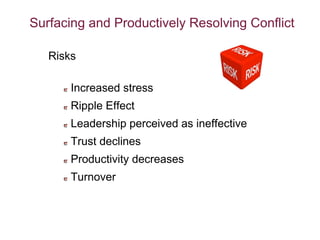
Risks
Increased stress
Ripple Effect
Leadership perceived as ineffective
Trust declines
Productivity decreases
Turnover
Surfacing and Productively Resolving Conflict
The Key
Both
sides can
win
Positions vs. Interests
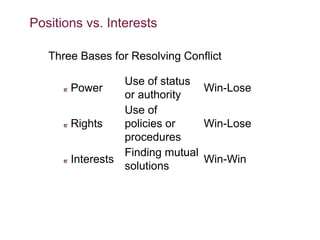
Three Bases for Resolving Conflict
Power
Rights
Interests
Use of status
or authority
Use of
policies or
procedures
Finding mutual
solutions
Win-Lose
Win-Lose
Win-Win
Positions vs. Interests
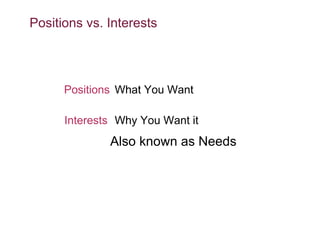
Positions
Interests
Also known as Needs
What You Want
Why You Want it
Positions vs. Interest
Argue for our position
Don’t listen to the other person
Fear losing more than we gain
Think we must threaten or make promises
Positions: Tangible, Finite & require Justificatio
We
Positions vs. Interest
Are underlying needs (motivation)
Require explanation rather than justification
Can be satisfied in many different ways
Interests: abstract and intangible
Interests:
Positions vs. Interests
Position
Interest
Positions vs. Interests
Is psychologically positive
Is not “caving in” to someone else
Leads to creative solutions
Preserves the relationship
Expands the pie for both parties
Satisfying Interests
Kilmann Conflict Model
Five Conflict Behaviors
Walk away
Used when issues
trivial, emotions are
high, need more
information
Benefits: reduce immediate stress and save time
Costs: resentment and buildup of hostility
Relatively easy for “Owls”
Avoiding
Five Conflict Behaviors
Suppression,
just smooth
things over
Only when peace is more important than a
solution
Benefits: moves things along, builds harmony
Costs: loss of credibility and influence
Relatively easy for “Doves”
Accommodating
Five Conflict Behaviors
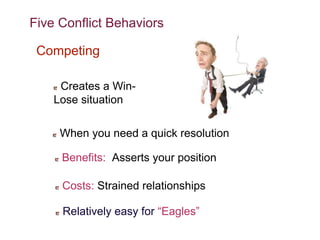
Creates a Win-
Lose situation
When you need a quick resolution
Benefits: Asserts your position
Costs: Strained relationships
Relatively easy for “Eagles”
Competing
Five Conflict Behaviors
Lets Make a Deal
When faced with
polarizing choices
Benefits: Pragmatic
Costs: Partially sacrifice needs
Not easy for any communication style
Compromising
Five Conflict Behaviors
“We can both win”
When issues are
critical and new ideas
needed
Benefits: High quality decisions
Costs: Takes trust, time, and effort
Relatively easy for “Roadrunners”
Collaborating
Levels of Communication
Words 7%
38%Paralanguage
Non Verbal 55%
Skill of Listening
Hearing is the same as listening.
Skill of Listening
Listening involves more than your ears.
Skill of Listening
People who get the facts right
are always good listeners.
Skill of Listening
Good listening comes naturally
when we pay attention.
Skill of Listening
Good listeners never interrupt.
Skill of Listening
Posture effects listening.
Skill of Listening
Most listening distractions
can be controlled.
Skill of Listening
If you can’t remember something,
then you weren’t really listening.
Skill of Listening
Listening is a passive activity.
Skill of Listening
You can listen well and
do other things at the same time.
Skill of Listening
“Top executives have
learned to be excellent
listeners. They
understand the
importance of good
listening. The best
managers do far more
than allow listening to
happen. They realize
that listening improves
effectiveness,
accomplishes more, and
earns profits.”
In Search of Excellence
Tom Peters
Deliberative
Empathic
The Skill of Listening
Words - Situation - Speaker - Meaning
Speaker - Situation - Words - Meaning

Conflict presentation