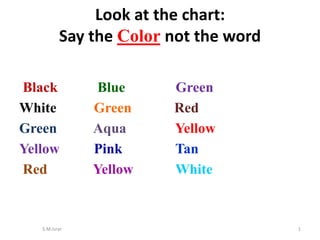
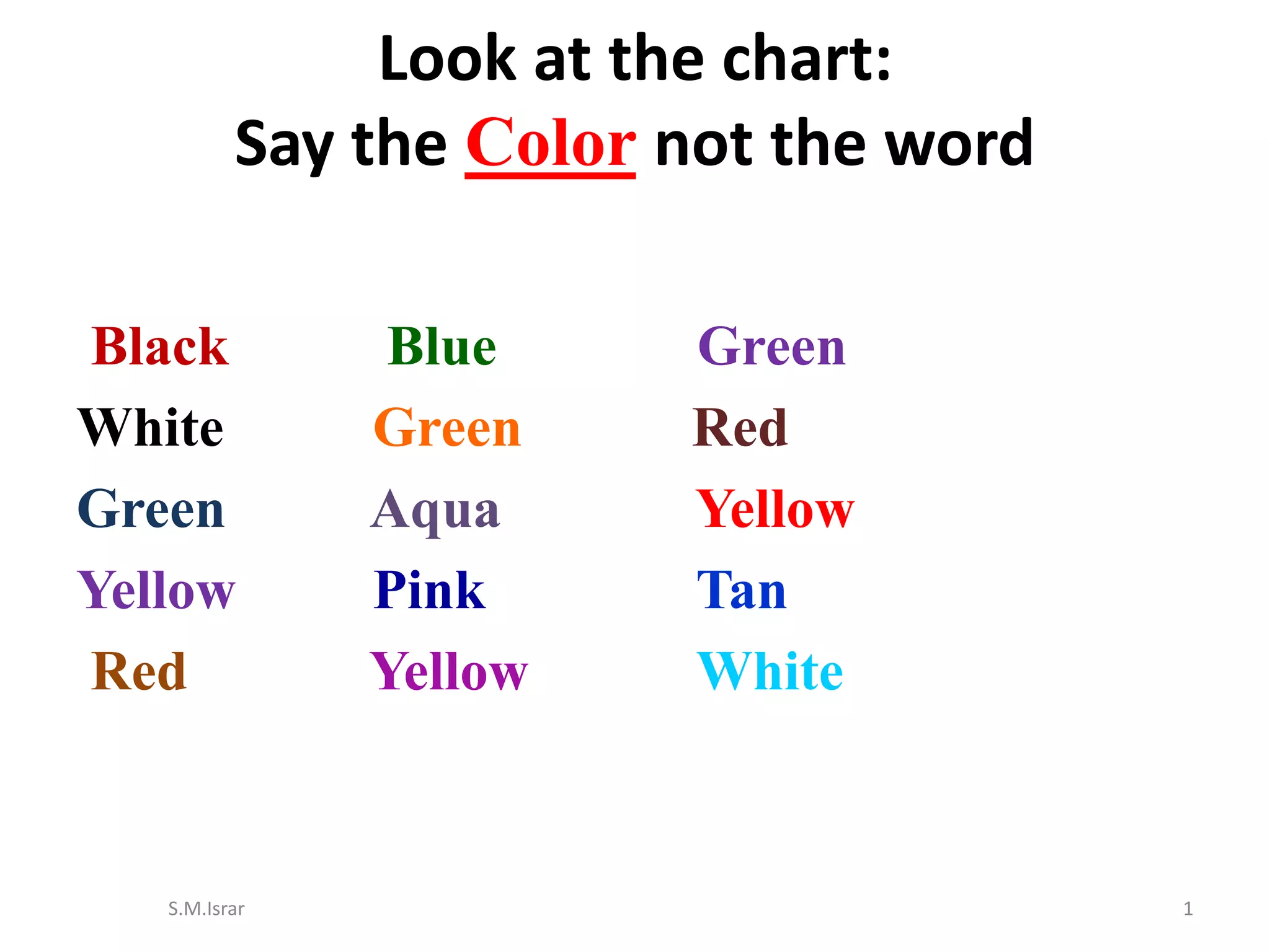

Black Blue Green
White Green Red
Green Aqua Yellow
Yellow Pink Tan
Red Yellow White
S.M.Israr 1
Look at the chart:
Say the Color not the word
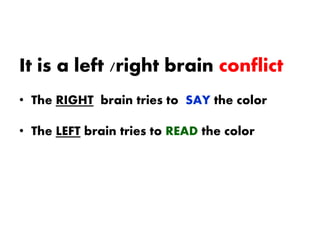
It is a left /right brain conflict
• The RIGHT brain tries to SAY the color
• The LEFT brain tries to READ the color
By. Ms .S Peter
3
CONFLICT
S.M.Israr 4
What is conflict?
• A state of incompatibility of ideas between two
or more parties or individuals( dict)
Conflict management is the practice of identifying
and handling conflict in a sensible, fair and
efficient manner
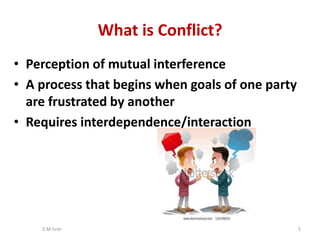
• Perception of mutual interference
• A process that begins when goals of one party
are frustrated by another
• Requires interdependence/interaction
S.M.Israr 5
What is Conflict?
S.M.Israr 6
Types of conflict
• Inter-personal & intra-personal
• Inter-group & intra-group
(Departmental)
Competitive & Disruptive
• Internal conflict – Person Vs self
• External conflict –
 Person Vs Person,
 Person Vs Society,
 Person Vs Nature ( natural disaster)
 Person Vs Technology
 Person Vs Supernatural
S.M.Israr 7
Types……….
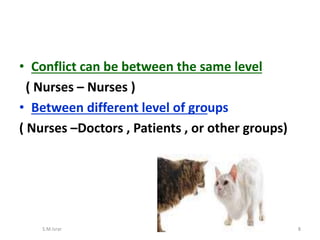
• Conflict can be between the same level
( Nurses – Nurses )
• Between different level of groups
( Nurses –Doctors , Patients , or other groups)
S.M.Israr 8
• Conflict is a natural part of any team or
relationship.
• It can be healthy or unhealthy for the
relationship, depending on how it is handled.
• When conflict is handled constructively, it
promotes growth and problem solving.
S.M.Israr 9
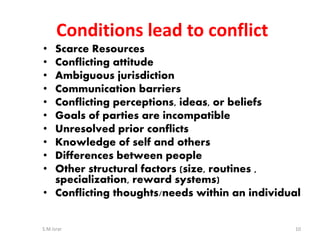
• Scarce Resources
• Conflicting attitude
• Ambiguous jurisdiction
• Communication barriers
• Conflicting perceptions, ideas, or beliefs
• Goals of parties are incompatible
• Unresolved prior conflicts
• Knowledge of self and others
• Differences between people
• Other structural factors (size, routines ,
specialization, reward systems)
• Conflicting thoughts/needs within an individual
S.M.Israr 10
Conditions lead to conflict
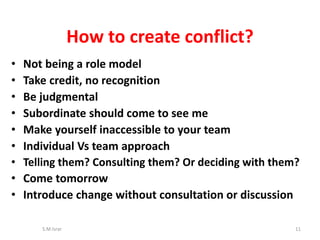
• Not being a role model
• Take credit, no recognition
• Be judgmental
• Subordinate should come to see me
• Make yourself inaccessible to your team
• Individual Vs team approach
• Telling them? Consulting them? Or deciding with them?
• Come tomorrow
• Introduce change without consultation or discussion
S.M.Israr 11
How to create conflict?
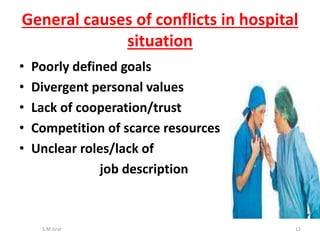
• Poorly defined goals
• Divergent personal values
• Lack of cooperation/trust
• Competition of scarce resources
• Unclear roles/lack of
job description
S.M.Israr 12
General causes of conflicts in hospital
situation
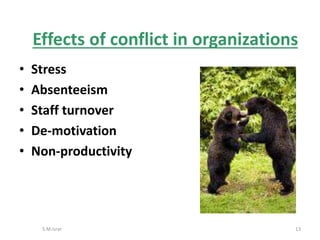
• Stress
• Absenteeism
• Staff turnover
• De-motivation
• Non-productivity
S.M.Israr 13
Effects of conflict in organizations
S.M.Israr 14
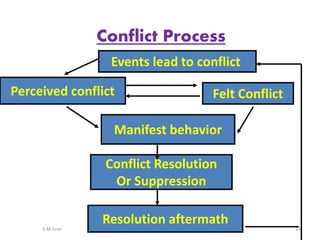
Conflict Process
Events lead to conflict
Perceived conflict Felt Conflict
Manifest behavior
Conflict Resolution
Or Suppression
Resolution aftermath
• Predict (Latent) : conflict behaviour
• Perceived : person aware of the stressful situation
exists
• Felt : feelings and attitudes affect the conflict
• Manifest : change of behaviour result from the
earlier stages
• Resolution: tension is reduced- negotiated, problem
solved – mutual agreement
• Aftermath: negotiation, peace and reconciliation
prevent reoccurrence of the conflict situation ---------
-- or reoccur and start again
S.M.Israr 15
Stages of conflict
S.M.Israr 16
Conflict
Management
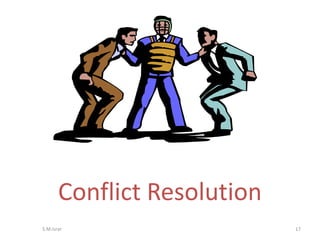
Conflict Resolution
S.M.Israr 17
• Confront problems, communicate openly and
respectfully with someone of opposing
opinion
S.M.Israr 18
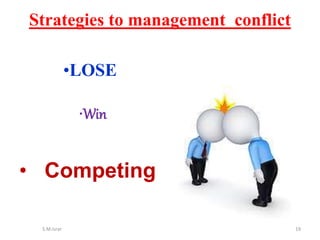
•LOSE
•Win
• Competing
S.M.Israr 19
Strategies to management conflict
• Competition (win-lose situation)
• Accommodation (win-win situation)
• Avoidance (lose-lose situation)
• Compromise (lose-lose situation)
• Collaboration (win-win situation)
S.M.Israr 20
Methods to deal with conflicts
Lose-lose
–Compromise
–Bribes
–Arbitration
–General rule
S.M.Israr 21
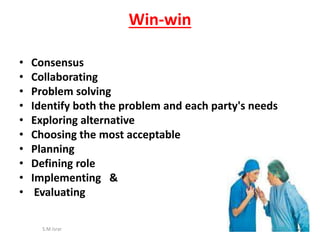
• Consensus
• Collaborating
• Problem solving
• Identify both the problem and each party's needs
• Exploring alternative
• Choosing the most acceptable
• Planning
• Defining role
• Implementing &
• Evaluating
S.M.Israr 22
Win-win
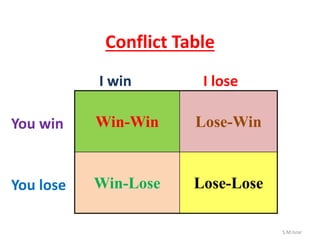
Conflict Table
S.M.Israr
Win-Win Lose-Win
Win-Lose Lose-Lose
I win I lose
You win
You lose
1. RUN---------- not comfort, not beneficial
2. Change your attitude Understand (other person’s)
point of view – may be he have a problem with you or with
your attitude)- Try to understand it
3. Change their attitudeshow them another angle
help them see you as a person
4. Take a stand your attitude is not their problem
• You cannot change their attitude even after you try
S.M.Israr 24
The strategies
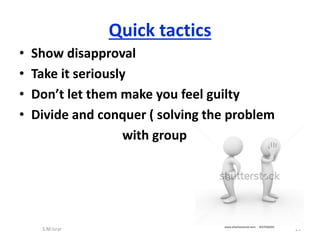
• Show disapproval
• Take it seriously
• Don’t let them make you feel guilty
• Divide and conquer ( solving the problem
with group
S.M.Israr 25
Quick tactics
Steps to resolve conflicts
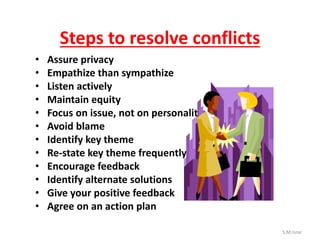
• Assure privacy
• Empathize than sympathize
• Listen actively
• Maintain equity
• Focus on issue, not on personality
• Avoid blame
• Identify key theme
• Re-state key theme frequently
• Encourage feedback
• Identify alternate solutions
• Give your positive feedback
• Agree on an action plan
S.M.Israr
Is friendly intervention by consent and invitation
for settling differences between parties
The mediator plays several roles
• Friendly intervener by consent
• Housekeeper
• Ringmaster
• Educator
• Communicator
• ‫ا‬innovator
S.M.Israr 27
Mediation
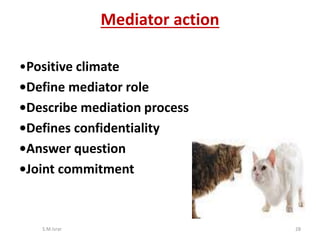
•Positive climate
•Define mediator role
•Describe mediation process
•Defines confidentiality
•Answer question
•Joint commitment
S.M.Israr 28
Mediator action
• Frequent meeting of your team
• Allow your team to express openly
• Sharing objectives
• Having a clear and detailed job description
• Distributing task fairly
• Never criticize team members publicly
• Always be fair and just with your team
• Being a role model
S.M.Israr 29
How to prevent conflicts
A structured, assertive, communication approach for
managing and resolving conflict.
D -- Describe the specific situation
E -- Express your concerns about the action
S -- Suggest other alternatives
C -- Consequences should be stated
When to use it?
• Whenever you have a personal conflict with
another health team member that threatens your
ability to perform your job well—
• Have timely discussion
S.M.Israr 30
DESC Script
• D- ‘When you scream at me in front of my co-workers
about the delay in care, you’re making it personal’.
• E- ‘This reduces my credibility with the patients and
undermines my authority with staff. I feel you don’t
respect me.’
• S-’ If you are upset about delays or other patient care
issues, pull me aside and I will address your concerns.’
• C- ‘If your outbursts continue we won’t have a working
relationship, and patient care will suffer.’
S.M.Israr 31
DESC Example
• L- Listen
• E- Empathize
• E- Explain
• N- Negotiate
S.M.Israr 32
LEEN- Model for Conflict
Resolution
• L- “Can you help me understand why
you are upset”.
• E- “That is understandable, I can see why
you are upset”.
• E- “The reason we wanted to do this
was because—”
• N- “ Let’s agree on a path forward”.
S.M.Israr 33
Conflict with Patients/Families
• L- “Can you help me understand how you see the
situation, how you are weighing the risks and
benefits.”
• E-” I can see how you see it that way”.
• E-” Let me explain how I see things.”
• N-” Let’s put the patient first and agree on
a plan”.
S.M.Israr 34
Conflict with Clinicians
S.M.Israr
4 Magic phrases at work you can use
to respond anything
•Tell me more
•Why would you say that ?
•Say that – why don’t you do that?
•Ask that – why do you ask that ?
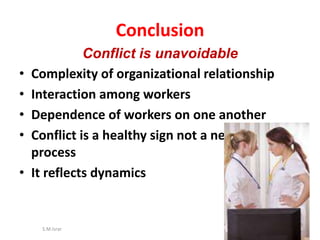
Conflict is unavoidable
• Complexity of organizational relationship
• Interaction among workers
• Dependence of workers on one another
• Conflict is a healthy sign not a negative
process
• It reflects dynamics
S.M.Israr 36
Conclusion
• Poorly managed conflicts
–Unfavorable with counter productive results
–Problems and negative attitude
• Well managed conflicts
–Stimulate competition
–Identify legitimate differences
–Powerful source of motivation
S.M.Israr 37
Conclusion (Cont’d)
S.M.Israr 38
THANK
YOU
ALL

What is Conflict ? how can we resolve it ?

  • 1.
    Black Blue Green WhiteGreen Red Green Aqua Yellow Yellow Pink Tan Red Yellow White S.M.Israr 1 Look at the chart: Say the Color not the word
  • 2.
    It is aleft /right brain conflict • The RIGHT brain tries to SAY the color • The LEFT brain tries to READ the color
  • 3.
    By. Ms .SPeter 3 CONFLICT
  • 4.
    S.M.Israr 4 What isconflict? • A state of incompatibility of ideas between two or more parties or individuals( dict) Conflict management is the practice of identifying and handling conflict in a sensible, fair and efficient manner
  • 5.
    • Perception ofmutual interference • A process that begins when goals of one party are frustrated by another • Requires interdependence/interaction S.M.Israr 5 What is Conflict?
  • 6.
    S.M.Israr 6 Types ofconflict • Inter-personal & intra-personal • Inter-group & intra-group (Departmental) Competitive & Disruptive
  • 7.
    • Internal conflict– Person Vs self • External conflict –  Person Vs Person,  Person Vs Society,  Person Vs Nature ( natural disaster)  Person Vs Technology  Person Vs Supernatural S.M.Israr 7 Types……….
  • 8.
    • Conflict canbe between the same level ( Nurses – Nurses ) • Between different level of groups ( Nurses –Doctors , Patients , or other groups) S.M.Israr 8
  • 9.
    • Conflict isa natural part of any team or relationship. • It can be healthy or unhealthy for the relationship, depending on how it is handled. • When conflict is handled constructively, it promotes growth and problem solving. S.M.Israr 9
  • 10.
    • Scarce Resources •Conflicting attitude • Ambiguous jurisdiction • Communication barriers • Conflicting perceptions, ideas, or beliefs • Goals of parties are incompatible • Unresolved prior conflicts • Knowledge of self and others • Differences between people • Other structural factors (size, routines , specialization, reward systems) • Conflicting thoughts/needs within an individual S.M.Israr 10 Conditions lead to conflict
  • 11.
    • Not beinga role model • Take credit, no recognition • Be judgmental • Subordinate should come to see me • Make yourself inaccessible to your team • Individual Vs team approach • Telling them? Consulting them? Or deciding with them? • Come tomorrow • Introduce change without consultation or discussion S.M.Israr 11 How to create conflict?
  • 12.
    • Poorly definedgoals • Divergent personal values • Lack of cooperation/trust • Competition of scarce resources • Unclear roles/lack of job description S.M.Israr 12 General causes of conflicts in hospital situation
  • 13.
    • Stress • Absenteeism •Staff turnover • De-motivation • Non-productivity S.M.Israr 13 Effects of conflict in organizations
  • 14.
    S.M.Israr 14 Conflict Process Eventslead to conflict Perceived conflict Felt Conflict Manifest behavior Conflict Resolution Or Suppression Resolution aftermath
  • 15.
    • Predict (Latent): conflict behaviour • Perceived : person aware of the stressful situation exists • Felt : feelings and attitudes affect the conflict • Manifest : change of behaviour result from the earlier stages • Resolution: tension is reduced- negotiated, problem solved – mutual agreement • Aftermath: negotiation, peace and reconciliation prevent reoccurrence of the conflict situation --------- -- or reoccur and start again S.M.Israr 15 Stages of conflict
  • 16.
  • 17.
  • 18.
    • Confront problems,communicate openly and respectfully with someone of opposing opinion S.M.Israr 18
  • 19.
  • 20.
    • Competition (win-losesituation) • Accommodation (win-win situation) • Avoidance (lose-lose situation) • Compromise (lose-lose situation) • Collaboration (win-win situation) S.M.Israr 20 Methods to deal with conflicts
  • 21.
  • 22.
    • Consensus • Collaborating •Problem solving • Identify both the problem and each party's needs • Exploring alternative • Choosing the most acceptable • Planning • Defining role • Implementing & • Evaluating S.M.Israr 22 Win-win
  • 23.
    Conflict Table S.M.Israr Win-Win Lose-Win Win-LoseLose-Lose I win I lose You win You lose
  • 24.
    1. RUN---------- notcomfort, not beneficial 2. Change your attitude Understand (other person’s) point of view – may be he have a problem with you or with your attitude)- Try to understand it 3. Change their attitudeshow them another angle help them see you as a person 4. Take a stand your attitude is not their problem • You cannot change their attitude even after you try S.M.Israr 24 The strategies
  • 25.
    • Show disapproval •Take it seriously • Don’t let them make you feel guilty • Divide and conquer ( solving the problem with group S.M.Israr 25 Quick tactics
  • 26.
    Steps to resolveconflicts • Assure privacy • Empathize than sympathize • Listen actively • Maintain equity • Focus on issue, not on personality • Avoid blame • Identify key theme • Re-state key theme frequently • Encourage feedback • Identify alternate solutions • Give your positive feedback • Agree on an action plan S.M.Israr
  • 27.
    Is friendly interventionby consent and invitation for settling differences between parties The mediator plays several roles • Friendly intervener by consent • Housekeeper • Ringmaster • Educator • Communicator • ‫ا‬innovator S.M.Israr 27 Mediation
  • 28.
    •Positive climate •Define mediatorrole •Describe mediation process •Defines confidentiality •Answer question •Joint commitment S.M.Israr 28 Mediator action
  • 29.
    • Frequent meetingof your team • Allow your team to express openly • Sharing objectives • Having a clear and detailed job description • Distributing task fairly • Never criticize team members publicly • Always be fair and just with your team • Being a role model S.M.Israr 29 How to prevent conflicts
  • 30.
    A structured, assertive,communication approach for managing and resolving conflict. D -- Describe the specific situation E -- Express your concerns about the action S -- Suggest other alternatives C -- Consequences should be stated When to use it? • Whenever you have a personal conflict with another health team member that threatens your ability to perform your job well— • Have timely discussion S.M.Israr 30 DESC Script
  • 31.
    • D- ‘Whenyou scream at me in front of my co-workers about the delay in care, you’re making it personal’. • E- ‘This reduces my credibility with the patients and undermines my authority with staff. I feel you don’t respect me.’ • S-’ If you are upset about delays or other patient care issues, pull me aside and I will address your concerns.’ • C- ‘If your outbursts continue we won’t have a working relationship, and patient care will suffer.’ S.M.Israr 31 DESC Example
  • 32.
    • L- Listen •E- Empathize • E- Explain • N- Negotiate S.M.Israr 32 LEEN- Model for Conflict Resolution
  • 33.
    • L- “Canyou help me understand why you are upset”. • E- “That is understandable, I can see why you are upset”. • E- “The reason we wanted to do this was because—” • N- “ Let’s agree on a path forward”. S.M.Israr 33 Conflict with Patients/Families
  • 34.
    • L- “Canyou help me understand how you see the situation, how you are weighing the risks and benefits.” • E-” I can see how you see it that way”. • E-” Let me explain how I see things.” • N-” Let’s put the patient first and agree on a plan”. S.M.Israr 34 Conflict with Clinicians
  • 35.
    S.M.Israr 4 Magic phrasesat work you can use to respond anything •Tell me more •Why would you say that ? •Say that – why don’t you do that? •Ask that – why do you ask that ?
  • 36.
    Conflict is unavoidable •Complexity of organizational relationship • Interaction among workers • Dependence of workers on one another • Conflict is a healthy sign not a negative process • It reflects dynamics S.M.Israr 36 Conclusion
  • 37.
    • Poorly managedconflicts –Unfavorable with counter productive results –Problems and negative attitude • Well managed conflicts –Stimulate competition –Identify legitimate differences –Powerful source of motivation S.M.Israr 37 Conclusion (Cont’d)
  • 38.