Major Muscles
Lloyd Dean
Muscles you need to know!
Breaking them down will help
with the learning process.
Small targets!
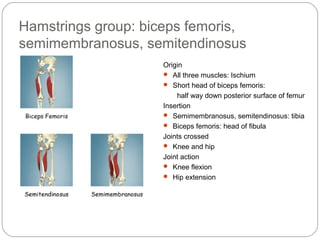
Hamstrings group: biceps femoris,
semimembranosus, semitendinosus
Origin
 All three muscles: Ischium
 Short head of biceps femoris:
half way down posterior surface of femur
Insertion
 Semimembranosus, semitendinosus: tibia
 Biceps femoris: head of fibula
Joints crossed
 Knee and hip
Joint action
 Knee flexion
 Hip extension
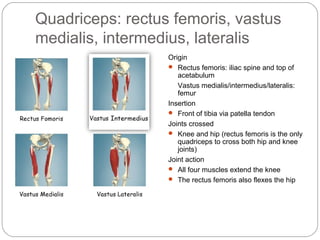
Quadriceps: rectus femoris, vastus
medialis, intermedius, lateralis
Origin
 Rectus femoris: iliac spine and top of
acetabulum
Vastus medialis/intermedius/lateralis:
femur
Insertion
 Front of tibia via patella tendon
Joints crossed
 Knee and hip (rectus femoris is the only
quadriceps to cross both hip and knee
joints)
Joint action
 All four muscles extend the knee
 The rectus femoris also flexes the hip
Muscles of the Shoulder Girdle
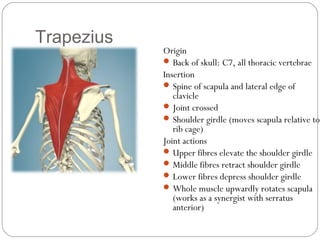
Trapezius

Origin
 Back of skull: C7, all thoracic vertebrae
Insertion
 Spine of scapula and lateral edge of
clavicle
 Joint crossed
 Shoulder girdle (moves scapula relative to
rib cage)
Joint actions
 Upper fibres elevate the shoulder girdle
 Middle fibres retract shoulder girdle
 Lower fibres depress shoulder girdle
 Whole muscle upwardly rotates scapula
(works as a synergist with serratus
anterior)
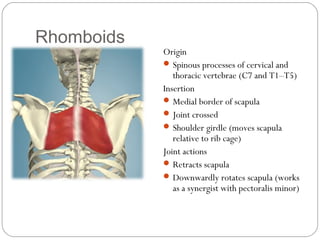
Rhomboids

Origin
 Spinous processes of cervical and
thoracic vertebrae (C7 and T1–T5)
Insertion
 Medial border of scapula
 Joint crossed
 Shoulder girdle (moves scapula
relative to rib cage)
Joint actions
 Retracts scapula
 Downwardly rotates scapula (works
as a synergist with pectoralis minor)
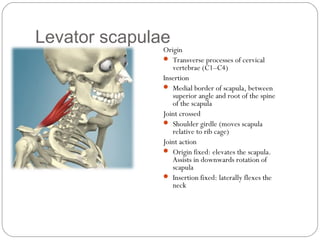
Levator scapulae

Origin
 Transverse processes of cervical
vertebrae (C1–C4)
Insertion
 Medial border of scapula, between
superior angle and root of the spine
of the scapula
Joint crossed
 Shoulder girdle (moves scapula
relative to rib cage)
Joint action
 Origin fixed: elevates the scapula.
Assists in downwards rotation of
scapula
 Insertion fixed: laterally flexes the
neck
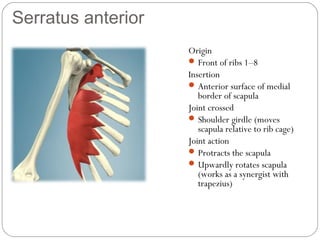
Serratus anterior
Origin
 Front of ribs 1–8
Insertion
 Anterior surface of medial
border of scapula
Joint crossed
 Shoulder girdle (moves
scapula relative to rib cage)
Joint action
 Protracts the scapula
 Upwardly rotates scapula
(works as a synergist with
trapezius)
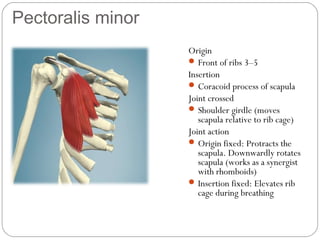
Pectoralis minor
Origin
 Front of ribs 3–5
Insertion
 Coracoid process of scapula
Joint crossed
 Shoulder girdle (moves
scapula relative to rib cage)
Joint action
 Origin fixed: Protracts the
scapula. Downwardly rotates
scapula (works as a synergist
with rhomboids)
 Insertion fixed: Elevates rib
cage during breathing
Muscles of the Shoulder Joint
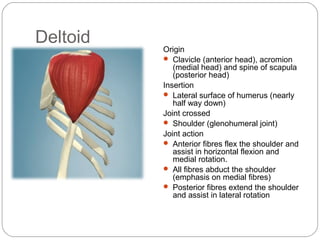
Deltoid

Origin
 Clavicle (anterior head), acromion
(medial head) and spine of scapula
(posterior head)
Insertion
 Lateral surface of humerus (nearly
half way down)
Joint crossed
 Shoulder (glenohumeral joint)
Joint action
 Anterior fibres flex the shoulder and
assist in horizontal flexion and
medial rotation.
 All fibres abduct the shoulder
(emphasis on medial fibres)
 Posterior fibres extend the shoulder
and assist in lateral rotation
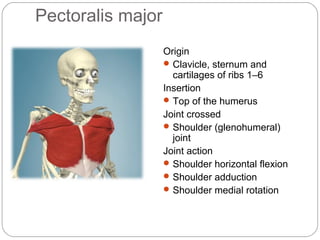
Pectoralis major
Origin
 Clavicle, sternum and
cartilages of ribs 1–6
Insertion
 Top of the humerus
Joint crossed
 Shoulder (glenohumeral)
joint
Joint action
 Shoulder horizontal flexion
 Shoulder adduction
 Shoulder medial rotation
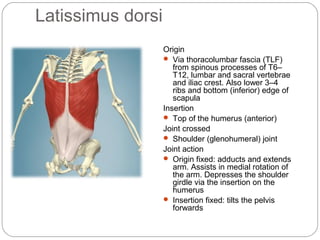
Latissimus dorsi
Origin
 Via thoracolumbar fascia (TLF)
from spinous processes of T6–
T12, lumbar and sacral vertebrae
and iliac crest. Also lower 3–4
ribs and bottom (inferior) edge of
scapula
Insertion
 Top of the humerus (anterior)
Joint crossed
 Shoulder (glenohumeral) joint
Joint action
 Origin fixed: adducts and extends
arm. Assists in medial rotation of
the arm. Depresses the shoulder
girdle via the insertion on the
humerus
 Insertion fixed: tilts the pelvis
forwards
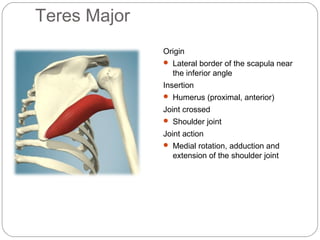
Teres Major
Origin
 Lateral border of the scapula near

the inferior angle
Insertion
 Humerus (proximal, anterior)

Joint crossed
 Shoulder joint

Joint action
 Medial rotation, adduction and

extension of the shoulder joint
Muscles of the Shoulder Joint
Rotator Cuff
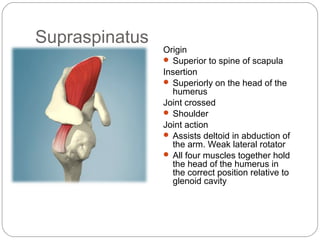
Supraspinatus

Origin
 Superior to spine of scapula
Insertion
 Superiorly on the head of the
humerus
Joint crossed
 Shoulder
Joint action
 Assists deltoid in abduction of
the arm. Weak lateral rotator
 All four muscles together hold
the head of the humerus in
the correct position relative to
glenoid cavity
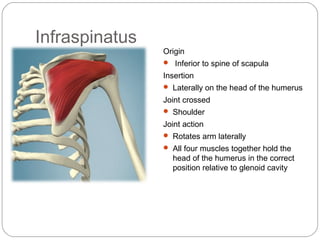
Infraspinatus
Origin
 Inferior to spine of scapula

Insertion
 Laterally on the head of the humerus

Joint crossed
 Shoulder

Joint action
 Rotates arm laterally
 All four muscles together hold the

head of the humerus in the correct
position relative to glenoid cavity
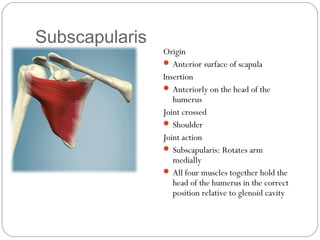
Subscapularis

Origin
 Anterior surface of scapula
Insertion
 Anteriorly on the head of the
humerus
Joint crossed
 Shoulder
Joint action
 Subscapularis: Rotates arm
medially
 All four muscles together hold the
head of the humerus in the correct
position relative to glenoid cavity
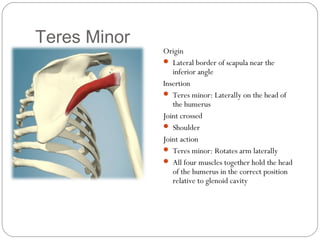
Teres Minor

Origin
 Lateral border of scapula near the
inferior angle
Insertion
 Teres minor: Laterally on the head of
the humerus
Joint crossed
 Shoulder
Joint action
 Teres minor: Rotates arm laterally
 All four muscles together hold the head
of the humerus in the correct position
relative to glenoid cavity
Muscles of the Elbow
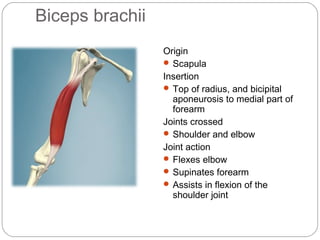
Biceps brachii
Origin
 Scapula
Insertion
 Top of radius, and bicipital
aponeurosis to medial part of
forearm
Joints crossed
 Shoulder and elbow
Joint action
 Flexes elbow
 Supinates forearm
 Assists in flexion of the
shoulder joint
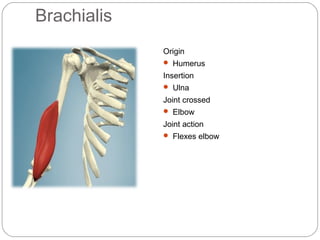
Brachialis
Origin
 Humerus

Insertion
 Ulna

Joint crossed
 Elbow

Joint action
 Flexes elbow
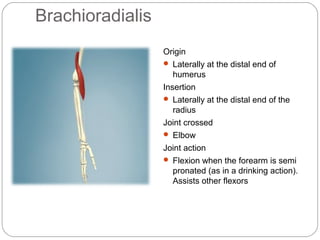
Brachioradialis
Origin
 Laterally at the distal end of
humerus
Insertion
 Laterally at the distal end of the
radius
Joint crossed
 Elbow
Joint action
 Flexion when the forearm is semi

pronated (as in a drinking action).
Assists other flexors
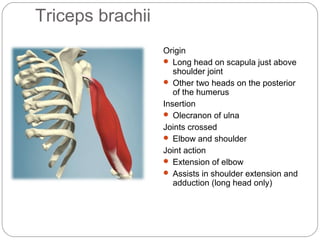
Triceps brachii
Origin
 Long head on scapula just above
shoulder joint
 Other two heads on the posterior
of the humerus
Insertion
 Olecranon of ulna
Joints crossed
 Elbow and shoulder
Joint action
 Extension of elbow
 Assists in shoulder extension and
adduction (long head only)
Muscles of the Vertebral Column
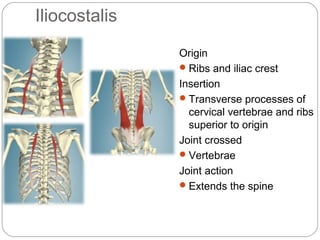
Iliocostalis
Origin
 Ribs and iliac crest
Insertion
 Transverse processes of
cervical vertebrae and ribs
superior to origin
Joint crossed
 Vertebrae
Joint action
 Extends the spine
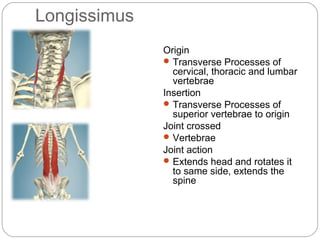
Longissimus
Origin
 Transverse Processes of
cervical, thoracic and lumbar
vertebrae
Insertion
 Transverse Processes of
superior vertebrae to origin
Joint crossed
 Vertebrae
Joint action
 Extends head and rotates it
to same side, extends the
spine
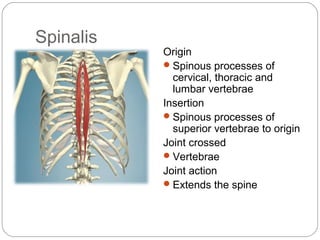
Spinalis

Origin
 Spinous processes of
cervical, thoracic and
lumbar vertebrae
Insertion
 Spinous processes of
superior vertebrae to origin
Joint crossed
 Vertebrae
Joint action
 Extends the spine
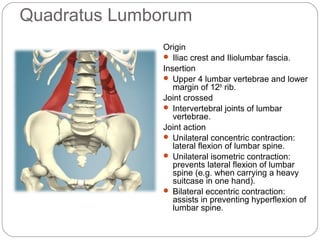
Quadratus Lumborum
Origin
 Iliac crest and Iliolumbar fascia.
Insertion
 Upper 4 lumbar vertebrae and lower
margin of 12th rib.
Joint crossed
 Intervertebral joints of lumbar
vertebrae.
Joint action
 Unilateral concentric contraction:
lateral flexion of lumbar spine.
 Unilateral isometric contraction:
prevents lateral flexion of lumbar
spine (e.g. when carrying a heavy
suitcase in one hand).
 Bilateral eccentric contraction:
assists in preventing hyperflexion of
lumbar spine.
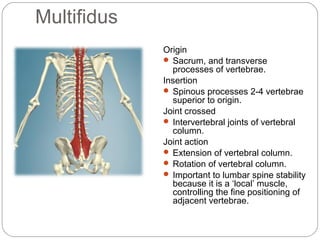
Multifidus
Origin
 Sacrum, and transverse
processes of vertebrae.
Insertion
 Spinous processes 2-4 vertebrae
superior to origin.
Joint crossed
 Intervertebral joints of vertebral
column.
Joint action
 Extension of vertebral column.
 Rotation of vertebral column.
 Important to lumbar spine stability
because it is a ‘local’ muscle,
controlling the fine positioning of
adjacent vertebrae.
Anterior Abdominal Wall
Muscles
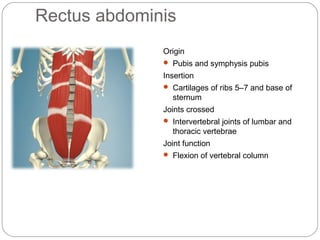
Rectus abdominis
Origin
 Pubis and symphysis pubis

Insertion
 Cartilages of ribs 5–7 and base of

sternum
Joints crossed
 Intervertebral joints of lumbar and

thoracic vertebrae
Joint function
 Flexion of vertebral column
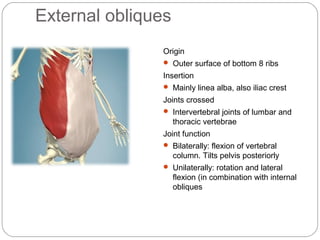
External obliques
Origin
 Outer surface of bottom 8 ribs

Insertion
 Mainly linea alba, also iliac crest

Joints crossed
 Intervertebral joints of lumbar and

thoracic vertebrae
Joint function
 Bilaterally: flexion of vertebral

column. Tilts pelvis posteriorly
 Unilaterally: rotation and lateral

flexion (in combination with internal
obliques
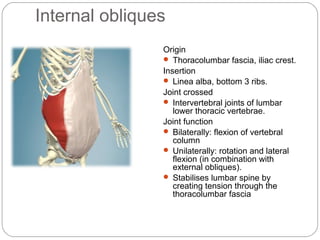
Internal obliques
Origin
 Thoracolumbar fascia, iliac crest.
Insertion
 Linea alba, bottom 3 ribs.
Joint crossed
 Intervertebral joints of lumbar
lower thoracic vertebrae.
Joint function
 Bilaterally: flexion of vertebral
column
 Unilaterally: rotation and lateral
flexion (in combination with
external obliques).
 Stabilises lumbar spine by
creating tension through the
thoracolumbar fascia
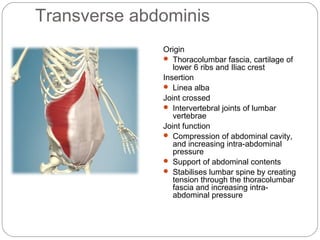
Transverse abdominis
Origin
 Thoracolumbar fascia, cartilage of
lower 6 ribs and Iliac crest
Insertion
 Linea alba
Joint crossed
 Intervertebral joints of lumbar
vertebrae
Joint function
 Compression of abdominal cavity,
and increasing intra-abdominal
pressure
 Support of abdominal contents
 Stabilises lumbar spine by creating
tension through the thoracolumbar
fascia and increasing intraabdominal pressure
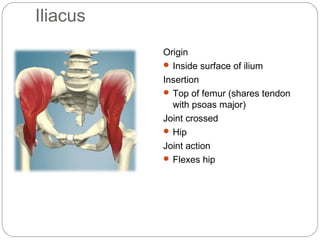
Iliacus
Origin
 Inside surface of ilium
Insertion
 Top of femur (shares tendon
with psoas major)
Joint crossed
 Hip
Joint action
 Flexes hip
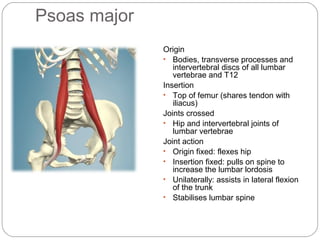
Psoas major
Origin
• Bodies, transverse processes and
intervertebral discs of all lumbar
vertebrae and T12
Insertion
• Top of femur (shares tendon with
iliacus)
Joints crossed
• Hip and intervertebral joints of
lumbar vertebrae
Joint action
• Origin fixed: flexes hip
• Insertion fixed: pulls on spine to
increase the lumbar lordosis
• Unilaterally: assists in lateral flexion
of the trunk
• Stabilises lumbar spine
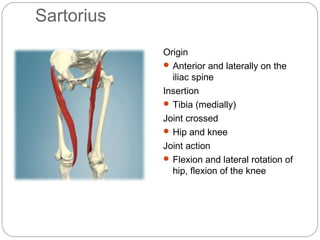
Sartorius
Origin
 Anterior and laterally on the
iliac spine
Insertion
 Tibia (medially)
Joint crossed
 Hip and knee
Joint action
 Flexion and lateral rotation of
hip, flexion of the knee
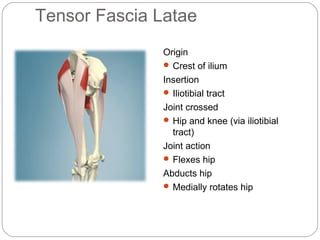
Tensor Fascia Latae
Origin
 Crest of ilium
Insertion
 Iliotibial tract
Joint crossed
 Hip and knee (via iliotibial
tract)
Joint action
 Flexes hip
Abducts hip
 Medially rotates hip
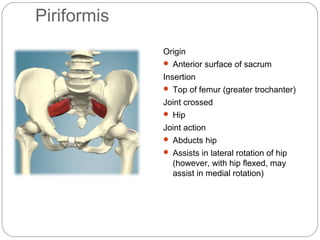
Piriformis
Origin
 Anterior surface of sacrum
Insertion
 Top of femur (greater trochanter)
Joint crossed
 Hip
Joint action
 Abducts hip
 Assists in lateral rotation of hip

(however, with hip flexed, may
assist in medial rotation)
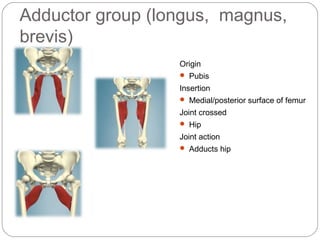
Adductor group (longus, magnus,
brevis)
Origin
 Pubis

Insertion
 Medial/posterior surface of femur

Joint crossed
 Hip

Joint action
 Adducts hip
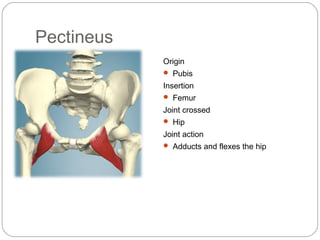
Pectineus
Origin
 Pubis

Insertion
 Femur

Joint crossed
 Hip

Joint action
 Adducts and flexes the hip
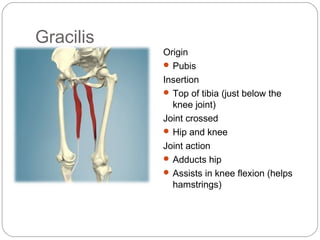
Gracilis
Origin
 Pubis
Insertion
 Top of tibia (just below the
knee joint)
Joint crossed
 Hip and knee
Joint action
 Adducts hip
 Assists in knee flexion (helps
hamstrings)
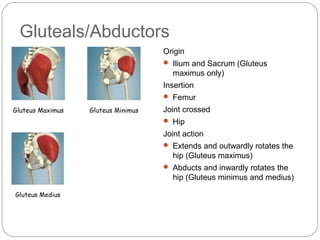
Gluteals/Abductors
Origin
 Ilium and Sacrum (Gluteus

maximus only)
Insertion
 Femur

Joint crossed
 Hip

Joint action
 Extends and outwardly rotates the

hip (Gluteus maximus)
 Abducts and inwardly rotates the

hip (Gluteus minimus and medius)
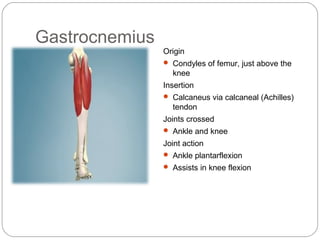
Gastrocnemius
Origin
 Condyles of femur, just above the

knee
Insertion
 Calcaneus via calcaneal (Achilles)

tendon
Joints crossed
 Ankle and knee

Joint action
 Ankle plantarflexion
 Assists in knee flexion
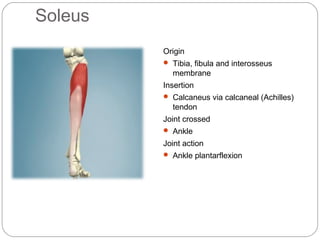
Soleus
Origin
 Tibia, fibula and interosseus

membrane
Insertion
 Calcaneus via calcaneal (Achilles)

tendon
Joint crossed
 Ankle

Joint action
 Ankle plantarflexion
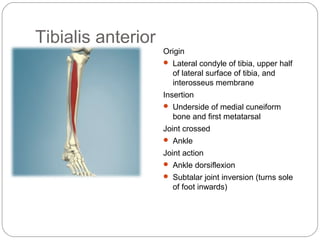
Tibialis anterior
Origin
 Lateral condyle of tibia, upper half

of lateral surface of tibia, and
interosseus membrane
Insertion
 Underside of medial cuneiform

bone and first metatarsal
Joint crossed
 Ankle

Joint action
 Ankle dorsiflexion
 Subtalar joint inversion (turns sole

of foot inwards)

Major Muscles CYQ Level 3

  • 1.
  • 2.
    Muscles you needto know! Breaking them down will help with the learning process. Small targets!
  • 3.
    Hamstrings group: bicepsfemoris, semimembranosus, semitendinosus Origin  All three muscles: Ischium  Short head of biceps femoris: half way down posterior surface of femur Insertion  Semimembranosus, semitendinosus: tibia  Biceps femoris: head of fibula Joints crossed  Knee and hip Joint action  Knee flexion  Hip extension
  • 4.
    Quadriceps: rectus femoris,vastus medialis, intermedius, lateralis Origin  Rectus femoris: iliac spine and top of acetabulum Vastus medialis/intermedius/lateralis: femur Insertion  Front of tibia via patella tendon Joints crossed  Knee and hip (rectus femoris is the only quadriceps to cross both hip and knee joints) Joint action  All four muscles extend the knee  The rectus femoris also flexes the hip
  • 5.
    Muscles of theShoulder Girdle
  • 6.
    Trapezius Origin  Back ofskull: C7, all thoracic vertebrae Insertion  Spine of scapula and lateral edge of clavicle  Joint crossed  Shoulder girdle (moves scapula relative to rib cage) Joint actions  Upper fibres elevate the shoulder girdle  Middle fibres retract shoulder girdle  Lower fibres depress shoulder girdle  Whole muscle upwardly rotates scapula (works as a synergist with serratus anterior)
  • 7.
    Rhomboids Origin  Spinous processesof cervical and thoracic vertebrae (C7 and T1–T5) Insertion  Medial border of scapula  Joint crossed  Shoulder girdle (moves scapula relative to rib cage) Joint actions  Retracts scapula  Downwardly rotates scapula (works as a synergist with pectoralis minor)
  • 8.
    Levator scapulae Origin  Transverseprocesses of cervical vertebrae (C1–C4) Insertion  Medial border of scapula, between superior angle and root of the spine of the scapula Joint crossed  Shoulder girdle (moves scapula relative to rib cage) Joint action  Origin fixed: elevates the scapula. Assists in downwards rotation of scapula  Insertion fixed: laterally flexes the neck
  • 9.
    Serratus anterior Origin  Frontof ribs 1–8 Insertion  Anterior surface of medial border of scapula Joint crossed  Shoulder girdle (moves scapula relative to rib cage) Joint action  Protracts the scapula  Upwardly rotates scapula (works as a synergist with trapezius)
  • 10.
    Pectoralis minor Origin  Frontof ribs 3–5 Insertion  Coracoid process of scapula Joint crossed  Shoulder girdle (moves scapula relative to rib cage) Joint action  Origin fixed: Protracts the scapula. Downwardly rotates scapula (works as a synergist with rhomboids)  Insertion fixed: Elevates rib cage during breathing
  • 11.
    Muscles of theShoulder Joint
  • 12.
    Deltoid Origin  Clavicle (anteriorhead), acromion (medial head) and spine of scapula (posterior head) Insertion  Lateral surface of humerus (nearly half way down) Joint crossed  Shoulder (glenohumeral joint) Joint action  Anterior fibres flex the shoulder and assist in horizontal flexion and medial rotation.  All fibres abduct the shoulder (emphasis on medial fibres)  Posterior fibres extend the shoulder and assist in lateral rotation
  • 13.
    Pectoralis major Origin  Clavicle,sternum and cartilages of ribs 1–6 Insertion  Top of the humerus Joint crossed  Shoulder (glenohumeral) joint Joint action  Shoulder horizontal flexion  Shoulder adduction  Shoulder medial rotation
  • 14.
    Latissimus dorsi Origin  Viathoracolumbar fascia (TLF) from spinous processes of T6– T12, lumbar and sacral vertebrae and iliac crest. Also lower 3–4 ribs and bottom (inferior) edge of scapula Insertion  Top of the humerus (anterior) Joint crossed  Shoulder (glenohumeral) joint Joint action  Origin fixed: adducts and extends arm. Assists in medial rotation of the arm. Depresses the shoulder girdle via the insertion on the humerus  Insertion fixed: tilts the pelvis forwards
  • 15.
    Teres Major Origin  Lateralborder of the scapula near the inferior angle Insertion  Humerus (proximal, anterior) Joint crossed  Shoulder joint Joint action  Medial rotation, adduction and extension of the shoulder joint
  • 16.
    Muscles of theShoulder Joint Rotator Cuff
  • 17.
    Supraspinatus Origin  Superior tospine of scapula Insertion  Superiorly on the head of the humerus Joint crossed  Shoulder Joint action  Assists deltoid in abduction of the arm. Weak lateral rotator  All four muscles together hold the head of the humerus in the correct position relative to glenoid cavity
  • 18.
    Infraspinatus Origin  Inferior tospine of scapula Insertion  Laterally on the head of the humerus Joint crossed  Shoulder Joint action  Rotates arm laterally  All four muscles together hold the head of the humerus in the correct position relative to glenoid cavity
  • 19.
    Subscapularis Origin  Anterior surfaceof scapula Insertion  Anteriorly on the head of the humerus Joint crossed  Shoulder Joint action  Subscapularis: Rotates arm medially  All four muscles together hold the head of the humerus in the correct position relative to glenoid cavity
  • 20.
    Teres Minor Origin  Lateralborder of scapula near the inferior angle Insertion  Teres minor: Laterally on the head of the humerus Joint crossed  Shoulder Joint action  Teres minor: Rotates arm laterally  All four muscles together hold the head of the humerus in the correct position relative to glenoid cavity
  • 21.
  • 22.
    Biceps brachii Origin  Scapula Insertion Top of radius, and bicipital aponeurosis to medial part of forearm Joints crossed  Shoulder and elbow Joint action  Flexes elbow  Supinates forearm  Assists in flexion of the shoulder joint
  • 23.
    Brachialis Origin  Humerus Insertion  Ulna Jointcrossed  Elbow Joint action  Flexes elbow
  • 24.
    Brachioradialis Origin  Laterally atthe distal end of humerus Insertion  Laterally at the distal end of the radius Joint crossed  Elbow Joint action  Flexion when the forearm is semi pronated (as in a drinking action). Assists other flexors
  • 25.
    Triceps brachii Origin  Longhead on scapula just above shoulder joint  Other two heads on the posterior of the humerus Insertion  Olecranon of ulna Joints crossed  Elbow and shoulder Joint action  Extension of elbow  Assists in shoulder extension and adduction (long head only)
  • 26.
    Muscles of theVertebral Column
  • 27.
    Iliocostalis Origin  Ribs andiliac crest Insertion  Transverse processes of cervical vertebrae and ribs superior to origin Joint crossed  Vertebrae Joint action  Extends the spine
  • 28.
    Longissimus Origin  Transverse Processesof cervical, thoracic and lumbar vertebrae Insertion  Transverse Processes of superior vertebrae to origin Joint crossed  Vertebrae Joint action  Extends head and rotates it to same side, extends the spine
  • 29.
    Spinalis Origin  Spinous processesof cervical, thoracic and lumbar vertebrae Insertion  Spinous processes of superior vertebrae to origin Joint crossed  Vertebrae Joint action  Extends the spine
  • 30.
    Quadratus Lumborum Origin  Iliaccrest and Iliolumbar fascia. Insertion  Upper 4 lumbar vertebrae and lower margin of 12th rib. Joint crossed  Intervertebral joints of lumbar vertebrae. Joint action  Unilateral concentric contraction: lateral flexion of lumbar spine.  Unilateral isometric contraction: prevents lateral flexion of lumbar spine (e.g. when carrying a heavy suitcase in one hand).  Bilateral eccentric contraction: assists in preventing hyperflexion of lumbar spine.
  • 31.
    Multifidus Origin  Sacrum, andtransverse processes of vertebrae. Insertion  Spinous processes 2-4 vertebrae superior to origin. Joint crossed  Intervertebral joints of vertebral column. Joint action  Extension of vertebral column.  Rotation of vertebral column.  Important to lumbar spine stability because it is a ‘local’ muscle, controlling the fine positioning of adjacent vertebrae.
  • 32.
  • 33.
    Rectus abdominis Origin  Pubisand symphysis pubis Insertion  Cartilages of ribs 5–7 and base of sternum Joints crossed  Intervertebral joints of lumbar and thoracic vertebrae Joint function  Flexion of vertebral column
  • 34.
    External obliques Origin  Outersurface of bottom 8 ribs Insertion  Mainly linea alba, also iliac crest Joints crossed  Intervertebral joints of lumbar and thoracic vertebrae Joint function  Bilaterally: flexion of vertebral column. Tilts pelvis posteriorly  Unilaterally: rotation and lateral flexion (in combination with internal obliques
  • 35.
    Internal obliques Origin  Thoracolumbarfascia, iliac crest. Insertion  Linea alba, bottom 3 ribs. Joint crossed  Intervertebral joints of lumbar lower thoracic vertebrae. Joint function  Bilaterally: flexion of vertebral column  Unilaterally: rotation and lateral flexion (in combination with external obliques).  Stabilises lumbar spine by creating tension through the thoracolumbar fascia
  • 36.
    Transverse abdominis Origin  Thoracolumbarfascia, cartilage of lower 6 ribs and Iliac crest Insertion  Linea alba Joint crossed  Intervertebral joints of lumbar vertebrae Joint function  Compression of abdominal cavity, and increasing intra-abdominal pressure  Support of abdominal contents  Stabilises lumbar spine by creating tension through the thoracolumbar fascia and increasing intraabdominal pressure
  • 37.
    Iliacus Origin  Inside surfaceof ilium Insertion  Top of femur (shares tendon with psoas major) Joint crossed  Hip Joint action  Flexes hip
  • 38.
    Psoas major Origin • Bodies,transverse processes and intervertebral discs of all lumbar vertebrae and T12 Insertion • Top of femur (shares tendon with iliacus) Joints crossed • Hip and intervertebral joints of lumbar vertebrae Joint action • Origin fixed: flexes hip • Insertion fixed: pulls on spine to increase the lumbar lordosis • Unilaterally: assists in lateral flexion of the trunk • Stabilises lumbar spine
  • 39.
    Sartorius Origin  Anterior andlaterally on the iliac spine Insertion  Tibia (medially) Joint crossed  Hip and knee Joint action  Flexion and lateral rotation of hip, flexion of the knee
  • 40.
    Tensor Fascia Latae Origin Crest of ilium Insertion  Iliotibial tract Joint crossed  Hip and knee (via iliotibial tract) Joint action  Flexes hip Abducts hip  Medially rotates hip
  • 41.
    Piriformis Origin  Anterior surfaceof sacrum Insertion  Top of femur (greater trochanter) Joint crossed  Hip Joint action  Abducts hip  Assists in lateral rotation of hip (however, with hip flexed, may assist in medial rotation)
  • 42.
    Adductor group (longus,magnus, brevis) Origin  Pubis Insertion  Medial/posterior surface of femur Joint crossed  Hip Joint action  Adducts hip
  • 43.
    Pectineus Origin  Pubis Insertion  Femur Jointcrossed  Hip Joint action  Adducts and flexes the hip
  • 44.
    Gracilis Origin  Pubis Insertion  Topof tibia (just below the knee joint) Joint crossed  Hip and knee Joint action  Adducts hip  Assists in knee flexion (helps hamstrings)
  • 45.
    Gluteals/Abductors Origin  Ilium andSacrum (Gluteus maximus only) Insertion  Femur Joint crossed  Hip Joint action  Extends and outwardly rotates the hip (Gluteus maximus)  Abducts and inwardly rotates the hip (Gluteus minimus and medius)
  • 46.
    Gastrocnemius Origin  Condyles offemur, just above the knee Insertion  Calcaneus via calcaneal (Achilles) tendon Joints crossed  Ankle and knee Joint action  Ankle plantarflexion  Assists in knee flexion
  • 47.
    Soleus Origin  Tibia, fibulaand interosseus membrane Insertion  Calcaneus via calcaneal (Achilles) tendon Joint crossed  Ankle Joint action  Ankle plantarflexion
  • 48.
    Tibialis anterior Origin  Lateralcondyle of tibia, upper half of lateral surface of tibia, and interosseus membrane Insertion  Underside of medial cuneiform bone and first metatarsal Joint crossed  Ankle Joint action  Ankle dorsiflexion  Subtalar joint inversion (turns sole of foot inwards)