
LEVERS & TYPES
LEVERS OF THE BODY
INTRODUCTION
©2021 DR ROHIT BHASKAR PT HTTPS://WWW.PT-PEDIA.COM/
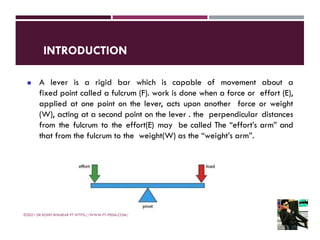
◼ A lever is a rigid bar which is capable of movement about a
fixed point called a fulcrum (F). work is done when a force or effort (E),
applied at one point on the lever, acts upon another force or weight
(W), acting at a second point on the lever . the perpendicular distances
from the fulcrum to the effort(E) may be called The “effort’s arm” and
that from the fulcrum to the weight(W) as the “weight’s arm”.
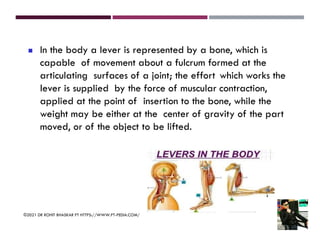
◼ In the body a lever is represented by a bone, which is
capable of movement about a fulcrum formed at the
articulating surfaces of a joint; the effort which works the
lever is supplied by the force of muscular contraction,
applied at the point of insertion to the bone, while the
weight may be either at the center of gravity of the part
moved, or of the object to be lifted.
©2021 DR ROHIT BHASKAR PT HTTPS://WWW.PT-PEDIA.COM/
CLASSIFICATIONS OF LEVERS
◼ There are three orders or classed of levers,
each of which is characterized by the relative
positions of the fulcrum, effort and weight.
◼ 1st order lever
◼ 2nd order lever
◼ 3rd order lever
©2021 DR ROHIT BHASKAR PT HTTPS://WWW.PT-PEDIA.COM/
1ST ORDER LEVER
©2021 DR ROHIT BHASKAR PT HTTPS://WWW.PT-PEDIA.COM/
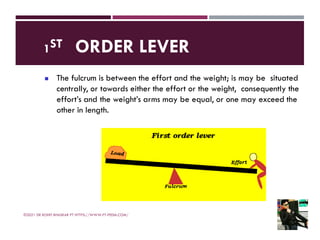
◼ The fulcrum is between the effort and the weight; is may be situated
centrally, or towards either the effort or the weight, consequently the
effort’s and the weight’s arms may be equal, or one may exceed the
other in length.
2ND ORDER LEVER
©2021 DR ROHIT BHASKAR PT HTTPS://WWW.PT-PEDIA.COM/
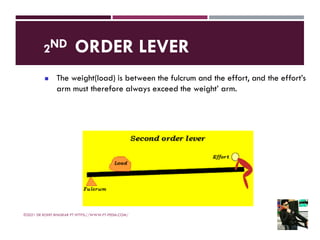
◼ The weight(load) is between the fulcrum and the effort, and the effort’s
arm must therefore always exceed the weight’ arm.
3rd ORDER LEVER
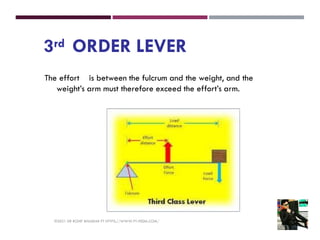
The effort is between the fulcrum and the weight, and the
weight’s arm must therefore exceed the effort’s arm.
©2021 DR ROHIT BHASKAR PT HTTPS://WWW.PT-PEDIA.COM/
MECHANICAL ADVANTAGE
©2021 DR ROHIT BHASKAR PT HTTPS://WWW.PT-PEDIA.COM/
◼ MECHANICAL ADVANTAGE : the efficacy of a force in relation to a
lever is dependent upon tow factors, i.e the force exerted (W) or (E) ,
and its perpendicular distance from the fulcrum
(weight’s arm or effort’s arm). The product of these two factors is known
as the Moment of Force (or toque). When the weight’s and effort’s arms
are of equal length and effort of a magnitude equal to that of the
weight will be required to lift it. No advantage is gained but the
machine is useful for measuring weights as, for example, in the common
balance.
◼ If, however, the length of the effort’s arm exceeds that of
the weight’s arm, less effort will be required to achieve a
similar result and an advantages will be gained by the
use of the lever. This is known as a Mechanical advantage,
and it is obtained in levers of the 1st order when the
fulcrum is nearer to the weight than to the effort, and in all
levers of the 2nd order. It is never obtained in levers of the
3rd order.
©2021 DR ROHIT BHASKAR PT HTTPS://WWW.PT-PEDIA.COM/
LEVERS OF THE BODY
©2021 DR ROHIT BHASKAR PT HTTPS://WWW.PT-PEDIA.COM/
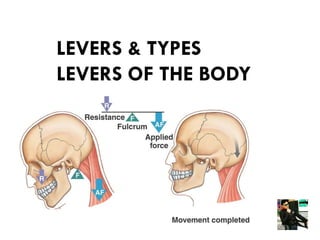
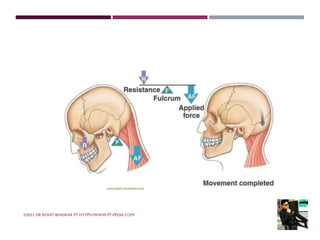
1st order lever
◼ the feature of this order is stability, and a state of
equilibrium can be achieved either with or without
mechanical advantage. One example of this type of lever
is demonstrated during nodding movement of the head; the
skull represents the lever, the atlanto-occipital joints the
fulcrum, the weight is situated anteriorly in the face, and
the effort is supplied by the contraction of the posterior
Neck muscles, applied at their attachment to the occipital
bone.
©2021 DR ROHIT BHASKAR PT HTTPS://WWW.PT-PEDIA.COM/
2nd order lever
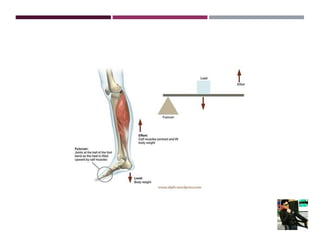
◼ this is the lever of power as there must always be a
mechanical advantage. An example in the lower limb is
demonstrated when the heels are raised to stand on the
toes. The tarsal and metatarsal bones are stabilized by
muscular action to form the lever, the fulcrum is at the
metatarsophalangeal join, and the weight of the body is
transmitted through the ankle joint to the talus. The effort is
applied at the insertion of the tendo- calcneum by the
contraction of the calf muscle. In the arm, the action of
Brachioradialis muscle in flexing the elbow joint can be
taken as another example of a type of lever which is
relatively uncommon in the body.
©2021 DR ROHIT BHASKAR PT HTTPS://WWW.PT-PEDIA.COM/
3rd order lever
◼ in the human body there are more examples of the
3rd order of levers than of any other types. This type
of lever, in which there is always a mechanical
disadvantages, is the lever of velocity, the loss of
mechanical advantage being outweighed by the
advantages gained by speed and range of
movement. Both in the days of primitive man and in
modern times, speed and range of movement have
often proved to be a greater asset than power.
©2021 DR ROHIT BHASKAR PT HTTPS://WWW.PT-PEDIA.COM/
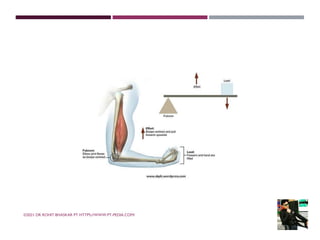
◼ When the lever is the forearm, the fulcrum is the
elbow joint, and when the effort is supplied by the
contraction of the Brachialis muscle applied at its
insertion, and the weight is some object held in the
hands, it can be seen that a small amount of
muscular contraction will be translated into much
more extensive and rapid movement at the hand.
The action of the Hamstring muscles in flexing the
knee is another simple example.
©2021 DR ROHIT BHASKAR PT HTTPS://WWW.PT-PEDIA.COM/
THANK YOU
©2021 DR ROHIT BHASKAR PT HTTPS://WWW.PT-PEDIA.COM/

Levers in Human Body ( Physiotherapy ) - Dr Rohit Bhaskar

  • 1.
  • 2.
    INTRODUCTION ©2021 DR ROHITBHASKAR PT HTTPS://WWW.PT-PEDIA.COM/ ◼ A lever is a rigid bar which is capable of movement about a fixed point called a fulcrum (F). work is done when a force or effort (E), applied at one point on the lever, acts upon another force or weight (W), acting at a second point on the lever . the perpendicular distances from the fulcrum to the effort(E) may be called The “effort’s arm” and that from the fulcrum to the weight(W) as the “weight’s arm”.
  • 3.
    ◼ In thebody a lever is represented by a bone, which is capable of movement about a fulcrum formed at the articulating surfaces of a joint; the effort which works the lever is supplied by the force of muscular contraction, applied at the point of insertion to the bone, while the weight may be either at the center of gravity of the part moved, or of the object to be lifted. ©2021 DR ROHIT BHASKAR PT HTTPS://WWW.PT-PEDIA.COM/
  • 4.
    CLASSIFICATIONS OF LEVERS ◼There are three orders or classed of levers, each of which is characterized by the relative positions of the fulcrum, effort and weight. ◼ 1st order lever ◼ 2nd order lever ◼ 3rd order lever ©2021 DR ROHIT BHASKAR PT HTTPS://WWW.PT-PEDIA.COM/
  • 5.
    1ST ORDER LEVER ©2021DR ROHIT BHASKAR PT HTTPS://WWW.PT-PEDIA.COM/ ◼ The fulcrum is between the effort and the weight; is may be situated centrally, or towards either the effort or the weight, consequently the effort’s and the weight’s arms may be equal, or one may exceed the other in length.
  • 6.
    2ND ORDER LEVER ©2021DR ROHIT BHASKAR PT HTTPS://WWW.PT-PEDIA.COM/ ◼ The weight(load) is between the fulcrum and the effort, and the effort’s arm must therefore always exceed the weight’ arm.
  • 7.
    3rd ORDER LEVER Theeffort is between the fulcrum and the weight, and the weight’s arm must therefore exceed the effort’s arm. ©2021 DR ROHIT BHASKAR PT HTTPS://WWW.PT-PEDIA.COM/
  • 8.
    MECHANICAL ADVANTAGE ©2021 DRROHIT BHASKAR PT HTTPS://WWW.PT-PEDIA.COM/ ◼ MECHANICAL ADVANTAGE : the efficacy of a force in relation to a lever is dependent upon tow factors, i.e the force exerted (W) or (E) , and its perpendicular distance from the fulcrum (weight’s arm or effort’s arm). The product of these two factors is known as the Moment of Force (or toque). When the weight’s and effort’s arms are of equal length and effort of a magnitude equal to that of the weight will be required to lift it. No advantage is gained but the machine is useful for measuring weights as, for example, in the common balance.
  • 9.
    ◼ If, however,the length of the effort’s arm exceeds that of the weight’s arm, less effort will be required to achieve a similar result and an advantages will be gained by the use of the lever. This is known as a Mechanical advantage, and it is obtained in levers of the 1st order when the fulcrum is nearer to the weight than to the effort, and in all levers of the 2nd order. It is never obtained in levers of the 3rd order. ©2021 DR ROHIT BHASKAR PT HTTPS://WWW.PT-PEDIA.COM/
  • 10.
    LEVERS OF THEBODY ©2021 DR ROHIT BHASKAR PT HTTPS://WWW.PT-PEDIA.COM/ 1st order lever ◼ the feature of this order is stability, and a state of equilibrium can be achieved either with or without mechanical advantage. One example of this type of lever is demonstrated during nodding movement of the head; the skull represents the lever, the atlanto-occipital joints the fulcrum, the weight is situated anteriorly in the face, and the effort is supplied by the contraction of the posterior Neck muscles, applied at their attachment to the occipital bone.
  • 11.
    ©2021 DR ROHITBHASKAR PT HTTPS://WWW.PT-PEDIA.COM/
  • 12.
    2nd order lever ◼this is the lever of power as there must always be a mechanical advantage. An example in the lower limb is demonstrated when the heels are raised to stand on the toes. The tarsal and metatarsal bones are stabilized by muscular action to form the lever, the fulcrum is at the metatarsophalangeal join, and the weight of the body is transmitted through the ankle joint to the talus. The effort is applied at the insertion of the tendo- calcneum by the contraction of the calf muscle. In the arm, the action of Brachioradialis muscle in flexing the elbow joint can be taken as another example of a type of lever which is relatively uncommon in the body. ©2021 DR ROHIT BHASKAR PT HTTPS://WWW.PT-PEDIA.COM/
  • 14.
    3rd order lever ◼in the human body there are more examples of the 3rd order of levers than of any other types. This type of lever, in which there is always a mechanical disadvantages, is the lever of velocity, the loss of mechanical advantage being outweighed by the advantages gained by speed and range of movement. Both in the days of primitive man and in modern times, speed and range of movement have often proved to be a greater asset than power. ©2021 DR ROHIT BHASKAR PT HTTPS://WWW.PT-PEDIA.COM/
  • 15.
    ◼ When thelever is the forearm, the fulcrum is the elbow joint, and when the effort is supplied by the contraction of the Brachialis muscle applied at its insertion, and the weight is some object held in the hands, it can be seen that a small amount of muscular contraction will be translated into much more extensive and rapid movement at the hand. The action of the Hamstring muscles in flexing the knee is another simple example. ©2021 DR ROHIT BHASKAR PT HTTPS://WWW.PT-PEDIA.COM/
  • 16.
    ©2021 DR ROHITBHASKAR PT HTTPS://WWW.PT-PEDIA.COM/
  • 17.
    ©2021 DR ROHITBHASKAR PT HTTPS://WWW.PT-PEDIA.COM/ ©2021 DR ROHIT BHASKAR PT HTTPS://WWW.PT-PEDIA.COM/
  • 18.
    THANK YOU ©2021 DRROHIT BHASKAR PT HTTPS://WWW.PT-PEDIA.COM/ ©2021 DR ROHIT BHASKAR PT HTTPS://WWW.PT-PEDIA.COM/