BIOMECHANICS
SPINE
CONTENTS:
Basic of human spine
Spinal curves
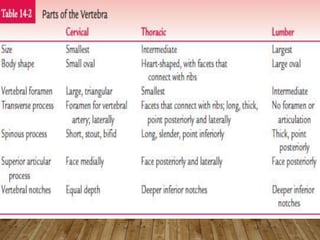
Features of the vertebrae
Features of the intervertebral disks
Articulations
Spinal ligaments
Kinetics of spine
Kinematics of spine
HUMAN SPINE:
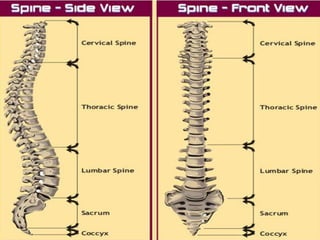
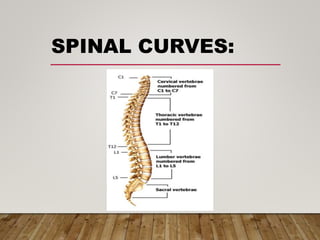
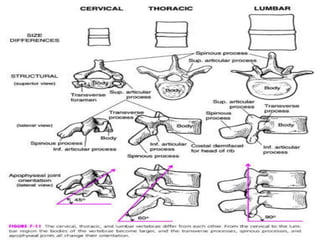
 A curved stack of 33 vertebrae structurally
divided into five regions:
 cervical region - 7 vertebrae
 thoracic region - 12 vertebrae
 lumbar region - 5 vertebrae
 sacrum - 5 fused vertebrae
 coccyx - 4 fused vertebrae
SPINAL CURVES:
CURVES
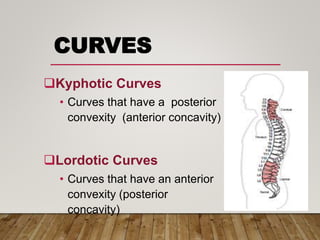
Kyphotic Curves
• Curves that have a posterior
convexity (anterior concavity)
Lordotic Curves
• Curves that have an anterior
convexity (posterior
concavity)
PRIMARY AND SECONDARY
CURVES:
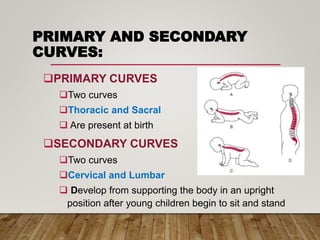
PRIMARY CURVES
Two curves
Thoracic and Sacral
 Are present at birth
SECONDARY CURVES
Two curves
Cervical and Lumbar
 Develop from supporting the body in an upright
position after young children begin to sit and stand
ABNORMAL CURVES:
 Scoliosis-abnormal lateral curve of more than
10°
 “twisted disease”
 Kyphosis-exaggerated thoracic curve
 “humped disease”
 Lordosis-accentuated lumbar curve
 “bent-backward disease”
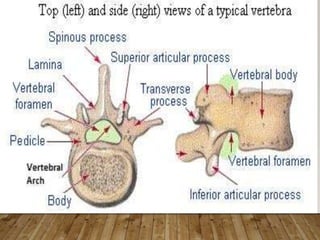
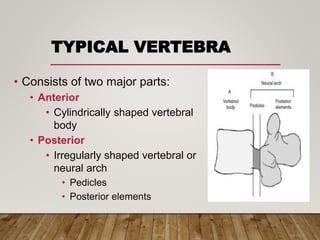
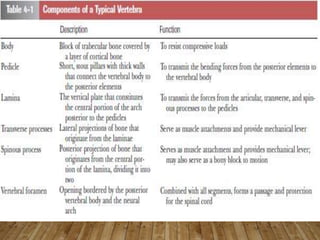
TYPICAL VERTEBRA
• Consists of two major parts:
• Anterior
• Cylindrically shaped vertebral
body
• Posterior
• Irregularly shaped vertebral or
neural arch
• Pedicles
• Posterior elements
TYPICAL VERTEBRA
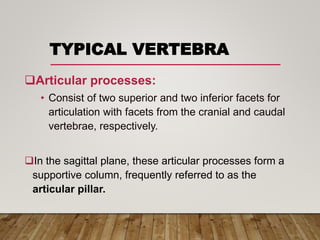
Articular processes:
• Consist of two superior and two inferior facets for
articulation with facets from the cranial and caudal
vertebrae, respectively.
In the sagittal plane, these articular processes form a
supportive column, frequently referred to as the
articular pillar.
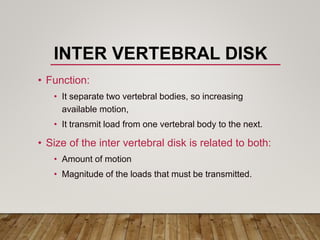
INTER VERTEBRAL DISK
• Function:
• It separate two vertebral bodies, so increasing
available motion,
• It transmit load from one vertebral body to the next.
• Size of the inter vertebral disk is related to both:
• Amount of motion
• Magnitude of the loads that must be transmitted.
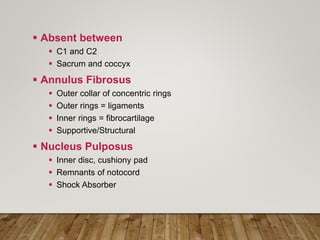
 Absent between
 C1 and C2
 Sacrum and coccyx
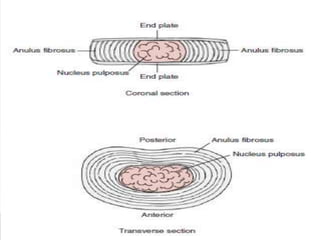
 Annulus Fibrosus
 Outer collar of concentric rings
 Outer rings = ligaments
 Inner rings = fibrocartilage
 Supportive/Structural
 Nucleus Pulposus
 Inner disc, cushiony pad
 Remnants of notocord
 Shock Absorber
INTER VERTEBRAL DISK
 The inter vertebral disks:
 Make up about 20% to 33% (1/3) of the length of the vertebral
column
 Increase in size from the cervical to the lumbar regions.
 Disk thickness varies:
 Approxi.3 mm in the cervical region,
 where the weight-bearing loads are the lowest
 About 9 mm in the lumbar region,
 where the weight-bearing loads are the greatest
INTERVERTEBRAL DISK
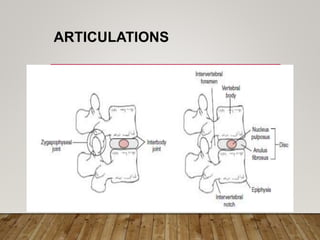
ARTICULATIONS
ARTICULATIONS
Interbody Joints
 Available movements at the interbody joints
 gliding, distraction and compression, and rotation (also called tilt or rocking in
the spine)
 Gliding motions can occur in the following directions:
 anterior to posterior, medial to lateral, and torsional.
 Tilt motions can occur in
 anterior to posterior and in lateral directions.
 These motions, together with the distraction and compression,
constitute six degrees of freedom
Interbody Joints
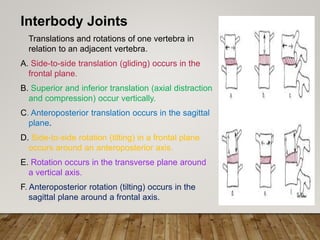
Translations and rotations of one vertebra in
relation to an adjacent vertebra.
A. Side-to-side translation (gliding) occurs in the
frontal plane.
B. Superior and inferior translation (axial distraction
and compression) occur vertically.
C. Anteroposterior translation occurs in the sagittal
plane.
D. Side-to-side rotation (tilting) in a frontal plane
occurs around an anteroposterior axis.
E. Rotation occurs in the transverse plane around
a vertical axis.
F. Anteroposterior rotation (tilting) occurs in the
sagittal plane around a frontal axis.
LIGAMENTS AND JOINT
CAPSULES
• The ligamentous system of the vertebral column is extensive
and exhibits considerable regional variability.
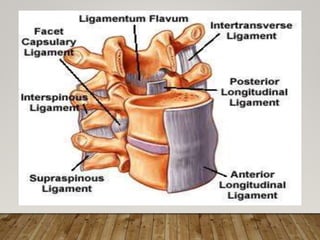
• Six main ligaments are associated with the intervertebral and
zygapophyseal joints.
1. Anterior longitudinal ligament
2. posterior longitudinal ligament
3. Ligamentum flavum
4. Interspinous ligament
5. Supraspinous ligament
6. Intertransverse ligaments
LIGAMENTS AND JOINT
CAPSULES
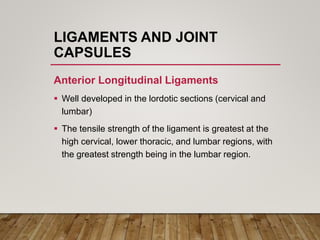
Anterior Longitudinal Ligaments
 Well developed in the lordotic sections (cervical and
lumbar)
 The tensile strength of the ligament is greatest at the
high cervical, lower thoracic, and lumbar regions, with
the greatest strength being in the lumbar region.
LIGAMENTS AND JOINT
CAPSULES
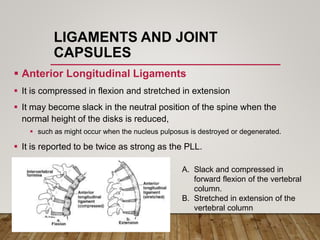
 Anterior Longitudinal Ligaments
 It is compressed in flexion and stretched in extension
 It may become slack in the neutral position of the spine when the
normal height of the disks is reduced,
 such as might occur when the nucleus pulposus is destroyed or degenerated.
 It is reported to be twice as strong as the PLL.
A. Slack and compressed in
forward flexion of the vertebral
column.
B. Stretched in extension of the
vertebral column
LIGAMENTS AND JOINT
CAPSULES
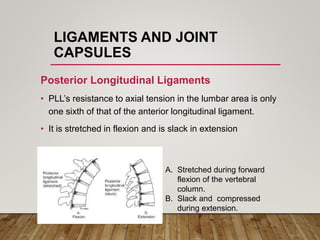
Posterior Longitudinal Ligaments
• PLL’s resistance to axial tension in the lumbar area is only
one sixth of that of the anterior longitudinal ligament.
• It is stretched in flexion and is slack in extension
A. Stretched during forward
flexion of the vertebral
column.
B. Slack and compressed
during extension.
LIGAMENTS AND JOINT
CAPSULES
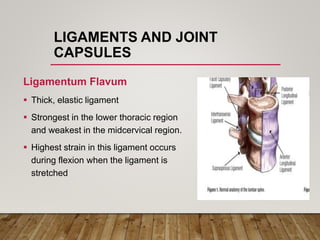
Ligamentum Flavum
 Thick, elastic ligament
 Strongest in the lower thoracic region
and weakest in the midcervical region.
 Highest strain in this ligament occurs
during flexion when the ligament is
stretched
LIGAMENTS AND JOINT
CAPSULES
Interspinous Ligaments
 The interspinous ligament, along with the supraspinous
ligament, is the first to be damaged with excessive
flexion
 Contribute to lumbar spine stability
 Degenerate with aging
LIGAMENTS AND JOINT
CAPSULES
Supraspinous Ligament
 The supraspinous ligament, like the interspinous
ligament, is stretched in flexion, and its fibers resist
separation of the spinous processes during forward
flexion.
 During hyperflexion, the supraspinous ligament, along
with the interspinous ligament, is the first to fail
LIGAMENTS AND JOINT
CAPSULES
Intertransverse Ligaments
 The ligaments are alternately stretched and compressed
during lateral bending.
 During lateral bending to the left
 The ligaments on the right side are stretched and offer resistance
 The ligaments on the left side are slack and compressed during this
motion.
 During lateral bending to the right
 The ligaments on the left side are stretched and offer resistance to this
motion
KINETICS
 Vertebral column is subjected to
 Axial compression, tension, bending,
torsion, and shear stress
 During normal functional activities & also
at rest
KINETICS
• Vertebral column’s ability to resist these loads
 Varies among spinal regions and
 Depends on the
 Type, duration, and rate of loading
 Person’s age and posture
 Condition and properties of the various structural
elements
 Vertebral bodies, joints, disks, muscles, joint
capsules & ligaments
AXIAL COMPRESSION
 Force acting through the long axis of the spine at right angles to
the disks
 Occurs as a result of the
 Force of gravity
 Ground reaction forces
 Forces produced by the ligaments and muscular contractions
 The disks and vertebral bodies resist most of the compressive
force.
BENDING
 Bending causes both compression and tension on the structures of the
spine.
 In forward flexion:
 the anterior structures (anterior portion of the disk, anterior ligaments, and muscles)
are subjected to compression;
 the posterior structures are subjected to tension.
 The resistance offered to the tensile forces
By:
 collagen fibers in the posterior outer anulus fibrosus, zygapophyseal joint
capsules, and posterior ligaments
 help to limit extremes of motion
 hence provide stability in flexion
TORSION
Torsional forces are created during axial rotation that
occurs as a part of the coupled motions that take place in
the spine.
This kind of force tries to twist the bone along its long
axis
Torsional forces generally result in short or long spiral
fractures
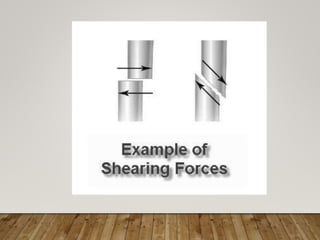
SHEAR
 Shear forces act on the mid plane of the disk and tend to cause each
vertebra to undergo translation
 move anteriorly, posteriorly, or from side to side in relation to the
inferior vertebra
 In the lumbar spine,
 Zygapophyseal joints resist some of the shear force, and the
 Disks resist the remainder.
 When the load is sustained,
 disks exhibit creep
 zygapophyseal joints may have to resist all of the shear force.
KINEMATICS
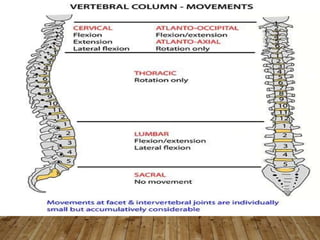
 The motions available to the column as a whole are
flexion and extension, lateral flexion, and rotation.
 These motions appear to occur independently of each
other
 At the level of the individual motion segment,
 these motions are often coupled motions.
COUPLED MOTION
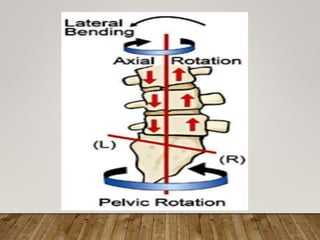
 Coupling is defined as the consistent association of one motion
about an axis with another motion around a different axis.
 The most predominant motions that exhibit coupled behaviors
are
 lateral flexion and rotation.
 Pure lateral flexion and pure rotation do not occur in any region
of the spine.
 In order for either motion to occur, at least some of the other must
occur as well
KINEMATICS
 Coupling patterns, as well as the types and amounts of motion
that are available
 are complex,
 differ from region to region
 depend on the
 spinal posture, curves,
 orientation of the articulating facets,
 fluidity, elasticity, and thickness of the inter-vertebral disks
 extensibility of the muscles, ligaments, and joint capsules
KINEMATICS
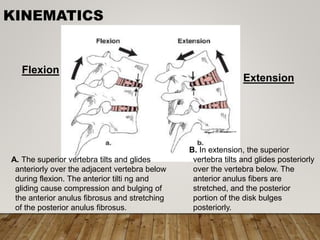
A. The superior vertebra tilts and glides
anteriorly over the adjacent vertebra below
during flexion. The anterior tilti ng and
gliding cause compression and bulging of
the anterior anulus fibrosus and stretching
of the posterior anulus fibrosus.
B. In extension, the superior
vertebra tilts and glides posteriorly
over the vertebra below. The
anterior anulus fibers are
stretched, and the posterior
portion of the disk bulges
posteriorly.
Extension
Flexion
KINEMATICS
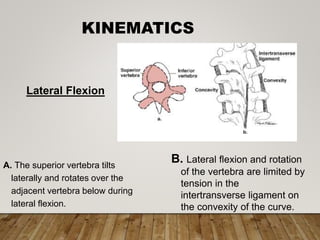
A. The superior vertebra tilts
laterally and rotates over the
adjacent vertebra below during
lateral flexion.
B. Lateral flexion and rotation
of the vertebra are limited by
tension in the
intertransverse ligament on
the convexity of the curve.
Lateral Flexion
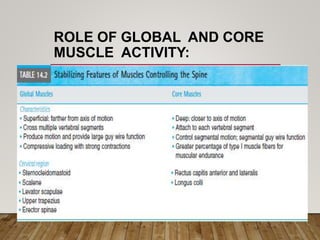
ROLE OF GLOBAL AND CORE
MUSCLE ACTIVITY:
Biomechanics spine

Biomechanics spine

  • 2.
  • 3.
    CONTENTS: Basic of humanspine Spinal curves Features of the vertebrae Features of the intervertebral disks Articulations Spinal ligaments Kinetics of spine Kinematics of spine
  • 4.
    HUMAN SPINE:  Acurved stack of 33 vertebrae structurally divided into five regions:  cervical region - 7 vertebrae  thoracic region - 12 vertebrae  lumbar region - 5 vertebrae  sacrum - 5 fused vertebrae  coccyx - 4 fused vertebrae
  • 6.
  • 7.
    CURVES Kyphotic Curves • Curvesthat have a posterior convexity (anterior concavity) Lordotic Curves • Curves that have an anterior convexity (posterior concavity)
  • 8.
    PRIMARY AND SECONDARY CURVES: PRIMARYCURVES Two curves Thoracic and Sacral  Are present at birth SECONDARY CURVES Two curves Cervical and Lumbar  Develop from supporting the body in an upright position after young children begin to sit and stand
  • 9.
    ABNORMAL CURVES:  Scoliosis-abnormallateral curve of more than 10°  “twisted disease”  Kyphosis-exaggerated thoracic curve  “humped disease”  Lordosis-accentuated lumbar curve  “bent-backward disease”
  • 11.
    TYPICAL VERTEBRA • Consistsof two major parts: • Anterior • Cylindrically shaped vertebral body • Posterior • Irregularly shaped vertebral or neural arch • Pedicles • Posterior elements
  • 15.
    TYPICAL VERTEBRA Articular processes: •Consist of two superior and two inferior facets for articulation with facets from the cranial and caudal vertebrae, respectively. In the sagittal plane, these articular processes form a supportive column, frequently referred to as the articular pillar.
  • 16.
    INTER VERTEBRAL DISK •Function: • It separate two vertebral bodies, so increasing available motion, • It transmit load from one vertebral body to the next. • Size of the inter vertebral disk is related to both: • Amount of motion • Magnitude of the loads that must be transmitted.
  • 17.
     Absent between C1 and C2  Sacrum and coccyx  Annulus Fibrosus  Outer collar of concentric rings  Outer rings = ligaments  Inner rings = fibrocartilage  Supportive/Structural  Nucleus Pulposus  Inner disc, cushiony pad  Remnants of notocord  Shock Absorber
  • 18.
    INTER VERTEBRAL DISK The inter vertebral disks:  Make up about 20% to 33% (1/3) of the length of the vertebral column  Increase in size from the cervical to the lumbar regions.  Disk thickness varies:  Approxi.3 mm in the cervical region,  where the weight-bearing loads are the lowest  About 9 mm in the lumbar region,  where the weight-bearing loads are the greatest
  • 19.
  • 20.
  • 21.
    ARTICULATIONS Interbody Joints  Availablemovements at the interbody joints  gliding, distraction and compression, and rotation (also called tilt or rocking in the spine)  Gliding motions can occur in the following directions:  anterior to posterior, medial to lateral, and torsional.  Tilt motions can occur in  anterior to posterior and in lateral directions.  These motions, together with the distraction and compression, constitute six degrees of freedom
  • 22.
    Interbody Joints Translations androtations of one vertebra in relation to an adjacent vertebra. A. Side-to-side translation (gliding) occurs in the frontal plane. B. Superior and inferior translation (axial distraction and compression) occur vertically. C. Anteroposterior translation occurs in the sagittal plane. D. Side-to-side rotation (tilting) in a frontal plane occurs around an anteroposterior axis. E. Rotation occurs in the transverse plane around a vertical axis. F. Anteroposterior rotation (tilting) occurs in the sagittal plane around a frontal axis.
  • 23.
    LIGAMENTS AND JOINT CAPSULES •The ligamentous system of the vertebral column is extensive and exhibits considerable regional variability. • Six main ligaments are associated with the intervertebral and zygapophyseal joints. 1. Anterior longitudinal ligament 2. posterior longitudinal ligament 3. Ligamentum flavum 4. Interspinous ligament 5. Supraspinous ligament 6. Intertransverse ligaments
  • 25.
    LIGAMENTS AND JOINT CAPSULES AnteriorLongitudinal Ligaments  Well developed in the lordotic sections (cervical and lumbar)  The tensile strength of the ligament is greatest at the high cervical, lower thoracic, and lumbar regions, with the greatest strength being in the lumbar region.
  • 26.
    LIGAMENTS AND JOINT CAPSULES Anterior Longitudinal Ligaments  It is compressed in flexion and stretched in extension  It may become slack in the neutral position of the spine when the normal height of the disks is reduced,  such as might occur when the nucleus pulposus is destroyed or degenerated.  It is reported to be twice as strong as the PLL. A. Slack and compressed in forward flexion of the vertebral column. B. Stretched in extension of the vertebral column
  • 27.
    LIGAMENTS AND JOINT CAPSULES PosteriorLongitudinal Ligaments • PLL’s resistance to axial tension in the lumbar area is only one sixth of that of the anterior longitudinal ligament. • It is stretched in flexion and is slack in extension A. Stretched during forward flexion of the vertebral column. B. Slack and compressed during extension.
  • 28.
    LIGAMENTS AND JOINT CAPSULES LigamentumFlavum  Thick, elastic ligament  Strongest in the lower thoracic region and weakest in the midcervical region.  Highest strain in this ligament occurs during flexion when the ligament is stretched
  • 29.
    LIGAMENTS AND JOINT CAPSULES InterspinousLigaments  The interspinous ligament, along with the supraspinous ligament, is the first to be damaged with excessive flexion  Contribute to lumbar spine stability  Degenerate with aging
  • 30.
    LIGAMENTS AND JOINT CAPSULES SupraspinousLigament  The supraspinous ligament, like the interspinous ligament, is stretched in flexion, and its fibers resist separation of the spinous processes during forward flexion.  During hyperflexion, the supraspinous ligament, along with the interspinous ligament, is the first to fail
  • 31.
    LIGAMENTS AND JOINT CAPSULES IntertransverseLigaments  The ligaments are alternately stretched and compressed during lateral bending.  During lateral bending to the left  The ligaments on the right side are stretched and offer resistance  The ligaments on the left side are slack and compressed during this motion.  During lateral bending to the right  The ligaments on the left side are stretched and offer resistance to this motion
  • 32.
    KINETICS  Vertebral columnis subjected to  Axial compression, tension, bending, torsion, and shear stress  During normal functional activities & also at rest
  • 33.
    KINETICS • Vertebral column’sability to resist these loads  Varies among spinal regions and  Depends on the  Type, duration, and rate of loading  Person’s age and posture  Condition and properties of the various structural elements  Vertebral bodies, joints, disks, muscles, joint capsules & ligaments
  • 34.
    AXIAL COMPRESSION  Forceacting through the long axis of the spine at right angles to the disks  Occurs as a result of the  Force of gravity  Ground reaction forces  Forces produced by the ligaments and muscular contractions  The disks and vertebral bodies resist most of the compressive force.
  • 35.
    BENDING  Bending causesboth compression and tension on the structures of the spine.  In forward flexion:  the anterior structures (anterior portion of the disk, anterior ligaments, and muscles) are subjected to compression;  the posterior structures are subjected to tension.  The resistance offered to the tensile forces By:  collagen fibers in the posterior outer anulus fibrosus, zygapophyseal joint capsules, and posterior ligaments  help to limit extremes of motion  hence provide stability in flexion
  • 36.
    TORSION Torsional forces arecreated during axial rotation that occurs as a part of the coupled motions that take place in the spine. This kind of force tries to twist the bone along its long axis Torsional forces generally result in short or long spiral fractures
  • 37.
    SHEAR  Shear forcesact on the mid plane of the disk and tend to cause each vertebra to undergo translation  move anteriorly, posteriorly, or from side to side in relation to the inferior vertebra  In the lumbar spine,  Zygapophyseal joints resist some of the shear force, and the  Disks resist the remainder.  When the load is sustained,  disks exhibit creep  zygapophyseal joints may have to resist all of the shear force.
  • 39.
    KINEMATICS  The motionsavailable to the column as a whole are flexion and extension, lateral flexion, and rotation.  These motions appear to occur independently of each other  At the level of the individual motion segment,  these motions are often coupled motions.
  • 41.
    COUPLED MOTION  Couplingis defined as the consistent association of one motion about an axis with another motion around a different axis.  The most predominant motions that exhibit coupled behaviors are  lateral flexion and rotation.  Pure lateral flexion and pure rotation do not occur in any region of the spine.  In order for either motion to occur, at least some of the other must occur as well
  • 43.
    KINEMATICS  Coupling patterns,as well as the types and amounts of motion that are available  are complex,  differ from region to region  depend on the  spinal posture, curves,  orientation of the articulating facets,  fluidity, elasticity, and thickness of the inter-vertebral disks  extensibility of the muscles, ligaments, and joint capsules
  • 44.
    KINEMATICS A. The superiorvertebra tilts and glides anteriorly over the adjacent vertebra below during flexion. The anterior tilti ng and gliding cause compression and bulging of the anterior anulus fibrosus and stretching of the posterior anulus fibrosus. B. In extension, the superior vertebra tilts and glides posteriorly over the vertebra below. The anterior anulus fibers are stretched, and the posterior portion of the disk bulges posteriorly. Extension Flexion
  • 45.
    KINEMATICS A. The superiorvertebra tilts laterally and rotates over the adjacent vertebra below during lateral flexion. B. Lateral flexion and rotation of the vertebra are limited by tension in the intertransverse ligament on the convexity of the curve. Lateral Flexion
  • 46.
    ROLE OF GLOBALAND CORE MUSCLE ACTIVITY: