
Food Labels and Recipe
Modification
Applying the Principles of Nutrition to
a Physical Activity
Learning Outcomes
• Interpret and understand the relevance of information given on a

food label
• Describe the advantages and disadvantages of certain foods
• Calculate the percentage of calories in a food coming from fat,
protein and carbohydrates.
• Define an organically produced food
Task
Textbook challenge

We’ve covered pages 11 – 29
3 minutes to get prepared for direct questions
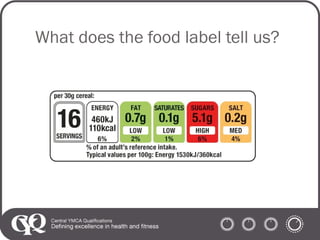
What does the food label tell us?
What the label tells you
•
•
•
•
•

The name of the food
The weight of the food
Any special storage considerations
An indication of minimum durability - a ‘best before’ date
Place of origin if there is a chance that the consumer could be
misled
• Nutritional information must be given if a claim is made on the
packaging, i.e. ‘low in fat’ or ‘high in fibre. The nutritional
breakdown should be for a 100g/100ml serving.
• Pictures on foods must be honest and not misleading
• In 2004 the Genetically Modified (GM) labelling rules came into
force
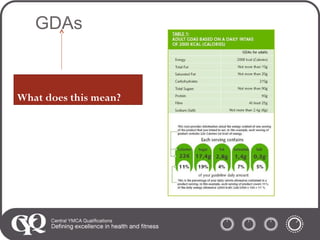
GDAs

What does this mean?
Guideline Daily Amounts
 GDAs are a guide to the total amount of energy and

nutrients that a healthy adult should be eating per day
 Derived from Estimated Average Requirements for energy
for men and women aged between 19−50 of normal weight
and/or for weight maintenance
 The energy GDA values (2500kcals for males and
2000kcals for females) take account of the current activity
levels and lifestyle of the ‘average person’, which is
considered to be fairly sedentary
 The GDAs for fats and saturates are derived from the
dietary reference values of these nutrients as published by
the Department of Health (1991)
 For salt, the GDA is based on the 6g per day as
recommended by COMA (1994) and then confirmed by
SANC (Scientific Advisory Committee on Nutrition) 2003.
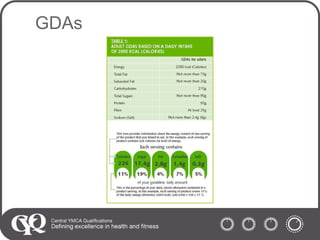
GDAs
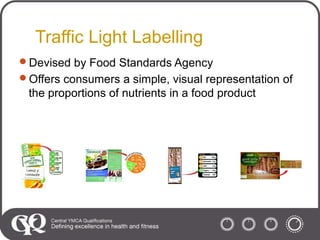
Traffic Light Labelling
Devised by Food Standards Agency
Offers consumers a simple, visual representation of

the proportions of nutrients in a food product
Nutritional Claims
Trans fats
• It is not a legal requirement to declare how many trans fatty acids are in a food
unless a ‘low in trans fatty acids’ claim is made on the packaging. Trans fats are
widely used by food manufactures because they are cheap to produce and have a
long shelf life
Organic
• must be grown/produced in accordance with EU laws on organic production
Fat and Sugar
• Can be misleading
• Few legal guidelines in this area
• Practically no restrictions on manufacturers making low fat claims
• ‘lite’ or ‘light’ can be used to mean reduced fat, sugar, alcohol or even salt
• It can even be used to describe the colour and texture of food
How to work out the percentage kcals
from fat
Look at the nutrient label:

Energy

291KJ/70cKal

Protein

3g

Carbohydrate

8g

Fat

3g

Multiply the grams of fat by 9 (9kcal per gram) to get the amount in calories:
3 x 9kcal = 27kcal
Divide this number by the number of calories per serving / 100grams:
27 divided by 70 = .385
Multiply this number by 100 to get the percentage = 38.5%
Recipe Modification
What ways can food be cooked?

Food preparation methods can facilitate healthy
eating:
• Steaming
• Dry frying
• Grilling
• Baking
Give your partner some advice…..
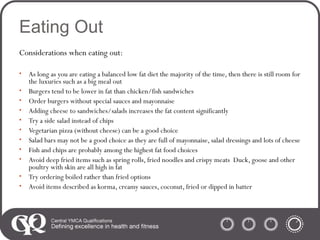
Eating Out
Considerations when eating out:
•
•
•
•
•
•
•
•
•
•
•

As long as you are eating a balanced low fat diet the majority of the time, then there is still room for
the luxuries such as a big meal out
Burgers tend to be lower in fat than chicken/fish sandwiches
Order burgers without special sauces and mayonnaise
Adding cheese to sandwiches/salads increases the fat content significantly
Try a side salad instead of chips
Vegetarian pizza (without cheese) can be a good choice
Salad bars may not be a good choice as they are full of mayonnaise, salad dressings and lots of cheese
Fish and chips are probably among the highest fat food choices
Avoid deep fried items such as spring rolls, fried noodles and crispy meats Duck, goose and other
poultry with skin are all high in fat
Try ordering boiled rather than fried options
Avoid items described as korma, creamy sauces, coconut, fried or dipped in batter
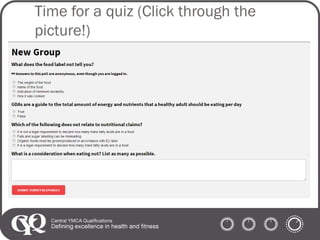
Time for a quiz (Click through the
picture!)

Food labels

  • 1.
    Food Labels andRecipe Modification Applying the Principles of Nutrition to a Physical Activity
  • 2.
    Learning Outcomes • Interpretand understand the relevance of information given on a food label • Describe the advantages and disadvantages of certain foods • Calculate the percentage of calories in a food coming from fat, protein and carbohydrates. • Define an organically produced food
  • 3.
    Task Textbook challenge We’ve coveredpages 11 – 29 3 minutes to get prepared for direct questions
  • 4.
    What does thefood label tell us?
  • 5.
    What the labeltells you • • • • • The name of the food The weight of the food Any special storage considerations An indication of minimum durability - a ‘best before’ date Place of origin if there is a chance that the consumer could be misled • Nutritional information must be given if a claim is made on the packaging, i.e. ‘low in fat’ or ‘high in fibre. The nutritional breakdown should be for a 100g/100ml serving. • Pictures on foods must be honest and not misleading • In 2004 the Genetically Modified (GM) labelling rules came into force
  • 6.
  • 7.
    Guideline Daily Amounts GDAs are a guide to the total amount of energy and nutrients that a healthy adult should be eating per day  Derived from Estimated Average Requirements for energy for men and women aged between 19−50 of normal weight and/or for weight maintenance  The energy GDA values (2500kcals for males and 2000kcals for females) take account of the current activity levels and lifestyle of the ‘average person’, which is considered to be fairly sedentary  The GDAs for fats and saturates are derived from the dietary reference values of these nutrients as published by the Department of Health (1991)  For salt, the GDA is based on the 6g per day as recommended by COMA (1994) and then confirmed by SANC (Scientific Advisory Committee on Nutrition) 2003.
  • 8.
  • 9.
    Traffic Light Labelling Devisedby Food Standards Agency Offers consumers a simple, visual representation of the proportions of nutrients in a food product
  • 10.
    Nutritional Claims Trans fats •It is not a legal requirement to declare how many trans fatty acids are in a food unless a ‘low in trans fatty acids’ claim is made on the packaging. Trans fats are widely used by food manufactures because they are cheap to produce and have a long shelf life Organic • must be grown/produced in accordance with EU laws on organic production Fat and Sugar • Can be misleading • Few legal guidelines in this area • Practically no restrictions on manufacturers making low fat claims • ‘lite’ or ‘light’ can be used to mean reduced fat, sugar, alcohol or even salt • It can even be used to describe the colour and texture of food
  • 11.
    How to workout the percentage kcals from fat Look at the nutrient label: Energy 291KJ/70cKal Protein 3g Carbohydrate 8g Fat 3g Multiply the grams of fat by 9 (9kcal per gram) to get the amount in calories: 3 x 9kcal = 27kcal Divide this number by the number of calories per serving / 100grams: 27 divided by 70 = .385 Multiply this number by 100 to get the percentage = 38.5%
  • 12.
    Recipe Modification What wayscan food be cooked? Food preparation methods can facilitate healthy eating: • Steaming • Dry frying • Grilling • Baking
  • 13.
    Give your partnersome advice…..
  • 14.
    Eating Out Considerations wheneating out: • • • • • • • • • • • As long as you are eating a balanced low fat diet the majority of the time, then there is still room for the luxuries such as a big meal out Burgers tend to be lower in fat than chicken/fish sandwiches Order burgers without special sauces and mayonnaise Adding cheese to sandwiches/salads increases the fat content significantly Try a side salad instead of chips Vegetarian pizza (without cheese) can be a good choice Salad bars may not be a good choice as they are full of mayonnaise, salad dressings and lots of cheese Fish and chips are probably among the highest fat food choices Avoid deep fried items such as spring rolls, fried noodles and crispy meats Duck, goose and other poultry with skin are all high in fat Try ordering boiled rather than fried options Avoid items described as korma, creamy sauces, coconut, fried or dipped in batter
  • 15.
    Time for aquiz (Click through the picture!)

Editor's Notes

  • #2 {"11":"Work out carbs and protein\n","7":"The GDAs should not be regarded as individual targets but as a benchmark of the contribution an individual product makes to their daily requirement of nutrients. As we have seen, individual energy and nutrient requirements vary depending on activity levels, age, weight and gender. These guidelines should be viewed as just that. The inclusion of GDAs on food packaging will allow the consumer to see at a glance how a product contributes to their overall nutritional intake and make informed choices on healthy eating. \n","9":"Discuss advantages and disadvantages\n","10":". These laws require food sold as 'organic' to come from growers, processors and importers who are registered and approved by organic certification bodies, which are in turn registered by the Department for Environment, Food and Rural Affairs (DEFRA) or a similar control body elsewhere in the European Union.\n \nLabels on food sold as 'organic' must indicate the organic certification body that the processor or packer is registered with, e.g. the Soil Association. The labels must, at the minimum, include a code number that denotes the approved inspection body. The name or trademark (logo) of the certification body may also be shown. It is not always possible to make products entirely from organic ingredients, since not all ingredients are available in organic form. Manufacturers of organic food are permitted to use specific non-organic ingredients provided that organic ingredients make up at least 95% of the food. \n"}