Rashed Dawabsheh
Hip joint
Ball and socket joint
Weight bearing joint
Stable joint
between the femur and acetabulum of

the pelvis
Added

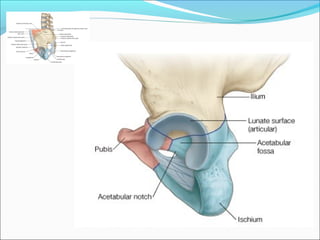
Anatomical Components:
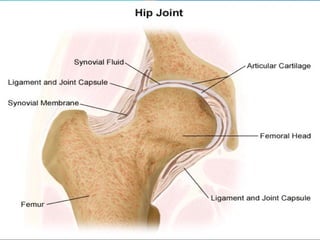
Articular Capsule
2. Acetabular labrum
3. Ligaments:
1.







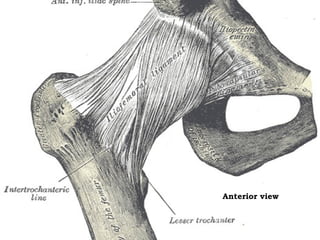
Iliofemoral
Pubofemoral
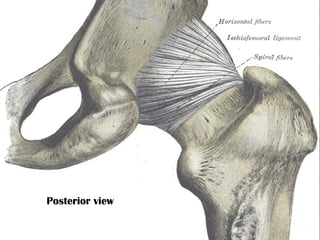
Ischiofemoral
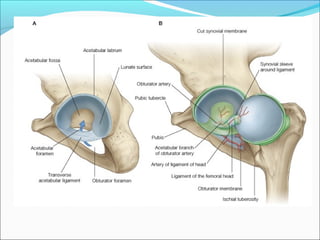
Ligament of the head of the femur
Transverse ligament of the acetabulum
Anterior view
Posterior view
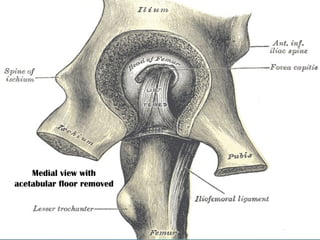
Medial view with
acetabular floor removed
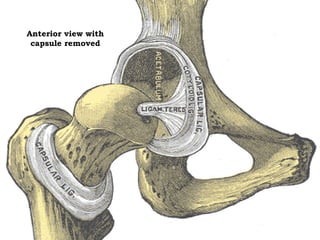
Anterior view with
capsule removed
Added

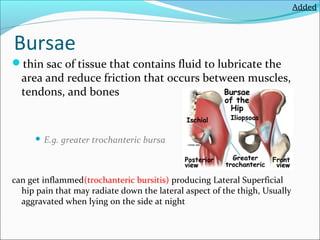
Bursae
thin sac of tissue that contains fluid to lubricate the

area and reduce friction that occurs between muscles,
tendons, and bones



E.g. greater trochanteric bursa

can get inflammed(trochanteric bursitis) producing Lateral Superficial
hip pain that may radiate down the lateral aspect of the thigh, Usually
aggravated when lying on the side at night
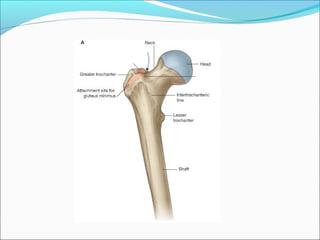
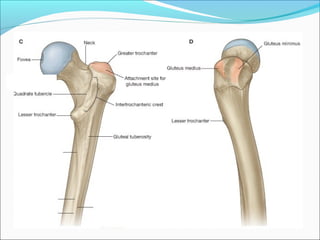
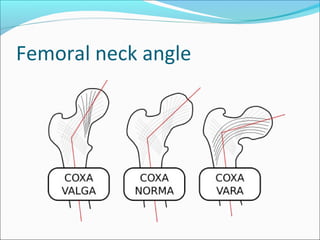
Femoral neck angle
Added

Surrounding Vital Structures:
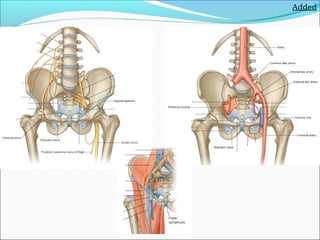
 Nerves:
All of the nerves that travel down the thigh pass by the hip. The main nerves
are the femoral nerve in front and the sciatic nerve in back of the hip. A
smaller nerve, called the obturator nerve, also goes to the hip

Blood Vessel & Blood Supply of the Joint
femoral artery passes by the front of the hip area, and has a deep branch,
called the profunda femoris. The profunda femoris sends two vessels that
go through the hip joint capsule.
Lateral & Medial femoral circumflex arteries
These vessels are the main blood supply for the femoral head,
the ligamentum teres (Ligament of the head of the femur) contains a
small blood vessel hat gives a very small supply of blood to the top of
the
femoral head.
Added
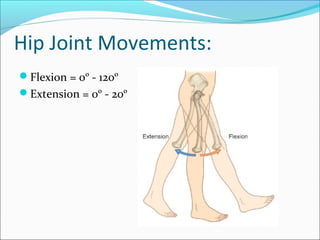
Hip Joint Movements:
Flexion = 0º - 120º
Extension = 0º - 20º
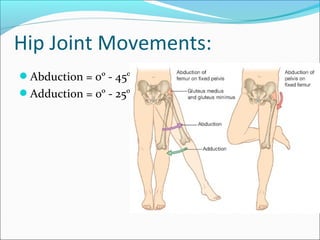
Hip Joint Movements:
Abduction = 0º - 45º
Adduction = 0º - 25º
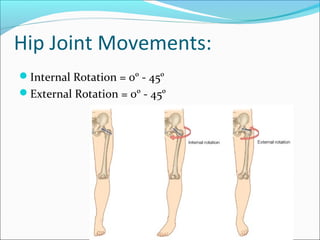
Hip Joint Movements:
Internal Rotation = 0º - 45º
External Rotation = 0º - 45º
History
 Hip Joint Pain:

- Groin pain that may radiate to the Ant. Thigh & knee
- Usually increased with activity (OA)
- Pain over the greater trochanter is typically
trochanteric bursitis
-The buttock is not the hip! Buttock pain is typically
from the sciatic nerve or lumbar spine
History
 Limping can be due to:

- Pain (as in antalgic limp).
- Shortening of one of the limbs.
- Weakness in abductors (as in trendelenburg gait).
Added

History
 Age:

in >70 or postmenopausal woman, there is an
increased
chance of neck fracture
Important Questions:
- How did this affect your daily activity?
- How Long/Far can you walk?
- Do you use any Walking Aid?
Added

Examination
Before Examination:
1.Introduction
2.Privacy
3.Position: for most of the exam the patient should be supine lying on a

flat table. patient's hands should remain at his/her sides with the head resting on
a pillow. The knees and hips should be in the anatomical position

4.Privacy
5.Exposure: patient's hips should be exposed so that the quadriceps muscles and
greater trochanter can be assessed
Added

Examination
Look …. Feel …. Move….
 Look:

- Gait (while ptn is standing)
- Masses / Scars / Lesions / Signs of trauma or
previous surgery
- Bony alignment (rotation, leg length)
- Muscle bulk and symmetry at the hip and knee
Added

Examination
 Feel:

- Tenderness over the greater trochanter
(Trochanteric Bursitis)
- Assessing for fractures & Injuries look for
Tenderness over: ischial spine, Pubic Rami,
Lesser trochanter & ischial tuberosity
Added

Examination
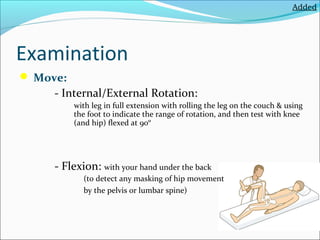
 Move:

- Internal/External Rotation:
with leg in full extension with rolling the leg on the couch & using
the foot to indicate the range of rotation, and then test with knee
(and hip) flexed at 90º

- Flexion: with your hand under the back
(to detect any masking of hip movement
by the pelvis or lumbar spine)
Added

Examination (Move Cont.)
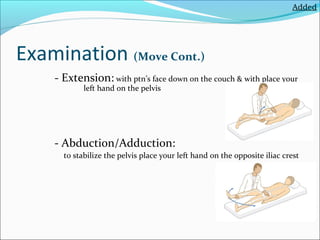
- Extension: with ptn’s face down on the couch & with place your
left hand on the pelvis

- Abduction/Adduction:
to stabilize the pelvis place your left hand on the opposite iliac crest
Added

Examination (Move Cont.)
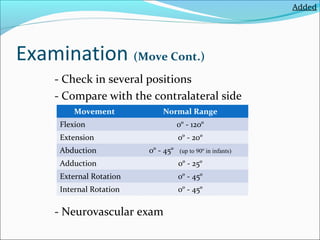
- Check in several positions
- Compare with the contralateral side
Movement

Normal Range

Flexion

0º - 120º

Extension

0º - 20º

Abduction

0º - 45º

(up to 90º in infants)

Adduction

0º - 25º

External Rotation

0º - 45º

Internal Rotation

0º - 45º

- Neurovascular exam
Special Tests
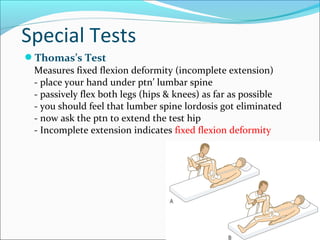
Thomas’s Test
Measures fixed flexion deformity (incomplete extension)
- place your hand under ptn’ lumbar spine
- passively flex both legs (hips & knees) as far as possible
- you should feel that lumber spine lordosis got eliminated
- now ask the ptn to extend the test hip
- Incomplete extension indicates fixed flexion deformity
Special Tests
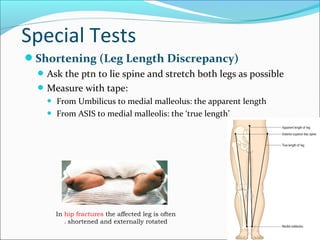
Shortening (Leg Length Discrepancy)
 Ask the ptn to lie spine and stretch both legs as possible
 Measure with tape:



From Umbilicus to medial malleolus: the apparent length
From ASIS to medial malleolis: the ‘true length’

In hip fractures the affected leg is often
. shortened and externally rotated
Special Tests
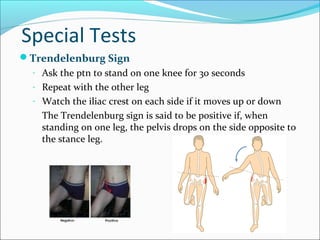
Trendelenburg Sign
- Ask the ptn to stand on one knee for 30 seconds
- Repeat with the other leg
- Watch the iliac crest on each side if it moves up or down

The Trendelenburg sign is said to be positive if, when
standing on one leg, the pelvis drops on the side opposite to
the stance leg.
Special Tests
Trendelenburg Sign
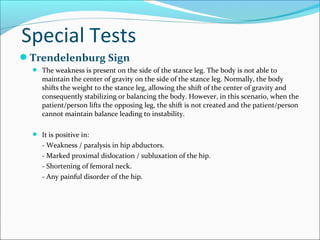
 The weakness is present on the side of the stance leg. The body is not able to

maintain the center of gravity on the side of the stance leg. Normally, the body
shifts the weight to the stance leg, allowing the shift of the center of gravity and
consequently stabilizing or balancing the body. However, in this scenario, when the
patient/person lifts the opposing leg, the shift is not created and the patient/person
cannot maintain balance leading to instability.

 It is positive in:

- Weakness / paralysis in hip abductors.
- Marked proximal dislocation / subluxation of the hip.
- Shortening of femoral neck.
- Any painful disorder of the hip.
Imaging
X-ray
CT scan
MRI
Sonography
Others.

hip joint

  • 1.
  • 2.
    Hip joint Ball andsocket joint Weight bearing joint Stable joint between the femur and acetabulum of the pelvis
  • 6.
    Added Anatomical Components: Articular Capsule 2.Acetabular labrum 3. Ligaments: 1.      Iliofemoral Pubofemoral Ischiofemoral Ligament of the head of the femur Transverse ligament of the acetabulum
  • 7.
  • 8.
  • 9.
  • 10.
  • 13.
    Added Bursae thin sac oftissue that contains fluid to lubricate the area and reduce friction that occurs between muscles, tendons, and bones  E.g. greater trochanteric bursa can get inflammed(trochanteric bursitis) producing Lateral Superficial hip pain that may radiate down the lateral aspect of the thigh, Usually aggravated when lying on the side at night
  • 14.
  • 15.
    Added Surrounding Vital Structures: Nerves: All of the nerves that travel down the thigh pass by the hip. The main nerves are the femoral nerve in front and the sciatic nerve in back of the hip. A smaller nerve, called the obturator nerve, also goes to the hip Blood Vessel & Blood Supply of the Joint femoral artery passes by the front of the hip area, and has a deep branch, called the profunda femoris. The profunda femoris sends two vessels that go through the hip joint capsule. Lateral & Medial femoral circumflex arteries These vessels are the main blood supply for the femoral head, the ligamentum teres (Ligament of the head of the femur) contains a small blood vessel hat gives a very small supply of blood to the top of the femoral head.
  • 16.
  • 17.
    Hip Joint Movements: Flexion= 0º - 120º Extension = 0º - 20º
  • 18.
    Hip Joint Movements: Abduction= 0º - 45º Adduction = 0º - 25º
  • 19.
    Hip Joint Movements: InternalRotation = 0º - 45º External Rotation = 0º - 45º
  • 20.
    History  Hip JointPain: - Groin pain that may radiate to the Ant. Thigh & knee - Usually increased with activity (OA) - Pain over the greater trochanter is typically trochanteric bursitis -The buttock is not the hip! Buttock pain is typically from the sciatic nerve or lumbar spine
  • 21.
    History  Limping canbe due to: - Pain (as in antalgic limp). - Shortening of one of the limbs. - Weakness in abductors (as in trendelenburg gait).
  • 22.
    Added History  Age: in >70or postmenopausal woman, there is an increased chance of neck fracture Important Questions: - How did this affect your daily activity? - How Long/Far can you walk? - Do you use any Walking Aid?
  • 23.
    Added Examination Before Examination: 1.Introduction 2.Privacy 3.Position: formost of the exam the patient should be supine lying on a flat table. patient's hands should remain at his/her sides with the head resting on a pillow. The knees and hips should be in the anatomical position 4.Privacy 5.Exposure: patient's hips should be exposed so that the quadriceps muscles and greater trochanter can be assessed
  • 24.
    Added Examination Look …. Feel…. Move….  Look: - Gait (while ptn is standing) - Masses / Scars / Lesions / Signs of trauma or previous surgery - Bony alignment (rotation, leg length) - Muscle bulk and symmetry at the hip and knee
  • 25.
    Added Examination  Feel: - Tendernessover the greater trochanter (Trochanteric Bursitis) - Assessing for fractures & Injuries look for Tenderness over: ischial spine, Pubic Rami, Lesser trochanter & ischial tuberosity
  • 26.
    Added Examination  Move: - Internal/ExternalRotation: with leg in full extension with rolling the leg on the couch & using the foot to indicate the range of rotation, and then test with knee (and hip) flexed at 90º - Flexion: with your hand under the back (to detect any masking of hip movement by the pelvis or lumbar spine)
  • 27.
    Added Examination (Move Cont.) -Extension: with ptn’s face down on the couch & with place your left hand on the pelvis - Abduction/Adduction: to stabilize the pelvis place your left hand on the opposite iliac crest
  • 28.
    Added Examination (Move Cont.) -Check in several positions - Compare with the contralateral side Movement Normal Range Flexion 0º - 120º Extension 0º - 20º Abduction 0º - 45º (up to 90º in infants) Adduction 0º - 25º External Rotation 0º - 45º Internal Rotation 0º - 45º - Neurovascular exam
  • 29.
    Special Tests Thomas’s Test Measuresfixed flexion deformity (incomplete extension) - place your hand under ptn’ lumbar spine - passively flex both legs (hips & knees) as far as possible - you should feel that lumber spine lordosis got eliminated - now ask the ptn to extend the test hip - Incomplete extension indicates fixed flexion deformity
  • 30.
    Special Tests Shortening (LegLength Discrepancy)  Ask the ptn to lie spine and stretch both legs as possible  Measure with tape:   From Umbilicus to medial malleolus: the apparent length From ASIS to medial malleolis: the ‘true length’ In hip fractures the affected leg is often . shortened and externally rotated
  • 31.
    Special Tests Trendelenburg Sign -Ask the ptn to stand on one knee for 30 seconds - Repeat with the other leg - Watch the iliac crest on each side if it moves up or down The Trendelenburg sign is said to be positive if, when standing on one leg, the pelvis drops on the side opposite to the stance leg.
  • 32.
    Special Tests Trendelenburg Sign The weakness is present on the side of the stance leg. The body is not able to maintain the center of gravity on the side of the stance leg. Normally, the body shifts the weight to the stance leg, allowing the shift of the center of gravity and consequently stabilizing or balancing the body. However, in this scenario, when the patient/person lifts the opposing leg, the shift is not created and the patient/person cannot maintain balance leading to instability.  It is positive in: - Weakness / paralysis in hip abductors. - Marked proximal dislocation / subluxation of the hip. - Shortening of femoral neck. - Any painful disorder of the hip.
  • 33.